
Panorama of Ent Cancers and Literature Review: Epidemiological Profile and Therapeutic Management
Objective: To compile generalized data on head and neck cancers from a leading hospital in our country. Method: A retrospective, descriptive study spanning from January 1, 2010, to December 31, 2020, a period of 11 years, at the CNHU-HKM University ENT Clinic-CCF. The records of patients seen for histologically confirmed head and neck cancer were included. The independent variables were sociodemographic, clinical, paraclinical, and therapeutic. Patients received surgery, chemotherapy, or radiotherapy depending on the histological type and stage of diagnosis. Statistical analysis was performed using Epi Info version 7.2.5 and Microsoft Excel 2021 version 16.0.1 software, and the Kaplan-Meier nonparametric statistical method. Results: We collected 151 cases of malignant tumors, for which 74 records were usable. The incidence of head and neck cancers was 13.72 cases per year. The mean patient age was 41.22 years, ranging from 1 to 75 years. The predominance was male, with a sex ratio of 1.55. Alcohol consumption was the main risk factor in 50% of cases, followed by tobacco use in 23.07%. The consultation time was at least 6 months. The cancer location involves the face (17/74), the oral cavity (12/74), and the larynx (10/74). Histologically, carcinomas (53/74) were predominant. Nearly 60.81% of diagnoses were made at a late stage. From a therapeutic perspective, 49 patients received treatment. Of these, 22 received chemotherapy alone, 19 received surgery alone, and only one patient received radiation. The two-year overall survival rate was less than 60%. Conclusion: Increased awareness and resource mobilization would improve the overall management of head and neck cancers for long-term patient survival.
Lawson Afouda S¹*, Gnagbolou A¹, Avakoudjo F², Medji S¹, Séidou F³, Kouevi A¹ and Adjibabi W¹
Abbreviations
Introduction
ENT cancers are malignant tumors located at the junction of pathways dedicated to the body’s vital functions. These include nutrition, respiration and communication, which makes them a worrying subject. In sub-Saharan Africa, they have a variable incidence of 16.5 to 154.3 cases per year [1, 2, 3, 4]. According to the International Agency for Research on Cancer (IARC) of the World Health Organization (WHO), one in five people worldwide develops cancer during their lifetime [5]. Anatomopathological examination, sometimes confronted with immunohistochemistry, remains essential in the diagnosis of cancerous pathologies. ENT care is surgical, chemo-radiotherapeutic and combines other specialties in a context of multidisciplinary consultation. The vital prognosis depends on the histopathological type, the early diagnosis and adequate therapeutic management. This prognosis could be compromised by complications related to treatment or spontaneous progression without any treatment. In industrialized nations, cancer is the second leading cause of death, after cardiovascular diseases [6]. On the African continent, where data relating to cancers are not always generalized and are part of short-term work, we set ourselves the objective of having an overview of ENT cancers in our country. It took into account epidemiological data and therapeutic management.
Methods
This was a retrospective study with a descriptive purpose. This study was carried out at the University Clinic of Otorhinolaryngology and Head and Neck Surgery (ORL- CCF) of the Hubert Koutoukou Maga National University Hospital Center (CNHU-HKM) in Cotonou. It is a first-line reference center in our country’s health pyramid which also includes oncology specialists, a large number of radiologists and pathologists. The study took place over the period from January 1, 2010 to December 31, 2020, i.e. 11 years. The files of patients who were received for ENT consultation and/or hospitalized for histologically confirmed head and neck cancer were included. We excluded unusable files. The independent variables were socio-demographic, clinical, and paraclinical. The lesions thus objectified made it possible to determine the histological type and to give it a classification. According to the therapeutic modalities, whether they involved surgery, chemotherapy, radiotherapy, or a therapeutic combination, the evolution was assessed in terms of survival. The data were collected from consultation and hospitalization records, patient operative reports, and the electronic file archiving the results of anatomopathological examinations. These data were entered and processed using KoboCollect software version 2023.1.2. Statistical analysis was performed using Epi Info software version 7.2.5, Microsoft Excel 2021 version 16.0.1 and the Kaplan-Meier non-parametric statistical method.
Results
Over the study period from 2010 to 2020, i.e. eleven (11) years, 25,986 patients were seen in ENT consultations for various conditions. We collected 336 cases of histologically confirmed tumors, of which 151 were malignant. According to the inclusion criteria, we only retained 74 usable files. The hospital frequency of ENT cancers was 0.58% with an annual incidence of 13.72 cases.
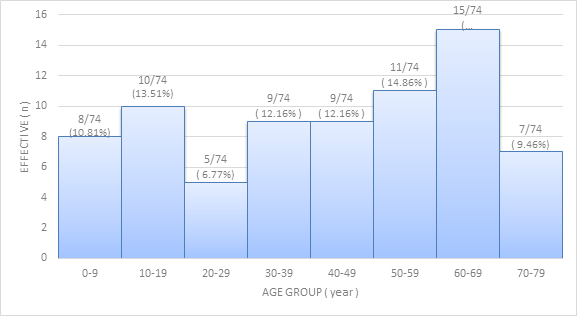
The mean age of the patients was 41.22 years ± 22.05 with extremes of 01 year and 75 years. The age group of 60 to 69 years was the most represented in 20.27% (15/74) of cases. (Figure 1) summarizes the distribution of patients according to age groups.
Possible factors suspected in the occurrence of ENT cancer were present in 26/74 patients. Alcohol consumption was found to be the main risk factor in 50% (13/26), followed by tobacco consumption in 23.07% (6/26). Coexistence of alcohol and tobacco consumption was noted in 19.23% (5/26). In addition, exposure to wood and cement dust was present in one (01) patient in each case.
The average consultation time was 22 months. The majority of patients, 60.81% (45/74), consulted the year of the onset of the first symptoms. (Table 1) summarizes the distribution of patients according to the consultation time.
| Effective (n) | Percentage (%) | |
|---|---|---|
| 0 to 12 months | 45 | 60.81 |
| 0 to 3 months | 17 | 22.97 |
| 3 to 6 months | 12 | 16.22 |
| 6 to 12 months | 16 | 21.62 |
| 12 to 24 months | 8 | 10.81 |
| 24 to 36 months | 8 | 10.81 |
| 36 to 48 months | 5 | 6.76 |
| 48 to 60 months | 3 | 4.05 |
| >60 months | 5 | 6.76 |
| Total | 74 | 100 |
Table 1: Distribution of patients with ENT cancers according to consultation time.
Among the different reasons for consultation, pain appeared as the predominant reason for consultation in 52.70% (39/74) of cases, followed by nasal obstruction in 22.97% (17/74) and facial deformity in 18.91% (14/74).
In the sample, 68.92% (51/74) of patients presented with a swelling. The neck was the most frequently found site (19/51) and the nodular appearance was predominant (21/51). In half of the cases, the covering skin was normal (27/51). The swelling was often hard in consistency (31/51), and did not bleed on contact (36/51), it was mobile (27/51) in relation to the deep plane and painful to palpation (26/51).
Physically, the primary lesions were located preferentially and in decreasing order on the face, oral cavity, larynx and neck. (Table 2) summarizes the different locations of the primary tumors.
| Effective (n) | Percentage (%) | |
|---|---|---|
| Face | 17 | 22.97 |
| Oral cavity | 12 | 16.22 |
| Larynx | 10 | 13.51 |
| Neck | 10 | 13.51 |
| Pharynx | 9 | 12.17 |
| Nasopharynx | 5 | 6.76 |
| Oropharynx | 3 | 4.06 |
| Hypopharynx | 1 | 1.35 |
| Nose | 6 | 8.1 |
| *Others | 4 | 5.41 |
| Unspecified | 6 | 8.11 |
| Total | 74 | 100,00 |
| Carcinoma | 53 | 71.62 |
| Squamous cells | 40 | 54.05 |
| Adenocarcinoma | 6 | 8.11 |
| Papillary | 7 | 9.46 |
| Lymphoma | 15 | 20.27 |
| No Hodgkin | 10 | 13.51 |
| Burkitt | 7 | 9.45 |
| B-Cell | 3 | 4.06 |
| Hodgkin | 5 | 6.76 |
| Sarcoma | 5 | 6.76 |
| Chondrosarcoma | 3 | 4.06 |
| Rhabdomyosarcoma | 1 | 1.35 |
| Unclassified Cell Sarcoma | 1 | 1.35 |
| Melanoma | 1 | 1.35 |
| Total | 74 | 100 |
Table 2: Summary of locations of ENT cancers in patients. *Others: metastasis from prostate cancer (2), metastasis from lung canc
sarcoma. Melanoma was the rarest histological type; all these data were recorded in (Table 3) below as well as their evolutionary stage (Table 4).
| Effective (n) | Percentage (%) | |
|---|---|---|
| Stage 0 | 2 | 2.7 |
| Stage I | 8 | 10.81 |
| Stage II | 7 | 9.46 |
| Stage III | 20 | 27.03 |
| Stage IV | 25 | 33.78 |
| Undetermined | 12 | 16.22 |
| Total | 74 | 100 |
Table 3: Summary of Cancer Stages.
It appears that the diagnosis was made at a late stage (45/74). Specifically, (Table 5) grouped the lymphoma cases according to the Ann Arbor classification.
| Internship | Effective (n) | Percentage (%) |
|---|---|---|
| Stage I | 2 | 13.33 |
| Stage II | 7 | 46.67 |
| Stage III | 2 | 13.33 |
| Stage IV | 4 | 26.67 |
| Total | 15 | 100 |
Table 4: Ann Arbor classification.
Of 74 patients, treatment was effective in 49. Therapeutically, 29.73% (22/74) received chemotherapy alone. Surgery alone was performed in 25.68% (19/74). The combination of surgery and chemotherapy was the treatment for 9.46% (7/74); only one patient was treated with surgery and chemo-radiotherapy. In the same study period, 41.89% (31/74) were lost to follow-up, 25.68% (19/74) had a favorable evolution, 32.43% (24/74) died including (15/24) from carcinoma, (7/24) from lymphoma and (2/24) from sarcoma.
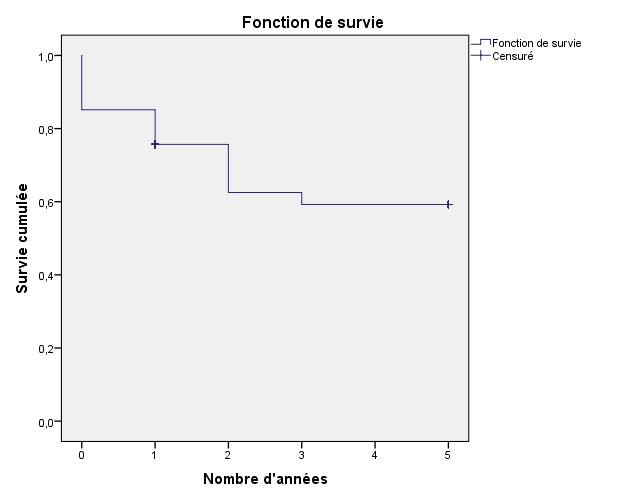
The overall survival rate in the study after 02 years was less than 60% as indicated by the Meyer-Kaplan graph in (Figure 2).
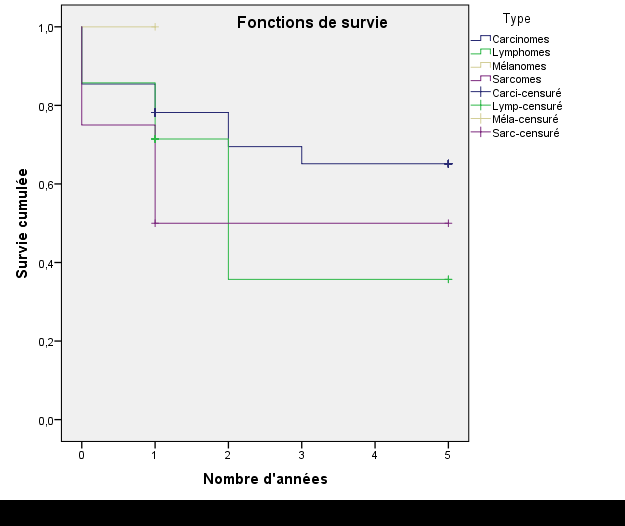
In the present study, lymphoma was the cancer with the lowest survival at two (02) years, as illustrated in (Figure 3).
Discussion
Over the study period from 2010 to 2020, i.e. eleven (11) years, 25,986 patients were seen for ENT consultations for various conditions. We identified 151 cases of histologically confirmed malignant tumors. Of the 151 cases, we were only able to use 74 files. The hospital frequency of ENT cancers in this series studied was 0.58%. This probably underestimated proportion is, however, comparable to that of Amana in Togo and Djomou in Cameroon of 0.48% and 0.51% respectively [7, 8] . On the other hand, the frequency observed in our study represents a quarter of that found by Randriamanovonsta in Madagascar which was 2.29% [9]. This noted difference could be explained by the fact that the ENT consultation in our country receives everyone and is therefore not specific to an oncology service.
The incidence of ENT cancers in the department where the study took place was 13.72 cases/year. This rate corroborates those of Kouassi-Ndjeundo and Sereme respectively of 13.6 cases/year and 12.8 cases/year [10, 11]. Nevertheless, in other countries of the sub-region, a clear increase in this incidence could be noted. Thus, it was 23 cases/year in Nigeria, 34 cases/year in Cameroon and 40.1 cases/year in Togo [7, 8, 12]. This lower incidence in our series may denote the low rate of the general population estimated at 14,500,000 inhabitants.
The average age of the patients was 41.22 years with extremes of 01 year and 75 years. The same forty was found by the studies of several authors of the sub-region. These are Hounkpatin in Parakou, Amana in Togo, Djomou in Cameroon, Sowunmi in Nigeria [7, 8, 12, 13] . For Randriamanovonsta in Madagascar, Guizard in France and Kassirian in Canada, the average age was around fifty or even sixty [9, 14, 15] . The observation made during this study revealed that The age of predilection for cancer was between 60 and 70 years. Studies carried out by Hounpkatin and Njifou found younger subjects belonging to the age group of 50 to 59 years [13, 16] .
The sex ratio was 1.55; these values are comparable to those of other studies conducted by Amana and Randriamanovonsta [7, 9]. Our values are lower than those reported by Sowunmi, Djomou and Njifou, which were respectively 1.7; 1.9 and 1.96 [8, 12, 16]. In Europe, the sex ratio found by Guizard in France and Kassirian in Canada was significantly higher, reaching respectively 4.9 and 3.63 [14, 15]. The male subject would therefore be at greatest risk of developing head and neck cancer.
In relation to lifestyle, we noted alcohol and tobacco consumption in some patients. Similar trends have been observed in other studies, notably in that of Amana in Togo and Njifou in Cameroon, which also identified alcohol consumption as the main risk factor in respective proportions of 38% and 59.34%, followed by tobacco consumption in 21% and 44.71%. Amana and Njifou also noted an association between alcohol and tobacco consumption in 16.46% and 38.21% of cases respectively [7, 16]. For Randriamanovonsta the trend was reversed and therefore tobacco consumption was the top risk factor [9]. In the West, the rate of smoking and alcoholism appears to be significantly higher in 62.7% and 69.6% of patients [15]. Due to the mixing of populations and their habits, the media coverage of information, and an improvement in purchasing power, tobacco and alcohol consumption are becoming part of people’s daily lives and unfortunately constitute a risk factor for the occurrence of head and neck cancers. We report exposure to wood dust and cement dust in this work.
When we look at diagnostic aspects, the average consultation time was 22 months. A population of 60.81% (45/74) consulted more than 6 months after the onset of the first symptoms. In Cameroon, Djomou also noted that the majority of consultations occurred after 6 months in 85.5% of cases [8].
On the other hand, the average consultation time found by Randriamanovonsta and Kassirian was much lower than that observed in the present study. It was respectively 7.73 months and 3.9 months [9, 15].
Within this study, an extension of the consultation time could be noted, due to the clinical manifestation made up of common symptoms likely to be underestimated or go unnoticed by the patient. The population uses other unconventional therapeutic means. Moreover, in our context, these patients work in the informal sector and generally do not subscribe to a mutual health insurance.
Pain emerged as the main reason for consultation, affecting half of the patients 52.70% (39/74) in this sample. Nasal obstruction was the second reason, affecting 22.97% of patients (17/74), closely followed by facial deformity in 18.82% of patients (14/74).
The results of this study were consistent with other research. Djomou also identified pain as the primary complaint in 95% of cases, followed by headaches in 49.8% of cases, and facial deformity in 36.77%. On the other hand, Randriamanovonsta reported pain as the second most common complaint, following endo-oral swelling [8, 9]. For Guizard in France, lesions located in the oral cavity appeared to be the primary reason for consultation in 35.3% of patients [14].
The clinical signs of the physical examination will depend on the organ involved. If in our study series the cancer sites were facial, oral, laryngeal, cervical, pharyngeal or nasal, laryngeal cancer came first in the study by Ciolofan in Romania [17]. Functional signs initially manifest themselves through common symptoms. Nasal obstruction is the result of facial compression by the tumor, leading to facial deformation and pain that can be likened to headaches. These signs indicate that patients are seen late or even at a stage of complication. It is when these signs appear in a patient with pain that the clinician can already suspect a malignant process.
The histological type was confirmed by pathological examination. The distribution of histological types in this study was similar to the results of other authors in the literature. Thus, Hounkpatin in Parakou, Benin, Amana in Togo, Djomou in Cameroon, Randriamanovonsta in Madagascar, and Erinoso in Nigeria all found that carcinoma, particularly the squamous cell variant, was the predominant histological type in ENT cancers, followed by lymphoma, sarcoma, and lastly melanoma [7, 9, 13, 18] .
This finding is linked to the fact that ENT cancers involve, among other things, the upper aerodigestive tract, whose internal configuration is based on non-keratinized squamous tissue.
Chemotherapy alone was the treatment of choice in our series, 22/74 patients who were inoperable due to late diagnosis. Chemotherapy was also indicated when the lesion was extensive or when it was multifocal cancerous ENT lesions. To save the patient from debilitating surgery, it was performed in lesser proportions, 19/74 patients. The combination of surgery, chemotherapy and radiotherapy was performed in only one patient. Indeed, this could be explained by the insufficient technical platform indicated by the absence of a radiotherapy center. Furthermore, it should be noted that this option cannot be done on site and when it is possible, it is entirely at the expense of the patient who does not have health insurance. In developed countries with efficient technical platforms, radiotherapy seems to be the first means of treatment for ENT cancers because it is diagnosed at an early stage. This is the case of Nigeria, or France [12, 14] .
During the study period, 31 patients were lost to follow- up probably due to lack of financial means, after referral to traditional treatment or following a spontaneously fatal evolution. Official deaths recorded were 24 patients during the period. Favorable evolution was noted in 19 cases with an overall survival at two years of less than 60%. For Tharia, the 5-year survival was 53% for squamous cell carcinomas [19]. Sowunmi also reported a large number of patients lost to follow-up during their study period [12].
Conflict of Interest: The authors stated that there is no conflict of interest.
Funding Statement: The authors received no specific funding for this work.
Conclusion
Head and neck cancers have a significant incidence and can occur at any age.
In developing countries, late patient consultation also results in late diagnosis. Squamous cell carcinoma was the most common histological type found. Therapeutic management should involve better management of the healthcare system but also involve public decision-making authorities. Increased awareness would improve long-term patient survival.
References
-
Sando P, Badiane AS, Edimo LEF, Kane Ba NF, Rachidou H et al. (2023) Primary oto-rhino-laryngological cancers: Epidemiological, clinical and therapeutic aspects of 231 cases in Senegal. World Journal of Advanced Research and Reviews 20(02): 474-477.
-
Dapaah G, Hille J, Faquin WC, Whittaker J, Dittrich CM et al. (2022) Prevalence of human papillomavirus-positive oropharyngeal squamous cell carcinoma in one of the largest tertiary care centers in sub-Saharan Africa. Arch Pathol Lab Med 146(8): 1018-1023.
-
Bambara C, Diallo AG, Zaghre N, Lengani NI, Sare WH et al. (2025) Epidemiological data and diagnostic characteristics of ENT tumors in Burkina Faso. Epidemiological and Diagnostic Profile of ENT Tumors in Burkina Faso. Medicine and Surgery in the Tropics 3(2): 87-92.
-
Rimi MI, Yaro MA, Salis U, Joseph BT, Kabir M (2025) Histopathological pattern of oropharyngeal tumors in patients seen at the National Ear Care Center, Kaduna: A 10-year retrospective study (2014-2023). Sokoto Journal of Medical Laboratory Science 10(1): 55-66.
-
IARC, WHO. Cancer topics.
-
Wainsten JP (2022) The Medical Larousse. Larousse Edition: 6th (Edn), UK, pp: 683-693.
-
Amana B, Foma W, Pegbessou E, Bissa H, Adam S et al. (2016) Primary oto-rhino-laryngological and cervico-maxillo-facial cancers: epidemiological and histopathological aspects. The Pan African Medical Journal 25: 47.
-
Djomou F, Siafa AB, Nkouo YCA, Eko DM, Bouba DA, et al. (2021) Epidemiology, clinical features and histology of ENT cancers: A cross sectional study from Yaounde. Health sciences and disease 22(8): 39-43.
-
Randriamanovonsta NE, Hasiniatsy NRE, Razakanaivo M, Rafaramino F (2015) Epidemiological and clinical characteristics of upper aerodigestive tract cancers in the CHUA/JRA Oncology Department from 2008 to 2012. Rev. med. Madag 5(3): 623-625.
-
Ndjeundo JK, Gattia KVN, Vroh BTS, Guessan KEBN, Dumas PK et al. (2015) Epidemiology and histopathology of upper aerodigestive tract cancers in Abidjan. The African Journal of ENT and Head and Neck Surgery 15: 41-46.
-
Sereme M, Ouoba WJ, Meda CH, Koueta A, Noa EEM and al. (2016) ENT and head and neck cancers in Burkina Faso. The African Journal of ENT and Head and Neck Surgery 16: 21-27.
-
Sowunmi AC, Ketiku KK, Olaniyi PA, Alabi AO, Fatiregun OA and al. (2015) Pattern of head and neck cancer in a tertiary institution in Lagos, Nigeria. Journal of Dental and Medical Sciences 14(12): 72-82.
-
Hounkpatin SHR, Brun LVC, Balle MC, Bouraima FA, Bossou TA and al. (2020) Histo-Epidemiological Profile of Head and Neck Cancers in Benin. International Journal of Otolaryngology and Head & Neck Surgery 09(1): 19.
-
Guizard AVN, Dejardin OJ, Launay LC, Bara S, Ledoux BML et al. (2017) Diagnosis and management of head and neck cancers in a high-incidence area in France: A population-based study. Medicine June 96(26): e7285.
-
Kassirian S, Dzioba A, Hamel S, Patel K, Sahovaler A et al. (2020) Delay in diagnosis of patients with head-and- neck cancer in Canada: impact of patient and provider delay. Current Oncology October 27(5): e467.
-
Njimah AN, Ngnembi AR, Essama L, Fewou A, Kouotou EA et al. (2018) Histopatho-logical aspects of ENT cancer in Douala General Hospital. Health sciences and diseases. 19(3): 39-44.
-
Ciolofan MS, Vlăescu AN, Mogoantă CA, Ioniță E, Ioniță I et al. (2017) Clinical, histological and immunohistochemical evaluation of laryngeal cancer. Curr Health Sci 43(4): 367-375.
-
Erinoso O, Okoturo E, Gbotolorun O, Effiom O, Awolola N et al. (2016) Emerging Trends in the Epidemiological Pattern of Head and Neck Cancers in Lagos, Nigeria. Ann Med Health Sci Res 6(5): 301-307.
-
Thariat J, Plana AM, Vérillaud B, Vergez S, Ferrand FR et al. (2020) Diagnosis, prognosis and treatment of sinonasal carcinomas (excluding melanomas, sarcomas and lymphomas). Cancer Bulletin 107(5): 601-611.
- 4th Branchial Cleft Sinus Anomaly Presenting as Recurrent Thyroid Abscess in A Child: A Case Report
- Parotid Duct Injury Repaired Using an Angiocatheter Stent: A Case Report
- Organization and Functionality of the Referral and Counter-Referral System for ENT Disorders in District Hospitals of N’Djamena, Chad: A Cross-Sectional Analytical Study
- Facial Metastases from a Gastrointestinal Stromal Tumor: A Case Report
- Could Antimicrobial Resistance Prove to Be Both a Threat and an Opportunity for us?
- Allergic Rhinitis in Senegal: Epidemiological, Clinical and Therapeutic Aspects