
Food for the Stomach Nourishing our Future: Assessment of Potassium Bromate in Local and Packaged Bread Sold in Ilorin Metropolis
Bread is an important food type created by cooking a batter of flour and water, possibly with other condiments. Potassium bromate is a flour improver that acts as an enhancer. It mostly operates in the late batter stage, energizing the mixture during late sealing and early baking. In Nigeria, the use of bromate in bread production was prohibited in 1993. Regardless, some bread manufacturers have continued to include potassium bromate in their products. Because of its widespread use, this analysis attempts to assess the concentration of Bromate in local and packaged breads sold in the Ilorin Metropolitan Area. It is cross-sectional descriptive research with laboratory analysis. A total of fifteen brands of breads were used in this study labeled as (A,B,C,D,G,J,O,K) as packaged bread and (E,I,L,M,N,E,H) as local bread. They were purchased randomly from bakeries, bus stops and markets in Ilorin, Kwara State Capital, and Nigeria. The bread was subjected to qualitative and quantitative analysis of Potassium bromate in bread. The qualitative result revealed black spot on the samples indicating the presence of potassium bromate. Three of the bread samples (J, L and O) did not show any visible black spot while other bread samples have black spot. The quantitative amount of potassium bromates found in each bread sample showed that the quantity of potassium bromates found in the different bread sample is above Food and Drug Agency (FDA) recommended standards, which is 0.02μg/g (0.02mg/ kg), with sample (M) having the highest concentration (0.62515) of potassium bromate, while sample (E) having the lowest concentration (0.42713) of potassium bromate. The outcome gotten from the research investigation actually inferred that consumer of bread sold in Ilorin are unaware of this harmful substance, notwithstanding a few existing enactments banning its utilization. The net cancer-causing impact of potassium bromate is accumulative, in this way consistency in consumption of bread with potassium bromate could prompt malignant growth over time. The principal issue in Nigeria is execution of the ban and immediate impacts are needed to abridge the utilization of this food poison.
Introduction
Bread is an important food type created by cooking a batter of flour and water, possibly with other condiments.
Although most bread is baked in the oven, some are steamed, singed, or prepared on an unoiled skillet. It very well could be raised or unrising salt, oil, and rising agents, such as yeast and baking powder, which are common ingredients. However, bread often contains a few components that can be used to improve the bread’s quality. Some of the primary known elements that differ from flour are: table salt, sugars, flavors, and no less than a flour improver, such as potassium bromate [1]. According to Kurokara Y, et al. [2] potassium bromate is a flour improver that goes about as an enhancing agent. It acts chiefly in the late batter stage invigorating the mixture during the late sealing and early baking Potassium bromate appears as white gems or powder. Potassium bromate has been utilized as a batter contingent for beyond 60 years. As indicated by the United States Department of Agriculture (USDA), it further develops mixture handling properties, internal crumb quality and low quantity in concentration from a very low to the highest concentration (75ppm) permissible by law. The component by which bromate acts in mixture is perplexing and not surely known [3]. In man, potassium bromate can cause cough and coarsed throat when breathed in [4]. Stomach ache, loose bowels, queasiness, vomiting, kidney problems, are a portion of the other non- malignant growth medical conditions related with ingestion of potassium bromate [4]. In other categories, various examinations have uncovered the capability of potassium bromate to cause disease in test animals and in people [5, 6]. Utilizing bromate as bread improver has been prohibited [7]. Likewise, in Nigeria and other African countries, the bromate use in bread making was restricted in 1993 [8]. Be that as it may, some bread producers have kept on incorporating potassium bromate in their bread. Because of the over use of it Hence, this review tries to evaluate the concentration of Bromate in local and packaged breads sold in Ilorin Metropolis. It is expected that the result of this study will assist to meet the challenges of achieving the execution of the ban of potassium bromate in the state, strengthen the already existing strategies to provide the level of implementation on the ban of potassium bromate in Kwara State and Nigeria at large. Support the government and other development partners to eliminate the use of potassium bromate in the production of bread in Nigeria, create positive social change by means of instituting policies that will incorporate health educational intervention in eliminating the utilization and net cancer-causing impact of potassium bromate in bread production in Nigeria.
Materials and Methods
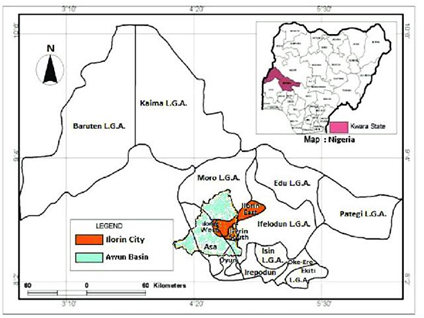
This study was carried out in Ilorin, the capital of Kwara State, North Central Nigeria, is a town located between the Northern and Southern parts of Nigeria at a distance of about 302 km north of Lagos and 475 km south of Abuja, Federal Capital Territory (FCT). There are three (3) Local Government Areas (LGAs) in the entire Ilorin metropolis: Ilorin East, Ilorin West and Ilorin South with their headquarters at Oke- Oyi, Warah and Fufu respectively. It lies on latitude 8o3’N and longitude 4o35’E (Figure 1) in the guinea savannah belt of Nigeria with a human population of 825,027 as projected from the 2006 National Population Census at an annual growth rate of 3.0%. Ilorin metropolis is populated by people of Yoruba, Hausa, Fulani, Nupe, Baruba and Igbo ethnic origins. The major religions of the inhabitants are Islam and Christianity while there are many social groups based on religions, political and ethnic inclinations. Ilorin East Local Government Area has its administrative headquarters in Oke-Oyi town. It is a densely populated Local Government Area. It has an area of 486km² and a population of 204,310 in 2006.Ilorin east is located close to the western axis of Kwara state. It is bounded by Asa and Ifelodun Local Government Areas. Wards in Ilorin east local government are 12, they are: Agbeyangi/ Gbadamu/ Osin, Apado, Bologun Gambari, Gambari, Ibagun, Magaji Are 17, Magaji Are 118 Iponrin, Marafa/Pepele, Maya/ Ile pepele, Maya/ Ile Apa, Oke oyi/ Oke ose/Alalubosa, Zango [9, 10, 11].
• Study Design: It is a descriptive cross-sectional descriptive study involving laboratory analysis.
• Inclusion Criteria: Respondents to be included in this study: Breads and their factories.
- Exclusion Criteria: Not all brands of breads were included in this study, only fifteen (15) brands were picked randomly by the researcher, which would herein be assessed
- Sample Collection: A total of fifteen brands of breads were used in this study. The different bread brands are listed below (Table 1). They were purchased randomly from bakeries, bus stops and markets in Ilorin, the Kwara State Capital, Nigeria.
| Samples | Type of Bread |
|---|---|
| A | Packaged Bread |
| B | Packaged Bread |
| C | Packaged Bread |
| D | Packaged Bread |
| E | Local bread |
| F | Local bread |
| G | Packaged Bread |
| H | Local Bread |
| I | Local Bread |
| J | Packaged Bread |
| K | Packaged Bread |
| L | Local bread |
| M | Local Bread |
| N | Local Bread |
| O | Packaged Bread |
Table 1: Types of Bread with their codes.
Reagents and Materials
Volumetric flasks (capacity 50,100,250 cm3), Beakers (capacity 50,100 cm3), Glass rode, Measuring cylinder, Dropping pipettes (capacity 100 cm3), Analytical balance, Centrifuge instrument • Reagents: Potassium bromates, Distilled water, Potassium iodide, Hydrochloric acid, Zinc sulfate, Sodium hydroxide, Sulfuric acid, Sodium thiosulfate.
Quantitative Analysis of Potassium Bromate in Bread
Transfer 200ml ZnSO4 solution to 600 or 800ml beaker and stir with speed controlled, motor driven glass stirs. Transfer 50ml of 0.1g test portion to stirred solution in 2-5g portions. Continue stirring for 5min, until all dry flour on surface is uniformly dispersed in liquid. While stirring, add 50ml of 0.4 in NaOH from pipette. Decrease speed of stirrer as stir can take up to 5min. Filter or centrifuge, clarifying supernate by filtration. Transfer 50ml of this test portion solution to 200ml Erlenmeyer. If smaller aliquot is taken to 50ml with H2O. Add 10ml of 2M H2SO4, 1ml of KI solution. 1 drop ammonium molybdate solution and 500ml H2O. While stirring add 5-8ml of 0.000359 M Na2SO2O3 (an excess). Add 5ml freshly prepared starch solution and titrate excess Na2SO2O3 with 0.0006 M KIO3. As end point approaches, add KIO3 solution slowly, one or two drops at a time, swirling and viewing flask after placing it on a white surface after each addition. Take first reddish or purple tinge as end point; then add seven more drops to confirm. Add additional
1ml of Na2SO2O3 solution and again titrate to additional end point. Average the two differences between amount of Na2SO2O3 solution added and KIO3 used in titrations; ug/ml KBrO3 = 10* (ml 0.000359 M Na2SO2O3 - ml 0.0006 M KIO3) Small sample from each bread brand was measured out into different test tubes. Water was added to wet the samples. 0.5ml of 1% potassium iodide solution in 2M HCl was added. The test tubes were labeled, covered with foils and allowed to stand for a day. The appearances of black spots on the samples indicate the presence of potassium bromate in the bread samples.
Results
Potassium bromates complexed with potassium iodide produced a purple colouration. The change in colour went from extremely light purple to purple with increment in concentration. The level of colour change corresponds with the degree of potassium bromate present [12]. An outcome showing the colour distinguishing proof of potassium bromate in the 15 bread tests. Three of the bread tests (J, L and O) (Table 2) didn’t show any apparent colour change when treated with potassium iodide. It consequently shows they are free from potassium bromate or that potassium bromate was available in the samples in little concentration that couldn’t be identified by the reagent. The wide range of various samples showed positive results for the presence of potassium bromate [13].
| Bread | Reaction | |
|---|---|---|
| A | ++ | |
| B | ++ | |
| C | ++ | |
| D | ++ | |
| E | ++ | |
| F | ++ | |
| G | ++ | |
| H | ++ | |
| I | + | |
| J | - | |
| K | + | |
| L | 0 | |
| M | + | |
| N | ++ | |
| O | - | |
| KEY | Strongly Present | ++ |
| Present | + | |
| Absent | - |
Table 2: Qualitative Assessment of Potassium Bromate in Bread.
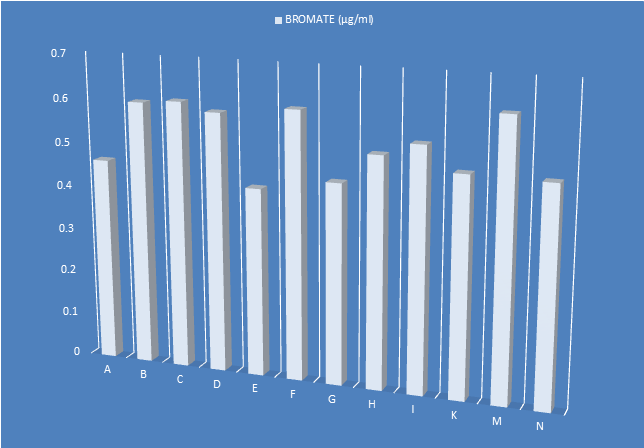
The quantitative amount of potassium bromates found in each bread sample is represented in Figure 2. From the chart above, the result showed that the quantity of potassium bromates found in the different bread sample is above Food and Drug Agency (FDA) recommended standard of 0.02μg/g (0.02mg/kg), with sample M (local bread) having the highest concentration (0.62515) of potassium bromate, while sample E (local bread) having the lowest concentration (0.42713) of potassium bromate, other samples had varying concentration of bromate. While three of the different bread brands (J, L, O) is free of potassium bromate.
Discussion
The result obtained from the bread analysis, showed that a great number of bread makers in Ilorin metropolis still use potassium bromate as a bread improver. Twelve (12) out of the fifteen (15) samples tested indicated the presence of high concentration of bromate. It shows the presence of black spot on the samples when treated with 0.5N potassium iodide solution in 2M of hydrochloric acid. Black spot was observed on the samples indicating the presence of potassium bromate. Three of the bread samples (J, L and O) did not show any visible black spot. This also implies that the above may be free of potassium bromate or that potassium bromate was present in the samples in residual amount that could not be detected by the reagent. Twelve (12) of the other bread samples had black spot which indicates positive result for the presence of potassium bromate in varying degrees, whereas three (3) out of the fifteen (15) bread sample (J, L, O) is free of potassium bromate. The quantitative amount of potassium bromate found in each bread sample was also represented in fig. 2, the result showed that the quantity of potassium bromate found in the different bread sample is above Food and Drug Agency (FDA) standard of 0.02μg/g (0.02mg/kg), with sample (M) having the highest concentration (0.62515) of potassium bromate, while sample (E) having the lowest concentration (0.42713) of potassium bromate, other samples had varying concentration of bromate except sample (J, L, O). The results of this research show that the bread samples analyzed has high detection of bromate in them.
This study in comparable with a study by the Food and Drug Administration in America tested several loaves of bread in circulation and discovered many of the loaves had detectable levels of bromate [5]. Three quarter of the loaves tested by the science laboratory UK in 1989 had significant residual bromate [14]. This was followed by its ban in Britain and many other countries. This study is also in agreement with the study of Airaodion AL, et al. [15], which reported that all the loaves of bread sampled analyzed had potassium bromate in them, therefore bread consumers and bakers are at risk of exposure to potassium bromate with health implications. Independent researchers had consistently reported the presence of KBrO3 in bread samples. The concentration of KBrO3 ranges from 0.036-0.092mg/g as reported by Alli L, et al. [16], and 0.012-0.093mg/g as reported by Airaodion AL, et al. [15], in the studies carried out in Gwagwalada, Abuja and Ibadan respectively. A similar study was carried out by Emeje M, et al. [17], which analysed bromate levels in bread brands sold in Abuja reported a concentration range of 1.01–11.33µg/g. Similarly, Magomya
AM, et al. [18], reported bromate concentration range of 2.46 -13.60µg/g in a study of bread samples sold in Zaria, Nigeria. Oyekunle JAO, et al. [19], also reported that the bromate concentration range of 6.33-41.336µg/g was obtained in their study of bread brands sold in Ile-ife metropolis of south western Nigeria. Obunwo C, et al. [20], Kelle HI, et al. [21] and Ojo RJ, et al. [22] reported 0.12-7.28µg/g,1.4-5.1µg/g and 0.5-8.4µg/g, as the concentration ranges of bromate in bread brands sold in Port-Harcourt, Asaba and Karu, Nigeria. The outcome of this examination shows that the bread tested has high identification of bromate in them.
There are essentially two different ways by which people might get harmed with potassium bromate, by ingestion when it is available in food like bread and by inward breath. It is consequently, undependable for the bread consumer and the bakery worker who works in a pastry shop where the substance is utilized as a bread improver. There has been a going contention over the utilization of bromate. Numerous researchers asserted in the mid 90’s that potassium bromate was probably going to be non-toxic, however, bread additive as the substance seems to be broken to immaterial levels during baking [23]. Anyway in 1993, In Nigeria NAFDAC has banned potassium bromate as food additive starting around 1993. Over 10 years after, we are still finding bromate in Nigeria bread. The outcome gotten from the research investigation actually inferred those consumers of bread sold in Ilorin west are as yet being presented to this harmful substance not withstanding a few existing enactments banning its utilization. The activity of bromate as a food enhancer is credited to its inhibitory activity on specific proteolytic proteins accordingly influencing the wholesome nature of bread. This prompts breakdown of nutrient A, B¹, B², E and niacin. The net cancer-causing impact of potassium bromate is accumulative, in this way consistency in consumption of bread with potassium bromate could prompt malignant growth over time. The presence of bromate in eatable staple call for concern, in light of its toxicological impact on people [14]. The principal issue in Nigeria is execution of the ban and immediate impacts are needed to abridge the utilization of this food poison.
Conclusion
While health is a result of numerous causes in communities, different parts of the community can contribute to and share responsibility for its protection and enhancement [24, 25, 26, 27, 28, 29, 30, 31, 32]. Thus, the findings of this study demonstrate that 12 of the 15 bread samples evaluated contained potassium bromate, which is detrimental to humans if consumed; nonetheless, the findings of this work confirm that potassium bromate is still utilized on bread production by bakers in Ilorin metropolis. For the safety of consumers and industrial personnel, bakers are strongly recommended not to use potassium bromate as a bread improver for the safety of consumers and industrial personnel. This study also underscores the importance of routine checks by the regulatory authorities in order to ensure that bakers always comply with rules and regulations and thereby safe guard the life of unsuspecting Nigerians. Until very recently, Potassium bromate is a flour improver that strengthens dough and allows the dough to rise higher during baking. Usually 0.02 μ g/g of potassium bromate is used during the flour treatment stage, and, if too much of the additive is used, or the bread is not baked long enough or at optimal temperature, then a residual amount will endure. Ideally, the act of baking changes its chemical composition and thus leaves no trace in the finished product.
Recommendation
- The result call for a conscious effort by relevant agencies especially NAFDAC to reaffirm and re-assert the ban on the use of bromate by bakeries.
- The agencies should educate people through public enlightenment on the danger use of bromate as food addictive.
- Therefore, Bread makers and Bakers are officially advised against the use of potassium bromate as bread improver. They should use alternative bread improvers such as:
- Yeast Ascorbic acid or Vitamin-C: Ascorbic acid, also known as vitamin C, is an essential nutrient found in citrus fruits. The use of this acid in bread dough in the range of 20-30 mg/kg of flour increased bread volume by 20%. it may be from natural or synthetic sources.
- Glucose oxidase: The use of enzymes is the best alternative to chemical compounds because they are generally recognized as safe and do not remain active after baking. One of the enzymes that can confer strength to the dough is glucose oxidase.
- Other food improvers and flour treatment agents include: ammonium persulphate, ammonium chloride and amylases
- Relevant agencies should also encourage the use of natural dough enhancers like vitamin c powder, egg, apple sauce etc.
References
-
Vicki S (2017) Bromate analysis: Food Science and Technology bulletin, pp: 240.
-
Kurokara Y, Takayarna S, Konishi, Y, Yoshio H, Shogo A, et al. (2015) Long term in vivo carcinogenicity tests of potassium bromate, Sodium hypochlorite and sodium chlorite conducted in Japan. Environmental Health Perspectives 69: 221-236.
-
Destefanis S, Giretto D, Muscolo MC, Cerbo DA, Guidetti G, et al. (2016) Clinical evaluation of a nutraceutical diet as an adjuvant to pharmacological treatment in dogs affected by Keratoconjunctivitis sicca. BMC Vet Res 12(1): 214.
-
Atkins DP (2015) Potassium Bromate in Bread Index to MAFF-UK. Food Surveillance Information Sheets.
-
CSPI (2014) Guidelines for carcinogen risk assessment Federal register 51(185): 33992-34003.
-
Watson Y (2000) Material safety data sheet potassium bromate. Mallinckrodt baker Inc. New Jersey.
-
Ekop AS, Obot IB, Ikpatt EN (2018) Anti-nutritional factors and potassium bromate content in bread and flour samples in Uyo Metropolis, Nigeria. EJ chemistry 5(4): 736-741.
-
Mahmud SS, Moni M, Imran AB, Foyez T (2021) Analysis of the suspected cancer-causing potassium bromate additive in bread samples available on the market in and around Dhaka City in Bangladesh. Food science & nutrition 9(7): 3752-3757.
-
Raimi MO, Adeolu AT, Enabulele CE, Awogbami SO (2018) Assessment of Air Quality Indices and its Health Impacts in Ilorin Metropolis, Kwara State, Nigeria. Science Park Journals of Scientific Research and Impact 4(4): 060- 074.
-
Raimi MO, Adio ZO, Odipe OE, Timothy KS, Ajayi BS, et al. (2020) Impact of Sawmill Industry on Ambient Air Quality: A Case Study of Ilorin Metropolis, Kwara State, Nigeria. Energy and Earth Science 3(1): 1-25.
-
Raimi OM, Samson TK, Sunday AB, Olalekan AZ, Emmanuel OO, et al. (2021) Air of Uncertainty from Pollution Profiteers: Status of Ambient Air Quality of Sawmill Industry in Ilorin Metropolis, Kwara State, Nigeria. Research Journal of Ecology and Environmental Sciences 1(1): 17-38.
-
Irogbeyi LA, Nweke IN, Akuodor GCH, Unekwe PCH, Asika ECH (2019) Evaluation of Levels of Potassium Bromate and Some Heavy Metals in Bread and Wheat Flour Sold in Aba Metropolis, South Eastern Nigeria. Asia Pac J Med Toxicol 8: 71-77.
-
David MO (2006) Nigeria No. 1 market for U.S. Wheat; Potential for other grains and feeds. USAID Foreign Agric Serv Bull, pp: 1-2.
-
(2009) Bromate in drinking-water: Background document for the development of WHO guidelines for drinking-water quality. WHO, pp: 1-15.
-
Airaodion AI, Ewa O, Ogbuagu EO, Ogbuagu U, Agunbiade AP, et al. (2019) Evaluation of potassium bromate in bread in Ibadan metropolis: Fifteen years after ban in Nigeria. Asian Food Science Journal 7(4): 1-7.
-
Alli L, Nwegbu M, Inyang B, Nwachukwu K, Ogedengbe J, et al. (2013) Determination of potassium bromate content in selected bread samples in Gwagwalada, Abuja‐Nigeria. International Journal of Health and Nutrition 4(1): 15-20.
-
Emeje M, Ofoefule S, Nnaji A, Ofoefule A, Brown S (2010) Assessment of bread safety in Nigeria: Quantitative determination of potassium bromate and lead. African Journal of Food Science 4(6): 394-397.
-
Magomya AM, Yebpella GG, Udiba UU, Amos HS, Latayo MS (2013) Potassium Bromate and Heavy Metal Content of Selected Bread Samples Produced in Zaria, Nigeria. International Journal of Science and Technology 2(2): 232-237.
-
Oyekunle JAO, Adekunle AS, Ogunfowokan AO, Olutona GO, Omolere OB (2014) Bromate and trace metal levels in bread loaves from outlets within Ile-Ife Metropolis, Southwestern Nigeria. Toxicol Rep 1: 224-230.
-
Obunwo C, Konne J (2014) Measurement of levels of potassium bromate and some heavy metals in bread samples produced in Port Harcourt metropolis, Nigeria. International Journal of Applied and Natural Sciences 3(3): 1-4.
-
Kelle HI (2017) Analysis of potassium bromate in bread Samples Sold in Asaba, Delta State, Nigeria by Qualitative and Spectrophotometric methods. Journal of Physical and Life Sciences 1: 128-136.
-
Ojo RJ, Kajang DD, Adebayo-Gege GI, Akintayo CO (2013) Analysis of Potassium Bromate and Hydrocyanic Acid Contents of Commonly Consumed Loaves of Bread and Wheat Flour Samples in Karu, Nasarawa State, Nigeria. IOSR Journal of Environmental Science, Toxicology and Food Technology 6 (1): 2319-2399.
-
Akunyili ND (2005) Eradication of potassium bromate from Nigerian bakery Industry. NAFDAC 5: 1-6.
-
Olalekan RM, Oluwatoyin O, Olalekan A (2020) Health Impact Assessment: A tool to Advance the Knowledge of Policy Makers Understand Sustainable Development Goals: A Review. ES Journal of Public Health 1(1): 1002.
-
Olalekan RM, Oluwatoyin OA, Olawale SH, Emmanuel OO, Olalekan AZ (2020) A Critical Review of Health Impact Assessment: Towards Strengthening the Knowledge of Decision Makers Understand Sustainable Development Goals in the Twenty-First Century: Necessity Today; Essentiality Tomorrow. Research and Advances: Environmental Sciences 2020(1): 72-84.
-
Raimi MO, Ihuoma BA, Esther OU, Abdulraheem AF, Opufou T, et al. (2020) Health Impact Assessment: Expanding Public Policy Tools for Promoting Sustainable Development Goals (SDGs) in Nigeria. EC Emergency Medicine and Critical Care, pp: 13.
-
Raimi MO, Moses T, Okoyen E, Sawyerr HO, Joseph BO, et al. (2020) A Beacon for Dark Times: Rethinking Scientific Evidence for Environmental and Public Health Action in the Coronavirus Diseases 2019 Era Medical and Research Microbiology 1(3).
-
Raimi MO, Raimi AG (2020) The Toughest Triage in Decision Impacts: Rethinking Scientific Evidence for Environmental and Human Health Action in the Times of Concomitant Global Crises. CPQ Medicine 11(1): 1-5.
-
Morufu OR, Tonye VO, Adedoyin OO (2021) Creating the Healthiest Nation: Climate Change and Environmental Health Impacts in Nigeria: A Narrative Review. Scholink Sustainability in Environment 6(1): 62.
-
Morufu OR, Ebikapaye O, Tuebi M, Aziba Anyam GR, Adedoyin OO, et al. (2021) Do Weak Institutions Prolong Crises? [#ENDSARs] in the Light of the Challenges and opportunities beyond COVID-19 Pandemic and the Next Normal in Nigeria. Communication. Society and Media 4(2): 19.
-
Raimi MO, Mcfubara KG, Abisoye OS, Ifeanyichukwu EC, Henry SO, et al. (2021) Responding to the call through Translating Science into Impact: Building an Evidence- Based Approaches to Effectively Curb Public Health Emergencies [COVID-19 Crisis]. Global Journal of Epidemiology and Infectious Disease 1(1).
-
Morufu OR, Aziba Anyam GR, Teddy CA (2021) ‘Silent Pandemic’: Evidence-Based Environmental and Public Health Practices to Respond to the Covid-19 Crisis. Intech Open.
- Intersecting Epidemics and Climate Vulnerabilities in Conflict- Driven Displacement: Epidemiology, Systemic Challenges, and One Health Gaps in South Sudan
- Advancing Domestic Health Financing for Community Health System Sustainability in South Sudan: The Boma Health Initiative Model (2025–2035)
- Prevalence and Correlates of Post-Exposure Prophylaxis Uptake among Men Who Have Sex with Men in Kisumu County, Kenya
- Medical, Ethical, and Legal Conflicts Surrounding Euthanasia in Argentina. Its Global Implications
- Knowledge and Attitude on Menstrual Hygiene among Adolescent Girls Studying in Secondary Level in Public Schools of Chitwan District, Nepal
- Biological Efficacy of an Adulticide Mixture (clothianidin + deltamethrin) as an Indoor Residual Spray against Adult Anopheles flavirostris in Palawan, the Philippines