
An Overview of Acidizing Procedures in Fractured Carbonated Reservoirs
Oil production and Drilling of an oil field formation is the only convenient way to transfer the oil from the reservoir to the well head surficial facilities. According to the various stages of drilling operations, formation damages are playing an important role in reducing the rock permeability. In this occasions, the accurate measurements must be taken to increase permeability of the fractured carbonated reservoirs. Therefore, oil could be easily moved through the formation layers and cracks. Moreover, steep rising in the rate of oil production may be another method of stimulating the well. The greatest appeal technique for optimizing the recovery factor in terms of increasing the productivity rate is the acidizing procedures that administered to the carbonated reservoir rocks. In this research, the techniques of acidizing due to increasing the permeability of the reservoir rock is being investigated and the differences between the types of applied methods are being demonstrated. That is to say that, these performances might cause to erode the welfare of a reservoir rock or erode a segment of the rock which collapse the acidizing channels. Consequently, acidizing could be applied to eliminate the emulsion which was formed in the open and close channels to block out water trapped in the rock. This method in carbonated reservoirs when the fracture produce by Heavy liquids could reduce the acid pressure.
Introduction
The purpose of matrix or fracture acidizing is to restore or improve an oil or gas well’s productivity by dissolving material in the productive formation that is restricting flow, or to dissolve formation rock itself to enhance existing, or to create new flow paths to the wellbore [1]. Two key factors dominate the treatment selection and design process when planning an acid job; formation type – carbonate, sandstone, or shale, and formation permeability – the ability of fluid to flow through the formation in its natural state. Formation type determines the type(s) of acid necessary and formation permeability determines the pressure required for pumping the acid into the formation. The pores (although most of them are too small in scale) are never empty and in any case a fluid which can be water, oil or gas is inside them. If the fluid flow in rocks and the pores are interconnected in such a way as to force the fluid in motion; obviously, blocking and not communicating of these holes makes the fluid contained within them remain in detention [2]. It is clear whatever the pores have more way to each other, their fluid will be linked more and in this case, the permeability of them reached higher limit. Thus, the flow and passing fluid through the pores is faster and easier to implement. Finally, by the above discussion on oil reservoir mentioned, we can extract oil or gas better from the porosity.
Acid Placement and Diversion
Acid placement is one of the most important concerns during matrix acidizing treatments. A successful treatment design consisting of proper selection of acid types, additives, and volumes may result in inefficient stimulation if the acid does not adequately cover the target interval. Insufficient acid coverage of long target zone or multiple intervals is mainly due to presence of heterogeneities such as presence of a thief zone (high permeability zone), different rock lithology, and varying formation fluid properties [3]. Diversion techniques are used to ensure proper acid coverage along the target interval. Diversion within the formation may guide acid to the damaged target zone and prevent the acid to run away into high permeability zones. Following is the summary of some of the acid placement and diversion methods.
Coil-Tubing
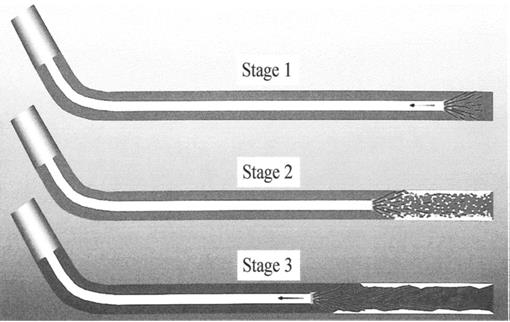
Using coil-tubing strings is very common for fluid placement in matrix acidizing treatments. The fluid placement model tracked multiple interfaces for multiple injections, and handled coil-tubing tail movement during injection.
Ball Sealers
Ball sealers are small rubber-coated or biopolymer balls that are pumped into the well with the acid system in order to temporary seal perforations. Therefore, this mechanical diversion technique is mainly used for cased and perforated wells.
Classification of Acidizing Technologies
Generally there are two types of acidizing in the oil industry as mentioned below: A) Acid fracturing: mostly used in carbonate formations, involves pumping acid at higher pressures, but still lower than those used during fracking. The acids fracture the rock, allowing for the flow of oil and gas. B) Matrix acidizing: mostly used in sandstone formations, acid is pumped into a well at low pressures, dissolving sediments and mud solids, increasing the permeability of the rock, enlarging the natural pores, and stimulating the flow of oil and gas [3].
Acid Fracturing
Acid fracturing treatment is usually confined to limestone layers. This method can be found in carbonate reservoirs as an affected area and also to activate carbonate layers without damage and can give desired results. Acid fracturing is another type of hydraulic fracturing. In both cases, efforts are being made to obtain conductive channel, which is started from the well and have more influence on the layer. The main geometry of the fracture is nearly the same in both. The difference between the two methods is that how conductive of fractures create and remain [4].
Matrix Acidizing
This operation in both levels of carbonate and sandstone is used. In the formation of sandstone treatment matrix acidizing have to fix the formation damage or flaws in perforation operation or pores near the well. Theoretically, the acid flows into the system through the rock pores and solid and materials in the direction of movement liquid thwarted in pores solved in it and increase fluid flow to the well. Therefore in sandstone formations, matrix acidizing formation operation is considered only practical in order to fix the formation damage [5]. Matrix acidizing operation in a sandstone formation is only have chances of success when the sandstone formation damage in the layer of sandstone is soluble and remove by acid. matrix Acidizing in sandstone that were not damaged, cannot be noticeably increased. But here, there is one important exception that is layers with fracture and natural holes. In this type of matrix acidizing in sandstone layers can give a good result. in carbonate reservoirs Matrix acidizing is operated in channels that is name worm hole. This influence is in the region near the well [6].
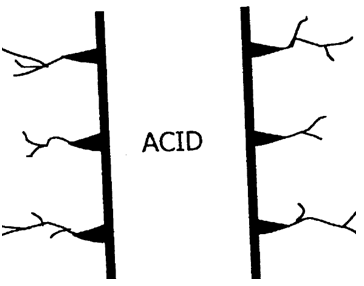
Producing worm hole in carbonate reservoir rocks are very similar to movement and holes made of worms in the ground. It is possible that from the single wormhole more worm hole is branched. Weak acids such as acetic acid and delayed acids tend to be more of a wormhole branch, because due to the low speed of reaction, the acid lost in the layers is high. This matter helps to have a better acidizing if operate in certain and secure range therefore. The structure of worm hole created, it depends on injection rate and temperature and characteristics of reservoir response. In carbonate layers, matrix acidizing mostly is an operation as shortcutting for damaged zone [7, 8].
Causes of Formation Damage
Formation damage may occur during any of steps below.
- Drilling
- Cementing
- Perforating
- Production
- Maintenance and repair of wells
- Acidizing and motivation [8, 9, 10]
Perhaps there is no operation that the possibility of formation damage is zero during it. Therefore in the formation damage assessment, all aspects and history of the well should be investigated. All of the items that should be considered in the formation damage is included:
The Mechanism of Formation Damage during Hydraulic Fracturing
During the hydraulic fracturing, Damages may be occurring. The most significant of formation damage mechanisms are include:
- The influx of particles and these particles are trapped in propane parts
- Fluid issues arising from conflicting by each other
- Non broken polymer gels are trapping in fractures that propane is entered to them.
- The transformation of particles which are trapped, surrounding by propane [13, 14]. This problem may be caused by broking propane when used them with inadequate resistance. This kind of particles is formed and trapping within pores, causing formation damage. The hydraulic fracturing tend to reduce the influx because the production is done through the fractures and the fluid is linear not radial so production of these materials are reduced significantly.
Characteristics of used Acids
Success of acidizing procedures mostly depend on the type of acid, volume of them and limitations are related to them. Some kinds of acid that are used in acidizing operation in wells are mentioned [15]:
A - Mineral acids: A - Hydrochloric acid (HCl) the most common acid which is used is hydrochloric acid. This acid concentration of 5% to a maximum of 37% is available and the common type of it, has a purity of 15% weight fraction. And is used in limestone and dolomite rocks commonly, but it is clear that other materials in the rock can be solved, is affected. Because, it is a strong acid and influence on metals, so it is always with anticorrosive materials. In addition, is added with different materials to have a best result of acidizing, in different purposes [16].
B – Combine of HCI – HF
The function of this type of acid is usually in silica stone due to the rate of corrosion of acid (HF). In this case, the acid (HF) is operated and then a second acid (HCl) starts to effect on rock. This combination of acids doesn’t have much consumption. This combination is called Mud Acid.
Organic acids: Formic Acid and Acetic Acid: The most common type of organic acid that is used in Acidizing is acetic acid. This acid is offered regularly at concentrations up to 10% weight fraction and similar with the above mentioned, is used usually in limestone and dolomite rocks and it has Two advantages rather than hydrochloric acid, one of them would be that, does not effect on the metal casing and it could be able to preserve in high heat. Secondly, due to the fact that, it is weaker than hydrochloric acid and corrosive action of reservoir rock is performed with delay, and it makes an opportunity that all parts affect easily. But it's an expensive acid (with compared hydrochloric acid prices) and thus, it does not have consumption as much as HCl. Formic acid, almost has similar properties compared with hydrochloric acid, however, it is necessary to mention that it affect faster and have more corrosive effect partly [17, 18].
Powder or crystal acids like Sulfamic acid & Chloric-acetic acid: These types of acid have lower influence than the above-mentioned acids, but, they are like powder or crystal so, their transportation are more convenient and they are dissolved easily in water moreover, can be used simply in different places, but the significant issues is temperature. Base on this fact it decomposes at temperatures above 180°F and lose their properties. For this reason, it is recommended not to use at temperatures above 160°F [19].
Hybrid Acid Mixture
These acids include combination of mineral and organic acids, which are used certainly, in different cases with their properties. For instance, due to the speed action of hydrochloric acid is high; it increased the life of acid by adding acetic acid which has slower effect. It is obvious that in this case the mineral acids effect firstly, and as long as their acidity is not destroyed, the organic acid remain active continuously and after organic acid start to act.
These types of acids are included, hydrochloric acid - acetic acid or hydrochloric acid- formic acid or other forms. The usage of these kinds of acids it leads to increase the depth of penetration in the reservoir rock [20, 21].
Factors Affecting Acid Reactions
The types of methods of acidizing and sample of consumption acids was mentioned partly. And to the extent determined, which acid and in which cases would be better. Nevertheless, other factors are affected in Acidizing and it needs to be mentioned. These factors are:
Pressure
To investigate the influence of this factor, it would be better to consider the chemical reactions in this topic. The case of hydrochloric acid and carbonate rocks will be briefly discussed.
$$2HCl - CaCO_3 \rightarrow CaCl_2 - Co_2 - H_2O$$
The Result of this interaction will be carbon dioxide and dissolved salt water. The Limitation of this interaction in contact rate (contact ability) would be the released hydrogen ions. If the above mention remains static and there is no local change, the decomposition of molecules will cause interaction recession. Practical experiments have shown that the speed of interaction in the atmosphere, compared with the theoretical molecular decomposition, will be about 20 times increased, it bases on the motion of CO$_2$ gas in atmospheric pressure and release from this place, that it leads to move the reaming composition and as a result it exits from the static mode and due to this action the contact of hydrogen ions with limestone rock would be easy. So whatever the pressure is less in composition, the intensity of interaction will be higher.
Acid Concentration
Practical experiments and new theories about the effect of hydrochloric acid on limestone is proved in this correlation:
$$r_H = -K(\gamma C)_H^{0.2}$$
The formula shows that against the previous ideas. There is no direct correlation between the effect of acid on interaction and increasing concentration of it.
$$\gamma = \text{activity Coefficient of hydrochloric acid in limestone contact area}$$
$$C = \text{concentration of acid in moles per liter}$$
$$(\gamma C)_H = \text{Acid strength}$$
$$K = \text{Intensity interaction factor}$$
Temperature
According to the above formula, the intensity of interaction coefficient was calculated $7 \times 10^{-6}$ at 75 Fahrenheit degrees. Practical experiments have shown, whatever temperature increase, the rate of coefficient, rises directly, it can be deduced that the effect of hydrochloric acid at 150 Fahrenheit degrees in limestone could be extremely rapid. So, with increasing the intensity of temperature, the interaction increases logically and the only limitation is, in the motion and exhaust gas that remained obviously moreover, other factors are affected (pressure) in this issue.
Acid Type
It is obvious that type of acid and acidic power, depends on the ability of acid hydrogen separation
$$H_A \leftrightarrow H^+ + A^-$$
$$HCL \leftrightarrow H^- - CL^-$$
The equilibrium concentration sets can be defined as follows.
$$K_{HA} = \frac{[H^-] \leftrightarrow [A^-]}{[HA]}$$
At the top, $K_{HA}$ will be the balance coefficient of acid which is commonly called the acid dissociation constant value.
As we shown, the power of acid is the separated hydrogen ions that release from it. Moreover, in above definition, whatever the released hydrogen ions are in high level, the amount of $K_{HA}$ will increase. As a result the acid would be stranger. According to the above mentioned. Any acids with high dissociation constant are called strong acid and if the dissociation constant is low namely, weak acid.
Equilibrium in Acid Reaction
In general, a chemical interaction is continues until the available or the produced materials in composition be balance. In this mode, the effect of acid on a salt is possible to remain some of the initial acid without any action. For instance, in one set of hydrochloric acid and limestone rock, after the production of water, $CO_2$ and dissolved salt, the reaction had reached to equilibrium state and despite of having an acid and limestone in composition, there will be not any interaction in this case, if the gas release from the composition in any situation, two objects (acid and limestone) are combined to reach an equilibrium again. Thus, the conditions should be provided that the time for reaching the equilibrium state is excessive to have more opportunities to fulfill all its strength completely (e.g. pressure is decreased or temperature is increased).
Rock Characteristics
When acid is pumped into the reservoir rock, it is certainly dissolve some parts that are contact with them. Numerous experiments demonstrated that the effect of acid on the reservoir rock is not integrated. Due to the entire reservoir rock properties are not the same. It is obvious that in any paths, if the pores of the reservoir rock have better connection to each other, the acid is passed through them easily. Because the rock in contact with them and have better influence in that part.
As a result, the material type, porosity, fissures and compressibility of reservoir as well as some other properties in acidizing operations have a significant effects.
Selection of Acidizing Method
Several factors are involved in choosing method of acidizing. Admittedly, with regard to a system that provides the conditions to reaching the ultimate goal is considered in this issue. As the previous discussed there are different methods of acidizing operations in wells. The simplest way of acidizing is pumping the acid into wells or keeping them next to the production layer (Spot) in order to wash channels(perforations) and finally washing the well with acid. This operation in most cases with the attendance of drilling rig is so common, due to keep the acid (Spot) in adjacent layers to operate the Circulation with process fluid in the well. acidizing in this situation of design is not very complicated. The only factor that is significant would be, the amount of acid in adjacent channels and wellbores, contacting with reservoir rocks. Basically, in this Acidizing system, the aim is not to increase the permeability of the reservoir rock and it is the only action for washing inside the network (Perforation) and in simple terms it is just for washing the channels that fluid flow easily from reservoir rock into the well. As a result, we could say that it does not have much expertise to design a system. Therefore, regardless of this method, other significant methods are selected to discuss more in this section. The important thing to make a decision in acidizing operation. Is, to have all the necessary information that is obtained from wells. All data such as reservoir rock properties, well pressure situation, productivity index, etc., are under scrutiny. The ultimate goal of acidizing is determined by reviewing the information, (For instant, the purpose of the acidizing is doubling well production rate). Generally, it could be helped to achieve the goal by analyzing advantages and disadvantages of existing systems. moreover, the appropriate decision is taken about the acidizing system and then the system is designed for the well. First of all, investigating is performed with regard to information of the well, whether the acidizing will be resolved the issue? And which method would be better, matrix Acidizing or Fracture Acidizing? Or just internal acid wash is required for well. That are mentioned before, the last method does not require a particular design.
Methodology of Investigating Parameters
Matrix Acidizing is Generally used in Following Cases
- During drilling, to fix reservoir rock damages and formation damages. Totally, to eliminate the factor that is mentioned to produce more from wells.
- Increasing well production by increasing the permeability of the reservoir rock is one of the uses of this system. This method increase production rate up to 150% (in homogenous reservoir rock)
- This system in most cases is used in acidizing, because it does not disturb zone boundaries, or change them little .it means that in some cases due to the generated fractures are connected to reservoir rocks and produce unwanted water or gas, this method is used for Acidizing.
The important issue in this case is permeability of the reservoir rock to the extent that acid could pump in it. Obviously, it would be impossible otherwise; fractures must be produced in reservoir rock. This method has been proven that pumping acid into the reservoir rock is difficult if penetration is less than 5 milli Darcy. More over This system can be used in sand and carbonate layers.
Acid Fracturing can be used in below Conditions
1. The reservoir rock or layers are located in depth and so tight. In addition, it could not appropriate with any other devices for production. 2. In some cases, that reservoir rock has fractures and cracks this method is used to connect them to each other and more production is generated. In other words, the permeability is increased beside the production by generating the fractures. This method of Acidizing is used in damage and undamaged formation during drilling. In a perfect design and job, we can get to doubled production. And several factors are involved in this issue, such as permeability, temperature, and depth of the rock reservoir.
Acid Additives
Each acid have a corrosion difficulties and different characteristics too. According to acid profile and their usage, different materials are added to acid moreover, these additives have their own particular characteristics and therefore they are linked to the particular usage.
- Corrosion Inhibitors of metals, including objects that are added to acids. It is the purpose of adding these materials to prevent corrosion of metals causing by contact with the acid. This additive according to their property. Make a thin layer on metals and prevent to direct contact of acid with metals. The amount and type of this mixed sample, depends on the existing conditions. And for example, according to the concentration of acid, ambient temperature and metal property, the amount and type of this additive is considered.
- One of the substances adding to acid are materials that increase reservoir rocks dissolution and contact of acid (Surfactants). In fact, this additive increase acid absorption in reservoir rock in addition they prevent to emulsify in reaction.
- Iron salts that are made because of the acid attendance. Or they might be in the reservoir rocks, in contact with hydrochloric acid change in to chloride form. As long as the acidic ambiance is attended in reaction (acid does not lost all of its acidity yet) they play their role as a solution if the PH of ambiance surge quickly deposition are produced. It is obvious that this deposition collapse rock pores. So, to prevent the deposition of these salts, the substances are added in to acid (Complexion Agents).
- During acid pumping, some materials are added (Agents Gelling), to reduce the pressure drop (friction). In addition, it also increases the acid life and penetration depth. If this material have more viscosity, acid lost is taken less more over some specific materials are also available to reduce these difficulties.
- some materials are added in Acidizing operation to have a homogenous injection. (Diverting Agents). In fact, these materials block the high permeable parts (relatively and compared with other parts of the reservoir rocks) temporarily. So, the flow diverted to other parts and it will make the direction for them, ultimately this action enhances their permeability. (Usually when the thickness is more than 30 feet).
- when, Acid contact with the reservoir rock the operation is started to solve parts that contact with them, in addition the strength is reduced by moving more in to reservoir rocks so, it does not too noticeable.
As a result, some materials are added in order to penetrate more into the reservoir rocks to slow down the acid affection. (Retarding Agents) this additive leads to manage the acid power and acid contact with the reservoir rock is not lose. Moreover during the penetration into reservoir rocks acid have also the power.
Design of Matrix Acidizing Treatment
As it mentioned before, the significant parameter in this case is pressure, which is pumped into the reservoir rocks. It should be considered that pressure should be less than the formation fracture pressure. Another issue is acid rate flow, which is pumped into the reservoir rocks. This operation could be calculated due to the characteristics of the reservoir rocks and pressure. About the amount of acid that must be used, accuracy is not obvious. The reason is that the effect of acid is not visible in the reservoir rock which leads to some uncertainties remain unresolved. Although, various experiments are performed on different rocks samples in surface condition. Furthermore an important issue in this case is the rock porosity. It can be deduced that acid volume base on the porosity and damaged zone during the drilling or production is determined. If the damaged zone of the reservoir rock with a radius of two feet is considered we will have a surface about 12 feet and 1 foot in height. In this situation by considering 35% of the pore spaces (Porosity) to fill them in a depth of 2 feet, volume of 40 gallons per foot fluid is necessary. Therefore, for better result, at least 100 or more gallons of acid rock is considered. This number is almost universally accepted and tested. It should be noted that is also used in 200 gallons per foot. It is obvious that about concentration of acid must be said, the higher concentration of acid is used the larger quantity of rock dissolved are produced. In addition, experiments have shown that the strength of the acid solution to a concentration of 15% is a linear trend however, by increasing, the direct trend disappears and then the acid solution at a concentration of 23% will reach to maximum power. After that, if the strength of acid concentration is increased the acid solution can be reduced to some extent. it is usual that the temperature less than 200 ° F to a maximum concentration of 28% acid is used. According to above procedure, the below method is solution for matrix acidizing design. It should be mentioned that in order to design, the reservoir information must be available as much as possible. It is obvious that after the acid pumping, a fluid is pumped into the well with less weight (usually gasoil) to move remaining acid from well into reservoir rock. The volume of fluid is usually slightly higher than the capacity of the well to ensure that all acids penetrate into the reservoir rock. About an hour after acidizing well is opened for washing.
Design the Fracture in the Reservoir Rock
After investigating well production situation by comparing and considering well position and also condition of the reservoir rock, fracturing operation is decided. For example, by investigating the available information, the result is concluded due to the low permeability of the production layer and enhancing the oil production rate, fracture should be generated in the rock. All in all, we can use formulas and diagrams, to solve the problems but, final solution is not easy. The main reason is that uncontrolled fracturing operation and uncertain fluid characteristics treatment in reservoir rock. And even in some cases, information is not adequate. Perhaps, only three factors are available for designer in fracturing operation with compared to all of the parameters. 1. The fluid that is supposed to create the fracture.
Viscosity type, lost condition, volume are available as much as possible.
2. The amount and pressure of fluid injection.
3. Materials with fluid, type, size (gravel diameter) and the volume of materials is under control.
Fluid type composition play main role in creating fractures and the length and width of them is also dependent on it.
Considering the Economic Aspects
It should be considered the efficiency after operation. In addition, price of materials and fluid consumption should be calculated according to usage, and different materials are evaluated finally, it is necessary that the result is predicted obviously. In simple terms, the costs will be compensated after operation then planning prepare to do by considering all available information. It is necessary that in each case the efficiency rate and safety factor should be considered.
Incompatible Additives in Hydraulic Fracturing Fluids
This type of damage that is often with Water blocking is happened in Matrix or creates by emulsion. And it can be detected before the operation by performing compatibility test to prevent the unwanted results.
Non Broken Gels
Not broken Gels can also produce damages. The most used fluids in hydraulic fracturing are designed that available Gels automatically break after a while, or the gel additives is added to break them. Gels in hydraulic fracturing fluids should be broken after the operation that backflow be performed easily. This type of damage may be surmountable by HCL or enzymes that are available for polymer.
Conclusion
By applying acidizing procedures in carbonated reservoirs, these results could be addressed as below:
1. The acidizing is one of the most functional stimulated method through the wells.
2. The usage of matrix acidizing due to low cost and low barriers of implementing is considered as one of the appropriate options for the well stimulation in the petroleum industries. 3. The administration of acid or hydraulic fracturing in the reservoirs with low permeability (less than five milli Darcy) should be investigated accurately. 4. For reservoirs with low permeability, applying Xylene (to reduce skin damage) and HCl(to increase the relative permeability of the reservoir rock) are recommended. 5. Coiled Tubing is the efficient measurements in acidizing operation that is provided significant performances. 6. According to specified properties of each well such as physical condition, basic acidizing program in terms of physical properties of the reservoir rock and fluid, bottom hole pressure and temperature, types and qualities of metals, combination of optimized acid are implemented.
Consequently, to optimize the acid volume in certain conditions in each well, a significant amount of additives for controlling, improving and expanding the range of performance for different acid parameters are available. Therefore, before the acidizing processes, the additives of acid composition from the standpoint should be strongly optimized efficiently.
References
-
Li-qiang Z, Nian-yin L, Wen-jin L, Ping-li L, Qian Z (2007) Large-scale acid fracturing techniques in PuGuang. Nat Gas Ind 27(7): 4e7.
-
Nianyin L, Liqiang Z, Qian Z, Xiaoning R, Pingli L (2008) Acid etched fracture conductivity study in acid fracturing. Drill Prod Technol 31(6): 59e62-5292.
-
Weidong J, Xugang W, Jianfang J, Hu En'an (1998) Simulation experimental research on acid-etched fractures' conductivity. Drill Prod Technol 21 (6): 27e29.
-
Fu Yongqiang, Guo Jianchun, Zhao Jinzhou (2003) A systematic study of the complex lithology conductivity-etched-fracture conductivity. Drill Prod Technol 26 (3): 22e25.
-
Malic MA, Hill AD (1989) A New Technique for Laboratory Measurement of Acid Fracture Conductivity. Society of Petroleum Engineers, SPE Annual Technical Conference and Exhibition, San Antonio, Texas.
-
Nierode DE, Kruk KF (1973) An Evaluation of Acid Fluid-Loss Additives, Retarded Acids, and Acidized Fracture Conductivity. Society of Petroleum Engineers, Fall Meeting of the Society of Petroleum Engineers of AIME Las Vegas, Nevada.
-
Beg MS, Kunak AO, Gong M, Zhu D, Hill AD (1998) A Systematic Experimental Study of Acid Fracture Conductivity. Society of Petroleum Engineers, SPE Production & Facilities 13(4): 5.
-
Ruffet C, Fery JJ, Onaisi A (1998) Acid Fracturing Treatment: a Surface Topography Analysis of Acid Etched Fractures to Determine Residual Conductivity. SPE Journal 3(2): 8.
-
Crowe CW, Hutchinson BH, Trittipo BL (1989) Fluid Loss-off Control: The Key to Successful Acid Fracturing. SPE Production Engineering 4(2): 6.
-
Nian-yin LI, Zhao Li-qiang, Lui Ping-li (2006) Study on acidizing fluid leak-off in carbonate acid fracturing. West China Explor Eng 3.
-
Coulter AW, Crowe CW, Barrett ND, Miller BD (1976) Alternate Stages of Pad Fluid and Acid Provide Improved Leakoff Control for Fracture Acidizing Society of Petroleum Engineers, SPE Annual Fall Technical Conference and Exhibition, New Orleans, Louisiana.
-
Hill AD, Zhu D, Wang Y (1995) The Effect of Wormholing on the Fluid Loss Coefficient in Acid Fracturing. SPE Production & Facilities 10(4): 7.
-
Kibodeaux KR, Zeilinger SC, Rossen WR (1994) Sensitivity Study of Foam Diversion Processes for Matrix Acidization. Society of Petroleum Engineers, SPE Annual Technical Conference and Exhibition, New Orleans, Louisiana.
-
Parlarv M, Parris MD, Jasinski RJ (1995) An experimental study of Foam flow through Berea Sandstone with Applications to Foam Diversion in Matrix Acidizing. Society of Petroleum Engineers, SPE Western Regional Meeting, Bakersfield, California.
-
Economides MJ, Kenneth G (2000) Reservoir Simulation. Willy & Sons Ltd.
-
Williams BB, Gidley JL, Schechter RS (1979) Acidizing Fundamentals. Society of Petroleum Engineers of AIME, New York, 6.
-
Leonard K (2001) Production Enhancement with Acid simulation. Pennwell Corp.
-
Faruk Civan (2007) Reservoir Formation Damage: Fundamentals, Modeling, Assessment, and Mitigation 2nd (Edn.) Gulf Professional Pub, Amsterdam, Boston, pp: 1114.
-
O’Driscoll Kieran (1995) Acidizing Concepts and Design. BJ Co.
-
Allen TO, Roberts AP (2012) Production operations Well Completions, Workover and Stimulation 2nd (Edn.) OGCI and Petro Skills Publications, 1.
-
Guo B (2007) Petroleum Production Engineering A Computer-Assisted Approach. Gulf Professional Publishing.
- Nigeria’s Vulnerability in the Face of Global Energy Policy
- A Simulation Study of Investigation of Optimum Oil Production Performance by Applying Various Gas Injection Methods in Oil Reservoir
- Characterization of Permo-Triassic Reservoirs through Thermal Maturity Assessment of Westphalian Source Rocks in the Cheshire Basin
- Influence of Microwax on the Rheological and Thermal Behaviour of a Wax Crude Oil
- Real-Time Monitoring and Performance Optimization of Steam Injection in Heavy Oil Reservoirs Using Fiber Optic Sensing and Integrated Predictive Simulation Models
- Rapid On-Site Determination of the Total Petroleum Hydrocarbon Content of Soils by Handheld Fourier Transform Near-Infrared Spectroscopy: Development of a Global, Site- and Scanner- Independent Calibration Model