
Dual Benefit of CO2 Sequestration: Storage and Enhanced Oil Recovery
Carbon dioxide (CO2) sequestration is usually implied in geological formations because; they can provide the pore volumes needed to store large amount of CO2; they have adequate permeability required for efficient injection; and they are widely distributed geographically. They also possess the seal (Cap rock) needed to keep the stored CO2 in place. Of all the sedimentary formations, saline aquifers have the largest global sequestration capacity. Saline aquifers might exist at the bottom of an oil reservoir that acting as a pressure support to the oil reservoir. CO2 can be sequestered in saline aquifers underlying oil reservoirs or in saline aquifers that are located away from the oil reservoirs. In this study the dual benefit of CO2 sequestration will be introduced in which the CO2 will be injected in saline aquifers underlying oil reservoirs. The CO2 will be injected in the aquifer at the bottom part using different well schemes (horizontal and vertical wells). Numerical reservoir simulation software was used to build the reservoir and aquifer models and to carry out the CO2 injection and oil recovery. The injected CO2 will migrate from the aquifer to the oil zone and the oil will be produced through oil producers. Different combination between CO2 injectors and oil producers will be used to maximize the amount of stored CO2 and the oil recovery. The simulation results showed that CO2 can be stored in saline aquifers underlying oil reservoirs. The saline aquifer will start releasing CO2 to the oil zone after it gets saturated with CO2. The aquifer dissolved 5% of its volume CO2 and after this saturation whatever CO2 injected migrated to the oil zone and reduced the viscosity of oil and increased the oil recovery. Horizontal well gave better storage capacity and also gave better recovery compared to vertical wells. The oil recovery increased by 75 % of the residual oil using this method after seawater injection.
Introduction
CO2 is usually injected into formations at high pressure and high temperature in which the CO2 is in its supercritical condition. Storing CO2 in a supercritical condition will allow the storage to store more CO2 because of the less volume occupied by CO2 at this state [1]. While CO2 is injected into the formation, the major mechanisms that ensue CO2 sequestration are: (i) Physical/Structural trapping, due to the low permeability of the cap or sealing rock that will prevent CO2 from migration or leak to the surface or other resources in the underground [1, 2], (ii) Solubility trapping, in which the injected CO2 will dissolve in water to its solubility limit that based on the water composition, (iii) Mineral trapping – the dissolved CO2 in water will produce carbonic acid that will react with the rock and precipitate calcite mineral, and (iv) Residual or Capillary trapping which occurs after CO2 injection stops and water begins to imbibe into the aquifer displacing the CO2 already in the aquifer. Not all the CO2 is displaced but some are left behind as residual CO2 (residual trapping). Zhang and Agarwal carried out numerical simulation and optimization for CO2 storage in saline aquifers [3]. They used Genetic Algorithms (GA) to optimize parameter such as; CO2 injection rate, CO2 injection pressure, injection depth, well schemes (vertical/horizontal). Their optimizer can be used to optimize the sequestration capacity of CO2 in saline aquifers. They developed a code that can be used to study the leakage of CO2 during storage in abandoned wells. Also it can be used to the enhancement in methane gas recovery from depleted gas reservoirs. The developed optimizer can be used to investigate the CO2 storage in heterogeneous geological formations. Zhang and Agarwal optimizer code matched the simulation results obtained by other codes and they utilized their code to optimize the process of CO2 sequestration in different scenarios and different well patterns [3]. Zhang and Agarwal carried out numerical simulation to study the CO2 sequestration efficiency, safety, and its economic feasibility before sequestration in field scale saline aquifers [4]. They carried out the simulation study on three large identified saline aquifers and their simulation results were in agreement with that obtained from seismic data in CO2 monitoring during sequestration. Seo and Mamora performed experimental and simulation studies to assess the possibility of sequestering supercritical CO2 in depleted gas reservoirs [5]. They obtained the relative permeability curves by simulating the experimental results, and they use the relative permeability in the simulation of field cases. They constructed 3D simulation model to investigate he injection of supercritical CO2 in depleted gas reservoirs. The simulation results showed that the amount of CO2 stored in depleted gas reservoirs is related to the depletion and the reservoir capacity. The higher the depletion and the larger the reservoir the higher was the sequestered CO2. The simulation results showed that 4.8 million tons can be stored and 56 years in depleted gas reservoirs compared to 1.2 million tons in 29 years. They showed that the injection rate of the supercritical CO2 did not affect the storing capacity of the reservoirs and also in addition to CO2 storage, 1.3 BSCF natural gas was produced during the 29 years sequestration period and 4.9 BSCF was produced in the case of 56 years sequestration. This actually shows the mutual benefits of the sequestration of CO2 in depleted gas reservoirs, more gas will be produced due to the high reservoir pressure obtained by CO2 injection and in the same time CO2 is stored in these reservoirs. Nogueria and Mamora investigated the CO2 sequestration in depleted gas reservoirs in addition to impurities from the flue gas from the surface separators such as nitrogen [6]. One of the proposed objectives of CO2 sequestration is to maintain the pressure of gas reservoirs. In addition to that CO2 can be stored in these reservoirs because they have large storage capacity compared to oil reservoirs having the same pore volume. They proposed the injection of CO2 with a mixture of nitrogen gas and other flue gas impurities to enhance the combustion of the produced gas. They found out that injecting CO2 with impurities did not affect the CO2 storage volume in depleted gas reservoirs. They concluded that to maximize the CO2 sequestration volume, impurities should be injected with CO2, and also this will reduce the compression requirements and improve the sweep efficiency and in turn enhance the gas recovery. Adebayo proposed a technique to monitor the CO2 sequestration in the down hole using combined resistivity and temperature logging [7]. The proposed technique can be used to monitor the dissolution/precipitation cause by CO2/Brine/Rock/Interactions (CBRI) with the carbonate formations in saline aquifers. Also, the proposed technique can be used to assess and evaluate the effectiveness of scale inhibitors injected to prevent the scale caused by CO2 interaction with the carbonate reservoirs (calcium carbonate or calcium sulfate scale). They have done resistivity and temperature logging on carbonates for three months continuously during the CO2 injection and the dissolution/precipitation observed clearly from the recorded logs. CBRI produced carbonic acid which reacted with the carbonate at low pH, once the pH increased this will cause carbonate precipitation. The proposed technique was able to capture the dissolution and the precipitation of carbonates inside the core during CO2 injection. Olabode and Radonjic studied the interaction between the stored CO2 and the cap rock (shale) in the underground storage [8]. They carried out experimental work for longer time periods at high temperatures. They found out that the CO2 affected the shale cap rock integrity and the surface area of the rock exposed to the reaction increased and this also will impact the pore geometry and pores connectivity due to the interaction. They concluded that the contact time has strong impact on the shale integrity due to the reactivity of the carbonic acid generated from the reaction of CO2 and brines. Mohamed investigated the effect of CO2 sequestration on the permeability of vuggy carbonate aquifers [9]. They carried out several core flooding experiments with continuous CO2 injection to study the effect of CO2 interaction won the rock permeability. They found out that the CO2 injection may increase the rock permeability due to dissolution or damage the rock permeability due to the precipitation of calcium carbonate and the reaction depends on reservoir conditions of permeability, pressure, temperature and porosity. The experimental results showed that two sources of damage were identified; the first one was due to calcium carbonate precipitation and the second one due to fines migration of the clay minerals that exist in the core. Shtepani studies CO2 sequestration in gas condensate reservoirs [10]. He integrated the laboratory results with modeling study that was done before compositional simulation and field pilot test for CO2 injection. He showed that the phase behavior of CO2 and gas condensate will affect the storage volume of CO2 in depleted gas condensate reservoirs. The PVT study should be carried out to study the phase behavior because this will be important in building the equation of state model (EOS). He shows that the coreflood experiments should be performed in addition to the PVT experiment to determine the CO2 breakthrough and the results from the flooding experiment can be used to study the sensitivity using commercial simulators to study the feasibility of CO2 sequestration in depleted gas condensate reservoirs. Barrufet investigated the CO2 storage capacity in different geologic formations, for different levels of CO2 purity and different injection schemes [11]. They studied the storage of CO2 in depleted gas condensate reservoirs and into saline aquifer using compositional reservoir simulation model. They found out that the presence of impurities such as nitrogen and methane in CO2 decreased the storage capacity of the reservoir. They concluded that an optimization study should be carried out based on the economic optimum between the cost of the impurities separation such as nitrogen and methane from the CO2, compression, and the CO2 injection rate. The simulation results showed that, the mass of CO2 sequestrated per pore volume in the aquifer is 13 times smaller than that of the depleted gas condensate reservoir model. The saline aquifer of the same volume as a depleted gas reservoir has lower storage capacity because of its low overall compressibility. However, aquifers tend to have a far larger extent, which often compensates somewhat for this lower ratio and therefore provides storage for significant volumes of CO2. Pilisi and Ceyhan carried out a feasibility study of CO2 sequestration in deep water formations in the Gulf of Mexico [12]. They performed complete description of the whole process of the CO2 capture and sequestration including the technical limitations from the surface to the underground storage. In deep offshore reservoirs the liquid CO2 has higher density and that may cause hydrates that will fill the pore space and act as trapping mechanism. They concluded that, deep water sub-seabed sequestration provides an enormous storage capacity to counteract increasing world consumption of fossil fuels. Pilisi and Ceyhan concluded that, large scale simulations are needed to investigate the impact of geochemical reactions on the deep water sea bed region and also the impact of the liquid CO2 injection on the water chemistry in the deep water [12]. Daneshfar carried out a feasibility study for CO2 sequestration in the Arbuckle formation in Oklahoma [13]. They performed a general review for CO2 storage in saline aquifers using the existing wells, they found out that the criteria that control the sequestration process are; geology of the aquifer, lithology of the storage reservoir, cost of the operations, CO2 sequestration impact on the reservoir rock properties, and depth of the completed intervals. The residual oil in the Arbuckle formation will affect the reaction chemistry that will impact CO2 sequestration. The numerical simulation results of CO2 sequestration in disposal well in the Arbuckle formation showed that the dissolution/precipitation of the minerals took place in the near-wellbore. Residual oil retarded the dissolution of the mineral and delayed the reaction in the near-wellbore area.
CO2 flooding is used to enhance the oil recovery from carbonate and sandstone reservoirs. CO2-EOR has many problems such as viscous fingering and gravity override. Hoffman and Shoaib developed a numerical model for CO2 enhanced oil recovery [14]. Their model showed that the CO2 injection in low permeability shale recovered more oil. They showed that CO2 injection will enhance the sweep efficiency and support the reservoir pressure. CO2 can be injected into the reservoir either by using vertical or horizontal injectors but the horizontal injector capacity was higher compared to the vertical one. The objective of this paper is to investigate the dual benefit of CO2 sequestration in saline aquifers underlying oil reservoirs using numerical simulation software. The specific objectives are as follows: 1) investigate the CO2 sequestration in saline aquifers, 2) investigate the effect of the slow release of the sequestered CO2 to the oil reservoir on the oil recovery due to the viscosity reduction, and 3) studying the effect of different well schemes on the oil recovery by the slow released CO2 from the storage aquifer.
Simulation Model
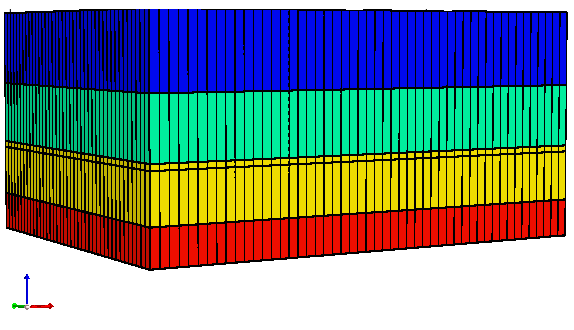
Simulation data initialization was done using drainage area with length of 8000 ft and width of 6000 ft. The thickness of oil bearing zone was 145 ft and for aquifer 70 ft was used. Grid blocks in X = 50 with a length of each grid block equals to 160 ft. Grid Blocks in Y = 40 with a length of each grid block equals to 150 ft. This thickness was divided in to five layers with Average porosities of 0.18, 0.17, 0.1, 0.18 and 0.15 respectively for first and second layer of reservoir, low permeability layer and two layers for the aquifer. Average permeability of 100 md, 80 md, 0.01 md 75 md, and 90 md respectively were set for the five layers. The middle layer permeability was set to be low to slow down the release CO2 during the sequestration process. The length of the horizontal well was 2500 ft (for both injector and producer). The first three layers (from the top) are oil zones while the last two layers are aquifer. The grid block permeability in x, y, and z directions is perm x = perm y = 10 * perm z. The reservoir pressure was set to be 4000 psi, the minimum miscibility pressure (MMP) = 1600 psi, Pb (bubble point pressure) = 1400 psi, gas/oil contact (GOC) = 9000 ft. Figure 1 shows the initial model as described. The following well properties were considered; maximum injection pressure = 5500 psi, for injectors, operating bottom hole pressure (BHP) = 1800 psi for producers, and gas/oil ratio (GOR) = 8000 scf/stb, well radius= 0.625 ft, and Skin damage = 1.5.
CO2 Sequestration in the Aquifer
Figure 2 shows the CO2 sequestration in the saline aquifer, the injection started at 2014 for 10 years and then stopped at 2024.
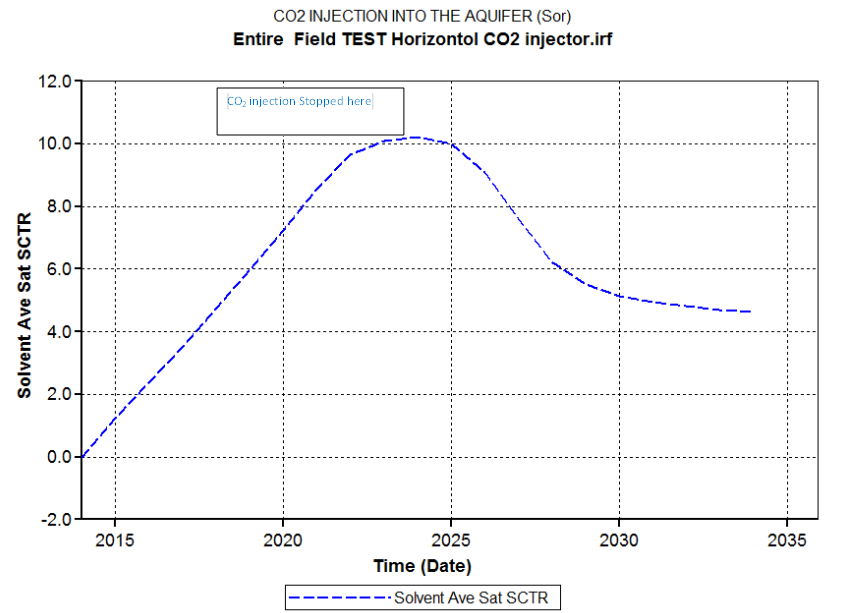
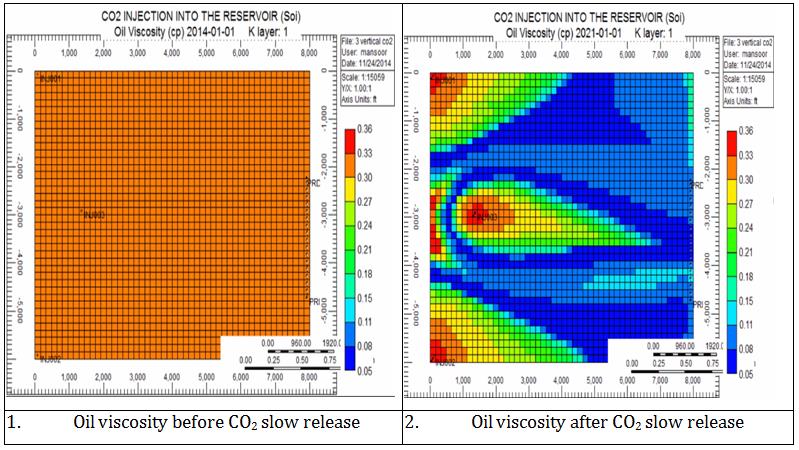
The saturation of CO2 reached 10% of the aquifer volume and after the injection stopped at 2024 almost 50% of the stored CO2 migrated to the oil zone. After the slow release of CO2 to the oil zone, the saturation of CO2 in the aquifer became 5% of the aquifer volume. From this figure we can utilize the mutual benefit of CO2; sequestration in the saline aquifer and part of this CO2 will migrate to the oil zone to swell the oil and reduce its viscosity. Once the oil viscosity reduced, the oil production will increase even without injecting CO2 in the oil zone itself. Applying this method will help get rid of CO2 and enhance the oil production from oil reservoirs without applying secondary or enhanced oil recovery methods. Figure 3 shows the viscosity of the oil in the oil zone before and after the slow releases of CO2 from the aquifer to the oil zone.
Enhanced Oil Recovery due to CO2 Sequestration in the Aquifer
In this section we will study the effect of CO2 sequestration in the aquifer on the oil recovery from the oil zone at different scenarios. Different well schemes (vertical/horizontal) and the oil recovery in the oil zone will be from the residual oil saturation, Sor (residual oil saturation in this reservoir is 0.29) and from the initial oil saturation (Soi) in other schemes.
Enhanced Oil Recovery from Residual Oil Saturation
Figure 4 shows the oil recovery factor from the residual oil saturation (Sor) due to the slow release CO2 from the aquifer zone.
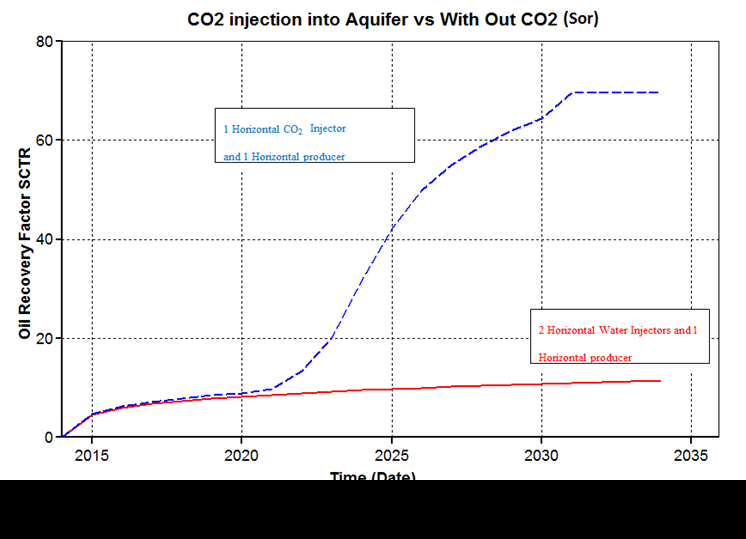
Figure 4: Oil recovery due to CO2 slow release from the aquifer to the oil zone. As indicated previously almost 50 vol% of the sequestered CO2 in the aquifer migrated to the oil zone and welled the oil. The oil recovery increase reached almost 70% of the residual oil saturation due the oil viscosity reduction by CO2 slow release from the aquifer. Injecting water as a secondary recovery mechanism after the primary recovery oil recovered 12% of the residual oil. Comparing the two scenarios, water injection in the oil zone only recovered 3.5% of the initial oil in place, whereas the oil recovery due to the CO2 sequestration in the aquifer was 20.3%. There was a huge difference between the two scenarios and the CO2 sequestration one was more efficient and cost effective because in this case CO2 sequestration will enhance the oil recovery also, all what we have to do is to inject the CO2 at the lower part of the aquifer to maximize the amount of CO2 sequestered in the aquifer. Part of the stored CO2 will migrate to the oil zone to reduce the oil viscosity and this will enhance the oil production. In the same time CO2 injection in the aquifer underneath an oil reservoir will increase the oil reservoir pressure. The viscosity reduction will increase the oil recovery because less pressure drop is required to mobilize the low viscosity oil and the production from the oil zone will be naturally without injecting the CO2 in the oil zone and in the same time no water injection is required in both the oil and aquifer zones. The mutual benefits of the CO2 sequestration will be achieved in this case by storing CO2 in the aquifer till the CO2 solubility limit reached in the aquifer water, and excess of CO2 will be released to the oil zone to swell the oil and reduce its mobility. Different well schemes were simulated at the residual oil conditions as follows: 1. Both injector and producer are horizontal( one injector and one producer well)
2. Both injectors and producers are vertical ( Three
vertical gas injectors and three vertical producers)
3. Vertical injectors and horizontal producers (Three
vertical gas injectors and one horizontal producer) The simulation was carried out from 2015 to 2034. In all scenarios maximum injector pressure is set to 5500
with the decided design and following results were generated for oil average saturation and oil average recovery factor shown in the Figure 5 and Figure 6.
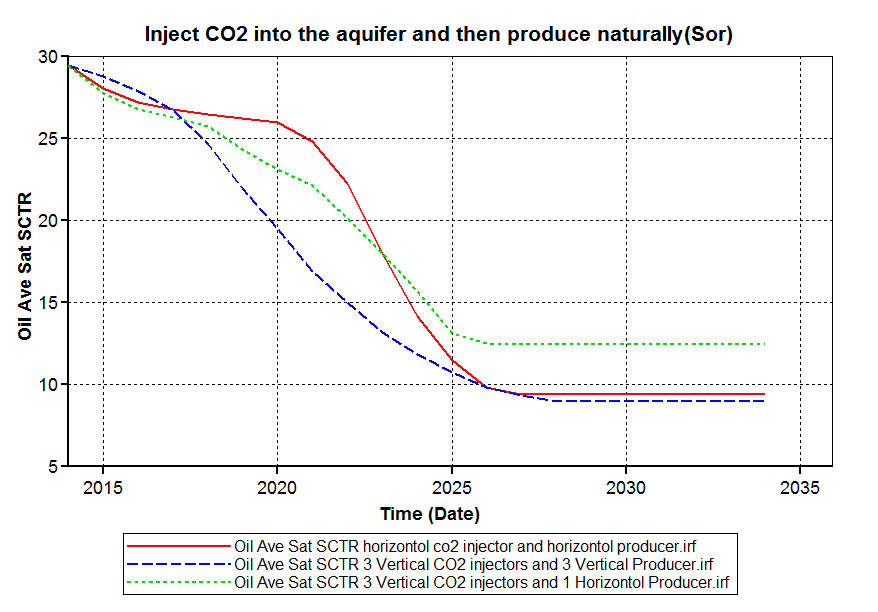
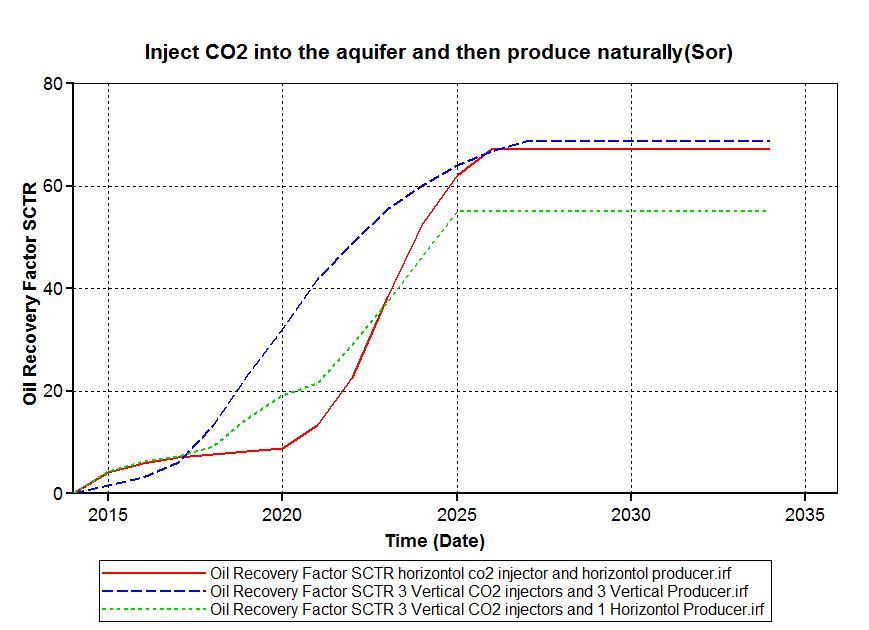
In this case CO2 was injected into the aquifer and the oil was produced from the oil zone without water injection. The vertical well scheme produced low at start but as the CO2 saturation increased into the reservoir it made more oil mobile and provide enough energy to reach production wells. This effect can also be seen in vertical injectors with horizontal producer case where production is high compare to horizontal injector but dropped later when vertical injectors cannot provide more mobility to the oil as saturation of oil becomes as low as 13%. Vertical injector and producer with 3 wells each has better sweep and should be preferred.
Enhanced Oil Recovery from Initial Oil Saturation
In this case the CO2 was injected into the aquifer zone at the early life of the reservoir and the oil was produced naturally from the oil zone. Three well were designed in this category;
1. Both injector and producer are horizontal( one injector and one producer well)
2. Both injectors and producers are vertical ( Three
vertical CO2 injectors and three vertical oil producers)
3. Vertical injectors and horizontal producers (Three
vertical CO2 injectors and one horizontal producer) The simulation started from 2015 to 2034. In all scenarios maximum injector pressure is set to be 5500 psi (to avoid reservoir fracturing, in which CO2 sequestration will stop when the reservoir pressure reached this value). The maximum oil production for the oil producers was set to be 30,000 bbl/day. The number of wells and for each case is indicated in the plots. The simulation was ran with the decided design and following results were generated for oil average saturation and oil average recovery factor shown in the figures below, Figures 7 and Figure 8.
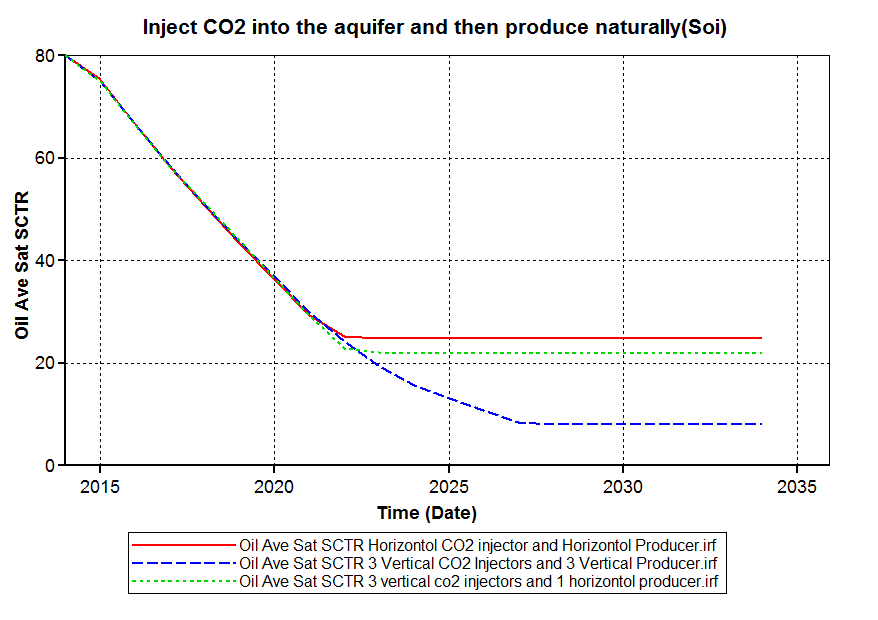
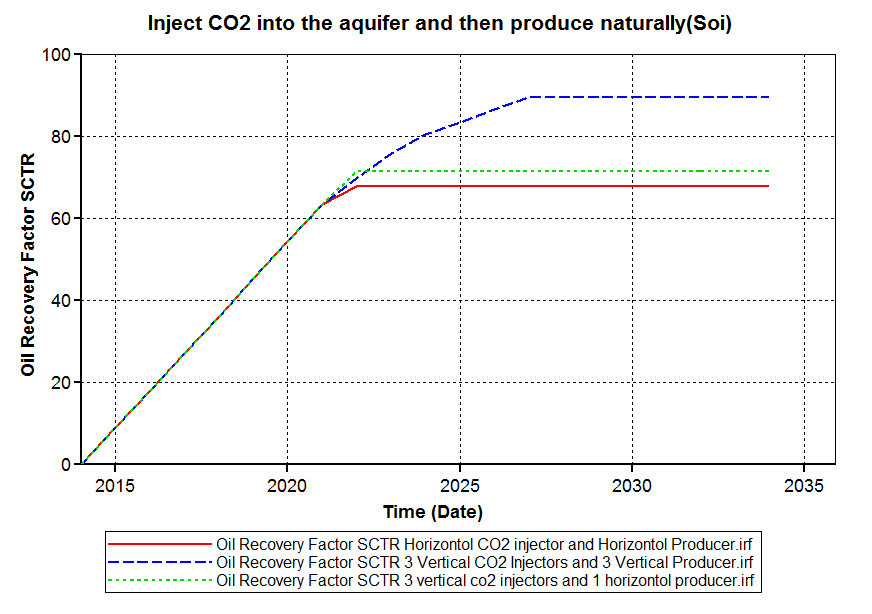
Figure 8: Oil recovery factor versus time. From the two figures it is clear that in all scenarios the CO2 started to be released from the aquifer zone at the same time (nearly 2022) and the oil recovery started to increase at this time. The highest oil recovery was obtained in the case of three vertical CO2 injectors and three vertical CO2 producers, and this can be attributed to the coverage of CO2 sequestration in this scenario was the highest. The design of well schemes in which the maximum CO2 can be stored in the reservoir will help in getting more oil from the oil zone because more CO2 will migrate and swell the oil.
Conclusion
In this study, the mutual benefits of CO2 sequestration in aquifers was investigated, where the stored CO2 will migrate to the oil zone and swell the oil and enhance the oil recovery. The following are the conclusions that can be drawn from this study: 1. Simulation results showed that the sequestered CO2 in the aquifer migrated to the oil zone and reduced the oil viscosity more than 6 folds. The reduction in the oil viscosity will enhance the oil recovery by the natural reservoir energy.
2. CO2 sequestration in aquifers increased the oil recovery from the overlying oil zone by two mechanisms; the first one is the increase in oil mobility and the second one due to the increase the oil zone pressure due to the CO2 sequestration in the aquifer.
3. Different well schemes affected the oil recovery from the oil zone. The well scheme that provided the maximum storage capacity was horizontal well located at the bottom of the aquifer zone.
References
-
Benson SM, Cole DR (2008) CO2 Sequestration in Deep Sedimentary Formations. Elements 4(5): 4325- 4331.
-
Wang S, Lee M, Park MK, Kim J (2010) Box Experiments on Monitoring the CO2 Migration in a Homogeneous Medium Using Electrical Resistivity Survey. Geoscience Journal 14(1): 77-85.
-
Zhang Z, Agarwal R (2012) Numerical Simulation and Optimization of CO2 Sequestration in Saline Aquifers. The International Conference on Energy Sustainability, San Diego, California, USA.
-
Zhang Z, Agarwal R (2013) Numerical Simulation of Geological Carbon Sequestration in Saline Aquifers: Three Case Studies. International Conference on Energy Sustainability collocated with the ASME Heat Transfer Summer Conference and the ASME International Conference on Fuel Cell Science, Engineering and Technology, Minneapolis, Minnesota, USA.
-
Seo JG, Mamora DD (2005) Experimental and Simulation Studies of Sequestration of Supercritical Carbon Dioxide in Depleted Gas Reservoirs. J Energy Resour Technol 127(1): 1-6.
-
Nogueria M, Mamora DD (2008) Effect of Flue-Gas Impurities on the Process of Injection and Storage of CO2 in Depleted Gas Reservoirs. J Energy Resour Technol 130(1): 013301-013305.
-
Adebayo AR, Al-Yousef HY, Mahmoud M (2014) An Experimental Investigation of the Use of Combined Resistivity and Temperature Logs for Scale Monitoring In Carbonate Formations During CO2 Sequestration. J Energy Resour Technol 137(3): 032202-0322011.
-
Olabode A, Radonjic M (2014) Shale Caprock/Acidic Brine Interaction in Underground CO2 Storage. J Energy Resour Technol 136(4): 042901-042906.
-
Mohamed IM, He J, Nasr-El-Din HA (2012) Experimental Analysis of CO2 Injection on Permeability of Vuggy Carbonate Aquifers. J Energy Resour Technol 135(1): 013301-013307.
-
Shtepani E (2006) CO2 Sequestration in Depleted Gas/Condensate Reservoirs. Society of Petroleum Engineers, SPE Annual Technical Conference and Exhibition, San Antonio, Texas, USA.
-
Barrufet MA, Bacquet A, Falcone G (2010) Analysis of the Storage Capacity for CO2 Sequestration of a Depleted Gas Condensate Reservoir and a Saline Aquifer. Society of Petroleum Engineers, Journal of Canadian Petroleum Technology 49(8): 23-31.
-
Pilisi N, Ceyhan I (2010) CO2 Sequestration in Deepwater Subseabed Formations. Society of Petroleum Engineers, SPE International Conference on CO2 Capture, Storage, and Utilization, New Orleans, Louisiana, USA.
-
Daneshfar J, Hughes RG, Civan F (2009) Feasibility Investigation and Modeling Analysis of CO2 Sequestration in Arbuckle Formation Utilizing Salt Water Disposal Wells. J Energy Resour Technol 131(2): 023301-023310.
-
Hoffman TB, Shoaib S (2013) CO2 Flooding to Increase Recovery for Unconventional Liquids-Rich Reservoirs. J Energy Resour Technol 136(2): 022801- 022810.
- Nigeria’s Vulnerability in the Face of Global Energy Policy
- A Simulation Study of Investigation of Optimum Oil Production Performance by Applying Various Gas Injection Methods in Oil Reservoir
- Characterization of Permo-Triassic Reservoirs through Thermal Maturity Assessment of Westphalian Source Rocks in the Cheshire Basin
- Influence of Microwax on the Rheological and Thermal Behaviour of a Wax Crude Oil
- Real-Time Monitoring and Performance Optimization of Steam Injection in Heavy Oil Reservoirs Using Fiber Optic Sensing and Integrated Predictive Simulation Models
- Rapid On-Site Determination of the Total Petroleum Hydrocarbon Content of Soils by Handheld Fourier Transform Near-Infrared Spectroscopy: Development of a Global, Site- and Scanner- Independent Calibration Model