
Phase Separation of Asphaltene Dissolved in Toluene Leads to Nuclei Formation Promoted by the Very Low Solubility of Fraction A1. Soluble Fraction A2 Hinders Nuclei Flocculation
Short Communication
Sudden aggregation of asphaltenes in toluene at room conditions is the consequence of reaching solubility concentration (close to 90 mg L-1) of the very low soluble asphaltene component A1 [1, 2, 3]. Thus at concentrations close to about 90 mg L-1 solid phase separation occurs with formation of nuclei where although type A1 molecules prevail, the nuclei contain enough A2 type molecules to keep them in solution. This view, henceforth called phase separation and dispersion view (PSD view) is consistent with formation in one step of aggregates containing n molecules instead of multimers such as dimers, trimers and so on. Indeed it is well known that highly polar molecules, in non polar solvents such as toluene, form multimers after a significant number of steps [4]. For decades the above phase separation was confused with a kind of” inverse micelle” formation because its similarities with the behavior of surfactant in oily media. In this case however, it has been postulated that aggregation of surfactants in oily media occurs by the stepwise formation of multimers [5]. Moreover, using either the molecular aggregation or the micellar views is very hard to understand the start-stop aggregation observed. In the present PSD view phase separation is promoted by A1 as described above and flocculation of nuclei is hindered by introduction of the soluble component A2 in the separated nuclei. Thus, nuclei produced could be described as a solid A1-A2 solution with a solubility parameter close enough to the one of toluene so to keep them in solution. Thus the nuclei formed could be defined as a liophilic colloid stabilized by A2. As reported several times [6, 7, 8], using the p- nitrophenol (PNP) method, asphaltenes could be fractionated in the two main components A1 and A2, where solubility (in toluene, laboratory conditions) of A1 is very low (around 90 mg L-1) whereas solubility of A2 is close to the one found for asphaltenes (5-12%, depending on sample). The method has been tested many times and with different samples always affording the two fractions with similar solubility differences. Solubility parameters of asphaltenes, A1 and A2 were consistent with A1 being less soluble than A2 in over 50 different solvents [9]. Compared with A2, the H/C values, obtained from elemental analysis, consistently afford lower values for A1 (see Table 1). However, these fractions share similarities, such as similar content of heteroatoms, similar C-13 NMR spectra and similar LDI MS (Laser desorption Ionization mass spectrometry). For instance, Figure 1, corresponding to Hamaca asphaltenes, shows no significant differences between the C-13 spectra of these fractions.
| H/C | %dif^{d}$ | |||
| Sample | As | A1 | A2 | |
| Boscan | 1.192 | 1.105 | 1.17 | 5.5 |
| Hamaca | 1.075 | 1.06 | 1.11 | 4.7 |
| Furrial | 0.97 | 0.903 | 0.989 | 8.9 |
| Cerro Negro | 1.138 | 1.023 | 1.102 | 6.9 |
| CNR^{b}$ | 1.115 | 1.084 | 1.185 | 9.1 |
| Model^{c}$ | 1.11 | 1.024 | 1.11 | 7.7 |
Table 1: H/C values a of Asphaltenes and Fractions A1 and A2.
a Experimental values from references (6 to 8). b Sample obtained from a Cerro Negro residue. c Calculated for the molecular models shown in Figure 2. In this case the H/C value calculated for A2 was used for asphaltenes.
d ( ) ( ) ( )
$$ \cdot = \frac {1 0 0 \left(\left(H / C\right) _ {A 2} - \left(H / C\right) _ {A 1}\right)}{/ (H / C)} $$
; errors in H/C values are usually better than 2%.
( ) 2 1 100 / /
H C H C
/ %dif A A Asph
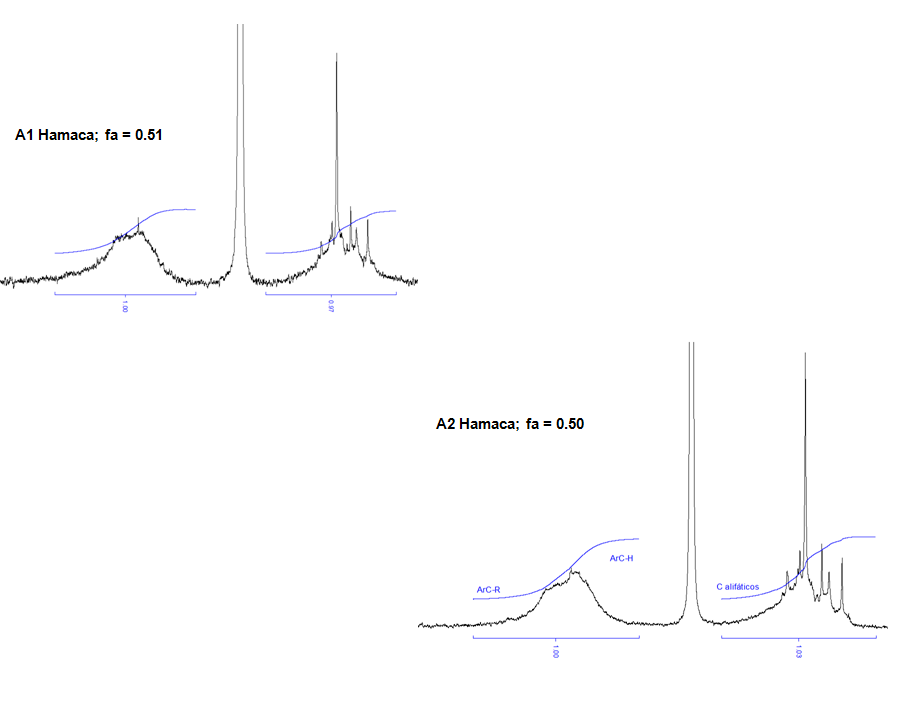
Figure 1: 13C NMR of fractions A1 and A2 corresponding to Hamaca asphaltenes registered in CD2 Cl2 at room conditions. Spectra were obtained in an apparatus as described earlier. As shown, aromaticity values fa, defined as area of aromatics over total area were close to 0.5 in both cases. A similar result (not shown) was found for asphaltenes. Spectra were measured in CD2 Cl2 using the reported conditions.
Sócrates Acevedo. Phase Separation of Asphaltene Dissolved in Toluene Leads to Nuclei Formation Promoted by the Very Low Solubility of Fraction A1. Soluble Fraction A2 Hinders Nuclei Flocculation. Pet Petro Chem Eng J 2017, 1(2): 000115.
Copyright© Sócrates Acevedo.
| M1 | M2 | |
|---|---|---|
| C | 42 | 42 |
| H | 43 | 47 |
| N | 1 | 1 |
| S | 1 | 1 |
| H/C | 1.024 | 1.119 |
| DBE | 22 | 20 |
| MM | 593.877 | 597.909 |
| fa | 50 | 50 |
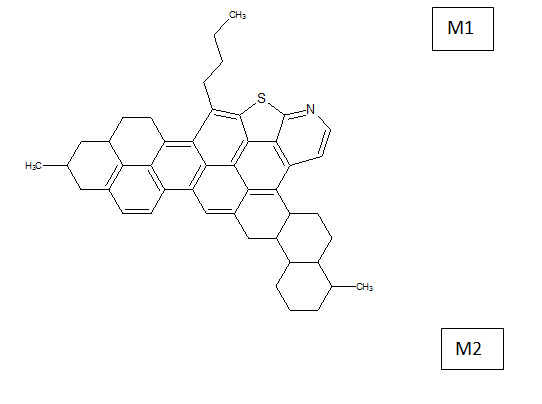
Table 2: Atom content, H/C, DBE and MM of Molecular Models A1 and A2.
a. Double bond equivalent:
$$ \mathrm {D B E} = \left(2 C + 2 + N - H\right) / 2 $$ Similarities between MM distributions and C NMR, combined with small differences in H/C suggest structural differences such as the one shown in Figure 2 for molecular models M1 and M2 where the two aliphatic rings in M1 were opened to build molecular model M2 [8, 12, 13]. These structures resemble other recently proposed [3].
Sócrates Acevedo. Phase Separation of Asphaltene Dissolved in Toluene Leads to Nuclei Formation Promoted by the Very Low Solubility of Fraction A1. Soluble Fraction A2 Hinders Nuclei Flocculation. Pet Petro Chem Eng J 2017, 1(2): 000115.
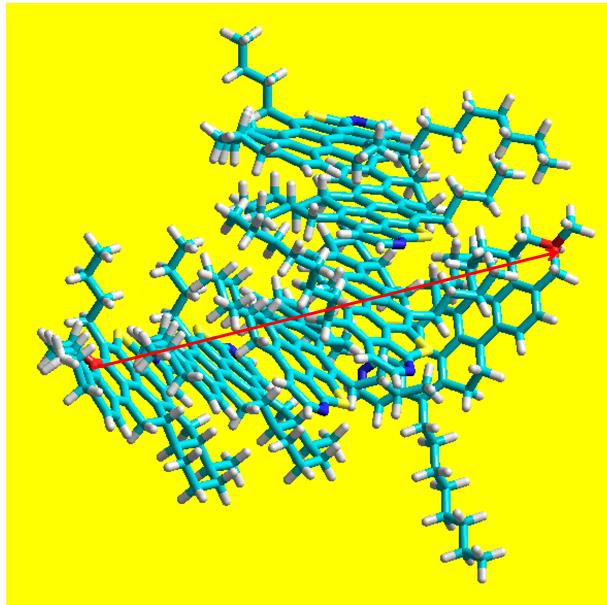
It is expected that when the above nuclei are formed in toluene, the long aliphatic open chains of M2 will hamper the approach of these nuclei to each other resulting in its dissolution or dispersion. It is well known that presence of long aliphatic open chains in asphaltene derivatives could increase solubility up to the point of making them soluble in n-heptane. Such is the case of asphaltenes alkylated with n-octyl alkyl groups [13]. Using Diffusion-Ordered Spectroscopy H Nuclear Magnetic Resonance (DOSY), Durand et al observed asphaltenes aggregates with radii close to 1.56 nm in toluene at very high dilution (about 100 mg L -1 [10] Similar values for the smallest particles (about 1.25 nm radii) were reported for asphaltenes dissolved in resins (3%) using the combined Transmission Electron Microscopy-Freeze Fracture technique [11]. Figure 3 illustrate an example of an asphaltene nuclei or nanoaggregate built with seven model molecules: four M1 and three M2 type. This was formed using the Molecular Mechanics package of HiperChem after geometrical optimization. As shown, with seven molecules distances between extremes afford values close to radii measure for particles.
Copyright© Sócrates Acevedo.
The above nuclei have been called nanoaggregates by Mullins and this was done without any consideration regarding phase separation [3]. I believe that the word nucleus conveys the idea of phase separation and hence I choose to use it in this work.
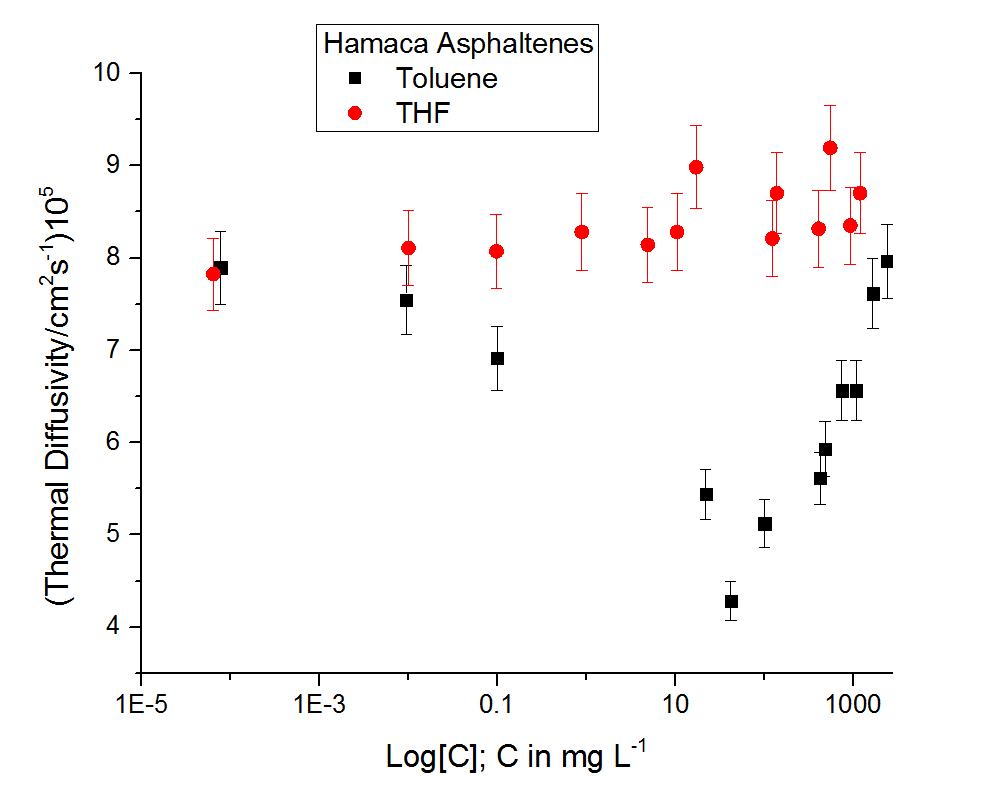
As reported earlier [1], measurements of thermal diffusivity D in toluene at room conditions show a minimum when plotted versus asphaltene concentration. This behavior was consistent with aggregate formation at concentrations close to 100 mg L -1. By contrast, no significant change in D was observed in THF using the same sample concentrations (see Figure 4). It is known that asphaltene form aggregates in THF at room conditions; for instance, number average molecular weight measurement afforded values close to 4000 g mol -
1, 12, much higher than the now accepted mean around 600 [3]. Thus data in Figure 4 is coherent with the PSD view in toluene and with step-wise aggregation in THF. The reason for this is that A1 fraction is soluble in THF, so no phase separation is expected in these diluted solutions. From the above it is evident that PSD behavior will occur in solvents where asphaltenes are soluble and A1 is not. Apart from toluene and other monoaromatics like xylene and cumene, the PSD behavior is expected for carbon tetrachloride, 1,2-dichloroethane, among others [9]. The above nuclei have been called nanoaggregates by Mullins and this was done without any consideration regarding phase separation [3]. I believe that the word nucleus conveys the idea of phase separation and hence I choose to use it in this work. We conclude by underling that nuclei or nanoaggregate formation is a consequence of phase separation promoted by A1 and dispersion promoted by A2.
References
-
Acevedo S, Ranaudo MA, Pereira JC, Castillo J, Fernández A, et al. (1999) Thermo-optical studies of asphaltene solutions: Evidence for solvent-solute aggregate formation. Fuel 78(9): 997-1003.
-
Andreatta G, Bostrom N, Mullins OC (2005) High-Q Ultrasonic Determination of the Critical Nanoaggregate Concentration of Asphaltenes and the Critical Micelle Concentration of Standard Surfactants. Langmiur 21(7): 2728-2736.
-
Mullins OC (2008) Review of the Molecular Structure and Aggregation of Asphaltenes and Petroleomics. Society of Petroleum Engineers 13(1): 48-57.
-
Dega-Szafran Z, Szafran M, Kreglewski M (1980) Aggregation of 4-Substituted Pyridine N-Oxide- Trifluoroacetates in Benzene. J Chem Soc Perkin Trans 2, 10: 1516-1519.
-
Hiemenz PC, Rajagopalan R (1997) Principles of Colloid and Surface Chemistry, Third Edition, Revised and Expanded. pp 386.
-
Gutiérrez LB, Ranaudo MA, Méndez B, Acevedo S (2001) Fractionation of asphaltene by complex formation with para–nitrophenol. A method for structural studies and stability of asphaltene colloids. Energy Fuels 15 (3): 624-628.
-
Acevedo S, Escobar O, Echevarría L, Gutierrez LB, Méndez B (2004) Structural Analysis of Soluble and Insoluble Fractions of Asphaltenes Isolated Using the PNP Method. Relation between Asphaltene Structure and Solubility. Energy & Fuels 18(2): 305-311.
-
Acevedo S, Cordero T, Josmelith M, Carrier H, Bouyssiere B, et al. (2009) Trapping of Paraffin and Other Compounds by Asphaltenes Detected by LDI TOF MS. Role of A1 and A2 Asphaltene Fractions in This Trapping. Energy Fuels 23 (2): 842-848.
-
Acevedo S, Castro A, Vásquez E, Marcano F, Ranaudo MA (2010) Investigation of Physical Chemistry Properties of Asphaltenes Using Solubility Parameters of Asphaltenes and Their Fractions A1 and A2. Energy Fuels 24(11): 5921-5933.
-
Durand E, Clemancey M, Lancelin JM, Verstraete J, Espinat D, et al. (2009) Aggregation States of Asphaltenes: Evidence of Two Chemical Behaviors by 1H Diffusion-Ordered Spectroscopy Nuclear Magnetic Resonance. J Phys Chem C 113(36): 16266-16276.
-
Acevedo S, García LA., Rodriguez P (2012) Changes of Diameter Distribution with Temperature Measured for Asphaltene and Their Fractions A1 and A2. Impact of These Measurements in Colloidal and Solubility Issues of Asphaltenes. Energy Fuels 26(3): 1814- 1819.
-
Acevedo S, Gutiérrez LB, Negrin JG, Pereira JC, Méndez B, et al. (2005) Molecular weight of petroleum asphaltenes: A comparison between mass spectrometry and vapor pressure osmometry. Energy & Fuels 19(4): 1548-1560.
-
Acevedo S, Escobar G, Aquino JA, Gutiérrez LB (1992) Synthesis and isolation of octylated asphaltenes standards for calibration of GPC columns and determination of asphaltenes molecular weights. Fuel 71: 1077-1079.
- Nigeria’s Vulnerability in the Face of Global Energy Policy
- A Simulation Study of Investigation of Optimum Oil Production Performance by Applying Various Gas Injection Methods in Oil Reservoir
- Characterization of Permo-Triassic Reservoirs through Thermal Maturity Assessment of Westphalian Source Rocks in the Cheshire Basin
- Influence of Microwax on the Rheological and Thermal Behaviour of a Wax Crude Oil
- Real-Time Monitoring and Performance Optimization of Steam Injection in Heavy Oil Reservoirs Using Fiber Optic Sensing and Integrated Predictive Simulation Models
- Rapid On-Site Determination of the Total Petroleum Hydrocarbon Content of Soils by Handheld Fourier Transform Near-Infrared Spectroscopy: Development of a Global, Site- and Scanner- Independent Calibration Model