
Types, Examples and Working Mechanism of Rheo-Improvers Lubricating Oil Additives
Lube oil additives play an important role to facilitate our daily life. And the most important one is Rheo-Improve lubricating oil additive, because it is performance enhancing additive it consists of two type viscosity index improvers and pour point depressants. This mini review highlights of Rheo-Improvers importance. Viscosity modifier (preparationof some examples, general properties, working mechanism and factors that limit their action). Pour point depressants (examples, general properties, working mechanism).
Introduction
The major role in the science is how to make life so easy and eco-friendly. Lubrication is a feature of how to live an easy life. Lubrication in simply form is the use of material to improve one surfaces over another by using lubricant. Lube oil additives are chemical components or blend used at a specific treat rate, generally from 1 to 35 % of the oil volume, depending on the machine to provide one or more functions in the fluid. Some additives impart specific property to the base oil or suppress undesirable base oil properties and finally others enhance existing base oil properties. Lubricant is additive with oil mixed together to give very good efficiency and save the metal from friction and wear. There are many type of additives and today we will take about an important one (Rheo- improvers).
According to new classification of lubricating oil additives which depending on the working function the additives classify into 3 major category:
- Rheo- improvers
- Maintainers
- Tribo-improvers
Rheo-Improvers (Rheological Properties Improvers)
Rheo-Improvers are responsible for fluidity of base oil. They contribute mainly under hydrodynamic conditions to the lubrication performance by changing or modifying the bulk properties of the liquid. They are lubricating performance additives. Rheological Properties Improvers could be categorized as tribo-improvers “indirect” between regimes of hydrodynamic and mixed lubrication [1].
Viscosity Modifier
The most important property of the oil is viscosity. Formerly, viscosity modifier (VM) which can called also viscosity index improvers (VII) that reduce the rate of viscosity change with temperature. It is one of the Examples [10]:
performance additives engine lubricants. The bulk properties are dependent on the structure of the base fluids [1]. Structural features of VM are polymers and copolymers [2, 3, 4, 5, 6, 7, 8, 9].
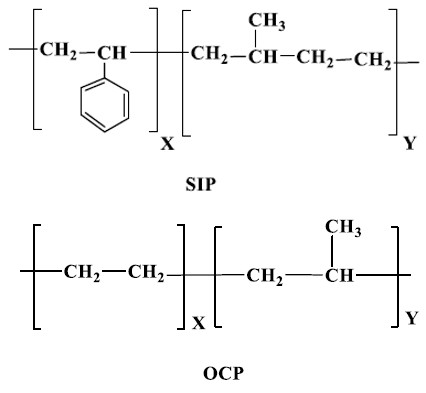
| Some Examples of Viscosity Modifiers | Chemical Structure |
| SIP: styrene-co- isoprene | |
| OCP: olefin copolymers and the major classes are poly alkyl methacrylate and poly isobutylenes. | |
$$ \left| \mathrm {C H} _ {3} \right| $$
$$ \mathrm {C H} _ {2} $$
$$ \mathbf {C} $$ $$ \text {P o l y a l k y m e t h a c y l a t e} $$
$$ \mathrm {C H} _ {3} $$
$$ \mathrm {C H} _ {2} $$
$$ \mathbf {C} $$ $$ \mathrm {C H} _ {3} $$
$$ [ 0 ] $$ Rasha S Kamal. Types, Examples and Working Mechanism of Rheo-Improvers Lubricating Oil Additives. Pet Petro Chem Eng J 2018, 2(2): 000162.
PMA : polymethacrylates preparation
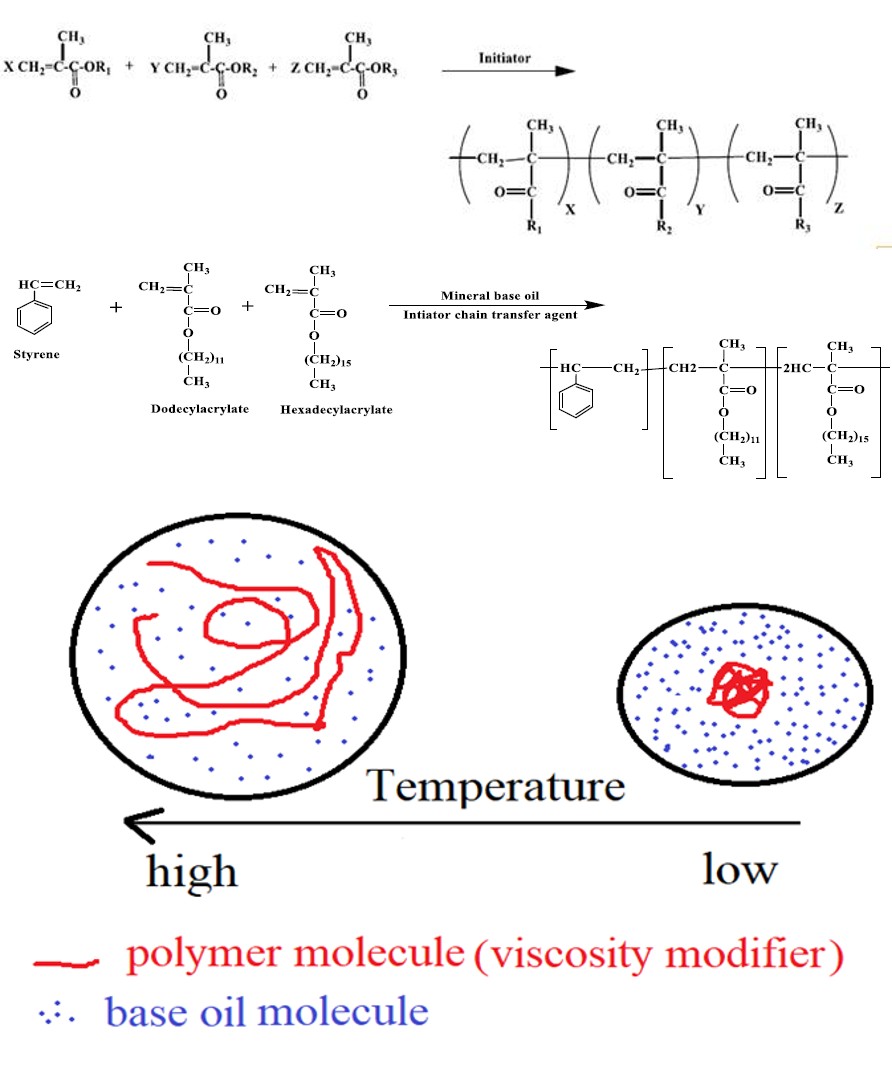
SPE: Styrene Poly Ester
Mechanism of Viscosity Index Improver: Polymers molecules expands as the temperature is raised, due to the
polymer so to make degradation need trace of peroxides catalyst not affect by temperature); 3. Compatibility with other additives present in the oil [10] Factors that Limit the Action of Viscosity Modifiers
- Nature of the base oil (chemical structure of base oil);
- Concentration of the additive (an optimum concentration);
Rasha S Kamal. Types, Examples and Working Mechanism of Rheo-Improvers Lubricating Oil Additives. Pet Petro Chem Eng J 2018, 2(2): 000162.
3. Molecular weight of the additive (increase the molecular weight increase the efficiency as viscosity modifier until limited weight); 4. Polymer composition (effect of the substituted radical, R); 5. Pressure (due to relationship between the pressure and temperature) [10, 2]. Pour Point Depressants Pour point depressant is one of the performance additives engine lubricants [10]. The pour point is defined as enable lubricant to flow at low temperatures. The pour of an oil has been considered for a long time as the principal properties affecting the cold starting of an engine. At very low temperature the oil freeze (oil cannot pour or flow) that causes damage to the machine elements and although uses the pre-heating system but loose time and energy [1]. The reason of pour less is after refining and get lubricating oil there are fine wax crystals in the mineral oil which accumulate together under low temperature and make a lattice interlocking network which absorb the oil and prevent its pour or flow, so here appear the important of pour point depressant [15, 16, 17, 18, 19, 20, 21, 22, 23, 24].
Structural features of pour point depressant (PPD) are polymers can be used to interfere with wax crystal growth and alter the formation of the interlocking network for examples: Examples Polymethacrylates at Concentration of 0.1 to 0.5%
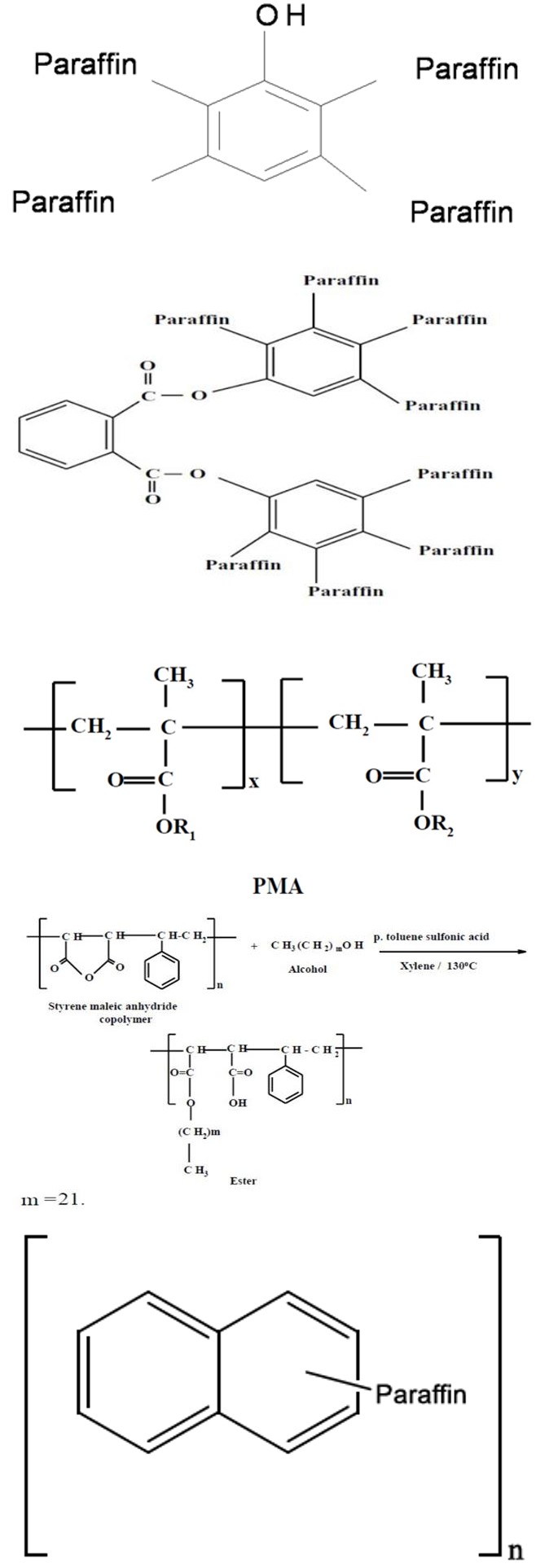
Alkylated wax naphthalene
Long Chain Alkyl Phenols (Tetra Paraffin Phenol)[10]
Di (Tetra Paraffin Phenol) Phthalate
Esterification of Styrene-Maleic Anhydride Copolymer as Pour Point Depressant
This copolymer by using docosanol as an alcohol and in concentration 0.0625% give very good result as pour point depressant ≥ -24 [10, 14].
Rasha S Kamal. Types, Examples and Working Mechanism of Rheo-Improvers Lubricating Oil Additives. Pet Petro Chem Eng J 2018, 2(2): 000162.
Mechanism of Pour Point Depressant
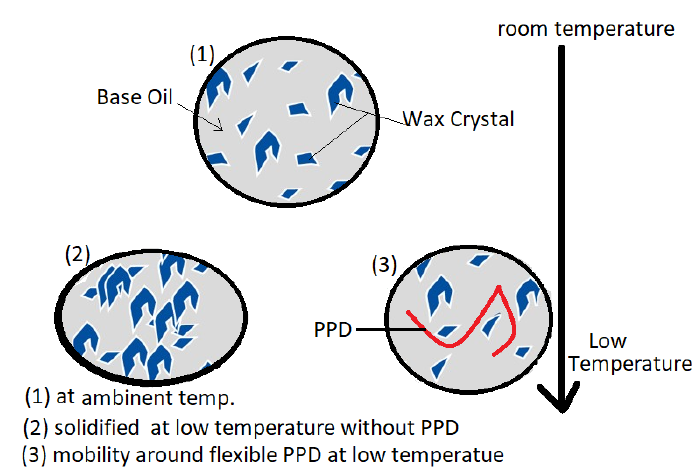
When oil subjected to very low temperatures (freeze) may undergo changes in their physical properties:- 1. Solidification but without precipitation of a solid phase; 2. Solidification with precipitation of a solid phase [25, 26, 27]. This solid phase may be according to size divided to a) Macrocrystals of paraffins which cause total solidification of oil. b) Microcrystals of wax which swell, forming a crystalline structure trapping a significant volume of oil [10, 14], so pour point depressant mechanism in simply way it means modify wax crystal formation to reduce interlocking at low temperatures and increase mobility of wax crystal around the flexible pour point depressants allowing the oil to continue to flow by adsorbed this type of additives on the wax crystals and inhibit the growth of a lattice interlocking network [1, 13, 15].
References
-
Ichiro Minami (2017) Molecular Science of Lubricant Additives. Appl Sci 7(445): 1-33.
-
Alphonse S (1968) Motor Oils and Engine Lubrication. 2nd (Edn.).
-
Abdel-Azim A, Abdel-Azim, Malcolm B Huglin (1983) Viscometric behaviour of polystyrene in tetralin/cyclohexane mixtures. Polymer 24: 1429- 1433.
-
Bair S, Qureshi F (2003) The high pressure rheology of polymer-oil solutions. Tribology International 36(8): 637-645.
-
Pawlak Z (2003) Tribochemistry of Lubricating Oils. 1st (Edn.), Elsevier, UK, 45: 382..
-
Pedersen KS, Ronningsen HP (2003) Influence of Wax Inhibitors on Wax Appearance Temperature, Pour Point, and Viscosity of Waxy Crude Oils. Energy Fuels 17: 321-328.
-
Santos JCO, Santos IMG, Souza AG, Sobrinho EV, Fernandes VJ, et al. (2004) Thermoanalytical and rheological characterization of automotive mineral lubricants after thermal degradation. Fuel 83(17- 18): 2393-2399.
-
Souza MSM (2000) Quime Deriv 382: 20.
-
Noria Corporation (2017) Lubricant Additives-A Practical Guide. Machinery Lubrication.
-
Kamal RS, Ahmed NS, Nasser AM (2017) Synthesis and Evaluation of Multifunctional Lube Oil Additives. Omniscriptum & Co.Kg, Noor Publishing.
-
Nasser AM, Ahmed NS, Kamal RS (2011) Preparation and Evaluation of Some Terpolymers As Lube Oil Additives. Journal of Dispersion Science And Technology 32(4): 616-621.
-
Mohamad SA, Ahmed NS, Hassanein SM, Rashad AM (2012) Investigation of polyacrylates copolymers as lube oil viscosity index improvers. Journal of Petroleum Science and Engineering 100: 173-177.
-
Amal Nassar, Ahmed NS (2003) Synthesis and Evaluation of Ethoxylated Polyesters as Viscosity Index Improvers and Pour Point Depressants for Lube Oil. International Journal of Polymeric Materials and Polymeric Biomaterials 52(9): 821- 832.
-
Abdel Azim AAA, Nassar AM, Ahmed NS, El Kafrawy AF, Kamal RS (2009) Multifunctional Additives Viscosity Index Improvers Pour Point Depressants and Dispersants for Lube oil. Petroleum Science and Technology 27(1): 20-32.
-
Ahmed NS. Nassar AM, Nasser RM, Khattab AF, Abdel Azim AAA (2008) Synthesis and Evaluation of Some Polymeric Compounds as Pour Point Rasha S Kamal. Types, Examples and Working Mechanism of Rheo-Improvers Lubricating Oil Additives. Pet Petro Chem Eng J 2018, 2(2): 000162. Depressants and Viscosity Index Improvers for Lube Oil. Petroleum Science and Technology 26(12): 1390-1402.
-
Machado ALC, Lucas EF, Gonzalez G (2001) Poly (ethylene-co-vinyl acetate) (EVA) as wax inhibitor of a Brazilian crude oil: oil viscosity, pour point and phase behavior of organic solutions. J of Petroleum Science and Engineering 32(2-4): 159-165.
-
Zhang J, Wu C, Li W, Wang Y, Cao H (2004) DFT and MM calculation: the performance mechanism of pour point depressants study Fuel 83(3): 315-326.
-
Zhang J, Wu C, Li W, Wu N (2005) Molecular dynamics simulation guiding the improvement of EVA-type pour point depressant Fuel 84(16): 2039- 2047.
-
Song Y, Ren T, Fu X, Xu X (2005) Study on the relationship between the structure and activities of alkyl methacrylate–maleic anhydride polymers as cold flow improvers in diesel fuels. Fuel Processing Technology 86(6): 641-650.
-
Hipeaux JC, Born M, Durand JP, Claudy P, Lètoffè JM (2000) Physico-chemical characterization of base stocks and thermal analysis by differential scanning calorimetry and thermomicroscopy at low temperature Thermochimica Acta 348(1-2): 147- 159.
-
Xuhong G, Brian AP, John SH, Robert KP (2004) Crystallization of Long-Chain n-Paraffins from Solutions and Melts As Observed by Differential Scanning Calorimetry. Macromolecules 37(15): 5638–5645.
-
Zhang J, Wu C, Li W, Wang Y, Han Z (2003) Study on performance mechanism of pour point depressants with differential scanning calorimeter and X-ray diffraction methods. Fuel 82(11): 1419-1426.
-
Coutinho JAP, Cauphin C, Daridon JL (2000) Measurements and modelling of wax formation in diesel fuels. Fuel 79(6): 607-616.
-
Zuo JY, Zhang DD, Ng HJ (2001) An improved thermodynamic model for wax precipitation from petroleum fluids. Chem Engng Sci 56(24): 6941- 6947.
-
Jukić A, Tomašek LJ, Janović Z (2005) Polyolefin and poly(alkyl methacrylate) mixed additives as mineral lubricating oil rheology modifiers. Lubr Sci 17(4): 431-449.
-
Queimada AJN, Dauphin C, Marrucho IM, Coutinho JAP (2001) Low temperature behaviour of refined products from DSC measurements and their thermodynamical modelling. Thermochim Acta 372(1-2): 93-101.
-
MiranteJoão FIC, Coutinho JAP (2001) Cloud point prediction of fuels and fuel blends. Fluid Phase Equilib 180(1-2): 247-255. Rasha S Kamal. Types, Examples and Working Mechanism of Rheo-Improvers Lubricating Oil Additives. Pet Petro Chem Eng J 2018, 2(2): 000162.
- Nigeria’s Vulnerability in the Face of Global Energy Policy
- A Simulation Study of Investigation of Optimum Oil Production Performance by Applying Various Gas Injection Methods in Oil Reservoir
- Characterization of Permo-Triassic Reservoirs through Thermal Maturity Assessment of Westphalian Source Rocks in the Cheshire Basin
- Influence of Microwax on the Rheological and Thermal Behaviour of a Wax Crude Oil
- Real-Time Monitoring and Performance Optimization of Steam Injection in Heavy Oil Reservoirs Using Fiber Optic Sensing and Integrated Predictive Simulation Models
- Rapid On-Site Determination of the Total Petroleum Hydrocarbon Content of Soils by Handheld Fourier Transform Near-Infrared Spectroscopy: Development of a Global, Site- and Scanner- Independent Calibration Model