
Reagent on Oil Basis to Increase Oil Recovery and Isolation of Water Breakthrough into Oil Producing Wells
The issue of selective isolation of water inflow into oil producing wells is considered in the article. For this purpose, an oil-based composition was developed for selective isolation of water from the formation to producing wells. The composition, in addition to oil, also contains alcohols (lower alcohols: methyl, ethyl, butyl, propyl, etc.), and an oxidizing agent. Components of the ingredients are met in the bottomhole zone of the well where a chemical reaction occurs, resulting in a paste-like substance. This substance blocks both water and oil channels. However, this substance does not dissolve in water, but it dissolves well in oil. This property gives an ability to the composition to isolate water selectively. Thus, the plugged water channels prevent the flow of water into the well, while part of the composition which clogging the oil channels dissolves into the oil, releases the oil channels and provides the flow of oil from the formation into the well.
Introduction
It is known that majority of oil fields are developed either on natural mode, or on the mode of artificial maintenance of formation pressure at the expense of contour or in-contour flooding. The consequence of this is the watering of reservoirs and oil producing wells. Injection into the water leg as working agents, as a rule accelerates the pace of watering. The nature of watering is influenced by many factors, such as geological structure (level of heterogeneity) and reservoir properties (permeability of layers), physical and chemical properties of reservoir fluids (viscosity etc.), development mode, exploiting methods, etc.
The presence of zones of different permeability in the productive reservoir (multi-layering), the sharp change of viscosity in formation fluids at a water-drive mode lead to water breakthrough of high permeable layers of an environment and partial or complete disconnection from medium and low permeable intervals. Especially, the fast water breakthrough occurs in interlayers with viscous oils. At artificial water drive regime water finding its way from injectors to the producers through the high permeability interlayers. In this case, it floods not only the producers, but also decreases the coverage of the reservoir by injected water and it leads to the oil beaning bypassed. Therefore, various methods and reagents for the isolation of formation waters to producers are applied.
Dynamics of watering wells usually has its characteristics. So, first, water cut appears in the producing of wells, and then a constant increase in the water content occurs. Then the water cut is stabilized somewhat. In the next period water cut grows. In this case, the transition from one state to another occurs sporadically. In [1], a similar mechanism of watering is explained by the formation of microchannels and their expansion in the initial period. During the stabilization period, the microchannel floods do not change in cross- section or change insignificantly. The increase in water breakthrough corresponds to a dramatic expansion of the ways of water inflow or to the connection of other watered interlayers. The water breakthrough of the wells is also strongly influenced by the thickness of the reservoir [2]. Here it should be noted that the non- uniformity of the water cut in the formation and well production is also significantly influenced by the micro heterogeneity of a relatively homogeneous reservoir, often aggravated by an increase in pump capacity. As a result, the downhole pressure of wells decreases. This leads to an increase in water cut in well production, which indicates an increase in the size of water supply channels.
From the given example it is visible, that sources of water and character of watering layers and production of wells are various. So, as prematurely flooded interlayers and zones, which may be a consequence not only of the zonal or layered heterogeneity of productive strata, but also the presence of a window between productive and water bearing layers [3]. The extraction of associated water requires large resources and appropriate technological techniques. In most cases it is more advantageous to prevent watering of well production, to isolate or limit the flow of water into oil wells. The main purpose of water-insulating works in the oil well is blockage of water inflows while maintaining the permeability of the net part of the reservoir. Thus, all works related to the limitation of the influxes should not significantly affect the oil saturated parts of the reservoir.
Obviously, the use of selective materials that reduce the phase permeability for water with constant phase permeability for oil is the most advantageous. Therefore, the practice of limiting the flow of water to producing wells uses various technological methods and materials. In the isolation of base water, the method of squeezing the insulating material into the formation is mainly used to create a screen. For this purpose, degassed high-viscosity oil, oil-masut mixture, hydrophobic emulsion, foaming agent from oil, ammonium hydroxide, etc. are used. As the theoretical calculations show, in a homogeneous formation screens in a water-oil zone with a radius of 5- 10 m limit the inflow of waters not more than on 2-3 month at average modes of fluid production. Analysis of the results of water isolation with oil-cement slurries showed that its efficiency is 31% [1]. As seen efficiency is not high. It is also the case with other materials with the addition of cement. In this regard, the search for new insulating materials is underway, which has high filtration properties.
Selective isolation of the influxes is given a great attention to simplify the work technology and improve their efficiency. To achieve this goal, it is expedient to use materials with selective properties concerning oil and formation waters. It is obvious, that such materials should be used which in channels occupied by water, will form clogging and rather persistent masses, and in oil saturated parts blockage or not occur at all, or they will be dissolving in oil, to be carried out. Such materials can serve as well-filtered, already prepared materials which injected into the layer. For instance, the method of isolation of formation waters with use of heavy oil [4]. It is true that, such method gives positive results in some fields. However, water insolation with such methods has shorter life and ineffective and in the fields with overpressure it is impossible to achieve the goal at all. Because, this ingredient pasty and it has no hardness. For this reason, it moves back from the formation to the well due to high formation pressure.
Another known way of isolation in the composition of water-oil emulsion where takes a place demulgator [5]. However, a component is absent in the composition that can consolidate in the reservoir condition. Therefore, the reverse flow of composition from formation into the wellbore is unavoidable, and the result of effective processing time will be minimal. Another way of insulation of formation waters is used clay, polymers and water [6], where, in the composition as a polymer, goes 5% aqueous solution acrylic-nitrile-SBS styrene copolymer and cement. The presence of clay in the insulating composition leads to the fact that when clay meets with water, it can swell, and block the pores of the formation. However, this property of clay occurs even during the preparation of the composition on the ground, and re-swelling of the clay in pores of formation loses its meaning. On the other hand, the combination of water and cement is likely to cause complications in the operating pipeline even before it is put into the well, other way around, such composition can block oil bearing pores.
In other work, for isolation of water breakthrough, after injection of elastic composition – where the basis is polyacrylamide, to prevent of a reverse flow into the wellbore, it is necessary to inject a cement solution [7].
Several reagents are known to isolate water inflows into oil wells. However, not all of them meet the requirements of such materials. The special literature [8, 9, 10] is known a large number of materials for selective isolation of the water inflows. For this purpose it is offered wide use of polymeric materials such as water dispersions of latex naphtha-soap, copolymers of acrylic and polyacrylic acids, etc. They in contact with mineralized formation water containing ions of semi- valent metals, precipitate and form a shield on the way of water inflows and retain their original physical properties in the oil environment [11, 12].
There are materials for which formation water is a reagent to form a clogging mass. Materials such as solutions of salts ferric iron, water-soluble sodium salts carboxymethyl-cellulose, etc. owns such properties. The desired results can be achieved also by injection into watered layers of two reagents, which not reacting to oil. Getting into the water-saturated zone, they react with each other and form water insoluble products that block the water-supply channels of the formation [9]. The work [13] provides a way to isolate water inflows from fractured layers to producing wells, where the commercial oil, cement and clay go into the composition. It is known that fractured reservoirs have their own specific characteristics. Therefore, the technologies which give positive results in layers, even with high permeability, can show ineffective result at application in fractured layers.
At a comparatively large number of developments on selective isolation of formation waters they cannot take into account all variety of physico -geological and physico- chemical conditions at which it is necessary to conduct insulating works. With the purpose of isolation of water breakthrough in oil producing wells watered oil bearing layers, sublayers, zones and regulation of the displacement process of oil through injection wells is widely used various chemical reagents and their compounds. One of such composites (oxidants of organic substances, including oil) is chromium anhydride.
Chromium anhydride or trioxide chromium Cr2O (chromium with 6 Valens connection) is a crystal by nature. Its oxidative properties are revealed in the presence of water. It is easily dissolved in any water (distilled, tap, marine, formation, etc.) with the transition of chromium (H2CrO4) or dual-chromium (H2Cr2O7) acid [14]. Aqueous solution of chromium anhydride chances into a 3 Valens connection by oxidizing of organic matter (Cr2O3). This is an exothermic process.
Oxidation of the lower alcohols (e.g. methyl) by chromium acid happens with the release of heat [7]:
3CH3O3 + 2CrO3 + 2H2O = 3CH2O +
Cr2O3 + 5H2O + 105,71 Kkal Methyl spirit Chromium acid Ant
aldehyde Chrome oxide
As a result of oxidative reaction of methyl spirit with chromium acid the chromium oxide, ant aldehyde and water are obtained. Chromium oxide-a solid substance does not dissolve in the water. The amount of heat at oxidation of alcohol by chromium acid is defined theoretically on the basis of the law Hess [15]. Numerous experiments on oxidation of oil with chromium acid have shown that not all oil is exposed to oxidation. Oils with a density of 0.900 g/cm3 and above are getting well oxidized. For example, the light oil of Surakhany field with the density of 0.840 g/sm3 is not oxidized with chromium acid under any circumstances. Oil of Kala field with the density 0.901 g/sm3 is getting partially oxidized with the 50% concentration of chromium acid. The oxidative process of oil is associated with the composition of oil. As it is known, naphthenic acids, mercaptans, mono and Disulfides, Tiofeny, Tiofany are components of oil [16]. These organic substances have good oxidation ability. Their density varies within the range of 0.950 – 1.064 g/sm3. As increases their percentage in the structure, density of oil increases too. Apparently, oils with density 0.900 g/sm3 and above contain enough organic matter to occur oxidation entirely. Asphaltenes and waxes which are the components of oil are the natural oxidation products.
In the process of oxidation, the oil becomes gelled. Its gelled condition depends on the concentration of chromium acid. With increasing concentration and amount of chromium acid, oil changes into gelled, pasty or solid state. Numerous laboratory studies have been carried out to determine the composition which based on chromium anhydride and oil. In order to select the optimal solution of the composition were tested oil from the fields of Bibi-Heybat with density of 0.910 g/sm3, Mishovdag with density 0.905 g/cm3, Kurovdag with density 0.922 g/cm3 and Palchig Pylpylesi with density 0.906 g/cm3, methyl spirit, chromium anhydride and water.
Experimental Methods
If oil oxidation is carried out without the presence of alcohol, the standard volume of oil (100 sm3) is poured into the glass. Then it is added a pre-prepared aqueous solution of chromium anhydride with the certain concentration on top of it. These mixes are stirred intensively in a glass for 3 minutes. Oil-alcohol emulsion is prepared in advance, when alcohol is involved in the oxidative process. Preparation of oil-alcohol emulsion is carried out by intensive mixing of oil and alcohol. Oil- alcohol emulsion is considered ready in the case when the separation of oil and alcohol occurs in 10 minutes after the stop of their mixing. Thus, it is experimentally found that after mixing within 20 minutes, the obtained oil- alcohol emulsion can be considered ready to the work. Then, the aqueous solution of chromium anhydride is added to the oil-alcohol emulsion. During the oxidation process of oil, the maximum reaction temperature changes.
The experiments on the choice of composition of solution were carried out in two parts. In the first part, it is involved oil and aqueous solution of chromium anhydride into the oxidation process, and in the second part it is added alcohol to this substance. Results of experiments carried out with oil of Bibi-Heybat field with density of 0.910 g/sm3, are given in the following table. At rows 1to 9 in the table is the result of the first part of experiments, and the rows 10 to 20 are the records when the alcohol is involved into the reaction.
The table shows that with the increase of aqueous solution of chromium anhydride oil getting oxidized and changes into the pasty state (rows 1-5). The maximum temperature of the oxidizing process also grows (column 8). In this case, with the increase in the concentration of chromium anhydride from 15% to 50%, the temperature increased from 42°C to 76°C. These experiments show that in all cases after the oxidative process is formed free water. With the increase of concentration of a solution, the quantity of the allocated free water decreases (column 9). For example, with a concentration of chromium anhydride solution of 15%, the amount of free water was equal to 65 sm3 (column 1), when the oil changes into the pasty state the amount of free water became 25 sm3. So-as the allocated free water after the oxidative process will occupy a part of the pores of the formation, then these pores will be potential ways of water penetration into the well after the carried-out water isolation works. Therefore, the developed new composition should be in such concentration that, even after the oxidative process free water was not been allocated.
With increasing the concentration of aqueous solution of chromium anhydride also increases the time of oxidative process (column 10). Within the experiments, the duration of the oxidative process increases from 15 to 75 minutes.
Results
The results of the second part of experiments show that when a certain amount of alcohol is added into the developed composition, the maximum temperature of the oxidative reaction becomes on 30-38 C with more than in its absence (comparison of columns 1-8 and 10-19). The presence of high temperature at oxidation of oil helps to push the insulating material deeper into the formation, thereby increasing the length of insulated channels in the porous medium. The presence of alcohol in the composition leads to the fact that at the end of the oxidative process there is no free water is allocated, and the duration of the oxidative process decreases by 5 times (column 4, 5 and 18).
It can be seen from the Table 1 that when there is no alcohol in composition, obtaining of homogeneous pasty state of oil after oxidative process depends also on the method of oil oxidation process. It is obtained pasty mass if to add 57.5 g oil into the chromium anhydride in the form of 50% solution and intensively mix them, otherwise, Under the same conditions without mixing parts of the composition not all oil participates in the oxidative process (row 5 and 9), but, with the presence of alcohol in the composition, the oxidizing process of oil occurs evenly and throughout the entire volume of the mixture. This is very important in the creation of the new technology of impact on layers developed by the new composition.
Comparison of results of experiments (row 5 and 8) shows, that consumption of chromium anhydride increases by 15% if try to get pasty condition of oil after oxidative process without alcohol. The Oxidized oil which was gained by proposed method was tested for solubility in oil and water. To ascertain the solubility, the product of oxidation is placed into the glass and is filled with oil and water. The filled specimens are left alone for 3-4 days. At the end of this period it became clear that the samples filled with oil was completely dissolved in it. of watered layers, but also for selective isolation of waters to oil wells.
| № | Oil, sм3 | Chromium anhydride | Methyl spirit, sм3(%) | Oil oxidation method | r T | Max. | n r | Free water sм3 | Oxidation time, minute. | Results | ||||||
|---|---|---|---|---|---|---|---|---|---|---|---|---|---|---|---|---|
| Weight, g | C | oncentratio | n | Volume of solution, sм3 | eactio | |||||||||||
| of aqueous | empe | |||||||||||||||
| solution | ature, | |||||||||||||||
| % | oC | |||||||||||||||
| 1 | 2 | 3 | 4 | 5 | 6 | 7 | 8 | 9 | 10 | 11 | ||||||
| 1 | 100 | 15 | 15 | 90 | - | Intensive mixing | 42 | 65 | 15 | Some thickening of oil | ||||||
| 2 | 100 | 30 | 30 | 80 | - | -----“----- | 56 | 52 | 20 | ------------------------“--- ------------------- | ||||||
| 3 | 100 | 40 | 40 | 70 | - | -----“----- | 72 | 36 | 24 | Thickening of oil | ||||||
| 4 | 100 | 50 | 50 | 66 | - | -----“----- | 75 | 22 | 45 | A tangible thickening of oil, flows | ||||||
| 5 | 100 | 57,5 | 50 | 76 | - | -----“----- | 76 | 25 | 50 | Oil get paste, does not flow. | ||||||
| 6 | 100 | 15 | 50 | 20 | - | -----“----- | - | 4 | 34 | Some thickening of oil | ||||||
| 7 | 100 | 45 | 50 | 60 | - | -----“----- | - | 14 | 60 | Thickening of oil | ||||||
| 8 | 100 | 45 | 50 | 60 | - | -----“----- | - | 20 | 65 | A tangible thickening of oil, flows | ||||||
| 9 | 100 | 57,5 | 50 | 76 | - | Without mixing oil and solution | 67 | 20 | 75 | Partial thickening of oil, pasty globules, with stirring formed a flowing mass | ||||||
| 10 | 100 | 15 | 50 | 20 | 11(10) | Intensive mixing | 72 | - | 6 | Thickening of oil | ||||||
| 11 | 100 | 15 | 50 | 20 | 25(20) | -----“----- | - | - | 8 | ---------------------------- “------------------ | ||||||
| 12 | 100 | 15 | 50 | 20 | 43(30) | -----“----- | 85 | - | 8 | ---------------------------- “------------------ | ||||||
| 13 | 100 | 30 | 50 | 40 | 11(10) | -----“----- | 100 | - | 7 | A tangible thickening of oil, flows | ||||||
| 14 | 100 | 30 | 50 | 40 | 25(20) | -----“----- | - | - | - 8 | ---------------------«----- ------------------- | ||||||
| 15 | 100 | 30 | 50 | 40 | 43(30) | -----“----- | - | - | - 8 | ---------------------«----- ---------------- | ||||||
| 16 | 100 | 50 | 50 | 66 | 11(10) | -----“----- | 101 | - | 9 | Close to pasty state | ||||||
| 17 | 100 | 50 | 50 | 66 | 25(20) | -----“----- | 103 | - | - 10 | ----------------------«---- ------------------- | ||||||
| 18 | 100 | 50 | 50 | 66 | 43(30) | -----“----- | 105 | - | 10 | Oil got a pasty state, does not flow | ||||||
| 19 | 100 | 50 | 50 | 66 | 43(30) | without mixing | 105 | - | - 10 | -----------------------«--- ------------------- | ||||||
| 20 | 100 | 60 | 50 | 80 | 43(30) | -----“----- | 107 | - | 15 | Pasty state, partially hardened |
Table 1: results of experiments oil-alcohol emulsion and aqueous solution of chromium anhydride.
emulsion with the content of 25-30% alcohol; the second part - 50% aqueous solution of chromium anhydride. For oxidation of 100 sm3 of oil, it is necessary to add to it 34- 43 sm3 of spirit and to gain emulsion it still needs to add 66 sm3 50% of aqueous solution of chromium anhydride. Because of oxidative reaction, the initial quantity of oil changes into homogeneous pasty condition which can be applied for selective isolation of influxes. With this aim, a series of experiments has been carried out which is presented below. To detect the effectiveness of waterproofing works in porous media using the developed composition, a special experimental installation was assembled, the scheme of which is presented in Figures 1 & 2. The installation consists of the following main parts: the cylinder is compressed to 120 MPA with air (1), and pressure regulator (2), the feeding tanks (3, 4, and 5) to serve fluids in the porous medium and the reservoir model (6). In tank 3 there is water intended for filtration in a porous environment or for displacement of oil from it. In tanks 4 and 5 there is a water solution of chromium anhydride and oil-alcohol emulsion respectively.
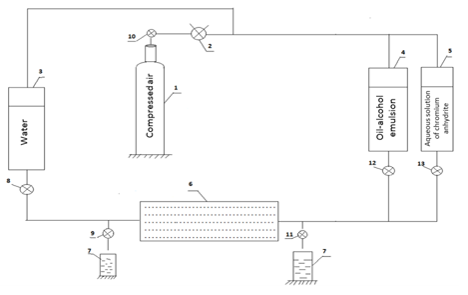
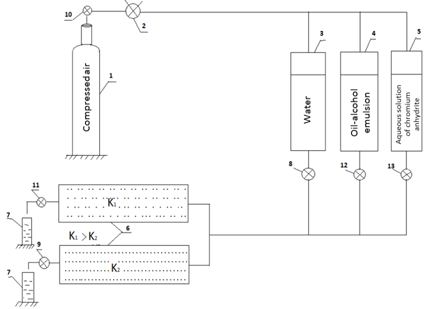
Differently connected feeding tanks allow simulating an aquifer and influx to the reservoir model (Figure 1) and a case when there is no direct hydrodynamic connection with the layered oil bearing zone (Figure 2). In the first case the porous medium can be considered as the bottomhole zone of the oil producing well near the aquifer or the flooded formation, and in the second case oil moved by support of water. According to the collected schemes experiments were conducted in two series. The first series of experiments explored the possibility of isolating water obtained compositions. The porous medium is made of quartz sand in a column of plexiglass with a length of 1m. The transparency of the model allows visually observing the boundary of penetration of the waterproof material along the model length. After the preparation of the porous medium it gets saturated with water under the impact of vacuum. The water-saturated model is connected to the experimental installation (Figure 1). When the rest is closed, valves 8, 10 and 11 are opened and the permeability of the porous medium is measured. The permeability of the porous medium was 19 Darcy. The choice of a porous medium with high permeability for the test of the developed composition is justified by the fact that the possibility of clogging a highly permeable reservoir, provides for the same effect in tight collectors.
Then in the output area of the model, which corresponds to the producing well, consistently injected parts of the developed composition. The first is pumped oil-alcohol emulsion from capacity 5 in quantity 86 sm3. Oil-alcohol emulsion is prepared from the oil of Bibi- Heybat field with density 0.910 g/sm3 and methanol. The water released from the porous medium is measured in pitcher 7. The volume of the released water corresponds to the volume of re-injected into the porous environment of the composition. Then at open valves 10, 12 and 9 it is pumped into the porous environment 40 sm3 - 50% of aqueous solution of chromium anhydride. The volumes of pumpable in a porous environment of parts correspond to the defined proportions (Table 1, row 18) at which oil getting oxidized passes in the pasty state. The total volume of injected material into the porous medium is 65% of pore volume. Visual observations showed that the composition injected in the porous medium penetrates the length of the model by 70 sm. After the process of injection into the porous environment at the open valve 9, the porous medium is left alone for 48 hours. This time is sufficient for full oxidation of the oil in the porous environment.
By the end of the rest time the boundary of the injected material’s length in the composition has advanced by another 10 sm. This happened due to the exothermic oxidative process in the porous environment. After the waterproofing works the permeability of the porous medium was again measured. To the pressure drop of 2.5 atm. Water filtration and ∆p=2.88atm. permeability was 0.0077 Darcy. Comparison of the results of filtration speed measurements of water before and after insulating works show that to resume water movement it is necessary to increase pressure 28.8 times. The filtration speed decreases by 155 times. This series of experiments under the above conditions are repeated for a porous medium with a permeability of 4 Darcy too. The results of these experiments proved to be a corresponding experiment with a porous environment of 19 Darcy permeability.
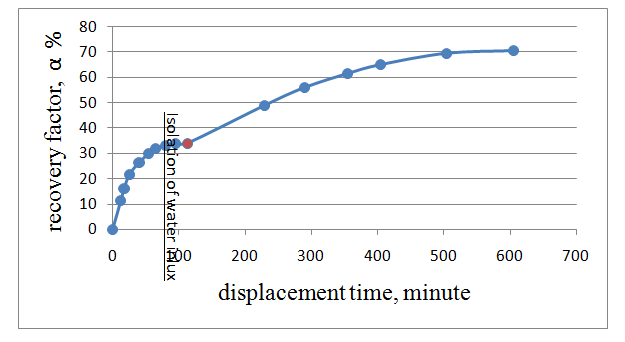
In the second series of experiments, the possibility of increasing the coverage to the thickness of the heterogeneous oil layer displacing by the agent with the help of the developed composition was investigated. For this purpose, in the experimental installation two models with different permeabilities are connected in parallel (Figure 2). This scheme simulates a hydrodynamic unrelated layered formation. The permeability of the layers equals 19 and 1 Darcy. In studies, the associated water was not modelled. Preliminary both models under vacuum fed oil by viscosity 15 sp. Then both oil saturated models are connected to the installation diagram. At open valves 10, 8, 9 and 11, oil is displaced from a formation by water from capacity 3. Displacement was carried out at pressure of 0.5 atm. Oil displaced from porous media measured separately in beakers 7. The process of displacement of oil has shown, process happens only in sublayers with high permeability, but in layers with low permeability oil is not fully covered by the displacing agent. The displacement of oil lasted until the water cut of a permeable layer reached up to 96%, simultaneously when 7 equivalent volumes of water pores are pumped through the formation system (Figure 3). The duration of displacement to insulating works is 125 minutes (Figure 4). Then, according to the method described in the first series of experiments in the reservoir system, the parts of the composition from capacity 4 and 5 are subsequently pumped. Their injection was carried out at pressure of 1 atm. Measurement showed that the injected composition moves only in a very permeable layer. As in the first series of experiments in the layer system pumped 86 sm3 oil- alcohol emulsions and 40 cm3 50% aqueous solution of chromium anhydride. After 48 hours of rest the process of displacement of oil by water again resumes. The displacement pressure is equal to 0.5 atm. Continuation of the process of displacement after insulation works shows that the permeable layer is completely excluded from development and the less permeable layer gives a start to development. From Figure 3 it is seen that if before insulating works in a high permeable layer recovery
80
| er | ||
| wat | ||
| n of | ||
| atio | ||
| sol | nlux | |
| I i | ||
70
recovery factor, α %
factor of oil was 0.36, after increase of coverage of less permeable layer with displacing agent recovery increased up to 0.73. This value of oil recovery is obtained when was pumped 1.5 equivalents of water volumes through the layer system. The duration of the displacement process is increased 5.2 times (Figure 4).
Results of conducted experiments show that the developed composition can be successfully used both for isolation of water inflows in production wells, and for regulation of the front of displacement through water injector wells.
Conclusions and Recommendations
- When mixing new components, depending on their percentage is formed gels or pasty substances of high viscosity, which is dissolving in water, but well soluble in oil.
- The new composition provides selective isolation of water inflows to the producers, thereby contributing to the increase in the productivity of wells.
- The developed composition can also be used to isolate the base and lower waters of prematurely watered interlayers and zones.
- The developed composition can be successfully used to regulate the front of the displacement through the injection wells to ensure the inclusion of low permeable parts of the formation.
References
-
Gabdulin RG, Kryvtsov AM (1971) On the conditions of watering wells with base water. researchers- production, Almetevsk, 13.
-
Blajevic VA, Umruhina EN (1972) Methods of reservoir insulation during drilling and wells operation.
-
Sultanov SA (1974) Control of water breakthrough oil bearing layers. M. Nedra.
-
Galyamov МN, Rakhimkulov RS (1978) Increasing the efficiency of oil wells exploitation at the late stage of field development. М Nedra, pp: 51.
-
Ismayilov AC, Mammadov NH, Yusifov RA (1998) Method of isolation of the layer.
-
Huseynov VG, Useynov AU, Mammadov KG (2003) A composition to isolate formation waters to the producers.
-
Bagirov MK, Afandiyev IY, Kazimov SP (2002) Methods of isolation reservoir waters to the production wells.
-
Blajevic VA, Umruhina EN (1972) Methods of reservoir insulation during drilling and wells operation.
-
Blynov GS, Roshhal EE (1968) Selective isolation of reservoirs in oil wells. Experience of carrying out of repair-insulating works in production wells.
-
Neftepromislovoyedelo (1986) New methods of limiting water inflows in wells at the fields of Ukraine M, 9.
-
Vojuckij SS (1960) Solutions of high-molecular compounds. M. Chemistry.
-
Kashirin VS (1968) Methods of water isolation in oil and gas wells. M.
-
Abdullayev MG, Habibullayeva SA (2018) About the prevention of water flows to the production wells. Eco Energetics scientific-technical journal 1: 67-72.
-
Glinka NL (1949) General Chemistry. М Goskhimizdat.
-
Pavlov BА, Terentyev AP (1969) Course of organic chemistry. M Chemistry
-
Chemical Encyclopedic Dictionary (1983) М Sovensiclopedia.
- Nigeria’s Vulnerability in the Face of Global Energy Policy
- A Simulation Study of Investigation of Optimum Oil Production Performance by Applying Various Gas Injection Methods in Oil Reservoir
- Characterization of Permo-Triassic Reservoirs through Thermal Maturity Assessment of Westphalian Source Rocks in the Cheshire Basin
- Influence of Microwax on the Rheological and Thermal Behaviour of a Wax Crude Oil
- Real-Time Monitoring and Performance Optimization of Steam Injection in Heavy Oil Reservoirs Using Fiber Optic Sensing and Integrated Predictive Simulation Models
- Rapid On-Site Determination of the Total Petroleum Hydrocarbon Content of Soils by Handheld Fourier Transform Near-Infrared Spectroscopy: Development of a Global, Site- and Scanner- Independent Calibration Model