
Improving Oil Recovery using Zeolite Nanoparticles Flooding
Both primary and conventional secondary recovery methods can approximately produce 35% of the original oil in place (OOIP). Application of nanotechnology in the petroleum industry as part of nanotechnology has already drawn attention for its great potential of enhancing oil recovery. In the last few years, some publications have already addressed this topic, but its mechanism to enhance oil recovery has not been released very clearly. The main objective of this paper is to investigate the effect of zeolite nanoparticles to improve oil recovery. This paper also aims to investigate the reason behind this improvement in oil recovery. A series of sand pack flooding experiments were conducted to study the effect of zeolite nanoparticles concentration in the displacing brine on wettability alteration, oil viscosity, interfacial tension and finally the ultimate recovery factor. Zeolite nanoparticles were prepared in 4 different concentrations (0.005, 0.01, 0.1 and 1 wt. %) using sonication method. Then zeolite nanoparticles were used for flooding in a sand pack model that was initiated using brine and crude oil of 30.749 API that was extracted from the western desert in Egypt. All nanoparticles have the same size of 5 nm. The base run was performed using conventional water flooding. The ultimate recovery factor by water flooding was found to be 50.4 % of the OOIP. Results have proved an enormous improvement on the recovery factor that reaches 70 % of the OOIP by using zeolite nanoparticles of a concentration of 0.01 wt. %. In this paper also, the effect of zeolite nanoparticles on oil viscosity, interfacial tension, and wettability alteration was investigated. Finally, an economic study was conducted to construct a comparison between zeolite nanoparticles flooding and conventional water flooding.
Introduction
Currently, enhanced oil recovery through chemical flooding acquires incremental attention on both laboratory and field scale [1, 2, 3, 4, 5, 6, 7]. The remaining oil in place after applying primary and secondary oil recovery methods reaches in most oil fields 65% of the original oil in place [8]. In the few past years, some changes were noticed in the way which crude oil is extracted all over the global market. As in Latin America, the production of crude oil was increased by approximately 4.4 MMbbl/day. About 1.0 MMbbl/day out of this production growth, was produced by the upgrading of crude oil properties from Venezuela [9]. Nanotechnology deals with various structures of materials having dimensions of what is called a nanoscale level, perhaps from 1 to l00 nm [10]. One nanometer (nm) is one billionth of a meter and it is 10,000 times smaller than the diameter of a human hair. A nanoelement compares to a basketball, like a basketball to the size of the earth. The promise and essence of the nanoscale science and technology are based on the demonstrated fact that materials at the nanoscale have distinct chemical, electrical, magnetic, mechanical and optical properties rather than the bulk materials [11]. Many researchers investigated the effect of some nanoparticles on improving oil recovery. They stated that the nanoparticles have the ability to penetrate the edge of the discontinuous phase and form a film between the oil and the rock, thus improves the oil recovery as illustrated in Figure 1. This mechanism is known as a joint mechanism [12, 13, 14].
![Figure 1: This mechanism is known as a joint mechanism [12-14].](/fulltextimages/3729/fig_1.jpeg)
El-hoshoudy AN, et al. Improving Oil Recovery using Zeolite Nanoparticles Flooding. Pet Petro Chem Eng J 2019, 3(2): 000186.
kerosene does not break the asphaltene molecules agglomeration. However, kerosene has shown its role as an effective diluent [18]. Nano-sized particles have shown their ability to change the physical and chemical properties compared to the particles in their natural size. These nanoparticles have also proved the ability to break down the agglomeration between the asphaltene molecules, so the interactions between clusters stop and the oil viscosity decreases [19]. Clark, et al. [20] concluded that increasing the reservoir temperature is not the only way that decreases the oil viscosity. A series of chemical reactions have shown also a noticeable performance for decreasing the crude oil viscosity. The addition of nanometals to the process of thermal hydrocarbon recovery can guarantee a more reduction in the oil viscosity when it is compared with steam injection only. However, there is not a possible way to combine these nanoparticles with the steam injection until now [21]. Accordingly, this research suggests that the best applicable method to investigate the effect of nanoparticles on the crude oil viscosity through measuring the oil viscosity after being exposed to nanofluid flooding. In addition, another method was used to study the effect of adding nanoparticles at different Copyright© El-hoshoudy AN, et al.
concentrations on crude oil at 200 ºF that represents the actual reservoir temperature. Wettability alteration or the change of the formation surface from oil wet to water wet has approved its ability to show a great enhancement to the oil recovery. Wettability alteration affects the relative permeability, fluid distribution, and fluid flow behavior (Hendraningrat et al.). Some nanoparticles have proved their ability to change the surface from hydrophobic to hydrophilic. In other words, some of the nanoparticles can change the surface properties from repelling water, to attract water and repelling oil instead. Accordingly, the electrostatic repulsion between oil and formation is noticed to be much higher during the existence of some nanoparticles. Then, a higher oil recovery occurs [22]. The probability of exploring new huge hydrocarbon fields is not that high as the way it was before. On the other hand, exploring small oil fields is not economic because of its high expensive costs [23]. Therefore, the most economical solution is to produce trapped oil inside the previously developed field. Surfactant flooding and nano flooding displacement are the two common methods that are used from enhanced hydrocarbon methods, to produce this trapped oil and to increase the oil recovery [24]. The use of nanotechnology was commonly needed in the downstream industry [25]. However, there are researches that have proved the great impact of using nanoparticles inside the reservoirs, where an enhancement of viscosity, interfacial tension, and wettability alteration occur [26]. For the optimum nanofluid displacement, the concentration of nanoparticles has to exceed the critical micelle concentration, to decrease the interfacial tension and to increase the oil recovery [27]. Giraldo, et al. [28] used SiO2 nanoparticles-based nanofluid and NiO/SiO2 nanoparticles-based nanofluid at a concentration of 100 mg/L and size of 116.5 nm. The researchers stated that the IFT in the absence of nanoparticles has a value of 26.2 mN/m. When nanoparticles are added to the system, the IFT decreases with both nanoparticles and was lower for the NiO/SiO2 nanoparticles regarding the SiO2 nanoparticles for the whole range of concentration evaluated. A minimum of interfacial tension is observed at 100 mg/L for both SiO2 and NiO/SiO2 nanoparticles with values of 20.5 mN/m and 17 mN/m, respectively. However, they stated that SiO2 did not show an increase in oil recovery regarding the one obtained in the water flooding step. Meanwhile, the NiO/SiO2 nanoparticles at the same concentration showed an increase in oil recovery up to 50%. Sayed and Mohamed [29] investigated the effect of silica nanoparticles on enhanced oil recovery. They found that the ultimate recovery factor has been increased at a certain size and concentration. They indicated that the El-hoshoudy AN, et al. Improving Oil Recovery using Zeolite Nanoparticles Flooding. Pet Petro Chem Eng J 2019, 3(2): 000186.
enhanced oil recovery in this situation results from the wettability alteration. Sayed, Adel and Mohamed [29, 30] investigated the effect of Alumina (Al2O3) nanoparticles on enhanced oil recovery. They found that the ultimate recovery factor of 81.13% is achieved at 10 g/L. of Al2O3. They indicated that the enhanced oil recovery in this situation results from the wettability alteration. Moreover, they have addressed the importance of some nanoparticles in reducing crude oil viscosity and enhanced oil recovery. This research serves to investigate the effect of zeolite nanoparticles flooding on oil recovery. Four different concentrations of zeolite nanoparticles (0.005, 0.01, 0.1 & 1 wt.%) with size of 5 nm will be used. Conventional water flooding case was considered as the base run. Then the zeolite nanoparticles will be sonicated in brine and used as a secondary recovery method. The crude oil viscosity and interfacial tension are measured before and after adding zeolite nanoparticles. The effect of zeolite nanoparticles on wettability alteration and improving oil recovery were investigated.
Experimental Work
Materials and Chemicals
Zeolite nanoparticles is Zeolite Y, CAS no. 1318-02-1. The material is grinded by ball mill until reach to nanosized particles in the range of 50-100nm. The data sheet of the material is available through Sigma Aldrich site at https://www.sigmaaldrich.com/catalog/product/sial/nis trm8850?lang=en®ion=EG&cm_sp=Insite-- recent_fixed--recent5-3
Preparation of Brine
Sodium chloride (NaCl) was used for preparing brine with a concentration of 35,000 ppm. This brine was then used for saturating sand pack, then soaked by crude oil to retrieve the initial reservoir conditions. Moreover, brine was used for preparing the nanofluid solution which is then undergoing a sonication process.
Determining Fluid Properties
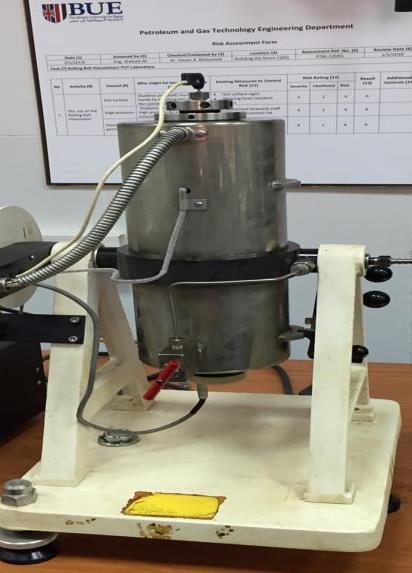
Pycnometer was used to measure the density of the fluids. While Chandler rolling ball viscometer was used to measure the fluid's viscosity. Finally, tensiometer was used to measure the interfacial tension. The density of crude oil was measured to be 0.87 g/cc and SG then is equal to 0.87 that is relevant to 30.7 API. The interfacial tension between crude oil and brine was measured as Copyright© El-hoshoudy AN, et al.
37.9 dyne/cm. While the viscosity was measured to be 9 cp for the crude oil.
Sand Pack Model
Average porosity is 28% and average absolute permeability is 832 mD. Sand pack inner diameter was 6 cm and the length is 15 cm. Bulk volume is equal to 425 cc. Figure 2 illustrates the flooding apparatus.
![Figure 2: Displacement flood apparatus (A: Pump; B: Brine solution; C: Sandstone holder; D: Pressure gauge; E: Sandstone holder with heating jacket; F: Zeolite nanoparticles solution; G: Measuring cylinder; H: Electrical heating unit; I: Zeolite nanoparticles solution solution) [31].](/fulltextimages/3729/fig_2.jpeg)
Sand Pack Initiation
Nanoparticles were prepared by the required concentrations in the previously prepared brine. Then this solution undergoes the sonication process inside a sonicator for 2-3 hours to make all nanoparticles suspended inside the solution or nanofluid.
Flooding Operation
First, the sand pack is filled with sand while considering packing the sand well. Then brine is injected to the sandpack till the sandpack is fully saturated with brine. Then, inject oil to displace the existing brine. Not all the brine is displaced by the oil. Accordingly, the amount of displaced brine is the same amount of the initial oil in place for this case, and by subtracting the amount of brine displaced by oil from the total amount of brine that was initially injected to saturate the sand pack, now the calculated amount of un-displaced brine can represent the connate water saturation. Thus, it is possible to have the sand pack conditions like initial reservoir conditions.
El-hoshoudy AN, et al. Improving Oil Recovery using Zeolite Nanoparticles Flooding. Pet Petro Chem Eng J 2019, 3(2): 000186.
Water Flooding
In the base run case, brine was injected to displace the oil and this case represents the conventional water flooding scenario. The amount of oil displaced by brine was measured to determine the oil recovery factor. Then, viscosity and interfacial tension of the displaced oil was measured. Relative permeability curve was constructed to determine if the sand pack is oil wet or water wet. This case was considered as a reference case for each following case, where the results of each nanofluid case were compared to this case of the conventional water flooding.
Injection of Nanofluids
After constructing the conventional water flooding as a reference case, zeolite nanofluid was injected in 4 different concentrations (0.005, 0.01, 0.1, 1.0 wt%). The oil recovery of each case was determined along with measuring viscosity, interfacial tension, and wettability alteration. Accordingly, the reason behind the change (whether an enhancement or reduction) in oil recovery for each case, was identified (due to change in oil viscosity, interfacial tension, and wettability). The experimental procedure was performed as follow: 1. Fill the sand pack with sand and consider packing the sand well. Then, determination of its dry weight. 2. Inject brine until the sand pack is fully saturated;
calculate absolute permeability from Darcy equation. Then, measuring the sand pack weight at its saturated condition. 3. Subtract dry weight from saturated weight and then divide the result by brine density to calculate the pore volume. 4. Inject oil to displace the existing brine. Not all the brine is displaced by the oil. Accordingly, the amount of displaced brine is the same amount of the initial oil in place for this case, and by subtracting the amount of brine displaced by oil from the total amount of brine that was initially injected to saturate the sand pack, now the calculated amount of un-displaced brine can represent the connate water saturation. The sand pack then simulates the reservoir having original oil in place and connate water. 5. Inject brine to displace the oil. For each fraction of the pore volume injected, the amount of injected brine is measured and the time is determined to calculate flow rate, then by substituting in Darcy equation, effective permeability is easily calculated.
Copyright© El-hoshoudy AN, et al.
6. Measure the amount of oil extracted to determine the oil recovery percentage. 7. Construct a relative permeability curve using absolute and effective permeability, to determine the change in wettability. 8. Measure the viscosity of the extracted crude oil. 9. Measure the interfacial tension between the extracted crude oil with the injected solution. To construct other cases than the conventional one, in step 5 inject the prepared nanofluid instead of brine. Then, compare the results to the conventional water-flooding scenario.
Waterflood
0 0.1 0.2 0.3 0.4 Relative permeability, fraction Krw Kro
Results and Discussion
Wettability Alteration
Base Run: Conventional Water Flooding: Relative permeability curve as shown in Figure 3 for conventional water-flooding depicts that the intersection of both curves occurs at water saturation of 0.36. Accordingly, the formation is strong oil wet. Then, any noticeable alteration in the wettability, will decrease the residual oil saturation and increases the oil recovery. The ultimate recovery factor reaches up to 50% of the original oil in place as shown in Figure 4.
Figure 4: Effect of conventional water flooding on oil recovery. Zeolite Flooding (Case 1): The zeolite is added to brine in concentrations of 0.005 wt %. After sonication, the nanofluids were injected to the core sample to displace El-hoshoudy AN, et al. Improving Oil Recovery using Zeolite Nanoparticles Flooding. Pet Petro Chem Eng J 2019, 3(2): 000186.
the oil. Relative permeability curve as shown in Figure 5. The intersection of both curves occurs at water saturation of 0.39 that means that formation is now slightly more Copyright© El-hoshoudy AN, et al.
water wet than the conventional water-flooding case. The oil recovery factor is 52 % of the original oil in place as Zeolite 0.005 wt. %
Zeolite Flooding (Case 2): The zeolite is added to brine in concentrations of 0.01 wt. %. After sonication, the nanofluids were injected to the core sample to displace the oil. Relative permeability curve as shown in Figure 7. The intersection of both curves occurs at water saturation El-hoshoudy AN, et al. Improving Oil Recovery using Zeolite Nanoparticles Flooding. Pet Petro Chem Eng J 2019, 3(2): 000186.
of 0.42 that means that formation is more water wet than the conventional water-flooding case. The oil recovery factor is 70 % of the original oil in place as shown in Figure 8.
Copyright© El-hoshoudy AN, et al.
Zeolite Flooding (Case 3): The zeolite is added to brine in concentrations of 0.1 wt %. After sonication, the nanofluids were injected to the core sample to displace the oil. Relative permeability curve as shown in Figure 9. The intersection of both curves occurs at water saturation of 0.4 that means that formation is more water wet than the conventional water-flooding case but less than a case of 0.01. The oil recovery factor is 67 % of the original oil in place as shown in Figure 10.
El-hoshoudy AN, et al. Improving Oil Recovery using Zeolite Nanoparticles Flooding. Pet Petro Chem Eng J 2019, 3(2): 000186.
Zeolite Flooding (Case 4): The zeolite is added to brine in concentrations of 1 wt. %. After sonication, the nanofluids were injected to the core sample to displace the oil. Relative permeability curve as shown in Figure 11. The intersection of both curves occurs at water saturation of 0.41 that means that formation is now slightly more water wet than the conventional water-flooding case. The oil recovery factor is 40 % of the original oil in place as shown in Figure 12.
El-hoshoudy AN, et al. Improving Oil Recovery using Zeolite Nanoparticles Flooding. Pet Petro Chem Eng J 2019, 3(2): 000186.
Reduction of Crude Oil Viscosity
Zeolite nanoparticles with four concentrations (0.005, 0.01, 0.1 and 1 wt. %) are added to the crude oil. The mixture is sonicated. Then, the crude oil viscosity is El-hoshoudy AN, et al. Improving Oil Recovery using Zeolite Nanoparticles Flooding. Pet Petro Chem Eng J 2019, 3(2): 000186.
measured using rolling ball viscometer as shown in Figure 13 at 200 ºF that represents the actual reservoir temperature.
Copyright© El-hoshoudy AN, et al.
Reducing Interfacial Tension between Crude Oil & Flooding Fluid
Zeolite nanoparticles with four concentrations (0.005, 0.01, 0.1 and 1 wt. %) are added to the crude oil. The El-hoshoudy AN, et al. Improving Oil Recovery using Zeolite Nanoparticles Flooding. Pet Petro Chem Eng J 2019, 3(2): 000186.
mixture is sonicated. Then, the interfacial tension is measured by using Tensiometer. Figure 15 shows the effect of each concentration of zeolite nanoparticles on interfacial tension. When the concentration of zeolite nanoparticles increases the interfacial tension decreases.
Copyright© El-hoshoudy AN, et al.
Economic Profile
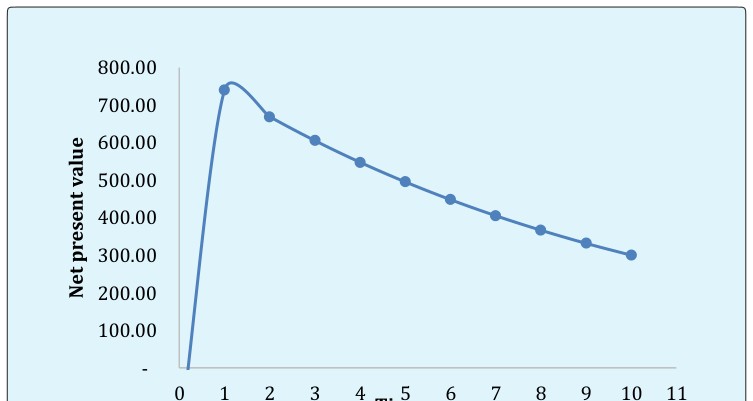
To find whether the need for this recovery mechanism is applicable or not. The net present value for the total project has been estimated. Firstly, the initial oil in place for a field is assumed to be 100 MM STB and the field comprise four production wells with the same decline rate. Also, the number of years for production is assumed to be 10 years. Moreover, drilling and production operational cost is assumed to be 25 million dollars considering the cost of flooding operations. More and more, a discount factor of 10% is also assumed. All the previous assumptions were applied to all the cases. However, the only variable now is the nano cost. The net present value for the water flood case is shown in Figure 16 and the net present value for the zeolite nanoparticles flooding of concentration 0.01 wt. % is shown in Figure 17. It is clear from the Figures that the net present value in case of using the zeolite nanoparticles is more than that of the conventional water-flooding case.
The effect of zeolite nanoparticles with four different concentrations (0.005, 0.01, 0.1, 1 wt.%) on crude oil viscosity, interfacial tension, wettability alteration, and oil recovery factor was investigated. Flooding of zeolite nanoparticles as a secondary recovery has proved its ability to reduce interfacial tension, crude oil viscosity and alter formation wettability and hence increase oil recovery. The oil recovery factor is 40 % of the original oil in place by conventional water flooding and increased to 70 % by using zeolite nanoparticles with a concentration of 0.01 wt. %. This paper has proved the ability of zeolite nanoparticles to reduce the oil viscosity and the interfacial tension, as well as it alters the formation wettability to be more water wet.
References
-
El-hoshoudy AN, Desouky SM, Ramzi M, Attia AM (2019) Experimental, modeling and simulation investigations of a novel surfmer-co-poly acrylates crosslinked hydrogels for water shut-off and improved oil recovery. Journal of Molecular Liquids 277: 142-156.
-
El-hoshoudy AN, Desouky SM (2018) Synthesis and evaluation of acryloylated starch-g-poly (Acrylamide/ El-hoshoudy AN, et al. Improving Oil Recovery using Zeolite Nanoparticles Flooding. Pet Petro Chem Eng J 2019, 3(2): 000186. Vinylmethacrylate/1-Vinyl-2-pyrrolidone) crosslinked terpolymer functionalized by dimethylphenylvinylsilane derivative as a novel polymer-flooding agent. Int J Biol Macromol 116: 434- 442.
-
El-hoshoudy AN, Desouky SM, Attia AM (2018) Synthesis of starch functionalized sulfonic acid co- imidazolium/silica composite for improving oil recovery through chemical flooding technologies. Int J Biol Macromol 118(Pt B): 1614-1626.
-
El-Hoshoudy AN, Desouky SEM, Elkady MY, Alsabagh AM, Betiha MA, et al. (2015) Investigation of optimum polymerization conditions for synthesis of cross- linked polyacrylamide-amphoteric surfmer nanocomposites for polymer flooding in sandstone reservoirs. International Journal of Polymer Science 2015: 14.
-
El-hoshoudy A, Desouky S, Elkady M, Alsabagh A, Betiha M, et al. (2017) Hydrophobically associated polymers for wettability alteration and enhanced oil recovery-Article review. Egyptian Journal of Petroleum 26(3): 757-762.
-
El-hoshoudy AN (2018) Quaternary ammonium based surfmer-co-acrylamide polymers for altering Copyright© El-hoshoudy AN, et al. carbonate rock wettability during water flooding. Journal of Molecular Liquids 250: 35-43.
-
El-hoshoudy AN (2019) Synthesis of acryloylated starch-g-poly acrylates crosslinked polymer functionalized by emulsified vinyltrimethylsilane derivative as a novel EOR agent for severe polymer flooding strategy. Int J Biol Macromol 123: 124-132.
-
Wei B, Qinzhi Li, Wang Y, Gao K, Pu W, et al. (2018) An Experimental Study of Enhanced Oil Recovery EOR Using a Green Nano-Suspension. SPE Improved Oil Recovery Conference_,_ Society of Petroleum Engineers, Tulsa, Oklahoma, USA, pp: 10.
-
Shah RD (2009) Application of nanoparticle saturated injectant gases for EOR of heavy oils. SPE annual technical conference and exhibition_,_ Society of Petroleum Engineers, New Orleans, Louisiana, pp: 12.
-
Poole CP, Owens FJ (2003) Introduction to nanotechnology_._ John Wiley & Sons
-
Mansoori GA (2005) Principles of nanotechnology: molecular-based study of condensed matter in small systems_._ World Scientific
-
Wasan D, Nikolov A, Kondiparty K (2011) The wetting and spreading of nanofluids on solids: Role of the structural disjoining pressure. Current Opinion in Colloid & Interface Science 16(4): 344-349.
-
Chengara A, Nikolov AD, Wasan DT, Trokhymchuk A, Henderson D (2004) Spreading of nanofluids driven by the structural disjoining pressure gradient. Journal of colloid and interface science 280(1): 192-201.
-
Mcelfresh PM, Wood M, Ector D (2012) Stabilizing nano particle dispersions in high salinity, high temperature downhole environments. SPE International Oilfield Nanotechnology Conference and Exhibition, Society of Petroleum Engineers, Noordwijk, The Netherlands, pp: 6.
-
Alomair OA, Matar KM, Alsaeed YH (2014) Nanofluids application for heavy oil recovery. SPE Asia Pacific Oil & Gas Conference and Exhibition_._ Society of Petroleum Engineers, Adelaide, Australia, pp: 18.
-
Alomair O, Alajmi A (2016) Experimental Study for Enhancing Heavy Oil Recovery by Nanofluid Followed by Steam Flooding NFSF. SPE Heavy Oil Conference El-hoshoudy AN, et al. Improving Oil Recovery using Zeolite Nanoparticles Flooding. Pet Petro Chem Eng J 2019, 3(2): 000186. and Exhibition_._ Society of Petroleum Engineers, Kuwait City, Kuwait, pp: 23.
-
Temperley H, Trevena D, Raveche HJ (1980) Liquids and their Properties: A Molecular and Macroscopic Treatise with Applications. Physics Today 33: 53.
-
Heinze J (1984) Cyclic voltammetry-electrochemical spectroscopy. New analytical methods (25). Angewandte Chemie International Edition in English 23(11): 831-847.
-
Wei L, Zhu JH, Qi JH (2007) Application of nano-nickel catalyst in the viscosity reduction of Liaohe extra- heavy oil by aqua-thermolysis. Journal of Fuel Chemistry and Technology 35(2): 176-180.
-
Clark PD, Clarke RA, Hyne JB, Lesage KL (1990) Studies on the effect of metal species on oil sands undergoing steam treatments. Aostra Journal of Research 6(1): 53-64.
-
Hamedi Shokrlu Y, Babadagli T (2010) Effects of nano-sized metals on viscosity reduction of heavy oil/bitumen during thermal applications. Canadian Unconventional Resources and International Petroleum Conference. Society of Petroleum Engineers, Calgary, Alberta, Canada, pp: 10.
-
Hendraningrat L, Li S, Torsaeter O (2013) A coreflood investigation of nanofluid enhanced oil recovery. Journal of Petroleum Science and Engineering 111: 128-38.
-
Zargartalebi M, Barati N, Kharrat R (2014) Influences of hydrophilic and hydrophobic silica nanoparticles on anionic surfactant properties: Interfacial and adsorption behaviors. Journal of Petroleum Science and Engineering 119: 36-43.
-
Sharma T, Kumar GS, Chon BH, Sangwai JS (2015) Thermal stability of oil-in-water Pickering emulsion in the presence of nanoparticle, surfactant, and polymer. Journal of Industrial and Engineering Chemistry 22: 324-334.
-
Esmaeilzadeh P, Hosseinpour N, Bahramian A, Fakhroueian Z, Arya S (2014) Effect of ZrO2 nanoparticles on the interfacial behavior of surfactant solutions at air–water and n-heptane–water interfaces. Fluid Phase Equilibria 361: 289-295. Copyright© El-hoshoudy AN, et al.
-
Arashiro EY, Demarquette NR (1999) Use of the pendant drop method to measure interfacial tension between molten polymers. Materials Research 2(1): 23-32.
-
Hezave AZ, Dorostkar S, Ayatollahi S, Nabipour M, Hemmateenejad B (2013) Investigating the effect of ionic liquid (1-dodecyl-3-methylimidazolium chloride ([C12mim][Cl])) on the water/oil interfacial tension as a novel surfactant. Colloids and Surfaces A: Physicochemical and Engineering Aspects 421: 63-71.
-
Giraldo LJ, Gallego J, Villegas JP, Franco CA, Cortes FB (2019) Enhanced waterflooding with NiO/SiO2 0-D Janus nanoparticles at low concentration. Journal of Petroleum Science and Engineering 174: 40-48. El-hoshoudy AN, et al. Improving Oil Recovery using Zeolite Nanoparticles Flooding. Pet Petro Chem Eng J 2019, 3(2): 000186.
-
Gomaa S, Salem A, Hassan M (2017) Relative Permeability Curves and Wettability Alterations by Alumina Nano Particles Flooding. Journal of Al Azhar University Engineering Sector 12(42): 103-119.
-
Gomaa S, Salem A, Hassan M (2018) Nanofluids hold EOR potential in Egypt's Western Desert. Oil & Gas Journal 116(4): 52-55.
-
El-Hoshoudy A, Desouky S, Betiha M, Alsabagh A (2016) Use of 1-vinyl imidazole based surfmers for preparation of polyacrylamide-SiO2 nanocomposite through aza-Michael addition copolymerization reaction for rock wettability alteration. Fuel 170: 161- 175. Copyright© El-hoshoudy AN, et al.
- Nigeria’s Vulnerability in the Face of Global Energy Policy
- A Simulation Study of Investigation of Optimum Oil Production Performance by Applying Various Gas Injection Methods in Oil Reservoir
- Characterization of Permo-Triassic Reservoirs through Thermal Maturity Assessment of Westphalian Source Rocks in the Cheshire Basin
- Influence of Microwax on the Rheological and Thermal Behaviour of a Wax Crude Oil
- Real-Time Monitoring and Performance Optimization of Steam Injection in Heavy Oil Reservoirs Using Fiber Optic Sensing and Integrated Predictive Simulation Models
- Rapid On-Site Determination of the Total Petroleum Hydrocarbon Content of Soils by Handheld Fourier Transform Near-Infrared Spectroscopy: Development of a Global, Site- and Scanner- Independent Calibration Model