
Mono-and di-cationic Ionic Liquids: Synthesis, Characterization and Applications in Batteries
In this paper, a mono-cationic ionic liquid (MIL) ([BMIM] [NTF2]) and two di-cationic ionic liquids (DILs) ([C5(MIM)2][NTF2]2 and [C6(MIM)2][NTF2]2) were synthesized by two-step method, and the conductivity, viscosity and electrochemical stability of the three ionic liquids were systematically studied and analyzed. The results show that the conductivity of MIL is better than that of DILs, while the viscosity and the electrochemical stability of DILs are higher than those of MIL. The viscosity of the DILs decreases with the increasing length of the group within the DILs. Finally, the application of MIL as the electrolyte in the lithium-oxygen battery was studied.
Introduction
Generally, low temperature molten salts with a melting point below 100°C are called ionic liquids (ILs) or room temperature molten salts, which are generally composed of inorganic anions and organic or inorganic cations and have the properties of both liquid and salt [1]. With very low vapor pressure, high electrical conductivity, wide electrochemical window, cryogenic liquid temperature range, strong ability of dissolving and catalytic properties, ILs have a good application prospect in the field of electrochemistry, material preparation, extraction separation, catalytic reaction, and organic synthesis etc [2, 3, 4, 5, 6] as compared with the traditional organic solvents. Therefore, ILs have attracted wide attention and become one of the research hotspots, and gradually moved from laboratory research to industrial applications [7].
At present, the ILs widely studied is mainly single cation ILs. However, in recent years, double cation ILs have attracted the attention of researchers, because they are composed of one double cation and two single anions, and the two cations are connected by linkers. They have the advantages of better thermal stability, higher density, wider liquid range and better physical and chemical controllability and have been used in various fields such as high temperature organic reaction process and dye-sensitized solar cell [8].
In this work, three imidazole based ILs were synthesized, including a mono-cationic IL (MIL) ([BMIM][NTF2]) and two di-cationic ILs (DILs) (C5(MIM)2][NTF2]2 and [C6(MIM)2] [NTF2]2). Their electrochemical stability, viscosity and conductivity at different temperatures were measured, and the effects of temperature and IL structure on their properties were also analyzed [9]. Finally, by taking the advantages of high electrochemical stability and conductivity of ILs, [BMIM][NTF2] was used as the electrolyte in the lithium- oxygen battery.
Experimental
Synthesis of MIL [BMIM][NTF2]
[BMIM][NTF2] was synthesized by ion exchange method [10, 11]. In a typical procedure, 25mL of lithium trifluoromethanesulfonimide (11.8g) solution was added drop wise to 20mL of [BMIM][Cl] (6.77g) solution, and stirred continuously for 20min. During this process, the solution is gradually stratified. Then, the lower light yellow liquid was extracted with dichloromethane, and the solution was continuously washed with deionized water. The obtained solution was dried with anhydrous magnesium sulfate. The extractant dichloromethane in the product was volatilized in a vacuum drying oven, and the solution was further dried to finally obtain a colorless and viscous IL.
Synthesis of DILs [C5(MIM)2][NTF2]2 and [C6(MIM)2][NTF2]2
The two kinds of DILs were synthesized by a similar method [12]. Taking the synthesis of [C5(MIM)2][NTF2]2 as an example, the synthesis path was divided into the following two steps: 23.0g of 1,5-dibromopentane was firstly added dropwise to 16.4g of N-methylimidazole solution in a round bottom flask. The solution was magnetically stirred at room temperature for 2h to obtain solid [C5(MIM)2][Br]2 bromide salt. Subsequently, the obtained bromine salt was dissolved into 100mL of deionized water, and 50ml of ethyl acetate was added to dissolve the unreacted N-methylimidazole. Finally, the solution was rotary-evaporated at 80°C to remove the solvent to obtain solid [C5(MIM)2][Br]2, which was transferred into a vacuum drying oven and dried at 80°C to remove the remaining trace solvent and water.
Secondly, 19.7g of the [C5(MIM)2][Br]2 and 28.7g of LiNTF2 were dissolved in deionized water respectively, and were mixed until the solution state was changed. The ion exchange reaction was completely carried out by stirring at room temperature for 12h, and the mixture was allowed to stand until layered. The hydrophobic DIL [C5(MIM)2][NTF2]2 obtained from the lower layer was washed with deionized water for several times. Finally, the obtained DIL was dried in a vacuum drying oven at 80°C. It was determined by a constant moisture titrator that the water content in the [C5(MIM)2][NTF2]2 was less than 0.1wt%.
Measurements of Conductivity, Viscosity and Electrochemical Stability
The ILs was placed in the beaker in a constant temperature water bath. The conductivity electrode connected to the conductivity meter was inserted into the beaker and stand still, so that the ILs was naturally cooled to the temperature to be measured in the constant temperature water bath. After stabilizing for five minutes, the conductivity was measured every 5°C. All samples were measured twice and the average value was taken.
The viscosity has a great influence on the mass transfer of ILs, and therefore the viscosity of these ILs at different temperatures was measured by the viscometer (Lovis 2000M, Anton Paar GmbH). The temperature accuracy of the instrument is ±0.01°C, and the uncertainty of the measured viscosity is ±1%.
The electrochemical stability of three different ILs was tested in a three-electrode cell connected to the electrochemical workstation (CHI 660D). Among them, two platinum wires were used as working electrode and auxiliary electrode, respectively, and a saturated calomel electrode (SCE) was used as reference electrode. The scanning rate is 50mV s-1.
Assembly and Charge/Discharge Tests of Lithium-Oxygen Battery
Ketjen black (KB) and polytetrafluoroethylene (PTFE) at the mass ratio of 8:2 were fully dispersed in a certain amount of ethanol. After being stirred to ethanol volatilization, a rubber slurry was formed, which was evenly spread on the foam nickel with a diameter of 12mm and dried for 12h at 80°C to remove residual moisture and solvent. The mass of KB on the electrode is assessed to be 1.1±0.1 mg.
The lithium-oxygen battery was assembled in a glove box filled with argon (H2O≤1ppm, O2≤1ppm) [13, 14]. Using [BMIM][NTF2] solvent containing 0.1M LiNTF2 as electrolyte, the assembly sequence of the battery was: lithium sheet → 50µL electrolyte → diaphragm → absorbent paper → 50µL electrolyte → oxygen electrode sheet, in which the side containing active substance was in contact with the electrolyte. In order to eliminate the influence of other components in the air (especially water and carbon dioxide) on the battery performance, all lithium-oxygen battery tests were tested in a glove box filled with high-purity oxygen (H2O≤1ppm).
In the oxygen glove box, the galvanostatic charge/ discharge performance of the battery is studied, and its actual specific capacity was calculated. The charge and discharge cut-off voltage was set to 4.5 and 2.0 V, respectively. The charge and discharge tests were conducted by LAND CT2001A charge and discharge instrument.
Results and Discussion
1H NMR Characterization of the Three ILs
The 1H NMR spectra of the three ILs were recorded by using a Bruker Avance 500MHz spectrometer (Germany) with deuterated dimethyl sulfoxide (DMSO) as the solvent. The 1H NMR results of the three ILs are consistent with the target products [10]: [BMIM][NTF2]: 9.11 (s,1H), 7.77 (t,1H), 7.70 (t,1H), 4.16 (t,2H), 3.85 (s,3H), 1.71 (m,2H), 1.25 (m,2H), 0.91 (t,3H); [C5(MIM)2][NTF2]2: 9.09 (s,2H), 7.73 (t,2H), 7.70 (t,2H), 4.17 (t,4H), 3.86 (s,6H), 1.83 (m,4H), 1.24 (m,2H); [C6(MIM)2][NTF2]2: 9.09 (s,2H), 7.73 (t, 2H), 7.70 (t,2H), 4.16 (t,4H), 3.86 (s,6H), 1.80 (m,4H), 1.28 (m,4H), suggesting the high puritity of the three ILs.
Conductivity of the Three ILs
The relationship between conductivity (σ) and temperature (T) of the three ILs is shown in Figure 1A. It can be seen that the conductivity of the three ILs increases with increasing temperature, and [BMIM][NTF2] exhibits the highest conductivity at the same temperature. For the two
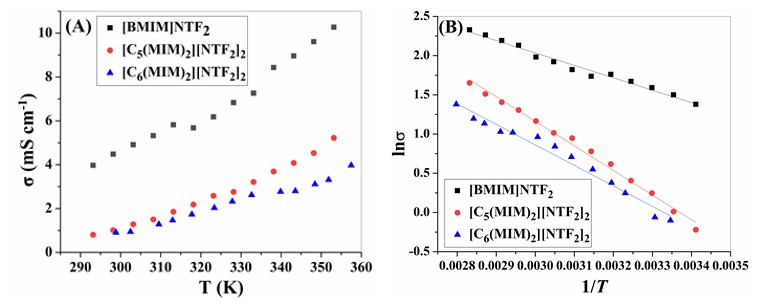
kinds of DILs, the conductivity of [C5(MIM)2][NTF2]2 is higher than that of [C6(MIM)2][NTF2]2. By comparing the length of the intermediate group between the two kinds of DILs, it can be found that the shorter the intermediate group between the DILs, the higher the conductivity. Because the size of ions in the DILs is larger than that in the MIL, the mobility of the DILs is lower than that of the MIL. Thus, the conductivity of the DILs is slightly lower than that in MIL.
The relationship between the logarithm value of conductivity (lnσ) and the reciprocal of temperature (1/T) is shown in Figure 1B. It shows a good linear relationship between lnσ and 1/T. According to Arrhenius formula: lnσ = lnσ0 + Ea/RT, where σ is conductivity (mS cm–1), σ0 is a constant, Ea is the activation energy of conductivity (kJ mol–1), R is the gas constant (8.314 J mol–1 K–1), and T is thermodynamic temperature (K), the activation energy of conductivity of [BMIM][NTF2] is calculated to be 13.16 kJ mol–1, which is significantly lower than those of [C5(MIM)2] [NTF2]2 (26.10 kJ mol–1) and [C6(MIM)2][NTF2]2 (21.77 kJ mol–
1). The conductivity of IL is affected by many factors, such as its own density, viscosity, relative molecular weight and ion size [15, 16, 17]. The conductivity of the MIL is better than that of the other two DILs, and the Ea of MIL is higher than that of the other two DILs. For the DILs, the length of intermediate group influences the Ea in a degree. The results show that Ea decreases with increasing length of intermediate group.
Viscosity of the Three ILs
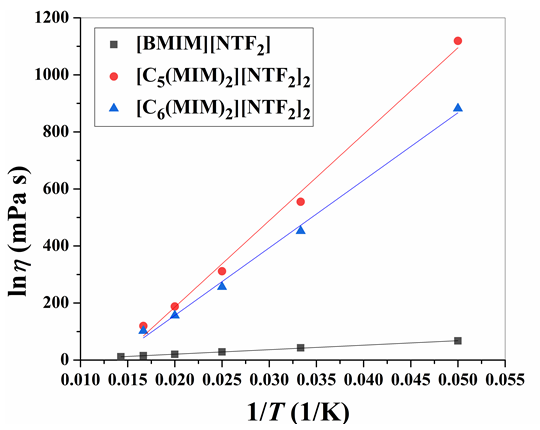
Due to the strong interactions between cation and anion of ILs, ILs usually exhibit high viscosity (η) [18, 19]. It has been reported that the dynamic properties of ILs are closely related to the binding strength of ion pairs, and the hydrogen bond in ILs can increase the fluidity of ILs [9]. Figure 2 displays the relationship between the logarithm value of viscosity (lnη) and the reciprocal of temperature (1/T). As can be seen, lnη exhibits a good linear relationship with 1/T, conforming to Arrhenius formula: lnη = lnη0 + Eη/R_T_, where η is conductivity, η0 is a constant, Eη is the viscosity activation energy (kJ mol–1), R is the gas constant (8.314 J mol–1 K–1), and T is thermodynamic temperature (K). The viscosity activation energy (Eη) of [BMIM][NTF2] (0.40 kJ mol–1) is smaller than those of those of [C5(MIM)2] [NTF2]2 (0.54 kJ mol–1) and [C6(MIM)2][NTF2]2 (0.52 kJ mol–
1), suggesting that the ionic liquid state of the MIL is more easier to be changed than the two DILs. Therefore, MIL is often liquid at room temperature. The ionic liquid state of the DILs is usually changed under harsh conditions, and they exhibit high viscosity.
Electrochemical Stability of the Three ILs
The electrochemical stability of the three ILs was measured by linear sweep voltammetry (LSV), and the results are presented in Figure 3. The LSV curve of the MIL, [BMIM][NTF2] is significantly different from those of the other two DILs. When the voltage is less than 2.0 V, the currents of the MIL and the DILs are roughly the same, and there is no significant difference in the stability of the three ILs. However, when the voltage exceeds 2.0 V, the currents of the MIL increase dramatically, suggesting the low stability of the MIL. While the currents of the DILs increase little, which can be ascribed to the relatively high stability of the DILs? Therefore, the electrochemical stability of the DILs is higher than that of the MIL.
![Figure 3: The LSV curve of the MIL, [BMIM][NTF2] is significantly different from those of the other two DILs. When the voltage is less than 2.0 V, the currents of the MIL and the DILs are roughly the same, and there is no significant difference in the stability of the three ILs. However, when the voltage exceeds 2.0 V, the currents of the MIL increase dramatically, suggesting the low stability of the MIL. While the currents of the DILs increase little, which can be ascribed to the relatively high stability of the DILs? Therefore, the electrochemical stability of the DILs is higher than that of the MIL.](/fulltextimages/8085/fig_3.png)
Application of ILs in Batteries
Based on the good electrochemical stability and conductivity of ILs [20], the MIL of [BMIM][NTF2] is taken as the electrolyte of lithium-oxygen battery, and the application of IL in lithium-oxygen battery is investigated by its first cycle of charge/discharge capacity Figure 4. It can be seen that when [BMIM][NTF2] is used as the electrolyte in lithium-oxygen battery, it exhibits high charge/discharge capacity, and the discharge capacity and charge capacity on the first cycle can reach 4700 mAh g–1 and 2331 mAh g–1, respectively. Therefore, ILs might be a potential candidate as the electrolyte in lithium-oxygen batteries.
![Figure 4: It can be seen that when [BMIM][NTF2] is used as the electrolyte in lithium-oxygen battery, it exhibits high charge/discharge capacity, and the discharge capacity and charge capacity on the first cycle can reach 4700 mAh g–1 and 2331 mAh g–1, respectively. Therefore, ILs might be a potential candidate as the electrolyte in lithium-oxygen batteries.](/fulltextimages/8085/fig_4.png)
Conclusions
In this study, three imidazole based ILs were synthesized, including a MIL [BMIM][NTF2] and two DILs, [C5(MIM)2] [NTF2]2 and [C6(MIM)2][NTF2]2. The conductivity, viscosity and electrochemical stability of the three ILs were studied. The conductivity of the three ILs increases with increasing temperature at the same temperature, the conductivity of MIL is better than those of DILs. The viscosity of DILs is higher than that of MIL, and the viscosity of DILs decreases with increasing length of the group within the DILs. The electrochemical stability of DILs is higher than that of MIL. Finally, the MIL is used as the electrolyte in the lithium- oxygen battery, exhibiting high charge/discharge capacity. These findings suggest that the synthesized three imidazole based ILs especially MIL might be potential candidates to be used for lithium-oxygen batteries.
Acknowledgement
As part of the projects of Department of Chemical Engineering, University of Shanghai for Science and Technology. We attach our sincere thanks to Dr. Yao C. His guidence and patience contributes to the success of the study.
References
-
Wilkes JS (2002) A short history of ionic liquids–from molten salts to neoteric solvents. Green Chem 4(2): 73- 80.
-
Chang JK, Chen SY, Tsai WT, Deng MJ, Sun IW (2007) Electrodeposition of aluminum on magnesium alloy in aluminum chloride (AlCl3)–1-ethyl-3- methylimidazolium chloride (EMIC) ionic liquid and its corrosion behavior. Electrochemistry Communication 9(7): 1602-1606.
-
Kaliszan R, Marszall MP, Markuszewski MJ, Baczek T, Pernak J (2004) Suppression of deleterious effects of free silanols in liquid chromatography by imidazolium tetrafluoroborate ionic liquids. J Chromatogr A 1030(1- 2): 263-271.
-
Yan XR, Anguille S, Bendahan M, Moulin P (2019) Ionic liquids combined with membrane separation processes: A review. Separation and Purification Technology 222(1): 230-253.
-
Borun A (2019) Conductance and ionic association of selected imidazolium ionic liquids in various solvents: A review. J Mol Liq 276: 214-224.
-
Mi X, Luo S, Cheng JP (2005) Ionic liquid-immobilized quinuclidine-catalyzed Morita-Baylis-Hillman reactions. J Org Chem 70(6): 2338-2341.
-
Sasikumar BG, Arthanareeswaran AFI (2018) Recent progress in ionic liquid membranes for gas separation. J Mol Liq 266(15): 330-341.
-
Eftekhari A, Liu Y, Chen P (2016) Different roles of ionic liquids in lithium batteries. J Power Sources 334: 221- 239.
-
Fumino K, Wulf A, Ludwig R (2008) Strong, localized, and directional hydrogen bonds fluidize ionic liquids, Angew Chem Int Ed 47(45): 8731-8734.
-
Safari N, Shirini F, Tajik H (2020) Preparation and characterization of a novel DABCO based tetra cationic ionic liquid as a reusable catalyst for the multi- component synthesis of 2H-indazolo[2,1-b]phthalazine- trione and [1,2,4] triazoloquinazolinone derivatives under solvent-free condition. J Mol Struct 1201.
-
Shaplov AS, Morozova SM, Lozinskaya EI, Vlasov PS, Gouveia ASL, et al. (2016) Turning into poly(ionic liquid)s as a tool for polyimide modification: synthesis, characterization and CO2 separation properties. Polym Chem 7(3): 580-591.
-
Anderson JL, Ding RF, Ellern A, Armstrong DW (2005) Structure and properties of high stability geminal dicationic ionic liquids. J Am Chem Soc 127(2): 593-604.
-
Zhang JQ, Sun B, Zhao YF, Tkacheva A, Liu ZJ, et al. (2019) A versatile functionalized ionic liquid to boost the solution-mediated performances of lithium-oxygen batteries. Nat Commun 10: 602.
-
Gao KN, Wang HR, He MH, Li YQ, Cui ZH, et al. (2020) Interfacial integration and roll forming of quasi-solid- state Li-O2 battery through solidification and gelation of ionic liquid. J Power Sources 463: 228179.
-
Zheng Y, Zheng YJ, Wang Q, Wang Z (2021) Density, viscosity, and electrical conductivity of 1-alkyl-3- methylimidazolium dicyanamide ionic liquids. J Chem Eng Data 66(1): 480-493.
-
Musia M, Cheng S, Wojnarowska Z, Paluch M (2020) Density, viscosity, and high-pressure conductivity studies of tricyanomethanide-based ionic liquids. Journal of Molecular Liquid 317: 113971.
-
Baird ZS, Uusi-Kyyny P, Dahlberg A, Cederkrantz D, Alopaeus V (2020) Densities, viscosities, and thermal conductivities of the ionic liquid 7-methyl-1,5,7- triazabicyclo[4.4.0] dec-5-enium acetate and its mixtures with water. Int J Thermophys 41: 160.
-
Neumann J, Paschek D, Strate A, Ludwig R (2021) Kinetics of hydrogen bonding between ions with opposite and like charges in hydroxyl-functionalized ionic liquids. J Phys Chem B 125(1): 281-286.
-
Zheng YZ, Zhou Y, He HY, Guo R, Chen DF (2021) Nitrile group as IR probe to detect the structure and hydrogen- bond properties of piperidinium/pyrrolidinium based ionic liquids and acetonitrile mixtures. J Mol Liq 322: 114548.
-
Malik M, Ng KL, Azimi G (2020) Physicochemical characterization of AlCl3-urea ionic liquid analogs: Speciation, conductivity, and electrochemical stability. Electrochim Acta 354: 136708.
- Nigeria’s Vulnerability in the Face of Global Energy Policy
- A Simulation Study of Investigation of Optimum Oil Production Performance by Applying Various Gas Injection Methods in Oil Reservoir
- Characterization of Permo-Triassic Reservoirs through Thermal Maturity Assessment of Westphalian Source Rocks in the Cheshire Basin
- Influence of Microwax on the Rheological and Thermal Behaviour of a Wax Crude Oil
- Real-Time Monitoring and Performance Optimization of Steam Injection in Heavy Oil Reservoirs Using Fiber Optic Sensing and Integrated Predictive Simulation Models
- Rapid On-Site Determination of the Total Petroleum Hydrocarbon Content of Soils by Handheld Fourier Transform Near-Infrared Spectroscopy: Development of a Global, Site- and Scanner- Independent Calibration Model