
Experimental Investigation of Reservoir Rock Wettability Alteration by Matricaria Chamomilla Extract
Residual oil can be mobilized by reducing the interfacial tension between oil and water and/or by altering the wettability of the rock through surfactant flooding. Recently natural surfactants have been considered as opposite to synthetic surfactants due to environmental problems associated with synthetic surfactants. This work introduces a plant-based natural surfactant named Matricaria Chamomilla as an agent of reservoir rock wettability alteration. Qualitative and quantitative methods were used to measure rock samples' wettability. For this purpose, flotation wettability, separation wettability, and the pendant drop method were used. The results show that Matricaria Chamomilla extract (MCE) changes the reservoir rock wettability to some degree equivalent to other natural surfactants. The highest wettability variation was observed at 12%wt MCE concentration with 28% change and 21% for critical micelle concentration (CMC) of 5.5%wt.
Introduction
Generally, Enhanced Oil Recovery (EOR) schemes can be categorized into thermal and non-thermal methods depending on whether or not heat is employed. Non-Thermal EOR methods consist of chemical and gas injection and engineered water processes [1]. Surfactant flooding has been implemented as one of the main Chemical EOR methods (CEOR), especially for sandstone reservoirs [2, 3]. Recently, the application of surfactant flooding becoming a reality by targeting more challenging reservoirs such as carbonated ones [4]. Surfactant flooding improves oil recovery by reduction of interfacial tension between oil and aqueous phases and wettability alteration of the reservoir rock [5, 6, 7]. Wettability is one of the main reservoir rock features that can have an effect on all measured core properties, such as relative permeability and capillary pressure [8, 9]. It is extremely important to evaluate improved recovery methods in all phases, from primary production to water flooding, chemical flooding, and microbial oil recovery [10, 11, 12, 13, 14, 15, 16]. Lake, et al. have conducted an extensive literature survey on wettability. Various parameters should be considered, including environmental effects, surfactant cost, surfactant losses (adsorption onto rock face), interfacial tension reduction, and oil recovery [17]. Different varieties of surfactants are used for enhanced oil recovery in the world. All these surfactants have a high price, which causes the chemical process to be uneconomical in some situations [18]. A comprehensive review by Kamal and his co-workers was conducted on surfactant flooding for sandstone and carbonate reservoirs, emphasizing phase behavior, interfacial tension (IFT), structure-property, and adsorption. Also, the recent trends, future challenges, and limitations for EOR were thoroughly reviewed. It was concluded that most of the reported surfactant flooding was conducted in sandstone reservoirs with low temperature and low salinity, while high temperature and high salinity in carbonate reservoirs are still challenging [16]. In addition, wettability alteration of carbonate rock through surfactant and foam application was found to be essential for fractured reservoirs concerning oil recovery improvement [19, 20].
Due to the environmental problems with industrial surfactants, the applicability of natural-based or biodegradable surfactants has turned into an interesting subject for many researchers in recent years [21, 22, 23, 24, 25, 26]. Natural surfactants classification is like the classification of chemical surfactants. They are nonionic, cationic, anionic, and amphoteric types [27]. Maryami Nejad [23] used a commercial surfactant (Triton x-100) and a natural plant surfactant (Zizyphus Spina-Christi) to investigate the wettability alteration of oil-wet carbonate rock. The results show that Triton X-100 has a higher potential for wettability alteration of the carbonate rock sample towards the water- wet condition than Zizyphus Spina-Christi (called Cedar). Ahmadi, et al. [24] investigated wettability alteration by three commercial surfactants (Cationic C16TAB, Anionic SDS, nonionic Triton X-100 (TX100)) and natural-based surfactant, which derived from roots of Glycyrrhiza Glabra by implementing contact angle measurements. Wettability tests were conducted on oil-wetted calcite crystals. All surfactants could reduce the oil wetness of the initially oil-wet surface, but none of them made the surface water-wet. Ravi, et al. [25] investigated the wettability alteration of carbonate rock by Mulberry leaf extract. They stated that the wettability of oil-wet carbonate rocks in the best state altered from about 150 to 30 degrees. They concluded that Mulberry leaf extract precipitated or adsorbed on the rock surface considerably affects wettability alteration.
An extensive review of the application of natural surfactants for enhanced oil recovery was provided by Bachari, et al. [28]. It was concluded that natural surfactants could provide new prospects due to their lower cost, availability, biodegradability, and being environmentally friendly. The Matricaria Chamomilla is one of the oldest acknowledged herbs of old medicine that goes back to the Asteraceae family [29]. Chamomilla is one of two species generally used for making the herbal infusion and one of the herbs containing flavonoid compounds [30]. Also, it is the primary and active chemical element in chamomile flowers, mainly flavonoids [31]. The Matricaria Chamomilla is low in price compared with synthetic surfactants and is abundantly accessible in the Middle East, Central Asia, and Eastern Europe. Recently El Mihyaoui, et al. [32] provided a comprehensive review on the application of Matricaria Chamomilla. In this review, reports on the taxonomy, botanical and ecology description, ethnomedicinal usages, phytochemistry, biological and pharmacological properties, probable application in different industries, and encapsulation were thoroughly gathered and critically evaluated.
This paper examined the feasibility of Matricaria Chamomilla extract for porous media wettability alteration usable for chemical oil recovery processes. Qualitative and quantitative approaches were used for this purpose. Floating and separation wettability tests were used for the qualitative wettability, and the contact angle approach was used for the quantitative wettability tests. The two approaches were implemented to demonstrate the total effects of the Matricaria Chamomilla hydro glycolic extract on the carbonate rock sample wettability.
Method and Materials
In this study, carbonate core was taken from an oilfield for the wettability measurement. The core sample was crushed and sorted with 270 mesh sieves (53 microns) for floating wettability and separation wettability tests. The core was cautiously cut into pellets and polished to obtain a flat and smooth surface for contact angle measurement. The distilled water utilized throughout this study was reverse osmosis (RO) produced in the laboratory. Crude oil and Kerosene were used as the oil phase. The concentration of the Matricaria Chamomilla varied from zero to 12% by weight. The MCE critical micelle concentration (CMC) was reported to be about 5.5 % by weight [33]. The wettability of rock samples was measured by qualitative and quantitative wettability tests.
Qualitative Wettability Tests
The qualitative wettability tests were conducted on crushed limestone rock samples to check the Matricaria Chamomilla’s effectiveness in altering the wettability of the crude-oil aged crushed rock samples. Rock material was crushed and sorted with 270 mesh sieves. The crushed rock sample was cleaned with toluene and dried in an oven. Some crushed rock samples were aged with crude oil at 90°C for several weeks. Using these clean and aged crushed rock samples, two qualitative tests were conducted on aged oil-wet rock samples to determine the wettability state, as explained below [34].
Flotation Test: In this test, 0.2 gram of crushed rock sample was added to a testing tube occupied with distilled water. The crushed rock sample is characterized as oil-wet if the rock material floated on top of the water (Figure 1(a)) and as water-wet, if the crushed rock sank to the bottom of the test tube (Figure 1(b)).
![Figure 1: Flotation test (a) oil-wet rock and (b) water-wet rock [34].](/fulltextimages/9214/fig_1.png)
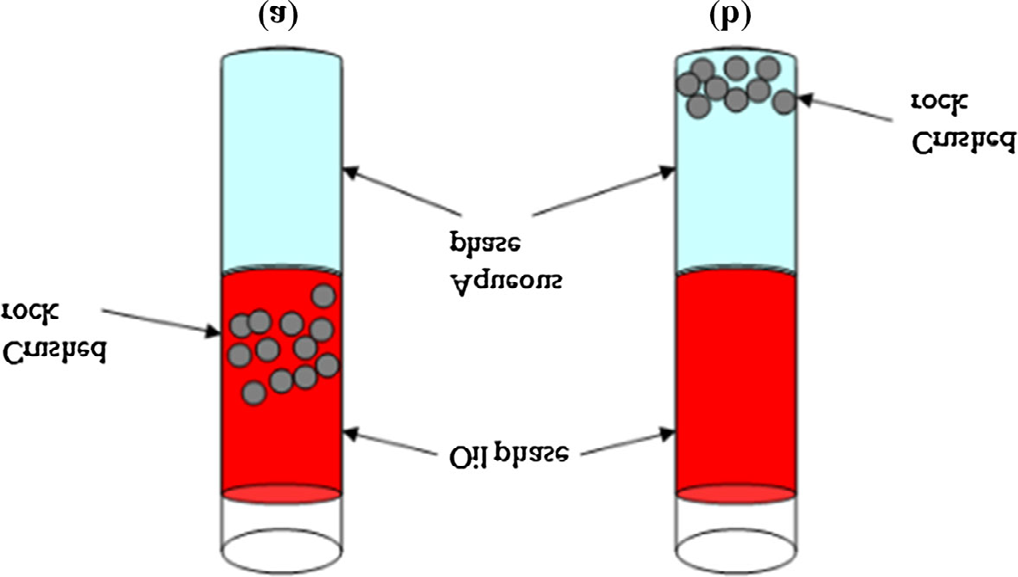
Two-phase separation test: In this test, 0.2 gram of prepared crushed rock was weighed and poured into a testing tube. Then, 20 ml of distilled water was added to the crushed rock samples, followed by 20 ml of crude oil. The testing tube was gently shaken, and then it was allowed to settle. The amount of crushed rock samples remaining in each phase gives a qualitative wettability index. If all crushed rock samples remain in the oil phase, then the material is strongly oil-wet, as shown in Figure 2(a). If they sink into the aqueous phase, where carrying with it a “shell” of oil, it is water-wet, as shown in Figure 2(b) [34].
![Figure 2: Two-phase separation test (a) oil-wet and (b) water-wet rock [34].](/fulltextimages/9214/fig_2.png)
Quantitative Wettability Test
The contact angle test was used as a quantitative wettability test in this work. The core was carefully cut and polished in order to obtain a flat and smooth surface for contact angle measurement by using the Sessile drop method. The sessile drop approach and modified sessile drop approach are the most generally used contact angle measurement in reservoir petroleum tests [15]. According to this approach, when water and oil come in contact with a solid surface, the wetting fluid will adhere and spread over the solid and push back the non-wetting fluid. At the addressed interface of two fluids and the solid surface, a contact angle will form and can record by imaging with optical devices. A sessile drop device was utilized in contact angle measurements, as shown in Figure 3. This device can automatically place a drop on the surface and measure the contact angle by its image processing software.
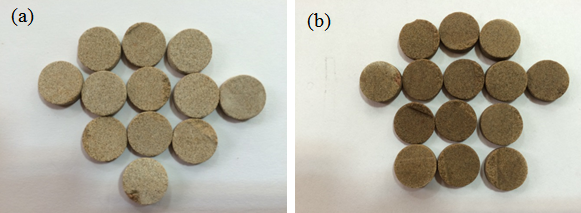
The following procedures were implemented for conducting contact angle measurement: (1) Clean pellet rock samples were aged in crude oil for two weeks at 90 ◦C. Figure 4 shows pellet core samples before and after aging with crude oil.
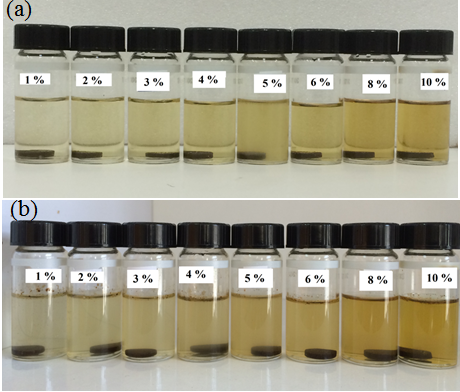
(2) Then, the pellet rock sample’s surfaces were rinsed with Kerosene to remove crude oil from the surface to obtain a smooth oil-wet surface, and they were dried with air. (3) Pellet rock samples were placed in different Matricaria Chamomilla extract solutions and were aged for one week, as shown in Figure 5.
(4) Pellet rock samples were removed from different Matricaria Chamomilla extract solutions, which were quickly rinsed with water and then placed on a clean surface to dry in the air. (5) The contact angle was measured by submerging the pellet rock samples in Kerosene and placing a drop of water on them. For the water-wet surface, the contact angle is < 90◦, and for the oil-wet surface, the contact angle is > 90◦.
Results and Discussion
Qualitative Wettability Tests
Qualitative tests were conducted to evaluate the ability of the Matricaria Chamomilla extract to change the wettability of oil-wet rock. As explained before, Matricaria Chamomilla extract was prepared in a beaker, and 0.2 gram of wet oil crushed rock sample was poured into the surfactant solution for one-week aging. Then the clean, oil-wet, and treated crushed rock samples were used for qualitative wettability tests.
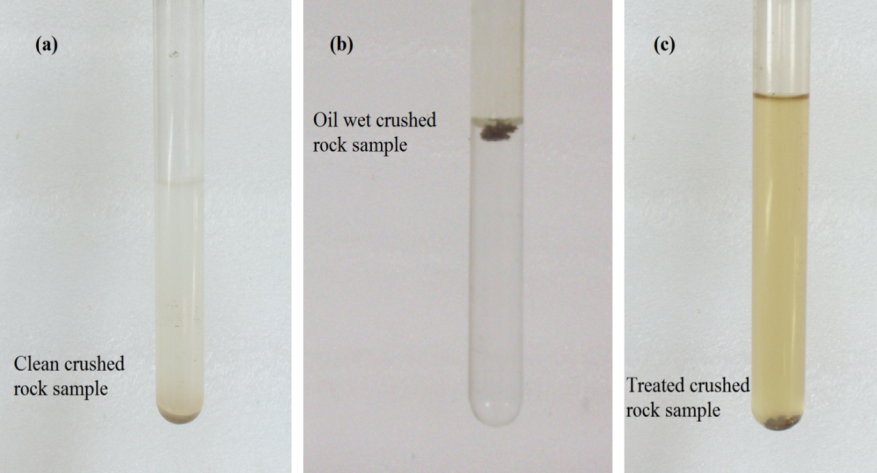
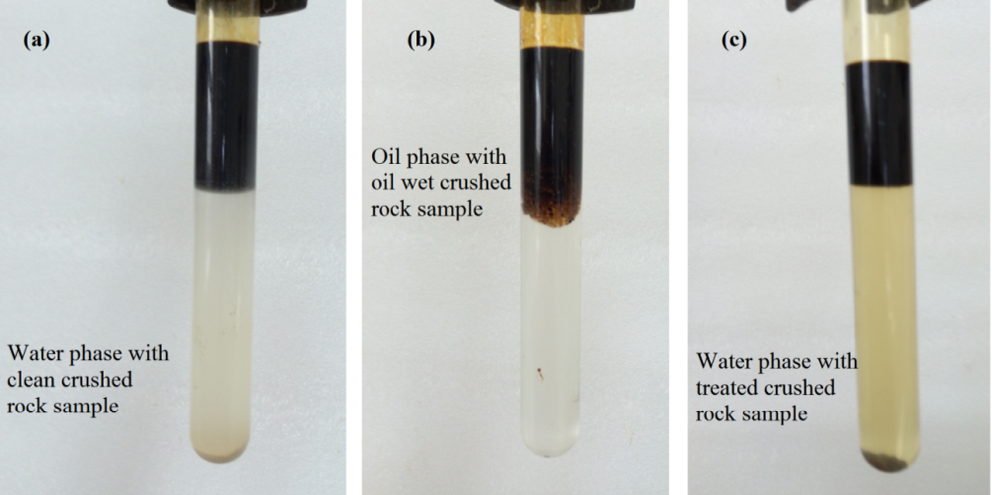
Flotation Test: Crushed rock samples were aged with crude oil and treated with 5.5 wt % Matricaria Chamomilla extract solution, and they were slowly poured on top of distilled water level. The results are shown in Figure 6. The clean crushed samples instantly sunk in the water, which shows strongly water-wet, as shown in Figure 6(a). The oil-wet crushed rock sample floated on the water’s top even after several days, as shown in Figure 6(b). The treated crushed rock sample instantly sunk in a 5.5 wt % Matricaria Chamomilla extract solution, as shown in Figure 6(c). In these tests, the alteration of oil-wet crushed rock sample to water-wet by Matricaria Chamomilla extract is the prestigious performance and robustness.
Two-phase separation test: Figure 7 shows two phases of separation test results. The crushed rock sample treated with 5.5 wt % Matricaria Chamomilla extract stayed in the water phase compared to the non-treated sample, which depicts a complete oil-wet state. Separation tests showed that the Matricaria Chamomilla extract changed the oil-wet crushed rock sample to water-wet, as seen in Figure 7(c).
Quantitative Wettability Test
The contact angle test was used as a quantitative wettability test in this work. Pellet rock samples were aged with crude oil and treated with various aqueous solutions of Matricaria Chamomilla extract. The contact angle was measured by a droplet of distilled water on a pellet rock sample in the presence of Kerosene. The concentration varied from zero to 12%. Figure 8 shows the photographic contact angle alteration of pellet rock surface aging with various aqueous solutions of Matricaria Chamomilla extract in Kerosene as an oil phase at room temperature and atmospheric pressure conditions. The contact angle of the rock sample before treatment with Matricaria Chamomilla extract (i.e., 0 %) is strongly oil-wet, as seen in Figure 8.
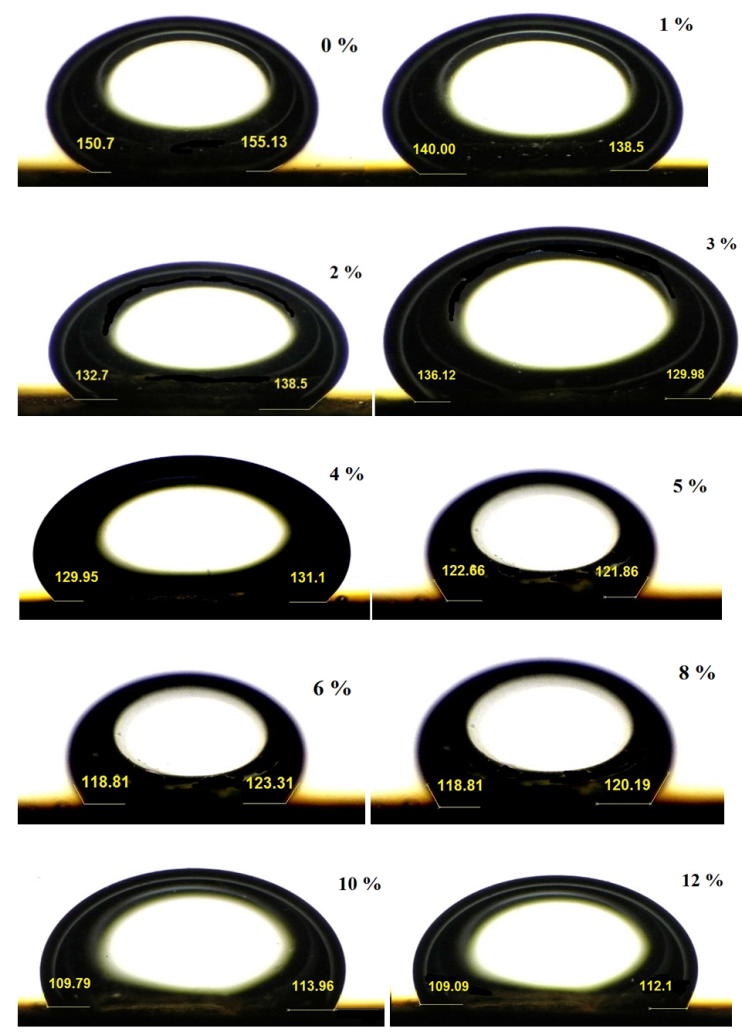
The addition of aqueous solutions of Matricaria Chamomilla extract changed the oil-wet pellet rock samples more toward neutral wet, as shown in Figure 9. The highest wettability variation was observed at 12%wt concentration with 28% change and for the CMC concentration was 21%.
Comparison of Wettability Alteration by Various Surfactants
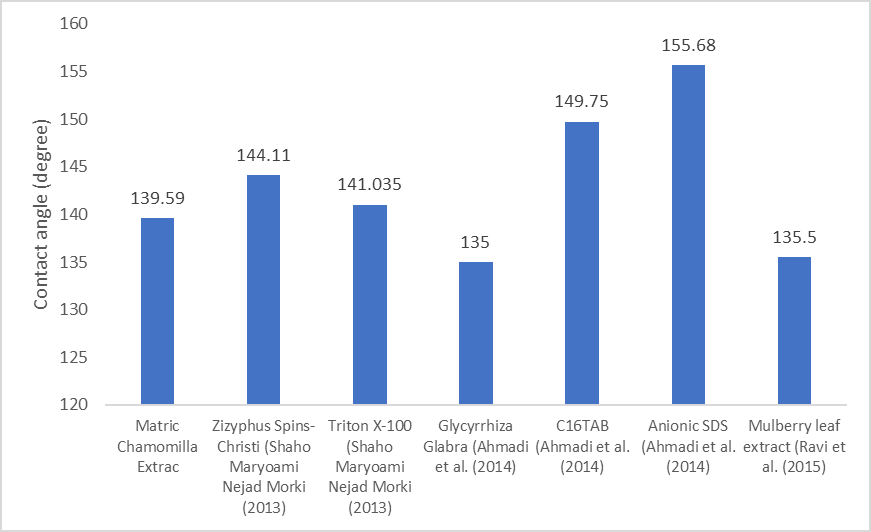
Due to the environmental fates of industrial surfactants, applications of biodegradable or natural-based surfactants turn into an interesting subject for many researchers in recent years [21, 22, 23, 24, 25]. The wettability of the oil-wet rocks was decreased due to the application of these surfactants. Figure 10 shows the final contact angle of treated oil- wet rocks with different industrial and plant surfactants and Matricaria Chamomilla extract. As seen in Figure 10, Matricaria Chamomilla extract effect on wettability alteration is similar to other plant surfactants, and it is more effective than synthetic surfactants used in chemical enhanced oil recovery.

Surfactants are surface-active substances that consist of a polar (hydrophilic) head and a nonpolar (hydrophobic) tail and have an affinity to aqueous and non-aqueous phases due to their amphiphilic nature. They can reduce the interfacial tension between the aqueous and oil phase and alter the reservoir wettability, from oil-wet to less oil wet, to promote more oil displacement [35]. Wettability is altered through ion-pairing between the hydrophilic head and the adsorbed basic components of the crude oil on sandstone rock; and the ion pairs formation with the adsorbed acidic components of the crude oil on carbonate surfaces [36]. The wettability alteration of the Matricaria Chamomilla extract as observed in this study and its interfacial tension reduction as reported by Shadizadeh and Kharrat [33] can be used for enhanced oil recovery of oil-wet and natural wet reservoirs through water relative permeability alteration. The observed change of oil-wet to less oil-wet is compatible with the most available surfactants. This might be due to its amphiphilic nature which reduced not only the IF [33] but also the contact angle.
Conclusions
This study investigated the feasibility of Matricaria Chamomilla extract as a surfactant agent for reservoir rock wettability-alteration usable for chemical oil recovery processes. Qualitative wettability tests (floating wettability and separation wettability tests) and quantitative wettability tests (contact angle using the pendant drop method) were implemented to demonstrate the total effects of the Matricaria Chamomilla extract on the reservoir rock wettability. Based on this study, the following conclusions were obtained.
- The treated crushed rock sample instantly sunk in 5.5 wt % Matricaria Chamomilla extract solution in the flotation wettability test. Alteration of oil-wet crushed rock sample toward water-wet by Matricaria Chamomilla extract is the prestigious performance and robustness. Also, separation tests showed that Matricaria Chamomilla extract changed the oil-wet crushed rock sample to water wet, where the treated crushed rock sample instantly sunk in the water phase.
- In the contact angle test, various aqueous solutions of Matricaria Chamomilla extract changed the oil-wet pellet rock samples toward neutral wet. The highest wettability variation was observed at 12%wt concentration with 28% change and for the CMC concentration of 5.5% was 21%.
- The Matricaria Chamomilla extract effect on wettability alteration is similar to other plant surfactants. The wettability alteration of Matricaria chamomilla extract is more effective than synthetic surfactants used in chemical enhanced oil recovery.
- Due to the environmental fates of the synthetic surfactants and the low cost of Matricaria Chamomilla extract, it can be used in chemical-enhanced oil recovery.
References
-
Kharrat R, Rabani A (2017) Practical Improved Hydrocarbon Recovery: An Industrial Guide Book for EOR and IOR. Lap Lambert Academic Publishing, pp: 180.
-
Pal S, Mushtaq M, Banat F, Al Sumaiti AM (2018) Review of surfactant-assisted chemical enhanced oil recovery, for carbonate reservoirs: challenges and future perspectives. Pet Sci 15: 77-102.
-
Massarweh O, Abushaikha AS (2020) The use of surfactants in enhanced oil recovery: a review of recent advances. Energy Rep 6: 3150-3178.
-
Lu J, Liyanage PJ, Solairaj S, Adkins S, Arachchilage GP, et al. (2014) New surfactant developments for chemical enhanced oil recovery. J Pet Sci Eng 120: 94-101.
-
Ahmadi MA, Shadizadeh SR (2013) Experimental investigation of adsorption of a new nonionic surfactant on carbonate minerals. Fuel 104: 462-467.
-
Kianinejad A, Rashtchian D, Ghazanfari MH, Kharrat R (2014) Apore-level investigation of surfactant crude oil displacement behavior in fractured porous media using one-quarter five-spot micromodels. Energy Sources, Part A: Recovery, Utilization, and Environmental Effects 36(7): 727-737.
-
Green D, Willhite GP (2018) Fundamental of Enhanced Oil. Society of Petroleum Engineers.
-
Parsons RW, Chaney PR (1966) Imbibition model studies on water-wet carbonate rocks. SPE J 6(1): 26-34.
-
Zhou X, Torsaeter O, Xie X, Morrow NR (1993) The effect of crude-oil aging time and temperature on the rate of water imbibition and long-term recovery by imbibition. SPE Annual Technical Conference and Exhibition, Houston, TX, USA.
-
Lake LW (1989) Enhanced Oil Recovery. Prentice-Hall, Englewood Cliffs, pp: 50.
-
Islam MR (1999) Emerging technologies in enhanced oil recovery. J Energy Sources 21(1-2): 97-111.
-
Thomas S (2008) Enhanced oil recovery-an overview. Oil Gas Sci Technol Rev D IFP Energy Nouv 63(1): 9-19.
-
Sheng J (2011) Modern Chemical Enhanced Oil Recovery. 1st (Edn.), Gulf Professional, Amsterdam.
-
Gandomkar A, Kharrat R (2012) The tertiary FWAG process on gas and water invaded zones: An experimentalstudy. Energy Sources 34(20): 1913-1922.
-
Anderson W (1986) Wettability literature survey-Part 2: Wettability measurement. J Pet Technology 38(11): 1246-1262.
-
Kamal MS, Hussein IA, Sultan SA (2017) Review on Surfactant Flooding: Phase behavior, retention, IFT, and field application. Energy & Fuel 31(8): 7701-7720.
-
Spildo K, Johannessen AM, Skauge A (2012) Low salinity waterflood at reduced capillarity. SPE Improved Oil Recovery Symposium, Tulsa, Oklahoma, USA.
-
Austad T, Matre B, Milter J, Saevereid A, Øyno L (1998) Chemical flooding of oil reservoirs 8. Spontaneous oil expulsion from oil- and water-wet low permeable chalk material by imbibition of aqueous surfactant solutions. Colloids and Surfaces A: Physicochemical and Engineering Aspects 137 (1-3): 117-129.
-
Kharrat R, Zallaghi M, Ott H (2021) Performance Quantification of Enhanced Oil Recovery Methods in Fractured Reservoirs. Energies 14(16): 4739.
-
Gugl R, Kharrat R, Shariat A, Ott H (2022) Evaluation of Gas based EOR Methods in Gas Invaded Zones of Fractured Carbonate Reservoir. Energies 15(13): 4921.
-
Pordel M, Shadizadeh SR, Jamialahmadi M (2012) A New Type of Surfactant for Enhanced Oil Recovery. Petroleum Science and Technology 30(6): 585-593.
-
Deymeh H, Shadizadeh SR, Motafakkerfard R (2012) Experimental investigation of Seidlitzia rosmarinus effect on oil-water interfacial tension: Usable for chemical enhanced oil recovery. Scientia Iranica 19 (6) 1661-1664.
-
Maryami Nejad MS (2013) Experimental Investigation of Wettability Alteration Effects on Relative Permeability of Carbonated Porous Media. MSc thesis, Petroleum University of Technology (PUT), Ahwaz, Iran.
-
Ahmadi MA, Galedarzadeh M, Shadizadeh SR (2014) Wettability Alteration in Carbonate Rocks by Implementing New Derived Natural Surfactant: Enhanced Oil Recovery Applications. Transport in Porous Media 106(3) 646-667.
-
Ravi SG, Shadizadeh SR, Moghaddasi J (2015) Core Flooding Tests to Investigate the Effects of IFT Reduction and Wettability Alteration on Oil Recovery: Using Mulberry Leaf Extract. Petroleum Science and Technology 33(3): 257-264.
-
Jalali A, Mohsenataba A, Shadizadeh SR (2019) Experimental investigation on new derived natural surfactant: wettability alteration, IFT reduction, and core flooding in oil-wet carbonate reservoir. Energy Sources Part A: Recovery Utilization and Environmental Effects.
-
Bera A, Mandal A (2015) Microemulsions: a novel approach to enhanced oil recovery: a review. J Pet Explor Prod Technol 5(3): 255-268.
-
Bachari Z, Isari AA, Mahmoudi H, Moradi S (2019) Application of Natural Surfactants for Enhanced Oil Recovery-Critical Review. IOP Conf Series Earth and Environmental Science, Prague, Czech Republic.
-
Srivastava JK, Shankar E, Gupta S (2010) Chamomile: A herbal medicine of the past with bright future. Molecular medicine reports 3(6): 895-901.
-
Heidari M, Sarani S (2012) Growth, Biochemical components and ion content of Chamomile (Matricaria Chamomilla L.) under salinity stress and iron deficiency. Journal of the Saudi Society of Agricultural Sciences 11(1): 37-42.
-
Nargesi S, Moayeri A, Ghorbani A, Seifinejad Y, Shirazdpour E, et al. (2018) The effects of Matricaria Chamomilla L.hydroalcoholic extract on atherosclerotic plaques, antioxidant activity, lipid profile and inflammatory indicators in rats. Biomedical research and therapy 5(10): 2752-2761.
-
El Mihyaoui A, da Silva J CGE, Charfi S, Castillo MEC, Lamarti A, Arnao MB Chamomile (2022) (Matricaria chamomilla L.): A Review of Ethnomedicinal Use, Phytochemistry and Pharmacological Uses. Life (Basel) 12(4): 479.
-
Shadizadeh SR Kharrat R (2015) Experimental Investigation of Matricaria Chamomilla Extract Effect on Oil-Water Interfacial Tension: Usable for Chemical Enhanced Oil Recovery. Petroleum Science and Technology 33(8): 901-907.
-
Salehi M (2009) Enhancing the spontaneous imbibition process in naturally fractured reservoirs through wettability alteration using surfactants: mechanistic study and feasibility of using biosurfactants produced from agriculture waste streams. The University of Kansas, USA.
-
Bashir A, Haddad AS, Rafati R (2022) A review of fluid displacement mechanisms in surfactant-based chemical enhanced oil recovery processes: Analyses of key influencing factors. Petroleum Science 19(3): 1211- 1235.
-
Kumar A, Mandal A (2019) Critical investigation of zwitterionic surfactant for enhanced oil recovery from both sandstone and carbonate reservoirs: adsorption, wettability alteration, and imbibition studies. Chem Eng Sci 209: 115222.
- Nigeria’s Vulnerability in the Face of Global Energy Policy
- A Simulation Study of Investigation of Optimum Oil Production Performance by Applying Various Gas Injection Methods in Oil Reservoir
- Characterization of Permo-Triassic Reservoirs through Thermal Maturity Assessment of Westphalian Source Rocks in the Cheshire Basin
- Influence of Microwax on the Rheological and Thermal Behaviour of a Wax Crude Oil
- Real-Time Monitoring and Performance Optimization of Steam Injection in Heavy Oil Reservoirs Using Fiber Optic Sensing and Integrated Predictive Simulation Models
- Rapid On-Site Determination of the Total Petroleum Hydrocarbon Content of Soils by Handheld Fourier Transform Near-Infrared Spectroscopy: Development of a Global, Site- and Scanner- Independent Calibration Model