
Questionnaire Based Survey on Depression and Anxiety among Perimenopausal Women to Determine their Attitude and Knowledge of Menopause
Perimenopause and menopause have affected approximately one billion women worldwide. To ascertain the Depression and anxiety among perimenopausal women to know their attitude and knowledge of menopause through questionnaire. The survey was conducted from February 2023 to June 2023. An easily completed questionnaire was used to obtain the data. In this study, only the data from 30 women who were identified to be in perimenopausal age group were analysed. The aim of this study was to explore perimenopausal women’s attitude and knowledge of menopause.
Introduction
Menopausal stage of life begins when a woman’s menstrual periods end permanently. This stage, which is also known as the “change of life,” denotes the end of a woman’s reproductive potential. Many medical professionals refer to the time when a woman’s hormone levels start to change to be called menopause. Perimenopause is a common term for the period of transition before menopause. The number of mature eggs in a woman’s ovaries decreases during this transitional period prior to menopause, and ovulation becomes irregular. Oestrogen and progesterone are also produced less frequently. Most menopausal symptoms are brought on by the significant drop in oestrogen levels [1].
Most frequently, menopausal transition starts between ages 45 and 55. It typically lasts seven years, but it can last up to fourteen years. The length of time can vary depending on lifestyle factors like smoking, the age at which it starts, and race and ethnicity. Oestrogen and progesterone, two hormones produced by the ovaries, are produced in varying amounts by the body during perimenopause. Each woman is affected by menopausal transition differently and in different ways. Women may put on weight more quickly due to changes in fat cells and how the body uses energy [2].
At any point in a woman’s life, there is very little knowledge about menopause around the world, and the media frequently portrays menopause negatively. The result of this is that a lot of women are unaware of a life stage that can be extremely symptomatic. In addition, many medical professionals lack adequate and current training on how to manage menopause [3]. It is predicted that 50 million women will experience menopause annually across the globe. It is anticipated that there will be 1.2 billion menopausal women worldwide. Hot flushes (40%), night sweats (17%), insomnia (16%), vaginal dryness (13%), mood disorders (12%), and weight gain (12%), were the most prevalent menopausal symptoms. In the United States, it is estimated that 40 to 50 million women experience vasomotor symptoms (hot flushes and/or night sweats), which account for 85% of postmenopausal women’s lifetime menopausal symptom experience [4]. The main purpose of the study is to determine the attitude, knowledge and mental changes that takes place in women during her perimenopausal phase.
Materials and Methods
A sample of 30 perimenopausal age women taken from Sarada Krishna Homoeopathic medical college and Hospital, Kulasekharam. Perimenopausal women age group of 45- 55 years will be selected based on the inclusion criteria. The information regarding the depression and anxiety among perimenopausal women to determine their attitude and knowledge of menopause, which will be recorded in pre- structured closed ended questionnaire. Questionnaire consists of questions targeted at information regarding the mental, physical, and social issues related to depression
Selection of Tools
and anxiety among perimenopausal age women. The women were informed it is mandatory to fill/return the questionnaire. Prior verbal consent was taken from the respondents and teachers for the study. The women who are not interested to participate were told that they may not return the questionnaire. Data documented from this study will be analyzed later and the results will be presented.
Inclusion Criteria: Women of age group 45-55 years. Exclusion Criteria: Women who had attained unnatural menopause, on medication such as anxiolytics, antidepressants, antipsychotic drugs and on any hormone replacement therapy. Women who were known case of systemic diseases, thyroid disorders and/or any genital pathology and women with missing period in last 12 months due to other physiological conditions other than menopause.
| Issues Faced | Questions | Yes | No |
|---|---|---|---|
| Depressed mood of feelings of hopelessness | |||
| Depressed on being insulted | |||
| Depressed when others hurt mentally | |||
| Depressed when family is not cooperative | |||
| Depressed on being alone | |||
| Depressed when doing household works | |||
| Depression | Depression due to financial crisis | ||
| Depressed during arguments at home | |||
| Depressed when husband is not cooperative | |||
| Anxiety while doing household works | |||
| Anxiety while approaching others | |||
| Anxiety when going into crowd | |||
| Anxiety | Anxiety when sitting alone | ||
| Anxiety after sunset | |||
| Anxiety on being alone | |||
| Anxious while speaking with others | |||
| Mood swings | |||
| Brooding of thoughts | |||
| Orientation | Forgetfulness | ||
| Difficulty in concentration | |||
| Loathing of life | |||
| Excessive sweating | |||
| Shivering of hands and legs | |||
| Physical Issues | Hot flushes all over the body | ||
| Feeling of discomfort | |||
| Sensation of indigestion | |||
| Sl No | Issues | No of Response | Percentage |
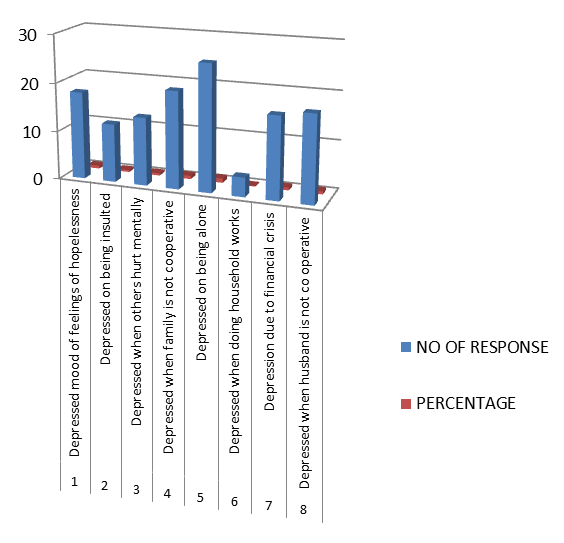
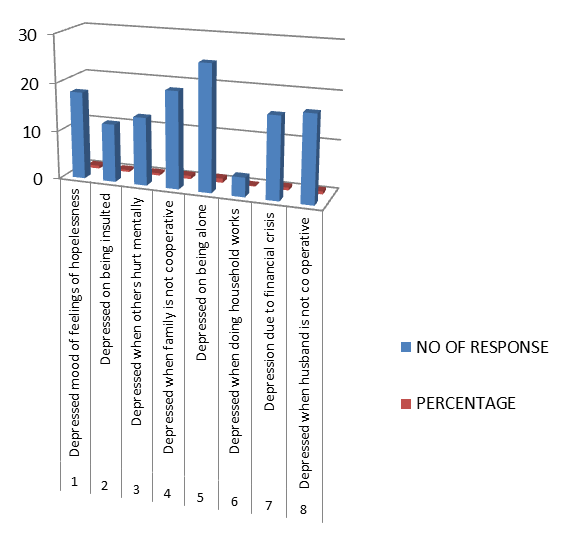
| 1 | Depressed mood of feelings of hopelessness | 18 | 60% |
| 2 | Depressed on being insulted | 12 | 40% |
| 3 | Depressed when others hurt mentally | 14 | 46.67% |
| 4 | Depressed when family is not cooperative | 20 | 66.67% |
| 5 | Depressed on being alone | 26 | 86.67% |
| 6 | Depressed when doing household works | 4 | 13.33% |
| 7 | Depression due to financial crisis | 17 | 56.67% |
| 8 | Depressed when husband is not co operative | 18 | 60% |
Table 1: Pre structured closed ended questionnaire.
Results and Discussion
This section includes tables and charts detailing the observations and outcomes of response of thirty participants on the pre structured questionnaire perceiving the mental, physical, issues faced by perimenopausal women.
| Sl No | Issues | No of Response | Percentage |
|---|---|---|---|
| 1 | Anxiety while doing household works | 10 | 33.33% |
| 2 | Anxiety while approaching others | 15 | 50% |
| 3 | Anxiety when going into crowd | 16 | 53.33% |
| 4 | Anxiety when sitting alone | 24 | 80% |
| 5 | Anxiety after sunset | 18 | 60% |
| 6 | Anxiety of being left alone in future | 19 | 63.33% |
| 7 | Anxiety while speaking with others | 16 | 53.33% |
| 8 | Anxiety about future of children | 23 | 76.67% |
Table 2: Distribution according to anxiety.
| Sl No | Issues | No of Response | Percentage |
|---|---|---|---|
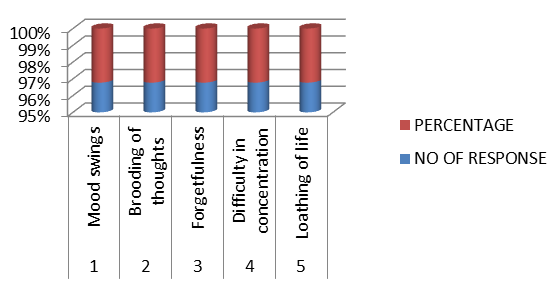
| 1 | Mood swings | 23 | 76.67% |
| 2 | Brooding of thoughts | 24 | 80% |
| 3 | Forgetfulness | 26 | 86.67% |
| 4 | Difficulty in concentration | 20 | 66.67% |
| 5 | Loathing of life | 13 | 43.33% |
Table 3: Distribution according to orientation.
| Sl No | Issues | No of Response | Percentage |
|---|---|---|---|
| 1 | Excessive sweating | 22 | 73.33% |
| 2 | Shivering of hands and legs | 15 | 50% |
| 3 | Hot flushes all over the body | 24 | 80% |
| 4 | Feeling of discomfort | 21 | 70% |
| 5 | Sensation of indigestion | 18 | 60% |
Table 4: Distribution according to physical issues.
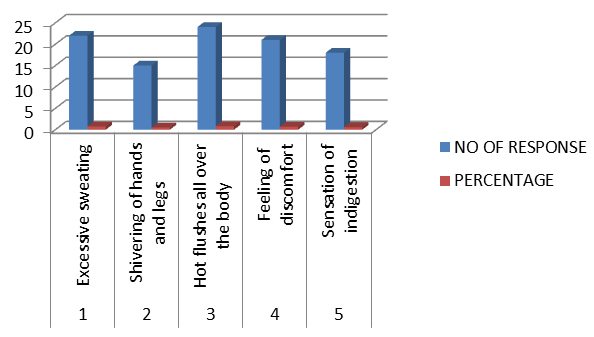
To my knowledge, this is the first survey that was conducted taking into consideration the women’s attitude towards enhancing their knowledge about menopause. This quantitative and qualitative analysis has demonstrated the necessity of beginning menopausal education in schools and continuing it throughout a woman’s lifetime. All women need to have access to medical professionals who are qualified to treat them. From the present study most of the respondents had faced issues in the mental level than the physical level. About 86.6% of the respondents faced depression on being alone and forgetfulness around menopausal time. About 80% of them had brooding of thoughts during menopause. Significant finding was that about 80% of the perimenopausal women had the feeling of hot flushes all over the body.80% of the menopausal women had anxiety when sitting alone.76.6% of the respondents faced mood swing around the menopausal time.76.6% women felt anxious about future of children.
About 73.3% respondents felt excessive sweating.70% of the women had a feeling of discomfort during this time. Around 66.6% of women faced difficulty in concentrating. Around 66.6% women felt depressed when family was not co-operating. Around 63.3% women felt apprehensive of being left alone in future.60% of women felt depressed when husband was not co-operative. Around 43.3% perimenopausal women felt loathing towards life.13.3% only showed depression while doing household work.
Previous survey demonstrated that the perimenopause/ menopause was accepted by 38.7% of women, while the second most frequent response—dreading it—was expressed by 31.0% of them. While women with negative attitudes were younger and premenopausal, postmenopausal women tended to have more positive attitudes towards menopause [5]. According to a study, women in their forties and younger consistently expressed fewer positive feelings about menopause than postmenopausal and older women [6].
Conclusion
Thirty perimenopausal age group women from Sarada Krishna Homoeopathic Medical College and Hospital were selected for the study. The study showed a variety of mental and physical level issues faced by perimenopausal women. On analysing the responses, it was noted that most of the respondents faced issues on Mental plane such as depressed on being alone, forgetfulness, brooding of thought and physical plane includes hot flushes all over the body, excessive sweating, feeling of discomfort. This study showed that symptoms of depression and anxiety vary in perimenopausal women. It was found that middle aged women who were in perimenopausal age group experienced increase of symptoms of depression, forgetfulness, brooding of thought.
Those who are having mental and physical issues during menopausal time needed counselling and proper care to make them feel comfortable. For improving this situation husband and the family also must be educated regarding menopausal changes. So that we can accept them with all their tantrums and be supportive. Inclusion of Phyto oestrogens, balanced diet and regular exercise can also be thought of in managing the situation.
References
-
Introduction to Menopause. Conditions and Diseases.
-
What Is Menopause. National Institute on Aging.
-
Gibson MC, Al-Edresi R (2001) Menopause epidemiology and demographics.
-
Aljumah R, Phillips S, Harper JC (2023) An online survey of postmenopausal women to determine their attitudes and knowledge of the menopause. Post Reprod Health 29(2): 67-84.
-
Sommer B, Avis N, Meyer P, Ory M, Madden T, et al. (1999) Attitudes toward menopause and aging across ethnic/ racial groups. Psychosom Med 61(6): 868-875.
- Occupational Stress and Mental Health Outcomes Among Police Officers: A Mini Review
- The Experience of Counterproductive Leadership on Mental Health and Impact on Retention in U.S. Marines: A Phenomenological Study
- Nomophobia in the Digital Age: A Study on College and University Students
- Emotional Regulation in Children with Autism and Learning Disabilities
- Antisemitism on American College Campuses and Its Impact on Jewish Students
- Exploring the Role of Empathy in the Associations of Family Functioning and Purpose in Life with Attitude towards Abortion among Undergraduates: A Moderation Analysis