
The Double Helical Structure of DNA in Quantum Mechanics, and Nonlinear Biomechanics
First, based on the extensive quantum mechanics in biology, Schrödinger equation at column coordinates and its solution may derive the double helical structure of DNA. It is necessity mathematical conclusion that quantum mechanics has symmetry. Second, we discuss the nonlinear biomechanics, which is related to chaos, fractal and soliton, etc. Third, an important character of the nonlinear biosystems is the formation of self-organization, which should decrease entropy. Fourth, we propose the preliminary epidemic equations of COVID-19, and discuss their meaning. Complex biology provides a wide region for entropy decrease in various isolated systems.
Introduction
Molecules are the basis of life. They are necessary considered as a quantum system in biology. York, et al. researched quantum mechanical treatment of biological macromolecules in solution using linear-scaling electronics structure methods [1]. McFadden, et al. proposed a quantum mechanical model of adaptive mutation [2]. DNA is an important basis of molecular biology [3]. It is well-known that the model of DNA is a double helical structure. Peyrard, et al. studied effective breather trapping mechanism for DNA transcription [4], and generation of high-energy localized vibrational modes in nonlinear Klein- Gordon lattices [5]. Mirzaee, et al. considered the DNA molecule as a quantum system, and discussed the relation among heredity, biology and DNA and quantum systems, and found a relation between the quantum information and some bio-processes such as cell division, heredity, and cloning. Their conclusion is that in cell division, DNA-replication and cloning all information in DNA are different [6]. Benham, et al. edited a book <Mathematics of DNA Structure, Function and Interactions> [7]. In this paper, we derive the DNA model by Schrödinger equation at column coordinates in the biologic quantum mechanics, and discuss the nonlinear biomechanics and its meaning, etc.
Extensive Quantum Theory of Biology
Great physicist Feynman pointed out: “There are certain situations in which the peculiarities of quantum mechanics can come out in a special way on large scale.” In a special situation “quantum mechanics will produce its own characteristic effects on a large or ‘macroscopic’ scale” [8]. Based on the extensive quantum theory in which the formulations are the same with the quantum mechanics and only quantum constant η and corresponding basic quantum elements are different [9, 10], we proposed the extensive quantum biology [11].
Schrödinger equation in quantum biology is basis, and induces time rhythm and periodicity. The neural pulse obeys “all-or-none law”, which is integrated “all” pulse, or “none”pulse, and never exist in fractional pulse. It is a typical quantized phenomenon, and is already the extensive quantum biology. Therefore, the nerve conduction may apply the nonlinear quantum biology and the soliton model, which keeps the integrality and veracity of information in biological transfer, in particular, for heredity.
The basic elements of the biological quantum can be the biological macromolecule [12], 20 types of amino acids, proteins, cells and individuals, etc. Nucleic acid has five types of base quantum: A, T, G, C and U. They as graph theory have only three types of vertex H, N and C.
Further, we researched the extensive quantum theory of DNA, and corresponding quantum theory and its many mathematical methods. Assume that the basic quantum elements of DNA are A-T and G-C. From this we discussed symmetry and supersymmetry of DNA, and the quantum theory and equations of DNA, in particular, the SU(2) gauge theory and some solutions of equation. We derived the double helical structure of DNA from Schrödinger equation with the simple linear potential, which may become the Bessel equation. Its solutions are Bessel functions, and may form the double helical structure of DNA in three dimensional spaces. From this model we predicted the discrete bound energy spectrum of DNA, and discussed some solutions of quantum mechanics and their meaning [13, 14].
The basic equation of quantum mechanics is the Schrödinger equation:
$$ i \hbar \frac {\partial \psi}{\partial t} = \left(- \frac {\hbar^ {2}}{2 m} \nabla^ {2} + U\right) \psi . [ 1 ] $$ The time-independent Schrödinger equation is:
$$ \Delta \psi + \frac {2 m}{\hbar^ {2}} (E - V) \psi = 0. [ 2 ] $$
$$ \mathrm {L e t} \quad \frac {2 m}{\hbar^ {2}} (E - V) = k ^ {2}, $$
, Equation(2) may become to the Helmholtz equation, i.e., wave equation. When V=E, it is Laplace equation. For the extensive quantum biology only $$ \hbar \rightarrow H. $$
DNA Model of Quantum Mechanics at Column Coordinates
For Equation (2) at column coordinates, by the general method let ( ) ( ) ( ) R Z z ψ ρ φ = Φ , then
2 '' 0 Z h Z + = . (3)
2 '' 0 m Φ + Φ = . (4)
$$ \mathrm {H e r e} \lambda = m ^ {2} \mathrm {a n d} - \mu = h ^ {2} $$
are two constants separated
variables.
$$ \rho^ {2} \frac {d ^ {2} R}{d \rho^ {2}} + \rho \frac {d R}{d \rho} + \left[ \rho^ {2} \left(k ^ {2} - h ^ {2}\right) - m ^ {2} \right] R = 0. \tag {5} $$ Equations (3) and (4) are the same. Both solutions are also the same:
$$ Z (z) = C \cos (h z) + D \sin (h z). \tag {6} $$
$$ \Phi (\phi) = A \cos m \phi + B \sin m \phi . \tag {7} $$
Here m is quantized. The phase difference of two trigonometric functions is / 2 π .
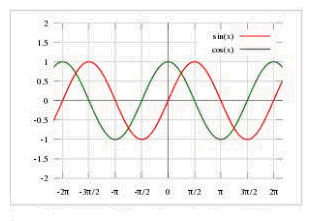
Equation (6) corresponds to Figure 1.
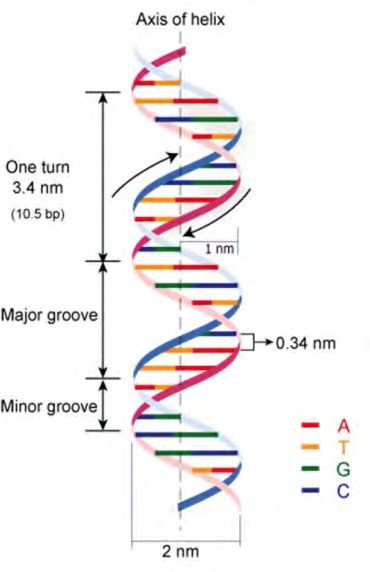
The equation (3) and its solution (6) just form and determine the double helical structure of DNA (Figure 2), in which / 2 π corresponds to the minor groove.
Its interaction between A-T and G-C is the hydrogen bond. When a≠b, it is an ellipse. When a=b=2nm, it is a radius of DNA, and 3.4nm is a thread pitch of DNA.
In this model of DNA, h and m are independent on energy E, potential V, the extensive quantum constant H and mass. It seems to correspond to the universality of DNA. Quantum theory has the axial symmetry that necessarily leads to the DNA. DNA can be considered as an internalization of wave.
In usual case the polar coordinate in the plane ( ) ( ) R ρ φ Φ should determine the circle (x=Rcost, y=Rsint) or the ellipse. But, general solutions show mainly the wave.
The general solution of Equation (5) is the m order Bessel function:
2 4 2 m m k k m m m k k J m m m m k m k ρ ρ ρ ρ ρ + ∞ $$ ) = \frac {\rho^ {m}}{2 ^ {m} m !} [ 1 - \frac {\rho^ {2}}{2 (2 m + 2)} + \frac {\rho^ {4}}{2 ^ {3} (2 m + 2) (2 m + 4)} - \dots ] = \sum_ {k = 0} ^ {\infty} (- 1) ^ {k} \frac {\rho^ {m + 2 k}}{2 ^ {m + 2 k} k ! (m + k)} $$
3 2 0 ( ) [1 ...] ( 1) 2(2 2) 2 ! 2 (2 2)(2 4) 2 !( )!
(8)
2 4 $$ J _ {1} (\rho) = \frac {\rho}{2} \left(1 - \frac {\rho^ {2}}{8} + \frac {\rho^ {4}}{1 9 2} - \dots\right) \tag {9} $$ So long as
$$ \rho < 1, \mathrm {s o} J _ {1} (\rho) \approx \frac {\rho}{2} \mathrm {d} $$
describes a circle.
The Bessel equation and its asymptotic solution for long DNA link may also form the double helical structure of DNA in three dimensional space [14]. For the m order Bessel equation (5), its general solution is:
$$ R (x) = A J _ {m} (x) + B N _ {m} (x). \tag {10} $$
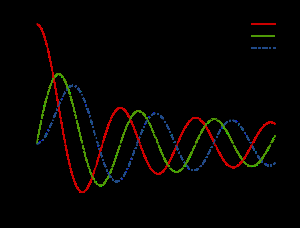
Here ( ) m J x are the Bessel functions (the cylinder functions) of the first kind (Figure 3) and ( ) m N x are the spherical Bessel functions of the third kind (also called the Hankel functions). It may be any potential. When V<E, it is Hankel equation, when V>E, it is imaginary Hankel equation,
If the bound condition is R(0)=0, there will be $$ A J _ {m} (0) + B N _ {m} (0) = 0. \tag {11} $$ For large x that corresponds possibly to the formulation of a long DNA link, and a result of long-term evolution, the asymptotic solution becomes:
$$ R \approx a \cos \left(x - \frac {\pi}{2} m - \frac {\pi}{4}\right) + b \sin \left(x - \frac {\pi}{2} m - \frac {\pi}{4}\right). \tag {12} $$ It corresponds also to Figure 1.
At the spherical coordinates, by general method let $$ \psi = R (r) \Theta (\theta) \Phi (\phi), $$
, which has the same Equation(6), and
may also form the double helical structure of DNA. Therefore,
quantum theory has the spherical symmetry that may lead to
the DNA.
Generally, the biologic systems have widely statistics, which is closely related to quantum mechanics. They seem to correspond mainly to bosons, and should have the extensive Bose-Einstein condensation (BEC).
A process of formulation of DNA should be: First, the quantum of DNA interact each other. Then they are long-term evolution, and connected each other, and finally form the double helical structure of DNA. Further, we should research mathematical-physics-biological significance of various parameters, and the biological meaning of the saddle-point, and so on.
In a word, Z(z) and ( ) φ Φ may all determine the double helical structure of DNA. Even the Bessel equation may also form the double helical structure of DNA. Quantum mechanics determines the structures and shapes of all molecules, including DNA and RNA.
Biomechanics and its Nonlinear Developments
Biomechanics investigates the mechanical properties of bone, cartilage, ligament, tendon, muscle, the neuro- musculo-skeletal system, and biomaterials, etc [15, 16, 17]. This assumes that some corresponding relations exist between biology and physics, and the biosystem and corresponding mechanics are related each other.
Based on the inseparability and correlativity of the biological systems, we proposed the nonlinear whole biology and four basic hypotheses [18]. It may unify reductionism and holism, structuralism and functionalism, and is consistent with the systems biology. Further, the loop quantum theory is applied to biology, and proposed the model of protein folding and lungs, and obtain four approximate conclusions [18].
Generally, biomechanics should be nonlinear. In nonlinear mechanics there are strange attractors and chaos. In biology and physiology there are widely various chaos and fractal [19] and the nonlinear dynamics. They include the excited or stimulated state of neuron and whose Hodgkin-Huxley equation [20], and the heart beats rhythmically and its Bonhoeffer-Van der Pol equation [21], and the exudation of hormone, and the dynamical disease and epidemic, and the complex structure of living systems [22], etc. Hartline equation in the inhibitory neural network may add the nonlinear terms, and then chaos will appear.
Goldberger, et al. proposed the fractal hypothesis on a mechanism of cardiac electrical stability, and some observations on the question as ventricular fibrillation 'chaos' [23, 24]. The fractal in biology may be dependent on gene, DNA and their structural formations. They are continuously embedded by some self-similarity, and form various organism. A self-similarity may construct the same new cells, synapses and so on. The blood, breathing and neural systems possess the fractal characters and the fractal dimensions.
Typical of nonlinear mechanics includes hydrodynamics and Lorenz model, which is applied to describe the model of brain, whose two wings correspond to two hemispheres [25]. Two hemispheres of brain jump about, which seems to thinking. It shows that life lies in cooperation in chaos. We discussed the fractal, chaos and soliton in nonlinear biology and neurobiology, in particular, for in which there are soliton-chaos double solutions [25]. In this case soliton may keep the integrality and veracity of information in neural transfer. The nonlinear mechanism of memory is researched [11]. Based on the extensive quantum theory in which the formulations are the same with the quantum mechanics and only quantum constant $h$ is different [9, 10], we proposed the extensive quantum biology [11].
The soliton and exciton of energy transfer in biological macromolecules are the typical nonlinear phenomena. Davydov investigated the soliton model of the vibrational energy transported along the biological macromolecules [26]. The known neural conduction may use Davydov soliton and its extension. For the Davydov model of a one-dimensional protein, Lomdahl and Kerr added the fluctuation and dispersion terms, and the lifetime of Davydov soliton is only the order ns [27]. Cottingham and Schweitzer calculated that the lifetime of a Davydov soliton at finite temperature is still 1ns for the $\alpha$-helical protein molecule using a first-order perturbation theory [28]. This is too short to be useful in biological processes. Using the quantum Monte Carlo technique, Wang, et al. investigated the one-dimensional Davydov model in the $\alpha$ helix, and found that Davydov soliton at 310K is instable [29].
We discussed biofield and some nonlinear theories in biology. They include chaos in biology and its application to cancer, and fractal and complex dimension in biology, etc. The nonlinear biothermodynamics and in which possible entropy decrease are investigated [30, 31, 32]. Generally, we proposed that entropy decrease due to internal interactions in the isolated system is possible. We defined the entangled scale, which mainly involves the number $n$ and entangled degree. Since coherence, entanglement and correlation are all internal interactions in information systems, we discussed quantitatively entropy decrease along coherence, and entropy increase only for incoherence. From beginning quantum heat engine, we must systematically study quantum thermodynamics. Based on some astrophysical simulation models, they shown that the universe evolves from disorder to structures, which correspond to entropy decrease. This is consistency with theoretical result. The simulation must be an isolated system only using internal gravitational interactions [33].
Hill equation described the mechanical property of muscle is [12]:
$$ (P + a)V = b(P_0 - P) $$
So the acceleration is:
$$ w = \frac{dV}{dt} = b \frac{d}{dt} \left( \frac{P_0 - P}{P + a} \right) = -\frac{b(P_0 - P)}{(P + a)^2} \frac{dP}{dt} $$
$F=mw$ is a traction force. This corresponds to the elastic mechanics. Further, it should be the nonlinear elastic mechanics.
The elastic mechanics may derive the oscillation. Van der Pol equation describes approximately the pulsation of heart. The nonlinear oscillational equation may derive soliton. The non-harmonic oscillator with force is:
$$ x'' + kx' - \beta x + \alpha x^3 = b \cos(\omega t) $$
It has the chaos solution. If $x''=0$ and $b=0$, it will be an ordinary differential form of Heisenberg unified equation [34]. If $x''\neq0$ and $k\neq0$, it will be an ordinary differential form of the square of the nonlinear Dirac equation:
$$ \left( \frac{\partial}{\partial x} + b - a\psi^2 \right)^2 \psi = 0 $$
and
$$ \left( \frac{\partial^2}{\partial x^2} + b^2 - 2ab\psi^2 \right) \psi - 2a\psi^2 \frac{\partial}{\partial x} \psi + a^2\psi^5 = 0 $$
In biology the quasispecies equation is:
$$\dot{x}_i = \sum_{j=0}^{n} x_j f_j Q_{ji} - \varphi x_j, \quad (i=0,1,...,n)$$
It is a nonlinear biological equation.
The replication equation is:
$$\dot{x}_i = x_i [f_j(\bar{x}) - \varphi(\bar{x})], \quad (i=0,1,...,n).$$
It and Lotka-Volterra equation are equivalence, such the theoretical ecology and the evolutionary game theory are completely contacted.
Different sensation systems are usually independent each other. Our collective open out the potential of blind children, and found through a period training of time, some children by touch or nose or ear can distinguish different colors, even simple figure and numbers. From this and other research, we proposed a hypothesis: The neural excitable cell is continuously induced and excited, then grow out new synapse and dendrite, and the feeling system, hearing system, smell system, etc., may joint to visual system, and form a new neural network, and achieve finally a transformation among vision and other sensations. Further, we proposed some possible tests, for example, for trained mammal, etc., and researched possible theories. It is a testable application of the nonlinear whole neurobiology. This may build a bridge between modern science and traditional culture, religion [35].
In the neurobiology Hodgkin-Huxley equations, FitzHugh-Nagumo equations and much interactions are all nonlinear. FitzHugh-Nagumo dynamical equations of a single neuron are:
$$c \frac{dV(t)}{dt} = V(t) - V^3(t) - y(t),$$
$$\frac{dy(t)}{dt} = \gamma V(t) - y(t) + b + \sqrt{2D} \xi(t).$$
Here b is a constant, and $\xi(t)$ represents Gauss white noise. We apply the qualitative analysis theory of the nonlinear equations, the characteristic matrix of Equations (20) and (21) is:
$$\begin{pmatrix} 1 - 3V^2 & -1 \\ \gamma & -1 \end{pmatrix}.$$
The solutions of $3V^2 - 1 + \gamma = 0$ are $(\pm \sqrt{1/3}, 0)$ and $(0,1)$, and the results of the qualitative analysis are independent of b and a random term $\xi(t)$. It is also a fractal structure.
Nonlinear Biology and Entropy
Generally, biological evolutions are increases of complexity and bioinformation. They should correspond to entropy decrease. In an evolutional process with long time, life forms a nonlinear complex and complete system with multi-levels: gene, cell, tissue, organ, system, individual, population, community, ecosystem, bio-sphere. If the biosystem is isolated at a certain time, the second law of thermodynamics will be violated.
Life forms a nonlinear, multi-level, complex and complete system during long-term evolution. The molecular motors play a very important role in maintaining high levels of order in biological systems. We think, the molecular motor corresponds to dS<0. In the microtubule the motor proteins have kinesin and dynein. Their moving way is hand-over-hand [36]. The kinesin moves matter of cell nucleus to cell membrane, and dynein moves matter of cell membrane to cell nucleus. Their transport direction is just opposite, but, both are not competition [37]. Moreover, many motors may work together, and produce speed with 10 time unit motor. It is namely order cooperative action [38]. Molecular motor transforms chemical energy of cell to mechanical energy [38, 39, 40, 41]. Motor protein general scale is 10nm, which is called Brownian motor [42]. It is also an extensive quantum.
The rotary motor is composed of biologic macromolecule, whose volume is small, and efficiency is very high almost 100%, and they may converse rotate. Its typical model is ATPase, which is a core enzyme for biologic energy translation in organism. The entire process of cell upgrowth and metabolism need energy, which is obtained from the chemical energy hydrolyzed by ATP under the most cases, and ATP is synthetized from ATPase. The molecular motor of ATPase may hydrolyze ATP, and may also synthetize ATP. This is similar with membrane and Maxwell demon.
Brownian motor may apply stochastic differential equation [43, 44, 45]:
$$\frac{dx}{dt} = \frac{\partial V(x(t), f(t))}{\partial x} + y(t) + F + D\xi(t).$$
Here $V(x, f)$ is the asymmetric potential of spatial period, $y(t)$ is periodic force, or random force; $F$ is load as study motor efficiency; $\xi(t)$ is Gauss white noise.
For Brownian motor, nonequilibrium and some breaking of the system symmetry are two necessary conditions to achieve directional motion in system [41, 46]. For a simplified motor system:
$$\frac{dx}{dt} = \frac{\partial V(x(t), f(t))}{\partial x} + A \sin \Omega t + D \xi(t).$$
If $A=0$, it will an equilibrium system.
Except Brownian motor motion induced by thermal noise, temporal or spatial symmetry breaking of a deterministic unbiased external force can also lead to directional motion of particles, called deterministic directional transport. Further, considering the mass and damping, the inertia of the particles will have a great impact, correspondingly called the inertial motor [44, 47, 41]. Inertial motors have very complex dynamical manifestations with regular transport orbits, chaotic transport phenomena, and the reversal phenomena of flows. And the direction of the flow depends on the mass and damping of the motor particles [48].
Directed motion at thermodynamic equilibrium implies the conversion of heat absorption from a single heat source into useful work, which is contrary to the second law of thermodynamics.
If changes of particle conformations are considered, the different moving states of motor particles can be described by coupled diffusion models [49, 38]:
$$\frac{dx}{dt} = \frac{\partial V_i(x)}{\partial x} + D_i \xi_i(t), i = 1, 2, \dots N.$$
Here $x = x(t, \omega)$.
Consider the stochastic differential equations for the coupled diffusion processes:
$$\frac{dx}{dt} = [F + \frac{\partial V_i(x)}{\partial x}] + D_i \frac{dB_i(t)}{dt}, i = 1, 2, \dots N.$$
Molecular self-organization is an autonomic process that forms molecules or polymer under non-external influence is nano-manufacture technology. Crane proposed two basic principles required for the self-assembly of molecules [50]. First, there must be multiple combinations between the components with weak interactions, and many combinations of weak interactions form strong interactions. Second, the assembly components must be highly complementary in topological geometry, resulting in tightly packed polymers. Further, Adleman proposed uses DNA computational experiments to study the programmable biochemical reactions for the self-assembly of DNA structures [51].
We proposed an entropy index of health on human body: $dS/dt$ should be least, even at period of time, man (woman) can regulate breath, body and ideology, and reach to $dS/dt<0$.
Such life lies in a combination between motion and rest, etc [30].
Preliminary Epidemic Equations of COVID-19
The propagation of COVID-19 is a typical nonlinear process with fractals and chaos. A key of controlling COVID-19 prevents propagation from reaching an irreversible chaos point. From corresponding nonlinear equations and their solutions, we may obtain three basic origins of disease, and corresponding therapeutic methods may be applied to COVID-19 [52]. This testifies that research on infectious diseases must apply the nonlinear whole medicine.
Liu, et al. developed two differential equations on COVID-19 epidemic model [53]. Beira, et al. discussed differential equations model-fitting analysis of COVID-19 epidemiological data to explain multi-wave dynamics [54]. Hall, et al. researched a mathematical modelling of the COVID-19 epidemic in Northern Ireland in 2020 [55].
By similar infectious disease epidemic equations [56, 57], let $x(t)$ is the number of people exposed, and $y(t)$ is the number of those potentially infected, we propose the preliminary epidemic equations of COVID-19:
$$\frac{dx}{dt} = \alpha xy - (\varepsilon + \delta)x - ky,$$
$$\frac{dy}{dt} = -\alpha xy + \delta x + ky.$$
Here $\alpha$ is infection rate, $\varepsilon$ is mortality rate, $\delta$ is cure rate, and $k$ is prevention rate. Their characteristic matrix is:
$$\begin{pmatrix} \alpha y - \varepsilon - \delta & \alpha x - k \\ -\alpha y + \delta & -\alpha x + k \end{pmatrix}.$$
Its eigen-equation is:
$$\lambda^2 + [\alpha(x - y) - k + \varepsilon + \delta] \lambda + \varepsilon(\alpha x - k) = 0.$$
$$\frac{d(x + y)}{dt} = -\varepsilon x,$$
For Equation (27) if $k=0$,
$$x = C \exp[\alpha y - (\varepsilon + \delta)].$$
As long as $\alpha y > \varepsilon + \delta$, it will increase exponentially. If $\alpha y = \varepsilon + \delta$, $dx/dt=0$. Equation (32) replaces into Equation (28) with $k=0$, and derives $$\frac{dy}{dt} = C' e^{ay} (-\alpha y + \delta).$$ (33)
Integral of Equation (33) is:
$$C_0 + \ln |y| - y + \frac{\alpha y^2}{2 \cdot 2!} - \frac{\alpha^2 y^3}{3 \cdot 3!} + \ldots = -C' \alpha t.$$ (34)
Its first approximant is:
$$y = C'' e^{-\alpha t}.$$ (35)
It will decrease exponentially.
For COVID-19 we edited the Special Issue in EC Neurology in January 2021. We believe that science will surely defeat the epidemic, and mankind will greet a bright future.
Conclusion
We discussed some mathematical and physical developments of biology and medicine, which include biofield and biological electromagnetics [58]. We also research nonlinear biology and biotopology, in which some knots may describe the protein folding. Further, symbolic dynamics of biology and the extensive quantum biology are researched. We studied the biothermodynamics and entropy. In thermodynamics of pharmacology, the main effects of various drugs are to promote internal interactions in body, and entropy decrease. We introduced the diagnostic space, treatment space and some medicinal vectors, and propose the matrix mechanics of pharmacology. It is also the input-output model of medical treatment. Moreover, we researched biology, medicine and pharmacology with time sequences. If we master the medication time, this will be able to get the minimum amount of medication, and the drugs can play the maximum treatment effect. If period is accurate, it can determine the time of play, negotiations, attack, etc. But, period of each individual should be change follow age, etc. This is a very valuable study [58].
Biology possesses some characters of whole, self-organization and jump-evolution, etc. An important nonlinear interaction is the formation of self-organization, which should decrease entropy. The second law of thermodynamics is essentially science, it should not become a belief.
The complex biology provides a wide region for research of possible entropy decrease in various isolated systems for different levels in biological systems, for example, membrane, enzyme, molecular self-assembly, adenosine triphosphates (ATP) and molecular motor, etc.
In a word, various mathematical and physical methods apply continuously different aspects in biology, this will accelerate deep development of modern biology.
References
-
York DM, Lee TS, Yang W (1998) Quantum mechanical treatment of biological macromolecules in solution using linear-scaling electronics structure methods. Phys Rev Lett 80(22): 5011-5014.
-
McFadden J, Al-Khalili J (1999) A quantum mechanical model of adaptive mutation. Biosystems 50(3): 203-211.
-
Micklos DA, Freyer G (2003) DNA Science: A First Course. 2nd(Edn.), Cold Spring Harbor Laboratory Press, USA, pp: 575.
-
Ting JL, Peyrard M (1996) Effective breather trapping mechanism for DNA transcription. Phys Rev E53(1): 1011-1020.
-
Bang O, Peyrard M (1996) Generation of high-energy localized vibrational modes in nonlinear Klein-Gordon lattices. Phys Rev E Stat Phys Plasmas Fluids Relat Interdiscip Topics 53(4): 4143-4152.
-
Mirzaee M, Chian MF (2007) DNA and quantum theory. First International Conference on Quantum, Nano and Micro Technologies (ICQNM'07), pp: 4.
-
Benham CJ, Harvey S, Olson WK, Swigon D (2009) Mathematics of DNA Structure, Function and Interactions. 1st(Edn.), Springer New York, pp: 356.
-
Feynman RP, Leighton RB, Sands M (1966) The Schrödinger Equation in a Classical Context: A Seminar on Superconductivity. In: Feynman RP, et al. (Eds.), The Feynman Lectures on Physics. Vol 3, Addison-Wesley Publishing Company.
-
Chang YF (2002) Development of Titius-Bode law and the extensive quantum theory. Physics Essays 15(2): 133-137.
-
Chang YF (2018) Extensive quantum theory with different quantum constants, and its applications. International Journal of Modern Mathematical Sciences 16(2): 148-164.
-
Chang YF (2012) Extensive quantum biology, applications of nonlinear biology and nonlinear mechanism of memory. NeuroQuantology 10(2): 183-189.
-
Volkenstein M (1977) Molecular Biophysics. 1st(Edn.), Academic Press, New York, pp: 634
-
Chang YF (2014) Extensive quantum theory of DNA and biological string. NeuroQuantology 12(3): 356-363.
-
Chang YF (2015) Some solutions of extensive quantum equations in biology, formation of DNA and neurobiological entanglement. NeuroQuantology 13(3): 304-309.
-
Fung YC, Perrone N, Anliker M (1972) Biomechanics: Its Foundations and Objectives. Prentice-Hall, Englewood Cliffs, San Diego, United States.
-
Fung YC (1981) Biomechanics: Mechanical Properties of Living Tissues. 1st(Edn.), Springer-Verlag New York, pp: 433.
-
Nigg BM, Herzog W (2007) Biomechanics of the Musculo- Skeletal System. 3rd(Edn.), J Wiley, pp: 688.
-
Chang YF (2012) Nonlinear whole biology and loop quantum theory applied to biology. NeuroQuantology 10(2): 190-197.
-
Chang YF (2013) Chaos, fractal in biology, biothermodynamics and matrix representation on hypercycle. NeuroQuantology 11(4): 527-536.
-
Aihara K, Matsumoto G, Ikegaya Y (1984) Periodic and non-periodic responses of a periodically forced Hodgkin- Huxley oscillator. J Theor Biol 109(2): 249-269.
-
Fitzhugh R (1969) Mathematical models of excitation and propagation in nerve. In: Schwan HP (Ed.), Biological Engineering. McGraw Hill, New York.
-
Cramer F (1988) Chaos and Order: The Complex Structure of Living Systems. Wiley-VCH Verlag.
-
Goldberger AL, Bhargava V, West BJ, Mandell AJ (1985) On a mechanism of cardiac electrical stability: The fractal hypothesis. Biophys J 48(3): 525-528.
-
Goldberger AL, Bhargava V, West BJ, Mandell AJ (1986) Some observations on the question: Is ventricular fibrilltion ‘chaos’. Physica D: Nonlinear Phenomina 19(2): 282-289.
-
Chang YF (2013) Neural synergetics, Lorenz model of brain, soliton-chaos double solutions and physical neurobiology. NeuroQuantology 11(1): 56-62.
-
Davydov AS (1982) Biology and Quantum Mechanics. Pergamon Press.
-
Lomdahl PS, Kerr WC (1985) Do Davydov solitons exist at 300K? Phys Rev Lett 55(11): 1235-1238.
-
Cottinghan JP, Schweitzer JW (1989) Calculation of the lifetime of a Davydov soliton at finite temperature. Phys Rev Lett 62(15): 1792-1795.
-
Wang X, Brown DW, Lindenberg K (1989) Quantum Monte Carlo simulation of the Davydov model. Phys Rev Lett 62(15): 1796-1799.
-
Chang YF (2013) Possible entropy decrease in biology and some new research of biothermodynamics. NeuroQuantology 11(2): 189-196.
-
Chang YF (2018) Entropy change in biological thermodynamics. International Journal of Research Studies in Biosciences 6(6): 5-12.
-
Chang YF (2020) Development of entropy change in philosophy of science. Philosophy Study 10(9): 517-524.
-
Chang YF (2021) Information, entropy decrease and simulations of astrophysical evolutions. Physical Science & Biophysics Journal 5(2): 1-11.
-
Heisenberg W (1966) Introduction to the Unified Field Theory of Elementary Particles. Interscience Publishers.
-
Chang YF (2013) A testable application of nonlinear whole neurobiology: Possible transformation among vision and other sensations. NeuroQuantology 11(3): 399-404.
-
Yildiz A, Forkey JN, McKinney SA, HA T, Goldman YE, et al. (2003) Myosin V walks hand-over-hand: single fluorophore imaging with 1.5nm localization. Science 300(5628): 2061-2065.
-
Karp G (2002) Cell and Molecular Biology. 3rd(Edn.), John & Whley Sons, New York, USA.
-
Julicher F, Ajdari A, Prost J (1997) Modeling molecular motors. Rev Mod Phys 69(4): 1269.
-
Hill TL (1977) Free Energy Transduction in Biology. 1st(Edn.), Academic Press, pp: 242.
-
Hill TL (1995) Free Energy Transduction and Biochemical Cycle Kinetics. 1st (Edn.), Springer-Verlag, New York, USA.
-
Reimann P (2002) Brownian motor: noisy transport far from equilibrium. Phys Rep 361(2-4): 57-265.
-
Astumian RD (1997) Thermodynamics and kinetics of a Brownian motor. Science 276(5314): 917-922.
-
Bug ALR, Berne BJ (1987) Shaking-induced transition to a nonequilibrium state. Phys Rev Lett 59(8): 948-950.
-
Magnasco MO (1993) Forced thermal ratchets. Phys Rev Lett 71(10): 1477-1481.
-
Astumian RD, Bier M (1994) Fluctuation driven ratchets: molecular motor. Phys Rev Lett 72(11): 1766-1769.
-
Qian M, Qian MP, Zhang XJ (2003) Fundamental facts concerning reversible master equations. Phys Lett A 309(5-6): 371-376.
-
Barbi M, Salerno M (2000) Phase locking effect and current reversal in deterministic underdamped ratchets. Phys Rev E 62(2): 1988-1994.
-
Jung P, Kissner JG, Hanggi P (1996) Regular and chaotic transport in asymmetric periodic potentials: Inertia ratchets. Phys Rev Lett 76(18):3436-3439.
-
Zhou HX, Chen YD (1996) Chemically driven motility of Brownian particles. Phys Rev Lett 77(1): 194-197.
-
Crane HR (1950) Principles and problems of biological growth. Science Monthly 70(6): 376-389.
-
Adleman LM (1994) Molecular computation of solution of combinatorial problems. Science 266(5187): 1021- 1024.
-
Chang YF (2021) Nonlinear whole medicine, extensive quantum medicine and three basic origins of disease. EC Neurology S2: 187-194.
-
Liu Z, Magal P, Seydi O, Webb G (2020) A COVID-19 epidemic model with latency period. Infect Dis Model 5: 323-337.
-
Beira MJ, Sebastião PJ (2021) A differential equations model-fitting analysis of COVID-19 epidemiological data to explain multi-wave dynamics. Sci Rep 11: 16312.
-
Hall PA, Kiss G, Kuhn T, Moutari S, Patterson E, et al. (2021) Mathematical modelling of the COVID-19 epidemic in Northern Ireland in 2020. Open Journal of Modelling and Simulation 9(2): 91-110.
-
Bailey NTJ (1975) The Mathematical Theory of Infections Diseases and Its Applications. Hafner Press, New York, pp: 413.
-
Anderson RM, May RM (1991) Infections Diseases of Humans. Oxford University Press, USA, pp: 768.
-
Chang YF (2021) Developments of mathematical- physical biology, matrix mechanics in pharmacology, and medicine with time sequences. Sumerianz Journal of Scientific Research 4(4): 85-94.
- Sense, Gravity, Parity & Chirality in Mathematical Physics
- Quantum Lattice Simulations PHYSICS: Microcircuit Particle Formation and Observable Macroscopic Irreversible Time - A Discrete Lagrangian with Cellular Automata Framework
- Quantum Biology from Biomacromolecule to Cell, and Central Dogma Described by Quantum Theory
- Focus, Agility, Speed and Technology (FAST) for Sustainability and Growth
- Square Root Metric Geometry and Pati-Salam Model in Curved Space-Time
- A Simple System Demonstrating the Mpemba Effect in Classical Mechanics