
Implications of New Quantum Spin Perspective in Quantum Gravity
Consequences of new quantum spin perspective in quantum gravity are far-reaching. Results of this novel perspective in loop quantum gravity, i.e., the modification of the equation of geometrical operators such as the area and the volume operator are known. Using newly proposed formula from this perspective, the magnitude of fundamental constants such as the reduced Planck constant ℏ, the gravitational constant G, the speed of light c, the Boltzmann constant kβ, the fine structure constant α, can be validated. With the aid of this perspective, we find new formulas for the fundamental Planckian quantities and the derived Planckian quantities. We also propose novel formulas for the Planck star such as the size, the curvature, the surface area and the size of black hole (for the Planck star) without modifying its significance. The relation of the quantum spin with the Planck temperature TP (TP ∝ n2), the Planck mass mP (mP ∝ n2), the Planck length lP (lP ∝ n) are also proposed using this novel perspective.
Introduction
The quantum spin is the crucial intrinsic concept or property in quantum physics. Penrose [1, 2] gave the notion of spin network in which the quantum spin is used to explain the space-time in discrete way. The spin network is the building block of loop quantum gravity (LQG) [3, 4, 5, 6, 7, 8, 9, 10]. LQG quantizes geometrical observables such as area and volume [11, 12, 13]. Earlier, Vyas [14] proposed a new perspective of quantum spin and applied it to the quantum geometry using the spin network.
In thermodynamics, the temperature is expressed as average kinetic energy of system of particles [15] i.e.,
$$\frac{1}{2}mv^2 = \frac{3}{2}k_pT$$
where $k_p$ is the Boltzmann constant. If the equi-partition theorem is taken into consideration, then one gets the kinetic energy, i.e., $\frac{1}{2}k_pT$ for each degrees of freedom (1D). By multiplying the numerator and denominator of left side of the equation (1) by mass $m$ and thereafter both sides by $r^2$, one obtains
$$\frac{p^2r^2}{2m} = \frac{k_pTr^2}{2}$$
In classical physics, the angular momentum (the scalar form) is written as $l = rp$, hence the equation takes the form,
$$l^2 = k_\beta Tr^2 m$$
(3)
Till now, domain of classical physics is considered. If Bohr’s hypothesis [16] of the angular momentum quantization is taken into consideration, then one enters into the quantum domain, i.e.,
$$l^2 = n^2 \hbar^2 = k_\beta Tr^2 m$$
(4)
where $\hbar = \frac{\hbar}{2\pi}$, is the reduced Planck constant. If $r, T$ and $m$ are replaced by Planckian quantities, i.e., $r = l_p T = T_p$ and $m = m_p$ respectively, one enters into the domain of the quantum gravity [17, 18, 19, 20]. Thus,
$$l^2 = n^2 \hbar^2 = k_\beta T_p l_p^2 m_p$$
(5)
In the theory of spin network, the total angular momentum $J$ is more essential than the angular momentum $l$, since $z$-direction is unknown priory. Hence, the value of $j$ plays an essential role than the value of $m$. So the total angular momentum $J$ is applied to the equation (5). In the theory of spin network, the quantum spin ($J$) is expressed as twice of the actual quantum spin $\frac{m}{2}$ [1, 2].
$$J = 2 \times \left( \frac{n\hbar}{2} \right)$$
(6)
where $J$ is the total angular momentum and $n$ is integer.
Hence, from the equation (5) and (6), one gets,
$$J^2 = 2^2 \times \left( \frac{n^2 \hbar^2}{2^2} \right) = k_\beta T_p l_p^2 m_p$$
(7)
The equation (7) is validated in Vyas, et al. [14]. In equation (7), if, $n = 1$ is taken into consideration, then one gets the novel definition of the reduced planck constant $\hbar$, i.e.,
$$\hbar = \sqrt{k_\beta T_p l_p^2 m_p} = 1.05375 \times 10^{-34} J.s$$
(8)
From equation (8), one can say that the obtained value of the $\hbar$ is approximately equal to the actual value of $\hbar$. In the physics, the maximum permitted value for the quantum spin is from $\frac{1}{2}$ to 2. Accordingly, the value of the integer $n$ (in equation (7)) is $n = 1, 2, 3, 4$. At quantum gravity scale, the consequences of this novel quantum spin perspective can be found in the following way.
Universal Constants from Quantum Spin
Using this novel perspective, we propose new formulas for fundamental physical constants such as the gravitational constant $G$, the speed of light $c$, the Boltzmann constant $k_\beta$, the fine structure constant $\alpha$ and also validate the value of these constants. For this purpose, $n = 1$ is taken into equation (7).
From equation (7), the value of the Boltzmann constant $k_\beta$ can be found as,
$$k_\beta = \frac{\hbar^2}{T_p l_p^2 m_p} \approx 1.3806 \times 10^{-23} J/K(\because n = 1)$$
(9)
From this novel formula, the obtained value of the Boltzmann constant $k_\beta$ is approximately equal to the actual value. One can also calculate the value of the universal gravitation constant $G$, and the speed of light $c$ by comparing the derived formula of the Planck temperature $T_p$ from the quantum spin (from equation (7)) with the old formula of the Planck temperature [14].
The actual formula of the Planck temperature is [17, 18, 19, 20]
$$T_p = \sqrt{\frac{\hbar c^5}{Gk_\beta^2}}$$
(10)
And the derived formula of the Planck temperature from equation (7) is written as
$$T_p = \frac{2^2 \times \left( \frac{n^2 \hbar^2}{2^2} \right)}{k_\beta l_p^2 m_p}$$
(11)
By comparing the equation (10) and (11), one gets,
$$\sqrt{\frac{\hbar c^5}{Gk_\beta^2}} = \frac{2^2 \times \left( \frac{n^2 \hbar^2}{2^2} \right)}{k_\beta l_p^2 m_p}$$
(12)
One can derive the novel formula for $G$, and $c$ from equation (12), i.e., $$ G = \frac {c ^ {5} m _ {P} ^ {2} l _ {P} ^ {4}}{\hbar^ {3}} \approx 6. 7 0 \times 1 0 ^ {7} N m ^ {2} / k g ^ {2} $$ (13)
3 8 5 4 2 2.9999 10 /
$$ c = \sqrt [ 5 ]{\frac {\hbar^ {3} G}{l _ {P} ^ {4} m _ {P} ^ {2}}} \approx 2. 9 9 9 9 \times 1 0 ^ {8} m / s \tag {14} $$ P P One can also derive the novel formula for the fine structure constant α using equation (8). The actual formula of the fine structure constant α is written as,
2 $$ \alpha = \frac {1}{4 \pi \varepsilon_ {0}} \frac {e ^ {2}}{\hbar c} $$
(15)
0 The new formula of the fine structure constant α from this perspective can also be found as,
2 e
| $c=\frac{5}{3}\sqrt{\frac{\hbar^{3}G}{t^{4}-\frac{2}{3}}}\approx 2.9999\times 10^{8}m/s$ | $\alpha=\frac{1}{4\pi\varepsilon_{0}}\frac{c}{\sqrt{k_{\beta}T_{P}l_{P}^{2}m_{P}}c}=0.00730597\approx 0.0072973$ |
Table 1: Comparison between the old formula and new formula of fundamental constant.
(16) These values are almost equal to actual values of these constants [17, 18, 19, 20]. This comparison suggests a good agreement with previous formalism. In the tabular form, the old formula is compared with the new formula of the fundamental constants, i.e.
| Sr. No. | Fundamental Constants | Old Formula | New Formula from Quantum Spin |
|---|---|---|---|
| 1 | Reduced Planck constant | E = ω | = k T l 2m β P P P |
| 2 | Boltzmann constant | R k = β N A | 2 k = β T l 2m P P P |
| 3 | Gravitational constant | Fr2 G = m2 | c 5m 2 l4 G = P P 3 |
| 4 | Speed of light | 1 c= µ ε 0 0 | 3G c= 5 l 4m2 P P |
| 5 | Fine structure constant | 1 e2 4πε c 0 | 1 e2 4πε k T l 2m c 0 β P P P |
Table 2: Comparison between the old formula and new formula of fundamental constant.
Further, we also propose new formulas for the fundamental Planckian quantities and the derived Planckian quantities.
The Fundamental Planck Units from Quantum Spin
One can also derive novel formulas from fundamental Planckian quantities from equation (7) and (8). For instance, the actual formula of the Planck length is written as [17, 18, 19, 20],
35 3 1.616 10 P G l m c
$$ = \sqrt {\frac {\hbar G}{c ^ {3}}} = 1. 6 1 6 \times 1 0 ^ {- 3 5} m \tag {17} $$ From equation (7), the derived novel formula for the Planck length is,
2 35 1.618 10 P P P l m k T m β $$ = \sqrt {\frac {\hbar^ {2}}{k T m}} = 1. 6 1 8 \times 1 0 ^ {- 3 5} m \tag {18} $$ Similar to the Planck length, the actual formula of the Planck mass is written as [17, 18, 19, 20],
8 2.176 10 P c m kg G
$$ = \sqrt {\frac {\hbar c}{G}} = 2. 1 7 6 \times 1 0 ^ {- 8} k g \tag {19} $$
From equation (7), the derived novel formula for the Planck mass is,
2 8 2 2.181 10 P P P m kg k l T β $$ = \frac {\hbar^ {2}}{k l ^ {2} T} = 2. 1 8 1 \times 1 0 ^ {- 8} k g \tag {20} $$ The actual formula of the Planck temperature is written as [17, 18, 19, 20], $$ T _ {P} = \sqrt {\frac {\hbar c ^ {5}}{G k _ {\beta} ^ {2}}} = 1. 4 1 6 \times 1 0 ^ {3 2} K \tag {21} $$ From equation (7), the derived novel formula for the Planck temperature is, $$ T _ {P} = \frac {\hbar^ {2}}{k _ {\beta} l _ {P} ^ {2} m _ {P}} = 1. 4 1 9 \times 1 0 ^ {3 2} K \tag {22} $$ The actual formula of the Planck time is written as [17, 18, 19, 20],
44 5 5.391 10 P G t s c
$$ = \sqrt {\frac {\hbar G}{c ^ {5}}} = 5. 3 9 1 \times 1 0 ^ {- 4 4} s \tag {23} $$ From equation (8), the derived novel formula for the Planck time is,
1 2 2 44 5 ( ) 5.378 10 P P P P k T l m G t s c
$$ = \sqrt {\frac {\left(k _ {\beta} T _ {P} l _ {P} ^ {2} m _ {P}\right) ^ {2} G}{c ^ {5}}} = 5. 3 7 8 \times 1 0 ^ {- 4 4} s \tag {24} $$ One can compare the old formulas fundamental Planck quantities [17, 18, 19, 20] with the newly derived formula from new quantum spin perspective in the tabular form. This table suggests a good agreement of the numerical values between the old fundamental Planck quantities and new fundamental Planck quantities.
| Sr. No. | Plank Units | Old Formula | New Formula from Quantum Spin |
|---|---|---|---|
| 1 | Planck length | $l_{P}=\sqrt{\frac{\hbar G}{c^{3}}}=1.616\times10^{-35}m$ | $l_{P}=\sqrt{\frac{\hbar^{2}}{k_{\beta}T_{P}m_{P}}}=1.618\times10^{-35}m$ |
| 2 | Planck mass | $m_{P}=\sqrt{\frac{\hbar G}{2}}=2.716\times10^{-8}kg$ | $m_{P}=\frac{\hbar^{2}}{k_{\beta}l_{P}^{2}T_{P}}=2.181\times10^{-8}kg$ |
| 3 | Planck Temperature | $T_{P}=\sqrt{\frac{\hbar^{5}}{Gk_{\beta}^{2}}}=1.416\times10^{32}K$ | $T_{P}=\frac{\hbar^{2}}{k_{\beta}l_{P}^{2}m_{P}}=1.419\times10^{32}K$ |
| 4 | Planck time | $t_{P}=\sqrt{\frac{\hbar G}{c^{5}}}=5.391\times10^{-44}s$ | $t_{P}=\sqrt{\frac{\left(k_{\beta}T_{P}l_{P}^{2}m_{P}\right)^{\frac{1}{2}}G}{c^{5}}}=5.378\times10^{-44}s$ |
Table 3: Fundamental Planck scale physical quantities.
The Derived Planck Units from Quantum Spin
The new set of formulas for the derived Planck quantities can also be found using novel quantum spin perspective. At the Planck scale, the matter and the space-time exist in the form of the quantum fields. So, when one gives the new sets of formula for the derived Planck quantities, it means that various derived physical Planck scale quantities at the Planck scale for quantum fields such as the Planck density $\rho_p$, Planck acceleration $a_p$, Planck momentum $P_p$, Planck force $F_p$, Planck energy $E_p$, Planck frequency $f_p$ and Planck charge $Q_p$ are introduced. At first glance, one thinks these quantities belong to any particle state, however at the Planck scale, only quantum fields exist.
The actual formula of the Planck charge $Q_p$ is written as [17, 18, 19, 20],
$$Q_p = \sqrt{4\pi\varepsilon_0 \hbar c} = 1.8755 \times 10^{-18} C$$ (25)
From equation (8), one gets new formula for the Planck charge, i.e.,
$$Q_p = \left( 4\pi\varepsilon_0 \sqrt{k_\beta T_p l_p^2 m_p c} \right)^{\frac{1}{2}} = 1.8745 \times 10^{-18} C$$ (26)
The actual formula of the Planck momentum $P_p$ is written as [17, 18, 19, 20],
$$P_p = m_p c = 6.5249 \text{ kg} \cdot \text{m} / \text{s}$$ (27)
From equation (7), one gets new formula for the Planck momentum, i.e.,
$$P_p = \frac{\hbar^2 c}{k_\beta T_p l_p^2} = 6.5310 \text{ kg} \cdot \text{m} / \text{s}$$ (28)
The actual formula of the Planck energy $E_p$ is written as [17, 18, 19, 20],
$$E_p = m_p c^2 = 1.9561 \times 10^9 \text{ J}$$ (29)
From equation (20), one gets new formula for the Planck energy, i.e.,
$$E_p = \frac{\hbar^2 c^2}{k_\beta T_p l_p^2} = 1.9593 \times 10^9 \text{ J}$$ (30)
The actual formula of the Planck density $\rho_p$ is written as [17, 18, 19, 20],
$$\rho = \frac{m_p}{l_p^3} = 5.1550 \times 10^{96} \text{ kg} / \text{m}^3$$ (31)
From equation (18), one gets new formula for the Planck density, i.e.,
$$\rho_p = m_p \left( \frac{k_\beta T_p m_p}{\hbar^2} \right)^{\frac{3}{2}} = 5.1527 \times 10^{96} \text{ kg} / \text{m}^3$$ (32)
The actual formula of the Planck acceleration $a_p$ is written as [17, 18, 19, 20],
$$a_p = \left( \frac{c}{t_p} \right) = 5.5608 \times 10^{51} \text{ m} / \text{s}^2$$ (33)
From equation (24), one gets new formula for the Planck acceleration, i.e.,
$$a_p = c \left( \frac{c^5}{\sqrt{k_\beta T_p l_p^2 m_p G}} \right)^{\frac{1}{2}} = 5.5783 \times 10^{51} \text{ m} / \text{s}^2$$ (34)
The actual formula of the Planck force $F_p$ is written as [17, 18, 19, 20],
$$F_p = \frac{E_p}{l_p} = 1.2103 \times 10^{44} \text{ N}$$ (35)
From equation (18), one gets new formula for the Planck force, i.e.,
$$F_p = E_p \sqrt{\frac{k_\beta m_p T_p}{\hbar^2}} = 1.2109 \times 10^{44} \text{ N}$$ (36)
The actual formula of the Planck frequency $f_p$ is written as [17, 18, 19, 20],
$$f_p = \frac{c}{l_p} = 1.8549 \times 10^{43} \text{ Hz}$$ (37)
From equation (18), one gets new formula for the Planck frequency, i.e.,
$$f_p = \frac{c \sqrt{k_\beta T_p m_p}}{\hbar} = 1.8560 \times 10^{43} \text{ Hz}$$ (38)
Here, in the tabular form, the derived Planck quantities [17, 18, 19, 20] are compared with the newly derived formulas from new quantum spin perspective. This table suggests a good agreement of the numerical values between the old derived Planck quantities and new derived Planck quantities.
| Sr. No. | Derived Planck Constants | Old Formula | New Formula from Quantum Spin |
|---|---|---|---|
| 1 | Planck density | $\rho=\frac{m_{p}}{l_{p}^{3}}=5.1550\times10^{96}kg/m^{3}$ | $\rho_{p}=m_{p}\left(\frac{k_{\beta}T_{p}m_{p}}{\hbar^{2}}\right)^{\frac{3}{2}}=5.1527\times10^{96}kg/m^{3}$ |
| 2 | Planck acceleration | $a_{p}=\frac{c}{t_{p}}=5.5608\times10^{51}m/s^{2}$ | $a_{p}=c\left(\frac{c^{5}}{\sqrt{k_{\beta}T_{p}l_{p}^{2}m_{p}}G}\right)^{\frac{1}{2}}=5.5783\times10^{51}m/s^{2}$ |
| 3 | Planck momentum | $P_{p}=m_{p}c=6.5249kg/m/s$ | $P_{p}=\frac{\hbar^{2}c}{k_{\beta}T_{p}l_{p}^{2}}=6.5310kg/m/s$ |
| 4 | Planck force | $F_{p}=\frac{E_{p}}{l_{p}}=1.2103\times10^{44}N$ | $F_{p}=E_{p}\sqrt{\frac{k_{\beta}m_{p}T_{p}}{\hbar^{2}}}=1.2109\times10^{44}N$ |
| 5 | Planck energy | $E_{p}=m_{p}c^{2}=1.9561\times10^{9}J$ | $E_{p}=\frac{\hbar^{2}c^{2}}{k_{\beta}T_{p}l_{p}^{2}}=1.9593\times10^{9}J$ |
| 6 | Planck frequency | $f_{p}=\frac{c}{l_{p}}=1.8549\times10^{43}H_{Z}$ | $f_{p}=\frac{c\sqrt{k_{\beta}T_{p}m_{p}}}{\hbar}=1.8560\times10^{43}H_{Z}$ |
| 7 | Planck charge | $Q_{p}=\sqrt{4\pi\varepsilon_{0}\hbar c}=1.8755\times10^{-18}C$ | $Q_{p}=\left(4\pi\varepsilon_{0}\sqrt{k_{\beta}T_{p}l_{p}^{2}m_{p}}c\right)^{\frac{1}{2}}=1.8745\times10^{-18}C$ |
Table 4: Derived Planck scale physical quantities.
New Quantum Spin Perspective and Planck Star
The Planck star proposed in the loop quantum gravity, is an important object that is resided at the singularity point of the black hole. The Planck star is created when the energy density becomes of the order of Planckian and at this point the quantum gravitational pressure prevents the gravitational collapse. This whole process takes many years for an outside observer, but it takes few seconds in the local frame of reference. The Planck star is supposed be a solution of the black hole information paradox in the loop quantum gravity. Using the new quantum spin perspective, we propose new formulas regarding the theory of the Planck star [21]. The actual formula of the size of the Planck star is written as [21]
n m r l m (39)
P P where lP is the Planck length, m is the initial mass for the Planck star, mP is the Planck mass and n is the positive integer.
From table (2), using the novel formula of the Planck length and the Planck mass, the formula of the size of the Planck star can be expressed as, n
2 2 mk l T r k T m η η
P P β (40)
2 P P β Since the curvature and the Planckian energy density are related to each other (R ∼ 8πρP) [21], it can also be expressed through novel mathematical expression (from table (3)), i.e.,
3 2
2 8 . P P P k T m R m β π η
(41) For n = 1 3 , the size of the Planck star and the surface area of
1 3
2 3 2 P P $$ A = \left(\frac {m}{m _ {P}}\right) ^ {\frac {2}{3}} l _ {P} ^ {2} $$ m l m the Planck star are and respectively P P [21]. Hence, the formula of surface area of the Planck star using new quantum spin perspective takes the form,
2 2 2 3 $$ l = \left(\frac {m k _ {\beta} l _ {P} ^ {2} T _ {P}}{\hbar^ {2}}\right) ^ {\frac {2}{3}} $$ mk l T A k T m η η
2 P P β (42) P P
β The life time of the black hole having mass of the order of 1012kg, is tBH = 14 × 109 years. The size of this black hole can be expressed as [21],
3 2 348 BH G r t c π η (43)
$$ \text {a n d} t _ {P} = \frac {l _ {P}}{c}, $$
$$ \mathrm {S i n c e}, l _ {P} = \sqrt {\frac {G \hbar}{c ^ {3}}} $$
The equation becomes [21],
2 3 3 348 348 l c t l r t t π π = (44)
P BH P BH P
From table (2), considering the formula of the Planck length lP, the equation becomes,
| t BH 3 348πt P | 2 k T m β P P |
|---|
From this modification, one can see that the size, the surface area involves some new Planckian quantities that adds new significance to this topic. Since, table (1) to table (3) are validated, this modification does not change the significance of the actual formula.
Other Consequences of this Novel Quantum Spin Perspective in Quantum Gravity
The quantum gravitational effect begins to appear when the Planck scale is considered. Therefore, this perspective is crucial at the quantum gravity scale, especially for the physics of big bang and black hole. At the Planck scale, for mutual small change, the Planck temperature TP, the Planck mass mP and the Planck length lP are related to the quantum spin. Therefore, we establish relationship of the quantum spin with the Planck temperature TP, the Planck mass mP and the Planck length lP. Here we take two Planckian quantities as constant, while establishing the relationship of the quantum spin with the third Planck quantity. For instance, the Planck mass and the Planck length are taken as constant, while establishing the relationship between the Planck temperature and the quantum spin. Here, it should be noted that the change in the value of the Planck temperature TP, the Planck mass mP and the Planck length lP with the integer n is very small at the Planck scale, but it adds new notion for the Planckian physics, i.e., quantum gravity.
Planck Temperature and Quantum Spin
One can also validate the equation (7) by calculating the value of TP , lP and mP. For Instance, the value of the Planck temperature from the equation (7) can be calculated, i.e.,
2 2 2 2 32 2 2 2 1.419 10 P P P
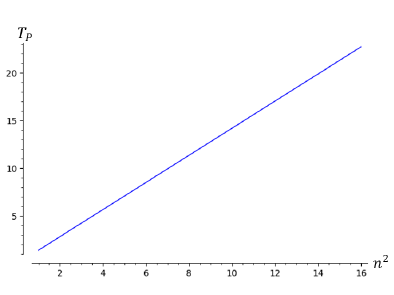
n η $$ \therefore T _ {P} = \frac {2 ^ {2} \times \frac {n ^ {2} \hbar^ {2}}{2 ^ {2}}}{k J ^ {2} m} = 1. 4 1 9 \times 1 $$ T K k l m β (46) Hence, this value is almost equal to actual value of TP [17, 18, 19, 20]. In the above formula, ℏ, kβ , 2 Pl , and mP are constant at the Planck scale. Hence, the Planck temperature depends on n2. Therefore, $$ \therefore T _ {P} = \Re_ {1} n ^ {2} \rightarrow T _ {P} \propto n ^ {2} \tag {47} $$
2
1 2 P P k l m β ℜ= η is a constant. The value of 1 ℜ is 1.419 ×
where
1032 K. Thus, the value of Planck temperature TP changes with the square of integer n at the Planck scale. With the increment
- in the value of the integer n2, the value of the Planck temperature TP also increases. The nature of such a plot TP → n2 is linear. This relationship is here given in the tabular form. where,
- 2
- 2
- 2
- P
- P
- P
- T n k l m β
- =
- n
- 2 n
- 1
- 1
- 1.419 X 1032 K
- 2
- 4
- 5.676 X 1032 K
- 3
- 9
- 12.771 X 1032 K
- 4
- 16
- 22.704 X 1032 K
Table 6: The relationship between the Planck temperature
Planck Mass and Quantum Spin
Similar to TP, the value of mP can be found using the equation (7), i.e.,
2 2 2 2 8 8 2 2 2 2.181 10 2.176 10 P P P
n η $$ = \frac {2 ^ {2} \times \frac {n ^ {2} \hbar^ {2}}{2 ^ {2}}}{k l ^ {2} T} = 2. 1 8 1 \times 1 0 ^ {- 8} k g \approx 2. 1 7 6 \times 1 0 ^ {- 8} $$ m kg kg k l T β (48) Hence, this value is almost equal to actual value of mP [17, 18, 19, 20]. ℏ, kβ , l 2 Pl and TP are constant at the Planck scale. Thus, the Planck mass depends on n2. Therefore,
2 2 2 P P m n m n ∴ ℜ ∝ = → (49)
2 $$ \Re_ {2} = \frac {\hbar^ {2}}{k _ {\beta} l _ {P} ^ {2} T _ {P}} $$
is a constant. The value of
2 ℜ is
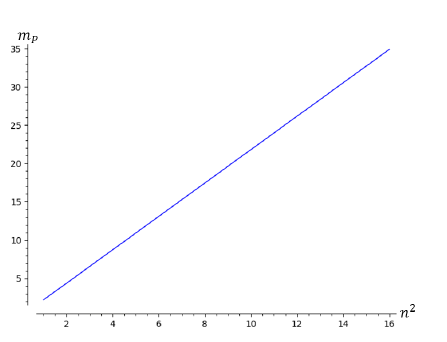
2.181×10⁻⁸ kg. Thus, the value of the Planck mass changes with the square of integer n at the Planck scale. With the increment in the value of the integer n2, the value of the Planck temperature mP also increases. The nature of such a plot mP → n2 is linear. This relationship is here given in the tabular form.
- 2
- 2
- 2
- P
- P
- P m n k l T β
- =
- n
- 2 n
- 1
- 1
- 2.176 X 10⁻⁸ K
- 2
- 4
- 8.724 X 10⁻⁸ K
- 3
- 9
- 19.629 X 10⁻⁸ K
- 4
- 16
- 34.896 X 10⁻⁸ K
Table 7: The relationship between the Planck temperature
Planck Length and Quantum Spin
Similar to TP, the value of lP can be found using the equation (7), i.e.,
2 2 2 2 35 35 2 2 1.618 10 1.616 10 P P P
n η − − × = = × ≈ ×
l m m k T m β (50)
Hence, this value is almost equal to actual value of lP [17, 18, 19, 20]. Here, ℏ, kβ , mP and TP are constant at the Planck scale. Thus, the Planck length depends on n. Therefore, $$ \therefore l _ {P} = \Re_ {3} \rightarrow l _ {P} \propto n \tag {51} $$
2 $$ \Re_ {3} = \frac {\hbar^ {2}}{k _ {\beta} T _ {P} m _ {P}} $$
is a constant. The value of
3
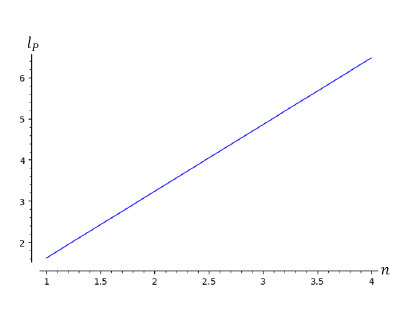
ℜ is 1.618 where × 10−35_m_. Thus, the value of lP changes with the integer n at the Planck scale. With the increment in the value of the integer n, the value of the Planck temperature lP also increases. The nature of such a plot lP → n is linear. This relationship is here given in the tabular form.
| n | l_{P}=\sqrt{\frac{\hbar^{2}}{k_{\beta}T_{P}m_{P}}}n |
| 1 | 1.618 X 10^{-35}m |
| 2 | 3.236 X 10^{-8}m |
| 3 | 4.854 X 10^{-8}m |
| 4 | 6.427 X 10^{-8}m |
Table 8: The relationship between the Planck temperature _l__P_ and the integer _n_.
Conclusions
This novel perspective of the quantum spin has far reaching consequences in the theory of quantum gravity.
Consequences of this novel perspective in LQG is known. With the aid of this novel perspective, the new formulas are derived for the reduced Planck constant, the Boltzmann constant kβ , the gravitation constant G, the fine structure constant α and the speed of light c. Moreover, the value of various universal constants can be validated by comparing the derived formula from the quantum spin with the old formula. we also find new formulas for fundamental Planckian quantities and the derived Planckian quantities using this novel perspective. Novel formulas for the Planck star such as the size, the curvature, the surface area and the size of black hole (for the Planck star) are proposed without modifying its significance. From this perspective, we establish relationship of the quantum spin, i.e., n with the Planck temperature TP, the Planck mass mP, and the Planck length lP at the Planck scale. The plots such as TP → n2, mP → n2 and lP → n are studied that add the new notion to in the physics of quantum gravity. Therefore, this perspective shows the importance of the quantum spin at the quantum gravity scale.
Acknowledgment
The authors are thankful to Physics Department, Saurashtra University, Rajkot, India.
References
-
Penrose R (1972) On the Nature of Quantum Geometry. In: Klauder J (Ed.), Magic Without Magic. Freeman, San Francisco, USA, pp: 333-354.
-
Penrose R (1971) Angular momentum: An approach to combinatorial space-time, In: Bastin T (Ed.), Quantum Theory and Beyond. Cambridge University Press, USA, pp: 151-180.
-
Rovelli C, Smolin L (1990) Loop space representation of quantum general relativity. Nucl Phys B 331(1): 80-152.
-
Rovelli C, Smolin L (1995) Spin networks and quantum gravity. Phys Rev D 52(10): 5743-5759.
-
Ashtekar A, Lewandowski J (2004) Background independent quantum gravity: a status report. Class Quantum Grav 21(15).
-
Mercuri S (2009) Introduction to Loop Quantum Gravity. General Relativity and Quantum Cosmology, arXiv.
-
Dona P, Speziale S (2010) Introductory Lectures to loop Quantum Gravity. General Relativity and Quantum Cosmology, arXiv.
-
Rovelli C (2008) Loop Quantum Gravity. Living Reviews in Relativity 11(5).
-
Esposito G (2011) An Introduction to Quantum Gravity. High Energy Physics, arXiv.
-
Ashtekar A, Bianchi E (2021) A Short Review on Loop Quantum Gravity. Reports on Progress in Physics 84(4): 042001.
-
Ashtekar A, Lewandowski J (1996) Quantum Theory of Gravity I: Area Operators. General Relativity and Quantum Cosmology 14: A55-A82.
-
Ashtekar A, Lewandowski J (1997) Quantum Theory of Geometry II: Volume Operators. General Relativity and Quantum Cosmology, arXiv, pp: 388-429.
-
Rovelli C, Smolin L (1994) Discreteness of Area and Volume in Quantum Gravity. Nuclear Physics B 442(3): 593-619.
-
Vyas R, Joshi M (2022) New quantum Spin Perspective and Geometrical Operators of Quantum Geoemetry. General Relativity and Quantum Cosmology, arXiv.
-
Greiner W, Neise L, Stöcker H (1995) Thermodynamics and Statistical Mechanics. 1st(Edn.), Spinger New York, USA.
-
Bohr N (1913) On the constitution of atoms and molecules. Philos Mag 26(1): 125.
-
Planck M (1978) Uber irreversible Strahlungsvorgnge. In: Schpf HG (Ed.), Von Kirchhoff bis Planck, Springer, pp: 166-171.
-
Tomilin K (1999) Natural Systems of Units to the Centenary Anniversary of the Planck System. Proceedings of the XXII Workshop On High Energy Physics And Field Theory, pp: 287-296.
-
Adler R (2010) Six easy roads to the Planck scale. Am J Phys 78(9): 925-932.
-
Woan G (2000) The Cambridge Handbook of Physics Formulas. Cambridge University Press, New York, USA.
-
Rovelli C, Vidotto F (2014) Planck Star. Int J Mod phys D 23(12).
- Sense, Gravity, Parity & Chirality in Mathematical Physics
- Quantum Lattice Simulations PHYSICS: Microcircuit Particle Formation and Observable Macroscopic Irreversible Time - A Discrete Lagrangian with Cellular Automata Framework
- Quantum Biology from Biomacromolecule to Cell, and Central Dogma Described by Quantum Theory
- Focus, Agility, Speed and Technology (FAST) for Sustainability and Growth
- Square Root Metric Geometry and Pati-Salam Model in Curved Space-Time
- A Simple System Demonstrating the Mpemba Effect in Classical Mechanics