
Detection of Carbapenemase Producing Enterobacteriaceae from Clinical Samples and their Susceptibility to Conventional Antibiotics and Medicinal Plant Extracts
Carbapenamases are enzymes that renders inactive, the carbapenems antibiotics which are often considered as the last treatment option for all serious infections. Carbapenemase-producing Enterobacteriaceae (CPE) has already been identified all over the world. In Kano and other part of Northern Nigeria, there are several reports that CPE is in circulation at a rate researchers have never imagined and is rapidly spreading to far rural communities. This study aims to detect Carbapenemase producing Enterobacteriaceae from clinical sample and determine their susceptibility to conventional antibiotics and Ficus ovata and Guiera senegalensis plant extracts. Isolates of Pseudomonas aeruginosa, E. coli and Klebsiella pneumoniae were collected from Murtala Muhammad Specialist Hospital, reconfirmed and screened for Carbapenemase production using the Modified Hodges Test. The highest occurrence of carbapenemase was observed in E. coli (14.3%), while the least was observed in K. pneumoniae 3(12%) and P. aeruginosa 2(6.7%). Ficus ovata and Guiera senegalensis Plants were extracted using ethanol, N-butanol and N-hexane as separate solvents. Of all the three plants extracts, highest yield was observed in N-Butanol extracts having 32.7% in Ficus ovata. Susceptibility test using antibiotics revealed a decreased sensitivity of the test isolates to some commonly used antibiotics; Cefotaxime (25μg), Cefixime (5μg), Levofloxacin (5μg), Amoxicillin (30μg) and Cefuroxime (30μg). Agar well diffusion test was employed at a concentration of 20, 10 and 5mg/ml. All the six extracts were observed to have the highest activity against P. aeruginosa with Guiera senegalensis having more inhibitory activity. This demonstrates the extracts potentials for extraction of chemotherapeutic agents.
Introduction
Carbapenemase enzymes are regarded as a serious threat affecting the global healthcare system. These enzymes are diverse and are in rapid circulation throughout the world [1]. Their health burden is coupled with the fact that the antibiotics which it renders inactive, are the ones regarded as the last resort treatment option against all serious bacterial infections caused by both Gram positive and Gram negative organisms [2]. To date, these enzymes are known to be produced by only Gram negative Enterobacteriaceae such as Klebsiella pneumoniae, Pseudomonas aeruginosa, Escherichia coli, and Acinetobacter baumannii among others [2, 3].
In Northern Nigeria, there are several reports including that of Yusuf T, et al. [4] that the rate of spread of these enzymes is moving at an alarming rate which if nothing is been done, there is the fear that it will continue to spread to far rural areas which have weak health care system. In Kano, Kaduna, Jigawa and other Northwestern states, different classes of Carbapenemase enzymes producing isolates have been reported to be in circulation. These enzymes are responsible for drug and surgical failures, prolong hospitalization, as well a high number of deaths [2].
For many years, the treatment of many infectious diseases using plant concoctions continue to yield promising outcomes. The activity recorded by these plants are mainly due to the reservoirs of bioactive constituents, and these constituents are reported to be in different proportion in different plants. However certain bioactive compounds were reported to be present only among given species of plants. The antibacterial activity of many medicinal plants and plant preparations has not been examined in Nigeria [5, 6]. Ficus ovata known as “Gamji dankwarai” in Hausa and Guiera senegalensis known as “Sabara” in Hausa, are known to be very active in managing different ailments such as stomach pain, wound and infertility in Kano and other part of Hausa land [7, 8, 9].
As newer classes and groups of carbapenemase enzymes continue to be discovered in Nigeria and Kano state in particular, and the high resistance profile coupled with fatal public health consequences exhibited by bacterial harboring Carbapenamases genes, it become very important to test their susceptibility to different classes of other antibiotics as well as Ficus ovata and Guiera senegalensis leaf extracts which were known to be effective in the treatment of various form of bacterial infections (Appendix 1 & 2).
Materials and Method
Sampling Site
The sampling site is Urology Center, Murtala Muhammad Specialist Hospital, located in Kano Municipal City, Kano state Nigeria.
![Figure 1: Map of Kano State Showing Kano Municipal City Local Gov’t, where the sampling site is located [10].](/fulltextimages/9508/fig_1.png)
Ethical Clearance
Ethical approval for the study was obtained from Kano State Health Hospitals Management Board.
Isolate Collection and Reconfirmation
A total of three clinical isolates (E. coli, K. pneumoniae and P. aeruginosa) obtained from urine culture were collected from Murtala Muhammad Specialist Hospital Urology Centre, located at Kano Municipal City Local Gov’t. Kano, over a period of two weeks. For every round of sample collection, the specimens were transported without delay, to the Microbiology Laboratory, Skyline University Nigeria, for re-confirmation as described by Cheesbrough M, et al. [11].
Modified Hodge Test for the Detection of Carbapenemase Production
Modified Hodge test (MHT) was employed for the phenotypic detection of Carbapenamases by the isolates. This was carried out as described by CLSI C.L.S.I [12]. McFarland 0.5 suspension of E. coli ATCC 25922 was prepared in peptone water to arrive at a dilution of 1:10. Using Mueller Hinton Agar, a lawn culture was prepared were E. coli, K. pneumoniae and P. aeruginosa were tested on the same plate using a single 10 μg ertapenem disc. The plate was incubated at 37°C for 18-24hrs. A positive test was observed following the appearance of a clover leaf-like indentation of E. coli ATCC 25922 along the test organism. The absence of growth was regarded as negative test as described by Nordmann PM, et al. [3].
Extraction of Plant Materials
The plant samples (Guiera senegalensis and Ficus ovata) were air dried, grounded and extracted by percolation using 3 different solvents (N-butanol, N-hexane and ethanol) to arrive at a total of six different extracts.
Antibacterial Susceptibility Test of the Extracts
The plants extracts were re-calculated to arrive at a concentration of 20mg/ml, 10mg/ml and 5mg/ml. Agar well diffusion test was used in testing their activity against the 3 different isolates.
Result and Discussion
Following the reconfirmation of the isolates using morphological appearance, motility, Gram reaction and biochemical test. All the isolates were observed to be Gram negative rod, motile, catalase positive with special ability to produce gas (Table 1). These characteristics as exhibited by all the test isolates (E. coli, Klebsiella pneumoniae and Pseudomonas aeruginosa) are in agreement with the report of Cheesbrough M, et al. [11, 13].
| isolate | Gram reaction | Morphology | Motility test | Catalase test | Gas production |
|---|---|---|---|---|---|
| E. coli | _ | Rod | + | + | + |
| Klebsiella pneumoniae | _ | Rod | + | + | + |
| Pseudomonas aeruginosa | + | Rod | + | + | + |
Table 1: ** Microscopy and Biochemical test.
Keys: +:Positive, -:Negative Table 1: Microscopy and Biochemical test.
In all the two plants, the highest yield was observed in N-Butanol having 32.7% in Ficus ovata and 26.3% in Guiera senegalensis. The lowest yield was observed in N-Hexane extract having 5.6% for Ficus ovata and 6.7% in Guiera senegalensis (Table 2). This may be due to the variation in the Phytoconstituents present in each of the plant. More so, the place of sample collection as well as time of sample collection was reported to directly affect the presence and or level of Phytoconstituents presents in plant extracts [1, 14, 15]. As reported by Yusha’u M, et al. [16] the varying extracts colour may be due to the level of abundance of some given Phytoconstituents which gives a distinct colour to each extracts.
| Plant | Solvent of extraction | Solvent polarity | Amount Weighed | Amount obtained | (%) yield | Colour | Smell |
|---|---|---|---|---|---|---|---|
| Ficus ovata | NH | 0.009 | 47 | 2.63 | 5.6 | Greenish black | Pleasant smell |
| NB | 0.586 | 47 | 15.37 | 32.7 | Greenish brown | Choky smell | |
| ET | 0.654 | 44 | 10.75 | 24.4 | Greenish brown | Pleasant smell | |
| Guiera senegalensis | NH | 0.009 | 50 | 3.37 | 6.7 | Dark green | Pleasant smell |
| NB | 0.586 | 50 | 13.16 | 26.3 | Dark green | Pleasant smell | |
| ET | 0.654 | 50 | 5.06 | 10.1 | Brownish green | Pleasant smell |
Table 2: Physical properties of Ficus ovata and Guiera senegalensis plants extracts.
Keys: NH: N-Hexane, NB: N-butanol, ET: Ethanol. Table 2: Physical properties of Ficus ovata and Guiera senegalensis plants extracts.
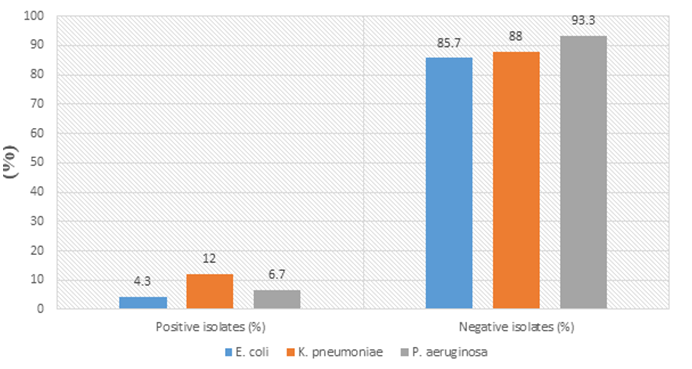
The Modified Hodge Test was carried out for the Detection of carbapenemase production (Table 3 & Figure 2), where the highest occurrence of carbapenemase was observed in E. coli (14.3%), while the least was observed in K. pneumoniae and P. aeruginosa having 3(12%) and 2(6.7%) respectively. These variations in the occurrence of this enzyme may be because not all strains or species of these isolates are capable of producing Carbapenamases. More so, it may be because the test isolates are clinical isolates and not all patients harbored these categories of isolates that produce Carbapenamases [2]. The work of Yusuf T, et al. [4], which report the first cases of the circulation of Carbapenemase isolates in Kano also revealed that carbapenemase-producing isolates are in circulation in different parts of Kano, at varying levels and locations.
| Number of Isolates screened | Positive isolates (%) | Negative isolates (%) | |
|---|---|---|---|
| E. coli | 35 | 5 (14.3) | 30 (85.7) |
| K. pneumoniae | 25 | 3 (12) | 22 (88) |
| P. aeruginosa | 30 | 2 (6.7) | 28 (93.3) |
Table 3: Modified Hodge Test for the Detection of carbapenemase production among isolates collected from Murtala Muhammed Special
The Antibacterial susceptibility test of the test isolates (E. coli, Klebsiella pneumoniae and Pseudomonas aeruginosa) revealed a decreased sensitivity of the test isolates to some commonly used antibiotics such as Cefotaxime (25 µg}, Cefixime {5µg}, Levofloxacin {5 µg}, Amoxicillin{30µg} and Cefuroxime{30µg} (Table 4). This shows that the resistant isolates exhibit resistance to other different classes of antibiotics which is a clear indication of their public health implications. These isolates have the capability in transferring resistance among the same and or different species making their existence a continuing threat [17, 18].
| Zone of inhibition (mm) | ||||
|---|---|---|---|---|
| Antibiotics | Concentration {µg} | E. coli | Klebsiella pneumoniae | Pseudomonas aeruginosa |
| Amoxicillin | 30 | 9 | 6 | 9 |
| Cefotaxime | 25 | 4 | 4 | 4 |
| Ceftriaxone | 45 | 13 | 11 | 12 |
| Cefixime | 5 | 6 | 0 | 0 |
| Levofloxacin | 5 | 12 | 0 | 9 |
| Ciprofloxacin | 5 | 9 | 15 | 8 |
| Imipenem | 10 | 11 | 13 | 9 |
| Cefuroxime | 30 | 4 | 9 | 8 |
| Ofloxacin | 5 | 9 | 14 | 12 |
| Erythromycin | 15 | 8 | 14 | 13 |
| Gentamycin | 10 | 6 | 14 | 6 |
| Azithromycin | 15 | 12 | 14 | 11 |
Table 4: Antibacterial susceptibility test of E. coli, Klebsiella pneumoniae sand Pseudomonas aeruginosa to some commonly used an
The result of the antibacterial activity of Ficus ovata and Guiera senegalensis extracts against some clinical isolate of Enterobacteriaceae (Table 5 and 6), shows that the activity of the extracts is quite dependent on the level of concentration. The activity decreases with a decrease in concentration from 200 mg to 100 mg and then 50 mg. This is in agreement with the work of Yaro MN, et al. [7] and Yusha’u M, et al. 16]. All the extracts of the two plants were observed to have the highest activity against P. aeruginosa, followed by E. coli while the least activity was recorded in K. pneumoniae isolate. Considering the very high resistance profile exhibited by Pseudomonas aeruginosa, as it remains one of the few isolates which have found to contain almost all the resistant genes that has been reported to exist among the diverse groups of Enterobacteriaceae [19, 20, 21]. The extracts activity can serve as a source of hope for the extraction of novel therapeutic agents that can be used to curtail the health problems posed by this bacterium.
| Extracts | Concentration (mg) | E. coli | Klebsiella pneumoniae | Pseudomonas aeruginosa |
|---|---|---|---|---|
| FO-NB | 20 | 8 | 12 | 9 |
| 10 | 4 | 8 | 6 | |
| 5 | 0 | 6 | 0 | |
| FO-NH | 20 | 11 | 13 | 8 |
| 10 | 10 | 9 | 6 | |
| 5 | 4 | 0 | 6 | |
| FO-ET | 20 | 14 | 8 | 11 |
| 10 | 9 | 6 | 6 | |
| 5 | 6 | 4 | 0 |
Table 5: Antibacterial activity of Ficus ovata Extracts against some clinical isolate of Enterobacteriaceae.
Keys: FO: Ficus ovata, NB: N-Butanol, NH: N-Hexane, ET: Ethanol. Table 5: Antibacterial activity of Ficus ovata Extracts against some clinical isolate of Enterobacteriaceae.
| Extracts | Concentration {mg} | E. coli | Klebsiella | Pseudomonas |
|---|---|---|---|---|
| GS-NB | 20 | 14 | 14 | 12 |
| 10 | 12 | 11 | 8 | |
| 5 | 8 | 6 | 7 | |
| GS-NH | 20 | 11 | 6 | 14 |
| 10 | 6 | 4 | 9 | |
| 5 | 4 | 4 | 7 | |
| GS-ET | 20 | 8 | 11 | 12 |
| 10 | 6 | 9 | 8 | |
| 5 | 4 | 4 | 4 |
Table 6: Antibacterial activity of Guiera senegalensis Extracts against some clinical isolate of Enterobacteriaceae.
Keys: GS: Guiera senegalensis, NB: N-Butanol, NH: N-Hexane, ET: Ethanol Table 6: Antibacterial activity of Guiera senegalensis Extracts against some clinical isolate of Enterobacteriaceae.
The activity recorded by Ficus ovata extracts as recorded in this study is in agreement with the findings of Oyeleke SB, et al. [5] and Kuetea V, et al. [9] who reported the presence of Alkaloids, flavonoids and tannins in the plants with inhibitory activity against E. coli, Shigella and Salmonella spp. The work of Onwuliri FC, et al. [22], Ogbeba J, et al. [6] conducted in Bauchi State and that of [8] conducted in Borno state, (North east) Nigeria report the aqueous and ethanol extracts of Guiera senegalensis to contain Tannins, flavonoids, saponins and alkaloids, with a significant inhibitory activity against both Gram negative (E. coli, Salmonella) and Gram positive (S. aureus) bacterial pathogens. Yaro MN, et al. [7] also report a significant activity by the extracts of Guiera senegalensis.
Conclusion
The highest occurrence of carbapenemase was observed in E. coli (14.3%), while the least was observed in K. pneumoniae and P. aeruginosa having 3(12%) and 2(6.7%) respectively. Of all the three plants extracts, highest yield was observed in N-Butanol extracts having 32.7% in Ficus ovata. The test isolates were observed to have a decreased sensitivity to some commonly used antibiotics. All the extracts of the two plants were observed to have the highest activity against P. aeruginosa, followed by E. coli while the least activity was recorded in K. pneumoniae isolate. The inhibitory activity exhibited by the extracts against the test isolates could justify their use locally in traditional medicine. The extracts have also demonstrated the potentials for the extraction of novel chemotherapeutic agents therefore future research should focus on identifying the individual components of each of the extracts with a view to identifying the specific active compounds. On the spread of CPE, the populace needs to be enlightened on the dangers of over- the-counter drugs, reckless use of antibiotics, and the need for adequate personal and community hygiene and dose completion therapy among others.
Recommendation
- The use of plants locally to treat infections should be backed by scientific evidences, else they can be toxic to humans. This also necessitate the need for toxicity studies on the extracts.
- Carbapenemase producing isolates can be spread easily as such extra care must be taken in ensuring an all-round environmental and personal hygiene as this has been noted as a means of dissemination of infectious agents with CPE inclusive.
- The co-selection of antibiotics, use of over the counter medication and over consumption of carbapenems antibiotics has been identified as the major causes and persistence of carbapenems resistance, therefore extra caution need to be applied when handling antibiotics.
- People with urinary tract infection should be fully diagnosed for confirmation before treatment using carbapenems antibiotics.
- Future research should focus on identifying the individual components of each of the extracts via Gas chromatography Mass spectroscopy (GC-MS), Thin layer chromatography and or phytochemical test with a view to identifying the specific active compounds.
- A larger sample size should be tested to cover a wider range of isolates, and appropriate bodies should take necessary measures to avoid the risk of occurrence of these enzymes of medical importance
- Funding This work received no funding.
- Conflict of Interest The authors declare no conflict of interest and have read and agree to the content of the manuscript.
References
-
Rabiu I, Yusha’u M, Abdullahi AM (2022) Antibacterial Activity of Colocasia esculenta Leaf extracts Against Multidrug Resistant Extended Spectrum Β-Lactamase Producing Escherichia coli and Klebsiella pneumonia. Bayero Journal of Pure and Applied Sciences 13(1): 7-12.
-
Rabiu I, Jaafaru IA, Abdullahi AM (2022) The Spread of 𝛽-Lactamases and Extended Spectrum 𝛽-Lactamase Enzymes among Bacteria: A Threat to Effective Health Care Delivery. EAS Journal of Biotechnology and Genetics 4(1): 11-23.
-
Nordmann PM, Gniadkowski CG, Giske L, Poire N, Woodford VM, et al. (2012) Identification and screening of carbapenemase-producing Enterobacteriaceae. Clinical Microbiology and Infection 18(5): 432-8.
-
Yusuf I, Arzai A (2011) First Detection of Carbapenemases Producing Clinical Bacterial Pathogens in Kano, Nigeria. Biological and Environmental Sciences Journal for the Tropics 8(3): 163-167.
-
Oyeleke SB, Dauda BE, Boye OA (2008) Antibacterial activity of Ficus capensis. African Journal of Biotechnology 7(10): 1414-1417.
-
Ogbeba J, Iruolaje FO, Dogo BA (2017) Antimicrobial efficacy of Guiera senegalensis and Prosopis africana leave extract on some bacterial pathogens. European Journal of Biology and Medical Science Research 5(2): 27-36.
-
Yaro MN (2017) Effect of concentration on the antimicrobial activity of phytochemicals from Guiera senegalensis leaves. Dutse Journal of Pure and Applied Sciences 3(2): 414-420.
-
Mamman IA, Isa MA (2013) Phytochemical and antibacterial activity of leave extracts of Guiera senegalensis lam on selected species of Gram positive and Gram negative bacteria. International Journal of Environment 2(1): 262-268.
-
Kuete V, Nana F, Ngameni B, Tsafack AM, Keumedjio F, et al. (2009) Antimicrobial activity of the crude extract, fractions and compounds from stem bark of Ficus ovata (Moraceae). J Ethnopharmacol 124(3): 556-561.
-
Nigeria Data Portal (2006) Nigeria population update.
-
Cheesbrough M (2010) District laboratory practice in tropical countries part two 1nd (Edn), Cambridge press United Kingdom.
-
CLSI (2014) Performance Standards for Antimicrobial Susceptibility testing. Twenty second Informational Standard.
-
Cheesbrough M (2017) District Laboratory Practice in Tropical countries 2nd (Edn), Cambridge University Press, United Kingdom.
-
Adamu HI, Rabi’u I, Mabeh BI (2021) A Review on the Use of Honey in the Treatment of Wound Infection. Asian Food Science Journal 20(1): 51-59.
-
Issa SB, Muazu M, Rabi’u I (2021) Phytochemical Analysis and Antibacterial Activity of Moringa oliefera Leaves Extract Against Certain Pathogenic Bacteria. Asian Journal of Biochemistry, Genetics and Molecular Biology 7(1): 34-43.
-
Yusha’u M (2011) Phytochemistry and inhibitory activity of Chrozophora senegalensis extracts against some clinical bacterial isolates. Bayero Journal of Pure and Applied Sciences 4(1): 153-156.
-
Jaafaru JA, Rabiu I, Idris KB, Abdulfatai K (2022) Determination of Inducible Clindamycin Resistance Amongst Clinical Isolates of Methicillin-Resistant Staphylococcus aureus in Kaduna, Nigeria. Journal of Advances in Microbiology 22(1): 32-38.
-
Jean S, Lee W, Lam C, Hsu C, Chen R, et al. (2015) Carbapenemase-producing Gram-negative bacteria: current epidemics, antimicrobial susceptibility and treatment options. Future Microbiol 10(3): 407-425.
-
Pranita TD, Patricia SJ (2018) Phenotypic Detection of Carbapenemase-Producing Organisms from Clinical Isolates. Journal of Clinical Microbiology 56(11): 01140- 01118.
-
Bora A, Sanjana R, Kumar BJ, Narayan SM, Pokhare K, et al. (2014) Incidence of metallo-beta-lactamase producing clinical isolates of Escherichia coli and Klebsiella pneumoniae in central Nepal. BMC Research Notes 7: 557.
-
Castanheira M, Mendes R, Gales R (2014) Emergence of the extended-spectrum β-lactamase GES-1 in a Pseudomonas aeruginosa strain from Brazil. Antimicrobial Agents and Chemotherapy 48(6): 2344- 2345.
-
Onwuliri F, Ndako J, Olabode AO, Echeonwu GON, Onwuliri EA, et al. (2009) Phytochemical screening and antibacterial activity of Guiera senegalensis leaf extracts. International Journal of Tropical Agriculture and Food Systems 3(2): 99-104.
- Evaluation of Proximate and Mineral Compositions of Momordica charantia L. (Cucurbitaceae)
- Targeting Superbugs: Efficacy of Bacteriophage Therapy against Antibiotic-Resistant Pseudomonas Aeruginosa in Urinary Tract Infections
- Genetic Insights into Prepubertal Gynecomastia: A Comprehensive Analysis of a Rare 45,X[2]/ 46,X, + mar[28] Karyotype
- The Efficiency of Biological Treatment Plants in Some Private Hospitals in the City of Basra, Iraq
- Exploring the Combined Efficacy of Carvacrol and Friedelin against Multi-Drug Resistant Bacteria in Upper and Lower Respiratory Tract Infections
- Isolation, Identification and Comparative Analysis of Oral Microbial Communities in Smokers and Non-Smokers: A Scientific Investigation