
Commercial Utilization of Microbial Polysaccharides: A Brief Global Perspective
Microbial polysaccharides are the water soluble renewable biopolymers which comprise a variety of polysaccharides produced by bacteria, fungi and yeast. These microbial polysaccharides have unusual molecular structure and peculiar conformations rendering them with unique and potentially interesting properties. In recent years, demand of natural polymers for various industrial applications has led to an increased attention towards production of microbial polysaccharides. Since the microbial origin polysaccharides have properties identical to the currently used gums they have been widely used as an alternative in various food, pharmaceutical, and cosmeceutical industries as emulsifiers, binders, gelling agents and suspending agents. There has been an increase in the adoption of microbially sourced polysaccharides and this surge in demand has resulted in the manufacturers to now focus on enhancing their production capacity. The current review deals with the worldwide commercial utilization of the microbial polysaccharides and their present status in the polysaccharide market.
Introduction
Microbial polysaccharides are renewable, biodegradable, versatile bio-polymers produced by several bacteria, yeast and fungi [1]. These are generally high molecular weight hydrated polysaccharides containing repeated units of sugar or sugar derivatives such as glucose, fructose, mannose etc [2]. Microorganism are a rich underexploited source of polysaccharides which serve as energy reserves, structural materials, are involved in molecular interactions and also store information [3]. The forms of polysaccharides produced by the organisms can be subdivided into bound polysaccharides or soluble polysaccharides. The bound polysaccharides are closely bound to the cell (sheaths, capsular polymers, condensed gels, loosely bound polymers, and attached organic materials) and soluble polysaccharides or the exopolysaccharides are weakly bound or are dissolved into the solution (soluble macromolecules, colloids, and slimes) [4, 5]. There is a high demand for naturally derived products since their synthetic counterparts are often associated with various potential health and environmental hazards. This rise in demand from the consumers has resulted in increased attention towards the production of polysaccharide by a variety of microbes [6]. These microbial polysaccharides have peculiar commercially important properties which makes them suitable for use across a wide range of applications in chemical, food, cosmetics and medical industries. Many researchers have discovered the potential of these microbial polysaccharides to act as a viscosifying, stabilizing, emulsifying, or gelling agents in food and pharmaceutical products. Besides these, polysaccharides are also known to possess a variety of bioactive properties such as antitumor, antioxidant, antibacterial, antiulcer, and cholesterol-lowering activity [7, 8, 9, 10]. However, numerous potential applications still wait to be explored and developed into commercial applications. The most important microbial polysaccharides include xanthan, the commercial polymer produced by the bacteria Xanthomonas campestris, Gellan (Sphingomonas paucimobilis), Cellulose (Acetobacter xylinum), Dextran (Leuconostoc mesenteroides), Spirulan (Arthospira pltensis), Alginate (Pseudomonas aeuroginosa), Levan (Bacillus subtilis), Hyaluronan (Pasteurella multocida) and Curdlan (Alcaligenes species) [2]. Microbial polysaccharides have a higher production cost than that of the other natural or synthetic polymers such as corn starch and celluose-derived products. The high production cost is the main constraint to their wider use in different fields and thus there is a need to develop new strategies in order to lower their production cost.
Sources of Microbial Polysaccharides
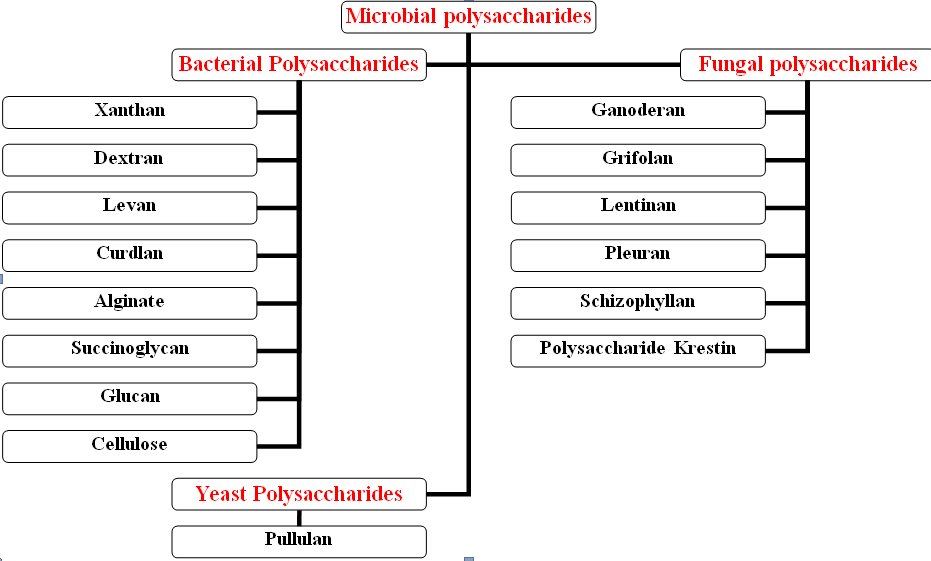
The microbial polysaccharides are usually classified as those derived from bacteria, fungi, algae and yeast (Figure 1).
Production of Microbial Polysaccharides
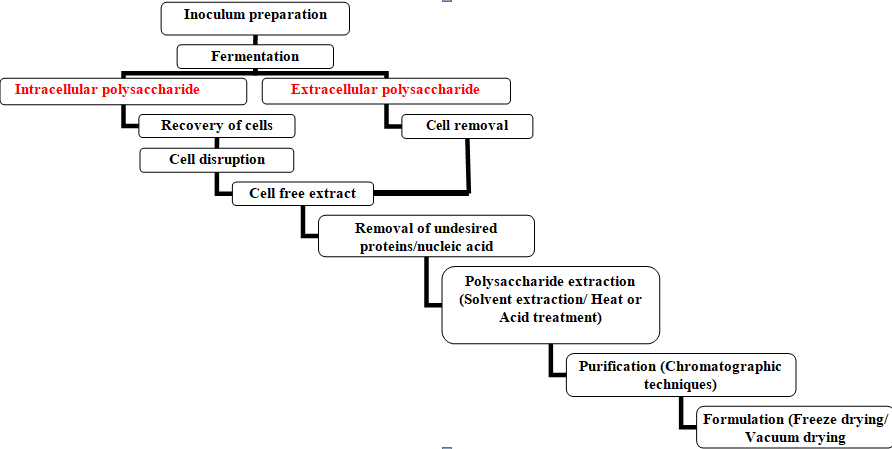
The typical microbial polysaccharide fermentation starts with the growth phase which is followed by the production phase [11]. The production is mostly carried out by batch fermentation in the presence of excessive carbon source and is significantly affected by the fermentation conditions which include temperature, pH, production medium, carbon source, nitrogen source etc. The differential synthesis of different polysaccharides can be achieved by manipulating the nutrient supply for e.g. limiting the nitrogen supply results in the production of neutral polysaccharides whereas limiting the metal ions results in the production of acidic polysaccharides. Since the production of polysaccharides depend upon the mode of operation, design of the fermenter and the microbial system used each production process requires a specific design [12]. Therefore, to accomplish the industrial production of desired polysaccharide the parameters affecting the entire production process should be well defined [13]. Figure 2 given below depicts the general procedure involved in the production of exopolysaccharides.
Commercially Available Microbial Polysaccharides and their Applications
Microbial polysaccharides are of a great commercial importance. These polysaccharides are water soluble gums that possess unique properties and have emerged as new and industrially important polymeric substances competing with natural gums obtained from marine algae and higher plants [14]. Xanthan, gellan, dextran, and alginate are among the common microbial polysaccharides in current use. The microbial polysaccharides are widely employed in the stabilization of foods, and production of several industrial and pharmaceutical compounds [15]. Due to their unique confirmations and physicochemical characteristics, microbial polysaccharides have found a wide range of applications as emulsifiers, stabilizers, binders, gelling agents, coagulants, and suspending agents. Other potential applications of these microbial polysaccharides such as immuno-modulation, anti-tumor, anti-microbial, anti- oxidant etc. are also reported. Table 1 summarizes some of the commercially available microbial polysaccharides and their applications.
| Name of the Polysaccharide | Producer Organism | Applications | References |
|---|---|---|---|
| Xanthan | Xanthomonas campestris | Improves the texture, mouth feel of the food product, enhances the stability, controls rheology, and reduces the syneresis. | [16] |
| Dextran | Leuconostoc mesenteroides | Used in drugs as a blood plasma expander, as an adjuvant, stabilizer, carrier and emulsifier in food, pharma and chemical industries, also used as a thickener and viscosifier in food industry. | [17] |
| Levan | Lactobacillus sanfranciscensis LTH 2590 | Prebiotic properties, Anti-tumor, Cholesterol lowering property, Inhibition of smooth muscle proliferation, blood plasma expander, anti-AIDS activity, anticlotting can act as an emulsifier, thickener, stabilizer, purification of biological materials, synthesis of nanostructured films, | [9,18-20] |
| Streptococcus 352 salivarius, Streptococcus mutants, Leuconostoc mesenteroides NRRL B-512F, and Lactobacillus reuteri LB121 | |||
| Curdlan | Anti-AIDS, Anti-viral activity, Immunomodulating, Anti-inflammatory, Used in drug delivery, Heavy metal adsorption, act as a binder, viscosifier, texture enhancer | [21-26] | |
| Alginate | Delivery of small drugs and proteins, wound dressings; Cell culture; Tissue regeneration; thickening, gel forming, stabilizing agents. | [27] | |
| Succinoglycan | Viscodifying and Emulsifying activity, Pseudo plasticizing, Crosslinking property, Cosmetic additive, | [28] | |
| Pullulan | Development of food packaging films, capsule shells, Tissue engineering, Targeted drug delivery, Gene delivery, Thickening, stabilizing agent in food and cosmetics. | [29-31] | |
| Fungal Glucans | Amauroderma rugosum, Cerrena unicolor, Ganoderma lucidium Pleurotus albidus, Fkammulina velutipes | Immunomodulatory, Hypolipidemic, Anti-oxidant, Antimicrobial | [32-35] |
| Lentinan | Lentinus edodes | Free radical scavenging activity, Increase plasma insulin and reduce BGL, Antimicrobial activity against Streptococcus mutans, Prevotella intermedia, E. coli, S. aureus and Sarcina lutea, Potently stimulated cytokine production, stimulate phagocytosis | [36-44] |
| Grifolan | Grifola frondosa | Macrophage activation, induction of IL-1, IL-6, and TNF-a secretion, Antimicrobial activity aginst Enterovirus 71, Reduce the serum levels of fasting blood glucose (FBG), oral glucose tolerance (OGT), cholesterol (TC), triglyceride (TG) and low-density lipoprotein cholesterol (LDL-C), and significantly decrease the hepatic levels of TC, TG and free fatty acids (FFA) | [45-47] |
| Schizophyllan | Schizophyllum commune | Activation of T cell, increase interleukin, and TNF-a production, Radical scavenging activity, ferric ion reducing power | [48-50] |
| Pleurotan | Pleurotus ostreatus | Radical scavenging activity, ferric ion reducing power, chelating transition metal ions, lipid peroxidation inhibition, and fluorescence quenching, Decrease alanine transaminase and aspartate transaminase levels in blood, increase superoxide dismutase, catalase, and glutathione peroxidase levels, and decrease malondialdehyde levels in blood and liver, Bursal disease virus, Stimulates macrophages, splenocytes, and thymocytes | [51-53] |
| Polysaccharide-Krestin (PSK) | Trametes versicolor | Stimulate cytokine production; HIV | [54-57] |
| Polysaccharopeptide (PSP) |
Table 1: Commercially available Microbial Polysaccharides and their Applications.
Advantages and Disadvantages of Microbial Polysaccharides in Comparison with Plant and Algal Counterparts
A majority of polysaccharides which are being commercially used in various industries are of plant origin. The studies on microbial polysaccharides have increased in the last decade because of their novel and unique properties making them compatible for use in various industries. The microbial polysaccharides have proved themselves to be equally competent with the polysaccharides of plant origin [58]. The advantages of microbial polysaccharides over its plant and algal counterparts have been summarized below:
- The production of microbial polysaccharides lacks seasonal dependency. It can be carried out under controlled conditions with more degree of freedom. The plant and algal counterparts however suffer from seasonal and regional dependency causing variability in the quality and quantity of exopolysaccharide produced.
- The production of polysaccharides by the microbes is not time consuming and is only a matter of few days, whereas it requires months and even years for the completion of production cycle in case of plants.
- In case of microbes the yield of polysaccharide can be enhanced by employing genetic engineering. The microbes have simpler genetics as compared to the higher organisms and thus the genetic manipulation of the microbes involved is much easier [59]. However, there are certain disadvantages as well connected with the microbial polysaccharides:
- Costly up-streaming and down-streaming process. The cost of the substrates and the infrastructure required for the large scale production of microbial polysaccharide is very high in comparison with simple extraction processes for plant polysaccharides.
- The overall productivity is comparatively low and the resultant viscosity of the polysaccharide limits the mass transfer.
Market of Microbial Products
The market for microbial polysaccharides is experiencing notable growth driven by their versatile properties and eco- friendly production methods. These polysaccharides, derived from microbial fermentation, offer a range of applications across various industries including food and beverages, pharmaceuticals, cosmetics, agriculture, and biotechnology. One of the key drivers behind the expansion of this market is the increasing demand for natural and sustainable ingredients. Microbial polysaccharides fit well within this trend, as they are biodegradable, renewable, and can be produced using organic waste materials or agricultural by- products, reducing reliance on traditional resources.
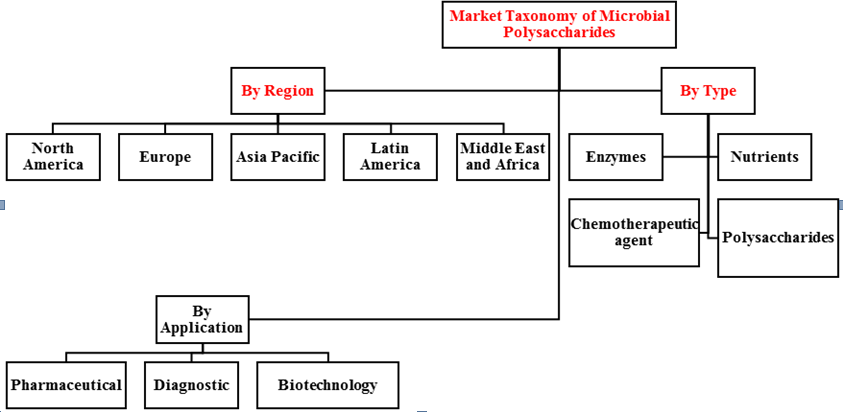
The global microbial products market is segmented on the basis of types, source, applications and end users. Based on types, the market has been segmented as enzymes, polysaccharides, nutrients (amino acids, nucleotides, vitamins, and organic acids, others), chemotherapeutic agents, antibiotics, vaccines, others. Based on the source, it has been segmented as bacterial, viral, fungal and others. On the basis of applications, the market has been segmented as pharmaceutical, diagnostic, biotechnology and others and on the basis of end users, the market has been segmented into pharmaceutical and biotechnological industries, hospitals & clinics, diagnostic labs, research & academics and others. In the similar fashion the taxonomy of microbial polysaccharide is also divided under the same heads (Figure 3).
The market for microbial products is driven by factors such as growing prevalence of diseases, rising demand for healthcare nutrients such as vitamins, rising rates of cancers, rising demand for diagnostics microbial products, rise of lifestyles industry recommending many of these products etc. The constraints on the market are the highly fragmented nature of the industry, pressures on profits due to cut throat competition, secrecy surrounding the fermentation process, substandard and low quality producers operating from unknown locations etc. Considering all these factors, the market for microbial products was valued at 6206.67 Million USD in 2020 and is expected to grow with a CAGR of 5.25% from 2020 to 2027. One another reason for this drastic growth can be considered to be the health consciousness of the consumers which have stimulated the clean label movement thus forcing the producers to use both the organic and unadulterated products. A highly lucrative area for the development of the polysaccharides and oligosaccharides market is projected to be Asia Pacific region excluding Japan (APEJ) followed by Europe where the consumption of polysaccharides and oligosaccharides in expected to grow at a moderate pace. As per the report published by Persistence Market Research, titled ‘Microbial Source Hydrocolloids Market: Global Industry Analysis 2013–2017 and Forecast 2018–2026’ the market of microbial polysaccharides is forecasted to reach US$ 509.1 Mn by the end of 2026 in terms of sales revenue. Among all the segments the bakery and confectionery segment is expected to consume a large share of microbial source polysaccharides as compared to the other segments which include beverages, meat & poultry, and dairy. By product type, the xanthan gum segment is expected be a prominent segment in the microbial source hydrocolloids market whose segment’s share is expected to rise to 57.7% by the end of 2026. The gellan gum segment holds the second-largest market share in the overall microbial source hydrocolloids market, and is expected to be 36.8% by the end of 2026 in the global microbial source hydrocolloids market. As per another report published by Fact.MR, titled “Polysaccharides and Oligosaccharides Market Forecast, Trend Analysis and Competition Tracking- Global Market Insights 2020 to 2030” the polysaccharides sourced from bacteria will witness the maximum growth and the global market of polysaccharides and oligosaccharides is estimated to leverage at a CAGR of over 5% during the period 2020- 2030, reaching a value pool of over US$ 22 Bn. Some of the key players involved in the manufacturing of the microbial polysaccharides are listed in Table 2 below.
| Manufacturing Company | Polysaccharide Manufactured | Headquarters | Branches in India |
|---|---|---|---|
| Archer Daniels Midland Company | Xanthan gum | Chicago, Illinois | Gurugram, Haryana |
| Cargill, Inc | Xanthan gum, Carrageenan | Minnesota, U.S. | Bari, Haryana; Gurugram, Haryana; Bengaluru, Karnataka |
| CP Kelco, | Xanthan gum, Gellan gum, Carrageenan | Atlanta, U.S. | Mumbai, Maharashtra |
| Deosen USA, Inc. | Xanthan gum | Piscataway, New Jersey | - |
| Hawkins Watts | Xanthan gum, Gellan gum | Auckland, New Zealand | - |
| Hispanagar, S.A | Agar polysaccharides | Burgos, Spain | - |
| Jungbunzlauer Holding AG | Xanthan gum and Gellan gum (TayaGel®) | Basel, Switzerland | Mumbai, Maharashtra |
| Koninklijke DSM N.V. | Xanthan gum, Gellan gum, Welan gum | Heerleen, Netherlands | Chennai, India |
| Lubrizol Corporation | Marine polysaccharides | Ohio, U.S. | Mumbai, Maharashtra |
Table 2: Key Players involved in the Manufacturing of the Microbial Polysaccharides.
Conclusion
The interest in microbial polysaccharides especially extracellular polysaccharides has considerably increased in the past few years. Due to their diverse functionality these microbial polysaccharides have found applicability in different industries such as food, pharmaceutical, chemical, heath etc. The demand for microbial polysaccharides is on the rise due to their ability to be manufactured using industrial waste as a substrate and their diverse range of desirable properties. This approach offers solutions to production and purification hurdles, ultimately enhancing product quality and advancing their journey towards commercial viability. Despite of their varied applicability the microbial polysaccharides constitute only a small fraction of the current polymer market since the cost involved in their production and recovery is comparatively high than the currently available gums. Lack of understanding of biosynthesis of polysaccharides and their extraction process pose an additional threat to the growth of polysaccharides and oligosaccharides market. Thus, in order to conquer the polysaccharide market the manufacturers should focus on the development of cost-effective production process, should explore high-value market niches such as cosmetics, pharmaceuticals, and biomedicine and look for certain functional properties which are comparatively better than the traditional polysaccharides. Expanding the market for microbial polysaccharides involves strategic efforts aimed at increasing awareness, improving accessibility, and showcasing their value proposition. Expanding the market for microbial polysaccharides involves a multi- faceted approach encompassing research and development, product diversification, marketing, collaborations, regulatory compliance, education, customer engagement, and sustainability initiatives. Investing in research and development is crucial to enhancing production processes and developing new applications. Product diversification allows for catering to a wide range of industries, from food to cosmetics, thus increasing market reach. Effective marketing campaigns raise awareness about the benefits and eco- friendly nature of microbial polysaccharides, driving demand. Collaborations with industry players, research institutions, and government agencies accelerate market penetration and innovation. Regulatory compliance ensures product safety and quality, instilling confidence in customers. Educational initiatives inform stakeholders about the applications and proper use of microbial polysaccharides, fostering adoption. Strong customer engagement builds loyalty through feedback channels, technical support, and timely delivery. Emphasizing sustainability credentials aligns with growing environmental concerns, positioning microbial polysaccharides as eco- friendly alternatives. By implementing these strategies, stakeholders can effectively expand the market for microbial polysaccharides, capitalizing on their diverse applications and sustainable attributes across industries.
Conflict of Interest
The authors declare no conflict of interest.
References
-
Giavasis I (2002) Physiological studies on the production of gellan gum by Sphingomonas paucimobilis. University of Strathclyde, UK, pp: 296.
-
Rahi DK, Chaudhary E, Malik D (2018) Production of Exopolysaccharide by Enterobacter cloacae, a root nodule isolate from Phaseolus vulgaris: Parameter optimisation for yield enhancement under submerged fermentation. Int J Basic Appl Res 8(9): 936-948.
-
Linton JD, Ash SG, Huybrechts L (1991) Biomaterials. London: Palgrave Macmillan, UK, pp: 215-261.
-
Nielsen PH, Jahn A (1999) Microbial extracellular polymeric substances: characterization, structure and function. Springer-Verlag Berlin Heidelberg, Germany, pp: 49-72.
-
Laspidou CS, Rittmann BE (2002) A unified theory for extracellular polymeric substances, soluble microbial products, and active and inert biomass. Water research 36(11): 2711-2720.
-
Rahi DK, Chaudhary E (2021) Biotechnological applications of exopolysaccharide produced by the wood rot fungi. Journal of Advanced Scientific Research 12(2 Suppl 1): 157-164.
-
Nagaoka M, Hashimoto S, Watanabe T, Yokokura T, Mori Y (1994) Anti-ulcer effects of lactic acid bacteria and their cell wall polysaccharides. Biological and Pharmaceutical Bulletin 17(8): 1012-1017.
-
Calazans GM, Lima RC, de Franca FP, Lopes CE (2000) Molecular weight and antitumour activity of Zymomonas mobilis levans. International Journal of Biological Macromolecules 27(4): 245-247.
-
Yoo SH, Yoon EJ, Cha J, Lee HG (2004) Antitumor activity of levan polysaccharides from selected microorganisms. International journal of biological macromolecules 34(1-2): 37-41.
-
He F, Yang Y, Yang G, Yu L (2010) Studies on antibacterial activity and antibacterial mechanism of a novel polysaccharide from Streptomyces virginia H03. Food Control 21(9): 1257-1262.
-
Oner E T (2013) Microbial production of extracellular polysaccharides from biomass. Pretreatment techniques for biofuels and biorefineries, Springer, Germany, pp: 35-
-
Nicolaus B, Kambourova M, Oner ET (2010) Exopolysaccharides from extremophiles: from fundamentals to biotechnology. Environmental technology 31(10): 1145-1158.
-
Ozcan E, Sargın S, Goksungur Y (2014) Comparison of pullulan production performances of air-lift and bubble column bioreactors and optimization of process parameters in air-lift bioreactor. Biochemical Engineering Journal 92: 9-15.
-
Jindal N, Khattar JS (2018) Microbial polysaccharides in food industry. Biopolymers for food design, Academic Press, US, pp: 95-123.
-
Huang Q, Jin Y, Zhang L, Cheung PC, Kennedy JF (2007) Structure, molecular size and antitumor activities of polysaccharides from Poria cocos mycelia produced in fermenter. Carbohydrate Polymers 70(3): 324-333.
-
Rosalam S, England R (2006) Review of xanthan gum production from unmodified starches by Xanthomonas comprestris sp. Enzyme and Microbial Technology 39(2): 197-207.
-
Bhavani AL, Nisha J (2010). Dextran-the polysaccharide with versatile uses. Int J Pharm Bio Sci 1(4) 569-573.
-
Korakli M, Pavlovic M, Ganzle MG, Vogel RF (2003) Exopolysaccharide and kestose production by Lactobacillus sanfranciscensis LTH2590. Applied and Environmental Microbiology 69(4): 2073-2079.
-
De Vuyst L, De Vin F, Vaningelgem F, Degeest B (2001) Recent developments in the biosynthesis and applications of heteropolysaccharides from lactic acid bacteria. International Dairy Journal 11(9): 687-707.
-
Sima F, Mutlu EC, Eroglu MS, Sima LE, Serban N, et al. (2011) Levan nanostructured thin films by MAPLE assembling. Biomacromolecules 12(6): 2251-2256.
-
Jagodzinski PP, Wiaderkiewicz R, Kurzawski G, Kloczewiak M, Nakashima H, et al. (1994) Mechanism of the inhibitory effect of curdlan sulfate on HIV-1 infection in vitro. Virology 202(2): 735-745.
-
Kataoka K, Muta T, Yamazaki S, Takeshige K (2002) Activation of macrophages by linear (1→ 3)-β-d-glucans: implications for the recognition of fungi by innate immunity. Journal of Biological Chemistry 277(39): 36825-36831.
-
Zhan XB, Lin CC, Zhang HT (2012) Recent advances in curdlan biosynthesis, biotechnological production, and applications. Applied Microbiology and Biotechnology 93: 525-531.
-
Dennehy KM, Brown GD (2007) The role of the β-glucan receptor Dectin-1 in control of fungal infection. Journal of Leucocyte Biology 82(2): 253-258.
-
Kumar H, Kumagai Y, Tsuchida T, Koenig PA, Satoh T, et al. (2009) Involvement of the NLRP3 inflammasome in innate and humoral adaptive immune responses to fungal β-glucan. The Journal of Immunology 183(12): 8061-8067.
-
Freitas F, Alves VD, Reis MA (2011) Advances in bacterial exopolysaccharides: from production to biotechnological applications. Trends in biotechnology 29(8): 388-398.
-
Lee KY, Mooney DJ (2012) Alginate: properties and biomedical applications. Progress in polymer science 37(1): 106-126.
-
Halder U, Banerjee A, Bandopadhyay R (2017) Structural and functional properties, biosynthesis, and patenting trends of bacterial succinoglycan: a review. Indian journal of microbiology 57(3): 278-284.
-
Tian Y, Visser JC, Klever JS, Woerdenbag HJ, Frijlink HW, et al. (2018) Orodispersible films based on blends of trehalose and pullulan for protein delivery. European Journal of Pharmaceutics and Biopharmaceutics 133: 104-111.
-
Vuddanda PR, Montenegro-Nicolini M, Morales JO, Velaga S (2017) Effect of plasticizers on the physico-mechanical properties of pullulan based pharmaceutical oral films. European Journal of Pharmaceutical Sciences 96: 290- 298.
-
Tiwari S, Patil R, Dubey SK, Bahadur P (2019) Derivatization approaches and applications of pullulan. Advances in Colloid and Interface Science 269: 296-308.
-
Chan PM, Kanagasabapathy G, Tan YS, Sabaratnam V, Kuppusamy UR (2013) Amauroderma rugosum (Blume & T. Nees) Torrend: nutritional composition and antioxidant and potential anti-inflammatory properties. Evidence-Based Complementary and Alternative Medicine: 304713.
-
Zhang Y, Kong H, Fang Y, Nishinari K, Phillips GO (2013) Schizophyllan: A review on its structure, properties, bioactivities and recent developments. Bioactive Carbohydrates and Dietary Fibre 1(1): 53-71.
-
Jaszek M, Osinska-Jaroszuk M, Janusz G, Matuszewska A, Stefaniuk D, et al. (2013) New bioactive fungal molecules with high antioxidant and antimicrobial capacity isolated from Cerrena unicolor idiophasic cultures. BioMed research international: 497492.
-
Wu M, Luo X, Xu X, Wei W, Yu M, et al. (2014) Antioxidant and immunomodulatory activities of a polysaccharide from Flammulina velutipes. Journal of Traditional Chinese Medicine 34(6): 733-740.
-
Mattila P, Suonpaa K, Piironen V (2000) Functional properties of edible mushrooms. Nutrition Reviews 16(7-8): 694-696.
-
Ina K, Kataoka T, Ando T (2013) The use of lentinan for treating gastric cancer. Anti-Cancer Agents in Medicinal Chemistry 13(5): 681-688.
-
Giavasis I (2014) Bioactive fungal polysaccharides as potential functional ingredients in food and nutraceuticals. Current opinion in biotechnology 26: 162-173.
-
Yamaguchi Y (2016) Immunotherapy of Cancer. Springer, Berlin, Germany, pp: 6-7.
-
Gulati V, Singh MD, Gulati P (2019) Role of mushrooms in gestational diabetes mellitus. AIMS Med Sci 6(1): 49-66.
-
Zhu H, Sheng K, Yan E, Qiao J, Lv F (2012) Extraction, purification and antibacterial activities of a polysaccharide from spent mushroom substrate. International Journal of Biological Macromolecules 50(3): 840-843.
-
Signoretto C, Marchi A, Bertoncelli A, Burlacchini G, Papetti A, et al. (2014) The anti-adhesive mode of action of a purified mushroom (Lentinus edodes) extract with anticaries and antigingivitis properties in two oral bacterial pathogens. BMC complementary and alternative medicine 14: 1-9.
-
Bisen PS, Baghel RK, Sanodiya BS, Thakur GS, Prasad GBKS (2010) Lentinus edodes: a macrofungus with pharmacological activities. Current medicinal chemistry 17(22): 2419-2430.
-
Kojima H, Akaki J, Nakajima S, Kamei K, Tamesada M (2010) Structural analysis of glycogen-like polysaccharides having macrophage-activating activity in extracts of Lentinula edodes mycelia. Journal of natural medicines 64: 16-23.
-
Yang BK, Gu YA, Jeong YT, Jeong H, Song CH (2007) Chemical characteristics and immuno-modulating activities of exo-biopolymers produced by Grifola frondosa during submerged fermentation process. International Journal of Biological Macromolecules 41(3): 227-233.
-
Zhao C, Gao L, Wang C, Liu B, Jin Y, Xing Z (2016) Structural characterization and antiviral activity of a novel heteropolysaccharide isolated from Grifola frondosa against enterovirus 71. Carbohydrate polymers 144: 382-389.
-
Guo L, Xie J, Ruan Y, Zhou L, Zhu H, et al. (2009) Characterization and immunostimulatory activity of a polysaccharide from the spores of Ganoderma lucidum. International immunopharmacology 9(10): 1175-1182.
-
Hobbs C (2005) The chemistry, nutritional value, immunopharmacology, and safety of the traditional food of medicinal split-gill fugus Schizophyllum commune Fr: Fr.(Schizophyllaceae). A literature review. International Journal of Medicinal Mushrooms 7(1&2): 127-140.
-
Zong A, Cao H, Wang F (2012) Anticancer polysaccharides from natural resources: A review of recent research. Carbohydrate polymers 90(4): 1395-1410.
-
Zhang Y, Li H, Hu T, Li H, Jin G, et al. (2018) Metabonomic profiling in study hepatoprotective effect of polysaccharides from Flammulina velutipes on carbon tetrachloride-induced acute liver injury rats using GC– MS. International Journal of Biological Macromolecules 110: 285-293.
-
Barakat OS, Sadik MW (2014) Mycelial growth and bioactive substance production of Pleurotus ostreatus in submerged culture. International Journal of Current Microbiology and Applied Sciences 3(4): 1073-1085.
-
Zhu KX, Nie SP, Tan L H, Li C, Gong DM, et al. (2016) A polysaccharide from Ganoderma atrum improves liver function in type 2 diabetic rats via antioxidant action and short-chain fatty acids excretion. Journal of agricultural and food chemistry 64(9): 1938-1944.
-
Giavasis I, Biliaderis C (2006) Functional food carbohydrates. CRC Press, Boca Raton, US, pp: 167-214.
-
Stachowiak B, Regula J (2012) Health-promoting potential of edible macromycetes under special consideration of polysaccharides: a review. European Food Research and Technology 234: 369-380.
-
Friedman M (2016) Mushroom polysaccharides: chemistry and antiobesity, antidiabetes, anticancer, and antibiotic properties in cells, rodents, and humans. Foods 5(4): 80.
-
Markova N, Kussovski V, Radoucheva T, Dilova K, Georgieva N (2002) Effects of intraperitoneal and intranasal application of Lentinan on cellular response in rats. International immunopharmacology 2(12): 1641-1645.
-
Lindequist U, Niedermeyer TH, Julich WD (2005) The pharmacological potential of mushrooms. Evidence- based complementary and alternative medicine 2: 285- 299.
-
Shit SC, Shah PM (2014) Edible polymers: challenges and opportunities. Journal of Polymers: 427259
-
Kambourova M, Oner ET, Poli A (2015) Industrial Biorefineries & White Biotechnology. Elsevier, Netherlands, pp: 523-554.
- Evaluation of Proximate and Mineral Compositions of Momordica charantia L. (Cucurbitaceae)
- Targeting Superbugs: Efficacy of Bacteriophage Therapy against Antibiotic-Resistant Pseudomonas Aeruginosa in Urinary Tract Infections
- Genetic Insights into Prepubertal Gynecomastia: A Comprehensive Analysis of a Rare 45,X[2]/ 46,X, + mar[28] Karyotype
- The Efficiency of Biological Treatment Plants in Some Private Hospitals in the City of Basra, Iraq
- Exploring the Combined Efficacy of Carvacrol and Friedelin against Multi-Drug Resistant Bacteria in Upper and Lower Respiratory Tract Infections
- Isolation, Identification and Comparative Analysis of Oral Microbial Communities in Smokers and Non-Smokers: A Scientific Investigation