
DNA Binding Potential and Antibacterial Activity of Metamizole
Metamizole is an anti-inflammatory medicine that is using in spasm, painkiller, reliever. The drug is using from a lot of people but there is a paucity of study about the antimicrobial and DNA binding activity of Metamizole. This study was aimed to investigate the antimicrobial (against Escherichia coli and Enterococcus faecalis) and DNA binding activity (on PUC18 Plasmid DNA) of Metamizole. The result of this study showed that Metamizole does not have antibacterial effect on Escherichia coli and Enterococcus faecalis, because both bacterial strain were grown at all concentrations (0.049 to 12.5 mg/ml). The electrophoretic pattern of DNA treated with Metamizole (concentrations of 250, 125 and 62.5 μg) showed same bands on agarose gel as negative control. Therefore Metamizole did not break the PUC18 vector DNA. It can be concluded that Metamizole might not pose a potential risk for our life. However, it must be investigated in other test systems.
Bacterial Strains
The test bacteria used in this study were from Bulent Ecevit University Medical Microbiology lab. Enterococcus faecalis ATCC 51299 as a gram positive bacteria and Escherichia coli ATCC 25922 as a gram negative bacteria. The bacterial strains were cultured in viable state via inoculation on Mueller-Hinton Broth and overnight incubation at 37°C.
| Introduction |
| Material and Methods |
Antimicrobial Activity of Metamizole
Minimum Inhibitory Concentration (MIC) and Minimum Bactericidal Concentration (MBC) of Metamizole were determined by dilution method.
Different concentrations of Metamizole (final concentrations of 0.049 to 12.5 mg/ml) were prepared and added to different tubes with 4 ml Mueller-Hinton Broth medium. So, a microbial suspension of 0.5 McFarland was obtained from two bacterial strains (Enterococcus faecalis ATCC 51299 as a gram positive bacteria and Escherichia coli ATCC 25922 as a gram negative bacterium) and the bacterial strains were cultured in prepared Mueller-Hinton Broth medium containing different Metamizole concentrations tubes. The tubes were then incubated at 37°C for overnight. The tube with the lowest concentration of the Metamizole at which no visible growth was reported as the MIC of the tested bacteria. The tubes were shaken to homogenize the contents and 100 μL of the contents of each tube was sub cultured by spreading Mueller-Hinton agar plastic petri dishes. The plates were incubated for 24 hours and then observed for any growth of colonies. Minimum bactericidal concentration was determined as the lowest concentration of Metamizole at which no colony observed following the sub culturing onto Mueller Hinton agar mediums [9, 10, 11].
DNA Binding Activity of Metamizole
DNA breaking potential of Metamizole was evaluated on PUC18 plasmid vector. The experiments were done in a volume of 8 μl in a microfuge tube containing 5 μl PUC18 (50μg/ml) plasmid DNA, and 5 μl of Metamizole in the concentrations of 250, 125 and 62.5 μg, respectively. In this research, untreated controls (PUC18 DNA) were also used. The reactions were incubated at 37°C temperature for 30 min. After incubation, the reaction mixture along with gel loading dye (6×) was loaded on a 2 % agarose gel for electrophoresis [12].
Result and Discussion
Antibacterial Activity of Metamizole
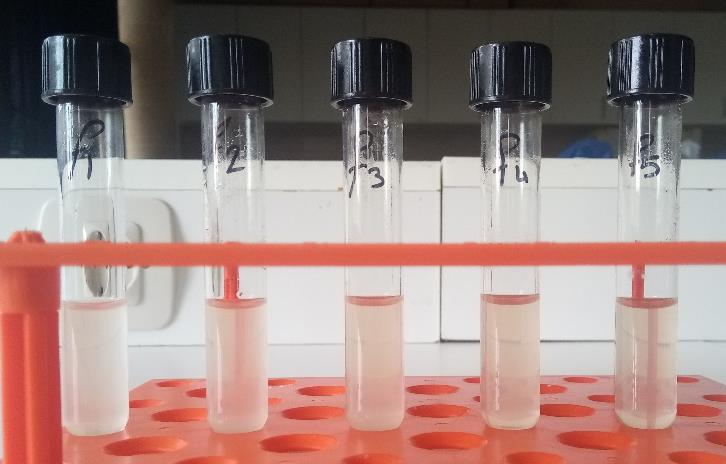
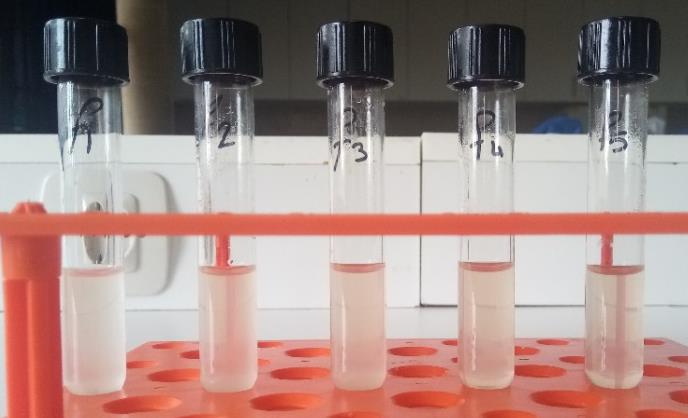
Minimum Inhibitory Concentration (MIC) and Minimum Bactericidal Concentration (MBC) of Metamizole were determined by dilution method. In this research we tested Enterococcus faecalis ATCC 51299 as a gram positive bacteria and Escherichia coli ATCC 25922 as gram negative bacteria. The result obtained from this research showed that Metamizole has no antibacterial effect on Enterococcus faecalis and Escherichia coli, because both bacterial strains were grown at all tested concentrations. For this reason we cannot report MIC and MBC for Metamizole against Enterococcus faecalis and Escherichia coli (Figure 2 & 3).
DNA Breaking Activity of Metamizole
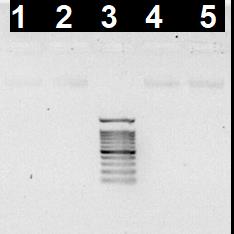
As it was shown in Figure 4, the electrophoretic pattern of DNA treated with Metamizole (concentrations of 250, 125 and 62.5 μg) showed same bands on agarose gel electrophoresis as untreated control. Therefore Metamizole did not break the plasmid DNA.
The results of this study showed that Metamizole has not antibacterial effect on Enterococcus faecalis and Escherichia coli. According to our knowledge, it was the first study that addresses the antibacterial effects Metamizole against Enterococcus faecalis and Escherichia coli. The results obtained from PUC18 plasmid DNA damaging assay showed that Metamizole has no genetoxic effect on PUC18 DNA, because the electrophoretic pattern of PUC18 DNA after Metamizole treatment showed same bands on agarose gel electrophoresis as untreated control. In our life some time we use different drugs for pain relief. Some of these drugs have genotoxic or antibacterial effects, for this reason we need to study about these substances.
In contrast to Metamizole, number of reviews concerning the genotoxic property of some other pain relief drugs has been published. For example Oliván, et al. [13] showed that Diclofenac, ibuprofen and naproxen were responsible of alterations in biochemical biomarkers evaluated and DNA damage.
| P. | ||||||||
|---|---|---|---|---|---|---|---|---|
| aeruginosa ATCC 9027 and E. coli ATCC 8739. | Milani, et | |||||||
| al. [16] | investigated the antimicrobial activity of | |||||||
| diclofenac and ibuprofen on E. faecalis. | In accordance with | |||||||
| this result, | Milani, et | al. [16] | diclofenac and ibuprofen | |||||
| have significantly more pronounced antibacterial activity | ||||||||
| against E. faecalis. |
Conclusion
The result of our research showed that Metamizole don’t have antimicrobial and genotoxic effect. It can be concluded that Metamizole might not pose a potential risk for our life. However, it must be investigated in other test systems.
Acknowledgments
This study was funded by Zonguldak Bulent Ecevit University Research Fund (Zonguldak Bulent Ecevit University- BAP) 2018-27095600-02.
References
-
Ricciotti E, Fitz Gerald GA (2011) Prostaglandins and Inflammation. Arterioscler Thromb Vasc Biol 31(5): 986-1000.
-
Jage J, Laufenberg-Feldmann R, Heid F (2008) Drugs for postoperative analgesia: routine and new aspects. Part 1: non-opioids. Der Anaesthesist (in German) 57(4): 382-390.
-
United Nations Department of Economic and Social Affairs (2005) Consolidated List of Products Whose Consumption and/or Sale Have Been Banned, Withdrawn, Severely Restricted of Not Approved by Governments (PDF) 12th (Edn.) New York: United Nations pp: 171-175.
-
Drugs.com (2015) International listings for Metamizole Page accessed.
-
Brayfield A (2013) Martindale: The Complete Drug Reference. Pharmaceutical Press.
-
Miljkovic MN, Rancic NK, Simic RM, Dusica M, Stamenkovic DM, et al. (2018) Metamizole: Current Status of the Safety and Efficacy. Hospital Pharmacology 5(3): 694-704.
-
Konijnenbelt PJ, van der HC, Ekhart C, Bos J, Bruhn J, Kramers C, et al. (2017) Metamizole (Dipyrone) as an Alternative Agent in Postoperative Analgesia in Patients with Contraindications for Nonsteroidal Anti-Inflammatory Drugs. Pain Pract 17(3): 402-408.
-
Jasiecka A, Maślanka T, Jaroszewski JJ (2014) Pharmacological characteristics of metamizole. Pol J Vet Sci 17(1): 207-214.
-
Norizadeh M, Hajipour O (2017) Antibacterial effect of brilliant blue food dye. IJMCM 7(2). 890-895.
-
Norizadeh Tazehkand M (2018) The investigation of anti-bacterial activity of Reactive Red-120. J Pharmacol Med Chem 2(1): 1-3.
-
Norizadeh tazehkand M, Valipour E (2019) Cytotoxic, antimicrobial and DNA breaking activity of Salgam. IJBB 56(2): 169-174.
-
Tazehkand MN, Moridikia A, Hajipour O, Valipour E, Timocin T, ET AL. (2016) The effects of 4-MEI on cell proliferation, DNA breaking and DNA fragmentation. Bratislavske Lekarske Listy 117(7): 371-375.
-
Gómez Oliván LM, Galar Martínez M, García Medina S, Valdés Alanís A, Islas Flores H, et al. (2014) Genotoxic response and oxidative stress induced by diclofenac, ibuprofen and naproxen in Daphnia magna. Drug Chem Toxicol 37(4): 391-399.
-
Tripathi Rina, Tripathi Pankaj, Pancholi SS (2014) Genotoxicity Studies of Diclofenac Sodium in the Bone Marrow and Germ cells of Laboratory Mice. Austin J Pharmacol Ther 2(10): 1054.
-
Al-Bakri AG, Othman G, Bustanji Y (2009) The assessment of the antibacterial and antifungal activities of aspirin, EDTA and aspirin-EDTA combination and their effectiveness as antibiofilm agents. J Appl Microbiol 107(1): 280-286.
-
Salem Milani A, Balaei Gajan E, Rahimi S, Moosavi Z, Abdollahi A, ET AL. (2013) Antibacterial Effect of Diclofenac Sodium on Enterococcus faecalis. J Dent 10(1): 16-22.
- Gallic and Citric Acid Present in the Peels of Tropical Fruits as an Alternative in the Fight against Cancer
- Treating the Forehead Lines with Combination of Forehead and Glabellar Botulinum Toxin Among Japanese Patients
- Clinical Evaluation of Patients Suffering from Breast Cancer & Determination of Treatment Therapies and Better Strategies Related to Breast Cancer
- Medieval Recipes by Al-Zahrāwī for Heart Palpitations Treatment
- Etiology and Prescription Errors of Myocardial Infarction in Different Health Care Systems of Azad Kashmir
- Early Diagnosis and Multidisciplinary Management of Turner Syndrome: A Paediatric Case Study