
Investigation of In Vitro Cytotoxic Effects of Flumethrin by Using Brine Shrimp Lethality Assay
Flumethrin is a synthetic insecticide, a type II pyrethroid derivative group derived structurally from naturally occurring pyrethrins in some plants. It is widely used in veterinary medicine, public health and agricultural struggle. It is commonly used in cattle and sheep for the treatment and control of infestations due to biting flies, sucking and stinging lice, ticks, scabies and other external parasites. It is used in the treatment of scabies infections in dogs. It is also frequently used in the control of Varroa disease in beehives. According to the World Health Organization (WHO) classification, flumethrin has class II toxicity (moderately hazardous). The acute oral LC50 value of flumethrin was 41-3849 mg/kg in female Wistar mice. Flumethrin is toxic to fish and aquatic animals. It has been reported that flumethrin is also toxic to honey bees, causing behavioral disorders and nerve damage, shortening hive performance and life span. Brine-shrimp (Artemia salina) Letalite assay is one of the toxicity tests used to determine LC50 level. Artemia salina larvae are widely used in the determination of cytotoxicity of samples which biological activities are investigated. The lethal effect of toxic substances on Artemia salina larvae in vivo allows the use of the quick and simple method “Brine Shrimp LetaliteTestâ€. Information is limited on what adverse effects of acute or low-dose repeated exposure to flumetrine can cause. In this study, the cytotoxic effect of flumethrin was investigated by Brine Shrimp Letalite assay. 9 different concentrations of flumethrin (0.005, 0.01, 0.025, 0.05, 0.1, 0.5, 0.75, 1 and 2.5 µg/L) were used in the experiment. At the end of the study, 50% lethal concentration of flumethrin to Artemia salina larvae was determined to be 0.67 µg/L. The LC50 values of flumethrin below 100 ppm are found to be within the toxic limits in terms of upper and lower safety limits.
Introductıon
The use of intensive and uncontrolled drugs in the protection against agricultural pests causes environmental pollution, deterioration of the natural balance and resistance to these compounds in a short time [1]. The rapid increase in the world population brought about the increase in the need for agricultural products. With the spread of intensive and irrigateds agriculture, plant diseases and pests have become epidemics. Although the discovery of pesticides of organic origin has been a glimmer of hope, the remnants of the environment have directed humanity to new searches again [2]. Pyrethroids are still very important drugs because of their safety and wide usage. Many insecticides currently available for use are more toxic in insect than in mammals. In many cases, this is closely related to the component’s selective effect on target structures. Pyrethroids are synthetic insecticides based on the structure of pyrethrins containing six insecticidal components of the natural insecticide pyrethrum. Since the 1970s, pyrethroids have been included in the insecticide group (25%), which is widely used in agricultural and environmental health in the world. These compounds have a spreading effect with nerve palsy. The mechanism of action is similar to DDT [3, 4].
Flumethrin is a synthetic insecticide, a type II pyrethroid derivative group derived structurally from naturally occurring pyrethrins in some plants. Synthetic pyrethroids are nervous system poison, which shows toxic effects on sodium channels of target arthropod and affects axons on the peripheral and central nervous system. It is widely used in veterinary medicine, public health and agricultural struggle. It is commonly used in cattle and sheep for the treatment and control of infestations related to biting flies, sucking and insect lice, tick, scabies and other external parasites [5, 6, 7]. It is used in the treatment of scabies infections in dogs. It is also frequently used in the control of Varroa disease in beehives. It is effective on both adult and larvae of susceptible parasites. The drug is resistant to destructive enzymatic effects and environmental conditions in susceptible parasites and has a long-lasting and protective activity. Although they are safer than some other pesticide groups, they are known to cause long-term or high-dose poisoning [8, 9, 10, 11, 12]. According to the World Health Organization (WHO) classification, flumethrin has toxicity class II (moderately hazardous) [13]. The acute oral LD50 value of flumethrin is 41-3849 mg/kg in female Wistar mice [14]. Flumethrin is toxic to fish and aquatic animals [15]. It has been reported that flumethrin is also poisonous in honey bees, causing behavioral disorders and nerve damage in the bees, shortening hive performance and life span [16]. In our country, pyrethroids containing different active substances are used in various ways under various trade names.
Daha fazla göster Daha az göster Artemia is an important test organism used for ecotoxicity tests [17]. The lethal effect of toxic substances on Artemia salina larvae allows the use of the quick and simple method “Brine Shrimp Lethality Test [18, 19]. This test was developed by Michael, et al. [20] and was adopted as a convenient method for the potential toxic effects of many chemicals or plant extracts [21, 22]. The main advantages of using A. salina as a material in toxicity tests are: (1) a rapid method (the time from cyst to larvae is 28-72 hours), (2) the cost is inexpensive, (3) the larvae are homogeneous, (4) can be used year-round without culture [17, 23], (5) have knowledge about the biology and ecology, (6) easy to manipulate and maintain in laboratory conditions (7) can be produced easily even in a small environment and well- plate, and (8) highly adapt to various test conditions [17, 24]. In addition, the results obtained with the modified form of this test with Artemia salina larvae are compared with the results obtained in toxicity tests with mammalian cell cultures [25]. In studies conducted to determine whether there is a correlation between some aquatic toxicity tests using Artemia salina and toxicity tests using rodents (mouse or rat), there was generally a good correlation between the results. Similarly, these chemicals have been observed to test their oral acute toxicity potential and give slightly better results than rodent tests compared to acute doses for humans [26, 27].
Information is limited about what undesirable effects acute or low-dose repeated exposure to flumetrine can cause. The aim of this study was to investigate the cytotoxic profile of flumethrin. Due to insufficient experimental studies on the subject, the data to be obtained contribute to science.
Materials and Methods
In this study, A. salina cysts of Agua tech brand were used as material. The toxicity test of flumethrin against A. salina was carried out according to the protocol proposed by Paredes, et al. [28]. A. salina eggs were incubated in a 500 ml glass aquarium containing salty water (3.6 g / 100 mL) with plenty of oxygen. Experiments were performed for 24 hours at 28°C, pH 8-8.5 for 16/8 light / dark period. A 60 W light bulb was used for lighting and hatching. After 48 hours of incubation, the mature Artemia larvae were hatched and collected with the aid of a pastor pipette and placed into test tubes containing 4.5 ml of sea water (10 larvae per tube). 9 different concentrations of flumethrin (0.005, 0.01, 0.025, 0.05, 0.1, 0.5, 0.75, 1 and 2.5 µg / L) were used in the experiments. Serial dilutions of DMSO at decreasing concentrations were performed to determine whether DMSO used as the solvent affected the toxicity results. Saline was used as negative control. After 24 hours of treatment with flumethrin, the dead and alive larvae were counted and recorded under a stereo microscope. The experiments were carried out in three replicates. At the end of the period, mobile and immobile Artemia samples were counted at each concentration of substance. Results were evaluated by SPSS 16.0 statistical package Probit analysis and 95% confidence limits were calculated with LC50 values.
Results
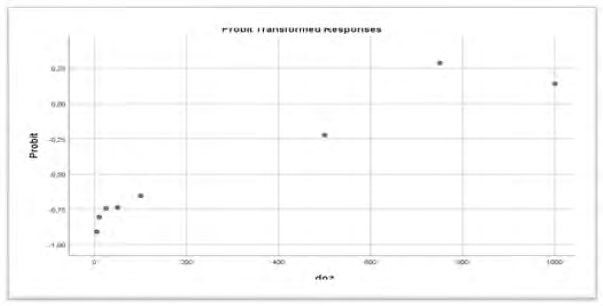
As a result of the evaluation of Flumethrin data by Probit analysis; LC50 values were not reached at concentrations of 0.005, 0.01, 0.025, 0.05, 0.1 µg/L. However, Flumethrin was found to have a cytotoxic effect close to LC50 after 0.5 µg/L. The concentration (LC50) at which Flumethrin kills 50% of A. salina larvae was determined to be 0.67 µg/L. DMSO used as solvent showed no toxic effects on A. salina larvae at specified concentrations. Figure 1 shows data based on exposure of Artemia salina to flumethrin in different concentrations.
Discussion
Pyrethroids are a widely used insecticide class applied inagricultural, turf grass, commercial, and residential settings to control a broad range of insect pests. Application ofsynthetic pyrethroids is increasing as they are used to replace other insecticides, such as organo-phosphates and carbamates, in residential pest control andin mosquito abatement programs [29, 30]. Pyrethroids may enter aquatic ecosystems via spraydrift, run-off, and wastewater treatment plant effluent [29]. Pyrethroids offer low toxicity to human applicators and non-target mammals and birds, they are highly toxic to invertebrates and also fishes [31]. Saltwater arthropods are more susceptible to pyrethroidchemicals than freshwater arthropods [32].
In the Brine Shrimp Letalite Test, the concentration of chemicals leading to the death of half of the A. salina larvae (LC50) was accepted as the active concentration. Raw chemicals with LC50 values below 100 ppm are highly toxic; Chemicals with LC50 values between 100 ppm and 500 ppm are considered to be toxic, LC50 values between 500 ppm and 1000 ppm are considered weak toxic and chemicals with LC50 values above 1000 ppm are considered non-toxic. According to the data obtained in this study, According to the data obtained in this study, flumethrin was found to be within toxic limits in terms of LC50 values below 100 ppm.
There isn’t enough study examining the toxicity of pyretroids on artemia salina. Liu, et al. [33] examined the acute toxicity of preterm pesticide to Artemia and showed that the sensitivity of Artemia to different pyrethroids was very different. LC50 concentrations against Artemia were found to be 4.68, 14.82, 18.12, 38.21,> 100,> 100 and> 100 mg / L for permethrin, chlorenthrin, imiprothrin, tetramethrin, bifenthrin, lambadacyhalothrin, deltamethrin, respectively. Therefore, the use of more toxic permethrin should be avoided in saline environments containing Artemia and suggested the use of less toxic pesticides such as bifentrin, beta-cyhalothrin and deltamethrin.
Nafisa, et al. [34, 35, 36] evaluated the acute toxicity (LC50) of pyrethroid pesticide (fenvalerate) on Artemia (brine shrimp). The value the LC50 of fenvalerate was found to be 0.18 ppm for Artemia. >100和>100 mg·L -1 。
Conclusıon
The results of this study showed that the cytotoxic effect on A. salina larvae exposed to flumethrin in vitro in 24 hours was observed after 0.5 µg/L concentration and no cytotoxic effect was found in other concentration ranges (0.005, 0.01, 0.025, 0.05, 0.1 µg/L ). LC50 values of flumethrin below 100 ppm have been found to be within very toxic limits. Flumethrin appear to be highly lethal at very low concentration. High sensitivity is alarming as it may have implications on natural resources.
References
-
Yorulmaz S, Ay A (2010) Enzymes involved in detoxification of pesticides in mites and insects. Journal of the Uludağ University, Faculty of Agriculture 24: 137-148.
-
Arslan N, Yılmaz G (1993) Flea grass (Pyrethrum Sp.) Species, a vegetable source in reducing pesticide pollution. Environmental Journal 6: 1-4.
-
Vais H, Williamson MS, Devonshire AL, Usherwood PN (2001) The molecular interactions of pyrethroid insecticides with insect and mammalian sodium channels. Pest Management Science, 57(10): 877- 888.
-
Soderlund DM, Clark JM, Sheets LP, Mullin LS, Piccirillo VJ (2002) Mechanisms of pyrethroid neurotoxicity: implications for cumulative risk assessment. Toxicology 171(1): 3-59.
-
Fourie LJ, Stanneck D, Horak IG (2003) The efficacy of collars impregnated with flumethrin and propoxur against experimental infestations of adult Rhipicephalus sanguineus on dogs. Journal of the South African Veterinary Association 74(4): 123-126.
-
Mehlhorn H, Schumacher B, Jatzlau A, Abdel- Ghaffar F, Al-Rasheid KA, et al. (2011) The effects of flumethrin (Bayticol® pour-on) on European ticks exposed to treated hairs of cattle and sheep. Parasitology Research 110(6): 2181-2186.
-
Fernández Salas A, Rodríguez Vivas RI, Alonso Díaz MA (2012) First report of a Rhipicephalus microplus tick population multi-resistant to acaricides and ivermectin in the Mexican tropics. Veterinary Parasitology 183(3-4): 338-342.
-
Caldas ED, Rebelo FM, Heliodoro VO, Magalhães AF, Rebelo RM (2008) Poisonings with pesticides in the Federal District of Brazil. Clinical Toxicology (Phila) 46(10): 1058-1063.
-
Sutton NM, Bates N, Campbell A (2007) Clinical effects and outcome of feline permethrin spot- on poisonings reported to the Veterinary Poisons Information Service (VPIS), London. Journal of Feline Medicine and Surgerys 9(4): 335-339.
-
Bradberry SM, Cage SA, Proudfoot AT, Vale JA (2005) Poisoning due to pyrethroids. Toxicology Review 24(2): 93-106.
-
Kolaczinski JH, Curtis CF (2004) Chronic illness as a result of low-level exposure to synthetic pyrethroid insecticides: a review of the debate. Food and Chemical Toxicology 42(5): 697-706.
-
Bateman DN (2000) Management of pyrethroid exposure. Journal of Toxicology: Clinical Toxicology 38(2): 107-119.
-
Anonim (2019) Pharmacologıcal Propertıes. Vet- erinary Ectoparasiti.
-
Anadón A, Martínez-Larrañaga MR, Martínez MA (2009) Use and abuse of pyrethrins and synthetic pyrethroids in veterinary medicine. Veterinary Journal 182(1): 7-20.
-
Nabian S, Rahbari S, Changizi A, Shayan P (2009) The distribution of Hyalomma spp. ticks from domestic ruminants in Iran. Medical and Veterinary Entomology 23(3): 281-283.
-
Oruc HH, Hranitz JM, Sorucu A, Duell M, Cakmak I, et al. (2012) Determination of acute oral toxicity of flumethrin in honey bees. Journal of Economic Entomology 105(6): 1890-1894.
-
Nunes BS, Carvalho FD, Guilhermino LM, Van Stappen G (2006) Use of The Genus Artemia in Ecotoxicity Testing. Environmental Pollution 144(2): 453-462.
-
Choudhary IM, Thomsen WJ (2001) Bioassay Techniques For Drug Development, Harwood Academic Publishers, pp: 8-10.
-
Libralato G, Prato E, Migliore L, Cicero AM, Manfra L (2016) A Review of Toxicity Testing Protocols and Endpoints with Artemia spp. Ecological Indicators 69: 35-49.
-
Michael A, Thompson C, Abramovitz M (1956) Artemia salina as a Test Organism for Bioassay. Science (New York, NY) 123(3194): 464-464.
-
Insanu M, Anggadiredja J, Kayser O (2012) Curcacycline A and B-New Pharmacological Insights to an Old Drug. International Journal of Applied Research in Natural Products 5: 26-34.
-
Rajabi S, Ramazani A, Hamidi M, Tahereh N (2015) Artemia salina as A Model Organism in Toxicity Assessment of Nanoparticles. Journal of Pharmaceutical Sciences 23(1): 20.
-
Manfra L, Savorelli F, Pisapia M, Magaletti E, Cicero AM (2012) Long-term Lethal Toxicity Test with The Crustacean Artemia franciscana. Journal of visualized experiments 62: 2182-2185.
-
Kokkali V, Katramados I, Newman JD (2011) Monitoring The Effect of Metal Ions on The Mobility of Artemia salina nauplii. Biosensors 1(2): 36-45.
-
Lewan L, Andersson M, Morales Gomez P (1992) The Use of Artemia salina in Toxicity Testing. Alternatives to Laboratory Animals 20(2): 297-301.
-
Calleja MC, Persoone G (1992) Cyst-based toxicity tests IV. The potential of ecotoxicological tests fort he prediction of acute toxicity in man as evaluated on the first ten chemicals of the MEIC programme. The ATLA Religion Database® 20(3): 396-405.
-
Lagarto PA, Silva YR, Guerra SI, Iglesias BL (2001) Comparative study of the assay of Artemia salina L. and the estimate of the medium lethal dose (LC50 value) in mice, to determine oral acute toxicity of plant extracts. Drug Research and Development Center (CIDEM), Biologic Research Department, Ciudad de La Habana, Cuba 8(5): 395-400.
-
Paredes PFM, Vasconcelos FR, Paim RTT, Marques MMM, Morais SM, et al. (2016) Screening of bioactivities and toxicity of Cnidoscolus quercifolius Pohl. Evid Based Complement Alternat Medicine 2016: 7930563.
-
USEPA (2005) US Environmental Protection Agency, Permethrin, EFED revised risk assessment for the reregistration eligibility decision on permethrin. Washington DC, pp: 93.
-
Gan J (2008) Synthetic pyrethroids: occurrence and behavior in aquatic environments. In: Gan J, Spurlock F, Hendley P, Weston D (Eds.), Washington DC, American Chemical Society, pp: 451.
-
Palmquist K, Fairbrother A, Salatas J, Guiney PD (2011) Environmental fate of pyrethroids in urban and suburban stream sediments and the appropriateness of Hyalella azteca model in determining ecological risk. Integrated Environmental Assessment and Management 7(3): 325-335.
-
Solomon KR, Giddings JM, Maund SJ (2001) Probabalistic risk assessment of cotton pyrethroids I:Distributional analyses of laboratory aquatic toxicity data. Environmental Toxicology and Chemistry 20(3): 652-659.
-
Liu Yong, Wang Xiaoyue, Qiu Lihong, Li Xuefeng, Chengju W (2011) Acute Toxicity of Seven Pyrethroid Insecticides to Brine Shrimp Artemia. Asian Journal of Ecotoxicology 6(5): 557-560.
-
Nafisa S, Siddiqui PJA, Halima K (2012) Acute Toxic Effect of Pesticides on Brine Shrimp and Opossum Shrimp. Pakistan Journal of Zoology 44(6): 1753- 1757.
-
Narahashi T, Zhao X, Ikeda T, Nagata K, Yeh JZ (2007) Differential actions of insecticides on target sites: basis for selective toxicity. Human Experimental Toxicology 26(4): 361-366.
-
Suzhen QI, Niu X, Wang DH, Wang C, Zhu L, et al. (2020) Flumethrin at sublethal concentrations induces stresses in adult honey bees (Apis mellifera L.). Science of The Total Environment 700: 134500.
- Gallic and Citric Acid Present in the Peels of Tropical Fruits as an Alternative in the Fight against Cancer
- Treating the Forehead Lines with Combination of Forehead and Glabellar Botulinum Toxin Among Japanese Patients
- Clinical Evaluation of Patients Suffering from Breast Cancer & Determination of Treatment Therapies and Better Strategies Related to Breast Cancer
- Medieval Recipes by Al-Zahrāwī for Heart Palpitations Treatment
- Etiology and Prescription Errors of Myocardial Infarction in Different Health Care Systems of Azad Kashmir
- Early Diagnosis and Multidisciplinary Management of Turner Syndrome: A Paediatric Case Study