
DNA Binding Effect and Antibacterial Effect of Bezafibrate, an Antilipemic Agent
Bezafibrate, an antilipemic agent has important effects on fatty acid metabolism and insulin sensitivity. Researches are very interested to study Drug-DNA interactions because DNA is an important material in maintaining cell life. In this research, DNA and protein binding activity of bezafibrate was studied by UV absorption titration and molecular docking method. In addition, the effect of the drug on Escherichia coli as a human intestinal flora bacterial strain was examined using Broth Dilution method and Agar Disc Diffusion method. In this research. Docking study showed that bezafibrate made 3 hydrogenic bonds and some hydrophobic bonds with the minor groove of double-helix DNA and with colchicine binding site between α-tubulin and β-tubulin. Bezafibrate showed no effect on the growth of the bacterial strain not only in the dilution method but also in the agar disc diffusion method.
Introduction
Bezafibrate, an antilipemic agent, has important effects on fatty acid metabolism and insulin sensitivity [1, 2]. The drug activates peroxisome proliferator-activated receptors (PPARs) that have important roles in the regulation of several genes involved in lipid metabolism. The drug decrease triglycerides and cholesterol in the blood. A large number of peoples are suffering from obesity. In our country, Turkey, in 1990, 18.8% of the adult populations (28.5% in women and 9% in men) were obese, while in 2010 this number increased to 36% (44% in women and 27% in men) [3]. Some study have shown that fibrate group drugs exert genotoxic effects [4, 5]. Bezafibrate is prescribed as tablets (200mg and 400mg) (https://www.drugbank.ca). Researches are very interested to study binding of drug to DNA because DNA (Deoxyribonucleic acid) is an important material in maintaining cell life. There are many drugs that have been withdrawn and abandoned after their toxic effect has been confirmed by researchers [6].
The mode of chemical substances binding to double- strand DNA can be by covalent, groove binding and intercalation way [7]. Generally, DNA-intercalators are considered as anticancer drugs because they have cytotoxic effects [8]. Different binding modes of chemicals to DNA can expose different effect to cells, which depend on cell type and tissue [9]. Although some drugs are used in the treatment of various patients, their side effects limit its usefulness. The minor groove of DNA is sensitive against the attacks of small drug molecules. Depending on the chemical structure of drugs, they show selectivity for some nucleophilic parts of DNA [10]. The human gastrointestinal tract contains a complex and dynamic population of microorganisms, which have a significant effect on the host and they maintain a dynamic balance under physiological conditions [11]. In addition, if clinicians are aware of the side effects of drugs they can prescript an appropriate drug and doses for patient [12]. Therefore this study aimed to investigate binding of bezafibrat on DNA and its effect on growth rate of Escherichia coli from the human intestine flora bacterial strains.
Material and Methods
Reagents
This research does not contain any studies with human or animal subjects performed by any of the authors. In this research, Escherichia coli ATCC-25922 was used as a bacterial strain and bezafibrate (catalog No: 1042-1) was purchased from Sigma-Aldrich and used as the test substance. The molecular weight of bezafibrate was 361.82 and its chemical structure was as follows (Figure 1):
DNA Binding Study of Bezafibrate by UV Absorption Measurements
0.1 mM of Calf Thymus DNA that was dissolved in Tris - EDTA buffer (0.5 molar EDTA, and 50mM Tris, pH 7.2) was titrated with 2 µl of bezafibrate (50 mM) and analyzed by absorption spectra recording in the range of 215 – 315 nm. After each bezafibrate addition, drug–DNA solutions were allowed to incubate for 5 min. The intrinsic DNA binding constant (Kb) was tried to obtain using equation 1 [13, 14]. Equation 1:
$$ \frac {1}{A - A 0} = \frac {1}{A \infty - A 0} + \frac {1}{K \left(A \infty - A 0\right)}. \frac {1}{C l i g a n d} $$ A0 is the first absorbance value of DNA. A∞ is the absorbance value of DNA- bezafibrate saturated state. A is the absorbance recorded at different concentrations of bezafibrate. C ligand is the concentration of bezafibrate.
DNA and Protein Binding Study of Bezafibrate by Molecular Docking Method
AutoGrid4 and AutoDock4 were used to set up and perform blind docking calculations between bezafibrate and reseptors (DNA sequence and microtubule protein).
The DNA sequence (PDB ID: 1BNA) and microtubule protein (1JFF) were obtained from the Protein Database (https:// www.rcsb.org/ ) in a 3D form, and 3D form of bezafibrate was retrieved from PubChem (https://pubchem.ncbi.nlm.nih. gov/ ) database. Auto Dock Tools were used to prepare the DNA, microtubule protein and bezafibrate files. To perform docking calculations, Lamarckian genetic algorithms were employed. The amounts of independent docking runs performed for each docking simulation was set to 100. Cluster analysis was performed on the docked results using a root mean square (RMS) tolerance of 0.5 A˚. The output from AutoDock was rendered with Discovery Studio tool [15, 16].
Effect of Bezafibrate on the Growth of Escherichia Coli
Mueller Hinton broth medium containing different concentrations of bezafibrate (serial dilutions made by creating a two-fold dilution with a starting concentration of 2.48 mM) were prepared and inoculated with an overnight culture of the strains followed by adjusting to standard turbidity of 0.5 McFarland. After that, the cultures were incubated at 37°C at 150 rpm for overnight to determine MIC (minimum inhibitory concentration) using UV-Visible spectrophotometry (Optizen 2120 UV) and CFU (colony forming units) counting. In addition, the test was repeated on Mueller Hinton agar using sterile blank discs containing 2.48, 1.24, 0.62, 0.31 and 0.155 mM of bezafibrate [17].
Results
DNA Binding Study by UV-VIS Spectrophotometry
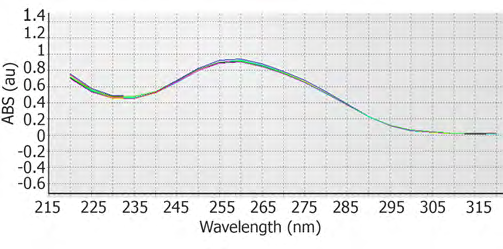
At 260 nm, the initial absorbance value (0.94) of the DNA solution (0.14 mM) did not change significantly after titration with bezafibrate solution (from 0.5 mM to 50 mM) showing that there is not any interaction between bezafibrate and the calf thymus double-strand DNA in the test condition (Figure 2).
DNA and Protein Binding Study of the Drug by Docking Analysis
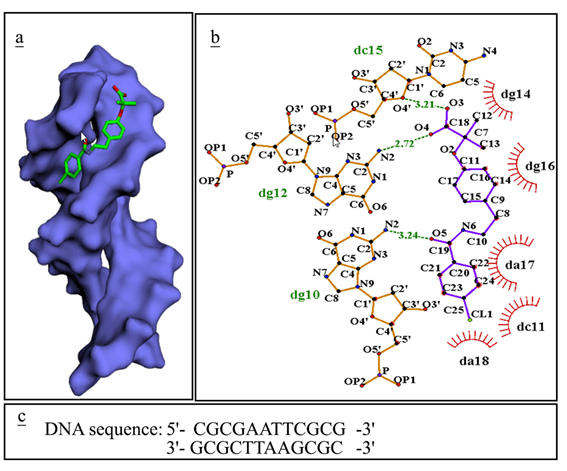
Docking study showed that bezafibrate was located in minor groove of double-helix DNA by making 3 hydrogen bonds including A:DG10:H22 - :Beza:O5, A:DG12:H22 - :Beza:O4 and Beza:H43 - B:DC15:O4’ with the bond length of 3.24, 2.72 and 3.21Å respectively (Figure 3). The different ligand conformers showed the minimum free binding energy -9.4 Kcal/mol and maximum free binding energy -4.43 Kcal/ mol (Table 1). In addition, the drug made hydrophobic bonds with the nucleotides including DG14, DG16, DA17, DC11 and DA18.
| Rank | Sub-rank | Run | Binding energy (Kcal/mol) | Cluster RMSD | Reference RMSD | Kb (1/M) | |
|---|---|---|---|---|---|---|---|
| 1 | 1 | 11 | -9.4 | 0 | 25.2 | 7.84E+06 | |
| 2 | 1 | 45 | -9.25 | 0 | 26.38 | 6.08E+06 | |
| 3 | 1 | 13 | -9.03 | 0 | 25.47 | 4.20E+06 | |
| 4 | 1 | 10 | -8.75 | 0 | 26.24 | 2.61E+06 | |
| 5 | 1 | 89 | -8.4 | 0 | 24.01 | 1.45E+06 | |
| 6 | 1 | 39 | -7.95 | 0 | 26.46 | 6.77E+05 | |
| 7 | 1 | 61 | -7.71 | 0 | 27.47 | 4.51E+05 | |
| 8 | 1 | 76 | -7.51 | 0 | 25.22 | 3.22E+05 | |
| 9 | 1 | 44 | -7.5 | 0 | 26.82 | 3.17E+05 | |
| 10 | 1 | 51 | -7.34 | 0 | 26.99 | 2.42E+05 | |
| 31 | 1 | 27 | -4.43 | 0 | 28.17 | 1.77E+03 |
Table 1: Docking summary of DNA with bezafibrate by the Auto Dock program generating different ligand conformers using Lamarckian
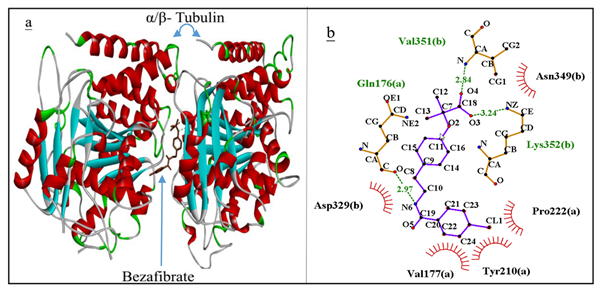
Bezafibrate bind to the Colchicine binding site between α-tubulin and β-tubulin. The hydrogen bonds between bezafibrate and α/β- tubulin’s amino acids included β:Val351: N - :Beza: O4, α: Gln176:O - :Beza: N6 and Beza: O3 - β:Lys352:
NZ with the bond length of 2.84, 2.97 and 3.24Å respectively. In addition, the docking analysis showed hydrophobic bonds between bezafibrate and some amino acids including Asp349 and Asp329 from β- tubulin and Pro222, Tyr210 and Val177
from α- tubulin. The different ligand conformers showed the minimum free binding energy -6.69 Kcal/mol and maximum free binding energy -4.07 Kcal/mol (Figure 4).
Effect of bezafibrate on the growth of Escherichia coli
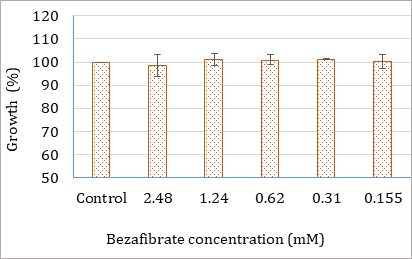
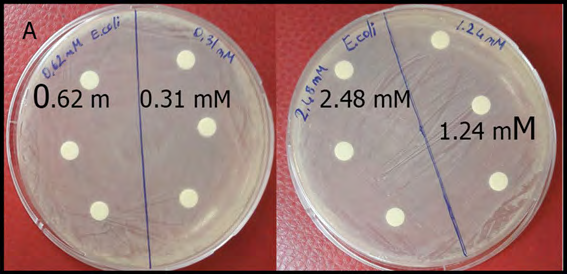
In Broth Dilution method none of the concentrations (2.48, 1.24, 0.62, 0.31 and 0.155 mM) of bezafibrate did show any inhibitory effect on the growth of the Escherichia coli. Both the colony-forming units per milliliter and the absorbance values of the culture of the treated samples and the culture of the untreated sample (control sample) were very close to each other (Figure 5). In the Disc Diffusion method, not any zone detected around the disks containing various concentrations of bezafibrate, showing that any of the drug concentrations did not inhibit the growth of the strain (Figure 6).
Discussion
Drug binding causes structural and conformational changes in DNA such as DNA bending, winding double or single-strand breaks, resulting in DNA damage [18]. UV- visible spectroscopy is the most common method to study drug-DNA interaction. After binding of a drug to DNA, hypochromic effects occurred in the spectrum of DNA due to changes in the conformation and structure of DNA (17). A hyperchromic effect is due to binding of chemicals to DNA which might result in the unwinding of DNA helix [19]. In UV- Vis spectrophotometry analysis, the absorbance of ctDNA did not show any changes by addition of bezafibrate. Molecular docking is a very important method in molecular biology and medicine design, such that docking- related papers have precipitously increased in https://www.ncbi.nlm. nih.gov/pmc, while the numbers of the papers were 2272 in 2004, it was reached to 11299 in 2018 in the website. There are many screen webserver, screen software, server and programs to do the docking analysis, from which the Autodock program [15, 16]. Is the most commonly used by researchers in worldwide [20]. Therefore in this research, highly automated docking software, Autodock tools were used to study the binding effect of bezafibrate to the DNA and microtubule proteins. In this research, bezafibrate was located at the minor groove of DNA. Minor-groove binding usually involves greater binding affinity and higher sequence specificity [21]. Before hydrogen bonds had been categorizing with a donor-acceptor distance in the ranges of 2.2–2.5, 2.5–3.2 and 3.2–4.0 A˚ as strong, moderate, and weak, respectively [22]. In this research, all of 3 hydrogen bonds shown in bezafibrate –DNA docked model had a donor- acceptor distance ranging from 2.72 to 3.24 A˚. On the other hand in docking study, bezafibrate made some hydrophobic bonds with DNA. A ligand (bezafibrate) conformers with minimum free binding energy (-9.4 Kcal/mol) and another with maximum free binding energy (-4.43 Kcal/mol) made 7.84E+06 and 1.77E+03 M-1 binding constant (Kb) value. The binding constant of Ethidium Bromide to DNA is equal to 1E+6 M-1 and has a strong hypochromic effect [23]. In another study, the DNA binding constant of Ethidium Bromide was reported as 1.3E+6 M-1 [24]. The discrepancies of the results spectrophotometry and docking analysis can result from the presence of NaCl in the buffer. In this study, phosphate buffered saline (PBS) was used as a buffer. We think that the NaCl present in PBS buffer decreased hydrophobicity of the drug. Furthermore, as previously reported about methyl 2-benzimidazole carbamate by Banduhn & Obe [25], it may be due to the binding and effect of bezafibrate on microtubules. Marina Isidori and her coworkers investigated the genotoxic effect of bezafibrate with Ames test using Salmonella typhimurium strains TA98 and TA100 and showed that bezafibrate and its photoproduct had no genotoxic risk [26]. Takayoshi Maiguma, et al. [27] by determining mitochondrial enzyme activity showed that more than almost 100 µM of bezafibrate reduced the human embryonal rhabdomyosarcoma cells (HRMSC) viability. The same group by Hoechst 33342 staining determined that the decreases of HRMSC viability were contributed to the chromatin condensation occurring in the cells after treatment by 500 µM bezafibrate. Chromatin condensation can result from DNA fragmentation [28]. Topaktas, et al. [29] reported bezafibrate to have a cytotoxic effect on cultured human peripheral blood lymphocytes. Lucia Rocco and her coworkers, using RAPD-PCR, Diffusion Assay and Comet Assay methods showed that bezafibrate (57 ng/L) led to a significant increase of DNA fragmentation in sperm cells [4]. Before, some reports have been published about the relation between the decline in brain functions, myalgia, myopathy and anemia [31, 32]. The findings can be related to the binding of the drug with DNA and/or with proteins involved in chromatin structure. Any alteration in the microbial composition (dysbiosis) has a direct effect on human health. Escherichia coli strain is one of the important strain in the intestine because the clinical manifestations of arthritis were appeared by the expression of beta-galactosidase by Escherichia coli. In addition decrease of Escherichia coli strain in the intestinal of the patients with ulcerative colitis cause to increase in the amount of non-normal flora bacteria even pathogenic strains in the intestinal tract [33]. Colicin proteins expressed by Escherichia coli inhibit bacterial growth of other species [34]. In this research, bezafibrate showed no cytotoxic effect for Escherichia coli.
Conclusion
According to the docking analysis, bezafibrate strongly binds to DNA and α/β- tubulin proteins while it showed no effect on Escherichia coli not only in the dilution method but also in the agar disc diffusion method. Therefore, the detrimental effect of bezafibrate on DNA fragmentation reported by other researchers using in-vivo or in-vitro methods may be due to the metabolites of the drug and/ or the binding of the drug to the DNA and/or the cell cycle proteins.
Acknowledgments
This research was conducted by Ibrahim Arman (Ebrahim Valipour) and was sponsored by Zonguldak Bulent Ecevit University Research Fund; Grant Number 2018- 50737594-01.
Conflict of Interest
There is not any conflict of interest.
References
-
Grygiel Górniak B (2014) Peroxisome proliferator- activated receptors and their ligands: nutritional and clinical implications-a review. Nutrition journal 13(1):17-25.
-
Ohno Y, Miyoshi T, Noda Y, Hiroki Oe, Norihisa Toh, et al. (2014) Bezafibrate improves postprandial hypertriglyceridemia and associated endothelial dysfunction in patients with metabolic syndrome: a randomized crossover study. Cardiovasc Diabetol 13(1): 71.
-
Erem C (2015) Prevalence of overweight and obesity in Turkey. IJC Metabolic & Endocrine 8: 38-41.
-
Rocco L, Peluso C, Cesaroni F, Cesaroni F, Morra N, Cesaroni D, et al. (2012) Genomic damage in human sperm cells exposed in vitro to environmental pollutants. J Environment Analytic Toxicol 2(1): 7.
-
Tawfeeq MM, Suzuki T, Shimamoto K, Hayashi H, Shibutani M, et al. (2011) Evaluation of in vivo genotoxic potential of fenofibrate in rats subjected to two-week repeated oral administration. Archives of toxicology 85(8): 1003-1011.
-
Siramshetty VB, Nickel J, Omieczynski C, Gohlke BO, Malgorzata ND, et al. (2015) Withdrawn a resource for withdrawn and discontinued drugs. Nucleic Acids Res 44(D1): D1080-D6.
-
Boer DR, Canals A, Coll M (2009) DNA-binding drugs caught in action: the latest 3D pictures of drug-DNA complexes. Dalton Trans (3): 399-414.
-
Martinez R, Chacon Garcia L (2005) The search of DNA- intercalators as antitumoral drugs: what it worked and what did not work. Curr Med Chem 12(2): 127-151.
-
Gurova K (2009) New hopes from old drugs: revisiting DNA-binding small molecules as anticancer agents. Future oncology 5(10): 1685-1704
-
Toptanci BÇ, Kizil G, Kızil M (2016) DNA damage mechanisms of anti-cancer drugs. Middle East Journal of Science 2(1): 33-49.
-
Canny GO, McCormick BA (2008) Bacteria in the intestine, helpful residents or enemies from within? Infection and immunity 76(8): 3360-3373.
-
Alp Ç, Karahan İ, Kalçık M (2018) Antihipertansif ilaçların kullanımı ile ilişkili yan etkiler: güncel literatürler eşliğinde gözden geçirme. Turkish Journal of Clinics and Laboratory 9(4): 342-347.
-
Kanakis C, Nafisi S, Rajabi M, Shadaloi A, Tarantilis PA, et al. (2009) Structural analysis of DNA and RNA interactions with antioxidant flavonoids. Journal of Spectroscopy 23(1): 29-43.
-
Marty R, N’Soukpoe-Kossi CN, Charbonneau DM, Kreplak L, Heidar-Ali, et al. (2009) Charbonneau DM, et al. Structural characterization of cationic lipid-tRNA complexes. Nucleic Acids Res 37(15): 5197-5207.
-
Morris GM, Huey R, Lindstrom W, Sanner MF, Belewet RK, et al. (2009) AutoDock4 and AutoDockTools4: Automated docking with selective receptor flexibility. J. Comput. Chem 30(16): 2785-2791.
-
Morris GM, Huey R, Olson AJ (2008) Using autodock for ligand‐receptor docking. Current protocols in bioinformatics 24(1): 8.
-
Valipour R, Yilmaz MB, Valipour E ( 2019) Study of DNA- Binding Activity and Antibacterial Effect of Escitalopram Oxalate, an Extensively Prescribed Antidepressant. Drug research.
-
Shaikh SA, Ahmed SR, Jayaram BA (2004) A Molecular thermodynamic view of DNA-drug interactions: a case study of 25 minor-groove binders. Arch Biochem Biophys 429(1): 81-99.
-
Tabassum S, Chandra Sharma G, Arjmand F, Ameer A (2015) DNA interaction studies of new nano metal based anticancer agent: validation by spectroscopic methods. Nanotechnology 21(19): 195102.
-
Chen YC (2015) Beware of docking! Trends Pharmacol Sci 36(2): 78-95.
-
Paul A, Bhattacharya S (2012) Chemistry and biology of DNA-binding small molecules. Curr Sci (Bangalore) 102(2): 212-231.
-
Yu J, Chen W, Wu C, Chen H (2014) PEG-protein interaction induced contraction of NalD chains. PLoS One 9(5): e96616.
-
Doglıa S, Graslund A, Ehrenberg A (1983) Binding of Ethidium Bromide to Self‐Complementary Deoxydinucleotides. European journal of biochemistry 133(1): 179-184.
-
Vardevanyan P, Antonyan AP, Parsadanyan M, Davtyan HG, Karapetyan AT (2003) The binding of ethidium bromide with DNA: interaction with single-and double- stranded structures. Experimental & molecular medicine 35(6): 527.
-
Banduhn N, Obe G (1985) Mutagenicity of methyl 2-benzimidazolecarbamate, diethylstilbestrol and estradiol: structural chromosomal aberrations, sister- chromatid exchanges, C-mitoses, polyploidies and micronuclei. Mutat Res 156(3): 199-218.
-
Isidori M, Nardelli A, Pascarella L (2007) Toxic and genotoxic impact of fibrates and their photoproducts on non-target organisms. Environ Int 33(5): 635-641.
-
Maiguma T, Fujisaki K, Itoh Y, Makino K, Teshima D, et al. (2003) Cell-specific toxicity of fibrates in human embryonal rhabdomyosarcoma cells. Naunyn Schmiedebergs Arch Pharmacol 367(3): 289-296.
-
Tounekti O, Belehradek J, Mir L (1995) Relationships between DNA fragmentation, chromatin condensation, and changes in flow cytometry profiles detected during apoptosis. Exp. Cell Res 217(2): 506-516.
-
Topaktas M, Kafkas NE, Sadighazadi S, Istifli ES, et al. (2017) In vitro cytogenetic toxicity of bezafibrate in human peripheral blood lymphocytes. Cytotechnology 69(4): 579-589.
-
Abd TT, Jacobson TA (2011) Statin-induced myopathy: a review and update. Expert Opin Drug Saf 10(3): 373- 387.
-
Ariad S, Hechtlinger V (1993) Bezafibrate-induced neutropenia. Eur J Haematol 50(3): 179.
-
Kacirova I, Grundmann M (2015) Fenofibrate-induced Anemia and Neutropenia–a case report. Clin Ther 37(8): e103.
-
Walujkar SA, Dhotre DP, Marathe NP, Lawate PS, Bharadwaj RS, et al. (2014) Characterization of bacterial community shift in human Ulcerative Colitis patients revealed by Illumina based 16S rRNA gene amplicon sequencing. Gut Pathog 6(1): 22.
-
Omerovic M, Müştak HK, Kaya İB (2017) Escherichia coli Patotiplerinin Virülens Faktörleri. Etlik Veteriner Mikrobiyoloji Dergisi 28(1): 1-6.
- Gallic and Citric Acid Present in the Peels of Tropical Fruits as an Alternative in the Fight against Cancer
- Treating the Forehead Lines with Combination of Forehead and Glabellar Botulinum Toxin Among Japanese Patients
- Clinical Evaluation of Patients Suffering from Breast Cancer & Determination of Treatment Therapies and Better Strategies Related to Breast Cancer
- Medieval Recipes by Al-Zahrāwī for Heart Palpitations Treatment
- Etiology and Prescription Errors of Myocardial Infarction in Different Health Care Systems of Azad Kashmir
- Early Diagnosis and Multidisciplinary Management of Turner Syndrome: A Paediatric Case Study