
In Vitro Antimicrobial Activity of Choline Effervescent Tablets against Some Pathogenic Bacteria and Fungi
1.1. Objectives: The objective of the present study was to evaluate the antimicrobial activity of available choline (sodium dichloroisocyanurate (NaDCC) ) effervescent tablet solutions. 1.2. Methods: Four bacteria and one fungi were used such as Bacillus subtilis, Staphylococcus aureus, Escherichia coli, Pseudomonas aeruginosa, and Candia albican. strains were selected to evaluate the antimicrobial activity of the sodium dichloroisocyanurate solutions by the agar wells diffusion assay. 1.3. Results: The results were significantly different among the tested solutions: 10000 ppm NaDCC solution produced the highest a high antimicrobial activity with Escherichia coli compared with liquid bleach (Clorox®);.,while another organisms such as Pseudomonas and candida were in a close effective compared with commercial product and 2000 ppm NaDCC soltion showed the lowest zones of inhibition, so The antimicrobial activity of NaDCC that was prepared in the lab was the same effective with commercial product was used as standard to compare with and its concentration was 5% (50000 ppm). 1.4. Conclusion: Even if all tested irrigating solution possessed antibacterial activity versus all tested bacterial strains, 3000 ppm NaDCC solution with liquid bleach 5% (Clorox®), and 1000ppm NaDCC sol. showed lower in vitro efficacy than 10000 ppm NaDCC solution.
Mofeed Al Nowihi1,2*, Abdu Faisal3, Maher Al Absi3 and Gawad Al Asbahi4
Introduction
Sodium hypochlorite (NaOCl) is still the preferred irrigating solution, the mechanical flushing of debris from the canal, the ability of the solution to dissolve vital and necrotic tissues, its antimicrobial action, the low surface tension and the lubricating action; in addition, it is inexpensive, with a long shelf life, and it is easily available [1]. NaOCl shows antiseptic properties due to the formation of hypochlorous acid and the subsequent release of chlorine, which is a very active bactericide [1].
Chlorine dioxide be internationally recognized the 4th generation disinfectant, the A1 level wide spectrum that World Health Organization (WHO) ,WHO and the World Food Programme (FAO) confirm, safety, efficient disinfectant, now be widely used in the sterilization of the numerous areas such as drinking water, food processing, environmental health, health care, and in clinical treatment for skin care liquid, cleaning agent and disinfectant, be directly used in human body both at home and abroad and start from dermatosis.
Human challenge studies have shown that contaminated surfaces may serve as the source for transmission of infectious agents. Contact with experimentally contaminated coffee cups has led to acquisition of rhinovirus infection [2] and contact with experimentally contaminated surfaces has led to acquisition of rotavirus infection [3].
Many human pathogenic viruses and bacteria may survive in a sufficient dose and for an appropriate duration to serve as a source of human exposure. Weber DJ, et al. [4], Sattar SA, et al. [5], Scott E [6] in experimental trials, disinfection of environmental surfaces has been shown to decrease or eliminate potential pathogens and thereby decrease or eliminate acquisition of disease [3].
Effervescent Chlorine Tablets are recommended around the world as the safer, more effective, economic and convenient disinfectant. Effervescent Chlorine Tablets are based on a dry chlorine donor, Sodium Dichloroisocyanurate (NaDCC) which is blended with effervescent components before being compressed into tablet form. The result is a fast-dissolving, highly convenient, safer and more accurate alternative to liquid bleach. Chlorine effervescent tablet solution provides a powerful disinfectant that will kill bacteria, fungi, viruses and spores of infectious body spills. Disinfecting solutions prepared from effervescent Chlorine Tablets are fast acting and have a complete spectrum of biocidal activity. Bacteria, bacterial spores, algae, fungi, protozoa and viruses are sensitive to their effects.
The purpose of this study was to evaluate both choline efferent tablet available product and common liquid bleach used for home (Clorox®) use for their efficacy against potential human pathogens. In addition, we evaluated the activity of these products against fungi.
Materials and Methods
Preparation of Sample
Effervescent sodium dichloisocyanurate anhydrous
Tablets (NaDCC) were dissolve in 100ml of purified water. There different concentrations of these effervescent tablets were prepared (1000 ppm, 3000 ppm.10000 ppm). While Clorox 5% solution used as its.
Bacterial Isolates
Bacterial isolates were obtained from Yemen S aureus, Pseudomonas aeruginosa, and Escherichia coli and fungi candida albican. Cultures were grown on trypti-case soy agar and stored at 4ºC on agar slants.
Ager Diffusion Wells Test
This study used Agar wells diffusion assay to determine the efficiency of sodium dichloisocyanurate by measuring the inhibition zone in each wells.
Methods
Four wells were made in plates each concentration prepared that mentioned above were inoculation in each wells and one wells was standard to compare with our solution. The plates of wells diffusion assay were duplicate to avoid the false positive may be happened during this project.
Results
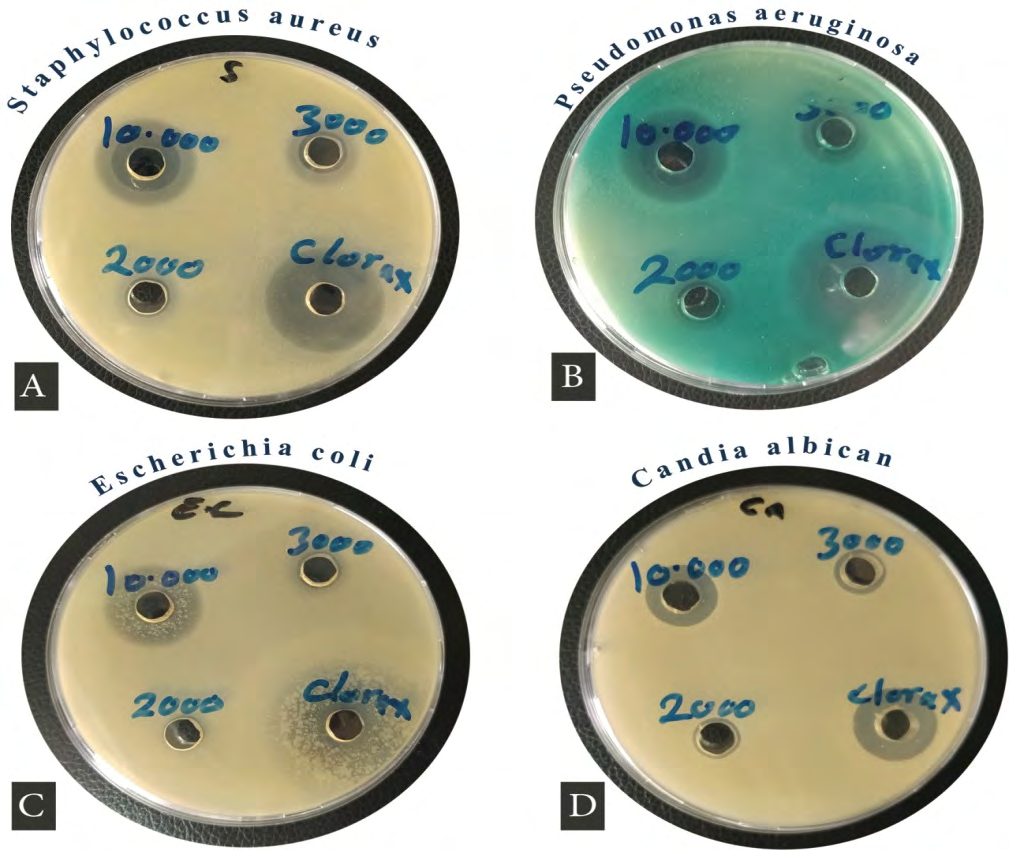
The results of this study showed a high antimicrobial activity with Escherichia coli compared with liquid bleach (Clorox®), while other organisms such as Pseudomonas and candida were in a close effective compared with commercial product. The high effective of sodium dichloisocyanurate was in 10000 ppm whereas other concentration (3000ppm, 2000ppm) were of effective in all organism. So, the antimicrobial activity od NaDCC that was prepared in the lab was the same effective with commercial product was used as standard to compare with and its concentration was 5% (50000 ppm). The result showed in Table 1 and the inhibition zones showed in Figure 1.
| Bacteria | 10000 ppm (n=3) | 3000 ppm (n=3) | 2000 ppm (n=3) | Clorox® (5%) (n=3) |
|---|---|---|---|---|
| Bacillus subtilis | 22.33 ± 0.58 | 10.67±1.15 | 6.67±0.58 | 24.67±0.58 |
| Staphylococcus aureus | 20.33±0.58 | 15±0 | 9.67±1.53 | 23.00±1 |
| Escherichia coli | 23.33±0.58 | 15.67±1.15 | 13.33±1.53 | 21.67±2.08 |
| Pseudomonas aeruginosa | 14.67±0.58 | 12.33±2.52 | 8.67±2.08 | 16.33±0.58 |
| Candia albican | 16.33±0.58 | 13.67±0.58 | 10.33±0.58 | 19.33 ±2.52 |
Table 1: Means of the diameters (in mm) of the inhibition zones by the agar diffusion wells assay.
Discussion
Infectious diseases stood out and made a highly concern in recent years include foodborne infection, and nosocomial infection. The acquisition of foodborne pathogenic infection occurs when contaminated raw fruits, vegetables, inadequate cooking of contaminated meats ingested, and contact with contaminated surfaces. While nosocomial infection occurs in hospitals and as environmental contamination. Therefore, surface disinfectant has been widely recommended to reduce the incidence of infection [7].
Locally in markets, there are various types of disinfectants such as Clorox® and Dettol®. In this research two commercial products of sodium hypochlorite and sodium dichloisocyanurate have been evaluated for their antimicrobial activity. One product was a liquid form (Clorox®) that used as its 5% (50000ppm) and the another product was a solid form (Effervescent Chlorine Tablets) that was prepared into three different concentrations (2000, 3000, & 10000ppm) of sodium dichloisocyanurate. The antimicrobial activity has evaluated by measuring diameter of inhibition zone and the tested microorganisms were E.
coli, P. aeruginosa, B. subtilis, S. aureus, and C. albicans. The results of this study revealed that prepared solution 10000ppm from effervescent tablets showed approximate antimicrobial activity to Clorox® 5% solution, where the diameter of inhibition zone was 23.33mm and 21.67mm on E. Coli, 22.33mm and 24.67mm on B. Subtilis, and 20.33ppm and 23mm on E. Coli for 10000ppm solution and Clorox® respectively [8].
The results of this current research agreed with pervious study that conducted in Brazil by Carlos et al who reported that 2% sodium hypochlorite solution displayed against S. aureus, P. aeruginosa, and C. albicans, the inhibition zones were enclose to 3000ppm prepared solution, however the study of Carlos et al. showed the 2% sodium hypochlorite solution has no antibacterial activity against of B. Subtilis that disagreed with our findings. Based on the results of this study, the capacity of NaDCC effervescent tablets was high against different organisms; moreover the handling and preparation of disinfectant solution of tablets were easier than liquid disinfectant, and to the best to our knowledge, the NaDCC effervescent tables safer than liquid disinfectant [9].
Conclusion
In the end, the effervescent tablets of NaDCC have strong antimicrobial activity and can be treated easily; furthermore, it has less hazard in compare with liquid irrigating solution. NaDCC is well established in the cleaning industry for both janitorial and hospital applications. NaDCC tablet formulations predominate as the favoured method of chlorine disinfection. With the advent of the Health and Safety at Work Act, COSHH (the Control of Substances Hazardous to Health Regulations) and CHIP (the Chemicals Hazard Information and Packaging for Supply Regulations), there has been a move towards safer handling and use of chemicals.
Acknowledgement
The authors are grateful to Mr. Gawed Al-Asbahi who help us to do this work.
Conflicted of Interest
The authors declare no conflicts of interest regarding the publication of this paper.
References
-
Torabinejad M, Walton RE, Endodontics (2009) Principles and practice. St. Louis, Missouri: Saunders Elsevier.
-
Gwaltney JMJR, Hendley JO (1982) Transmission of experimental rhinovirus infection by contaminated surfaces. Am J Epidemiol 16(5): 828-833.
-
Bonten MJ, Hayden MK, Nathan C, van Voorhis J, Matushek M, et al. (1996) Epidemiology of colonisation of patients and environment with vancomycin-resistant enterococci. Lancet 348(9042): 1615-1619.
-
Weber DJ, Rutala WA (1997) Role of environmental contamination in the transmission of vancomycin- resistant enterococci. Infect Control Hosp Epidemiol 18(5): 306-309.
-
Sattar SA, Springthorpe VS (1996) Transmission of viral infections through animate and inanimate surfaces and infection control through chemical disinfection. In: Hurst DJ (Eds.), Modeling Disease Transmission and Its Prevention by Disinfection. Cambridge University Press, Cambridge, England, pp: 224-257.
-
Scott E, Bloomfield SF (1990) The survival and transfer of microbial contamination via cloths, hands and utensils. J Appl Bacteriol 68(3): 271-278.
-
William A, Rutala MPH, Susan L, Mark D, Barbee MS, et al. (2000) Antimicrobial Activity Of Home Disinfectants And Natural Products Against Potential Human Pathogens. Infection Control and Hospital Epidemiology 21(1): 33- 38.
-
Carlos E, Rosane GR, Cyntia RA, Jesus DP, Manoel DSN (2003) Antimicrobial Effect of 2% Sodium Hypochlorite and 2% Chlorhexidine Tested by Different Methods. Braz Dent J 14(1): 58-62.
-
Clasena T, Edmondson P (2006) Sodium dichloroisocyanurate (NaDCC) tablets as an alternative to sodium hypochlorite for the routine treatment of drinking water at the household level. International Of Hygiene And Environmental Health 209(2): 173-181.
- Gallic and Citric Acid Present in the Peels of Tropical Fruits as an Alternative in the Fight against Cancer
- Treating the Forehead Lines with Combination of Forehead and Glabellar Botulinum Toxin Among Japanese Patients
- Clinical Evaluation of Patients Suffering from Breast Cancer & Determination of Treatment Therapies and Better Strategies Related to Breast Cancer
- Medieval Recipes by Al-Zahrāwī for Heart Palpitations Treatment
- Etiology and Prescription Errors of Myocardial Infarction in Different Health Care Systems of Azad Kashmir
- Early Diagnosis and Multidisciplinary Management of Turner Syndrome: A Paediatric Case Study