
An Overview on Haemovigilance Programme of India
Blood transfusion plays a vital role in the improvement of health and saves many lives. Haemovigilance system is the programme which ensures the transfusion safety by monitoring every step of transfusion process from donor to recipient. The ultimate object of haemovigilance system is improving the quality and safety of transfusion therapy. This article briefly describes about the haemovigilance programme of India.
Haemovigilance
Haemovigilance is a continuous process of data collection and analysis of transfusion-related adverse reactions in order to investigate their causes and outcomes, and prevent their occurrence or recurrence. It includes the identification, reporting, investigation and analysis of adverse reactions and events in recipients and blood donors as well as incidents in manufacturing processes and, eventually errors and “near- misses”. A Haemovigilance system is also an integral part of quality management in a blood system, triggering corrective and preventive actions, and for the continual improvement of the quality and safety of blood products and the transfusion process.
Haemovigilance is from the vein of the donor to the vein of the recipient and covers adverse reactions both due to blood transfusion and blood donation. It has two arms:
i. The recipientís arm i.e. reporting of Adverse Reactions with respect to Blood Transfusion in the patient is being covered under Haemovigilance Programme of India (HvPI) with the launch of the programme on 10th December 2012 in India.
ii. The donorís arm i.e. Reporting of Adverse Reactions associated with Blood Donations is being covered under National Blood Donor Vigilance Programme (NBDVP) which was launched on 14th June 2015 on World’s Blood Donor Day at Science City Kolkata under the ambit of HvPI.
Objective of Haemovigilance Programme of India
Recipient Haemovigilance
i) Monitor transfusion reactions, ii) Create awareness amongst health care professionals, iii) Generate evidence based recommendations, iv) Advise Central Drugs Standard Control Organization (CDSCO) for safety related regulatory decisions, v) Communicate findings to all key stakeholders and vi) Create national & international Linkages.
Donor Haemovigilance
i) Improve donor safety and satisfaction through monitoring, analyzing and researching adverse events, ii) Analyze risk factors , implement and evaluate preventive measures, iii) Provide evidence based support for Blood Donation Process improvement, iv) Reduce the frequency of adverse events v) Increase donation frequency.
Reporting Under the National Programmes
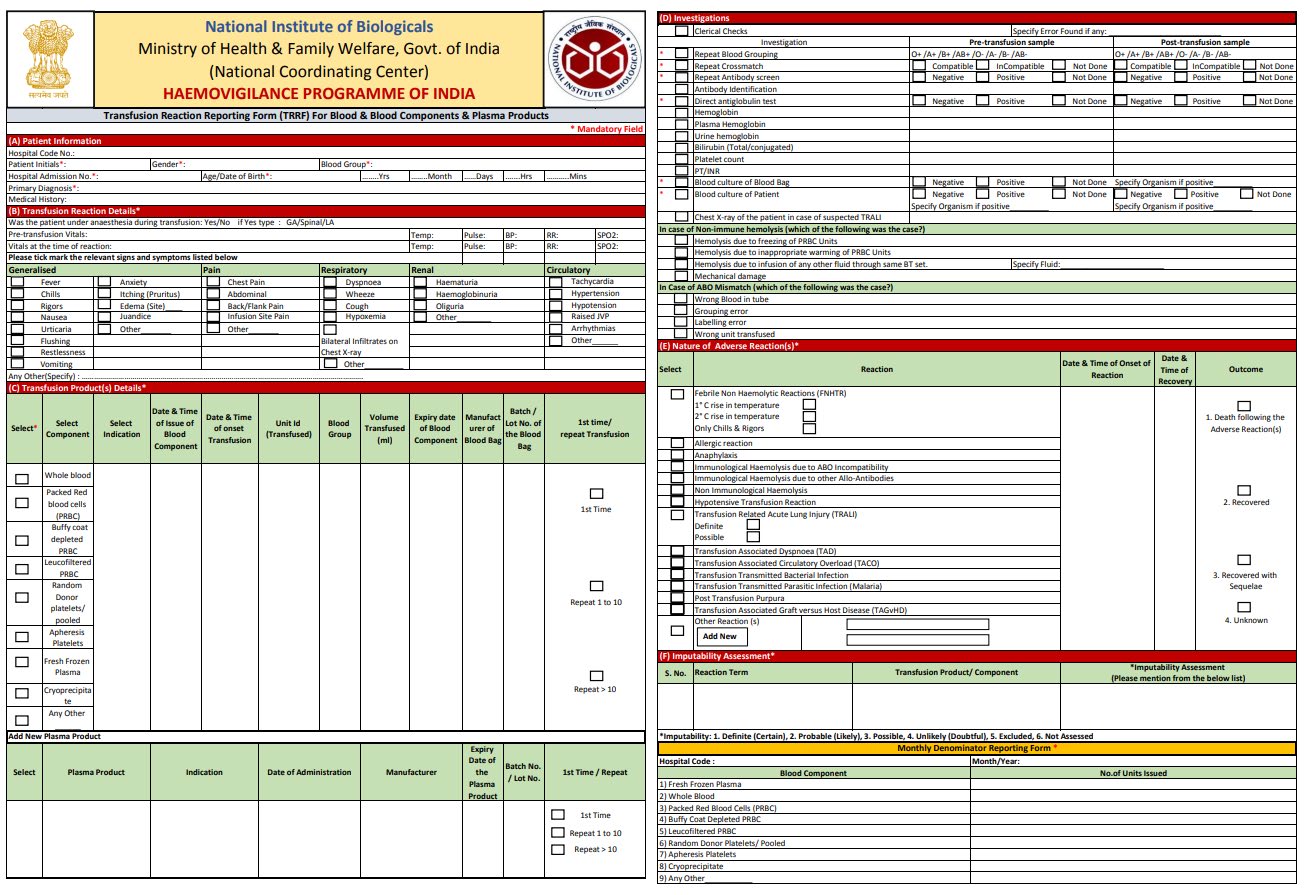
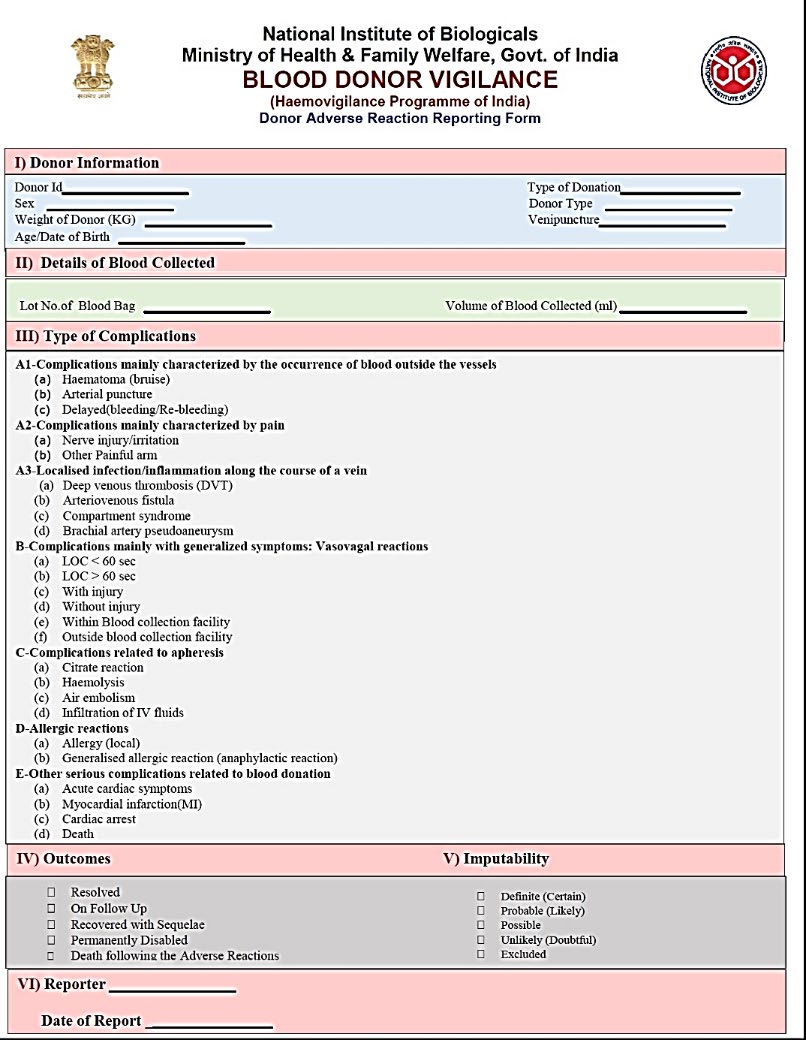
Under these programmes, the data pertaining to adverse reactions occurring in the patients & donors is collected, collated and analyzed by expert committees under HvPI at National Coordinating Centre of HvPI, NIB. NIB has a web based reporting system for adverse transfusion reactions and donor reactions via indigenously developed software(s) Haemo-Vigil and Donor-Vigil. The reporting of reactions is done via Software(s) in a uniform format i.e. Transfusion Reaction Reporting Form (TRRF) and (DARRF) respectively Figure 1 & 2 by enrolled centres using unique user id and password being provided by HvPI. NIB also launched the Toll Free No. (1800-180-2588) for the queries related to HvPI.
Procedure to Enrolment Under HvPI
Who Can Enrol?
Head/ Incharge of Transfusion Medicine Department/Blood Banks of India
How to Enrol?
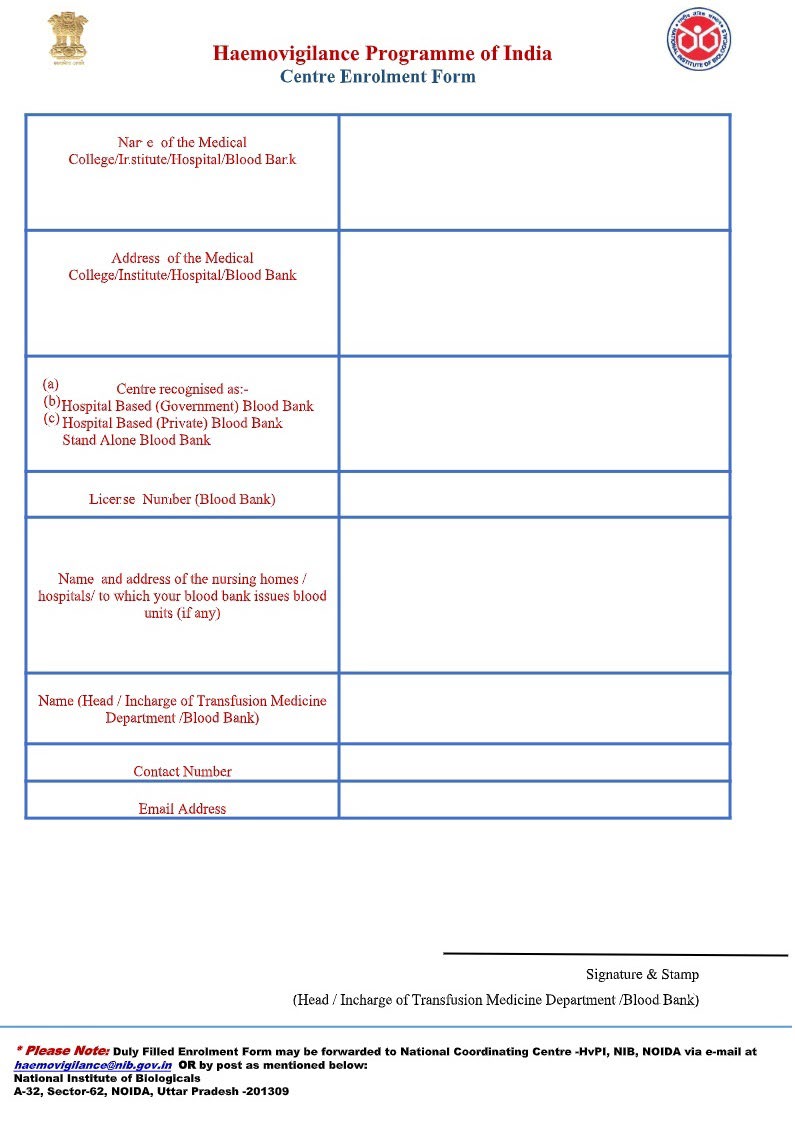
1) Head / Incharge of Transfusion Medicine Department / Blood Bank provides the necessary details to the National Coordinating Centre (NCC) - Haemovigilance Programme of India (HvPI) by sending the duly filled Enrolment Form Figure 3 either to NCC at National Institute of Biologicals, Ministry of Health & Family Welfare, Plot No. A-32, Sector-62, Institutional Area, NOIDA -201309 (U.P.) or via E-mail to NCC at haemovigilance@nib.gov.in.
2) NCC verifies the details provided by the centre
3) After verification, NCC issues the User Id and Password to the Head / Incharge of Transfusion Medicine Department/ Blood Bank to access the Haemo-Vigil Software and Doner- vigil Software for onward Submission of Transfusion Reactions Reports and Adverse Blood Donor Reaction Reports to NCC.
International Linkages
India is a member of International Haemovigilance Network (IHN) since 2014. NIB has also provided its services to the Royal Government of Bhutan for establishment of Haemovigilance System in their country [1, 2, 3, 4, 5].
Conclusion
Haemovigilance is a continuous process of data collection and analysis of transfusion-related adverse reactions in order to investigate their causes and outcomes, and prevent their further incidence. Haemovigilance is thus a tool to advance the quality of the blood transfusion chain, primarily focusing on safety. Haemovigilance is the quality indicator of a transfusion services. The HvPI envisages protecting & promoting public health by ensuring safe blood transfusion practices in the nation.
References
-
WHO (2005) WHO draft guidelines for Adverse Event Reporting and Learning Systems.
-
SABRE (2014) Serious Adverse Blood Reactions and Events (SABRE): User Guide for Mandatory Haemovigilance.
-
Satyajeet S, Akanksha B, Surinder S, Kalaiselvan VC, Pallavi K, et al.(2015) Review on haemovigilance practice in India. World Journal of Pharmacy and Pharmaceutical Sciences 4(12): 350-357.
-
Haemovigilance program of India (2015) Haemovigilance program of India, Newsletter 3(6).
-
National Institute of Biologicals (2012) Haemovigilance Programme of India.
- Gallic and Citric Acid Present in the Peels of Tropical Fruits as an Alternative in the Fight against Cancer
- Treating the Forehead Lines with Combination of Forehead and Glabellar Botulinum Toxin Among Japanese Patients
- Clinical Evaluation of Patients Suffering from Breast Cancer & Determination of Treatment Therapies and Better Strategies Related to Breast Cancer
- Medieval Recipes by Al-Zahrāwī for Heart Palpitations Treatment
- Etiology and Prescription Errors of Myocardial Infarction in Different Health Care Systems of Azad Kashmir
- Early Diagnosis and Multidisciplinary Management of Turner Syndrome: A Paediatric Case Study