
Effect of Sodium Valproate and Levetiracetam on Thyroid Hormones in Pediatric Patients with Epilepsy
Epilepsy is defined as a neurological disorder that is associated with excessive and abnormal cortical nerve cell activity in the brain. Epilepsy is idiopathic whereas some cases may be a result of brain injury, stroke, brain tumor, alcohol/drug abuse or due to genetic mutation. Long-term treatment with Antiepileptics [AEDs] is associated with cognitive impairment, idiosyncratic effects, chronic effects such as weight gain, increased risk of teratogenicity, and endocrine effects on reproductive, adrenal, and thyroid systems. Hence we decided quantify the effects of sodium valproate and levetiracetam monotherapy on thyroid levels in pediatric patients with epilepsy. We enrolled 30 patients, of <18 years, with confirmed cases of epilepsy, receiving AEDs either sodium valproate or Levetiracetam monotherapy, Children with severe systemic disorders were excluded from the study. There was a male predominance in our study. we analyzed the socioeconomic status, and found that 50% belong to lower-middle-class family. Majority were diagnosed with GTCS. With regard to the treatment with AEDs, majority of patients received valproate, With regard to the levels of thyroid hormone; we noticed that in group 2 majority of patients were hypothyroid, when compared to group1 where most of the patients were euthyroid. After analysis we come to the conclusion that group1 have more or less no change in thyroid levels; whereas group2 have mostly shown a shift towards hypothyroidism. Thereby we quantified the effects of sodium valproate and levetiracetam monotherapy on Thyroid levels in pediatric patients with epilepsy and we have determined the time for screening Interval as 7-12 months.
Introduction
Epilepsy is a chronic disease and it’s treatment is lifelong in one-third of the patients [1]. The prevalence of pediatric epilepsy is quite high. Over 10 million children worldwide are believed to have epilepsy [2]. Epilepsy is defined as a neurological disorder that is associated with excessive and abnormal cortical nerve cell activity in the brain. Most cases of epilepsy are idiopathic whereas some cases may be a result of brain injury, stroke, brain tumor, alcohol/drug abuse or due to genetic mutation. Long-term treatment with AEDs is associated with cognitive impairment, idiosyncratic effects, chronic effects such as weight gain, increased risk of teratogenicity, and endocrine effects on reproductive, adrenal, and thyroid systems [3]. Epilepsy is the second most common chronic neurological conditions seen by neurologists. It is estimated that there are around 55,00,000 people with epilepsy in India [4]. Result of brain injury, stroke, brain tumor, alcohol/drug abuse or due to genetic mutation [5].
Objectives
• To quantify effects of sodium valproate and levetiracetam monotherapy on thyroid levels in pediatric patients with epilepsy.
• To determine time for screening interval.
Materials and Methods
Thisprospective, observational, pilot study was conducted in a tertiary care hospital in Bangalore, Karnataka, India, after obtaining ethical committee clearance. This study was funded by Rajiv Gandhi University of Health Sciences, Bangalore under student short term scholarship [STS] programme [UGMED195].
In this study, we had30 patients, who attended outpatient and inpatient departments of pediatrics. Children younger than 18 years, with confirmed cases of epilepsy, receiving AEDs either sodium valproate or levetiracetam monotherapy, were enrolled in the study only after obtaining consent from the parents or the legal guardians. Children with severe systemic disorders like chronic kidney disease, chronic liver disease, neurological conditions like mental retardation, global development delay, autism etc were excluded from the study.
Data were entered in a Microsoft excel sheet, where demographic details were collected according to the modified Kuppuswamy scale. Disease characteristics such as type of epilepsy, onset and duration, time since last attack, frequency, family history of epilepsy, and co morbid conditions were also recorded. Treatment details such as drug, dose, and duration of treatment were noted. Investigations such as electroencephalography (EEG), magnetic resonance imaging, and computed tomographic scan if any were recorded.
Results
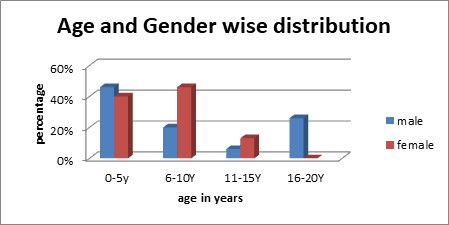
A total of 30 patients were included in the study. There was a male predominance (male 56%, female 44%). The majority of patients were in the age group of 0to 5 years (42%), followed by 6 to 10 years (33%) of age (Figure 1).
Among the 30 patients, 86% were from rural background and 13% were from urban background. On looking into the parents educational back ground, majority had completed their high school (26%). As per the modified Kuppuswamy scale [6], we analyzed the socioeconomic status of these 30 patients, and we found that 50% belong to lower-middle- class family (Table 1).
| Sociodemographic Data | Percentage | |
|---|---|---|
| Education of head of the family | ||
| Illiterate | 13 | |
| Primary school | 10 | |
| Middle school | 10 | |
| High school | 26 | |
| Intermediate school | 25 | |
| Graduate and PUC | 7 | |
| Professional and honor | 6 | |
| Occupation of head of the family | ||
| Unemployed | 3 | |
| Unskilled | 10 | |
| Semiskilled | 26 | |
| Skilled | 13 | |
| Clerical, shop owner | 26 | |
| Semi-professional | 16 | |
| Professional | 3 | |
| Socioeconomic class as per the modified kuppuswamy classification⁶ | ||
| Upper class | 6 | |
| Upper middle class | 10 | |
| Lower middle class | 50 | |
| Upper lower class | 36 | |
| Lower class | 0 |
Table 1: Sociodemographic data of patients with epilepsy.
On assessing the family history of seizures, 13% of patients reported with positive cases of epilepsy being treated/ or treated, within their near/dear family members.3% of patient’s had h/o head injury. With regard to the initiation of treatment, 46% of patients began treatment with AED within 4-12 months of attack i.e., the patient was brought to the hospital soon after the attack (Table 2).
| Percentage | |
|---|---|
| With 3 m of the attack | 30 |
| 4 m–1 y of attack | 46 |
| 1–2 y of attack | 10 |
| 2–3 y of attack | 3 |
| >3 y | 10 |
Table 2: Time taken to initiate antiepileptic drugs treatment after the first attack of seizure.
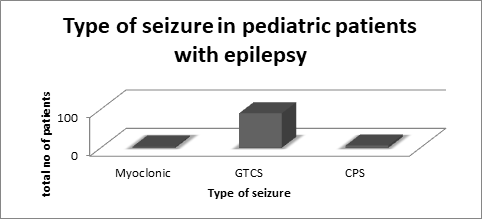
Among these 30pediatric patients, majority (90%) were diagnosed with generalized tonic clonic seizures (GTCS) followed by complex partial seizures (6%); and 6% myoclonic seizures (Figure 2).
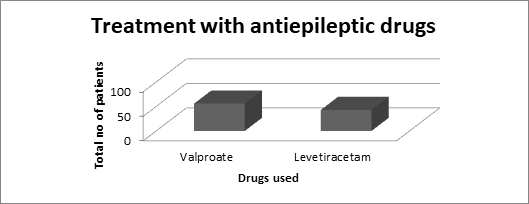
With regard to the treatment with AEDs, majority of the patients (56%) received valproate, while only 43% received levetiracetam (Figure 3).
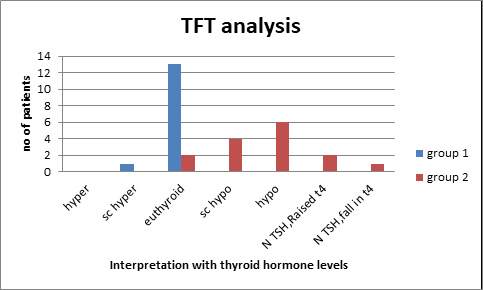
With regard to the levels of thyroid hormone, we noticed that in group 2 majority of patients were hypothyroid, when compared to group 1 (Table 4). In every individual, T4; T3 levels are more or less constant and reflect the ‘set-point’ of the hypothalamic–pituitary–thyroid (HPT) axis. Changes in hormone level status is associated with concordant changes in hormone and TSH levels .The population reference ranges for the thyroid hormones are relatively wide. Therefore, TSH has been recommended for screening test for thyroid dysfunction, because of relative constancy in thyroid hormone levels are associated with marked rise in TSH. However, screening only TSH means some patients will be wrongly diagnosed, whereas other conditions might be missed. Therefore many labs now routinely follow screening with T4 and TSH. It is required to consider whether total or free T4 and T3 levels are measured. If total form is considered then the binding proteins can cause error in interpretation of results. Hence we consider the free form of the hormones.
Discussion
There are several mechanisms through which the antiepileptic drugs can affect the thyroid hormone. Some of them increase the hepatic microsomal enzyme systems leading to the accelerated clearance of the thyroid hormone whereas the others the others interfere with the hypothalamic-pituitary axis [7]. Our study investigated the effect of sodium valproate and levetiracetam on the thyroid hormone levels in the pediatric patients, group 1 being the patients on treatment between 0-6 months and group 2 who are on treatment between 6-12 months.
Our study consisted of a total of 30 patients with male predominance in contrary to the earlier studies [8]. The
earlier literature excluded children with family history of hypothyroidism in contrary to our study that included such cases [8]. Our study included the detailed information of demographic data, seizure type, seizure etiology, epileptic syndrome, age at onset and selected AED identical to the earlier studies [8]. The investigations of our study included EEG as a diagnostic tool and showed abnormalities in a few patients similar to the other studies [6]. In the earlier studies, patients received drugs depending on the type of seizures in relation to their ages whereas our study includes majority of the patients on valproate [7, 8]. Results of this study are classified according to status of T3,T4,TSH as clinical hyperthyroidism, subclinical hyperthyroidism, euthyroid state, sub clinical hypothyroidism, clinical hyperthyroidism, normal TSH with rise in T4, normal TSH with fall in T4.
Conclusion
After analysis we come to the conclusion that group 1 (0-6 months of treatment) have more or less no change in thyroid levels; whereas group 2 (7-12 months of treatment) have mostly shown a shift towards hypothyroidism [subclinical-4 and clinical hypothyroidism-6]. Thereby we have quantified the effects of sodium valproate and levetiracetam monotherapy on thyroid levels in pediatric patients with epilepsy and we have determined the time for screening interval as 7-12 months.
References
-
Sherifa AH (2015) The effect of antiepileptic drugs on thyroid hormonal function; causes and implications. Expet review of clinical pharmacology 8(6): 741-750.
-
Ramjan S, Ayesha A, Shobha RR Hiremath, Usha HN (2015) Study of antiepileptic therapy in pediatric patients in a secondary care hospital. World Journal of Pharmacy and Pharmaceutical Science 4(11): 2052- 2062.
-
Hanan AN, Hana AA, Maha EA, Mona NA (2017) Knowledge and Taibah University Medical sciences 12(1): 90-95.
-
Abhishek P, Shakti KP, Pratap K, Truptirekha S (2011) Drug utilization pattern of antiepileptic drugs. A pharmacoepidemiologic and pharmacovigilance study in a tertiary teaching hospital in India. Asian Journal of pharmaceutical and clinical research 4(1): 96-99.
-
Leskieweiz M, Budziszewska B, Lason W (2008) Endocrine effects of antiepileptic drugs. National institute of health 65(11): 795-800.
-
Dwajini S, Adarsh E, Nirmala KS, Sahajananda H (2019) Sociodemographic, Rationale drug use of antiepileptic drugs among pediatric patients with epilepsy: A prospective study at a tertiary care hospital. J Neurosci rural Pract 10(3): 474-478.
-
Olcay G, Ahmet K, FatihT (2018) The effect of antiepileptic drugs on thyroid hormonal function: valproic acid and phenobarbital-Act neurologicabelgica. Acta Neurol Belg 120(3): 615-619.
-
Unsal Y, Tuba SY, Gulcin A, Huseyin AK, Hasan T (2014) The effect of antiepileptic drugs on thyroid function in children. Seizure 23(1): 29-35.
- Gallic and Citric Acid Present in the Peels of Tropical Fruits as an Alternative in the Fight against Cancer
- Treating the Forehead Lines with Combination of Forehead and Glabellar Botulinum Toxin Among Japanese Patients
- Clinical Evaluation of Patients Suffering from Breast Cancer & Determination of Treatment Therapies and Better Strategies Related to Breast Cancer
- Medieval Recipes by Al-Zahrāwī for Heart Palpitations Treatment
- Etiology and Prescription Errors of Myocardial Infarction in Different Health Care Systems of Azad Kashmir
- Early Diagnosis and Multidisciplinary Management of Turner Syndrome: A Paediatric Case Study