
Convection-Enhanced Delivery of Alkaloid - Loaded Maghemite Nanoparticles against 9L - Gliomass Cell Line
Convection Enhanced Delivery (CED) is a novel approach to synthesize and facilitate targeted delivery of phytocontituents/ pharmaceuticals to the brain. The CED procedure involves a minimally invasive surgical exposure of the brain, followed by placement of small diameter catheters directly into the brain tumor. The study was designed to synthesize unique, sustained release, targeted delivery with no toxicity of piperidine alkaloids along with maghemite (γ-Fe2O3), poly-ethylene glycol and human serum albumin conjugation using 9L-gliomass cell line. Subsequently different nanoparticles (NPs) were prepared Naked NPs and HSA- or polyethylene glycol (PEG)-coated NPs with/without piperidine alkaloid were studied. In vitro results showed no toxicity and a similar cell-kill efficacy of the piperidine alkaloid-loaded particles via HSA coating to that of free piperidine alkaloid, while piperidine alkaloid-loaded particles via PEG coating showed low efficacy.
Introduction
Oncology has seen an unprecedented breakthrough in recent decades, tumor is an uncontrolled growth of abnormal cells in body; different types of tumors exist i.e. benignant and malignant. However among of all type of cancer brain tumor is highly reported [1]. Brain tumor is a cluster of unusual cells that grows out of control in brain develops along with the symptoms including seizure, headaches, nausea, vomiting and difficulties in speech, impaired walk as well as lack of vocabulary, sensation and consciousness [2]. The management depends upon the type of cancer, recently combination therapy were mostly used such as surgery with chemotherapy and radiation. Furthermore, use of conventional drug was minimizing due to some common side effects and adverse drug reaction as well as drug resistance [3]. Subsequently awareness in complementary medicines and values of natural remedies were increases. The naturally obtained phytoconstituents were mostly used as anti- inflammatory, antimicrobial, and analgesic. What more among of all chemical constituent pharmacological study of piperideine alkaloids were recently revealing the anti- malignant activity [4]. Throughout the malignancy foliate receptors were extremely stimulated results uncontrolled multiplication of cell. Piperideine alkaloids are an amino acid analogue used for the management of many type of cancers including tumors of the brain, breast, ovaries along with leukemia’s [5]. On the other hand Piperideine alkaloids were limited used due to its poor rate of absorption, dose related cytotoxicity, wide range of distribution throughout the body, short half-life as well as drug resistance [6]. Present work showing attention in binding Piperideine alkaloids to γ-Fe2O3 NPs to overcome its Poor rate of absorption, toxicity, short half-life, drug resistance as well as enhance the tumor targeting in addition to improve its pharmacokinetic temperament. Additionally we used the combination of NPs with Convection-enhanced delivery (CED), thus keep away from the major drawback revealed by systemic administration [7].
Materials and Methods
Materials
Isolated piperideine alkaloid, glycine, divinyl sulfone (DVS), triethylamine (TEA), dimethyl sulfoxide (DMSO), FeCl2,NaNO3, potassium persulfate, 1-ethyl- 3-(3-dimethylaminopropyl) carbodiimide (EDC), N-hydroxysulfosuccinimide (sulfo NHS), NaOH, gelatin (from porcine skin), human serum albumin (HSA), polyethylene glycol (PEG, MW 400), PEG (MW 400) methacrylate (PEGMA), PEG dimethacrylate (PEGDMA), amino terminated PEGMA (NH2PEGMA) and Salts for buffers were purchased from Sigma Lab. Pvt. Ltd. (Mumbai, India). Formaldehyde was purchased from Meru Chem Pvt. Ltd. (Mumbai India).
Collection, Cultivation and Isolation of Piperideine Alkaloid
Papaya leaves were collected from the botanical garden of Columbia group of institutions; subsequently leaves were authenticated by Dr. SP Rao (Professor, Department of Pharmacognosy, Columbia Institute of Pharmacy, and Raipur). Furthermore 5 kg air-dried leaves were crushed as well as powdered by mixer grinder. There after soaked in 6 liter of 89 % ethanol, 10 % water and 1 % alcohol acetate for 2 days. Additionally the extract was decanted and the extraction repeated. The combined extracts were evaporated at 60°C in a rotary evaporator and converted into thick syrup which was shaken with 1 liter of water containing 20 ml alcohol acetate. The mixture was extracted with ethanol and the aq. phase was separated, adjusted to pH 11 with K2CO3 and then extracted thoroughly with ethanol. Whatsmore ethanol extract was washed with water, extracted with 5% hydrochloric acid and the acid extract was again adjusted to pH 11 and extracted with ethanol [8]. This ethanol, after drying over dry magnesium sulphate was stored to a dark brown ‘crude extract’ of papaya leaf alkaloids, from which piperidine precipitated collected after chilling. Isolated piperidine was confirmed by Dragendorff’s, Mayer’s and Hager’s test [9].
Preparation of γ-Fe2O3 NPs
γ-Fe2O3 NPs were narrow size of distribution prepared by nucleation as per the controlled growth of iron oxide thin films onto the gelatin/iron oxide nuclei, as earlier described. Subsequently, γ-Fe2O3 NPs were prepared in the range of 20.03±2.5 nm diameter. Along with addition of FeCl2 aqueous solution (20mmol/10mL in 0.1 N HCl) to 40 mL of an aqueous solution containing 120mg of porcine gelatin, followed by the addition of a sodium nitrate solution (15mmol/10mL in water). After a reaction time of 10 minutes, a sodium hydroxide aqueous solution (1 N) was added until a pH of 9.5 was obtained. This procedure was repeated four more times. During the entire procedure, the aqueous suspension was agitated at 60°C and kept in an inert environment [10]. The formed γ-Fe2O3 NPs were then washed from excess reagents with water using magnetic columns.
Conjugation of Human Serum Albumin (HSA) onto γ-Fe2O3 NPs: 5mg of HSA was added to 25mL of the γ-Fe2O3 NPs. There after NPs dispersed in water (1 mg/0.5mL). Mixture was then shaken at pH 9.5 and 60°C for 24 hours, and then cooled at room temperature. The physically coated NPs obtained as γ-Fe2O3 - HAS NPs which is further washed from excess HSA with phosphate-buffered saline by magnetic columns [11]. Polymerization of Polyethylene Glycol Acrylate Derivatives on the Surface of the γ-Fe2O3 NPs: Polymerization of polyethylene glycol acrylate monomers on the surface of γ-Fe2O3 NPs was accomplished by mixing 5mL of the γ-Fe2O3 NPs dispersed in a bicarbonate buffer (0.1 M, pH 8.1, 2.0 mg/mL) with 0.35mL of polyethylene glycol γ-Fe2O3 acrylate (PEGMA), 0.05mL of PEG dimethacrylate (PEGDMA), 0.1mL of NH2PEGMA, and 24mg of potassium persulfate dissolved in 25mL of a bicarbonate buffer (0.1M, pH 8.1). For the polymerization process, the above mixture was shaken at 75°C for 3 hours. The formed PEGM NPs were then washed from excess monomers by magnetic columns [12]. Physical Conjugation of Piperidine Alkaloids to the HSA-Coated NPs: Piperidine alkaloids was physically conjugated to the HSA coated NPs, γ-Fe2O3 - HSA, by adding 1mg of piperidine alkaloid dissolved in 0.5mL of dimethyl sulphoxide (DMSO) to 10mL of the nanoparticle dispersion in physiological buffer solution (PBS) (0.5mg/0.5mL). The reaction mixture was then shaken at room temperature for 18 hours [13]. The obtained γ-Fe2O3- HAS – piperidine alkaloid NPs were washed from excess piperidine alkaloid extract with PBS (0.1 M, pH 7.3) by magnetic columns. Higher concentrations of piperidine were obtained by increasing piperidine alkaloid concentration [14]. Piperidine Alkaloid Conjugation to the HSA – Coated and PEG – Coated γ-Fe2O3 NPs: Piperidine alkaloids were covalently conjugated to the HSA-coated γ-Fe2O3 NPs, In a typical experiment, 5mg of piperidine alkaloids were dissolved in 2.5mL of DMSO was added to 2.5mg of 1-ethyl- 3-(3-dimethylaminopropyl) carbodiimide (EDC) and 5mg sulfo-NHS dissolved in 2.5mL of water. The mixture was then shaken at room temperature for 30 minutes. Furthermore 20ml of the HSA-coated NPs were then added and the mixture was shaken at room temperature for 1 hour, after which the NPs were washed from excess reagents by magnetic columns. In a similar way piperidine alkaloid was conjugated to the terminal NH2 groups of the γ-Fe2O3 - PEG NPs. Higher concentrations of piperidine alkaloids were obtained by increasing the initial concentration of piperidine [15]. Evaluation of the Bound HSA Concentration: HSA bound to the γ-Fe2O3 NPs were evaluated by measuring the unbound proteins using Bradford assay 33 & 34 as well as data’s were compared from the predetermined concentration. Subsequently the average values were calculated by repeating measurement at least three times for each sample. The binding yield was calculated by multiplying the ratio of the concentration of the bound piperidine alkaloid to the initial concentration by 100. Evaluation of the Bound Piperidine Alkaloid Concentration: The concentration of piperidine bound to the γ-Fe2O3 NPs was indirectly determined by measuring the absorbance of the unbound drug at 303 nm. The binding yield was calculated piperidine concentration.
Development of 9L-Gliomass Cell Culture
9L glio-sarcoma cells were used in existing work which reveals more foliate receptor inducing effect were maintained at room temperature as well as 5% of carbon monoxide in Dulbecco’s Modified Eagle’s Medium (DMEM) (Biological Industries, Pune, India) enriched with 10% Fetal Calf Serum (FCS) and 1% penicillin/streptomycin and subcultured twice a week. The cells were plated at a density of 6X10⁴ per well in 24 well plates for the cell-kill experiment.
Results and Discussion
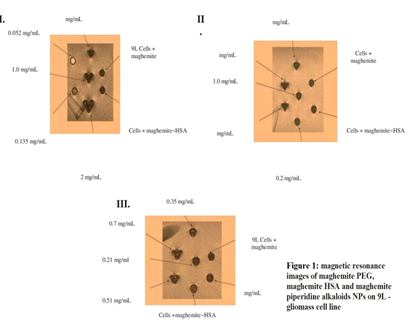
Isolated plant extract were evaluated subsequently by passing the alkaloidal test such as dragendorff’s, mayer’s and hager’s. Furthermore it reveals the presence of piperideine alkaloid. Synthesized γ-Fe2O3 NPs having very narrow size of distribution, this reveals more clinical application. What more efficacies of the NPs enhanced in brain, it also having higher binding capacity to piperidine alkaloids without affecting the efficacy of the drug, coating with both PEG and HSA was studied. Magnetic resonance image (MRI) for assessment of γ-Fe2O3 and γ-Fe2O3 HSA penetration into the cells: Pellets prepared from 9L cells incubated with γ-Fe2O3 and γ-Fe2O3 HSA NPs were placed in the MRI together with calibration vials containing free NPs at concentrations ranging between 0.03–5.0 mg/mL. The MRI (Figure 1) showed that both pellets consisted of 0.2±0.075 mg/mL γ-Fe2O3. 9L gliomass cells were treated with γ-Fe2O3 PEG, γ-Fe2O3 PEG- piperidine alkaloid, γ-Fe2O3 HSA and γ-Fe2O3 HSA- piperidine alkaloid for 48 hours. The γ-Fe2O3 HSA NPs showed no toxicity: 2.5%±2.3% cell kill. The msghemite HSA-piperidine alkaloid showed a similar efficacy to that of free piperidine alkaloid: 58%±8% and 75%±3% respectively. The γ-Fe2O3 PEG was marginal in means of toxicity: 6%±4%, but the efficacy of the γ-Fe2O3 PEG-piperidine alkaloid was relatively low with a wide range of variability: 45%±15%. In the present work, we tried to conjugate the antimalignant phytoconstituent piperidine alkaloid with biodegradable γ-Fe2O3 NPs, as the same time improves the penetration of the particles into the brain cells as well as enhances the efficacy of the drug against cancer cells. What more synthesized piperidine loaded γ-Fe2O3 NPs reveals selective distribution of the particles seen in the MRI, with no toxicity as well as it also helps in the sustained release of drug.
Conclusion
γ-Fe2O3 NPs were obtained by a simple thermic treatment of magnetite NPs. The ferrite particles obtained showed super paramagnetic behavior and non- hemolytic activity and can be successfully heated under a low magnetic field. The results show that these NPs might be potential materials for cancer treatment by magnetic hyper thermic therapy. In this study, we have demonstrated the possibility of binding an anti-cancer agent, Alkaloids, to biodegradable γ-Fe2O3 NPs, while preserving the penetration of the particles into the cells, and the efficacy of the drug against cancer cells. In addition, we have shown that the chosen formulation provides efficient distributions of the particles, depicted by MRI in real time, with no apparent toxicity, and that the clearance time of the particles is long, enabling slow drug release. Toxicities have recently been reported and also confined their clinical uses. Therefore, developments in drug delivery of such alkaloids are significance in improving their drug-like properties and thus, treatment efficiencies in clinic and decline their adverse effects. In this research work, the information was comprehensively summarized with the aim of providing an informative reference for relevant readers.
Conflict of Interest
Authors have no affiliation with any organization with a direct or indirect financial interest in the subject matter discussed in the manuscript.
- While they were participated equally in conception and design or analysis and interpretation of the data;
- Drafting the article or revising it critically for important intellectual content; and
- Approval of the final version.
References
-
Cooper GM (2000) The Development and Causes of Cancer. The Cell: A Molecular Approach. 2nd (Edn.), Sunderland (MA): Sinauer Associates.
-
Remer S, Murphy ME (2004) The Challenges of Long- Term Treatment Outcomes in Adults with Malignant Gliomas. Clin J Oncol Nurs 8(4): 368-376.
-
Arruebo M, Vilaboa N, Sáez-Gutierrez B, Lambea J, Tres A, et al. (2011) Assessment of the Evolution of Cancer Treatment Therapies. Cancers (Basel) 3(3): 3279-330.
-
Sahu MK, Singh VK, Rao SP (2018) Development and Evaluation of Antidiabetic Potential of Polyherbal Formulation in Streptozotocin Induced Animal Model. Int J Cell Sci Mol Biol 5(2): 0029-0037.
-
Sahu MK, Satapathy T, Netam AK, Prasad J (2018) Structural Architecture and Signal Transduction of Ion Channels: A Review. Res J Pharmacology and Pharmacodynamics 10(1): 38-44.
-
Satapathy T, Kaushik S, Netam AK, Prasad J, Rao SP, et al. (2018) Nano Delivery: A Smart Carrier for Treatment of Ovarian Cancer. World Journal of Pharmaceutical Research 7(9): 513-523.
-
Tuutijärvi T, Lu J, Sillanpää M, Chen G (2009) As (V) Adsorption on Maghemite Nanoparticles. J Hazard Mater 166(2-3): 1415-1420.
-
Levy I, Sher I, Corem-Salkmon E, Ziv-Polat O, Meir A, et al. (2015) Bioactive Magnetic Near Infra-Red Fluorescent Core-Shell Iron Oxide/Human Serum Albumin Nanoparticles for Controlled Release of Growth Factors for Augmentation of Human Mesenchymal Stem Cell Growth and Differentiation. J Nanobiotechnology 13: 34.
-
Herzberger J, Niederer K, Pohlit H, Seiwert J, Worm M, et al. (2016) Polymerization of Ethylene Oxide, Propylene Oxide, and other Alkylene Oxides: Synthesis, Novel Polymer Architectures, and Bioconjugation. Chem Rev 116(4): 2170-2243.
-
Ahmed SI, Heiba ZK, Ibrahim MM, Shaltout AA, Alzahrani E, et al. (2021) Synthesis and Characterization of Eco- Friendly CMC/Maghemite Nanocomposite Films. J Electro Mater 50(12): 7098-7109.
-
Mohamed HE, Afridi S, Khalil AT, Ali M, Zohra T, et al. (2020) Bio-Redox Potential of Hyphaene Thebaica in Bio-Fabrication of Ultrafine Maghemite Phase Iron Oxide Nanoparticles (Fe2O3 Nps) for Therapeutic Applications. Materials Science and Engineering: C, 112: 110890.
-
England CG, Ng CF, van Berkel V, Frieboes HB (2015) A Review of Pharmacological Treatment Options for Lung Cancer: Emphasis on Novel Nanotherapeutics and Associated Toxicity. Curr Drug Targets 16(10): 1057- 1087.
-
Hoffmann K, Maj E, Wojtczak A, Wietrzyk J, Łakomska I (2014) Metals in Medicine: Metal-Related Diseases. J Biol Inorg Chem 19 (Suppl 2): 779-814.
-
Perlstein B, Ram Z, Daniels D, Ocherashvilli A, Roth Y, et al. (2008) Convection-Enhanced Delivery of Maghemite Nanoparticles: Increased Efficacy and MRI Monitoring. Neuro Oncol 10(2): 153-161.
-
Ghods AJ, Irvin D, Liu G, Yuan X, Abdulkadir IR, et al. (2007) Spheres Isolated from 9L Gliosarcoma Rat Cell Line Possess Chemoresistant and Aggressive Cancer Stem‐Like Cells. Stem Cells 25(7): 1645-1653.
- Gallic and Citric Acid Present in the Peels of Tropical Fruits as an Alternative in the Fight against Cancer
- Treating the Forehead Lines with Combination of Forehead and Glabellar Botulinum Toxin Among Japanese Patients
- Clinical Evaluation of Patients Suffering from Breast Cancer & Determination of Treatment Therapies and Better Strategies Related to Breast Cancer
- Medieval Recipes by Al-Zahrāwī for Heart Palpitations Treatment
- Etiology and Prescription Errors of Myocardial Infarction in Different Health Care Systems of Azad Kashmir
- Early Diagnosis and Multidisciplinary Management of Turner Syndrome: A Paediatric Case Study