
Assessment of Quality of Life in Cancer Patients Supplemented with Ayurvedic Medicine (Body Revival): Case Reports
Background: Cancer patients experience a wide range of symptoms, which can affect their daily performance and quality of life (QoL). Objectives: The study’s goal was to evaluate the QoL of cancer patients who were taking natural polyherbal supplement (Body Revival). Methods: A small survey was conducted among 38 cancer patients, who were supplemented with Body Revival for ≥3 months. A structured and validated interview schedule was used to gather data from cancer patients. Results: Out of 38 cancer patients, 58.8% were male and 55% were in the age group of above 60, the majority with cancers in the breast (35%) and the reproductive system (male 27.8% and female 30%), and 44.4% male and 40% female had stage II disease. The QOL of the majority of patient symptoms was significantly improved (p<0.001) with Body Revival supplementation. It improved both the psychological and physical domains of day-to-day life, either by attenuating the adverse events of regular treatments for cancer or by enhancing vital energy in the body. Conclusions: Combining Body Revival supplements with routine medical care may help patients better control their negative symptoms, take initiative with their disease and treatment, and lead healthier lives. To strengthen the present findings, more research is required.
Introduction
The Cancer Registry specifies 18.1 million new cases and 10 million global deaths due to cancer in 2020. Breast, lung, colon, and prostate cancers are the most prevalent types of cancer, accounting for 12.5%, 12.2%, 10.7%, and 7.8% of all new cases, respectively [1]. One in nine Indians has a lifelong risk of developing cancer. The most common malignancies among men and women, respectively, were lung and breast cancers [2]. Studies on cancer survivorship aim to investigate a wide range of subjects related to cancer diagnosis and treatment-related outcomes, such as medical status, late effects of treatment, supplemental diet or medications, second cancers, and quality of life (QoL). The World Health Organization defines quality of life as “an individual’s perception of their position in life in relation to their goals, expectations, standards, and concerns in the context of the culture and value systems in which they live.” It includes subjective evaluations of both positive and negative aspects of life [3]. After receiving a cancer diagnosis and receiving treatment, most cancer patients report having trouble sleeping, feeling depressed, and having a bad quality of life.
Depending on the type and stage of the cancer being treated, “chemotherapy” usually refers to treatments given orally, intravenously, or subcutaneously with the goal of slowing or preventing the development of cancer cells. The majority of chemotherapeutic drugs have severe side effects, such as anorexia, vomiting, abdominal pain, diarrhea, hot flashes, headache, dyspnea, skin rash, fever, back pain, muscular cramps, exhaustion, vertigo, and oedema. The nutritional and performance state of patients is also affected by a variety of changes, such as changes in physiologic and psychological processes [4]. Many nations, including India, suggest using nutritional and herbal supplements with medicinal properties as adjunct therapy for cancer patients [5, 6, 7]. Body Revival, a formulated and marketed herbal liquid suspension (M/s Health Reactive, India) has been developed based on immunotherapy to treat cancers as mentioned in ancient Ayurvedic texts. Body Revival therapy unquestionably better the health condition in general and mental disabilities and illness due to weak immune circumstances by modulating signalling pathways or/and cellular functions [8, 9].
To the best of our knowledge, there are very few studies examining the QoL of Indian cancer patients employing herbal supplements; hence, this questionnaire based survey (Case Report) was conducted to explore the QoL of adult cancer patients who were consuming voluntarily Body Revival adjunct to cancer therapy in India.
Materials and Methods
An exploratory survey was done during June 2022 to August 2022, among cancer patients who used Body Revival voluntarily for more than 3 months and diagnosed to be in Stage I-IV of cancer of any cancer and had undergone radiotherapy or chemotherapy or surgery or combination. The participants were selected randomly from the registered of patients to continuously use Body Revival medicine through online for at least 3 months. The participants aged less than 19 years and more than 85 years were excluded from the study. The maximum number of survey participants for this case series study was target to 50. Without a control group, a case series describes the traits and results among a number of people who have either an illness or an exposure (which could be an intervention) over time.
Modified QoL questionnaire version II, designed and validated by Latha, et al. was used to assess the QoL of volunteers/ participants through telecommunications (telephone/Internet) [10]. This modified tool has 20 structured items, including 4 negative (score 4 to 1) and 16 positive (score 1 to 4) questions with a maximum total score of 80 (Table 1). The modified tool for cancer patients is found to be a valid and reliable tool and feasible to administer at the clinical settings. QoL of cancer patients was categorized into five according to scoring pattern: very high (above 60), high (59-50), average (49-36), low (35-27) and very low (below 27). The respond of cancer patient to individual question was marked and recorded in the prescribed format by the rater (physicians) over telecommunication after receiving their verbal consent for their willingness to participate in the survey (Table 1). Moreover, demographic information, including age, gender, height, weight, number of family members, occupation, total family income, cancer location, stage, and treatment, as well as the duration of Body Revival use, were taken.
| Very much (4) | Moderate (3) | A little | Not at all (1) | ||
|---|---|---|---|---|---|
| Q1 | How do you rate your overall quality of life during the past week? | ||||
| Q2 | How would you rate your overall physical conditioning during the past week? | ||||
| Q3 | Do you feel you are physically performing less than what you want to do? | ||||
| Q4 | Do you get the kind of support you need from your friends and relatives? | ||||
| Q5 | Do you experience any pain at present? | ||||
| Q6 | Does your pain interfere in your day-to-day activity? | ||||
| Q7 | Is your appetite normal? | ||||
| Q8 | Do you have any problem in sleep? | ||||
| Q9 | Do you feel you need more rest? | ||||
| Q10 | Do you feel fatigued? | ||||
| Q11 | Are you able to move around (physical) as usual? | ||||
| Q12 | Do you feel depressed? | ||||
| Q13 | Are you comfortable attending social functions as usual? | ||||
| Q14 | Do you have a fear of functional disability? | ||||
| Q15 | Do you feel very lonely or remote from other people? | ||||
| Q16 | Do you feel free to share your problems with your family members? | ||||
| Q17 | Do you have difficulty in remembering things? | ||||
| Q18 | Do you need any assistance to do your day-to-day activities? | ||||
| Q19 | Face the difficulties? | ||||
| Q20 | Do you feel your doctor is cooperative? |
Table 1: Quality of Life questionnaire tool for cancer participants using Body Revival.
Statistical Analysis
The collected information of the survey was input in the electronic data-sheet for statistical analysis using SPSS version 20 (IBM, Chicago, USA). Categorical variables were presented as frequencies and percentages. Qol individual score (quantitative data) of male and female were presented as mean and standard deviation (SD) and statistically analysed by single t-test and 95% Confidence Interval. Qol between male and female individuals were compared statistically using two-tailed Person’s correlation. P-value ≤ .005 was considered significant.
Results
Table 2 describes the demographic details of cancer participants. In this case series, out of 38 patients (18 male and 20 female), 61.2% of the males and 50% of the females were in the age group above 60 years, and 50% of them had a low BMI. Majority of them belonged to families with at least six members (55%) and a monthly family income above 50 thousand INR (males 72.2% and females 75%), and they had suffered from cancer for more than 12 years (males 71% and females 75%). In this survey, 27.8% of male participants and 35% of female participants were affected by prostate cancer and breast cancer, respectively. 44.4% of males and 40% of females were suffering from stage II, 22.2% and 30% in stage III and 33.3% and 30% in stage IV cancers. Chemotherapy was used in 44.4% of male patients and 65% of female patients, according to treatment history (Table 2). 55% of women and 66.6% of men continued to take the Body Revival product for a year.
| Category | Male | Percentage | Female | Percentage | |
|---|---|---|---|---|---|
| Number of participant | N | 18 | 100 | 20 | 100 |
| Age (years) | Mean ± SD | 58.89±17.39 | - | 54.40±17.75 | - |
| Age (years) | <40 | 3 | 16.6 | 5 | 25 |
| Age (years) | 40-60 | 4 | 22.2 | 5 | 25 |
| Age (years) | >60 | 11 | 61.2 | 10 | 50 |
| BMI | Low | 9 | 50 | 10 | 50 |
| BMI | Normal | 9 | 50 | 10 | 50 |
| BMI | High | 0 | 0 | 0 | 0 |
| Family member | ≤6 | 8 | 44.4 | 9 | 45 |
| Family member | >6 | 10 | 55.6 | 11 | 55 |
| Occupation | Paid worker | 7 | 38.9 | 6 | 30 |
| Occupation | Retired | 6 | 33.3 | 0 | 0 |
| Occupation | Business/others | 5 | 27.8 | 0 | 0 |
| Occupation | Unemployed | 0 | 0 | 14 | 70 |
| Income | <25,000 | 0 | 0 | 0 | 0 |
| Income | 25000-50000 | 5 | 28.8 | 5 | 25 |
| Income | >50000 | 13 | 72.2 | 15 | 75 |
| Cancer location | Breast | 0 | 0 | 7 | 35 |
| Cancer location | Lower GI | 2 | 11.1 | 2 | 10 |
| Cancer location | Upper GI | 5 | 27.8 | 1 | 5 |
| Cancer location | Lungs | 0 | 0 | 0 | |
| Cancer location | Reproductive system | 5 | 27.8 | 6 | 30 |
| Cancer location | Others | 6 | 33.3 | 4 | 20 |
| Stage | I | 0 | 0 | 0 | 0 |
| Stage | II | 8 | 44.4 | 8 | 40 |
| Stage | III | 4 | 22.2 | 6 | 30 |
| Stage | IV | 6 | 33.3 | 6 | 30 |
| Duration (m) | <12 | 7 | 38.9 | 5 | 25 |
| Duration (m) | 24-Dec | 10 | 55.6 | 12 | 60 |
| Duration (m) | >24 | 1 | 5.5 | 3 | 15 |
| Modern treatment | Chemotherapy | 8 | 44.4 | 13 | 65 |
| Modern treatment | Surgery | 6 | 33.3 | 8 | 40 |
| Modern treatment | Palliative | 4 | 22.2 | 4 | 20 |
| Body Revival use (m) | <6 | 4 | 22.2 | 5 | 25 |
| Body Revival use (m) | 12-Jun | 12 | 66.6 | 11 | 55 |
| Body Revival use (m) | >12 | 2 | 11.2 | 4 | 20 |
Table 2: The frequency and percent distribution of demographic variables among cancer participants.
Table 3 describes the QoL details of cancer participants. In this case series there were significant (p<0.001) improvement in QoL life of both male (48.38±4.66; 95% CI: 46.06-50.70) and females (48.75±5.98; 95% CI: 45.95-51.54) cancer patients, who were using Body Revival supplement. According to scoring, QoL was categorized in five categories (very high, high, average, low and very low). Overall, both men and females had average QoL scores (Figure 1). No participant gained sufficient scores to qualify for the very high QoL category. However, 10 (55.5%) men and 12 (60%) women who responded reported good quality of life, while 8 (45.5%) men and 8 (40%) women reported average quality of life (Table 3). Pearson Correlations (2-tailed) between male to female was r=0.330 and female to male was r=0.181.
| QoL variables | Quality of Life Score | |||||
|---|---|---|---|---|---|---|
| (Qs. No) | Male(Mean ± SD) | 95% CI | p-Value | Female(Mean ± SD) | 95% CI | p-Value |
| Qs.1 | 2.83±0.70 | 2.48-3.18 | <0.001 | 3.10±0.91 | 2.67-3.52 | <0.001 |
| Qs.2 | 3.50±0.51 | 3.24-3.75 | <0.001 | 3.35±0.81 | 2.96-3.73 | <0.001 |
| Qs.3 | 2.72±0.83 | 2.31-3.12 | <0.001 | 3.00±0.56 | 2.73-3.26 | <0.001 |
| Qs.4 | 2.50±0.78 | 2.10-2.89 | <0.001 | 2.45±0.82 | 2.06-2.83 | <0.001 |
| Qs.5 | 1.94±0.87 | 1.51-2.37 | <0.001 | 1.90±0.44 | 1.69-2.10 | <0.001 |
| Qs.6 | 2.88±0.75 | 2.51-3.26 | <0.001 | 2.80±0.95 | 2.35-3.24 | <0.001 |
| Qs.7 | 2.77±0.94 | 2.30-3.24 | <0.001 | 2.75±0.78 | 2.38-3.11 | <0.001 |
| Qs.8 | 1.77±0.80 | 1.37-2.17 | <0.001 | 1.95±0.75 | 1.59-2.30 | <0.001 |
| Qs.9 | 1.55±0.51 | 1.30-1.80 | <0.001 | 1.60±0.59 | 1.32-1.88 | <0.001 |
| Qs.10 | 1.83±0.61 | 1.52-2.14 | <0.001 | 1.90±0.78 | 1.53-2.26 | <0.001 |
| Qs.11 | 2.83±0.51 | 2.57-3.08 | <0.001 | 2.70±0.65 | 2.39-3.01 | <0.001 |
| Qs.12 | 1.55±0.70 | 1.20-1.90 | <0.001 | 1.30±0.57 | 1.03-1.56 | <0.001 |
| Qs.13 | 1.16±0.98 | 1.67-2.65 | <0.001 | 2.00±0.79 | 1.62-2.37 | <0.001 |
| Qs.14 | 2.72±0.66 | 2.38-3.05 | <0.001 | 2.35±0.48 | 2.12-2.57 | <0.001 |
| Qs.15 | 1.66-0.84 | 1.24-2.08 | <0.001 | 1.75±0.85 | 1.35-2.14 | <0.001 |
| Qs.16 | 2.55±0.98 | 2.06-3.04 | <0.001 | 2.35±0.93 | 1.91-2.78 | <0.001 |
| Qs.17 | 2.22±0.95 | 1.75-2.69 | <0.001 | 2.20±1.05 | 1.70-2.70 | <0.001 |
| Qs.18 | 2.61±1.24 | 1.99-3.22 | <0.001 | 2.90±0.96 | 2.44-3.35 | <0.001 |
| Qs.19 | 2.38±1.19 | 1.79-2.98 | <0.001 | 2.85±0.93 | 2.41-3.28 | <0.001 |
| Qs.20 | 3.33±0.84 | 2.91-3.75 | <0.001 | 3.55±0.68 | 3.22-3.87 | <0.001 |
| Total Score | 48.38±4.66 | 46.06-50.70 | <0.001 | 48.75±5.98 | 45.95-51.54 | <0.001 |
Table 3: Quality of Life of cancer patients treated with Body Revival Supplements.
Discussion
Our study aimed at exploring cancer patients’ QoL status and sought their association with Body Revival, an herbal supplement. Body Revival is composed with nine natural ingredients including water extract of Aegle marmelos fruit pulp (150 mg), Acorus calamus rhizome (175 mg), Withania somnifera root (325 mg), Blumea lacera fruit (115 mg), Rumex vesicarius whole plant (240 mg), Rubia cordifolia root (200 mg), Cucumis melo seed (200 mg), Symplocos racemosa stem bark (95 mg) and honey (Q.s). With this effort, we were able to gather a variety of information on a number of significant parts of cancer patients’ lives. The present study assessed QoL in patients after receiving the Body Revival supplement to enhance health benefits as a prognostic medical factor and predict survival.
Compared to the general community, cancer patients typically have a lower quality of life. It is a specific and multidimensional type of patient-reported outcomes which is perceived by patients as something that encompasses the patients’ social, financial, psychosocial, and physical activities [11]. In contrast to the results of recent studies by Alam, et al. at only 17.5% [4], and Nayek, et al. At only 17.2% [12], we have observed that 55–60% of participants have good QoL after supplementing with Body Revival, demonstrated the beneficial role of Body Revival (Figure 1). Additionally, we noticed a statistically significant association in the patients’ QoL between men and women.
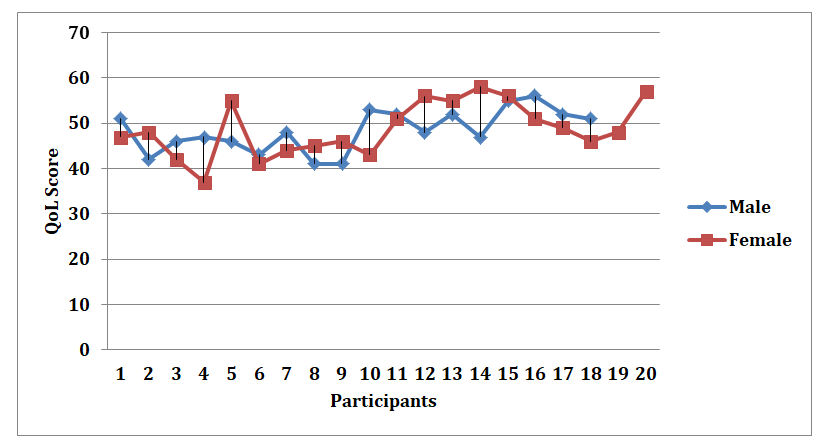
Moreover, in many cases, cancer patients experience loss of appetite, pain, muscular cramps, exhaustion, sleep disturbances, depression, and a poor quality of life after being diagnosed and treated for cancer. It is clear from this research that the number of ADRs has an effect on cancer patients’ physical and mental health. Due to chemotherapy, the majority of patients complained of nausea, discomfort, and fatigue. Body Revival supplements improved both physical and mental condition and enhanced QoL in the participants. In the present study, the pain (Qs 5) and fatigue (Qs 10) scores were significantly lowered, while, physical activity (Qs 11) and cognitive score (Qs 17) were moderately enhanced in both male and female participants. Hence, by combining Body Revival supplements with regular medical care, patients may be better able to manage their unpleasant symptoms, take control of their illness and medical care, and live healthier lives.
Conclusion
From the case reports, it may be concluded that Body Revival supplements taken during conventional therapy and palliative care can improve the quality of life of cancer patients. To confirm the current outcomes, further investigation is needed.
Limitations
Our study has limitations with low sample size, non- homogeneous data, convenience approach and possibility of response related biases
Acknowledgement
The authors duly acknowledge the participants and the board members of Health Reactive.
References
-
Sung H, Ferlay J, Siegel RL, Laversanne M, Soerjomataram I, et al. (2021) Global cancer statistics 2020: GLOBOCAN estimates of incidence and mortality worldwide for 36 cancers in 185 countries. CA Cancer J Clin 71(3): 209- 249.
-
Kumar SK, Chaturvedi M, Das P, Stephen S, Mathur P (2022) Cancer incidence estimates for 2022 and projection for 2025: Result from National Cancer Registry Programme, India. Indian J Med Res 156(4&5): 598-607.
-
Graham P, Stevenson J, Flynn D (1997) A new measure of health-related quality of life for children: preliminary findings. Psychology & Health 12(5): 655-665.
-
Alam MM, Rahman T, Afroz Z, Chakraborty PA, Wahab A, et al. (2020) Quality of life (QoL) of cancer patients and its association with nutritional and performance status: A pilot study. Heliyon 6(10): e05250.
-
Pandha HS, Kirby RS (2002) PC-SPES: Phytotherapy for prostate cancer. The Lancet 359(9325): 2213-2215.
-
Pal SK, Fatima SH (2020) Adventurism in herbal medicine the only option for economically challenged Indian cancer patients: perspective based on case histories. Biosc Biotech Res Comm 13(2): 571-575.
-
Fu B, Wang N, Tan HY, Li S, Cheung F, et al. (2018) Multi- component herbal products in the prevention and treatment of chemotherapy-associated toxicity and side effects: A review on experimental and clinical evidences. Front Pharmacol 9: 1394.
-
Khan M, Pandit S, Saha A, Somani R, Joshi V, et al. (2022) Perspective of using Indian polyherbal medicine in the treatment of cancer. Curr Res Cmpl Alt Med 6(3): 165.
-
Khan M, Somani R, Sur TK (2020) Assessment of immunopotentiation action of standardized Indian herbal formulation (Body Revival). Eur J Med Health Sci 2(2): 229.
-
Latha VE, Rakannan R, Mani CS, Muthuvel R, Surendren V (2011) Validation of cancer institute quality of life questionnaire version II for cancer patients in India. Indian J Cancer 48(4): 500-506.
-
Quinten C, Coens C, Ghislain I, Zikos E, Sprangers MAG, et al. (2015) The effects of age on health-related quality of life in cancer populations: a pooled analysis of randomized controlled trials using the European Organisation for Research and Treatment of Cancer (EORTC) QLQ-C30 involving 6024 cancer patients, Eur J Cancer 51(18): 2808-2819.
-
Nayak MG, George A, Vidyasagar MS, Mathew S, Nayak S, et al. (2017) Quality of life among cancer patients. Indian J Palliat Care 23(4): 445-450.
- Gallic and Citric Acid Present in the Peels of Tropical Fruits as an Alternative in the Fight against Cancer
- Treating the Forehead Lines with Combination of Forehead and Glabellar Botulinum Toxin Among Japanese Patients
- Clinical Evaluation of Patients Suffering from Breast Cancer & Determination of Treatment Therapies and Better Strategies Related to Breast Cancer
- Medieval Recipes by Al-Zahrāwī for Heart Palpitations Treatment
- Etiology and Prescription Errors of Myocardial Infarction in Different Health Care Systems of Azad Kashmir
- Early Diagnosis and Multidisciplinary Management of Turner Syndrome: A Paediatric Case Study