
Pre-Clinical Evaluation for Anti-Inflammatory, Antioxidant and Antibacterial Potential of Boswellia seratta
Objective: The present study was undertaken to evaluate the anti-inflammatory, anti-oxidant and antibacterial potential of Boswellia serrata extract. Methods: Antioxidant activity was determined using DPPH, Hydroxyl, and Total antioxidant capacity and nitric oxide radical scavenging activities. Anti-inflammatory activity was determined using hyaluronidase enzyme inhibitory assay in which Indomethacin was taken as a reference drug. Agar diffusion was used as a test for antibacterial activity. Grampositive (Staphylococcus aureus) and gram-negative (Escherichia coli) bacteria were chosen for the experiment. As a standard medication, ciprofloxacin was used. Results: Test sample free radical scavenging activity was assessed at 10μg, 50μg, and 100μg concentrations. Results demonstrated dose-dependent inhibition (75.90% at 100μl concentration). Results for hydroxyl radical scavenging activity were compared to Ascorbic acid at concentrations of 10μl, 50μl, and 100μl. Hydoxyl radical scavenging activity was dosedependent like free radical scavenging activity. Inhibition was highest at 100μl concentration (89%), while standard medication Ascorbic acid demonstrated 94.84%.Sample concentrations (10μg, 50μg, and 100μg) were tested for nitric oxide scavenging activity, with maximal scavenging reported. Obtained 87.64% at 100μl concentration, compared to 89.73% for reference medication BHA. Hyaluronidase enzyme inhibition testing results show 84.84 % inhibition at 100μl concentration (Maximum inhibition). Conclusions: Boswellia serrata standard extract shows dose-dependent free radical scavenging and hyaluronidase inhibitory activities.
Introduction
A free radical is a molecule or chemical fragment with one or more unpaired electrons in its most outer atomic orbital. Upon formation, they may exhibit high reactivity and set off a cascade of reactions [1]. Both endogenous and external sources contribute to the production of free radicals. Internal cellular processes of auto-oxidation or inactivation of small molecules from all cytoplasmic components (mitochondria, lysosomes, peroxisomes, endoplasmic reticulum, plasma membrane, etc.) generate free radicals from endogenous sources. In the other way, free radicals from exogenous sources are from several life style modification factors such as tobacco smoke, consumption of alcohol, pollutants, radiation, chewing tobacco etc [2]. These free radicals are extremely reactive and can swiftly capture an electron from other molecules, stabilizing them. Once the chain reaction begins, a living cell will be destroyed. Damage to genetic material like Deoxyribonucleic acid (DNA) is a common side consequence of reactive oxygen species’ toxic effects on cells and cell components. Rheumatoid arthritis, Alzheimer’s disease, cardiovascular irregularities, chronic kidney disease, cancer, and many other disorders can all be attributed to free radicals. Antioxidants neutralize the free radicals our bodies produce by interacting with them in a harmless way and breaking the chain events that lead to cell damage.
Materials and Methods
Materials
All of the chemicals utilized in this investigation (including DMSO, DPPH, BHA, hyaluronic acid, and hyaluronidase) were from commercial sources (Sigma- Aldrich, Bangalore) and were of pure analytical quality. Without additional purification, these compounds were put to use in the laboratory. Sun pure of New Delhi, India, generously provided a sample of their Boswellia seratta as a gift.
Extraction of B. serrata
After cleaning, drying, and grinding, B. serrate bark powder was stored for testing. The medication was extracted cold. For optimum bark drug extraction, 20 g powdered material was combined in 100 ml distilled water and ethanol in conical flasks apart for 24 hours. Following 24 hours, both extracts were filtered through muslin and centrifuged at 4000 rpm for 10 minutes at 4°C. At 50 ± 2oC, the supernatant evaporated under vacuum conditions. The experiment diluted tri-sodium citrate (positive control) stock solution (100 mg/ml) and each extract to 0.2, 0.4, 0.6, 0.8, and 1.0 mg/ml [3].
Antioxidant Activity
Free Radical Scavenging Activity: Samples of 10μg, 50μg, and 100μg free radical scavenging activities were dissolved in DMSO and collected in various test tubes. Add methanol to adjust the volume to 500μl. 5 mL of 0.1 mM methanolic 1, 1-diphenyl-2-picrylhydrazyl was added to these test tubes and shaken vigorously. A control with equal methanol and no test substance was kept. For 20 minutes, the tubes were at room temperature. The samples absorbance was 517 nm. The reference standard was BHA. This formula estimated free radical scavenging:
ControlOD-SampleOD %radical scavenging activity= ControlOD
(1) Hydroxyl Radical Scavenging Activity: The hydroxyl radicals are a type of reactive oxygen species that can successfully react with both organic and inorganic substances, as well as cellular components. Hydroxyl radicals capable in modifying the protein structure by reduce the disulphide bonds. Consequently produces many diseases such as cancer, atherosclerosis, diabetes etc. which can be prevented by antioxidants those are capable to accept electrons. DMSO samples (10μg, 50μg, and 100μg) were prepared in test tubes with 0.1M phosphate buffer to a volume of 250μl. 0.5 ml of 0.22% ascorbic acid, 0.5 ml of EDTA (0.018%), and 1 ml of Dimethyl sulphoxide (0.85% v/v in 0.1 M phosphate buffer, pH 7.4) were added to these tubes to start the reaction. This reaction mixes incubated 15 min at room temp. One ml of ice-cold TCA (17.5%w/v) stopped the process. For colour development, all tubes were given three milliliters of Nash reagent (150 g ammonium acetate, 3 ml glacial acetic acid, and 2 ml acetyl acetone combined and elevated to 1 L with distilled water). At 412 nm, spectrophotometrically quantify the yellow color intensity against reagent blank. Our reference standard was ascorbic acid (AA). Hydroxyl radical scavenging % was estimated using this formula:
Differenceinabsorbanceinsample %Hydroxyradical scavenging activity=1- x100 Differenceinabsorbanceinblank (2) Nitric Oxide Radical Scavenging Activity: Sodium nitroprusside in aqueous solution at physiological pH spontaneously creates Nitrite oxide, which combines with oxygen to form Nitrite ions, which may be detected at 550nm by spectrophotometer with Griess reagent (9). In this work, samples and Butylated hydroxylanisole (BHA) were mixed with 0.1M phosphate buffer (pH 7.2) at concentrations of 10μg, 50μg, and 100μg in test tubes up to 3ml. Sodium Nitroprusside (5mM) in buffered saline (pH7.2) was added to each tube (1 ml). The reaction mixture was RT-incubated for 30 min. The test compound-free control was maintained with the same amount of methanol. The aforementioned solution was combined with 1.5 ml of Griess reagent (1%) Sulphanilamide, 2% phosphoric acid and 0.1% N-(1 Naphthylethylenediamine dihydrochloride) after 30 minutes. Sample absorbance were 546 nm. Formula for calculating nitric oxide radical scavenging activity ControlOD-SampleOD %NOradical scavenging activity= x100 ControlOD
(3) Total Antioxidant Capacity: The total antioxidant capacity is calculated by reducing Phosphate-Molybdenum (VI) to (V), which indicates the existence of antioxidant components in the extract through absorbance at 695 nm (to identify the reduced green molybdenum complex). This assay measures bioactive antioxidant activity overall. The total antioxidant capacity of the test sample was assessed using Prieto, et al. approach, using samples at concentrations of 10μg, 50μg, and 100μg in test tubes. Add 1.9 mL of reagent solution (0.6 M sulfuric acid, 28 mM sodium phosphate, 4 mM ammonium molybdate). The tubes were incubated at 95°C for 90 min. before cooling to room temperature. Then each aqueous solution’s absorbance was measured at 695 nm against a blank. Ascorbic acid equivalents measure antioxidant capacity. Ascorbic acid equivalents were estimated using the usual graph. Reference standard was butylated hydroxy anisole (BHA). The data are reported as ascorbic acid equivalents (μg/mg extract). The higher absorbance value indicated higher antioxidant activity.
Anti-inflammatory Analysis: The assay medium containing 3-5U hyaluronidase (Sigma-Aldrich, Bangalore) in 100µl of 20mM sodium phosphate buffer (pH 7.0) with 77mM sodium chloride and 0.01% BSA was pre-incubated with various test compounds for 15 min at 37°C. Start the experiment by adding 100µl hyaluronic acid (0.03% in 300mM sodium phosphate, pH 5.35) to the incubation mixture. Incubate for 45 min at 37 °C. The undigested hyaluronic acid was precipitated using 1ml acid albumin solution of 0.1% bovine serum albumin in 24mM sodium acetate and 79mM acetic acid (pH 3.75). After 10 min at room temperature, the reaction mixture’s absorbance was 600 nm. The enzyme- free absorbance was used to calculate maximal inhibition. The percentage ratio of absorbance in test chemical vs. positive control was used to calculate inhibitory activity. To verify enzyme activity, a control experiment was conducted simultaneously, preincubating the enzyme with 5µl DMSO before the assay methods. Testing ranged from 100µg to 1000µg of compound in the reaction mixture. Reference standard was Indomethacin (Indo).
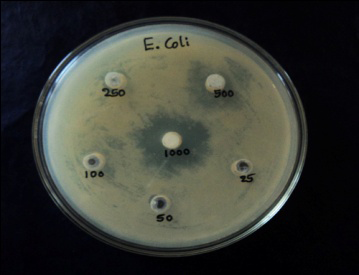
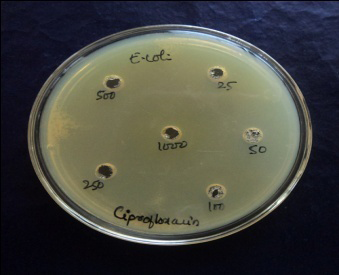
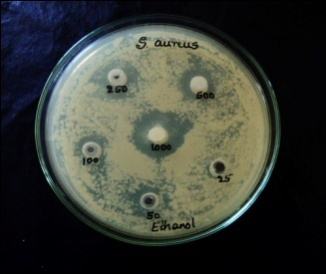
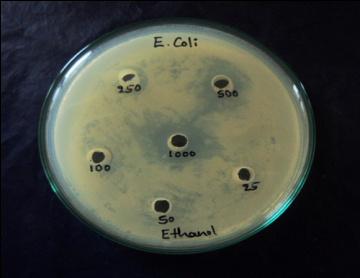
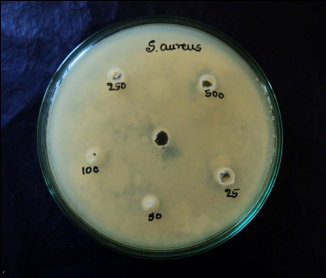
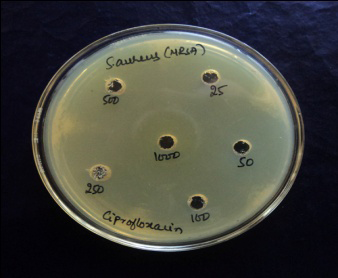
Antibacterial Activity of Boswellia serrate: Solvent Used: Ethanol Std. antibiotic used: Ciprofloxacin Concentrations screened: 1000, 500, 250, 100, 50, 25µg/ml. Remarks: Nil Analysis method: Agar diffusion Staphylococcus aureus, Escherchia coli tested. Description: Used Media: Peptone- 10g, NaCl-10g, Yeast extract-5g, Agar 20g in 1000 cc distilled water.
Method
Initially, bacteria stock cultures were revived by inoculating in broth media and growing at 37ºC for 18 hours wells were formed in the above media’s agar plates. On each plate, 18-hour-old cultures (100 μl, 10-4 cfu) were uniformly injected. The wells were filled with compound at various volumes after 20 min. All plates were incubated at 37ºC for 24 hours and the inhibitory zone diameter was measured.
Results
Antioxidant Activity of Extract
Free Radical Scavenging Activity: Table 1 showing free radical scavenging activity of Boswellia serrata extract at different concentrations of 10, 50 and 100 μl. The percentage inhibition of extract was 75.90%, however, it was 91.82% for standard butylated hydroxyl anisole.
Hydroxyl Radical Scavenging Activity: Figure 1 showing hydroxyl radical scavenging activity of Boswellia serrata extract at different concentrations of 10, 50 and 100 μl. The percentage inhibition of extract was 89.00%, however, it was 94.84% for standard ascorbic acid.
Nitric Oxide Scavenging Activity: Table 2 displays Boswellia serrata extract nitric oxide scavenging activity at 10, 50, and 100 μl doses. The percentage inhibition of extract was 87.64%, however, it was 89.73% for standard butylated hydroxylanisole.
Total Antioxidant Activity: Figure 2 showing nitric oxide scavenging activity of Boswellia serrata extract at different concentrations of 10, 50 and 100 μl. The percentage inhibition of extract was 49.10%, however, it was 45.73% for standard butylated hydroxylanisole.
Anti-Inflammatory Activity of Extract: Table 2 showing anti-inflammatory activity of Boswellia serrata extract at different concentrations of 10, 50 and 100 μl. The percentage inhibition of extract was 84.84%, however, it was 98.21% for standard indomethacin.
Antibacterial Activity of Boswellia serrata: The following table shows inhibitory zone diameters in millimeters.
| Organism | 25 | 50 | 100 | 250 | 500 | 1000 | MIC in µg |
|---|---|---|---|---|---|---|---|
| S.aureus | 0 | 0 | 0 | 0 | 3 | 5 | 1000 |
Table 1: Inhibitory zone diameters in millimeters.
| Organism | 25 | 50 | 100 | 250 | 500 | 1000 | MIC in µg |
|---|---|---|---|---|---|---|---|
| E.coli | 0 | 0 | 0 | 4 | 2 | 3 | 1000 |
| Organism | 25 µg | 50 µg | 100 µg | 200 µg | 400 µg | 800 µg | MIC (µg) |
| E.coli | 18 | 20 | 23 | 26 | 28 | 31 | 25 |
| S.aureus | 13 | 18 | 21 | 25 | 27 | 34 | 25 |
Table 2: Inhibitory zone diameters in millimeters.
Std.Ciprofloxacin
Discussion and Conclusion
Free radical, hydroxyl radical, nitric oxide radical, and total antioxidant activity of Boswellia serrata standardized extract were examined in this study. Boswellia serrata demonstrated maximal free radical scavenging activity at 100µl concentration (75.9%), while BHA showed 91.82% at the same concentration. The highest hydroxyl radical scavenging activity was recorded at 100µl (89.0%), compared to 94.84% for conventional ascorbic acid. BHA was used to measure nitric oxide radical scavenging. Maximum 87.64% (no scavenging) was observed in the 100µl test sample compared to BHA 89.73%. The standardized extract’s total antioxidant capacity was assessed using Prieto, et al. At 100µl concentration, the test chemical shows 49.1%, whereas the research antioxidant BHA shows 45.73% (more effective than standard antioxidant). This study found dose- dependent scavenging activity for all models in the Boswellia Serrata standardized extract.
References
-
Threlfall EJ, Fisher IST, Ward L, Tschape H, Gernersmidt P (1999) Harmonization of antibiotic susceptibility testing for Salmonella: Results of a study by 18 national reference laboratories within the European Union- funded Enter-Net group. Microb Drug Resist 5(3): 195- 200.
-
Walker RD (2000) Antimicrobial susceptibility testing and interpretation of results. In: Prescott JF (Ed.), Antimicrobial Therapy in Veterinary Medicine. Iowa State University Press, Ames IA, USA, pp: 12-26.
-
Awaley MG, Nakade JG, Kale A, Jaiswal HS, Bhawabhuti, et al. (2020) Antioxidant activity and characterization of ethanolic bark extract of _Boswellia serrata_. JETIR 7(11).
- Gallic and Citric Acid Present in the Peels of Tropical Fruits as an Alternative in the Fight against Cancer
- Treating the Forehead Lines with Combination of Forehead and Glabellar Botulinum Toxin Among Japanese Patients
- Clinical Evaluation of Patients Suffering from Breast Cancer & Determination of Treatment Therapies and Better Strategies Related to Breast Cancer
- Medieval Recipes by Al-Zahrāwī for Heart Palpitations Treatment
- Etiology and Prescription Errors of Myocardial Infarction in Different Health Care Systems of Azad Kashmir
- Early Diagnosis and Multidisciplinary Management of Turner Syndrome: A Paediatric Case Study