
Understanding Precision Medicine and its applications
Precision medicine is a transformative approach to disease treatment and prevention that leverages individual genetic, environmental, and lifestyle factors. It allows clinicians and researchers to make more precise predictions about the efficacy of specific treatments, improving patient outcomes. This method is similar to personalized matching in blood transfusions and other case, diabetic patients with similar glucose levels might receive different medications based on their genetic makeup and lifestyle. Despite its promise, precision medicine is not yet fully integrated into standard healthcare practices. Key factors driving this integration include genetic profiling, pharmacogenomics, targeted therapy, and the use of biomarkers. Genetic profiling can predict disease risk and treatment responses, while pharmacogenomics studies how genetic variations affect individual responses to medications. Targeted therapies like trastuzumab for HER2-positive breast cancer and biomarkers like PSA for prostate cancer screening demonstrate the precision approach’s effectiveness. Applications of precision medicine span various medical fields, including oncology, cardiology, infectious diseases, pulmonology, neurology, and diabetes management. The integration of big data, artificial intelligence, and machine learning facilitates comprehensive analyses of genetic, environmental, and lifestyle factors, leading to increasingly personalized and effective treatments.
Abbreviations
PM: Precision Medicine; DNA: Deoxyribonucleic Acid; BRCA: Breast Cancer Gene; VKORC1: Vitamin K Epoxide Reductase Complex Subunit 1; PSA: Prostate-Specific Antigen; FISH: Fluorescence In-situ Hybridization; HER: Human Epidermal Growth Factor Receptor; NGS: Next-Generation Sequencing; IHC: Immunohistochemistry; PIK3CA: Phosphatidylinositol- 4,5-Bisphosphate 3-Kinase Catalytic Subunit Alpha; HIV: Human Immunodeficiency Virus; CFTR: Cystic Fibrosis Transmembrane Conductance Regulator; APOE: Apolipoprotein E; PV: Pharmacovigilance; ADRs: Adverse Drug Reactions; HLA: Human Leukocyte Antigens; SLCO: Solute Carrier Organic Anion, TDM: Therapeutic Drug Monitering.
Introduction
The US national academy of sciences first used the term Precision Medicine (PM) in 2011 and defines it as an emerging approach for disease treatment and prevention that takes into account individual variability in genes, environment, and lifestyle for each person [1]. It has multidimensional aspect which was well reflected in President Obama introductory speech in the Precision Medicine Initiative, a ground-breaking research initiative to promote health and treat disease. Prior to now, most medical therapies were developed for the “average patient.” Due to this “one-size-fits-all” approach, some patients benefit from therapies while others do not [2]. This approach will give liberty to clinician and researchers to make more precise predictions regarding the effectiveness of specific treatment and prevention strategies for a particular disease in different demographic groups and even in individual. There are mainly two approach of prescribing medicine, universal and individual specific. The Universal approach focuses on creating treatment and prevention strategies for the general population with disease specific whereas in other approach individual features as well as diagnosis of disease is taken in consideration. It can be more understandable with example of blood transfusion, person requires a blood transfusion, blood is not administered from a donor chosen at random; instead, the blood type of the donor is carefully matched with that of the recipient in order to minimize the likelihood of complications Similar same cohort of diabetic patient with similar level of glucose may be prescribed different drug due to different individual genetic makeup and life style. The Human Genome Project by various countries drove up this change, and the quick rise in low-cost DNA sequencing methods made targeted treatments possible, which completely changed healthcare [3, 4, 5, 6]. Modern medicine currently incorporates multiple technologies to precisely diagnose and treat diseases. The foundation for achieving positive therapeutic results is mainly on the “five Rights”: delivering the Right medicine to the Right patient /diagnosis at the Right time, in the Right dosage, and via the Right route of administration of drugs [7], but we cannot ignore Right cost which all are basics of ration use of medicine. We always kept in mind that integrating emerging technology, artificial intelligence and pharmacogenomics undoubtedly increases effective individualised treatment, better health care service delivery to community but it should affordable cost to that individual patients and long way to go. Although precision medicine can be useful in some areas of medicine, it is not yet fully integrated into standard healthcare. It may be due to higher cost but it should remember “PM may result in increased drug costs for certain patient subgroups, but it is essential to recognize that it offers as a means to prevent the expenses associated with wasteful and ineffective treatment methods for individuals who do not respond to specific therapeutic approaches”. Many areas of healthcare and health research are expected to adopt this strategy in the near future, according to researchers. The main aim of present review to understand about precision medicine and its common applications so that we move forward towards precision medicine.
The Important factors for Precision Medicine
Genetic Profiling: Utilizes genetic information to predict disease risk such as BRCA1 and BRCA2 gene testing for breast and ovarian cancer risk for knowing treatment, and potential side effects.
Pharmacogenomics: It refers to the study of how the genetic makeup of an individual influences how they react to certain medications. This discipline seeks to design pharmaceuticals that are both effective and safe, as well as doses that are matched to the genetic makeup of an individual. In the field of pharmacogenomics, the following are some instances and significant concepts. Example: optimal dose of anticoagulant warfarin depends upon CYP2C9 and VKORC1.
Targeted Therapy: It refers to way of cancer treatment that employs medications or intervention to recognize and fight cancer cells. This is often achieved by disrupting specific chemicals that play a role in the growth and advancement of tumours. Targeted therapies differ from typical chemotherapy in that they specifically target and inhibit the growth and spread of cancer by focusing on specific molecular targets that are linked with cancer, rather than affecting all rapidly proliferating cells. This means target specific molecules involved in cancer growth and progression, Example, Trastuzumab for HER2-positive breast cancer.
Biomarker: Biomarkers are biological molecules present in blood, body fluids, or tissues that serve as indicators of normal or abnormal processes, ailments, or diseases. Example: PSA (Prostate-Specific Antigen) used for screening and monitoring prostate cancer and CA-125 is a marker for ovarian cancer, used in diagnosis and monitoring treatment response
Application of Precision medicine
Oncology: Breast Cancer: It can better stand by a case based question: - A 45-year-old patient, Mrs Rama Devi is diagnosed with metastatic cancer and undergoing treatment with doxorubicin and cyclophosphamide but patient will not able to tolerate this medicine. Precision medicine can help to improve Rama Devi’s treatment plan. A comprehensive genetic and molecular profiling of her tumour will be done to identifying specific genetic mutations, protein expressions, and other molecular characteristics which can help to determine the most effective targeted therapies. Next-generation sequencing (NGS) will be done to detect mutations in genes like HER2, BRCA1/2, PIK3CA, and Immunohistochemistry (IHC) and fluorescence in situ hybridization (FISH) to assess HER2 status. Suppose the genetic profiling reveals that Rama’s tumour is HER2- positive and has a PIK3CA mutation. HER2-positive tumours overexpress the HER2 protein, which can be targeted by specific therapies. PIK3CA mutations are involved in cell growth pathways and can also be targeted. Selection of Targeted Therapies for HER2-Positive Breast Cancer. Trastuzumab is selected for tar geting therapy as it is a monoclonal antibody that binds to the HER2 protein on the surface of cancer cells, inhibiting their growth and survival. Alpelisib is a PI3K inh ibitor specifically targeting the mutated PIK3CA gene, which helps in controlling the growth of cancer cells. Traditional chemotherapy will replace to a combination of Tra stuzumab and Alpelisib. This targeted approach is likely to be more effective against her specific cancer profile and may reduce the severe side effects associated with c hemotherapy. Regular follow up and monitoring response will be done by imaging and blood test to monitor the response to the new treatment regimen, further adjustments to the treatment plan can be made. If resistance to targeted therapies de velops, additional profiling may be necessary to identify new mutations or pathways involved. By applying precision medicine, Rama’s treatment plan is customized based on her individual cancer features, which increases the chances of treatment effectiveness and decreases the occurrence of adverse effects, through the use of pre cision medicine. Trastuzumab and Alpelisib, which are targeted medicines, are selected based on the presence of HER2 positive and PIK3CA mutation. This sho wcases how precision medicine can enhance the results for patients with intricate situations such as metastatic breast cancer. Consistent monitoring guarantees the ongoing effectiveness of the treatment and allows for necessary modifications, resulting in a flexible and individualized approach to cancer care.Similarly, it can be applied in various branches of medicine.
Cardiology: Warfarin Dosing: Warfarin is an anticoagulant with a narrow therapeutic window. Genetic testing for CYP2C9 and VKORC1 variants helps determine the appropriate dose, reducing the risk of bleeding or clotting complications.
Infectious Diseases: HIV Treatment: Genotyping the HIV virus helps identify drug-resistant strains, allowing for tailored antiretroviral therapy that is more effective against the specific virus variant.
Pulmonology: Cystic Fibrosis: CFTR gene mutations cause cystic fibrosis. Ivacaftor, targets specific mutations in the CFTR gene, improving lung function and quality of life in affected patients.
Neurology: Alzheimer’s Disease: APOE gene testing can indicate the risk of developing Alzheimer’s. While there is no cure, lifestyle changes and targeted therapies may help manage the risk and progression.
Metabolic disorder: Type 2 Diabetes: Genetic and metabolic profiling helps identify subtypes of diabetes, allowing for more precise treatment plans, such as specific medications or lifestyle interventions.
Increase drug safety: Pharmacovigilance (PV) has a significant role in mitigating adverse drug responses (ADRs), hence enhancing adherence. Several adverse drug reactions (ADRs) occur due to genetic variations in drug-metabolizing enzymes such as CYP450as in first line antituberular drug isoniazid. These variations can cause the drug to be metabolized either faster or slower than the usual rate [8, 9]. Likewise, the occurrence of allele HLA-B*1502 is linked to Stevens-Johnson syndrome in patients who are using carbamazepine [10], while SLCO1B1 is associated with Simvastatin-induced myopathy [11].Therefore, it is crucial to screen these biomarkers in order to identify patients who are susceptible to these drugs.
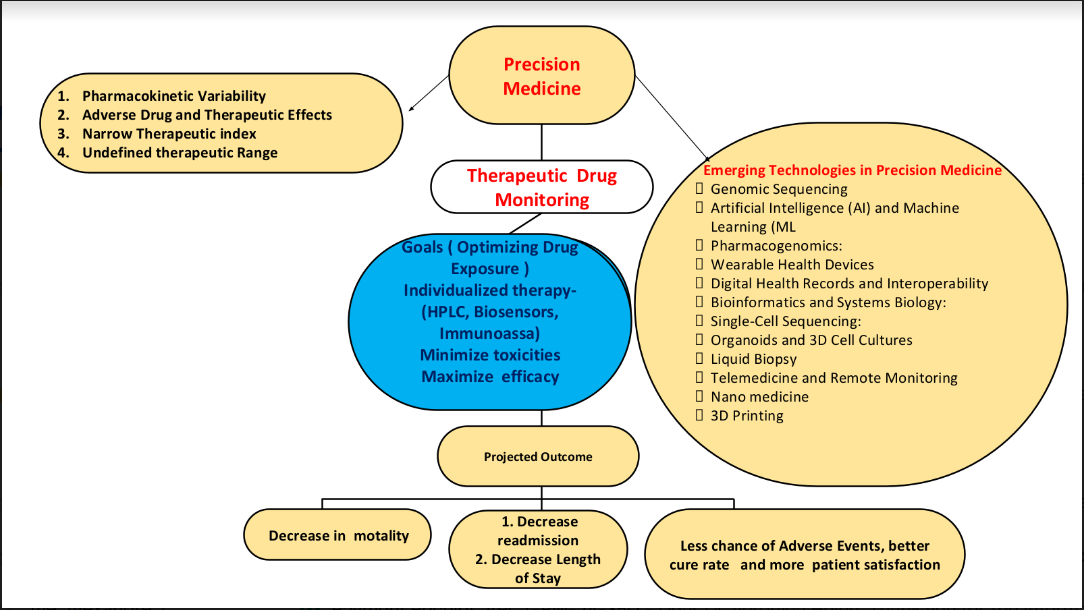
Therapeutic Drug Monitoring (TDM): TDM is crucial for PM execution, enabling dose adjustments for individual patients. Using a specified target exposure reduces pharmacokinetic and total response variability. Drug doses can be modified based on indicators such glucose/glycosylated hemoglobin, cholesterol, prostate-specific antigen, and blood pressure [12].
Regulatory aspect of Precision Medicine (PM): Clear cut regulatory guidelines available for therapeutics like FDA. Companion diagnostics can find a group of patients who are very likely to react to a medication, predict side effects, and keep an eye on how well a medication is working [13].
Disease Heterogeneity in PM: Abnormal molecular pathways in particular patient subgroups have been identified, and medicines targeting these targets have been produced. Disease heterogeneity contributes to response variability in selecting the proper treatment, as various mechanisms establish similar signs and symptoms [2, 13, 14]. The drug vemurafenib, which selectively targets mutated b-raf kinase in tumors with a V600E mutation, is effective for melanoma but less effective for colorectal carcinoma, highlighting the importance of considering disease heterogeneity [15]. Similarity it can be used in other branches/area of medicine (Figure 1).
Discussion
A more individualized approach to healthcare is provided by precision medicine, which has the potential to greatly enhance treatment outcomes across a wide variety of medical specialties. PM is basically personalised which based on evidence and genetic correlation with individual. The benefits of precision medicine, which include the potential to adapt therapies to specific patient profiles and reduce unfavourable outcomes, make it an essential area of attention for the future of healthcare. However, there are still hurdles that need to be overcome in order to deploy it more broadly.
Conclusion
Precision medicine is a transformative approach to disease treatment and prevention that uses individual genetic, environmental, and lifestyle factors to customize care. This method improves patient outcomes by making more precise predictions about the efficacy of specific treatments. Despite its promise, precision medicine is not yet fully integrated into standard healthcare practices. The integration of big data, artificial intelligence, and machine learning facilitates comprehensive analyses of genetic, environmental, and lifestyle factors, leading to increasingly personalized and effective treatments. Precision medicine provides a customized approach to healthcare, which has the potential to greatly enhance treatment results in various medical fields. Although there are still obstacles to overcome in implementing precision medicine on a larger scale, its advantages, such as the capacity to customize therapies based on specific patient characteristics and decrease negative consequences, make it an essential area of concentration for the future of healthcare.
The more research and use of technological innovations should be done to expand the scope and impact of precision medicine, so that improving outcomes across a wide range of diseases and conditions and ultimately improve health care delivery system at affordable cost.
References
-
Stone A (2016) Precision Medicine: Health Care Tailored to You. The White House Blog.
-
National Research Council (US) Committee on a Framework for Developing a New Taxonomy of Disease (2011) Toward Precision Medicine: Building a Knowledge Network for Biomedical Research and a New Taxonomy of Disease. National Academies Press, Washington DC, US, pp: 142.
-
March R (2024) The Changing Landscape of Precision Medicine. Astra Zeneca.
-
Akhoon N (2021) Precision Medicine: A New Paradigm in Therapeutics. Int J Prev Med 12: 12.
-
Gameiro GR, Sinkunas V, Liguori GR, Auler Junior JOC () Precision Medicine: Changing the Way We Think about Healthcare. Clinics 73: e723.
-
Denny JC, Collins FS (2021) Precision Medicine in 2030-Seven Ways to Transform Healthcare. Cell 18496): 1415-1419.
-
Grissinger M (2010) The Five Rights: A Destination Without a Map. Pharm Ther 35: 542.
-
Phillips KA, Veenstra DL, Oren E, Lee JK, Sadee W (2001) Potential role of pharmacogenomics in reducing adverse drug reactions: A systematic review. JAMA 286(18): 2270‑2779.
-
Blue Cross BlueShield Association (2004) Special report: Genotyping for cytochrome P450 polymorphisms to determine drug metabolizer status. Technol Eval Cent Assess Program Exec Summ 19(9): 1-2.
-
Man CB, Kwan P, Baum L, Yu E, Lau KM, et al. (2007) Association between HLA-B* 1502 allele and antiepileptic drug induced cutaneous reactions in Han Chinese. Epilepsia 48(5): 1015-1018.
-
The Search Collaborative Group (2008) SLCO1B1 variants and statin‑induced myopathy-a genomewide study. N Engl J Med 359(8): 789‑799.
-
Peck RW (2018) Precision medicine is not just genomics: The right dose for every patient. Ann Rev Pharmacol Toxicol 58: 105‑22.
-
Kola I, Bell J (2011) A call to reform the taxonomy of human disease. Nat Rev Drug Discov 10: 641‑642.
-
Chan AC, Behrens TW (2013) Personalizing medicine for autoimmune and inflammatory diseases. Nat Immunol 14: 106‑109.
-
Hyman DM, Puzanov I, Subbiah V, Faris JE, Chau I, et al. (2015) Vemurafenib in multiple nonmelanoma cancers with BRAF V600 mutations. N Engl J Med 373(8): 726‑736.
- Gallic and Citric Acid Present in the Peels of Tropical Fruits as an Alternative in the Fight against Cancer
- Treating the Forehead Lines with Combination of Forehead and Glabellar Botulinum Toxin Among Japanese Patients
- Clinical Evaluation of Patients Suffering from Breast Cancer & Determination of Treatment Therapies and Better Strategies Related to Breast Cancer
- Medieval Recipes by Al-Zahrāwī for Heart Palpitations Treatment
- Etiology and Prescription Errors of Myocardial Infarction in Different Health Care Systems of Azad Kashmir
- Early Diagnosis and Multidisciplinary Management of Turner Syndrome: A Paediatric Case Study