
Sensory Evaluation of Extruded Snacks Prepared from Triticale and Wheat Composite Flour
Sensory evaluation of five treatments for snack production conducted. Five treatments were used to produce snack as composite flour of wheat and triticale in different ratio Treatment one (100:0),Treatment two(85:15), treatment three (70:30) ,Treatment four (55:45), Treatment five (40:60) respectively. The wheat and triticale were obtained from Holeta agricultural research center wheat breeding program. The samples were presented to 15 panelists to rate them on a five point hedonic scale .Analysis of variances (ANOVA) was performed on the data gathered. The result showed that highest acceptance were for the treatments T1 (100:0), T2(85:15), T4(55:45), T5(40:60) respectively. Results revealed that there are a significant difference at p
Introduction
Triticale is a first artificially developed grain crop that can predominate wheat and rye in certain Characteristics. This crop can take a worthy place among cultivated crops, taking into account the fact that it has a high productive potential and stability of yields on an annual basis. The tendency of agricultural enterprises to obtain a high yield led to the fact that agricultural producers began to use actively chemicals in the manufacture, including plant growth regulators [1]. Growth regulators can stimulate the behavior of such processes as seed germination, photosynthesis, and protection from pathogenic micro flora, the formation of vegetative and generative organs of plants [2].
Healthy snacks need to be tasty, flavorful, visually appealing and packed for easy to carry. Nutritious snacks have the potential to prevent obesity related diseases such as: hypertension, heart disease, cancer, diabetes and bone diseases. Bran fraction of whole grains contains fiber and many essential minerals and nutrients. Many of the processed grain products do not contain the bran fraction. Whole grain products are recommended as they contain healthy bran fraction. It is recommended by the Nutrition Policy and Promotion [3]. Since most individual do not consume one- half the cereals containing whole grains. Consumers need to be educated to buy or prepare in their house kitchens healthy whole grain snacks. The development whole grain snacks would meet such a health promoting need. Such snacks should be simple to make containing only a few ingredients including spices that contain disease preventing nutrients.
Dietary Guidelines for Americans [4] that more than half of all cereal products consumed should contain whole grains. At all age groups males and females, consumption of refined grains is higher than that of whole grain products. It has been documented that consumption of whole grains products would lower the risk of many preventable lifestyle diseases [5]. It has been reported that heart disease risk was lowered with the consumption of whole grain rye and oats but not that by wheat [6]. However, many of the snacks on the market contain wheat. There is increasing hypersensitivity to wheat gluten in celiac patients. Healthy nutrient absorbing surface of the gut is needed. This surface is damaged and the needed nutrients cannot be absorbed in celiac patients resulting in many deficiency diseases. Hypersensitivity to foods containing gluten has been on the rise recently. Some of the possible reasons could be use of bacterial transaminase enzyme to glue meat scraps to make meat patties. The transamination of gluten during the digestion process in the gut could make it hypersensitive. Another reason may be that increased pollution and toxins in the environment has resulted in change in the intestinal microbes that have allergic reaction to gluten. In 2014 US Food and Drug Administration [7].
The implementation of triticale into the manufacture is complicated by the inherent negative traits of rye triticale varieties and the lack of processing technologies. The baking advantage of triticale grain is worse than that of wheat, as the bread has a smaller volume, jamming and cheesy crumb, sometimes the crust is covered with cracks. Critically, the baking quality of triticale flour is much worse. The structure and properties of the dough made from triticale flour are similar to the wheat dough of poor quality. This is due to the lack of quality and quantity of gluten, the high activity of amylolytic and proteolytic enzymes.
Materials and Methods
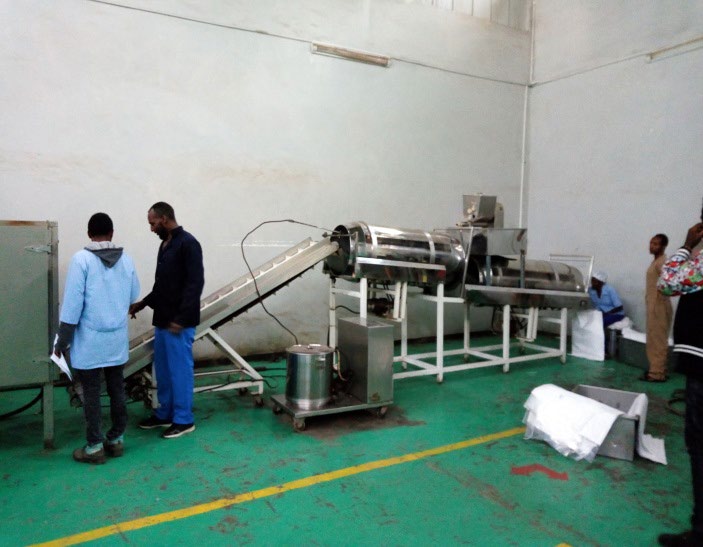
Wheat variety (Limu variety) and Triticale were obtained from Holeta wheat breeding program. The products (snacks) were prepared at Guts Agro Industry Hawasa (Tables 1 & 2).
| Ingredients | Total quantity |
|---|---|
| Wheat flour (Limu variety) | 33.50 kg |
| Triticale | 10.50 kg |
| Water | 3.06 L |
Table 1: Ingredients used for extruded snack formulation.
| Treatments (T) | Wheat: Triticale flour ratio | Quantity of wheat: triticale (kg) |
|---|---|---|
| T1 | 100:00:00 | 10kg: 0kg |
| T2 | 85:15:00 | 8.5kg: 1.5kg |
| T3 | 70:30:00 | 7kg: 3kg |
| T4 | 55:45:00 | 5.5kg: 4.5kg |
| T5 | 40: 60 | 4kg: 6kg |
Table 2: Treatments with the corresponding ratio.
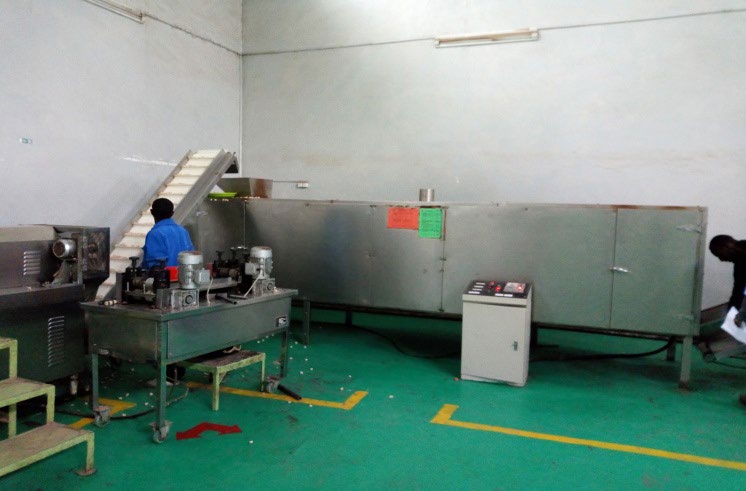
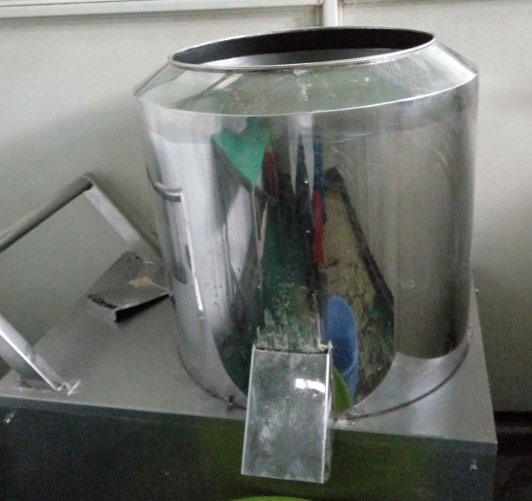
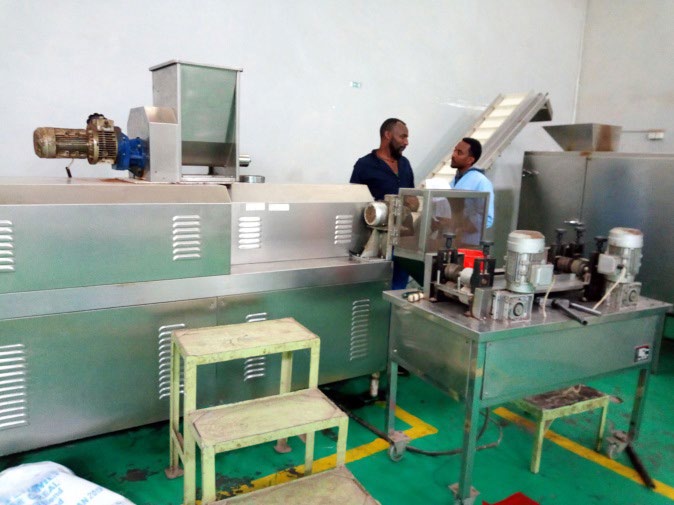
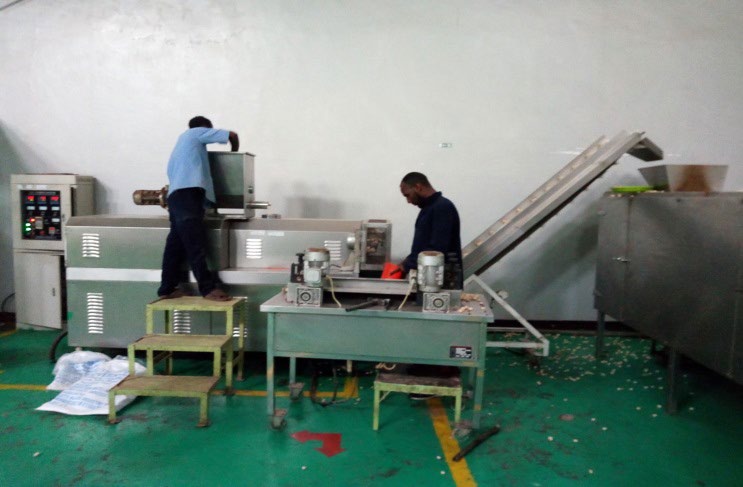
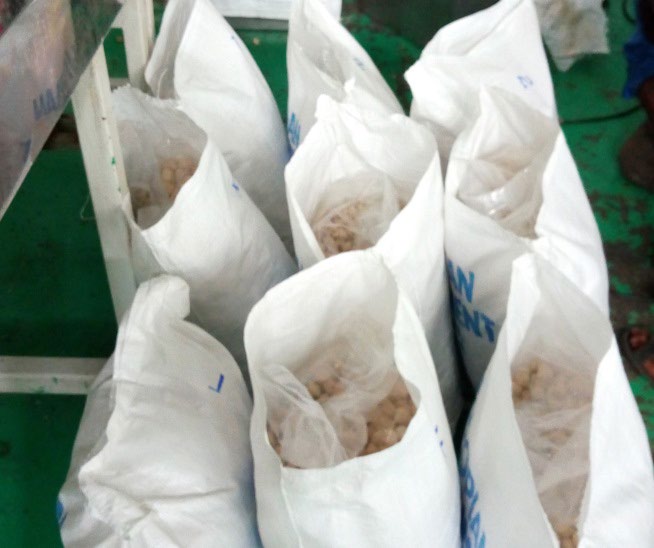
Below the pictures were obtained from Hawasa Guts Agro Industry (Figures 1-6).
Nutrient Analysis
The Association of Official Analytical Chemist [8] procedure was used to determine the nutrient Compositions (crude protein, moisture content, crude fat, total ash, water absorption capacity, oil absorption capacity) of the wheat, Triticale flour and Bread samples made from the blends of the above flours.
Sensory Evaluation
The treatments were coded and randomly presented to panelists in random order. In sensory evaluation five point hedonic scale (1= dislike very much, 2= dislike, 3=neither like nor dislike, 4= like, 5= like very much) were used.
Experimental Design and Data Analysis
The experiments were designed in completely randomized design (CRD). The analyses of variance (ANOVA) were performed to examine the significance level of all parameters measured. Least Significant Difference (LSD) test was used for means comparison by SPSS Version 23.
Result and Discussion
The water absorption of wheat was 1.62% while for Triticale was 1.25% which indicates the triticale flour absorbs less water than wheat flour. Regarding to the oil absorption the oil absorption of triticale (1.25%) was higher than wheat (1.12%) (Table 3). The ash content of triticale (1%) was higher than the wheat indicates the mineral content was higher compared to wheat. Generally the water absorption moisture content and protein content of wheat flours were higher than triticale while oil absorption, ash and fat content of triticale flour were higher than wheat (Table 3). The absorption of more water during mixing is a typical characteristic of composite starches [9]. Several studies also reported that the dough made from composite flour absorbed more water than that made from wheat flour alone [10, 11].
| Flour | Water absorption | Oil Absorption | MC | PC | Ash | Fat |
|---|---|---|---|---|---|---|
| Wheat | 1.62±0.88 | 1.12±0.17 | 12.25±1.17 | 8.88±0.29a | 0.5±0.00 | 1.25±0.35 |
| Triticale | 1.25±0.35 | 1.25±0.00 | 10.25±0.35 | 7.24±0.09b | 1±0.7 | 1.6±0.00 |
Table 3: Sensorial data using five point hedonic scales.
- MC=moisture content, PC=protein content.
- Tables below shows individual treatments with their water-to-flour ratio (not to exceed moisture content of 18%)
- (Tables 4-8).
- Treatment 1) 100% wheat flour (Control)
- S.No
- Ingredient
- Weight (kg)
- Moisture (%)
- Moisture (kg)
- 1
- Wheat flour
- 10
- 13.5
- 1.35
- 2
- Triticale flour
- 0
- 11.25
- 0
- 3
- Water
- 0.55
- 100
- 0.55
- Extrudate Moisture
- 18.00%
Table 4: Treatment one with water to flour ratio.
- Treatment 2) 85% wheat: 15% triticale flour
- S.No
- Ingredient
- Weight (kg)
- Moisture (%)
- Moisture (kg)
- 1
- Wheat flour
- 8.5
- 13.50%
- 1.15
- 2
- Triticale flour
- 1.5
- 11.25%
- 0.17
- 3
- Water
- 0.59
- 100.00%
- 0.59
- Extrudate Moisture (%)
- 18.00%
Table 5: Treatment two with water to flour ratio.
- Treatment 3) 70%wheat : 30% triticale flour
- S.No
- Ingredient
- Weight (kg)
- Moisture (%)
- Moisture (kg)
- 1
- Wheat flour
- 7
- 13.50%
- 0.95
- 2
- Triticale flour
- 3
- 11.25%
- 0.34
- 3
- Water
- 0.63
- 100.00%
- 0.63
- Extrudate Moisture (%)
- 18.00%
Table 6: Treatment three with water to flour ratio.
- Treatment 4) 55% wheat : 45% triticale flour
- S.No
- Ingredient
- Weight (kg)
- Moisture (%)
- Moisture (kg)
- 1
- Wheat flour
- 5.5
- 13.50%
- 0.74
- 2
- Triticale flour
- 4.5
- 11.25%
- 0.51
- 3
- Water
- 0.67
- 100.00%
- 0.67
- 10.67
- 1.9
- Extrudate Moisture (%)
- 18.00%
Table 7: Treatment four with water to flour ratio.
- Treatment 5) 40% wheat: 60% triticale flour
- S.No
- Ingredient
- Weight (kg)
- Moisture (%)
- Moisture (kg)
- 1
- Wheat flour
- 3.5
- 13.50%
- 0.47
- 2
- Triticale
- 5.25
- 11.25%
- 0.59
- 3
- Water
- 0.62
- 100.00%
- 0.62
- Extrudate Moisture (%)
- 18.00%
Table 8: Treatment five with water to flour ratio.
The above table (4-8) showed that the water to wheat and triticale ratio. To decrease the bulk density of snack the moisture content should not more than 18%. Because in snack manufacturing low bulk density products is needed by the consumers which is preferable when the product is low bulk density (Table 9).
| Taste | Color | Texture | Aroma | Overall acceptability | |
|---|---|---|---|---|---|
| T1 | 3.62±0.12 | 3.75±0.00 | 3.87±0.12 | 3.25±0.00^{ab}$ | $3.62±0.12^{a}$ |
| T2 | 3.62±0.12 | 3.00±0.25 | 3.12±0.12 | 3.37±0.12^{b}$ | $3.37±0.12^{ab}$ |
| T3 | 3.25±0.00 | 3.00±0.25 | 3.00±0.25 | 2.87±0.12^{c}$ | $2.75±0.00^{c}$ |
| T4 | 3.37±0.12 | 3.00±0.00 | 3.00±0.25 | 3.37±0.12^{a}$ | $3.25±0.25^{ab}$ |
| T5 | 3.50±0.25 | 3.00±0.37 | 3.00±0.50 | 3.00±0.00^{bc}$ | $3.25±0.25^{ab}$ |
Table 9: Sensorial data using five point hedonic scales.
Compared to the control (T1) treatment 2 (3.62) and treatment 5(3.5) were preferable in their taste. While the color of each treatments were not significantly different at p<0.05 .The texture of treatment one (3.25) and treatment two (3.37) were preferred compared to the other treatments. The aroma between the treatments there were significant difference at p<0.05.The overall acceptability were preferred by the panelists when the triticale flour increase but the bulk density of the snack high when the triticale flour increase. Acceptability. It was concluded that snack samples produced from treatment two (85:15) and treatment three (70:30) were more acceptance in their taste and over all acceptance .up to 30 % of triticale can be substituted on wheat flour to the production of snack by agro industry. Lorenz and Coulter (1991) reported that good quality breads were baked using wheat flour with 5 and 10% quinoa blend.
Conclusion
Five treatments were used for product formulation. Before formulation of the two composite flours the water absorption and oil absorption were evaluated. The water absorption of wheat was lower compared to the triticale flour and the mixing ratio of composite flour and water were not more than 18 % moisture content because of the product is needed by the consumers when the snack bulk density low as well as the shelf life of the snack long. Among the five treatments acceptance of (2.75-3.62) were obtained. It was concluded that snack samples produced from treatment two (85:15) and treatment three (70:30) were more acceptance in their taste and over all acceptance up to 30% of triticale can be substituted on wheat flour to the production of snack by agro industry.
References
-
Trofimova TA, Korzhov SI, Gulevsky VA, Obraztsov VN (2018) Assessing the Degree of Physical Degradation and Suitability of Chernozems for the Minimization of Basic Tillage. Eurasian Soil Science 51(9): 1080-1085.
-
Yakushev VP, Mikhailenko IM, Dragavtsev VA (2015) Reserves of agro-technologies and breeding for cereal yield increase in the Russian federation Agricultural biology 50(5): 550-560.
-
USDA (2015) Center for Nutrition Policy and Promotion.
-
USDA (2015) Nutrition Policy and Promotion. Dietary Guidelines for Americans.
-
Whole Grain Council (2009) Health Studies & Health Benefits.
-
Halnaes A, Kyro C, Anderson I, Lacoppidan S, Over- vad K, et al. (2016) Intake of whole grains is associ- ated with lower risk of myocardial infarction: the DanishDiet,Cancer and Health Cohort. Am J Clin Nutr 103: 999-1007.
-
FDA (2014) Food and Drug Administration defines glu- ten-free.
-
AOAC (2000) Official Methods of Analysis of the Association of Official Analytical Chemists, 17th (Edn.), The Association, Arlington, VA Chapt 45: 78E-80.
-
Doxastakis G, Zafiriadis I, Irakil M, Marlani H, Tananaki C (2002) Lupin, soya and triticale addition to wheat flour dough and their effect on rheological properties. Food Chem 77(2): 219-227.
-
Morita N, Maeda T, Miyazaki M, Yamamori M, Miura H, et al. (2002) Dough and baking properties of high amylase and waxy wheat flours. Cereal Chem 79: 491-495.
-
Lorenz K, Coulter L (1991) Quinoa flour in baked prod- ucts. Plant Foods Hum Nutr 41(3): 213-223.
- The Role of Podocyte Apoptosis and the Involvement of SIRT1 in Diabetic Nephropathy
- Dealcoholization of Beer by Osmotic Distillation for the Beverage Industry
- Biopolymer-Based Edible Packaging- Biomaterials, Methods, and Applications in Food Industry: An Updated Review
- Influence of Bioprocessing Methods on 'China Rice' (Gawal R1), and Soyabean Supplementation on the Quality of Complementary Food
- Cassava (Manihot esculenta) Varietal Growth, Yield and Cyanide Content Performance in Three Sites in the South- Eastern Semi Arid Regions of Kenya
- Food Waste Treatment, Recycling, Management and Production of Value-Products-An Update on Methodologies and Current Trends