
Effect of Cooling Rate on Physico-Chemical Properties of Mango Fruit
Mango (Mangiferaindica L) fruits were consumed for their pleasant taste and flavour. It rich sources of vitamins A, B and C. However, there is huge loss of the mango fruit during storage due to lack of temperature management and use of slow cooling rate. The objective of this study is therefore to investigate the effect of cooling rates on physical and chemical properties of mango fruits subjected to different cooling rates. The study was lied down with one factors randomized complete block design (RBCD) and replicated three times. Mango fruits were subjected to three different cooling rates (0.001, 0.019 and 0.087) through storage at different storage temperature (-1, 4 and -18°C) and evaluated in terms of physicochemical properties of the fruits during the storage. Data were analyzed by using Minitab software and the effect of cooling rate on all response variables measured was analyzed using Analysis of variance and the significance terms were accepted at 95% (p <0.05) confidence level. The result indicated that mango fruits subjected to different cooling rate exhibited significant change for all evaluated parameters. The mango fruits stored at highest cooling rates (0.087) preserves moisture contents from (70.57-64.45% ) and at lowest cooling rates, moisture reduced from (64.73-60.45%) pH increase (3.7-3.78) and Titratable acidity (TA) decrease (0.35-0.30 %) , total solid soluble (TSS) increase from (8.76-11.25 degree brix) weight loss increase (13.6-19.4%) and the ash content of mango fruits stored at highest cooling rates changed from (8.8-6.8%). This could be due to the fact that highest cooling rate (0.087) preserves physico-chemical properties. During this study because of some constraints, some parameters were not included. Therefore, based on the limitation of the work, further research is needed to study the effect of cooling rates on vitamin (A,C and B) and minerals and (protein, carbohydrates, fat), and beta-carotene of mango fruits which are not conducted in this research due to budget and time limitations, large scale cooling room needed. Generally, it was concluded that, highest loss of mango fruits occurred due to inappropriate storage temperature and highest cooling rates (0.087) preserve physico-chemical properties during storage periods.
Introduction
Mango (Mangifera indica L.) is a fruit native to the tropics and sub-tropics of world and it has been cultivated for more than 4,000 years. The mango fruits are belongs to Anacardiaceae family and it was disseminated all over the world in the beginning of the sixteenth century. Currently around a thousand well known varieties of mango are available [1]. Mango is one of the most widely cultivated fruits in world [2]. It makes up 50% of all the tropical fruits produced worldwide. Globally, India is the highest Producer of mango contributing 42.06% to total world production (Yadav, 2013) and followed by China (4.35milliontons), Thailand (2.6 million tons) and Indonesia (2.13milliontons) [3].
In Ethiopia, mango fruits are the leading fruit produced in most parts of eastern, southern and south-western both in area coverage and quantities produced [4]. Mango being a climacteric fruit possesses a very short shelf life and reach to respiration peak of ripening process on 3rdor 4thday after harvesting at ambient temperature [5]. Current export share of mango in Ethiopia is very small mainly due to low productivity. Growing and marketing of fresh produce in Ethiopia is limited by post-harvest losses both in terms of quantity and quality between harvest and consumption and as a result mango fruit loss exceeds 26.3% [6].
Mango usually consumed due to its excellent flavor, and high nutritional value like antioxidants such as ascorbic acid, proteins, carotenoids, vitamins A and C, and phenolic compounds [7]. Antioxidants are known to be unique constituents of a healthy diet and have been associated with reducing the risk of several degenerative disorders, including various types of cancer, cardiovascular or ophthalmological diseases [8]. Moreover it has a great role in balancing human diet by providing about 64-86 calories of energy per 100 g [9] and an attractive colour and distinct taste and aroma [10]. Although the mango fruits has nutritional and health importance because of its perishable nature it cannot be stored for long time and can be consumed as fresh fruit when available in the market as surplus [11].
However the application of cold storage can extend the period over which the fruits could be consumed when the fruits are not available or during scarcity periods. Cooling time is evaluate the efficiency of fast-cooling systems for commercial.
The cooling rate in relation to the velocity of movement of the ice water freezing front determines the type, size and distribution of ice formation [12]. As a result two kinds of cooling (slow cooling) which produces fewer larger ice crystals, and (fast cooling) which produces a greater number of smaller crystals) could be happens. Particularly slow cooling can result in textural changes and disruption of cell compartments causing the release of chemically reactive components [13]. The main loss for mango fruits was lack of properly storage Refrigeration is the one in which better results have been shown in the storage of mango fruits. The work of Carrillo-Lopez, et al. [14] stated that mango fruits can be stored for 2-3 weeks in cold storage at 13°C while it can stay only for 4 to 8 days at room temperature. Mango fruits stored in the cold storage may be more widely used if available during the off season. In addition, frozen mango fruit can be transported to remote markets that could not be accessed with fresh fruit [15]. Although cooling of fruits results in improved effects with respect to shelf life and availability throughout the year, various undesirable changes occur as a result of this process Martînez Monzó J, et al. [16]. Temperature fluctuation and cooling time are the major factors influencing the cooling rate, physico-chemical property of cold stored mango fruits. Specially, temperature management is the most important tool for extending shelf life and quality of agricultural commodities [17]. Therefore, the study was aimed to investigate the effect of cooling rates on physico- chemical properties of mango fruits.
Materials and Methods
Description of the Study Area
The experiment was conducted at Jimma University College of Agriculture and Veterinary Medicine (JUCAVM):-at department of Post-Harvest Management, in 2019 [18].
Sample Collection and Preparation
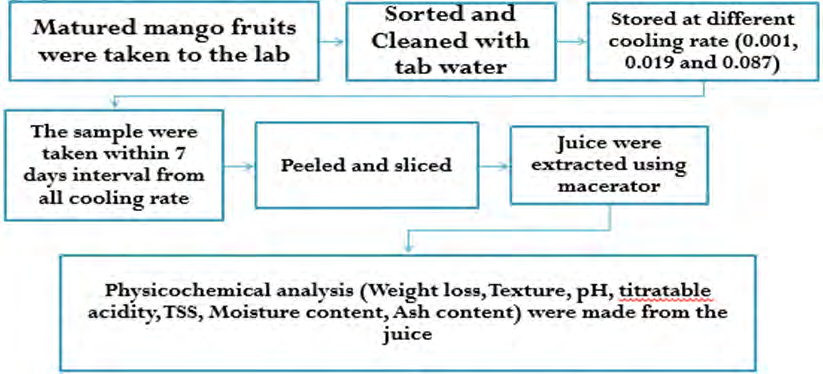
Fully matured local mango fruits were collected and purchased from jimma city merkato town and it was transported into post-harvest management laboratory at Jimma University. Means the mango fruits were purchased from Jimma super market, Merkato. All other materials were obtained from post-harvest management laboratory of the program in Food Science and post-harvest Technology (Figure 1).
Juice Preparation from Mango Fruits
The juice of mango fruits were prepared from sliced mango fruits after chipping. 200 grams of mango fruits was taken from each type of mango fruits which stored at different temperatures. The sliced mango fruits was thoroughly mixed and blended or mixed by using juicer or blender. Then, TSS, TA and pH ascorbic acid were measure from this juice (Figure 2).

Experimental Design and Treatment Combinations
The experiment was conducted using RCBD (randomized complete block design) by considering that there could be variation between different fridge type (deep freeze and normal fridge). The fruit cooling rate was used as a factor with three levels (cooling rate of the fruits stored at -1, 4 and -18°C). The experiment was replicated three times and for each treatment 3 fruits were considered. Therefore there were 9 total experimental units. To estimate the cooling rate, time and temperature combination during cooling process was recorded at each temperature and the cooling rate was calculated using the following models (Tables 1-3) (Figures 3-5).
$$ \operatorname {L n} \left(\frac {T - T a}{T 1 - t a}\right) = - C R ^ {*} t $$ $$ \mathrm {L n} \left(\frac {T - T _ {1}}{T 1 - t}\right) $$
CR = Cooling rate
T = Temperature of Produce
t = time
Ta = Cooling medium temperature and Ti is initial
temperature of products
| Time (minute) | Temperature (0c) | T-Ta | Ti-Ta | Ln(T-TA)/(Ti-Ta) |
|---|---|---|---|---|
| 0 | 25.7 | 24.7 | 24.7 | 0 |
| 10 | 20.6 | 19.6 | 24.7 | 0.2312 |
| 20 | 18.4 | 17.4 | 24.7 | 0.3505 |
| 30 | 16.6 | 15.6 | 24.7 | 0.4595 |
| 40 | 15.6 | 14.8 | 24.7 | 0.5121 |
| 50 | 12 | 11 | 24.7 | 1.8089 |
| 60 | 9.2 | 8.2 | 24.7 | 1.10266 |
| 70 | 4.5 | 7.2 | 24.7 | 1.2327 |
| 80 | 6.9 | 5.9 | 24.7 | 1.4318 |
Table 1: Time and temperature data used to calculate cooling rates at cooling medium 1°C.
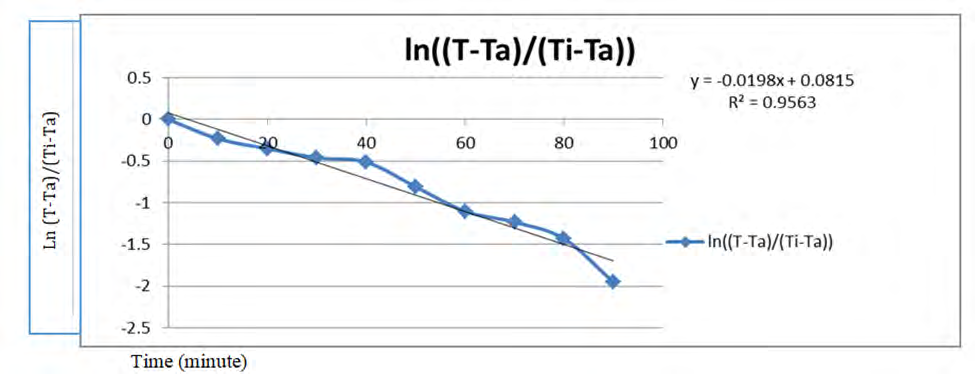
Cooling rate at 1°c cooling medium, obtained from formula, -CR =Slope, Therefore CR =0.019 Depend on the above graph the cooling rates at given temperature which was (-1°C) was 0.019 .this was obtain from the equation slope always equal with cooling rates. It can be written as the form of -CR =-slope. So, CR=0.019
| Time (minutes) | Temperature (°C) | T-Ta | Ti-TA | Ln (T-Ta)/(Ti-TA) |
|---|---|---|---|---|
| 0 | 24.5 | 20.5 | 20.5 | 0 |
| 10 | 18.3 | 14.3 | 20.5 | 0.36 |
| 20 | 16.2 | 12.2 | 20.5 | 0.518 |
| 30 | 1 3.5 | 9.5 | 20.5 | 0.769 |
| 40 | 13.2 | 9.2 | 20.5 | 0.8012 |
| 50 | 12.3 | 8.3 | 20.5 | 0.9041 |
| 60 | 9,7 | 5.7 | 20.5 | 1.2799 |
| 70 | 6.5 | 2.5 | 2 0.5 | 2.1041 |
Table 2: Time and temperature data used to calculate cooling rates at cooling medium 4°C.
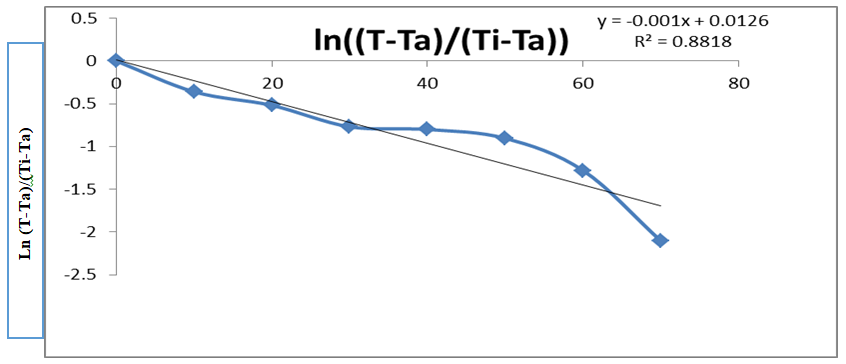
Time (minute) Figure 4: Effect of cooling at 4°C. Cooling rates always equal with slope. Therefore from above graph slope equal with 0.001. -CR =-Slope and it will be -CR = -0.001, Therefore, cooling rates at 40c was 0.001
| Time (minute) | Temperature (0c) | T-Ta | Ti-Ta | Ln(T-TA)/(Ti-Ta) |
|---|---|---|---|---|
| 0 | 23.6 | 41.6 | 41.7 | 0 |
| 5 | 15.2 | 33.2 | 41.7 | -0.2255 |
| 10 | 12.1 | 30.1 | 41.7 | -0.3235 |
| 15 | -7.5 | 10.5 | 41.7 | -1.3767 |
| 20 | -9.2 | 8.8 | 41.7 | -1.5533 |
| 25 | -11 | 7 | 41.7 | -1.8721 |
| 30 | -12.5 | 5.5 | 41.7 | -2.0233 |
| 35 | -14.5 | 3.5 | 41.7 | 1-2.4753 |
| 40 | -15.9 | 2.1 | 41.7 | -2.9861 |
| 45 | -17.5 | 0.5 | 41.7 | -4.4212 |
Table 3: Time and temperature data used to calculate cooling rates at cooling medium -18°C.
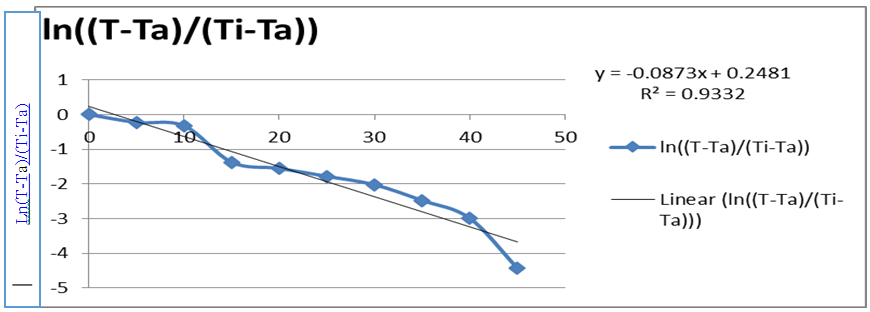
Time (minutes) Figure 5: Effect of cooling rate at -18°C Cooling rates =slope and -Cr=-0.087, Therefore, cooling rates at -180c = 0.087
Data Collected
Data were collected for determination of different Physico-chemical properties of mango fruits, such as percentage moisture contents, pH, total soluble solids, titratable acidity, and ash content. To determine these properties, AOAC method was used. Weight loss: Three fruits were stored at different cooling rates and temperatures. weight loss was determined by using the methods described by Rahman, et al. [19]. It was calculated with the help of a mass for seven days interval.
( ) Initial w 0 eight - final weight W = eight loss % Initial Weig t ×10 h Textural Analysis: Texture is parameters of fruits are perceived with the sense of touch either when the product is picked up by hand. The textures of mango fruits were measured by using textural analysis. During the measurement of textures mango fruits first, the texture analysis was adjusted at 60mm distance, 1.5mm/s speed and weighted at 2 Moisture Content Determination: Moisture content of the samples was determined according to AOAC [20]. To do this first Clean and dry moisture dish were prepared and the weight was weight as W1. Representative sample (2g) was placed on the dish and the weight taken (W2). It was placed in a hot air drying air, dried at 100oC for 6 hours, and cooled to room temperature. The weight after drying was measured as W3. The moisture content of sample was calculated by using the following formula:
w -w % moisture= ×100 w -w
2 3
2 1 Where: W1 = Weight of moisture dish, W2= initial Weight of the sample and moisture dish before drying W3 = Weight of moisture dish and sample after drying Or M -M moisture % = ×100 M ( )
2 1
2 Where M1 = mass of sample after drying and M2 = mass of sample before drying pH, Titrable Acidity: pH measurements was made according to Romanian standard methods 90/2007 by means of a Hanna digital pH-meter.10 grams of sample were weight and 50 ml of distilled water was added and stirred vigorously for 20 minutes. Sample water suspension was allowed standing for 30 minutes by which time most of the suspended ions would have settled out from the suspension. Then, pH meter was calibrated blank at pH of seven and four respectively. The electrode of the pH meter was inserted into the partly settled suspension. The pH value was be read from the pH meter and recorded.
After juice prepared, the titratable acidity (TA) of the juices was determined using method of Chiumarelli [21]. Titratable acidity gives a measure of the amount of organic acid present in a fruit. Citric acid is known to be the major acid in mango [22].
About 10 ml of sample was taken and dissolved in distilled water of 50 ml. Then, solution of sample was taken and titrates with 0.1N NaOH using phenolphthalein solutions as indicator until the orange color of the solution will be changed into pink colour. A triplicate measurement was taken and calculates as percent of citric acid by using the following equation:
mls NAOH used*0.1 NNaOH*D.F*equivalent factor TA (%)= ×100 Volume of sample The dominant acid of mango is citric acid, therefore, the mill equivalent factor for citric acid is 0.0064
Total Soluble Solids: The concentrations of dissolved sugars were determined using Refractometer as addressed in Islam MZ, et al. [23]. After calibrating with distilled water, 2 drops of sample was introduced on the prism and triplicate measurement was taken from the Refractometer. Result was expressed as oBrix (the amount of total dissolved solids in 100 g of juice product). Determination of Ash Content: According to AOAC [20], total ash content of the samples was determined by gravimetric method. Crucibles were clean and dry and ignite at 550oC for 1 hour and weight (m1). Ground sample (3 g) and crucible were weight (m2). The sample with crucible is dry in oven at 120oC or 1 hour. Then the dried sample was carbonized over a blue flame and ignited in a muffle furnace at 550oC until ashing complete (over 12 hrs). After being ignite, the sample was cooled to in desiccator and weight (m3). Finally total ash content was calculated as follows: Where m3 weight of ash +crucible, M2 weight of crucible +sample and M1 weight of crucible m -m Percentage Ash Content = ×100 m -m
3 1
2 1 Where m1 = weight of empty crucibles, m2 = weight of crucible + sample before ashing and m3= weight of crucible + ash
Statistical Analysis
The Experiment were analyzed by using Minitab software version 16 and subjected to one way ANOVA. The effect of cooling rates on physico-chemical properties of mango fruits was analyzed and expressed by differences between the sample means which conducted by using least significant differences (LSD) test. Mean difference were accepted at 5% probability level.
Result and Discussion
Physico-chemical Analysis
The experimental results were generally produced with the P<0.05 value with their respective standard error of mean and coefficient of variation. The results given below the table were mainly the appropriate means of the interaction of cooling at -10c, 40c and -180c (Tables 4&5).
| Parameters | WL | PH | TA | TSS | Texture | M.C | Ash |
|---|---|---|---|---|---|---|---|
| Initial Value | 0 | 4.05 | 0.35 | 7.5 | 20 | 75% | 25.87 |
Table 4: Show initial physico-chemical properties of mango fruits.
| Cooling Rate | Change of Moisture with Time | Change Of Weight With Time | ||||
|---|---|---|---|---|---|---|
| 7 days | 14 days | 21 days | 7 days | 14 days | 21 days | |
| 0.001 | 64.73+0.2a | 62.7+0.35b | 60.45+0.12b | 13.6+0.4a | 16.4+0.0a | 19.4+0a |
| 0.019 | 68.73+ 3.7b | 66.45+0.0a | 63.78+0.0c | 8.36+0 .0b | 11.4+0.0b | 14.96+0b |
| 0.087 | 70.57+0.1b | 65.3+0.0c | 64.45+0.0a | 5.9+0.0c | 12.9+0.0c | 14.07+0c |
Table 5: Effect of cooling rate on moisture content and weight of cooled stored mango fruits over 21 days of storage with mean an
There were significant differences due to cooling rate on moisture content of mango fruit stored for 7 days. The highest moisture content loss (75.57) was observed from mango cooled at 0.087 cooling rate while the lowest moisture content (64.73) was recorded from mango fruits which cooled at the cooling rate of 0.087.
This could be due to the fact that high cooling rate preserves the quality of the fruit including its moisture content. This result is inline the work of Manzano JE, et al. [24] who stated that cooling rate affects the moisture content of mango fruits during storage.
Also at 14 days there was significant difference because of cooling rate on moisture contents mango stored for
14 days at this days the highest (72.3) moisture content appeared at 0.001 cooling rates and the lowest (62.7) was at 0.087 cooling rates. Also at 21 days at there was more reduction of due to storage time increased. The moisture content variations in stored mangoes may be due to storage conditions. This hypothesis was verified by Manzano, et al. [25] that storage temperature affects the moisture content of fruits during storage.
Like moisture content, there were also significance differences because of cooling rates on moisture contents of mango fruits stored for 7 days. The highest weight loss was (13.6%) was understood from mango stored at cooling rates 0.001, while the lowest (5.9%) one observed from mango stored at cooling rates 0.087. At 14 days and 21 days the highest weight loss was observed from cooling rates at 0.001 and 0.019.
The weight loss was slowly change from cooling rates at 0.087.however weight was change highly from mango stored at cooling rates 0.001 and 0.019. Patel [26] reported that the loss in weight in mango could be decreased by cooling treatments. As cooling rates increase, weight loss slowly decreased (Table 6).
| Cooling rates | Change of TA with time (%) | Change of TSS with time | ||||
|---|---|---|---|---|---|---|
| 7days | 14days | 21days | 7days | 14days | 21days | |
| 0.001 | 0.45+0a | 0.44+0a | 0.39+0a | 8.76+0a | 9.87+0c | 11.25+0a |
| 0.019 | 0.38+0b | 35.01+0b | 0.31+0b | 7.85+0.32b | 8.22+0b | 9.25+0b |
| 0.087 | 0.35+0c | 0.33+0c | 0.30+0c | 7.5+1.16c | 8.00+0ab | 8.76+0c |
Table 6: Effect of cooling rate on (TA), and total solid soluble (TSS) of cooled stored mango fruits over 21 days of storage with
The TA of cooled mango fruits was highest (0.45) was observed from mango cooled at 0.001 cooling rate while the lowest TA (0.35) was recorded from mango fruits which cooled at the cooling rate of 0.001. This situation occurred or happened due to the fact that high cooling rate preserves the quality of the mango fruit including its moisture content. At 14 days and at 21 days the value of (TA) was decreased due to degradation acid were occurred. Similarly, Gil A, et al. [27] reported that, decrease in titratable acidity of mango fruits during cold storage has been reported.
The decline in acidity could be due to susceptibility of citric acid to oxidative destruction as impacted by the ripening environment Shahnawz M, et al. [28]. It was observed that percent titratable acidity had decreasing trend during 14 days of storage period that might be due to the degradation of citric acid which could be attributed to increased activity of citric acid glyoxylase during ripening or reduction in acidity may be due to their conversion into sugars and their further utilization in metabolic process in the fruit.
Tovar [27] were reported, for The highest total soluble solids ( 8.760brix) was observed in mangoes stored at Cooling rates 0.001 for 7 days, and the lowest (80brix) was obtained from mangos stored at cooling rates 0.087. These results reveal that time and temperature both are equally responsible for physicochemical changes of fruits and the major changes occur when fruits are stored for long time at high temperature. At 21 and 14 days at cooling rates 0.001 the highest TSS were observed. At all three cooling rates, TSS values were decreased .This may be occurred due to ,there was no alteration of cell wall and break down of carbohydrates into simple sugars. This increase and decrease in TSS are directly Correlated with hydrolytic changes in starch and conversion of starch to sugar being an important index of ripening process in mango and other climacteric fruit and further hydrolysis decreased the TSS during storage. Significant increase in sucrose content of mango has been observed during ripening and this has been attributed to an increase in total soluble solids during ripening [18].
The results of this study further indicate that increasing time and temperature decrease the acidity in stored mangoes.
The initial acidity of storing mangoes was recorded as 0.31% which was decreased down to 0.02% at ambient temperature. Whereas refrigerator temperature did not allow decreasing acidity much more except slight decrease and this may be due to storage conditions. These suggestions are also supported by Shahnawz, et al. [29], who reported that acidity values of mango either packed in carton or control sample also showed a decreasing trend from 2.17 to 0.08% on the 12th day when stored at ambient temperature 27 ± 1°C (Table 7).
| Cooling rate | Change of pH, with time | Change of textures with time | ||||
|---|---|---|---|---|---|---|
| 7days | 14days | 21days | 7days | 14days | 21days | |
| 0.001 | 4.55+0 a | 4.7+0 a | 4.87+0 a | 17.1+0 a | 10.93+0.0a | 10.8+0.0 a |
| 0.019 | 3.7+0b | 3.72+0 b | 4.1+0 b | 14.7+0 b | 13+0.0b | 12.58+0b |
| 0.087 | 3.7+0c | 3.71+0 c | 3.78+0 c | 14.1+0 c | 18.2+10.9 c | 10.3+0 c |
Table 7: Effect of cooling rate on pH, and textures of cooled stored mango fruits over 21 days.
There were significant differences due to cooling rate on pH of mango fruit which stored for 7 days. The highest pH (4.55) was observed from mango cooled at 0.001 cooling rate while the lowest pH (3.7) was recorded from mango fruits which cooled at the cooling rate of 0.001 by the same condition at 14 and 21 days the highest (4.7) and (4.87)value of pH was observed at cooling rates 0.001 and highest and at 0.087 was lowest.
Generally, the pH of samples were ranges from 4.55 to 3.7 at 7days and at cooling rates 0.087 and 0.001. The cooling rates 0.087 were generally lower in pH content than the cooling rates 0.001.This result was agreed with the research findings done by Tovar B, et al. [27]. Increase in pH during ripening and cooling of mango fruits and was similar to what was observed in the present study. According to the authors, there is an inverse relationship between titratable acidity and pH. The increase in pH (decline in acidity) could be due to utilisation of acids as respiration substrates [29].
Like significance difference was there in the change of pH of mango fruits, there was also change in textures of mango fruits during storages at different cooling rates and at different storage time. The change of textures at 7 days and at cooling rates 0.001 was observed as highest (17.1) and at cooling rates 0.087 it was lowest (14.1). Mebratie, et al. [30] state that the reduction in texture score during storage, might be due to the breakdown of insoluble (Table 8).
| Cooling rates | change ash with time | ||
|---|---|---|---|
| 7days | 14 days | 21 days | |
| 0.001 | 8.8+0.0b | 7.3+0.0b | 6.8+0.0 b |
| 0.019 | 9.24+0.0c | 7.9+0.0 a | 6.85+0.0 a |
| 0.087 | 15.24+0.0 a | 8.84+0.0c | 8.04+0.0 a |
Table 8: Effect of cooling rate on ash of cooled stored mango fruits over 21 days of storage.
Ash is the inorganic residue remaining after the water and organic matter and could not be decreased during storage [28]. The ash content was obtained by incineration of the sample at 550°C in muffle furnace, at this high temperature all the organic component in the samples burn out and inorganic component is left.
The ash content was having a significant difference on the cooling rates .The ash content of the ripen mango fruits was higher Baiyeri KP, et al. [31] reported higher ash content in mango fruits suggesting that tissue breakdown during ripening causes some mineral elements to be free and more available. This observation was supported by Shahnawz, et al. [28] who reported slight changes in proximate chemical composition such as protein.
Jin [32] suggested that low temperature storage is the most effective method for preserving the chemical composition of most perishable horticultural commodities. Because it retards respiration and delays ripening, besides imposing other undesirable metabolic changes. Heating is carried out in stages, first to derive the water, then to char the product thoroughly and finally to ash at 550o C in a muffle furnace [33].
Moisture content, pH and ash mango fruits: Table 6 shows that, the moisture content, obtained from mango fruits was initially without storage or without application of cold storage, it was 75%. However after it was stored in refrigerator at different time and different temperature it’s moisture content was varied from this amount. After it was stored at 10c temperature and stayed for seven day it’s moisture content varied from 75% to 64%. After seven days, means at 14 days moisture content was changed into 62% and at 21 days the moisture content 60%. But at highest cooling rates, moisture content was 70.75% and from table 6 moisture content was preserved at highest cooling rates.
According to table 8, Increase in pH from 4.55 to 4.87 during storage time 0f 7 days of mango fruits was similar to what was observed in the present study. However TA was decreased as it explained in table 7.The increase in pH (decline in acidity) during storage time and cooling rates could be due to utilisation of acids as respiration substrates [34].
The TSS of mango before stored was 7.50brix. But after stored at 0.001, 0.0190c and 0,0870c stayed in fridge for 7,14, and 21 days it were 7.85,8.22, and 9.250brix respectively. Significant increase in sucrose content of mango has been observed during storage time. Table 7 shows that, TSS increase across storage time due to ripening stage will be increased and also there is no alteration of cell wall.
According to result obtain from, table 8, texture of mango fruits decrease due to the solublization of pectin substances, break down of starch to soluble sugars and since there was loss of water from peel and it is not more affected at highest cooling rates.
Conclusions and Recommendation
The mango is a climacteric fruit and highly perishable fruit that requires specialized postharvest storage to preserve its properties and because of its perishable nature it cannot be stored for long time and can be consumed as fresh fruit when available in the market as surplus.
Cooling rate is an indicator of the time of cooling of a test product under a given situation. Physico-chemical
properties of mango fruits affected by cooling rates due to the alteration of cell wall, and degradation of organic acid into simplest sugar and cooling rates used to preserve physico- chemical properties of mango fruits, specially lowest cooling rates maintain these properties by reduction growth and multiplication of micro-organism as well as chemical reaction and enzyme activity. However this implies that, the same product can have different cooling rates while cooling at different temperature. So, temperature management is the most important tool for extending shelf life and quality of agricultural commodities.
Generally, the study was measured, effect of cooling rates on the physico-chemical properties of the mango fruit .Therefore, Low temperature storage is the most effective method for preserving the chemical composition of most perishable horticultural commodities. Because it retards respiration and delays ripening, besides imposing other undesirable metabolic changes. Society should have to store their product at low temperature which has higher cooling rate and extend shelf life of products.
Based on the limitation of the work the following recommendation could be forwarded for any research work in the future.
Further research is needed to know the effect of cooling rate on micro-nutrients (vitamin and minerals) and macro- nutrient (protein, carbohydrates, and beta-carotene) of mango fruit which are not conducted in this research due to budget and time limitations.
Also further research is needed in large scale cooling room especially for Ethiopian condition to know the impact of cooling rate in preserving physical and nutritional property of mango fruits.
References
-
Cruz Medina JDL, García HS (2002) Mango: post-Harvest operations. AGSI/FAO, Mexico, pp: 67.
-
Clarke M, Seng D, Whiting RH (2011) Intellectual capital and firm performance in Australia. Journal of intellectual capital 12(4): 505-530.
-
Dillon M, Chowdhury HA, Ahmed S, Islam R, Corrales M, et al. (2015) UNNExT Workshop on Agricultural Trade Facilitation and Business Process Analysis in Bangladesh. Promoting Mango Trade from Bangladesh to EU Mainstrean Market, Dhaka, Bangladesh.
-
Eshetu A, Ibrahim AM, Forsido SF, Kuyu CG (2019) Effect of beeswax and chitosan treatments on quality and shelf life of selected mango (Mangifera indica L.) cultivars. Heliyon 5(1): e01116.
-
Narayana CK, Pal RK, Roy SK (1996) Effect of pre-storage treatments and temperature regimes on shelf-life and respiratory behaviour of ripe Baneshan mango. J Food Sci Technol 33 (1): 79-82.
-
Kader A, Mitcham B (2009) Optimum procedures for ripening mangoes. Fruit ripening and ethylene management, UC Postharvest Technology Research Center 47.
-
Pamplona-Roger GD (2008) Healthy Foods. Editorial Safeliz, Colmenar Viejo, Spain.
-
Sogi DS, Siddiq M, Roidoung S, Dolan KD (2012) Total phenolics, carotenoids, ascorbic acid, and antioxidant properties of fresh‐cut mango (Mangifera indica L., cv. Tommy Atkin) as affected by infrared heat treatment. Journal of food science 77(11): C1197-C1202.
-
Rathore HA, Masud T, Sammi S, Soomro AH (2007) Effect of storage on physico-chemical composition and sensory properties of mango (Mangifera indica L.) variety Dosehari. Pakistan Journal of Nutrition 6(2): 143-148.
-
Singh NI, dhuique‐mayer C, lozano YVES (2007) Physico‐ chemical changes during enzymatic liquefaction of mango pulp (cv. Keitt). Journal of food processing and preservation 24(1): 73-85.
-
Masibo M, He Q (2009) Mango bioactive compounds and related nutraceutical properties-a review. Food Reviews International 25(4): 346-370.
-
IIR/IIF, Bøgh-Sørensen L (2007) Recommendations for the Processing and Handling of Frozen Foods. 4th (Edn.), TheRed Book, Iif iir France, pp: 176.
-
Lim MH, McFetridge JE, Liesebach J (2004) Frozen food components and chemical reactions. In: Tannenbaum SR, et al. (Eds.), Food science and technology. Marcel dekker, New york, USA, pp: 67- 82.
-
Carrillo LA, Ramirez-Bustamante JB, Valdez-Torres R, Rojas-Villegas, Yahia EM, et al. (2000) Ripening and ripening quality changes in mango fruit as affected by coating with an edible film. J Food Qlty 23(5): 479-486.
-
Barbosa-Cánovas GV, Altunakar B, Mejía-Lorío DJ (2005) Freezing of fruits and vegetables: An agribusiness alternative for rural and semi-rural areas. Food & Agriculture Org UN (158): 64.
-
Martînez-Monzó J, Martînez-Navarrete N, Chiralt A, Fito P (2001) Combined vacuum impregnation-osmotic dehydration in fruit cryoprotection. In: Fito P, et al. (Eds.), Osmotic Dehydration & Vacuum Impregnation. CRC Press, Boca Raton, Florida, pp: 61-78.
-
Olorunda AO (2000) Recent advances in postharvest technologies of banana and plantain in Africa. Acta Horticulturae 540: 517- 597.
-
Dadzie BK and Orchard JE (2007) Routine Post-Harvest Screening of Banana/Plantain Hybrids: Criteria and Methods. INIBAP Technical Guidelines 2, Wageningen, Netherlands, pp: 63.
-
Mahroop Raja MM, Raja A, Imran MM, Rahman AH (2011) Quality aspects of cauliflower during storage. International Food Research Journal 18(1): 427-431.
-
Association of Official Agricultural Chemists, Horwitz W (2002) Official methods of analysis. Association of Official Analytical Chemists, Washington DC.
-
Chiumarelli M, Pereira LM, Ferrari CC, Sarantópoulos CI, Hubinger MD, et al. (2010) Cassava starch coating and citric acid to preserve quality parameters of fresh‐cut “Tommy Atkins” mango. Journal of food science 75(5): E297-E304.
-
Ojo MA, Ade-Omowaye BIO, Ngoddy PO (2014) Nutrients and phytochemical profiles of some selected underutilized hard-to-cook legumes in Nigeria. The International Journal of Science and Technoledge 2(8): 108.
-
Islam MZ, Khan MTH, Hoque MM, Rahman MM (2012) Studies on the processing and preservation of dragon fruit (Hylocereus undatus) jelly. The Agriculturists 10(2): 29-35.
-
Manzano JE, Perez Y, Rojas E (2003) Coating waxes on Haden mango fruits (Mangifera indica L.) cultivar for export. Acta Horticulturae 455: 738-746.
-
Patel B, Tandel YN, Patel AH, Patel BL (2016) Chilling injury in tropical and subtropical fruits: A cold storage problem and its remedies: A review. International Journal of Science, Environment and Technology 5(4): 1882-1887.
-
Gil AM, Duarte IF, Delgadillo I, Colquhoun IJ, Casuscelli F, et al. (2000) Study of the compositional changes of mango during ripening by use of nuclear magnetic resonance spectroscopy. J Agric Food Chem 48(5): 1524- 1536.
-
Tovar B, Ibarra LI, Garcia HS, Mata M (2000) Some compositional changes in Kent mango (Mangiferaindica) slices during storage. J Appl Hort 2(1): 10-14.
-
Shahnawz M, Sheikh SA, Khaskheli SG (2012) Effect of storage on the physicochemical characteristics of the mango (Mangifera indica L.) variety, Langra. African Journal of Biotechnology 11(41): 9825-9828.
-
Gale CR, Christopher NM, Paul DW, Cyrus C (1995) Vitamin C and risk of death from stroke and coronary heart disease in cohort of elderly people. BMJ 310(6994): 1563-1566.
-
Mebratie MA, Woldetsadik K, Ayalew A, Haji J (2015) Comparative study of different banana ripening methods. Science Technology and Arts Research Journal 4(2): 32- 38.
-
Baiyeri KP, Aba SC, Otitoju GT, Mbah OB (2011) The effects of ripening and cooking method on mineral and proximate composition of plantain (Musa sp. AAB cv.‘Agbagba’) fruit pulp. African Journal of Biotechnology 10(36): 6979-6984.
-
Jin P, Wang K, Shang H, Tong J, Zheng Y (2009) Low‐ temperature conditioning combined with methyl jasmonate treatment reduces chilling injury of peach fruit. Journal of the Science of Food and Agriculture 89(10): 1690-1696.
-
Nanjundaswamy AM, Rahim A, Siddappa GS (1966) Proximate composition and suitability for preservation of some important varieties of mangoes grown in Salem. Indian Food Packer 20(3): 15-21.
-
Hailu Z, Mekonnen D (2017) Effects of controlled atmosphere storage and temperature on quality attributes of mango. Global Journals Inc 17(1): 17-25.
- The Role of Podocyte Apoptosis and the Involvement of SIRT1 in Diabetic Nephropathy
- Dealcoholization of Beer by Osmotic Distillation for the Beverage Industry
- Biopolymer-Based Edible Packaging- Biomaterials, Methods, and Applications in Food Industry: An Updated Review
- Influence of Bioprocessing Methods on 'China Rice' (Gawal R1), and Soyabean Supplementation on the Quality of Complementary Food
- Cassava (Manihot esculenta) Varietal Growth, Yield and Cyanide Content Performance in Three Sites in the South- Eastern Semi Arid Regions of Kenya
- Food Waste Treatment, Recycling, Management and Production of Value-Products-An Update on Methodologies and Current Trends