
Evaluation of Trace Metals in Water and Fish Meat, from Lake Nubia and Khartoum City, Sudan
The purpose of this work was to investigate the concentrations of some heavy metals, cadmium, nickel and lead, in two commercial fish species (Oreochromis niloticus and Bagrus bayad) procured from River Nile and Nubia Lake fisheries sites, during the period of time from May 2015 to January 2016. Desired fish and water samples from every species and water were randomly gathered via occasionally from the two fisheries production sites. In order to perform those three heavy metals level by utilizing atomic absorption spectroscopy (AAS(. The results of concentrations of heavy metals in fish flesh were revealed a significantly differences (P˂ 0.01). The concentration level of Ni, Pb were detected a higher in fish flesh of Bagrus bayad of Nubia Lake than the Oreochromis niloticus. Likewise level of Cd demonstrated the highest value in Oreochromis niloticus only. Heavy metals contents in water samples at various sites were demonstrated that the most note worthy concentration of Pb in Nile River (Khartoum city), which was (0.056 ppm) as significantly higher than that (0.042ppm) from Lake Nubia tests. The level of Cd and Ni were (0.011, 0.027ppm) in Nile River (Khartoum city) and (0.005 and 0.015ppm) in Lake Nubia, there were no significant diverse between them. Overall results showed none of the trace metals examined at both studied sites and fish flesh was over the prescribed admissible level showed by FAO/WHO and EC Committees.
Introduction
The contamination and pollution of the dirt, water, and air has turned out to be unavoidable accordingly of anthropogenic exercises. Natural contamination by harmful metals has expanded consistently since the mechanical insurgency, in this manner bringing about genuine biological issues [1]. The contamination of the sea-going environment with substantial metals has turned into an overall issue amid late years, since they are indestructible and the greater part of them effect sly affect life forms [2]. Among natural toxins, metals are of specific worry, because of their potential harmful impact and capacity to bioaccumulate in amphibian biological systems [3]. Trace metals can be named conceivably harmful (cadmium and lead), most likely fundamental (Nickel), and basic (copper, Zinc, and Selenium). The fundamental metals can likewise deliver lethal impacts when the metal admission is too much raised [4, 5]. Heavy metals are characteristic follow segments of the oceanic environment; however their levels have expanded because of modern, agrarian and mining exercises. Accordingly, sea-going fish species are presented to hoisted levels of heavy metals. The levels of metals in upper individuals from the food web like fish can achieve values commonly higher than those found in amphibian environment or in silt. Therefore contamination in the area is a critical issue with respect to the strength of the sea-going creatures and thusly, soundness of the fish customers [6]. Fish species are regularly the top buyers in sea-going biological systems and along these lines metal fixations in fish can go about as an ecological marker for the natural state [7, 8]. Fish are known to bioaccumulate metals and hence can be utilized as bio-monitors; likewise they have the upside of permitting the correlation of metal focuses among locales, where water tests are close or underneath the detection limits of the atomic absorption technique [9]. The goals of this study are: 1. To determine the concentrations of nickel, lead and cadmium in some fish species and water samples in Nile River (a round Khartoum city) and Lake Nubia at northern border of the Sudan. 2. To find a correlation between the presence of heavy metal in the two fish species and water sites.
Materials and Methods
Fish samples
Two regularly commercial fish species namely: Bagrus bayad, local name (Bayad) and Oreochromis niloticus local name (Bulti or Tilapia). Were chosen from two sites, Nubia Lake and River Nile in Khartoum city express (these ranges are experiencing serious unsettling influence human movement) for this examination. The samples gathered during May 2015 to January 2016. These specimens were arranged and washed with tap water to expel any following soil or clay, then put in protected boxes containing ice for safeguarding amid evaluation records and transferring to research laboratory for heavy metals determination. Water samples were taken from these sites at a profundity of 50 cm underneath the water surface at morning time. The specimens were kept in a plastic holder and were alluding to research center for heavy metals examination.
Determination of Heavy Metals
Water tests: Heavy metal concentrations in water were dictated by Atomic Absorption Spectrophotometer. (Model: 210/211VGP Atomic Absorption Spectrophotometer, Operator's Manual, January 2003, VER 3.94 C). The samples were arranged and broke down consecutively for cadmium, nickel and lead. The samples were sifted and afterward finished to required volume (100ml). Fish samples: Forty fish of each two species (Oreochromis niloticus and Bagrus bayad) were gathered from every site for heavy metal investigation. The gathered fish were washed with clean water, put in cleaned plastic sacks and put away solidified until examination was done. The internal viscera, head and scurfs were removed. The fish flesh samples were dried utilizing an electric stove at 105°C for around 18hours till a consistent weight is accomplished. Dried samples were granulated utilizing manual porcelain mortar. Powder samples were kept in sealed shut plastic packs till investigation. 2.0g of fish powder set in a silica vanishing pot of known weight the cauldron was put on a hot plate and allow evaporating until totally scorched the exchanged to a stifle heater at of 550°C and hurt at this temperature for eighteen hours. At the point when the throbbing is finished, cooled, and extricated with 5ml of 20% HCl and filtrated, arrangement and make up to 50ml with water, and blended utilized for heavy metals assurance by utilizing Atomic Absorption Spectrophotometer [10].
Results and Discussion
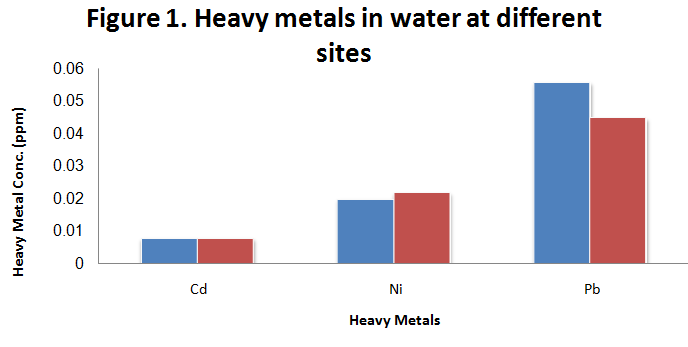
Heavy metals in water samples as per sites were exhibited in table (1). The levels of studied metals Cd, Ni and Pb in water from Nile River (Khartoum city) were recorded (0.011, 0.027 and 0.056 and 0.005, 0.015 and 0.042 ppm) from Lake Nubia, respectively. The concentrations of heavy metals for samples gathered from Nile River (Khartoum city) were higher than that gathered from Lake Nubia. However the high concentration might be resulted from anthropogenic procedures, for example, industry, agriculture, development, transportation, or residence, which are all around spoke to in the city. The outcome demonstrated that the high concentration of Lead (Pb) in Nile River (Khartoum city) and lower in Lake Nubia. This could be credited to wastes of industrial, farming or human activities releases around the urban areas (Khartoum Site). The findings in concurrence with Khalifa who found that the level of Cd and Pb 0.03 and 0.05, respectively in fish species and water samples could be high around coastline and cities [11]. Heavy metals contents in water samples at various sites were exhibited in table (1) and figure (1). The outcome demonstrated that the most noteworthy concentration of Pb in Khartoum city, which was (0.056_ppm_) as significantly higher than that (0.042_ppm_) from Lake Nubia tests, there were no critical diverse between them.
| Sites | Level of Heavy Metals (ppm) | ||
|---|---|---|---|
| Cd | Ni | Pb | |
| Khartoum City( Nile River) | 0.011± 0.001 | 0.027± 0.001 | 0.056± 0.003 |
| Lake Nubia | 0.005± 0.001 | 0.015± 0.001 | 0.042± 0.004 |
| Sig | ** | *** | ** |
Values are means of three replicates. Values are means ± Standard error. Cd = Cadmium, Ni = Nickel, Pb = Lead = highest significance (P˂ 0.01). * = highest significance (P˂ 0.001). ±= standard error
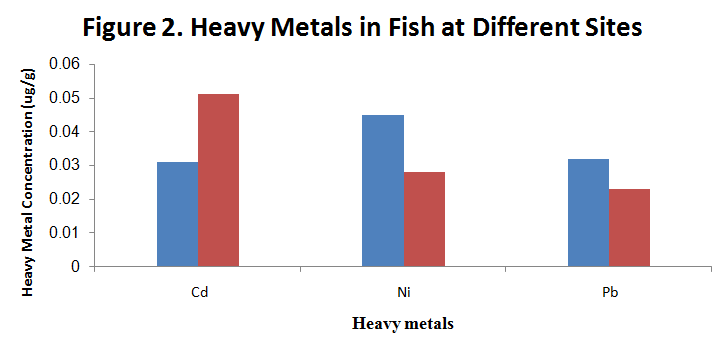
Heavy metals concentration in fish samples according to sites were shown in table (2).The concentrations of trace metals (Cd, Ni and Pb) in Orochromis niloticus samples were (0.045, 0.037and 0.028_µg/g_), respectively in Nile River(Khartoum city) and that of Lake Nubia were (0.043, 0.036 and 0.028_µg/g_). Lake Nubia tests demonstrated that there were lower gathered of heavy metals than that of Khartoum city tests. However Fish is among the dominant bio-indicator species used for acute toxicity assay of pollutants such as heavy metals since much attention has been drawn due to the wide occurrence of metals pollution in aquatic system. The quick advancement of businesses and agribusinesses have advance the expansion of ecological contamination albeit heavy metals in water framework can be normally created by moderate draining from rocks and soil into water which happens at low levels. Additionally Cd and Pb were among the aquatic metals pollutants, which generally exhibit at huge levels in water framework which may posture high toxicities on the sea-going living beings [12]. The present outcomes were in concurrence with Nor Hasyimah et al., who found that the level of metals Cd, Ni and Pb in fish muscles (0.042, 0.13 and 0.05_µg/g_) respectively [13].
| Sites | Fish Species | Level of heavy metals in (µg/g) fish sample | ||||
|---|---|---|---|---|---|---|
| Cd | Ni | Pb | ||||
| Khartoum (River Nile) | Orochromis niloticus | 0.036 ± 0.003 | 0.037 ± 0.001 | 0.027 ± 0.001 | ||
| Bagrus byad | 0.038 + 0.003 | 0.037 + 0.001 | 0.026 + 0.001 | |||
| Nubia Lake | Orochromis niloticus | 0.045 ± 0.003 | 0.036 ±0.001 | 0.028 ± 0.001 | ||
| Bagrus byad | 0.036 + 0.003 | 0.036 + 0.001 | 0.027+ 0.001 | |||
| Significance level | * | NS | NS |
Values are means of three replicates. Values are means ± Standard error. Cd = Cadmium, Ni = Nickel, Pb = Lead *= significance (P˂ 0.05). NS =not significance (P˂ 0.001). ±= standad error The outcomes demonstrated that the abnormal amounts of Cd were (0.043_µg/g_) in Oreochromis niloticus and the brings down were (0.038_µg/g_) in Bagrus bayad, there was most noteworthy significant (P˂ 0.001). The abnormal state of Pb were 0.028(µg/g) likewise in Oreochromis niloticus than that lower were 0.026 (µg/g) in Bagrus Bayad, there was elevated significantly (P˂ 0.05).While there was no centrality distinctive in level of Ni 0.037 (µg/g) for two species.
Conclusion
We concluded that, the different concentration of heavy metals such as Cd, Ni and, Pb in the studied fish flesh of fresh water organisms collected from both sites Nile River (Khartoum city and Lake Nubia) were found to be below the permissible level set by world health advisories (CODEX STAN 193-1995 (Amendment: 2010, Regulation (EC) No. 1881/2006 and FDA, 2001) [14, 15, 16].
References
-
Osma E, Serin M, Leblebici Z, Aksoy A (2012) Heavy Metals Accumulation in Some Vegetables and Soilsin Istanbul. Ekoloji 21(82).
-
MacFarlane GB, Burchettt MD (2000) Cellular distribution of Cu, Pb, and Zn in the Grey Mangrove Avicemnia marina (Forsk.). Vierh Aquatic Botanic: 68(1): 45-59.
-
Censi P, Spoto SE, Saiano F, Sprovieri M, Mazzola S, et al. (2006**)** Heavy metals in coastal water systems. A case study from the northwestern Gulf of Thailand. Chemosphere 64: 1167-1176.
-
Munoz-Olivas R, Camara C (2001) Speciation related to human health.
-
Tuzen M (2003) Determination of heavy metals in fish samples of the middle Black Sea (Turkey) by graphite furnace atomic absorption spectrometry. Food Chemistry 80(1): 119-123.
-
Yilmaz A (2005) Comparison of Heavy Metal Levels of Grey Mullet (Mugil cephalusL.) and Sea Bream (Sparusaurata L.) Caught in Uskenderun Bay (Turkey). Turk J Vet Anim Sci 29: 257-262.
-
Dillinger R, Prosi F, Segner H, Black H (1987) Contaminated food and uptake of heavy metals by rainbow trout (Salmo gairdneri): A field Study. Oecologia 73: 91-98.
-
Wildianarko B, Van Gestel CAM, Verweij RA, Van Straalen NM (2000) Associations between trace metals in sediment, water and guppy, Poecilia reticulate (Peters), from Urban streams of Semarang, Indonesia. Ecotoxicol Environ Saf 46: 101-107.
-
Ramelow GJ, Webre CL, Mueller CL, Beck JN, Young JC, et al. (1989) Variations of heavy metals and arsenic in fish and other organisms from the Calcasien River and Lake, Louisiana. Archive of Environ Contam Toxicol 18(6): 804-818.
-
Khalifa KM, A M Hamil, AQA Al-Houni, MA Ackacha ( 2010) Determination of Heavy Metals in Fish Species of the Mediterranean Sea (Libyan coastline) Using Atomic Absorption Spectrometry. PharmTech 2(2): 1350-1354.
-
Olaifa FE, Olaifa AK, Adelaja AA, Owolabi AG (2004) Heavy metal contamination of Clarias gariepinus from a lake and fish from farm in Ibadan, Nigeria. A f J of Biomed Res 7: 145-148.
-
Zhou SL, Liao FQ, WU SH, Zhang HF, Ren K (2008) Heavy metals contents in soil profiles of typical agricultural lands in Yixing, Jiangsu Province, China. Chinese Sci Bull 53:177-187.
-
Nor Hasyimah AK, James Noik V, The YY, Lee CY, Pearline Ng HC (2011) Assessment of cadmium (Cd) and lead (Pb) levels in Commercial marine fish organs between wet markets and supermarkets in Klang Valley, Malaysia. International Food Research Journal 18: 795-802.
-
CODEX STAN 193-1995 (Amendment: 2010). Codex General Standard for Contaminants for Food and Feed.
-
EC (2006) Regulation (EC) No. 1881/2006 - Maximum of four heavy metals in food stuff.
-
FDA (2001) Fish and Fisheries Products Hazards and Controls Guidance, 3rd (Edn.) Centre for Food Safety and Applied Nutrition, US Food and Drug Administration.
-
FAO (1983) Compilation of legal limits for hazard o us substances in fish and fishery products. FAO Fishery Circular 464: 5-100.
-
Multilingual Dictionary of Fish and Products (2009) News Books, London, pp: 368.
- Genetic Improvement of Nile Tilapia (Oreochromis niloticus): Advances in Selective Breeding and Genomic Approaches for Sustainable Aquaculture
- Microplastics, Contaminants, and Waste Hotspots: Divergences and Faults in Prioritizing Control Efforts
- Creating a Healthier, More Vibrant Open and Closed Aquatic Environment. A Submersible, Centrifugal Magnetically Affixed Current Changing Aquarium Pump
- An Attempt to Assess Alpha Diversity and Sample Size: Using the Ostracod Assemblages off Kumamoto Port, Japan
- Assessment of the Efficiency of Common Fishing Gears and Crafts Used at Mohananda River of Chapai Nawabganj, Bangladesh
- Fish Productivity and Biodiversity Status of Sundarban Mangrove in Bangladesh