
Induced Breeding of Striped Spiny Eel, Mastacembelus Pancalus: Considering Various Doses of Pituitary Gland Hormone
The induced breeding of the striped spiny eel Mastacembelus pancalus using PG hormone was done to develop breeding protocol of the species and the optimization of doses. The present study consisted of two trials and each trial had three treatments (T1, T2 and T3) with three replications of each. In first trial (double dose) fishes were injected with two separate doses of pituitary gland (PG) hormone. In the preliminary dose, females were injected at 55, 60 and 65 mg·kg-1 and in resolving dose, injected 105, 120 and 135 mg·kg-1 body weight in T1, T2 and T3 respectively. In second trial (single dose) fishes were injected only once at 160, 180 and 200 mg·kg-1 body weight in T1, T2 and T3 respectively. In both trials, males were injected at 55, 60 and 65 mg·kg-1 body weight in T1, T2 and T3 respectively. The water parameters such as water temperature, pH and DO were ranged from 26.5 to 31.2ºC, 7.06 to 8.04 and 4.1 to 5.6 mg·L-1 respectively which was not significantly (p
Introduction
There are three species such as Mastacembelus pancalus (local name: Guchi baim), Macrognathus aculeatus (local name: tara baim) and Macrognathus armatus (local name: shal baim) under Mastacembalidae family found in Bangladesh [1]. The Striped spiny eel (M. pancalus Hamilton, 1822) is one of the common species of the family and important eel fish in Bangladesh with great demand as a good traditional table fish. The species is distributed to India, Pakistan, and Bangladesh [2]. The demand of the species always exceeds the supply and the supply mostly depends on the captures resources. Guchi baim was available in rivers, canals, beels and inundated fields in the past throughout Bangladesh but presently it is under threat due to tremendous loss of natural habitat [3]. Though in last assessment of IUCN Bangladesh the fish is under category of ‘least concern’ but it was reported as ‘critically endangered’ by IUCN Bangladesh [4, 5]. The fish is not yet reported as culturable fish in the country. The main reasons behind this are the insufficient information on the captive breeding, inadequateness of natural fry and absence of commercial hatchery production seed [6]. Therefore, it becomes necessary to take up induce breeding of the fish. Knowledge of the reproductive biology of fish is essential for evaluating the commercial potentiality of its stock, life history, culture practice and management of its fishery [7]. Induced breeding is the most significant advancements in the field of aquaculture and is a technique to stimulate ripe fish breeders by pituitary gland (PG) hormone or any other synthetic hormone to breed in captive condition by promotion of timely release of sperms and eggs [8]. Pituitary gland secretes the gonadotropins i.e., Follicle Stimulating Hormone (FSH) and Luteinising Hormone (LH) which act as maturation of ovarian follicles and luteinisation in females and spermatogenesis in the testes of males. However, there is great variability in its effectiveness in different species [8]. Notable works have been done on striped spiny eel such as worked on the biology and fisheries [9]; on the reproductive biology [10, 11, 12, 13]; on the food and feeding habits [14]; on the fecundity [15]; on the embryonic and larval development [16, 17]; and on the captive breeding of the species considering the various hormonal responses [3, 6, 18]. However, there is no such details work on the dose optimization of a specific hormone of the particular species except [3, 18] who studied on the dose optimization and effects of PG on artificial propagation of M. pancalus. The all other experiments conducted with PG dose that injected in two times. The present study was the first time conducted to optimize the PG dose for the species in two different trials as I) Hormone injected in preliminary and resolving dose and II) administrated total hormones at single time i.e. no preliminary dose. The breeding behavior of the species also observed during the study.
Materials and Methods
Study Site
The study was conducted in the laboratory of Department of Fisheries and Marine Bioscience, Jessore University of Science and Technology, Jessore, Bangladesh. All the preparations needed for induced breeding of M. pancalus were done in the laboratory. The aquarium set up, water supply facilities; instruments required for hormone administration and working space were assured before the breeding program. The experiment was done from April to July, 2016.
Aquariums setup
The rectangular glass aquariums (36 inches x 15 inches x 14 inches) were used for both rearing and spawning of fish. The aquariums were supported with sand, gravel and bamboo slits, used as fish hiding place. The water hyacinth was supplied to hold the sticky eggs. All spiny eels appreciate floating plants.
Measurement of Water Quality
The water quality of the experimented aquarium were maintained and recorded carefully. Water parameters such as dissolved oxygen (DO), pH and water temperature were measured weekly during brood fish rearing and daily during induces. A pH meter (EZo DO; Model-7200; Made in Taiwan) was used for the measurement of pH and temperature; a DO meter (LT Lutron; Model- YK-22 DO; Made in Taiwan) was used for the measurement of DO. The water was exchanged daily at 20%-30% by siphoning so that excessive amount of iron, carbonate and other wastes were not accumulated at the bottom of the tank.
Collection and Rearing of Brood Fish
Samples of M. pancalus for induced breeding were collected from local fishermen at Joghati baor, Jessore Sadar. The fishes were reared in aquarium about one month (Figure 1). Tubefex was given twice as feed daily at early morning and evening according to their demand.
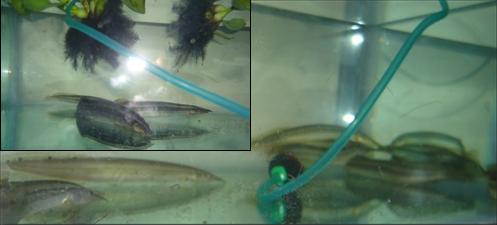
Figure1: Rearing of broods M. pancalus in the aquarium condition. Used water hyacinth and aeration (inset).
Selection of Broods and Pairing
Selection of brood fish is the main task on which successful spawning mostly depends. Improper selection of brood may result poor quality or fish may not spawn at all. Mature and healthy fishes were selected by observing morphological symptoms like swollen and enlarge abdomen for female and slender-shaped, smaller in size at the same batch with whitish belly for male. The body weight of individuals was measured by using electric weight balance (A&D Company. Ltd; Model-EK 1200I; Made in Japan) and noticed average body weight 9.00 ± 1.2 g. The selected broods were kept in separated experiment aquarium at sex ratio 1:1 for male and female for pairing and conditioning for 3-4 days.
Experimental Design
The experimental fish was induced with pituitary gland (PG) hormone in two different trials and each trial had three treatments (T1, T2, and T3) with three replications of each. In first trial (double dose) fishes were injected with two separate doses (Table 1). The resolving dose (2nd dose) received double amount of PG of the preliminary dose (1st dose). In the 2nd trial, fishes were induced with single dose of hormone and the amount of PG was the equivalent to the total amount of PG applied in 1st trial (Table 1).
| 1st trial | 2nd trial | |||||||||||||
|---|---|---|---|---|---|---|---|---|---|---|---|---|---|---|
| Treatment | Sex | |||||||||||||
| Preliminary dose (mg·kg-1) | Resolving dose (mg·kg-1) | Single dose (mg·kg-1) | ||||||||||||
| T 1 | Female | 55 | 105 | 160 | ||||||||||
| Male | - | 55 | 55 | |||||||||||
| T 2 | Female | 60 | 120 | 180 | ||||||||||
| Male | - | 60 | 60 | |||||||||||
| T 3 | Female | 65 | 135 | 200 | ||||||||||
| Male | - | 65 | 65 |
Hormone Administration
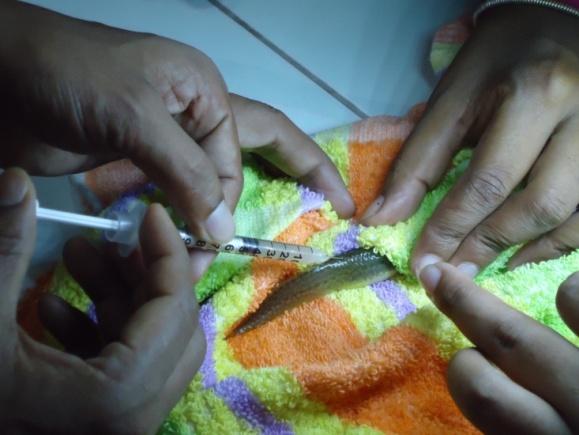
The brood fish were collected for hormone administration very carefully and wrapped with soft and moist cloth. The needle was pushed at the basal part of dorsal fin at an angle of 45º with the body (Figure 2). The amount of hormone for each fish was determined before according to the body weight of the broods. After the administration of hormones, the fishes were kept in separate aquarium at the sex ratio of 1:1 for natural propagation. The fishes were observed carefully at every 15 min with naked eye for any behavioral changes and spawning activity i.e. their body coloration, change of position, chasing behavior up to spawning time.
Determination of Fertilization Rate
The eggs were attached with the roots of water hyacinths in the aquarium. To determine the fertilization rate 10 eggs was taken from each replication of different treatment and placed in a Petridis containing water. Then the collected eggs were observed under a microscope (Carl Zesis microscopy GMBH, S.N. MKG8639, made by Germany) and fertilized eggs were counted and fertilization rate was calculated by following formula. The fertilized eggs were recognized as their transparent shell from the unfertilized eggs which were opaque.
Fertilization rate (%) = No. of fertilized eggs Total no. of eggs × 100
Determination of Hatching Rate
The hatching rate was the portion of the fertilized eggs that came out as developing larvae and was determining by counting the number of larvae from predetermined number of fertilized eggs. The hatching rate was calculated by the following formula:
Hatching rate % = No of hatchlings Total number of fertilized eggs × 100
Statistical Analysis
The results found in the study were subjected to statistical analysis, chi-square test that showed the significance (P<0.05) level of differences between the treatments. This statistical analysis was performed with the aid of the Microsoft Excel. Results
Water Quality
The physico-chemical condition such as temperature, pH and dissolved oxygen (DO) of water in experimental aquariums under different treatments of the two trials is presented in table 2. The water temperature, pH and DO were ranged from 26.5 to 31.1ºC, 7.06 to 8.04 and 4.1 to 5.6 mg·L-1 respectively in 1st trial and 28.7 to 31.2°C, 7.56 to 7.98 and 4.2 to 5.4 mg·L-1 at 2nd trial. The recorded water parameters were not significantly (p<0.05) different between treatments of the both trials.
| Trial | Parameters | T 1 | T 2 | T 3 | ||||||||||
|---|---|---|---|---|---|---|---|---|---|---|---|---|---|---|
| 1st | Temperature(ºC) | 28.39 ± 1.12 | 28.43 ± 1.16 | 28.48 ± 1.61 | ||||||||||
| pH | 7.73 ± 0.34 | 7.73 ± 0.11 | 7.80 ± 0.09 | |||||||||||
| DO (mg·L-1) | 4.67 ± 0.45 | 4.98 ± 0.46 | 4.85 ± 0.38 | |||||||||||
| 2nd | Temperature (ºC) | 29.99 ± 0.7 | 29.51 ± 0.44 | 29.96 ± 0.62 | ||||||||||
| pH | 7.80 ± 0.10 | 7.78 ± 0.14 | 7.75 ± 0.11 | |||||||||||
| DO (mg·L-1) | 4.82 ± 0.38 | 4.87 ± 0.31 | 4.69 ± 0.29 |
Table 2: Average water quality parameters of different treatment of two trials of inducing of M. pancalus.
Breeding Behavior and Spawning
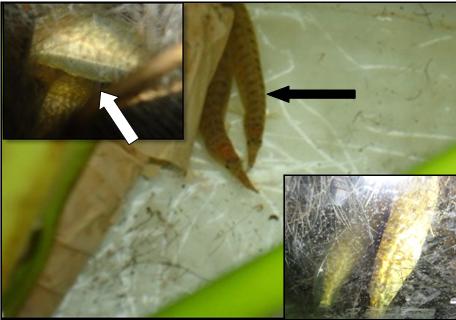
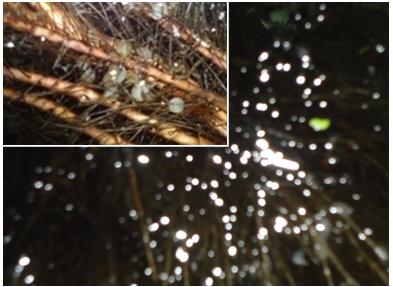
The different behavior of the species showed during copulation and some of them are presented in the figure 3. Both male and female changed from whitish-grey to yellowish body color after injected hormone the fish in case of both trials (Figure 3 inset right-down). Courtship begins with the male chasing the female and swimming in a tight circle at 9-10 h of administration of hormone (1st dose) irrespective of different trials (Figure 3 black arrow). The female and male moved together in anti-clockwise and the female was hold by the male and later bending its body, rubbing, knocking and nudging her (Figure 3 white arrow). Then the pair encircles each other around the roots of the water hyacinths for spawning and it takes place within 15 to 20 h after administration of PG hormone. Male releases sperm simultaneously with female and the eggs were fertilized externally. The eggs stick to the root of water hyacinths due to adhesive in nature (Figure 4). They spawned in different batches and took rest about 30 min after one span of spawning. The swimming movements of the female become slow at the end of the spawning activity and parent take rest at the bottom. The parents were removed from the spawning tank after spawning and noticed that their body color became gradually faded away. The fertilized eggs are spherical and transparent when unfertilized eggs are opaque (Figure 5). The eggs were started to hatch after 36-41 h of spawning.
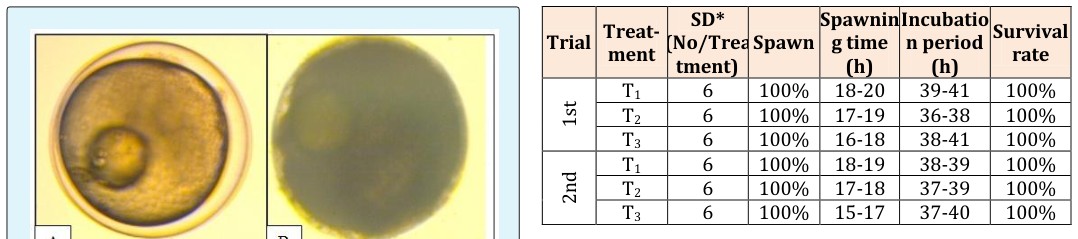
Fishes spawned 100% in all the treatments at 16-20h and 15-19h after hormone administration at 1st trial and 2nd trial respectively (Table 3). Incubation period also noticed more or less similar in both trials. The 100% survival rate of broods noticed in all the treatments of both trials.
- SD*
- (No/Trea
- Spawnin
- Incubatio
- Trial Treat-
- Survival
- Spawn g time n period ment rate tment)
- (h)
- (h)
- T1
- 6
- 100%
- 18-20
- 39-41
- 100%
- T2
- 6
- 100%
- 17-19
- 36-38
- 100%
- T3
- 6
- 100%
- 16-18
- 38-41
- 100%
- 1st
- T1
- 6
- 100%
- 18-19
- 38-39
- 100%
- T2
- 6
- 100%
- 17-18
- 37-39
- 100%
- T3
- 6
- 100%
- 15-17
- 37-40
- 100%
- 2nd
Table 3: Spawning performance, hours of spawned,
| Observed | Mean | ||||||||||||||||||||||
|---|---|---|---|---|---|---|---|---|---|---|---|---|---|---|---|---|---|---|---|---|---|---|---|
| Sampling | No of fertilized | Fertilization | Mean fertilization | ||||||||||||||||||||
| Trial | Treatment | number of | fertilization | ||||||||||||||||||||
| time | eggs | rate (%) | (%) | ||||||||||||||||||||
| eggs | (%) | ||||||||||||||||||||||
| 1st | T 1 | 2.00pm 4.00pm 6.00pm | 10 10 10 | 6 6 5 | 60 60 50 | 56.67 ± 5.77a | 64.44 ± 8.34a | ||||||||||||||||
| T 2 | 2.00pm 4.00pm 6.00pm | 10 10 10 | 7 7 8 | 70 70 80 | 73.33 ± 5.77b | ||||||||||||||||||
| T 3 | 2.00pm 4.00pm 6.00pm | 10 10 10 | 6 7 6 | 60 70 60 | 63.33 ± 5.77ab | ||||||||||||||||||
| 2nd | T 1 | 2.00 pm 4.00pm 6.00pm | 10 10 10 | 5 4 3 | 50 40 30 | 40.00 ± 10.0a | 55.56 ± 13.88a | ||||||||||||||||
| T 2 | 2.00pm 4.00pm 6.00pm | 10 10 10 | 6 7 7 | 60 70 70 | 66.67 ± 5.77b | ||||||||||||||||||
| T 3 | 2.00pm 4.00pm 6.00pm | 10 10 10 | 6 6 6 | 60 60 60 | 60.00 ± 00b |
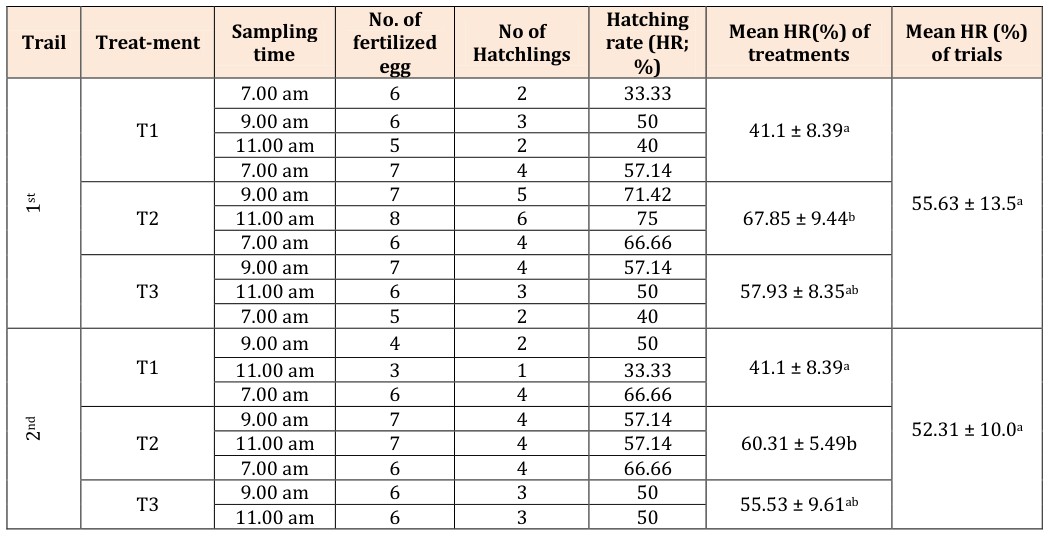
Table4: The fertilization rate of M. pancalus at double doses (1st trial) and single dose (2nd trial) of PG extract. (Mean ± SD); values of the fertilization rate with different superscripts (a,b,c) differ significantly (p<0.05) in each treatments and trials Hatching rate was found 41.1%, 67.85% and 57.93% in treatments of T1, T2 and T3 respectively in 1st trial and 41.1%, 60.31% and 55.53% in T1, T2 and T3 respectively in 2nd trial (Table 5). The highest hatching rate was recorded 67.85 ± 9.44 % in T2 at 1st trial. The significant (p<0.05) variation noticed in T2 in both trial compare to other treatments. There was no significant (p<0.05) variation in terms of hatching rate between 1st and 2nd trial.
- No. of fertilized
- Hatching rate (HR;
- Trail
- Treat-ment
- Sampling
- No of
- Hatchlings
- Mean HR(%) of time treatments egg
- %)
- 7.00 am
- 6
- 2
- 33.33
- 9.00 am
- 6
- 3
- 50
- 11.00 am
- 5
- 2
- 40
- 7.00 am
- 7
- 4
- 57.14
- T1
- 41.1 ± 8.39a
- 9.00 am
- 7
- 5
- 71.42
- 1st
- T2
- 67.85 ± 9.44b
- 11.00 am
- 8
- 6
- 75
- 7.00 am
- 6
- 4
- 66.66
- 9.00 am
- 7
- 4
- 57.14
- T3
- 57.93 ± 8.35ab
- 11.00 am
- 6
- 3
- 50
- 7.00 am
- 5
- 2
- 40
- 9.00 am
- 4
- 2
- 50
- T1
- 41.1 ± 8.39a
- 11.00 am
- 3
- 1
- 33.33
- 7.00 am
- 6
- 4
- 66.66
- 9.00 am
- 7
- 4
- 57.14
- 2nd
- T2
- 60.31 ± 5.49b
- 11.00 am
- 7
- 4
- 57.14
- 7.00 am
- 6
- 4
- 66.66
- T3
- 9.00 am
- 6
- 3
- 50
- 55.53 ± 9.61ab
- 11.00 am
- 6
- 3
- 50
Table 5: The hatching rate of M. pancalus at double doses (1st trial) and single dose (2nd trial) of PG extract.
Water Quality Parameters
Water quality parameters play an important role in successful breeding. Among them water temperature plays a vital role in gonadal development and timing of the spawning and hatching. If the optimum temperature of the species cannot be maintained the maturation may delay or the eggs may release spasmodically and the total number of egg may also be reduced [19]. The fertilization rate, hatching rate, survival rate, and embryonic development is closely dependent upon the oxygen supply and pH. The dissolved oxygen content of the water should not be below 4 - 5 ppm. Successful breeding of M. pancalus was performed at an ambient temperature ranged from 26.5 to 31.1ºC (Table 2) that was suitable for the breeding of M. pancalus which is supported by [20, 21] who reported that temperature ranged from 27 to 31ºC is favored by most of the indigenous small fishes for breeding. This range of temperature is also supported by [3, 6, 18] for breeding of M. pancalus and they all reported successfully breed within 26-31 ºC. Besides this, M. aculeate us was successfully bred by [22] at 27 to 33ºC and by [23] at 28 to 30ºC. Thus it may say that water temperature 27 to
31ºC could be the optimum temperature for breeding of eel fishes. The recorded water pH and dissolved oxygen varied from 7.06 to 8.04 and 4.10 to 5.6 mg·L-1 in both trials this also supported by [17, 18]. Afroz, et al. [17] conducted their experiment at 7.13 to 8.69 and 3.6 to 4.9 mg·L-1 of pH and DO respectively. Alam, et al. [18] successfully breed M. pancalus at 6.5 to 7.4 and 6.5 to 7.5 mg·L-1 of pH and DO respectively. Hasan, et al. [6] recorded pH value 7.13 to 8.69 and DO value 3.3 to 5 mg·L-1.
Breeding Behavior
The present study recorded yellowish body color of both male and female after hormone administration (Figure 3). This may be due to hormonal effect for the attraction of both sexes each other that help the female to spawn and the male to release milt successfully. Body coloration also has an important role in mate choice. Though there is no such other evidence in color changes of guchiaim, it may compare to other species like [24] recorded orange-red color spot on the operculum of both male and female after hormone administration in case of Puntius chola. Fishes showed a courtship behavior that is supported by [3, 6] for the same species. Fishes showed such behavior because the reproductive success of fish depends partly on ability to perform correct courtship behavior. The courtship begins with the male chasing the female and swimming in a tight circle. The similar observation was recorded [6, 25, 26]. In the present study, female and male moved together in anti-clockwise and the female was hold by the male and later bending its body, rubbing, knocking and nudging her. Male hold the female and then bending its body and rubbing to prepare her for spawning and that behavior pattern is supported by [3, 6, 22]. It was also found that during spawning, the male bent its body close to the female and released its milt simultaneously with female and the eggs were fertilized externally.
Breeding Performance
Pituitary gland (PG) extract was used as the inducing agent for breeding of M. pancalus and all the experimental fishes breed successfully (Table 3). Effectiveness of PG in induced breeding of spiny eel is supported by [3, 6, 18, 22]. The 100% spawned noticed in the present study by inducing different doses of PG in different phases confirm the effectiveness of PG hormones for the induce breeding of M. pancalus. The courtship and spawning began within 9-10 h and 16-20 h of hormone administration which was earlier than [16]. They noticed these behaviors at 29-32 h and 33-35 h after injecting of different hormones for the same species. The quick spawning occurred in T3 when the high dose (200 mg·kg-1) was applied at a time in the 2nd trial.
The incubation period of the species was more or less similar in all treatments of both trials and it was within 36-41 h. Rahman et al. [3] recorded incubation period 33- 35 h by carrying out study on induced breeding of M. pancalus with PG hormone. However, the little bit shorter incubation period noticed in T2 in both trials where PG used as medium dose in the present study. So it can be said that secretion of gonadotropins in female occurred quickly at higher dose than that of lower doses but the incubation is depended on other factors. In average of two trials, it was showed that 100% spawning performance, 70% fertilization rate and 64% hatching rate of M. pancalus in medium dose, 180 mg·kg-1 of PG rather than other two doses (160 mg·kg-1 and 200 mg·kg-1). The findings of the present study showed higher spawning but lower fertilization and hatching rate compare to other such studies on M. pancalus like [3, 18]. Alam et al. [18] showed 77% spawning rate, 91% fertilization rate and 80% hatching rate while [3] found 90% spawning rate, 90% fertilization and 80% hatching rate (Table 6). Farid et al. [22] reported high fertilization (86%) but low hatching rate (50%) for the same species using same hormones at different dose. However, low performance reported compare to present findings by [6] and recorded 50% spawning, 35% fertilization and 26% hatching performances by using PG at 60 mg·kg-1 body weight of M. pancalus. There was no prominent variation in terms of spawning and incubation time between 1st and 2nd trials. However, a bit higher fertilization and hatching rate in 1st trial (double doses) could be suggested for the inducing of the species.
| Performance | ||||||||||||||
| PG dose (mg·kg-1) | Reference | |||||||||||||
| Spawning (%) | Fertilization (%) | Hatching (%) | ||||||||||||
| 90 | - | 86 | 50 | Farid et al. 2008 | ||||||||||
| 170 | 77 | 91 | 80 | Alam et al. 2009 | ||||||||||
| 170 | 90 | 90 | 80 | Rahman et al. 2011 | ||||||||||
| 60 | 50 | 35 | 26 | Hasan et al. 2016 | ||||||||||
| 160 | 100 | 48.5 | 41 | Present study | ||||||||||
| 180 | 100 | 70 | 64 | |||||||||||
| 200 | 100 | 61.5 | 57 |
Table 6: The comparison of breeding performance at different PG dose of the present study with other such studies.
Table 6: The comparison of breeding performance at different PG dose of the present study with other such studies. The present findings indicated that the PG extract is effective in induction of M. pancalus under captive condition. The fish responded in all experimental doses but respect to fertilization (73.33%) and hatching 67.85% , PG extract at the double dose 60 mg•kg-1 + and 120 mg•kg-1 body weight) could be used as an appropriate dose for induced breeding and seed production of the species.
Acknowledgement
The present study was financially supported by the Ministry of Education, Peoples Republic of Bangladesh.
We also thank to the fishermen who supported us for collection of brood fishes.
References
-
(2008) Encyclopedia of Flora and Fauna of Bangladesh. Freshwater Fishes, Aseatic society of Bangladesh, Dhaka 23: 235.
-
Talwar PK, Jhingran AG (1991) Inland fishes of India and adjacent countries Oxford and IBH Publishing Co. PVT. Ltd., New Delhi, India, 2: 789-541.
-
Rahman MM, Miah MI, Hasan KR, Farid SM (2011) Effects of pituitary gland doses on artificial propagation of guchibaim, _Mastacembelus pancalus_ (Hamilton), J Bangladesh Agril Univ 9(2): 305-310.
-
IUCN Bangladesh (2000) Red Book of threatened fishes of Bangladesh, International Union for Conservation of Nature, Bangladesh Country Office, Dhaka, Bangladesh, pp: 116.
-
IUCN Bangladesh (2015) Red List of Bangladesh (5th volume). Freshwater Fishes. IUCN, International Union for Conservation of Nature, Bangladesh Country Office, Dhaka, Bangladesh, pp: 235.
-
Hasan MR, Islam MS, Afroz A, Bahdur P, Akter S (2016) Captive breeding of Striped Spiny Eel, _Mastacembelus_ _pancalus_ (Hamilton, 1822) considering the various hormonal responses. International Journal of Fisheries and Aquatic Studies 4 (3): 7-11.
-
Doha, Hye (1970) Fecundity of Padma river hilsha, _Hilsa ilisha_ (Ham.). Pakistan journal of Science 22: 176-184.
-
Surnar SR, Kamble AD, Walse NS, Sharma OP, Saini VP (2015) Hormone administration with induced spawning of Indian major carp. International Journal of Fisheries and Aquatic Studies 3(1): 1-4.
-
Suresh VR, Biswas BK, Vinci GK, Mitra K, Mukherjee A (2006) Biology and fishery of barred spiny eel, _Macrognathus pancalus_ (Hamilton, 1822). Journal of Acta Ichthyologica Piscatoria 36 (1): 31-37.
-
Karim MA, Hossain A (1972) Studies on the biology of _Mastacembelus pancalus_ (Spiny Eel, Hamilton) in artificial pond. Part II. Sexual maturity and Fecundity. Bangladesh Journal of Biology and Agricultural Sciences 1(2): 15-18.
-
Vettath R, Suresh BK, Biswas GK, Vinci KM, Mukherjee A (2006) Biology and fishery of barried spiny eel, _Macrognathus pancalus_ (Hamilton, 1822). Journal of Acta Ichthyologica Piscatoria 36(1): 31-37.
-
Saha BK, Islam MR, Saha A, Hossain AM (2006) Some aspect of reproduction of the indigenous spiny eel, _Mastacembelus pancalus_ from netrakona, Bangladesh. Bangladesh Journal of Zoology 34(2): 289-293.
-
Pathak BC, Ali R, Serajuddin M (2012) Comparative Analysis of Reproductive Traits in Barred Spiny Eel, _Macrognathu pancalus_ (Hamilton, 1822) from Lotic and Lentic Ecosystems of Gangatic Basin, India. World Journal of Fish and Marine Sciences 4 (5): 470-479.
-
Serajuddin M, Ali R (2005) Food and feeding habits of striped spiny eel, _Macrognathus pancalus_ (Hamilton), Indian Journal of Fisheries 52(1): 81-86.
-
Rahaman MM, Miah MI (2007) Fecundity of guchibaim, _Mastacembelus pancalus_. J Bangladesh Agril Univ 7(1):133-137.
-
Rahman MM, Miah MI, Taher MA, Hasan MM (2009) Embryonic and larval development of guchibaim, _Mastacembelus pancalus_ (Hamilton). J Bangladesh Agril Univ 7(1): 193-204.
-
Afroz A, Islam MS, Hasan MR, Hasnahena M, Tuly DM (2014) Larval rearing of spiny eel, Mastacembelus pancalus in the captivity with emphasis on their development stages. International Journal of Fisheries and Aquatic Studies 1(6): 163-167.
-
Alam M, Alam MS, Alam MA, Islam MA, Miah MI (2009) Dose optimization with PG hormone for induced breeding of _Mastacembelus pancalus_. Eco- friendly Agril 2(9): 799-804.
-
Healy MC (1971) Gonadal development and fecundity of the goby _Gobobus mimitus._ Transaction of the American Fisheries Society 100: 520-526.
-
Islam Z, Chowdhury AQ (1976) Induced spawning of major carp for commercial production of fry in the fish seed farm, Bangladesh Journal of Zoology 4 (2): 51-61.
-
Akhteruzzaman M, Kohinoor AHM, Shah MS (1992) Observations on the induced breeding of _Puntius_ _sarana_ (Hamilton). Bangladesh Journal of Zoology 20 (2): 291-295.
-
Farid SM, Miah MI, Habib MAB, Rahman MM (2008) Effect of pituitary gland (PG) doses on artificial propagation of endangered Tarabaim, _Macrognathus_ _aculeatus_ (BLOCH). Progress Agric 19 (2): 111-118.
-
Das SK, Kalita N (2003) Captive breeding of Peacock Eel, _Macrognathus aculeatus._ Journal of Aquaculture Asia 3: 17-18.
-
Vincent M, Thomas KJ (2008) Nuptial coloration and courtship behavior during induced breeding of the swamp barb _Puntius chola,_ a freshwater fish. Current science 94 (7): 922-925.
-
Nelson K (1964) The temporal patterning of courtship behavior in the glandulocaudine fishes (Ostariophysi, Characidae). Behavior 24(1): 90-145.
-
Nelson K (1965) After affects the courtship in the male three-spined stickle back. Zeitschrift für vergleichende Physiologie 50: 569-597.
- Genetic Improvement of Nile Tilapia (Oreochromis niloticus): Advances in Selective Breeding and Genomic Approaches for Sustainable Aquaculture
- Microplastics, Contaminants, and Waste Hotspots: Divergences and Faults in Prioritizing Control Efforts
- Creating a Healthier, More Vibrant Open and Closed Aquatic Environment. A Submersible, Centrifugal Magnetically Affixed Current Changing Aquarium Pump
- An Attempt to Assess Alpha Diversity and Sample Size: Using the Ostracod Assemblages off Kumamoto Port, Japan
- Assessment of the Efficiency of Common Fishing Gears and Crafts Used at Mohananda River of Chapai Nawabganj, Bangladesh
- Fish Productivity and Biodiversity Status of Sundarban Mangrove in Bangladesh