
Specific Diversity and Dynamics of the Phytoplankton Population in a Pond Fertilized with Chicken Droppings in the West Highlands Cameroon
Phytoplankton is one of the essential compartments of the food chain in aquatic ecosystems, especially in fish farming ponds. In order to contribute to the improvement of fish productivity in ponds by the production of phytoplankton through fertilization, a study was carried out at the Research and Application Farm, more precisely at the Aquaculture Station of the University of Dschang. The study was conducted in 9 derivation ponds of the same surface area (5.7 x 5.7 m) and 1 m depth with a flow rate of 3.23 litre/minute. Mesh net (1.5 mm) was attached to the inlet pipe of each pond to prevent fish intrusion from the reservoir. Each of the three treatments consisting of 0; 800 and 1000 kg/ha of chicken droppings was applied to one of the ponds randomly. Each treatment was repeated three times. Phytoplankton and water quality data were collected every two weeks. The results showed a richness of 237 species grouped in 6 phytoplankton phylum that were registered independently of the dropping dose. This species richness decreased with increase of the dropping dose either, 164; 121 and 109 species corresponding to doses 0; 800 and 1000 kg/ha respectively. On the other hand, density values were lowest in unfertilized ponds and highest in ponds fertilized with the highest dose (1000 kg/ha). For the production of phytoplanktonophagous fish the dose of 1000 kg could be used. However, it would be important to search for the optimal weekly fertilization dose.
Introduction
Phytoplankton is made up of all the plant micro- organisms suspended in the water, capable to product their own organic substance by photosynthesis, using solar energy, water, carbonic acid gas and nutrient salts. It is one of the essential compartments that condition the food chain in aquatic ecosystems, especially in fish farming ponds. Thus, in aquaculture production, the growth of fish, especially common carp and tilapia, depends on the autotrophic pathway and so on phytoplankton for between 50 and 80% of their growth. The organisms that make up phytoplankton are ecologically tolerant. Their development and stability depend essentially on the nutrient richness of the environment, especially phosphorus and nitrogen, and on the grazing of phytoplanktonophagous [1].
In China, waste from all sources has been spread in fish ponds for two millennia. It is the same with dropping, which is traditionally brought into fish nursery ponds to stimulate phytoplankton development. These practices have led several scientists to conduct studies on phytoplankton production in fish ponds. Barbe, et al. [2] have studied usage of phytoplankton to estimate the potential fish production in fish ponds. Other work has focused on monitoring phytoplankton in lakes, rivers and uncontrolled environments [3, 4, 5, 6, 7]. However, few works has been done on the management of phytoplankton organisms in earthen fish ponds despite the fact that they represent the most widely used infrastructure (70%) in the world. Moreover, none of this work has focused on the effect of the amount of fertilizer regularly applied in ponds on phytoplankton development.
The objective of this work is to contribute to the improvement of fish productivity by the production of phytoplankton through pond fertilization. More specifically, the aim is to evaluate the effect of the dose of chicken droppings on the richness, density and dynamics of phytoplankton development.
Materials and Methods
Area and Period of Study
The test was carried out at the Aquaculture Station of the Application and Research Farm (F.A.R) of the University of Dschang (North Latitude: 5°44’-5°36’ and Est Longitude: 10°06’-9°85’, altitude: 1392 -1396 m) located in the West Cameroon highlands agro-ecological zone. This zone is characterized by a short dry season (mid-November to mid-March) and a long rainy season (mid-March to mid- November). Annual rainfall varies between 1500 and 2000 mm and temperatures range between 14°C (July-August) and 25°C (February).
Obtaining and Conditioning of Chicken Droppings
In order to avoid variability in chemical composition, hen droppings were collected from the same farm and stored at room temperature. A sample was taken to determine the concentration of dry matter, total nitrogen and total phosphorus. The mean values of the dropping characteristics were as follows: dry matter (80.2 ± 3.33%), total nitrogen (2 ± 0.14%) and total phosphorus (1.5 ± 0.06%).
Experimental Ponds
The test was carried out inside 9 diversion ponds with the same surface area (5.7 x 5.7 m) and a depth of 1 m with a flow rate of 3.23 liters per minute. In order to eliminate undesirable organisms (fish) and increase the alkalinity of the environment, the ponds were dewatered for a period of 7 days and limed with quicklime at a dose of 400 kg/ha. Mesh size net (1.5 mm) was attached to the inlet pipe of each pond to prevent fish intrusion from the reservoir. Each of the three treatments consisting of 0; 800 and 1000 kg/ha of chicken droppings was applied in one of the ponds randomly. Each treatment was repeated three times.
Conduct of the Trial and Data Collection
Pond Fertilization: In order to control phytoplankton production, chicken droppings were applied to the ponds by spreading once a week for a period of 6 months. For this purpose, the fertilizer doses were weighed with an electronic precision scale 0.1g each time before application. Sampling of Phytoplankton Organisms: Phytoplankton sampling was carried out on a biweekly basis for 6 months. Sampling was carried out at 20 different points in the water column of each pond using a calibrated polyethylene container with a capacity of 1 liter, i.e. a total volume of 20 liters/pond filtered through a 40 µm mesh plankton sieve. A volume of 350 ml of concentrated phytoplankton was recovered, fixed by the addition of 5% formaldehyde and kept in plastic bottles for quantitative and qualitative analyses. Determination of the Physico-Chemical Characteristics of Water: The Secchi disc transparency, temperature, pH, dissolved oxygen and electrical conductivity were measured directly in the field using a ballasted Secchi disc attached to a graduated string, Thermo-Conductimeter, Thermo- PH meter, pH meter, Thermo-Oxymeter and Thermo- Conductimeter from HANNA respectively. Nitrite, nitrate and total phosphates were determined by spectrophotometry (spectrophotometer HACH DR/2000) according to Apha techniques [8]. Qualitative and Quantitative Analysis of Phytoplankton: Each previously filtered sample (350ml) was left to rest for a minimum of 24 hours to allow for phytoplankton sedimentation. A volume of 300ml of water was then removed above the phytoplankton residue by siphoning and the concentrated phytoplankton samples were kept in beakers. The qualitative analysis of the phytoplankton was carried out according to the method described by Nguetsop, et al. [9]. Thus, after homogenization, two drops (10 μl) of each concentrated phytoplankton sample were taken with a pipette, mounted between slide and slide and observed using an Olympus optical microscope (×40 objectives), model BH- 2, equipped with a nomarski lens. For each sample, three slides were prepared to ensure reproducibility of the slides [9].
The identifications were made using the keys of Bourelly and Manguin [10]; Compère [11]; Couté and Rousselin [12], Compère [13, 14]; Gasse [15]; Iltis [16]; Gasse [17]; Krammer and Lange-Bertalot [18].
The cell counts were performed using an inverted
microscope, ZEISS 47 12 02 with the ×40 objective as recommended by Lund, et al. [19]. After homogenization, 10 ml of the sample was taken with a calibrated pipette, placed in a settling cup and allowed to settle for 10 min. Counts were made on six fields taken randomly from the cup. The minimum number of units (cell, filament, cenobe or colony) counted per replicate of a sample was set at 400, in order to have an accuracy of ± 10 to 95% confidence interval.
Statistical Analyses
The collected data were subjected to the one-factor analysis of variance (ANOVA 1). In the case of significant differences between the means, the Duncan’s test was applied to separate them at the 5% significance level. SPSS 20.0 (Statistical Package for Social Sciences) was used for these analyses.
Results
Effects of Chicken Droppings Dose on Phytoplankton Species Richness and Distribution
The composition of the phytoplankton stand summarized in Table 1 shows that, independently of the doses of chicken droppings, a total of 237 species grouped in 6 phytoplankton phylum were recorded.
The distribution of phytoplankton species shows that of the 237 species identified, 164 are represented in unfertilized ponds, i.e. a proportion of 61.19%. As regards fertilized ponds, a total of 121 species or 51.05% were represented in ponds having received 800kg of dropping and 109 species representing 46% in 1000kg. From Table 1 summarizing the distribution of species, it can be seen that 83 out of 237 species were represented only in unfertilized ponds. The dominant species in these ponds are Merismopedia elegans, Mycrocystis aeruginosa, Nostoc entophytum.
In the fertilized ponds, the species specifically represented in the 800kg treatment were the highest (23 species out of 237) compared to those recorded with the 1000kg of chicken droppings dose (23 species). It should be noted that 66 species (i.e. 27.84% of the total species recorded) were represented transversally in all three treatments (0; 800 and 1000 kg).
The Pyrrophyte phylum is only represented in the ponds fertilized with the highest dose of chicken dropping, whereas the Rhodophyte phylum is only represented in the treatment with 800 kg/ha of chicken dropping.
| Phytoplankton taxa | Phytoplankton taxa (kg) | ||
|---|---|---|---|
| 0 | 800 | 1000 | |
| Cyanophytes | |||
| Pseudanabaena catenata | X | X | X |
| Merismopedia elegans | X | - | - |
| Tolypothrix distorta | X | X | X |
| Calothrix scytonemicola | - | X | - |
| Calothrix columbiana | - | - | X |
| Microcystis robusta | - | X | - |
| Microcystis aeruginosa | X | - | - |
| Nostoc entophytum | X | - | - |
| Lyngbya bargentii | X | - | - |
| Oscillatoria chlorina | X | - | - |
| Oscillatoria bornetii | - | - | X |
| Gomphosphaeria pusilla | X | - | - |
| Chlorophytes | |||
| Pediastrum duplex | X | X | X |
| Trentepohlia bossei | - | X | - |
| Chodatella quadriseta | X | - | - |
| Eremosphera gigas | - | X | - |
| Micratinium pusillum | - | X | - |
| Oedogonium nasatum | - | X | - |
| Carteria multifilis | X | - | - |
| Scenedesmus armatus | X | - | - |
| Scenedesmus opaliensis | X | - | - |
| Scenedesmus quadricauda var longispina | - | X | - |
| Scenedesmus quadricauda | - | X | - |
| Scenedesmus brasiliensis | X | - | - |
| Senedesmus armatus var bicaudatus | X | - | - |
| Scenedesmus acutiformis | X | - | - |
| Scenedesmus obtunus f. ecornis | - | X | - |
| Ulothrix zonata | X | - | - |
| Ulothrix subtllissima | X | - | - |
| Netriumdigitus var naegel | - | - | X |
| Spirotaenia condensata | X | X | X |
| Desmidium aequale | X | - | - |
| Pleurotaenium nodosum | X | - | - |
| Pleurotaenium sp. | - | X | X |
| Pleurotaenium cylindricum var stuhlmannii | X | - | - |
| Pleurotaenium elatum var camerounense | - | - | X |
| Pleurotaenium clavatum | X | X | X |
| Pleurotaenium clavatum var elongatum | X | X | X |
| Mougeotia sp. | X | X | X |
| Mougeotia drouetii | X | X | X |
| Closterium annae | X | - | - |
| Closterium calosporum var majus | - | - | X |
| Closterium cornu var javanicum | - | - | X |
| Closterium dianae | - | - | X |
| Closterium dianae var brevius | X | - | - |
| Closterium ehrenbergii | - | X | - |
| Closterium exile | X | X | X |
| Closterium kuetzingii | - | X | X |
| Closterium moniliferum | X | X | X |
| Closterium nasatum | X | X | X |
| Closterium parvulum | - | X | - |
| Closterium parvulum f. majus | X | X | - |
| Closterium ralfsii var hybridum | X | - | - |
| Closterium sp | X | - | - |
| Closterium tumidium var myladicum | - | X | - |
| Closterium tumidum | X | X | X |
| Cosmarium angulonum | - | X | - |
| Cosmarium connatum | X | - | - |
| Cosmarium gerdae | - | X | - |
| Cosmarium granatum | - | - | X |
| Cosmarium laeve | X | - | - |
| Cosmarium magnificum | X | - | - |
| Cosmarium margaritatum | X | - | - |
| Cosmarium monodii | X | - | - |
| Cosmarium monomazum | X | - | - |
| Cosmarium parolalis | X | - | - |
| Cosmarium quadrum | - | X | - |
| Cosmarium scottii | X | - | - |
| Cosmarium sp. | X | - | - |
| Cosmarium subamiculatum | X | - | - |
| Cosmarium vogesiacum | X | - | - |
| Cosmarium vogesiacum var f. bipunctatum | X | - | - |
| Euastrum pectinatum | X | X | X |
| Euastrum spinolosum, forma | X | X | X |
| Euastrum sphyroides var heironymusii | X | X | X |
| Euastrumspinolosum var lindae | X | - | - |
| Euastrumdivergens var bourrellyanum | X | X | X |
| Staurastrum cyclacanthum var. ubacathum | X | X | - |
| Staurastrum inflexum, forma | X | X | X |
| Staurastrum asterias | X | X | X |
| Staurastrum zonatum var productum | X | - | - |
| Staurastrum pingue | X | - | - |
| Staurastrum tetracerum var subexcavatum | X | X | X |
| Staurastrum polymorphum | X | X | X |
| Micrasterias truncate | X | - | - |
| Micrasterias sp. | - | X | X |
| Micraterias radiosa f. minuta | X | X | X |
| Micrasterias foliacae | X | X | X |
| Micrasterias mahabules harenis var comperei | X | - | - |
| Micrasterias crux-melitensis | X | X | X |
| Micrasterias radians | X | X | X |
| Spirogyra puncticulata, forma | - | X | - |
| Spirogyra parangabae | - | X | - |
| Spirogyra liana | - | X | - |
| Spirogyra verrucasa | - | X | - |
| Spirogyra neglecta | X | X | X |
| Spirogyra hollandiae | - | X | X |
| Spirogyra decimina | - | X | X |
| Spirogyra setiformis | X | X | X |
| Spirogyra maxima | - | X | - |
| Spirogyra irregularis | X | X | X |
| Spirogyra crassa | - | - | - |
| Spirogyra fluviatilis | - | - | X |
| Spirogyra majuscula | - | X | - |
| Spirogyra weberi | - | X | X |
| Spirogyr apseudoneglecta | X | X | X |
| Spirogyra variformis | X | X | X |
| Spirogyra asp. | X | X | X |
| Spirogyra gracilis | X | X | X |
| Spirogyra varians | X | - | - |
| Spirogyra corrugata | X | X | X |
| Spirogyra reflexa | - | - | X |
| Spirogyra chakiensis f. major | X | - | - |
| Gonatozygon sp | X | X | X |
| Gonatozygon brebisonii | - | X | - |
| Gonatozygon monotaenium var pilossellum | X | - | - |
| Gonatozygon kinahanii | X | X | X |
| Gonatozygon monotaenium | X | X | X |
| Gonatozygon aculeatum | X | X | X |
| Zygnema sp. | X | X | X |
| Bacillariophytes | |||
| Amphora libyca | X | - | - |
| Amphora ovalis | X | X | X |
| Amphora inariensis | X | - | - |
| Amphora sp. | X | - | - |
| Diploneis sp. | X | - | - |
| Stauroneis undata | X | - | - |
| Cymbella caespitora | X | - | - |
| Cymbella gaemanii | X | X | X |
| Cymbella hustedtii | X | X | X |
| Cymbella minuta | - | X | - |
| Cymbella naviculiformis | X | X | X |
| Cymbella prostrata | - | - | X |
| Cymbellasilesiaca | X | - | - |
| Cymbella sp | X | X | X |
| Gomphonema africanum | X | X | X |
| Gomphonema amoenum | X | - | - |
| Gomphonema angustum | X | X | X |
| Gomphonema clavatum | X | X | X |
| Gomphonema elongatum | - | X | - |
| Gomphonema parvulum | X | X | X |
| Gomphonema puiggarianum | X | - | - |
| Gomphonema minutum | X | - | - |
| Navicula elginensis | - | X | - |
| Navicula halophila | - | - | X |
| Navicula mutica f. intermedia | - | - | - |
| Navicula amphibola | X | X | X |
| Navicula cryptocephala | X | - | - |
| Navicula pseudogrimmei | X | - | - |
| Navicula americana | X | X | X |
| Navicula evanida | X | - | X |
| Naviculla sp | X | X | X |
| Navicula radiosa | - | X | - |
| Navicula consentanea | X | X | X |
| Navicula pusila | X | X | X |
| Navicula perminuta | X | - | - |
| Navicula explanata | - | X | X |
| Pinnularia acrosphaeria | X | X | X |
| Pinnularia undulata | X | - | - |
| Pinnularia ignobilis | X | X | X |
| Pinnularia gibba var mesogonyla | X | - | - |
| Pinnularia gibba | X | X | X |
| Pinnularia legumen | X | X | X |
| Pinnularia macilenta | X | - | - |
| Frustulia rhomboides | X | X | X |
| Fragilaria brevistriata | X | - | - |
| Fragilaria leptostauron var dubia | - | - | X |
| Fragilaria capucina | X | X | X |
| Fragilaria sp | X | X | X |
| Tabelaria sp | - | - | X |
| Meridion circulare | - | - | X |
| Rhopalodia acuminata | X | - | - |
| Rhopalodia rupestris | X | - | - |
| Rhoppalodia gibberula | X | - | - |
| Rhoppalodia bubissonii | X | - | - |
| Rhopalodia brebissonii | X | - | - |
| Eunotia siolii | X | - | X |
| Eunotia sp | X | X | - |
| Surirella suecica | X | - | - |
| Surirella splandida | X | - | - |
| Surirella tchadensis | X | - | - |
| Surirella robusta | X | - | - |
| Surirella sp | X | - | - |
| Surirella elegans | X | X | X |
| Surirella capronii | X | - | - |
| Surirella ovalis | X | - | - |
| Surirella brebissonii | - | X | - |
| Melosira arenaria | X | X | X |
| Melosira granulata | X | - | - |
| Melosira undulata | X | - | - |
| Aulacoseira tethera | - | X | - |
| Aulacoseira subartica | - | - | X |
| Aulacauseira canadensis | - | X | - |
| Aulacoseira crenulata | X | - | - |
| Aulacoseira distans | X | X | X |
| Hontzschia amphioxys | - | X | - |
| Euglenophytes | |||
| Euglena variabilis | X | X | X |
| Euglena oxyuris | X | - | - |
| Euglena limnopohila | X | - | - |
| Euglena texta | X | - | - |
| Euglena sp | - | - | X |
| Euglena oxyuris f. minima | - | X | X |
| Euglena tripteris var. klebsii | X | - | - |
| Euglena oxyuris f. Playfairii | X | X | X |
| Euglena geniculata | - | X | - |
| Euglena ehrenbergii | X | - | - |
| Euglena spirogyra | X | - | - |
| Lepocinclis acuminata | X | X | X |
| Lepocinclis fusiformis f. lemmermannii | - | X | - |
| Lepocinclis ovum | - | X | X |
| Lepocinclis salina | X | - | - |
| Lepocinclis sp | - | - | X |
| Phacus platalae | X | X | X |
| Phacus applanatus | X | - | - |
| Phacus quadricauda | X | - | - |
| Phacus pleuronecte | X | - | - |
| Phagus tortus | X | X | X |
| Phacus sp | - | X | X |
| Phacus lemmermannii | - | X | X |
| Phacus orbicularis | X | X | X |
| Phacus longicauda | X | X | X |
| Trachelomonas african avar. pulchella | - | X | - |
| Trachelomonas conica | X | X | X |
| Trachelomonas hispida f. Minor | - | - | X |
| Trachelomonas hispida var duplex | - | - | X |
| Trachelomonas planctonica | X | - | - |
| Trachelomonas robusta | X | X | X |
| Trachelomonas verrucosa | X | X | X |
| Trachelomonas verrucosa var granulosa | - | X | - |
| Trachelomonas volvocina var punctata | X | - | - |
| Astasia velox | - | X | X |
| Astasia acus | X | - | - |
| Distigma proteus | X | - | - |
| Pyrrophytes | |||
| Peridinium sp | - | - | X |
| Peridinium cinctum | - | - | X |
| Peridinium volzii | - | - | X |
| Sphaerodinium polonicum | - | - | X |
| Rhodophytes | |||
| Thoreara mosissima | - | X | - |
Table 1: Distribution of phytoplankton taxa according to the droppings dose The cross (x) in each box indicates the presence of t
Phylum Distribution of Phytoplankton Species as a Function of Dropping Dose
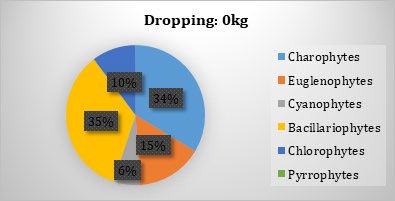
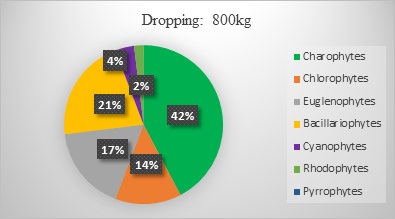
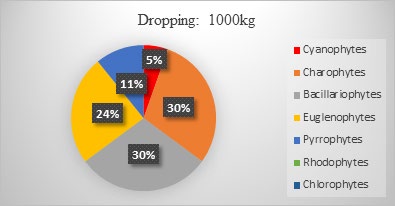
Figure 1 illustrates the distribution of species by phylum as a function of dropping dose. Overall, in unfertilized ponds, the algal flora is dominated by species belonging to the Bacillariophytes phylum (34%) whereas ponds fertilized at 800 and 1000 kg were dominated by Charophytes at 42 and 30% respectively.
Dynamics of Phytoplankton Density as a Function of Dropping Dose
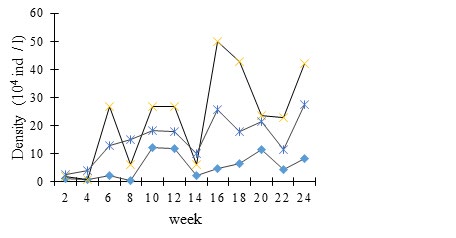
The evolution of phytoplankton density as a function of manure dose is illustrated in Figure 2, which shows that the trend, profile and rate of change in density were generally comparable between treatments.
Regardless of the test period, the lowest phytoplankton density values were observed in unfertilized ponds and the highest in ponds fertilized with the highest dose of chicken dropping (1000 kg/ha).
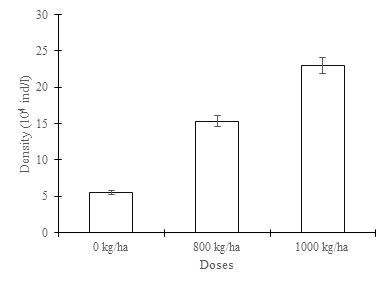
Statistical analysis conducted on phytoplankton density showed that there was no significant difference (p < 0.05) between ponds fertilized at the 800 and 1000 kg of chicken droppings (Figure 3).
a, b; bars with the same letter are not significantly different (p > 0.05); ind : individual, l : liter Figure 3: Comparison of phytoplankton density in ponds as a function of droppings dose.
Phytoplankton Diversity Index
The index Shannon & Weaver diversity and equitability summarized in Table 2 showed a decrease with increasing fertilizer dose. Thus, the highest values of Shannon’s index and equitability were recorded in unfertilized ponds and the lowest in ponds fertilized with the 1000 kg of chicken droppings.
| Diversity index (bits / ind) | Chicken droppings | ||
|---|---|---|---|
| 0 (kg/ha) | 800 (kg/ha) | 1000 (kg/ha) | |
| Shannon & Weaver | 2,70 | 2,17 | 2,10 |
| Equitabilité J | 0,52 | 0,45 | 0,44 |
Table 2: Index of Phytoplankton Species Diversity.
Correlation between Physicochemical Characteristics of Water and Phytoplankton Density as a Function of Fertilizer Dose: Correlations between physicochemical characteristics of water and phytoplankton density (Table 3) showed that phytoplankton density is negatively and highly correlated (p < 0.01) with electrical conductivity, pH, dissolved oxygen, nitrite and nitrate in the control treatment. Conversely, phytoplankton density is positively and strongly correlated to transparency, dissolved oxygen and pH in the treatment at the dose of 800 kg/ha chicken droppings.
| Physicochemical Characteristics | Density of Phytoplankton | ||
|---|---|---|---|
| 0 kg | 800 kg | 1000 kg | |
| Transparency | +0,061 | +0,966** | +0,134 |
| Temperature | +0,760** | -0,815** | -0,348 |
| O 2 | -0,994** | +0,209 | +0,981** |
| pH | -0,750** | -0,926** | -0,075 |
| NO - 2 | -0,927** | -0,283 | +0,165 |
| NO - 3 | -0,818** | -0,359 | +0,233 |
| PO 3- 4 | +0,482 | -0,499 | -0,999** |
Table 3: Correlation between physicochemical characteristics of the water and phytoplankton density.
**: significant correlation p < 0.01 (bilateral); Table 3: Correlation between physicochemical characteristics of the water and phytoplankton density.
Discussion
Results on the effect of the droppings dose on the composition of the phytoplankton showed that species richness was higher in the unfertilized ponds (control treatment). This observation is probably related to changes in the physicochemical characteristics of the water influenced by fertilizer doses. Patrick [20] has shown that the diversity of an environment can decrease when it is polluted. According to Moss [21], this observation is due to the fact that only species capable of adapting to a strong enrichment of the environment in nutrients and to an environment presenting extreme conditions according to the physico-chemistry, will have an advantage in eutrophic conditions. The population of species incapable of adapting decreases and that of species capable of adapting increases, and the proportions of taxa as a function of trophic level are thus modified according to the populations of these taxa. Radji, et al. [7] also reported that the dynamics of phytoplankton populations are influenced by the physicochemical characteristics of the water.
The highest species richness in the control treatment shows the high variability of the species living in an environment. These results are verified by Shannon & Weaver’s indices of diversity and lower equitability in fertilized ponds. The imbalance observed in the fertilized environments would come from a continuous supply of fertilizers that modify the physicochemical characteristics of the water. Moreover, only species that are cosmopolitan or have a broad ecological spectrum are capable of adapting to variations in the physicochemical characteristics of water.
The species richness of the genus Spirogyra was highest in the treatment at the dose of 800 kg/ha droppings. This result is contrary to those reported by Nguetsop [22]; Folefack [23] who found spirogyra in abundance in flowing waters with high organic pollution. The difference between these results would be due to the fact that species belonging to this genus are found in various ecological conditions; in lakes, ponds and marshes, in oligo- to eutrophic waters with a pH ranging from 5 to 8 [24].
The number of phytoplankton phytoplankton branches found in fertilized ponds was higher compared to the four phytoplankton phytoplankton branches (Cyanophytes, Chlorophytes, Euglenophytes, Bacillariophytes) obtained by Ponce-Palafox, et al. [25] on the effect of organic and chemical fertilization on the production of phytoplankton and carp in polyculture. The same is true with results obtained by Agadjihouede, et al. [26] who recorded a single branch (Chlorophytes) in tanks fertilized with chicken droppings and cow dung). The observed differences are thought to be due to the direct effect of fertilizer doses on the physicochemical characteristics of the water. Indeed, the concentrations of nitrites (7.92 ± 0.05 mg/l), nitrates (8.03 ± 0.2 mg/l) and phosphates (4.68 ± 0.05 mg/l), which are essential for the development of phytoplankton in our tests, were significantly higher.
Phylum of phytoplankton such as Cyanophytes, Chlorophytes, Euglenophytes and Bacillariophytes identified were similar to those observed by several authors in freshwater [4, 9, 25, 26]. This observation can be justified by their cosmopolitan character and in particular by their relative abundance in African freshwater [16].
Rhodophytes and Pyrrophytes with very low diversity were only present in the fertilized ponds. This would be due to the fact that these branches are mostly marine species and their presence in fresh water is limited to about thirty infrequent genus. These taxa are therefore very rare in Sudanian waters [16].
Species in the Charophytes phylum as well as Bacillariophytes were more abundant in the control treatment. The high proportion of species belonging to these branches would be linked to the poor tolerance of these species to pollution and/or the fact that they have been little consumed by zooplankton despite their high nutritional quality [27] due to the significantly low zooplankton density in this treatment.
Rhodophytes were very poorly diversified in terms of species in the fertilized ponds, thus justifying the mesotrophic nature of the fertilized waters. Indeed, Rhodophytes proliferate better in oligotrophic aquatic environments where the water is little polluted [28].
Phytoplankton density showed that the number of cells per unit volume obtained was significantly higher in fertilized ponds. This observation would be due to the nutrient richness of the environment in relation to the dose of droppings. Moreover, correlations showed that the phytoplankton density was highly and significantly (p < 0.01) negative to electrical conductivity, pH, dissolved oxygen, nitrite and nitrate in the control treatment.
Conclusion
The development of phytoplankton in ponds has shown that species richness, species distribution, density and dynamics have been affected by the dose of chicken droppings. The species richness has inversely evolved with respect to the droppings dose. On the other hand, phytoplankton density increased with fertilizer application. It was noted that the proportion of Cyanophytes, phylum not very useful for fish, decreased with the chicken intake in favour of Bacillariophytes having an important nutritional quality for fish. For optimal production of phytoplanktonophagous fish, the dose of 1000 kg could be used.
References
-
Hasnaoui M, Souissi S, Balvay G (2007) Distribution spatio-temporelle du phytoplancton dans un etang d’alevinage (station de la Deroua, Beni-Mellal, Maroc). Sud sciences & technologies, pp: 12.
-
Barbe J, Schlumberge O, Bouretz N (1999) Utilisation du phytoplancton pour estimer la production piscicole potentielle des etangs. Bull Fr Peche Piscic 355: 387-402.
-
Kemka N, Njine T, Zebaze Togouet SH, Niyitegeka D, Nola M, et al. (2004) Phytoplancton du lac municipal de Yaounde (Cameroun) : Succession ecologique et structure des peuplements. Revue des sciences de l’eau / Journal of Water Science 17(3): 301-316.
-
Njine T, Kemka N, Zebaze Togouet SH, Nola M, Niyitegeka D, et al. (2007) Peuplement phytoplanctonique et qualite des eaux en milieu lacustre anthropise: cas du lac municipal de Yaounde (Cameroun). African Journal of Science and Technology Science and Engineering Series 8(1): 39 -51.
-
Nguetsop VF, Fonkou T, Dekoum VM, Ndemafo MN, Pinta JY (2007) Relationships between algae taxa and physico- chemical characteristics of water in wetlands and water bodies. Cameroon J Exper Biol 3(2): 70-79.
-
Fonge BA, Tening AS, Egbe EA, Yinda GS, Fongod AN, et al. (2012) Phytoplankton diversity and abundance in Ndop wetland plain, Cameroon. African Journal of Environmental Science and Technology 6(6): 247-257.
-
Radji R, Bandje A, Issifou L, Edorh T, Kouami K (2013) Diversite et dynamique des assemblages phytoplanctoniques dans les ecosystemes aquatiques au Sud du Togo. Afrique Science 9(2): 67-77.
-
Greenberg A (1985) Standard methods for the examination of water and waste water, 16th (Edn.), American Public Health Association, Washington, pp: 1268.
-
Nguetsop VF, Fonkou T, Lekeufack M, Pinta JY (2009) Assemblages dalgues et relations Avec quelques parametres environnementaux dans deux sites marecageux de lOuest-Cameroun. Revue des Sciences de l’Eau 22 (1) 15-27.
-
Bourrelly P, Manguin E (1952) Algues d’eau douce de la Guadeloupe et dépendances, SEDES, Paris, pp : 276.
-
Compere P (1974) Algues de la region du lac Tchad. II- Cyanophycees. Cah ORSTOM ser Hydrobiol 8(3/4): 165- 198.
-
Coute A, Rousseli G (1975) Contribution a Ietude des algues d’eau douce du moyen Niger (Mali). Bull Mus Nat Hist Nat Pari Ser Bot 21: 73-176.
-
Compere P (1976) Algues de la region du lac Tchad. V. Chorophycophytes 1. Cah ORSTOM ser Hydrobiol 10(2): 77-118.
-
Compere P (1977) Algues de la rdu lac Tchad. VII- Chorophycophytes 3e partie : Desrnidiees Cah ORSTOM Hydrbiol 11(2): 77-177.
-
Gasse F (1980) Les diatomEes lacustres plio-pleistocene du gadeb (Ethiopie). Systematique, paleoecologie, biostratigraphie. Rev Algol 1 : 62-249.
-
Iltis A (1980) Les algues. La Flore et Faune Aquatiques de l’Afrique Sahelo-Soudanienne (Tome I). In: Durand JR, LEvEque C, (Eds.), Collection Initiations Doc Tech, ORTOM, pp: 44: 9-61.
-
Gasse F (1983) Diatom assemblages in East Africa: classification, distribution and ecology. Rev Hydrobiol Trop 16: 3-34.
-
Krammer k, Lange-Bertalot H (1991) Süsswasserflora von Mitteleuropa. Bacillariophyceae. Teil 3: Centrales, Fragilariaceae, Eunotiaceae. Fischer verlag, Stuttgart, Allemagne, pp: 598.
-
Lund JWG, Kilpling C, Le Cren ED (1958) The inverted microscope method of estimating algal numbers and the statistical basis of estimation by counting. Hydrobiology 11: 143-170.
-
Patrick R (1973) Use of algae, especially diatoms, in the assessment of water quality. In: Cairns J, Dickson KL, (Eds.), Biological Methods for the Assessment of Water Quality, ASTM STP 528, American Society for Testing and Materials, Philadelphia, pp: 76-95.
-
Moss B (1998) Ecology of fresh waters: man and medium, past to future. Blackwell Science, Oxford, pp : 557.
-
Nguetsop VF (1990) Flore algale de quelques marecages à Cyrtosperma senegalense dans la région de Yaoundé. Mémoire de Maîtrise, Univ Yaoundé, pp: 88.
-
Folefackc A (1989) Étude de la flore algale du lac municipal de Yaoundé. Mémoire de Maîtrise, Univ Yaoundé, pp: 77.
-
Forster K (1982) Das Phytoplankton des Siisswassers. Conjugatophyceae: Zygnematales and Desmidiales (Zygnemataceae). DieBinnengewâsser, E. Schweizerbart, Stuttgart 8(1) : 16.
-
Ponce-Palafox JT, Arredondo-Figueroa JL, Medina- Carrillo F, Castillo-Vargasmachuca S, Regalado-De Dios M (2010)The effect of chemical and organic fertilization on phytoplankton and fish production in carp (cyprinidae) polyculture system. Rev Bioscienc 1(1): 1171-1186.
-
Agadjihouede H, Bonou CA, Chikou A, Laleye P (2010) Production comparee de zooplancton en bassins fertilises avec la fiente de volaille et la bouse de vache. International Journal of Biological and Chemical Sciences 4(2): 432-442.
-
Lam CWY, Silvester WB (1979) Growth interaction among blue-green algae. Hydrobiology 63(2): 135-143.
-
Adjahouinou DC, Liady ND, Fiogbe DE (2012) Diversite phytoplanctonique et niveau de pollution des eaux du collecteur de Dantokpa (Cotonou-Benin) International Journal of Biological 6(5): 1938-1949.
- Genetic Improvement of Nile Tilapia (Oreochromis niloticus): Advances in Selective Breeding and Genomic Approaches for Sustainable Aquaculture
- Microplastics, Contaminants, and Waste Hotspots: Divergences and Faults in Prioritizing Control Efforts
- Creating a Healthier, More Vibrant Open and Closed Aquatic Environment. A Submersible, Centrifugal Magnetically Affixed Current Changing Aquarium Pump
- An Attempt to Assess Alpha Diversity and Sample Size: Using the Ostracod Assemblages off Kumamoto Port, Japan
- Assessment of the Efficiency of Common Fishing Gears and Crafts Used at Mohananda River of Chapai Nawabganj, Bangladesh
- Fish Productivity and Biodiversity Status of Sundarban Mangrove in Bangladesh