
Conservation and Promotion of Major Catfishes and Chital in the Padma River Systems
A study was carried out to identify the location of Pangasius pangasius, Sperata aor, Rita rita, Wallago attu, Notopterus chitala and Bagarius bagarius species and its habitats, breeding and nursery ground of Padma River. Primary data was collected by semi-structured questionnaires which included selected area, survey fishing methods, conducted a series of focus group discussions (FGD) and applying local ecological knowledge (LEK), fish market survey and monitoring breeding ground. Secondary data collected from Department of Fisheries, literature review and Internet sites. About five locations of Godaghari, Charghat, Ishwardi, Goalondo and Noria basin of the river identified with variations in area and depth; soil and water quality. Total production of five basins recorded at 107.23±8.34, 97.80±7.76, 89.93±6.64, 81.35±5.54 and 72.95±5.04 mt during the year 2014 to 2018, respectively. A decreasing trend of total production in the five basins noted between 2014 and 2018 which was differed significantly (P>0.05). The ecosystem health of the upper Padma River basins for six species affected by insufficient water flow from Farakka Barrage, shallow depth, blocked water flow, use of chemicals, pesticide and flood embankments and over exploitation. The action plan efforts for saving the stock of major cat fishes and chitol would be developed by ensuring ecosystem health of the river, declare the basins of the river as conservation, upgrade management method for the conservation, enforcement of fishing rules, control over exploitation and illegal fishing, prohibition on harvesting of brood fishes and ensure sufficient water flow from Ganga River through Farakka Barrage.
Introduction
The River Padma is the main distributary of the Ganges that originates in the Gangotri glacier of the Himalayan and enters into Bangladesh from India at Shibganj Upazila of Chapai Nawabganj district (Latitude 24° 65’ N; Longitude 88° 06’ E) where becomes known as the Padma River. The river Padma, second longest river of Bangladesh, is the habitat of the richest freshwater fish fauna of Bangladesh [1]. The Padma river is believed to be an important spawning and feeding ground for riverine fish species of northwestern Bangladesh. The river conserves a rich variety of fish species which supports to the commercial fisheries. The important major fishes (Pangas, Pangasius pangsius; Ayre, Sperata seenghala; Rita, Rita rita, Boal, Wallog attu and Chital, Notopterus chitala and Baghair, Bagarius bagarius) in the Padma river has been found for a long time. There are many practical advantages for promoting these species in riverine system in Bangladesh. Some important considerations of these six species are good taste and bone less, delicious flavoured flesh, scope for conservation and promotion, and high local market trade among the fresh water fishes of Bangladesh. The river conserves a rich variety of fish species which support to the commercial fisheries. During the year 2016- 17, a total of 2052.00 mt (FRSS 2016-2017) of native pangas, ayre, rita, baghair and boal were captured from the River Padma. If necessary initiatives would be undertaken for conservation and promotion the production could be increased at higher level. These fishes are hardy fish in nature, populations of these species are now rapidly declining due to over explotation, environmental degradation, pollution and lack of proper management [2, 3]. Reduction of pressure on the wild stock as well as providing protection to the existing populations is prime steps to get success in conservation of any fish species. Over exploitation of the wild stock to meet the market demand has been enlisted as one of the major reasons behind rapid declination of major cat fish population [4].
Considering the importance of these species in nutritional, economic and biodiversity point of view, their conservation and propagation are considered important. There are strong and recent evidences in taking efforts towards the significant increase in availability of the potential fish like hilsha [5]. With emphasis on the Padma river systems, there are several studies conducted Rahman, et al. [6]; Joadder, et al. [7]; Hasan, et al. [4] in assessing the availability of fishes, unfortunately no comprehensive study found with major focus on the major catfish and chital. Therefore, present study aimed to identify the fisheries production, breeding and nursery ground breeding season; determining the factors affecting the fish habitat and production; and recommending measures appropriate action for conservation and rehabhilization of major catfishes and chital in the Padma river systems of Bangladesh.
Materials and Methods
Selection of Location and Area of the River
The study was focused in six Upazilas of Godaghari, Charghat and Bagha in Rajshahi district;
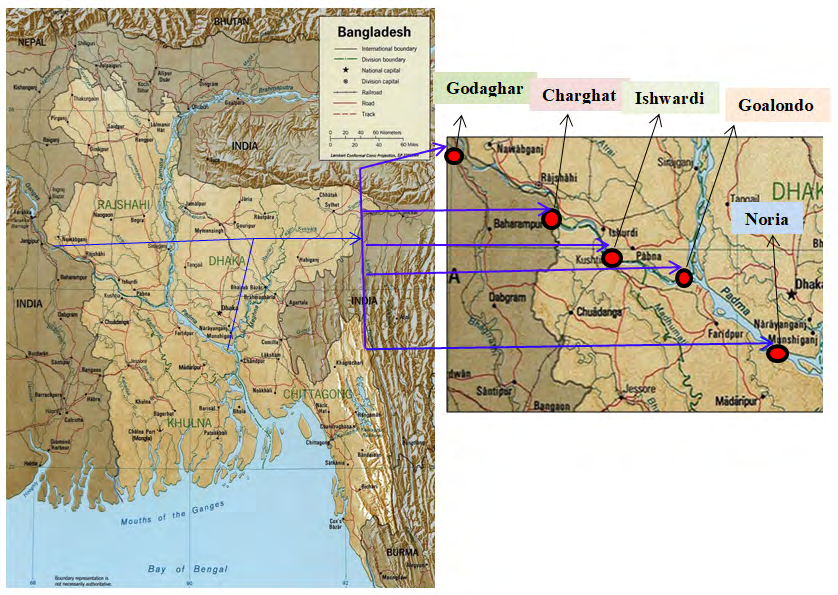
Ishwardi in Pabna district; Goalondo in Rajbari district and Noria in Shariatpur district of Bangladesh (Figure 1). The study area was selected by resouce person of the different basin sites through rapid assessment.
**Experimental Procedure**
The study was conducted during January to July, 2019 with particular emphasis on soil and water quality, biological productivity and status of fishery exploitation. A standard questionnaire was prepared, pre-tested and finalized. The questionnaire consisted of both quantitative and qualitative information. A survey was conducted for a total of 120 fishermen (24 members in each basin) on the basis of developed questionnaires. The research was operationalized through collection of both primary and secondary data. Primary data was collected by field observation which comprised of selected area of the river basin, survey of different fishing methods, conducted a series of Focus Group Discussions (FGDs) applying Local Ecological Knowledge (LEK), survey of fish market adjacent to waterbody, depot holders and monitoring feeding and breeding ground. Secondary data were collected from Department of Fisheries (DoF), comprehensive literature review and internet sites.
**Formation of Committee and Awareness Meeting**
Questionnaire based survey was conducted by a total of 120 stakeholders. Local management committee with 24 members of each basin was selected. Basin area was organized with the community people living in the selected area through participatory discussion. Regular meeting were arranged fortnightly by the implementing team at every basin during investigation period where all stakeholders’ representative along with Upazilla Fisheries Officer,
**Water Quality Parameters**
Physico-chemical parameters in the river were monitored every 15 days interval between 9.00 and 10.00 h. The parameters were followed by the standard method of APHA [8]. A bamboo made meter scale was used to measure water depth. Water temperature was measured using a Celsius thermometer and dissolved oxygen, pH and total dissolved solids were calculated with the help of a multi meter (HQ 40 D, HACH, USA). Soil quality was also studied in terms of organic carbon by Walkley and Black [9]; organic matter by Piper [10]; and texture by Palmer and Troeh [11].
**Morphometry and Hydrodynamics of Experiment**
Generally, the main sources of water input into the Padma River ecosystem was Ganga river basin of India. Water flows were determined by both rainfall and flooded water from the Ganga river basin raising obstacle by Farakka Barrage, India. In the dry season, almost 70% areas of the waterbody were dried up except the lower region of Padma River where Jamuna River connected in Goalanda, Rajbari district. The accumulation or exchange of water took place during southwest monsoon. After recession of flood, water level in the river decreased snapping the other waterbody connection with the river. When surface area of the river was shrinking, fishes moved with water flow into deep water area of the river. The water of the river lost by Farraka Barrage caused shrinkage of the effective water area and lowering of depth in the river which affected the status of the aquatic biodiversity of the river of upper region.
**Fishing Method**
Detail survey on fishing method of the Padma River was conducted with particular emphasis on number of different gears and traps. Fishers’ used boat for transport of nets and related materials and used seine net (ber jal), komor jal, bua jal, lift net, cast net, current jal, various type of fish traps, hook and lines according to season and availability of different species of fish. During monsoon and post monsoon, fisher’s used lift net, current jal, traps, hook and lines to catch fishes. They also operated cola fishing by sein net (Ber jal and Komor jal) in winter, spring and summer season.
The number of code of IUCN [12] was followed to categorize the status of the six species and to compare the trend among different years Shannon index was followed by Shannon [13].
**Shannon Diversity Index**
$$H = \sum_{i=1}^{n} - \left( P_i * \ln P_i \right)$$
Where:
- $H$ = the Shannon diversity index
- $P_i$ = fraction of the entire population made up of species $i$
- $S$ = numbers of species encountered
- $\sum$ = sum from species 1 to species $S$
- Note: The power to which the base $e$ (e = 2.718281828...) must be raised to obtain a number is called the natural logarithm (ln) of the number.
**Analysis of Experimental Data**
The collected data were analyzed through one way ANOVA using MSTAT followed by Duncan’s Multiple Range Test to find out whether any significant difference existed among treatment means [14, 15]. Standard deviation in each parameter was calculated and expressed as mean ±S.D.
Results
Location of the Basin
A total number of six basins were identified in the different sites of Padma River on the basis field survey and indigenous knowledge of local fisher’s (Table 1). Among the six basins, according to 95.83% responded, Bagha, Rajshahi basin was not found for the feeding and breeding ground of important six species. But according to (91.67-98.33)% responded, Godagari and Charghat, Rajshahi; Ishwardi, Pabna; Goalondo, Rajbari and Noria, Munshigong were found to be suitable for the breeding, feeding and nursery grounds for major catfish and chital.
| Location | Responded percentage (%) (n=120) | Remarks | |
|---|---|---|---|
| Godagari | Matikata to Sharengpur | 97.50 | Identified for breeding, feeding and nursery ground |
| Charghat | Eshobpur to Sarda bazar | 98.33 | Identified for breeding, feeding and nursery ground |
| Bagha | Vanukor, Mirgonj | 95.83 | Not suitable for breeding, feeding and nursery ground for last 15 years |
| Ishwardi | Sharaghat to Hardinge bridge | 91.67 | Identified for breeding, feeding and nursery ground |
| Goalondo | Uregatha to Doulatdia | 93.33 | Identified for breeding, feeding and nursery ground |
| Noria | Khejurtola bazar to Palerchor | 97.50 | Identified for breeding, feeding and nursery ground |
Table 1: Identified the location of the six basins of Padma River.
Area of the Basin
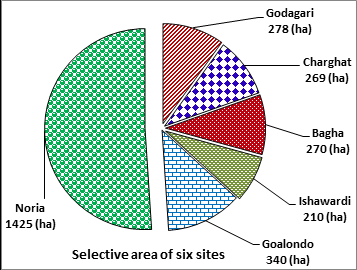
The names of the identified basins were Godagari, Bagha and Charghat, Rajshahi; Ishwardi, Pabna; Goalondo, Rajbari and Noria, Munshigong (Figure 2). The area of the Godagari, Bagha, Charghat,Ishwardi, Goalondo and Noria basins were 278±8.80, 269±6.55, 270±5.34, 210±4.05, 340±6.23 and 1425±8.68 ha, respectively.
Physical Characteristics of River
Soil texture of six basins of Padma River bed was silty, clay and loam. In the deeper bed, structure of soil texture appeared to have predominantly loam and in the river sites were found to be clay to sandy (Table 2). Sand, clay and silt’s percentage of six sites were varied from 20% to 30%, 10% to 18% and 51% to 68%, respectively. Organic carbon and organic matter’s percentage of six sites were ranged from 0.20% to 0.38% and 0.35% to 0.57%. Highest percentage of organic carbon and organic matter were recorded at 0.38% and 0.57% in Godaghari, Rajshahi basin and lowest percentage of organic carbon and organic matter were recorded at 0.20% and 0.35% in Noria, Munshigong. The soil bed of the Noria, Munshigong appeared to be sandy loam (sand, 30%, clay, 18% and silt, 52%) which was more suitable habitat for major cat fish and chitol. The soil bed of Godagari basin was found to be enriched with bivalve spats which indicated the rich habitat of pangas.
| Organic carbon (%) | Organic matter (%) | Soil texture | |
|---|---|---|---|
| Godagari | 0.38±0.02 | 0.57±0.02 | Silty clay loam (Sand: 20%, clay: 17%, silt: 63%) |
| Charghat | 0.33±0.01 | 0.54±0.02 | Silty loam (Sand: 22%, clay: 10%, silt: 68%) |
| Bagha | 0.30±0.01 | 0.48±0.02 | Silty loam (Sand: 24%, clay: 10%, silt: 66%) |
| Ishwardi | 0.27±0.01 | 0.41±0.01 | Silty loam (Sand: 22%, clay: 14%, silt: 64%) |
| Goalondo | 0.21±0.01 | 0.37±0.01 | Sandy loam (Sand: 32%, clay: 17%, silt: 51%) |
| Noria | 0.20±0.01 | 0.35±0.01 | Sandy loam (Sand: 30%, clay: 18%, silt: 52%) |
Table 2: Soil quality of six basins of the Padma River during experimental period.
Depth of the Basins
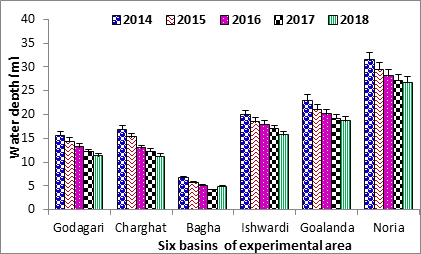
The depth of the six basins was recorded in the figure 3. The lowest depth of the Godagari was found at 11.26±6.94 m in the year 2018 and highest depth was found at 15.62±6.04 m in 2014. The lowest depth of the Charghat, Bagha, Ishawardi and Goalanda was found at 11.19±4.06, 4.91±1.30, 15.69±4.60 and 18.58±4.46 m in the year 2018 and in 2014, highest depth was recorded at 16.88±4.81, 6.70±1.62, 19.88±4.90 and 22.96±5.03 m, respectively. Lastly in 2018, the lowest depth of the Noria was at 26.66±6.80 m and highest depth was recorded at 31.47±5.97 m in 2014.
The highest depth of the selected six basins of the Padma River was recorded in the year 2014 and lowest depth was found in 2018. The lowest depth was found in Bagha, Rajshahi. So, this basin was not suitable for the habitat of major cat fish and chitol. There was a tendency to decrease the depth of the river bed shallow to shallower between 2018 and 2014 due to siltation and negative impact of Farakka Barrage.
Physico-Chemical Parameters of Water
The physico-chemical parameters of water of five basins were shown in the table 3. Water quality parameters were found within more or less suitable range during the study period. Lowest water temperature was recorded at 22.55 ± 5.050C in the basin of Ishwardi and highest water temperature was at 23.70 ± 5.450C in the Godagari’s basin . The temperature varied from 14.30 to 32.700C in the selected five basin. The pH range varied from 7.40 to 7.90 in the selected five basins of the Padma River. The highest pH was at 7.81±0.34 in the basin of Goalando and lowest pH was recorded at 7.38±0.66 in the Charghat’s basin. The lowest dissolve oxygen was recorded at 6.99±0.66 mg.L-1 in the basin of Ishwardi and highest was at 7.56±0.52 mg.L-1 in Noria. The range of dissolve oxygen was varied from 6.90 to 8.00 mg.L-1 in the selected five basins. The TDS range was varied from 185.00 to 522.00 mg.L-1 in the selected five basin of the Padma River. The highest TDS was found at 380.50±1.88 mg.L-1 in the basin.
| Parameters | Godagari | Charghat | Ishwardi | Goalondo | Noria |
|---|---|---|---|---|---|
| Temperature (oC) | 23.70 ± 5.45 (14.30-32.10) | 22.85 ±5.77 (14.50-31.20) | 22.55 ± 5.05 (15.00-30.10) | 22.95 ±5.12 (15.20-32.70) | 23.20±5.66 (15.40-31.20) |
| pH | 7.70±0.35 (7.90-7.50) | 7.38±0.66 (7.40- 7.36) | 7.62±0.55 (7.40-7.90) | 7.81±0.34 (7.60-7.95) | 7.78±0.52 (7.80-7.68) |
| Dissolve oxygen (mg.L-1) | 7.35±0.22 (7.50-7.20) | 7.12 ± 0.34 (7.00-7.24) | 6.99±0.66 (6.90-7.05) | 7.23 ± 0.48 (7.40-7.06) | 7.56±0.52 (8.00-7.12) |
| TDS (mg.L-1) | 380.50±1.88b (512.00-249.00) | 383.50±1.36a (522.00-244.00) | 375.00± 2.13c (507.00-243.00) | 379.00±2.13c (514.00-244.00) | 345.50± 2.13d (506.00- 185.00) |
Table 3: Physico-chemical characteristics of six basins of the Padma River during experimental period.
Figure with different superscripts in the same row differed significantly (P>0.05).
Figures in the parenthesis indicate the range of Godagari and lowest TDS was recorded at 345.50± 2.13 mg.L-1 in the basin of Noria, Munsigong. The TDS range of five basin was differed significantly (P>0.05).
Fishing Gears and Craft
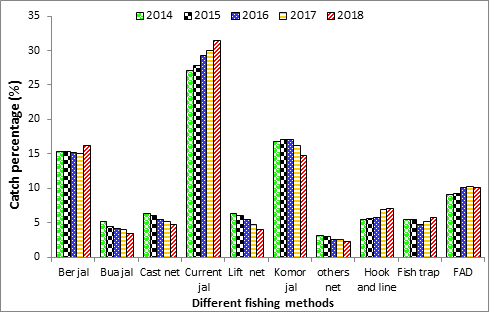
About 10 types of fishing methods were identified in the six basins of Padma River (Figure 4). In 2014, the percentage of catch statistics of six basins showed the use of Ber jal, Bua jal, Cast net, Current jal, Lift net, Komor jal, Other net, Hook and line, Fish trap and FAD were 15.30%,
5.10%, 6.30%, 27.10%, 6.30%, 16.80%, 3.10%, 5.50% and 5.40% and 9.10%, respectively. The number of using illegal current jal, ber jal (kaperi jal) and FAD were increased in 2013. Illegal using of current jal, ber jal (kaperi jal) and FAD were increased 27.10 to 31.50%, 15.30 to 16.20% and 9.10 to 10.10% between 2014 and 2018. Fishing by Hook and line and Fish trap were also increased at the rate of 5.50 to 7.10% and 5.40 to 10.10% during 2014 to 2018. On the other hand, Fishing by Bua jal, Cast net, Lift net and other nets were decreased at 5.10 to 3.4%, 6.3 to 4.8%, 6.3 to 4.0% and 3.1 to 2.3% during the year 2014 to 2018, respectively. There was a significant difference (P<0.05) in the percentages of fish catches among different fishing methods in that five years. A significant negative trend in fish catches was observed with Bua jal, Cast net, Lift net and other nets during.
Fish Breeding Season
According to survey, scientific knowledge, and FGD and LEK the breeding seasons of major cat fish and chitol species were identified (Table 4). About 98.33% responded was agreed that Pangasius pangasius species bred in the month of July to September and 95.83% responded discussed that Sperata aor build nest during reproduction and normally bred before the onset of the monsoon. According to 91.67% responded, Rita rita species bred on June to July and 93.33% said that Wallago attu bred once in a year in monsoon during May-August with a peak in June-July. About 97.50% responded was approved that Notopterus chitala bred between June and July by building nest and 95.83% responded agreed that Bagarius bagarius bred before the commencement of the monsoon rains (April-June). Pangasius pangasius, Sperata aor and Notopterus chitala attained maturity within three to four years and Rita rita, Wallago attu and Bagarius bagarius was gained their maturity within two to three years.
| Responded percentage (%) (n=120) | Maturity stage (Yr.) | Breeding season | |
|---|---|---|---|
| Pangasius pangasius (Pangas) | 98.33 | 3+ | July-September |
| Sperata aor (Ayre) | 95.83 | 3+ | April-May |
| Rita rita (Rita) | 91.67 | 2+ | June-July |
| Wallago attu (Boal) | 93.33 | 2+ | May-August |
| Notopterus chitala (Chitol) | 97.50 | 3+ | June-July |
| Bagarius bagarius (Baghair) | 83.33 | 2+ | April-June |
Table 4: Breeding season of important six species.
Fish Production
Pangas, Pangasius Pangasius Native pangas production of five basins is presented in the figure 5.A. The highest pangas production was recorded at 7.21±1.11, 4.42±1.01, 7.15±1.44 and 12.67±2.42 mt in the basin of Godagari, Charghat, Goalondo and Noria in the year 2014 and lowest production recorded at 4.22±0.94, 2.87±0.74, 3.50±0.86 and 10.35±2.04 mt in the same basin. In 2016, only 0.33 mt pangas was found in the Ishwardi basin. There was a decreasing trends was found in the five basins between 2014 and 2018.
Ayre, Sperata aor Figure 5.B represents the Ayre, Sperata aor production of five basin in the Padma River. The lowest production was
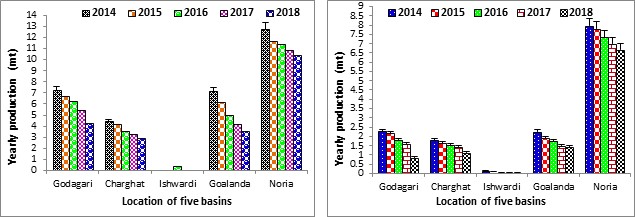
Figure 5A: The catch statistics of Pangasius angasius species in five basins of Padma river during 2014 to 2018.
recorded at 0.85±0.01. 1.11±0.01, 0.04±0.00, 1.42±0.06 and 6.66±1.22 mt in the basin of Godagari, Charghat, Ishwardi, Goalondo and Noria and highest production was found 2.27±0.90, 1.80±0.01, 0.14±0.00, 2.26±0.04 and 7.97±1.66 mt in the five basins. A decreasing trends was found in the five basins during 2014 to 2018.
Rita (Rita rita) Species, Rita rita production of five basins is presented in the figure 5.C. The highest rita production was recorded at 1.10±0.07, 6.58±1.01, 0.14±0.01, 2.23±0.08 and 5.25±0.88 mt in the basin of Godagari, Charghat, Ishwardi, Goalondo and Noria in the year 2014 and lowest production was at 0.70±0.01, 4.67±0.90, 0.07±0.01, 1.18±0.06 and 3.96±0.44 mt in the same basins. A decreasing trends was recorded in the five basins between 2014 and 2018.
Figure 5B : The catch statistics of Sperata aor species in five basins of Padma River during 2014 to 2018.
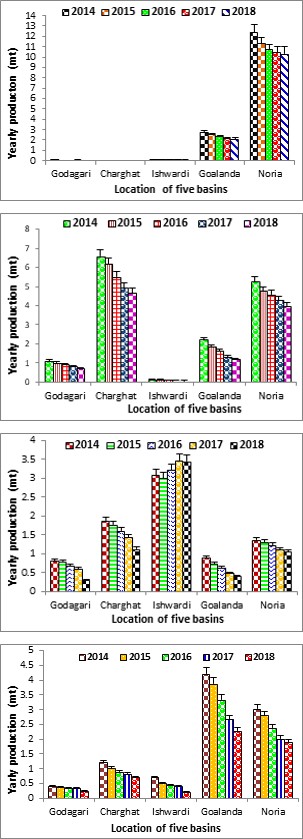
Figure 5C : The catch statistics of Rita rita species in the five basins of Padma river during 2014 to 2018.
Figure 5E: The catch statistics of chitol, Notopterus chitola in five basin of Padma river during 2014 to 2018.
Figure 5D: The catch statistics of Wallago attu species in the five basins of Padma river during 2014 to 2018.
Figure 5F: The catch statistics of baghair, Bagarius bagarius in five basin of Padma river during 2014 to 2018.
Figure 5(A-F): The catch statistics of six species in the five basin of Padma River during 2014 to 2018.
Boal, Wallago attu Figure 5.D represents the Boal, Wallago attu production of five basin in the Padma River. The lowest production was recorded at 0.09±0.00, 2.07±0.04 and 10.32±2.01 mt in the basin of Ishwardi, Goalondo and Noria and highest production was at 0.11±0.00, 0.14±0.01, 2.76±0.55 and 12.40±2.05 mt in the basin of Godagari, Ishwardi, Goalondo and Noria basins. The production Wallago attu was zero in Charghat during five years and the production of boal was also zero during 2016 to 2018 in the Godaghari basin. A decreasing trends recorded in the five basins between 2014 and 2018.
Chitol, Notopterus chitola Species, Notopterus chitola production of five basins is presented in the figure 5.E. The highest chitol’s production was recorded at 0.81±0.01, 1.88±0.02, 3.08±0.08, 0.89±0.05 and 1.36±0.03 mt in the basin of Godagari, Charghat, Ishwardi, Goalondo and Noria in the year 2014 and lowest production was at 0.31±0.00, 1.22±0.01, 3.45±0.03, 0.40±0.01 and 1.06±0.02 mt in the same basins. There was a decreasing trends was recorded in the five basins between 2014 and 2018. But in Ishwardi, control natiural breeding of chitol was practiced by Asraf uddin duburi Chandbarimore, Ishwardi.
Baghair, Bagarius bagarius Figure 5.F represents the Baghair, Bagarius bagarius production of five basin in the Padma River. The lowest production was recorded at 0.25±0.00, 0.71±0.00, 0.21±0.00, 2.28±0.44 and 1.90±0.04 mt in the basin of Godagari, Charghat, Ishwardi, Goalondo and Noria and highest production was at 0.42±0.01, 1.21±0.01, 0.71±0.01, 4.22±0.77 and 3.02±0.88 mt in the basin of Godagari, Ishwardi, Goalondo and Noria. A decreasing trends was found in the five basins between 2014 and 2018.
Total Production
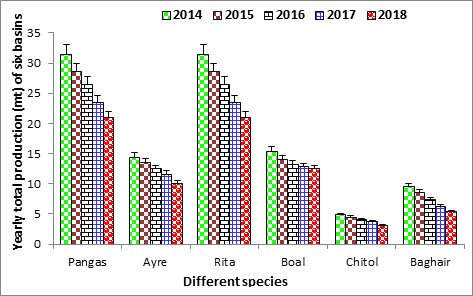
Yearly total production of six species is presented in the figure 6. The total production of pangas, Pangasius pangasius was noted at 31.45±5.42, 28.54±4.42, 26.42±3.88, 23.51±3.32 and 20.94±2.24 mt between 2014 and 2016. During 2014 to 2018 the production of ayre, Sperata aor was at 14.44±2.44, 13.59±2.22, 12.48±1.88, 11.60±1.44 and 10.08±1.08 mt in the five basin. Between 2014 and 2018, the total production of rita, Rita rita was recorded at 31.45±5.34,
28.54±5.04, 26.42±4.66, 23.51±4.34 and 20.94±3.88 mt and the production of boal, Wallago attu recorded at 15.41±3.04, 14.05±2.88, 13.17±2.10, 12.79±2.06 and 12.48±2.01 mt in the five basins. The total production of Chitol, Notopterus chitola recorded was at 8.02±1.48, 7.61±1.33, 7.36±1.23, 7.11±1.12 and 6.34±0.98 mt and production of baghair, Bagarius bagarius was noted at 9.58±1.88, 8.60±1.37, 7.41±1.22, 6.26±1.15 and 5.35±1.04 mt between 2014 and 2016.
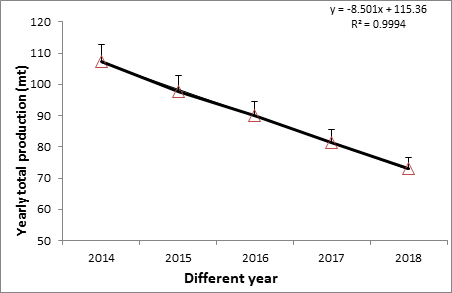
Total production of five basins were recorded at
107.23±8.34, 97.80±7.76, 89.93±6.64, 81.35±5.54 and 72.95±5.04 mt during the year 2014 to 2018, respectively (Figure 7). A decreasing trend of total significantly (P>0.05). The decreasing trends or regression type was linear and the equation was y = - 8.501x +115.36; where, R2 is 0.9994. The production of Pangasius pangasius species was production was recorded between 2014 and 2018 in five basins of the Padma River which was differed decreased at the percentage of 9.25, 15.99, 25.25 and 33.42% between 2014-15 and 2017-18 (Figure 8.A). The decreasing trends or regression type was linear and the equation was y= 8.177x +5.35; where, R2 is 0.9965. In case of Sperata aor, the decreasing percentage was at 9.25, 15.99, 25.25 and 33.42% beteen 2014-15 and 2017-18, and decreasing trends or regression type was linear and the equation was y = 7.74x + 2.385; where, R2 is 0.9951 (Figure 8.B). The decreasing production percentage of rita, Rita rita was 9.08, 16.73, 25.29 and 30.84% between the year 2014-15 and 2017-18 and decreasing trends or regression type was Polynomial and the equation was y = 0.525x2 +10.009x - 0.6; where, R2 is 0.9972 (Figure 8.C).
Decreasing production of Wallago attu recorded 9.51, 15.54, 18.18 and 20.33% during the year 2014-15, 2015-16, 2016- 17 and 2017-18, respectively (Figure 8.D). The decreasing trends or regression type was Polynomial and the equation was y= 0.97x2 +8.36x + 2.265; where, R2 is 0.9936. In case of Notopterus chitala, the decreasing production percentage was recorded at 8.57, 17.76, 24.90 and 35.51% between 2014-15 and 2017-18 and decreasing trends or regression type was linear and the equation was y = 8.796x - 0.305;
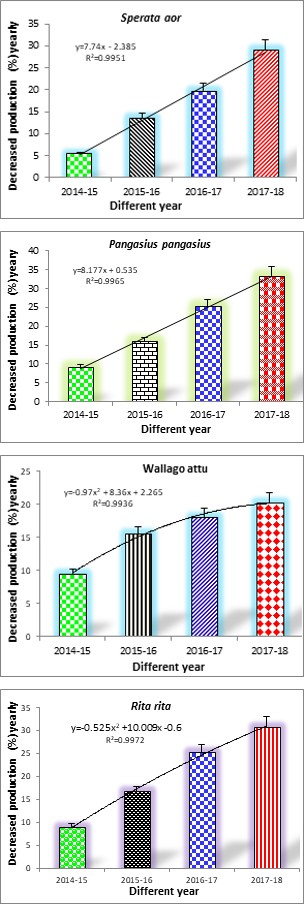
Figure 8A: Year wise a decreased trends of Pangasius pangasius production percentage during 2014-15 to 2017-2018.
Figure 8C: Year wise a decreased trends of Rita rita production percentage during 2014-15 to 2017-2018.
where, R2 is 0.9948 (Figure 8.E). The decreasing production percentage of Bagarius bagarius was recorded at 14.17, 28.65, 34.49 and 43.81% between 2014-15 and 2017-18 and regression type was linear and the equation was y= 9.476x + 6,59; where, R2 is 0.9698 (Figure 8.F). Total production percentage of six species was decreased at 31.97% between 2014-15 and 2017-18 in the Padma River which was differed significantly (P>0.05).
Figure 8B: Year wise a decreased trends of Sperata aor pro- duction percentage during 2014-15 to 2017-2018.
Figure 8D: Year wise a decreased trends of Wallago attu pro- duction percentage during 2014-15 to 2017-2018.
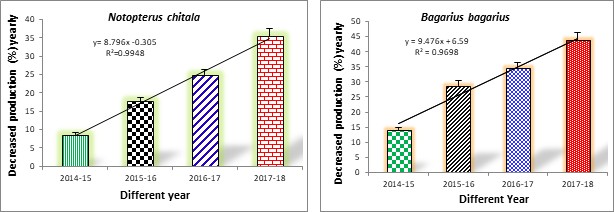
Figure 8E: Year wise a decreasing trends of Notopterus chitola production percentage during 2014-15 to 2017-2018.
Figure 8F: Year wise a decreasing trends of Bagarius bagarius production percentage during 2014-15 to 2017-2018.
Figure 8(A-F): Decreasing trend of six species in five basins of the Padma River during 2014-15 to 2017-2018.
Nursery of chitol, Notopterus chitola
The location of Notopterus chitola nursery of Padma River was in Harding Bridge and Lalon Satu, Sara Ghat and Boro para, Ishwardi, Pabna. Control natural breeding was practiced in these three sites of the river for fry production. The habitat of chitol was developed by installing with bamboo pole, and plastic and cemented drum at the bottom of the basin. Upper site of the dram cut out and placed in a target place of breeding area. Rice brain and mustard oil cake (80:20) packed in a jute fiber packet and placed weekly in the targeted conserve area by traditional method. A brood fish of 100 chitols was released in every targeted conserve area of Padma River. When the habitat of chitol was suitable for their feeding and breeding, wild chitol was attracted and wild population of chital joined with these 100 brood fishes. After breeding the fertilized eggs were attached with the dram and dissolved yolk sac. At the age of 14 days fry with dram was placed in 8 to 9 meter depth of water. After next 2 to 3 days the dram with fry collected and fry (8-10cm) was ready for sale to fry collectors. The production number of Harding Bridge and Lalon Satu nursery area were at 0.14±0.01, 0.16±0.0, 0.17±0.01 and 0.11±0.01million during 2015 to 2018. Between 2015 and 2018, production of Saraghat area was recorded at 0.07±0.00, 0.08±0.00, 0.10±0.00 and 0.06±0.00 million. The production number of Boropara area was counted at 0.12±0.01, 0.14±0.01, 0.15±0.01and 0.19±0.01million between 2015 and 2018 (Table 5).
| Location | Stocking of brood (Number) | Area (ha) | Production in number (million) | Remarks | |||
|---|---|---|---|---|---|---|---|
| 2015 | 2016 | 2017 | 2018 | ||||
| Harding Bridge and Lalon Satu | 100 | 2.2 | 0.14 ±0.01 | 0.16 ±0.01 | 0.17 ±0.01 | 0.11 ±0.01 | Decreased production due to barrage of Rup pur Nuclear Power Plant |
| Saraghat | 100 | 1.1 | 0.07 ±0.00 | 0.08 ±0.00 | 0.10 ±0.00 | 0.06 ±0.00 | |
| Boropara | 100 | 1.5 | 0.12 ±0.01 | 0.14 ±0.01 | 0.15 ±0.01 | 0.19 ±0.01 |
Table 5: The number of production (million) in the 03 nursery area of Iswardi basin in Padma River.
Another practice of ayre, Sperata aor nursery was practiced in the Saraghat area by fisher Md. Abdur Rahman, Saraghat, Ishwardi. The habitat of ayre fish was developed for natural breeding. Ayre build nest during reproduction and guard as well normally breeds before the start of the monsoon. An expert fisher drived in the water and find out the nest and colleced fry of ayre from the nest. The collected record of this area was 8000, 14000 and 19000 number of fry during the year 2016, 2017 and 2018, respectively.
Status of Fishes
The status of the six fishes was ranked as different status of IUCN (Table 6). Pangas, Pangasius pangasius species was facing as extremely higher risk of extinction (Critically endangered, CR) in Ishwardi and Goalnanda, facing as high risk of extinction (Vulnerable status, VU) in Charghat and facing as lower risk of extinction (Vulnerable status, LR) in Godagari and Noria. The species Ayre, Sperata aor was facing as extremely higher risk of extinction (CR) in Ishwardi, facing as very high risk of extinction (EN) in Charghat, facing as high risk of extinction (VU) in Godagari and Goalondo and facing as lower risk of extinction (LR) in Noria. The species rita, Rita rita was facing as extremely higher risk of extinction (CR) in Godagari and Charghat, facing as very high risk of extinction (EN) in Ishwardi, facing as high risk of extinction (VU) in Goalondo and facing as lower risk of extinction (LR) in Noria. The species Boal, Wallago attu was facing as extremely higher risk of extinction (CR) in Ishwardi, facing as very high risk of extinction (EN) in Godagari, Charghat and Goalondo and (Critically endangered, CR; Endangered, EN); Vulnerable status, VU; Lower Risk, LR; ranking followed IUCN) facing as lower risk of extinction (LR) in Noria. The species Chitol, Notopterus chitala was facing as very high risk of extinction (EN) in Goalondo and Noria, facing as higher risk of extinction (VU) in Godagari and Charghat, and facing as lower risk of extinction (LR) in Ishwardi. The species Baghair, Bagarius bagarius was facing as extremely higher risk of extinction (CR) in Charghat, Ishwardi and Goalondo and facing as very high risk of extinction (EN) in Godagari and Noria.
| English name | Scientific name | Picture | Location | Status | |||||
|---|---|---|---|---|---|---|---|---|---|
| Pagas | Yellow tail catfish | Pangasius pangasius | Godagari | LR | |||||
| Pagas | Yellow tail catfish | Pangasius pangasius | Charghat | VU | |||||
| Pagas | Yellow tail catfish | Pangasius pangasius | Ishwardi | CR | |||||
| Pagas | Yellow tail catfish | Pangasius pangasius | Goalondo | CR | |||||
| Pagas | Yellow tail catfish | Pangasius pangasius | Noria | LR | |||||
| Pagas | Yellow tail catfish | Pangasius pangasius | Ayre/Aor | Long-whiskered catfish | Sperata aor | Godagari | VU | ||
| Charghat | EN | ||||||||
| Ishwardi | CR | ||||||||
| Goalondo | VU | ||||||||
| Noria | LR | ||||||||
| Rita | Rita | Rita rita | Ayre/Aor | Long-whiskered catfish | Sperata aor | Godagari | CR | ||
| Rita | Rita | Rita rita | Ayre/Aor | Long-whiskered catfish | Sperata aor | Charghat | CR | ||
| Rita | Rita | Rita rita | Ayre/Aor | Long-whiskered catfish | Sperata aor | Ishwardi | EN | ||
| Rita | Rita | Rita rita | Ayre/Aor | Long-whiskered catfish | Sperata aor | Goalondo | VU | ||
| Rita | Rita | Rita rita | Ayre/Aor | Long-whiskered catfish | Sperata aor | Noria | LR | ||
| Rita | Rita | Rita rita | Boal/Boali/Boallee | Wallago | Wallago attu | Godagari | EN | ||
| Charghat | EN | ||||||||
| Ishwardi | CR | ||||||||
| Goalondo | EN | ||||||||
| Noria | LR | ||||||||
| Knife fish/Chitol | Clown Knifefish | Notopterus chitala | Boal/Boali/Boallee | Wallago | Wallago attu | Godagari | VU | ||
| Knife fish/Chitol | Clown Knifefish | Notopterus chitala | Boal/Boali/Boallee | Wallago | Wallago attu | Charghat | VU | ||
| Knife fish/Chitol | Clown Knifefish | Notopterus chitala | Boal/Boali/Boallee | Wallago | Wallago attu | Ishwardi | LR | ||
| Knife fish/Chitol | Clown Knifefish | Notopterus chitala | Boal/Boali/Boallee | Wallago | Wallago attu | Goalondo | EN | ||
| Knife fish/Chitol | Clown Knifefish | Notopterus chitala | Boal/Boali/Boallee | Wallago | Wallago attu | Noria | EN | ||
| Knife fish/Chitol | Clown Knifefish | Notopterus chitala | Baghair | Dwarf goonch | Bagarius bagarius | Godagari | EN | ||
| Charghat | CR | ||||||||
| Ishwardi | CR | ||||||||
| Goalondo | CR | ||||||||
| Noria | EN |
Table 6: Status of six fish species in five basins.
Marketing Channel
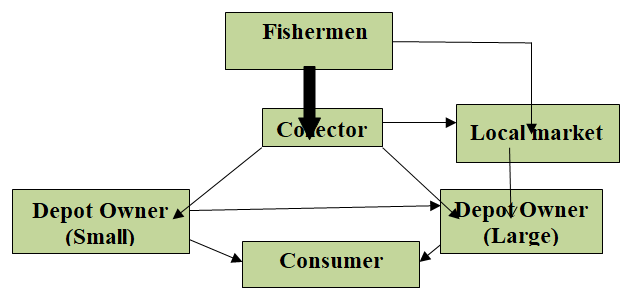
In most cases the fishes were marketed in the nearby markets based on auction through fisher to depot holder (Figure 9). The marketing channel of fish business was found to be consisted with the fisher’s, foria (middle men), depot owner’s suppliers and agents. The trading pattern involved a series of intermediaries from fisherman to consumer. In general it was found that the fisherman sale the fish in the local market. The collectors collect the fish and sale in depot and transfer the fish to big market.
Major Problems Reported by the Fishermen
A major problem reported by the fishermen in the study sites is shown in the table 7. About 87.50% to100% responded fisher’s was argued siltation and sedimentation and 91.67% to 100.00% said shallow depth and water flow was responsible for the lower production of major cat fish and chitol. On the other hand, according to 91.67% to 100.00% and 91.67% to 100.00% fisher’s, over exploitation and illegal fishing was responsible for lower production of six species including other fish species.
| Findings | Percentage (%) of responded fisher’s in different basin | ||||
|---|---|---|---|---|---|
| Godagari (N=24) | Charghat (N=24) | Ishwardi (N=24) | Goalondo (N=24) | Noria (N=24) | |
| Siltation and sedimentation | 95.83 | 100.00 | 91.67 | 91.67 | 87.50 |
| Shallow depth and water flow | 95.83 | 100.00 | 95.83 | 91.67 | 91.67 |
| Over exploitation | 100.00 | 95.83 | 100 | 95.83 | 91.67 |
| Illegal fishing | 100.00 | 100.00 | 91.67 | 95.83 | 91.67 |
| No sanctuary | 100.00 | 100.00 | 95.83 | 91.67 | 95.83 |
| Lack of Govt. support | 95.83 | 100.00 | 95.83 | 95.83 | 95.83 |
| Pollution | 83.33 | 95.83 | 83.33 | 79.17 | 83.33 |
| Fishing by poisoning | 91.67 | 83.33 | 95.83 | 91.67 | 79.17 |
| Unplanned dam | 95.83 | 95.83 | 79.17 | 83.33 | 83.33 |
Table 7: Major problems reported by the fishermen in the study sites.
According to 91.67% to 100.00% fishers, declaring no sanctuary was the causes of lower production of fish. About 95.83% to 100.00% fisher’s said that lack of governments’ support was created negative impact of the production of selected basins. According to 79.17% to 95.83% fishers’, pollution and fishing by poisoning was the another causes of lower production of fishes. About 79.17% to 95.83% responded argued that construction of unplanned dam was responsible for the critical production fish.
Discussion
The water depth of the Padma River was showed a decreasing trend between 2014 and 2018. The physico- chemical factors were found to be more or less in normal range in the five basins of Padma River which is agreed by APHA [8]. Water temperature of the five basins of Padma River showed increasing trend in monsoon and post monsoon season and decreasing trend in winter which is supported by Mathew [16]. The uniformly average value of oxygen range (6.90 to 8.00 mg.L-1) was noted in the five basins of the river agrees well with the findings of APHA [8]. pH (7.40 to 7.90) values of the river was more or less similar with the findings of Boyd [17] and Chakraborty and Mirza [18].
The fishing effort with various types of fishing methods such as seine net (especially kaperi jal), gill net (current jal) and FAD was increased between the year 2014 and 2018. But use of current jal was increased dramatically during same period. As a result, an average number of fishes declined in the surveyed five basins of the Padma River which is very similar to the study of Haroon, et al. [19]. He reported eighteen types of fishing gears from the Sylhet sub-basin and thirteen type’s gears recorded from Mymensingh subbasin. Sugunan and Bhattacharjia [20] found a wide variety of fishing methods employed in the beels of Assam, India which are very similar to the present study.
The catch statistics indicate that fishing pressure of the five basins of the Padma River was increased rapidly in the year 2014 to 2018. As a result, a decreasing trend in production percentage of the river was clearly pronounced within five years which was very similar to the report of Moyle and Leidy [21]. According to them, worldwide 20% of all freshwater species are extinct, endangered or vulnerable. The total catch statistics of major cat fish and chitol in the Padma river indicated that percentage of six species was sharply decreased within five years which is very similar to the study of Chakraborty [22, 23, 24, 18]. Shannon index, Shannon [13] was used to identify the present status of the five basins of the Padma River. Indicators of IUCN [12] were used for ranking of six species of Padma River. Commercially important Pangas (Pangasius pangasius) species was facing as extremely higher risk of extinction (CR) in the basin of Ishwardi and Goalondo, Vulnerable status in Charghat and Lower Risk in Godagari and Noria. The status of ayre (Sperata aor) was extremely higher risk of extinction (CR) in Ishwardi basin, extremely high risk of extinction (EN) in Charghat, Vulnerable status (VU) in Godagari and Goalondo basin and lower risk (LR) in Noria basin. The position of rita (Rita rita) was extremely higher risk of extinction (CR) in Godagari and Charghat basin, extremely high risk of extinction (EN) in Ishwardi, Vulnerable status (VU) in Goalondo basin and lower risk (LR) in Noria basin. In status of Boal (Wallago attu) was extremely higher risk of extinction (CR) in Ishwardi, extremely high risk of extinction (EN) in Godagari, Charghat and Goalondo, and lower risk (LR) in Noria basin. The species chitol (Notopterus chitala) was extremely high risk of extinction (EN) in Goalondo and Noria, Vulnerable status in Godagari and Charghat, and lower risk (LR) in Ishwardi basin. The status of Baghair (Bagarius bagarius) was extremely higher risk of extinction (CR) in Charghat, Ishwardi and Goalondo basin and extremely high risk of extinction (EN) in Godagari and Noria basin. Due to over-exploitation and various ecological changes in natural aquatic ecosystem health such as five basins of Padma River, commercially important six species were very stress position which is agreed with the findings of Mohsin, et al. [25], Galib, et al. [26] and Sarker [27].
Control natural breeding and nursery of Notopterus chitola was practiced in the Harding Bridge and Lalon Satu, Sara Ghat and Boro para sites of the river for chitol fry production [28]. The study clearly showed that major cat fish and Chitol fish of five basins of the Padma River were subjected to over exploitation resulting in gradual deterioration of fish population including targeted six species. On the other hand, aquatic ecosystem health of the Padma River is varying due to global affect, construction of Farakka Barrage of Ganga River, other flood control barrage, soil erosion, siltation and sedimentation. Domestic organic wastes (sewage) directly or indirectly passing through canals or small river to Padma River were polluted the aquatic ecosystem health. The genetic stock structure of aquatic populations was reduced due to pollution and destructive fishing practices [29]. Over exploitation and indiscriminate killing of fish occurred due to the use of pesticides which is very much similar to the observation of Chakraborty [23]. Stock of the wildlife brood fishes in the breeding ground of river basin was also suffered significant damages resulting in a reduction of biodiversity as noted by Nishat [30], Zaman [31] and Chakraborty [23]. In this study, Pangasius pangasius attained maturity at the end of the third to forth year age and breeding season of Pangas was identified in the month of July to September which is agreed by David [32], Rahman [33]. Sperata aor built nest during reproduction and guard as well normally bred before the onset of the monsoon (April to May) at the age of third or fourth year [34]. Breeding period of Rita rita was in the month of June and July. That finding is agreed by Alam, et al. [35]. From this study it is found that Wallago attu bred once in a year in monsoon during May to August with a peak in June-July which is supported by Ahmad [36] and Talwar and Jhingran [34]. Notopterus chitala attained maturity at the age of three years plus and bred between June and July by building nest [37, 38]. Bagarius bagarius attained maturity at the end of the two to third year and breeding season of that species is identified in the month of April to June which is very much closed to study of Talwar and Jhingran [34].
A management committee of the chitol fish nursery was formed who developed a working frame on sharing of benefits, developing rules and regulations for nursery resource management. Weekly meeting was held by the management committee to monitor and progress of the chitol nursery practice. Participation of local communities and their active involvement played an important role in overall management of the fishery resources of Padma River [25, 24].
The natural populations of cat fishes and chitol was drastic declined due to over exploitation, habitat degradation, water pollution, destruction of the breeding grounds and lack of proper management and was faced the threat of extinction in nature. Conservation measures reduction of pressure on the natural populations of any fish species under threat is the first and foremost measure to conserve the particular fish species [23]. Stock of the six broad fishes and other species in the breeding ground was suffered significant damages, resulting in a reduction of biodiversity as well as a decline in the socio-economic importance of different basins of Padma River as a source of food and materials of livelihood which is very similar investigation of Nishat [30] and Zaman [31]. Comparatively better result of fish production was recorded with Noria basin of Shariatpur district might be due to the efforts taken for Hilsha fish conservation in terms of awareness increase, fishing ban during breeding season, declaration of fish sanctuary, provide fishers with VGF and alternative employment opportunities DOF [5], which ultimately increased the production of different fish species.
Conclusion
The ecosystem health of the Padma River basin for six species was affected by insufficient water flow from Farakka Barrage of Ganga River for insufficient area, shallow depth and blocked water flow, use of chemicals, fertilizer, pesticide and infrastructure development and over exploitation. The action plan efforts for saving the stock of major cat fishes and chitol will be as, develop ecosystem health of the river, declare the basin of the river as conservation; upgrade management method for the conservation and promotion of catfish and chital, enforcement of fishing rules; control over exploitation and illegal fishing; prohibition on harvesting of brood fishes during breeding period, ensure sufficient water flow from Ganga River through Farakka Barrage, and regular flow of water in basin, develop an alternative income generating activities during breeding season, control unplanned construction of flood embankments, sluice gates; controlling use of pesticides and agrochemicals to reduce water pollution. Comparatively a better management especially for Hilsha conservation and better governance for the fishermen affected the availability and production of the major catfish and chital in Noria basin of Shariatpur district.
Acknowledgement
The authors acknowledge the moral support and facilities provided by employees of Fisheries Department and stakeholder of the related area for its kind support and cooperation.
References
-
Jones T, Phillips B, Williams CE, Pittock J (2003) _Managing_ _rivers wisely_: lesions from WWF’s work for integrated river basin management. WWF (World Wildlife Fund) International, Gland Switzerland.
-
Patra MK, Acharjee SK, Chakraborty SK (2005) Conservation categories of siluroid fishes in North-East Sundarbans, India. Biodiversity Conservation 14(8): 1863-1876.
-
Stone R (2007) The last of the leviathans_._ Science 316(5832): 1684-1688.
-
Hasan H, Rahman MM, Sarker MR, Ali MM, Hossen S (2016) Fish diversity and traditional fishing activities of the river Padma at Rajshahi, Bangladesh. World J Fish and Marine Sci 8(3): 151-157.
-
DoF (2019) _National fish week 2019 compendium_ (in Bangla). Department of Fisheries, Ministry of Fisheries and Livestock, Bangladesh, pp: 160.
-
Rahman MM, Hossain MY, Ahmed F (2012) _Biodiversity in_ _the Padma distributary of the Ganges river, Northwestern_ _Bangladesh_: recommendations for conservations. World J Zool 7(4): 328-337.
-
Joadder MAR, Galib SM, Haque SMM, Chaki N (2015) Fishes of the river Padma, Bangladesh: current trend and conservation status_._ J Fish 3(2): 259-266.
-
APHA (1998) Standard methods for the examination of water and wastewater, 20th (Edn.), American Public Health Association, Washington, DC, USA.
-
Walkley A, Black IA (1934) An examination of the Degtjareff method for determining soil organic matter, and a proposed modification of the chromic acid titration method. Soil Science 37(1): 29-38.
-
Piper C (1950) Soil and plant analysis. Inter Science Publisher inc., New York.
-
Palmer RG, Troeh FR (1995) Introductory Soil Science Manual, Oxford University Press, Oxford, U.K.
-
IUCN (2000) Red book of threatened Fishes of Bangladesh. IUCN-The World Conservation Union Cambridge, U.K.
-
Shannon CE (1948) A mathematical theory of communication. Bell Syst Tec J 27: 379-656.
-
Duncan DB (1955) Multiple range and multiple F-testes. Biometrics 11(1): 1-42.
-
Zar JH (1984) Biostatistics. Prentice-Hall, Inc. Englewood Cliffs, NJ, U.S.A.
-
Mathew PW (1975) Limnology and productivity of Govindgarh Lake, Maddya Prodesh, India. J Inland Fish Soc India 11: 16-24.
-
Boyd CE (1982) Water Quality Management for Pond Fish Culture. Elsevier, The Netherlands.
-
Chakraborty BK, Mirza JA (2010) Status of Aquatic Resources in Someswari River in Northern Bangladesh. J Asian Fish Sci 23(2): 174-193.
-
Haroon AKY, Halder GC, Rahman SL, Razzaque MA, Alam M, et al. (2002) Sylhet-Mymensingh Basin Fish Stock Assessment. Final Report. Bangladesh Fisheries Research Institute, Reverine Station, Chandpur, Bangladesh.
-
Sugunan VV, Bhattacharjea BK (2000) Ecology and Fisheries of Beels in Assam. Bull. No. 104, CIFRI, Barrackpore, West Bengal, India.
-
Moyle PB, Leidy RA (1992) Loss of biodiversity in aquatic ecosystems: Evidence from fish faunas. In: Fiedler PL, Jain SK, (Eds.), Conservation Biology: The Theory and Practice of Nature Conservation, Preservation, and Management, UCDAVIS, New York, pp: 128-169.
-
Chakraborty BK (2009) Study of Aquatic Biodiversity of Someswari and Nethai River; Gharia and Nidaya Beel of Northern Bangladesh. In: Nakamura TK, (Ed.), Aquaculture Research Progress, Nova Science Publishers, New York, pp: 3231-268.
-
Chakraborty BK (2010) Status and Position of Aquatic Biodiversity of Four Beels and its Floodplain Level of Northern Bangladesh with a Good Practice of Beel Nurseries and Community Based Co-Management Policy. In: Daniels JA, (Ed.), Advances in Environmental Research, Nova Science Publishers, New York 8: 121- 164.
-
Chakraborty BK, Shahroz MH, Bhuiyan AB, Bhattacharjee S, Chattoraj S (2020) Status of Indian major carps spawns in the Halda River along with marketing and economic condition of the Fishers and related collectors. International Journal of Biological Innovations India 51(1): 40-50.
-
Mohsin ABM, Haque SMM, Galib SM, Fahad MFH, Chaki N, et al. (2013) Seasonal abundance of fin fishes in the Padma River at Rajshahi district, Bangladesh. World Journal of Fish and Marine Sciences 5(6): 680-685.
-
Galib SM, Naser SMA, Mohsin ABM, Chaki N, Fahad FH (2013a) Fish diversity of the River Choto Jamuna, Bangladesh: Present status and conservation needs. International Journal of Biodiversity and Conservation 5(6): 389-395.
-
Sarker SU (1993) Faunal diversity and their conservation in freshwater wetlands. In: Freshwater Wetlands in Bangladesh Issues and Approaches for Management, IUCN, The World Conservation Union, Cambridge, UK, pp: 105-122.
-
Radheyshyam, Sarngi N (2004) Breeding for sac- fry production of feather back fish (_Notopterus_ _chitala,_Hamilton) in control condition. Abstract, Souvenir Natl Semi Zoology and Human Welfare, pp:16.
-
Mazid MA, Hossain MS (1995) Development of fisheries resources in floodplains. BFRI publication No. 12. Fisheries Research Institute, Mymensingh, Bangladesh.
-
Nishat A (1993) Freshwater wetlands in Bangladesh: Status and Issues. Freshwater wetlands in Bangladesh: Issues and Approaches for management. IUCN, Gland, Switzerland, pp: 9-22.
-
Zaman SMH (1993) Agricultural development and sustainability of wetlands. In: Freshwater wetlands in Bangladesh: Issues and Approaches for Management. IUCN, Gland, Switzerland, pp: 63-178.
-
David A (1963) Fishery biology of the Schilbeid cat- fish, Pangasius pangasius (Hamilton) and its utility and propagation in culture ponds. Indian Journal of Fisheries 10: 521-600.
-
Rahman MK (1992) Aquaculture of Pangasius pangasius. Annual Report (1989-91). Fisheries Research Institute, Riverine Station, Chandpur, Bangladesh.
-
Talwar PK, Jhingran AG (1991) Inland Fishes of India and Adjacent Countries, Oxford and IBH Publishing Co. Pvt. Ltd. New Delhi Calcutta, India, pp: 547-548.
-
Alam A, Joshi KD, Das SC (2016) Feeding and reproductive behaviour of the river catfish _Rita rita_ (Hamilton, 1822) in the river Ganga. India Indian Journal of Animal Sciences 86(6): 736-740.
-
Ahmad N (1944) On the spawning habits and development of the so-called freshwater shark, Wallagonia attu (Bloch and Schneider). Proceedings of the National Institute of Sciences of India 10(2): 193-199.
-
Rahman AKA (1989) Freshwater Fishes of Bangladesh, 1st (Edn.), Zoological Society of Bangladesh, Department of Zoology, University of Dhaka, Dhaka-1000, pp: 322- 323.
-
Sarkar UK, Negi RS, Deepak PK, Lakra WS, Paul SK (2008) Biological parameters of the endangered fish _Chitala chitala_ (Osteoglossiformes: Notopteridae) from some Indian rivers. Fisheries Research 90(1): 170-177.
- Genetic Improvement of Nile Tilapia (Oreochromis niloticus): Advances in Selective Breeding and Genomic Approaches for Sustainable Aquaculture
- Microplastics, Contaminants, and Waste Hotspots: Divergences and Faults in Prioritizing Control Efforts
- Creating a Healthier, More Vibrant Open and Closed Aquatic Environment. A Submersible, Centrifugal Magnetically Affixed Current Changing Aquarium Pump
- An Attempt to Assess Alpha Diversity and Sample Size: Using the Ostracod Assemblages off Kumamoto Port, Japan
- Assessment of the Efficiency of Common Fishing Gears and Crafts Used at Mohananda River of Chapai Nawabganj, Bangladesh
- Fish Productivity and Biodiversity Status of Sundarban Mangrove in Bangladesh