
Note on the Presence of the Crab Callinectes Sapidus Rathbun, 1896 on the African Atlantic Coast: Case of the Ramsar Ecological Site ‘’ Merja Zerga‘’
Following a scientific prospecting mission, a direct observation of the crab Callinectes sapidus Rathbun, 1896 was recorded. This observation confirms the expansion of this species in the Atlantic fringe, including the Merja Zerga Biological Reserve.
Introduction
In the current state, invasive alien species represent one of the greatest threats to biodiversity, and impact the socio- economic activities of populations adjacent to the areas of introduction. Among the countries covering a significant Invasive species Origins Found on presence of invasive species. Morocco hosts 102 invasive species (animal and plant) of which 34 are alien according to the Global Invasive Species Database [1]. The marine environment is no exception to this rule where invasive species in this biotope count a few individuals (Table 1).
| Crepidula fornicata(Mollusk) | The east coast of North America | Mentioned among the mollusks of Morocco without any details on its distribution [8] |
|---|---|---|
| Bursatella leachii (mollusk) | The Lessepsian migration, through the Suez Canal through ballast water | the French coasts to the far west of this sea in Morocco |
| Artemia franciscana(American brine shrimp) | America | Mar Chica, Nador [9] |
| Etrumeus golanii (Clupeiformes fish) | The Lessepsian migration, through the Suez Canal | The Mediterranean coast side of Morocco [10] |
Table 1: Invasive species in Morocco in marine and coastal waters [11].
Table 1 : Invasive species in Morocco in marine and coastal waters [11].
The Merja Zerga, the subject of this note, is a Ramsar site and a biological reserve of international importance in terms of biodiversity and socio-economics in Morocco. The presence of Callinectes sapidus Rathburn, 1896 was reported for the first time on the 07.09.2021 in this site during a diagnostic mission carried out by the national museum of natural history of the scientific institute (Figure 1) and confirms at the same time its existence in the African atlantic coast.
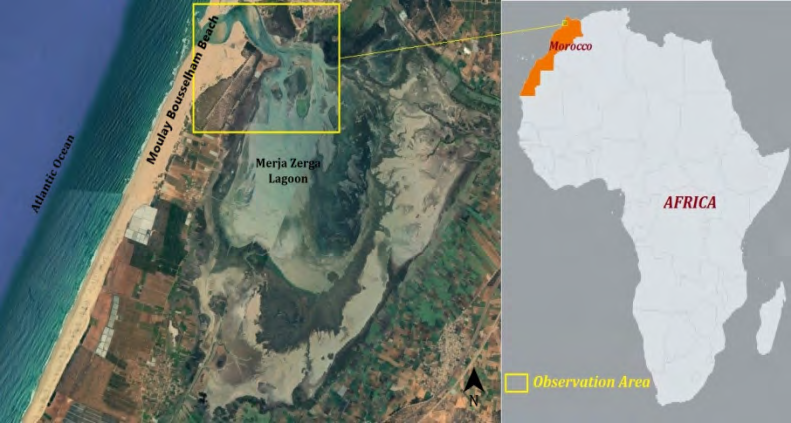
Figure1: The observation area of the Blue Crab in the Merja Zerga lagoon in the North Atlantic coast of Morocco.
This crab is a danger for the biodiversity because of its hyper aggressiveness to which nothing resists (Figure 2), it consumes everything in its path and leaves behind it damages on the local species (crustaceans, mollusks, small fishes...) thanks to its hyper-powerful claws and its speed.
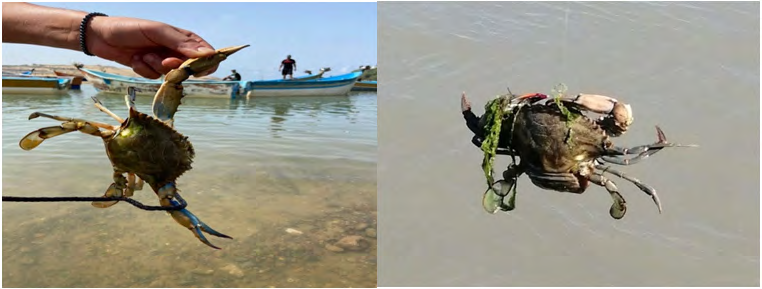
The impact of this species has been reported by fishermen who are sounding the alarm on the threats to the natural resources in this lagoon, which impacts the social and economic activities afterwards (destruction of the fishing nets, the shellfish activities...) if no action is taken to combat this scourge, and informed us that its first appearance was about two years ago in 2019.
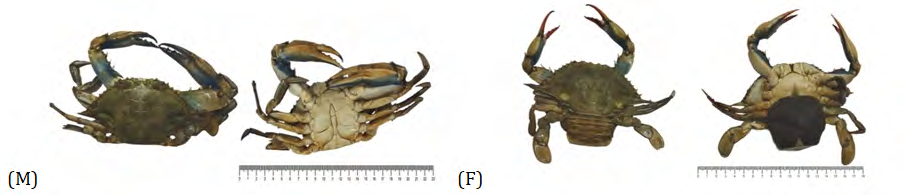
Captured individuals (ovigerous female, male) were measured, weighed, photographed and preserved (Figure 3), in order to enrich the reference collection of the natural history museum of the scientific institute and for the study of this non-native species by our researchers later.
Conclusion
Impact studies should be conducted on the biology and population dynamics of Callinectes sapidus in this lagoon and its dispersal potential. This will allow us to determine its impact on the ecosystem and to define a management strategy that reconciles the exploitation or possible eradication of this resource with the preservation of existing species, and it is recommended that the country takes into consideration urgently this problem which gradually destroys this biological reserve.
Acknowledgements
We would like to thank the natural history museum of the scientific institute for its resources and contribution in this study, I sincerely thank the artisanal fishermen in the Merja Zerga for their constructive comments and contributions.
References
-
Riyaha H, Bari A (2016) Les espèces exotiques envahissantes: états des lieux et méthodes de gestion. Colloque international sur “Les changements climatiques: quelles stratégies pour un développement durable?” Faculté Medicin et Pharmacie, Fez, Morocco.
-
Farid Y, Chennoui M, Assobhei O, Etahiri S (2013) Evaluation of the effect of the location of harvesting marine algae from the moroccan atlantic coast on antibacterial and anti-inflammatory activity. Revue de microbiologie industrielle, sanitaire, et environnementale 6(1): 54-66.
-
Benhissoune S, Boudouresque CF, Ver- laque M (2001) A checklist of the seaweeds of the Me- diterranean and Atlantic coasts of Morocco. II. Phaeophy- ceae. Botanica Marina 45(3): 217-230.
-
Cherif W, El Bour M, Grignon-Dubois M, Boudabous A, Ktari L (2018) Etude du potentiel anti-microfouling de deux codiaceae: Codium fragile et Codium bursa.
-
Sabour B, Reani A, El Magouri H, Haroun R (2013) Sargassum muticum (Yendo) Fensholt (Fucales, Phaeophyta) in Morocco, an invasive marine species new to the Atlantic coast of Africa. Aquatic Invasions 8(1): 97-102.
-
El Aamri F, Idhalla M, Tamsouri N (2018) Occurrence of the invasive brown seaweed Rugulopteryx okamurae (E.Y. Dawson) (Dictyotales, Phaeophyta) in Morocco (Mediterranean Sea). Mediterranean Fisheries and Aquaculture Research. Short Communication 1(2): 92- 96.
-
Hammada S (2007) Etudes sur la végétation des zones humides du Maroc. Catalogue et Analyse de la Biodiversité Floristique et Identification des principaux Groupements Végétaux. Doctoral thesis, Mohammed V University, Rabat, Morocco, pp: 1-199.
-
Menioui M (1987) Etude Nationale sur la Biodiversite -Faune marine. Rabat: MATEUH.
-
Ben Naceur H, Jenhani ABR, Romadhane M (2009) Ecobiological survey of the brine shrimp Artemia salina from Sabkhet El Adhibet (South-east Tunisia). Journal of the Marine Biological Association of the United Kingdom 89(6): 1109-1116.
-
Tamsouri MN, Benchoucha S, Idhalla M, El Aamrif F (2019) Etrumeus golanii(Actinopterygii: Clupeiformes: Dussumieriidae) a new Lessepsian migrant recorded in Morocco, Alboran Sea (South-West Mediterranean). Acta Ichthyologica et Piscatoria 49(1): 43-47.
-
Menioui M (2021) Elements for Reflection on Primary Invasive Alien Species (IAS) in Morocco, Actual and Potential Impacts. Book, Invasive Alien Species, pp: 196- 241.
- Genetic Improvement of Nile Tilapia (Oreochromis niloticus): Advances in Selective Breeding and Genomic Approaches for Sustainable Aquaculture
- Microplastics, Contaminants, and Waste Hotspots: Divergences and Faults in Prioritizing Control Efforts
- Creating a Healthier, More Vibrant Open and Closed Aquatic Environment. A Submersible, Centrifugal Magnetically Affixed Current Changing Aquarium Pump
- An Attempt to Assess Alpha Diversity and Sample Size: Using the Ostracod Assemblages off Kumamoto Port, Japan
- Assessment of the Efficiency of Common Fishing Gears and Crafts Used at Mohananda River of Chapai Nawabganj, Bangladesh
- Fish Productivity and Biodiversity Status of Sundarban Mangrove in Bangladesh