
Passive Phyto-Remediation of Heavy Metals by Biosorption of Sargassum cinereum
The industrial effluents with a high amount of pollutant, including heavy metals have adverse effects on the aquatic environment. Different costly conventional treatment technologies are applying for removal of heavy metals from the marine environment. The conventional treatment technologies produce a huge load of toxic chemical sludge on the environment. There is a need of detoxification of environment applying any biological method. So, remediation of heavy metals by marine macro algae is a novel eco-friendly alternative approach. The brown seaweed Sargassum cinereum were used as bio-absorber for heavy metals. To test the biosorption capacity of this brown seaweed, the artificial set up of heavy metal polluted environment were made within the beakers by keeping various concentration of heavy metal solution, and within that concentrated solution, Sargassum cinereum were emerged as per required amount. An optimized and validated Inductively Coupled Plasma-Optical Emission Spectroscopy (ICP-OES) has been applied to analyse elements, including, trace metals (Fe, Pb, Cr, As and Ag). The brown seaweed Sargassum cinereum used as bio-absorber for heavy metals. The artificial set up of heavy metal polluted environment were made within beaker by keeping various concentration of heavy metal solution, then Sargassum cinereum were used as per required amount. The iron concentration was 3520.35ppb in normal fresh Sargassum cinereum but Sargassum cinereum which was treated with various concentration of iron solution, showed very high concentration of iron. After 48 hours of treatment with 0.25mM iron solution Sargassum cinereum absorbed 6679.70ppb iron from the solution and treated with high concentration of iron solution such as 4mM absorbed maximum iron such as 21781.3089ppb. Similarly, Sargassum cinereum also have capacity of bio-sorption of Pb, Hg. The metal bio-absorption of Sargassum cinereum remarked for its metal storage capacity. It has been concluded that Sargassum cinereum absorb high amount of Fe, Pb and Hg from solution, so Sargassum cinereum may be use for heavy metal bio-absorption as phyco-cleaner of heavy metals from heavy metal polluted environment. In future, this brown seaweed may be used for cleaning of polluted environment cost effectively
Introduction
Globally, heavy metals contamination in marine coastal and estuarine ecosystem due to chemical disposal and effluents from various industries, anthropogenic activities and metal mining is one of the major problems. The load of high accumulation of toxic heavy metals to the environment, gradually increase the inclusion of toxic heavy metals to the food chain of marine organism indirectly affecting the health of human beings as they consume marine fishes and arthropods as food items. The bioaccumulation and persistence of heavy metals in environment, consequently biomagnifications of heavy metals in food chain causes the irreparable damage at very low concentration in the environment [1]. It has been reported that some of the heavy metals are mutagenic, carcinogenic and have dangerous health effects [2]. Trying to solve this problem, some conventional expensive techniques are applied to bio-remediate the toxic heavy metals but phytoremediation is regarded as the feasible and economically affordable approach [3]. It had been reported that seaweeds are bio-indicator of heavy metals pollution, as specific seaweed preferably grow in dense population in the area of specific metal pollution in the environmental. As they have contribution in the nutrients cycle of the aquatic ecosystem, so they easily indicate the water quality changes [4]. Bio-sorption is an inactive physiochemical process of naturally occurring biomass to allow passively concentrates and bind contaminant onto its structure. Some algae, fungi and microbial biomass had this inactive property due to their cell structure. Another opposite process of removal of contaminants from living environment by active living cells are known as bioaccumulation. Bio-sorption has several benefits such as high efficiency, less expensive, less production of chemical or biological sludge; no additional nutrients required and there is some possibility of metal recovery. Biosorption mechanisms are extra or intracellular accumulation or precipitation including cell surface precipitation and absorption. For filtration of contaminants from polluted environment and also filtering the harmful pollutants from industrial effluent is much beneficial than the use of ion exchange resin which is expensive. As bio- sorption capacity depends on surface area and cell structure of bio absorber, so, which seaweeds have large surface area have the power of high bio-sorption capacity. Some seaweed such as Sargassum, Macrocystis, Turbinaria and Cystoseria has large surface area and quite develop and complex thallus structure, so these seaweeds may be useful as bio-sorbent. Among these seaweeds, Sargassum cinereum were used for our study because this brown seaweed is easily and abundantly available as attach and floating condition during growth season, Sargassum cinereum, grow so densely which make huge dense forest like condition of brown seaweed along the coastal areas of Gulf of Mannar, Rameshwaram. Also, this species of brown seaweed is easily cultivatable. So, in this study, we used Sargassum cinereum to test its bio-sorbent capacity for metals such as iron, lead and mercury. Similarly, the combination of two metals biosorption capacity of this brown seaweed also done, because sometimes different industrial effluents may release couple of metals as compound form. The combined bio- sorption capacity of Sargassum cinereum will explain the metal-metal replacement mechanism during bio-sorption capacity. If environment is polluted with multiple heavy metals, then only a single seaweed will be enough and useful for biosorption to detoxify the environment.
Material and Methods
Collection of Samples
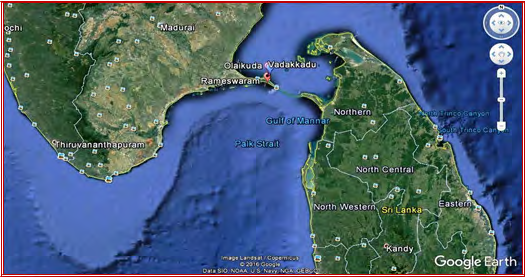
During survey, five Sargassum sp. such as S. cinereum, S. cinctum, S. cristaefolium, S. polycystum and S. wightii were reported. Among these five seaweeds, huge mass of Perchloric acid (4:1) were mixed and kept for 18 hours and then boiled to dryness. Again, the samples were cooled in room temperature and 10% HNO3 was mixed and filtered with what man (589/2) filter paper Sargassum cinereum was abundantly available in Vadakkadu coast, 8 km away from Rameshwaram Temple, south east coast of India (Figure 1).
Analysis of Heavy Metals of sargassum Sp.
The heavy metals such as Fe, Pb, Cr, As and Hg content of five Sargassum Sp. were analysed. The collected seaweeds were dried for one week and grinded to make powder. The 1gm of powder had been taken in the conical flask and 20ml concentrated HNO3 was mixed to it and was kept 24 hours at room temperature. The acid digested samples were boiled in hotplates at 120 ̊C and evaporated. In dry samples 20ml of Nitric acid and adjusted the volume of 25ml with 10% HNO3 solution. The extracts were analysed to estimate metals such as Fe, Pb, Cr, As and Hg in Inductively Coupled Plasma-Mass Spectroscopy (ICP-MS) and atomic absorption spectrophotometer.
Analysis of Bio-Sorption Capacity
After analysis of heavy metals of five different Sargassum sp., Sargassum cinereum has all five heavy metals in high amount naturally. So, I selected Sargassum cinereum to test its bio-sorption capacity of Fe, Pb and Hg. The single metal bio-sorption and combined metals bio-sorption capacity of Sargassum cinereum were evaluated. The fresh seaweed 10gm were kept in the normal distilled water which was considered as control. To evaluate the bio-sorption capacity, fresh Sargassum cinereum of 10gm was kept in different concentration of metal solution. The different concentrations of FeCl3 solutions such as 0.25mM, 0.5mM, 1mM, 2mM and 4mM were prepared with mixing of required amount of FeCl3 powder in 250ml distilled water. Similarly, for estimation of Pb bio-sorption capacity, five different concentrations of 0.25mM to 4mM were prepared by dissolving PbCl2 in 250 ml distilled water. For double metals bio-sorption capacity study, FeCl3 and PbCl2 were dissolved in distilled water as per required amount to prepare 0.25mM to 4mM solutions. For bio-sorption capacity study of Hg, 0.25mM to 4mM concentration solutions were prepared by dissolving mercuric chloride in water, and similarly, combination of Hg and Fe bio-sorption capacity also evaluated. The 1gm dry seaweed powder of each treatment had been taken in the conical flask and 20ml concentrated HNO3 was mixed to it and was kept 28 hours at room temperature. The acid digested samples were boiled in hotplates at 120 ̊C and evaporated. In dry samples 20ml of Nitric acid and Perchloric acid (4:1) were mixed and kept for 18 hours and then boiled to dryness. Again, the samples were cooled in room temperature and 10%HNO3 was mixed and filtered with what man (589/2) filter paper and adjusted the volume of 25ml with 10% HNO3 solution. The extracted solution were assayed for estimation of five metals such as Fe, Pb, and Hg with the help of Inductively Coupled Plasma-Mass Spectroscopy (ICP-MS) and atomic absorption spectrophotometer.
Anatomical Study
The 10gm of Sargassum cinereum were separately kept within those five different concentrated metal solutions and after 48 hours of treatment different parts such as leaf like foliage part, reproductive part and stem like part of seaweed were taken for its microscopic study. To know the anatomical structural changes of all parts of seaweed due to bio-sorption, three different parts as whole and also in section were mounted on distilled water and images were taken under Carl Zeiss Stereomicroscopy (0.9X).
Results
We selected five species of Sargassum and analysed their heavy metals content and it showed that Sargassum cinereum contained highest amount of Fe, Pb, Cr, As and Hg rather than Sargassum cinctum, Sargassum cristaefolium, Sargassum polycystum, and Sargassum wightii. The brown seaweed Sargassum cinereum contain 3520.35ppb Fe, 5.582ppb Pb, 65 ppb Cr and similarly 0.12ppb As and 0.35ppb Hg which clearly indicated its high metal content capacity. Among five different Sargassum Sp. Sargassum polycystum contained lowest amount of all heavy metals (Table 1).
| Species | Fe | Pb | Cr | As | Hg |
|---|---|---|---|---|---|
| Sargassum cinereum | 3520.35 | 5.582 | 65 | 0.12 | 0.35 |
| Sargassum cinctum | 500 | 4.256 | 45 | 0.15 | 0.01 |
| Sargassum cristaefolium | 1460 | 2.365 | 215 | 0.05 | 0.025 |
| Sargassum polycystum | 150 | 2.102 | 69 | 0.09 | 0.014 |
| Sargassum wightii | 1470 | 2.145 | 0.55 | 0.08 | 0.029 |
Table 1: Species wise heavy metals (ppb) content.
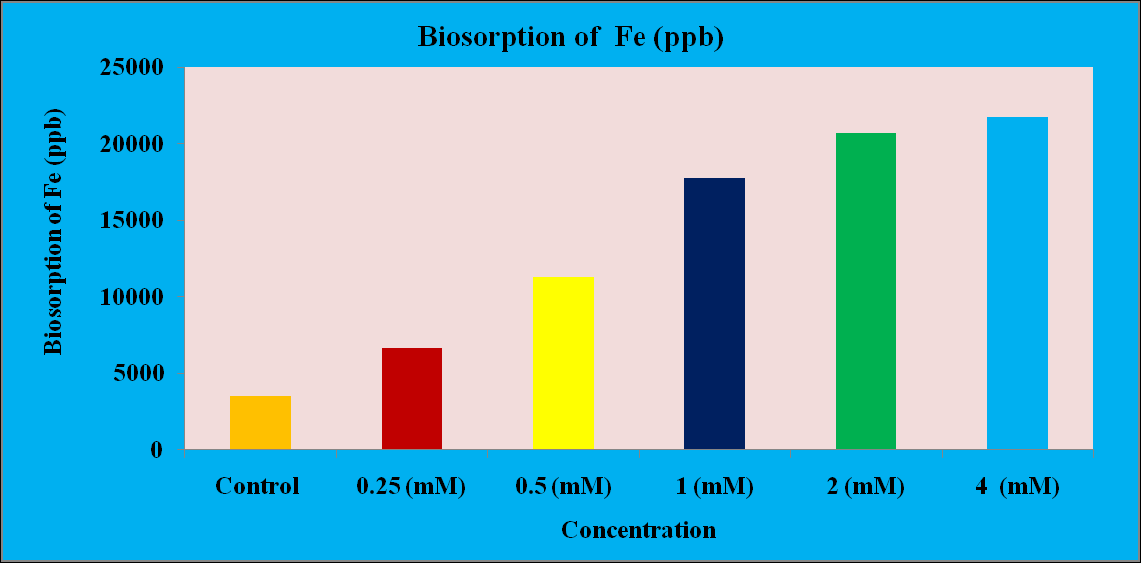
The ICP results showed that Sargassum cinereum bio-sorption capacity increased with increase of metal concentration in solution. For this study, the control was 10gm fresh Sargassum cinereum which was kept in 250ml normal seawater. The iron concentration of control was 3520.35ppb (Table 1) but Sargassum cinereum which was treated with various concentration of iron solution, showed high concentration of iron deposition. After 48 hours of treatment with 0.25mM iron solution Sargassum cinereum absorbed 6679.70ppb iron and treated with high concentration of iron solution such as 4mM which absorbed maximum iron such as 21781.3089ppb. The results of this study reported that S. cinereum had an excellent capacity of iron bio-sorption (Figure 3). So, this brown seaweed may be use as phytoremediator for removal of iron from highly polluted water bodies or from any industrial effluents after more extensive experiment in field condition. The anatomical and morphological structures of different parts of the thallus treated with different iron concentration were listed below (Figure 2). The parts of treated seaweed showed dark appearance due to accumulation of high iron. The vesicles on leaf like part was very dark due to high accumulation of iron which explained that this seaweed may be accumulated high iron due to its favourable morphological structures (Figure 2).
| Leaf like foliage part | Section of stem | Reproductive part |
|---|---|---|
| Control | ||
| (0.25 mM) | ||
| (0.5 mM) | ||
| (1 mM) | ||
| (2 mM) | ||
| (4 mM) |
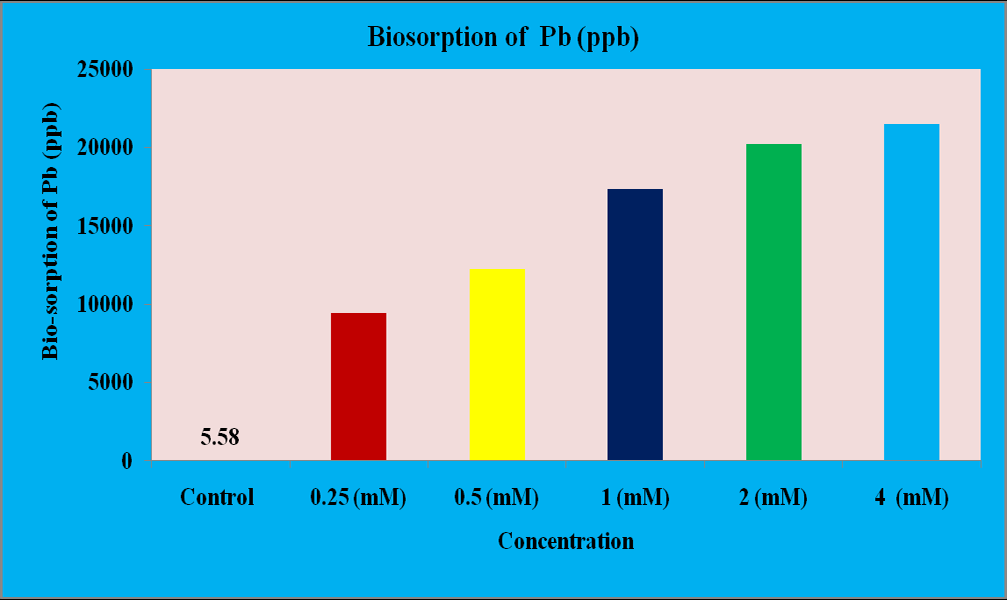
The biosorption of lead was increased with increase of metal concentration in the solution. So, the maximum absorption was estimated for seaweed treated with 4mM lead solution, the biosorption was 21490.22 ppb and the minimum iron absorption was 9437.70 ppb estimated at 0.25mM concentration (Figure 4). For this study, the control was 10gm fresh Sargassum cinereum which was kept in 250ml normal seawater. The concentration of Pb of control seaweed was 5.582 ppb (Figure 4).
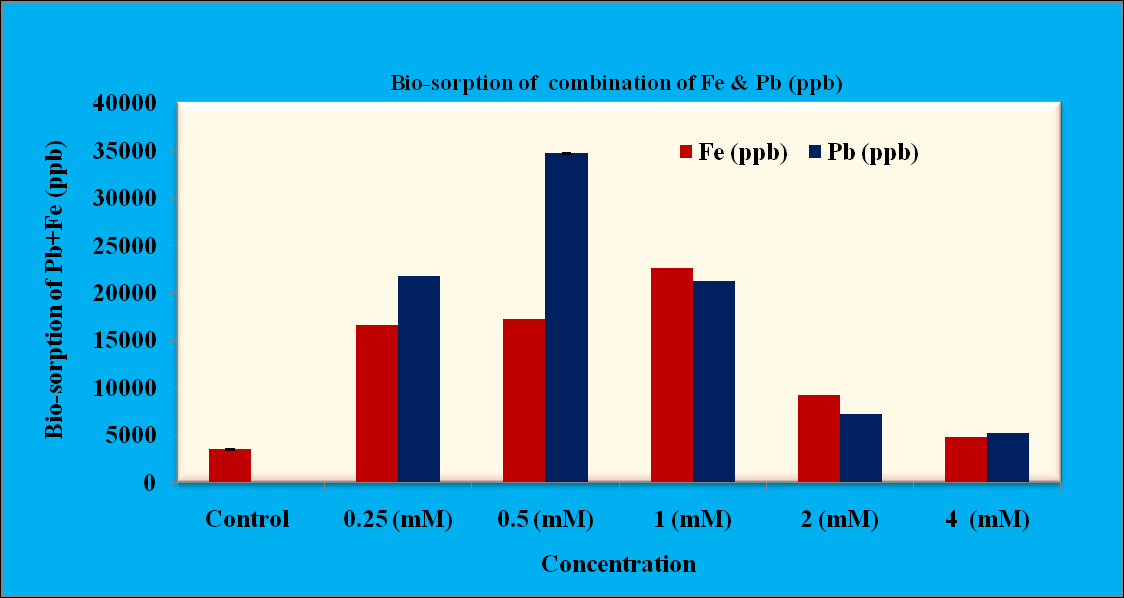
The seaweed treated with both iron and lead, explained different pattern of bio-absorption in comparison to the single metal treatment. The solution concentration from
0.25mM to 1mM, the metal absorption was gradually increased, but after 1mM concentration, the absorption capacity decreased gradually. It may be due to both metals reaction and formation of any unknown compounds which was not absorbed by Sargassum cinereum. The combined effect of metals showed that Sargassum was absorbed more iron than lead. But up to 0.2mM to 1mM concentration both metal absorption was increased and above that concentration absorption decreased gradually (Figure 5). For this study, the control was 10gm fresh Sargassum cinereum which was kept in 250ml normal seawater. The concentration of iron and Pb of control seaweed were 3520.35ppb and 5.582ppb (Figure 5).
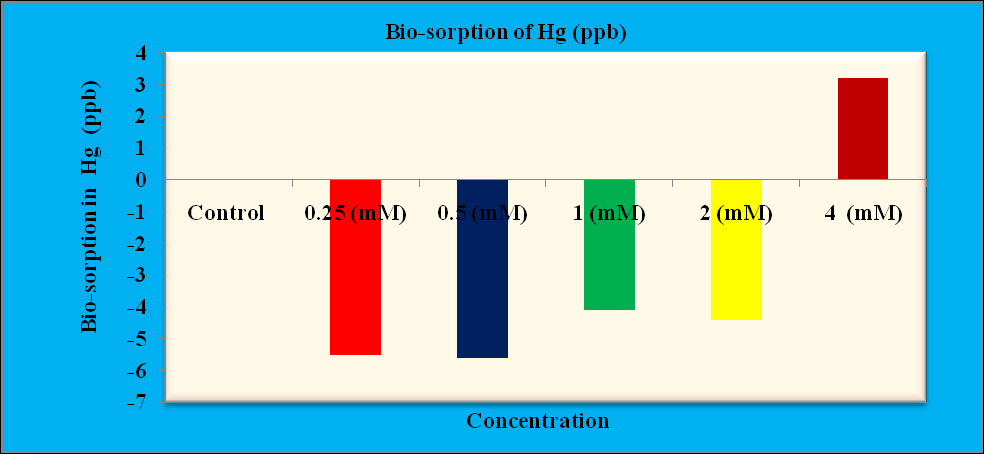
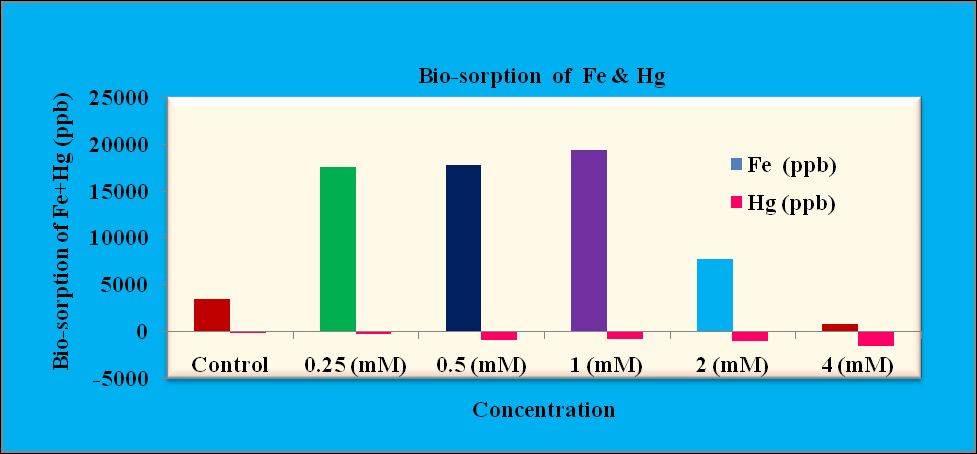
The seaweed treated with different concentration of only mercury had completely different effect and had no absorption up to 2mM concentration of mercury treatment. But only at 4mM concentration absorption of mercury was detected and it was very less (3.2ppb). It may be due to high concentration treatment; basically, Sargassum cinereum had no absorption capacity of mercury because no absorption was detected up to 2mM. But the biosorption was detected at 4mM mercury treatment may be due to high stress of mercury (Figure 6). It was also observed from combined metals effect of mercury and iron. So, from this study, it indicated that Sargassum cinereum absorbed iron in all concentration from 0.25mM to 4mM. But no absorption was found for mercury treatment. So, from single metal effect and combined metals effect, it can be concluded that Sargassum cinereum had no absorption capacity of mercury or may be if only mercury will very high in the environment, then it will be absorbed, even above 4mM concentration (Figure 7).
Discussions
Different species of marine algae accumulated heavy metals in their different body parts which study conducted along the Turkish Coast of the black Sea during 1998-2000 to study the heavy metal monitoring of seaweeds [5]. There are many previous literatures available on bio-accumulation and biosorption of metals and heavy metals reportedly. The plenty of work of elemental composition of different seaweeds have been reported periodically. But there is little gap of study of heavy metals biosorption capacity of seaweeds especially brown seaweed. As we saw huge mass of brown seaweed Sargassum Sp. is available along the coastal area, so we can utilize that mass of seaweed for bio-sorption of heavy metals and phycoremediate the polluted environment. Similarly, the brown seaweed, Sargassum cinereum naturally carrying high amount of Fe, Pb, Cr, As and Hg which have been observed from the result of heavy metal content of five different species of Sargassum. So, my focus was to test its bio-sorption capacity of these five heavy metals. Some South Korean brown seaweeds (Hizikia fusiformis, Laminaria japonica, and Undaria pinnatifida) reported for its high capacity of pH dependent biosorption of ions of heavy metals (Pb2+, Cd2+, Mn2+, Cu2+, and Cr2O72-). For positively charged ions like Pb2+, Cd2+, Mn2+, Cu2+, towards acidic pH 2 to 4, biosorption was maximum and towards basic pH 5 to 8, solution minimum biosorption was for negatively charged ions (Cr2O7 2-) [6]. The brown seaweed Sargassum tenerrimum after five sorption-desorption cycles, uptake of 63.43mg/g cadmium [7]. It has been reported that brown algae, Cystoseria indica also have temperature and pH dependent biosorption capacity of cadmium and nickel [8]. The brown seaweed Turbinaria conoides uptake of 220.1mg/g lead from column successfully [9]. In this present study, Sargassum cinereum showed high capacity of biosorption of iron 6679.70ppb to 21718.30ppb iron. It clearly indicates that this brown seaweed has iron biosorption capacity. This brown seaweed also has high biosorption capacity of lead and maximum absorption is 21490.22ppb after 4mM lead treatment. Similarly, the combined effect of iron and lead, also revealed that Sargassum cinereum also have biosorption capacity of iron and lead in combination. In nutshell, brown seaweed will be helpful to remove pollutant from polluted environment and water system after extensive experiment with Sargassum cinereum in field condition.
Acknowledgements
The authors are sincerely thanking to Dean and Director C.A.S in Marine Biology, Faculty of Marine Sciences, Annamalai University. The authors also thankful to DST, Govt. of India for funding support. All authors sincerely thank to all higher authorities of Annamalai University.
Funding
Authors are thankful to Department of Science and Technology, New Delhi, Government of India.
Conflict of Interest
Authors have no conflicts of interest to be disclosed.
References
-
Gochfeld M (2003) Cases of mercury exposure, bioavailability, and absorption. Ecotoxicology and Environmental Safety 56(1): 174-179.
-
Ali H, Khan E, Sajad MA (2013) Phytoremediation of heavy metals--concepts and applications. Chemosphere 91: 869-881.
-
Storelli MM, Storelli A, Marcotrigiano GO (2001) Heavy metals in the aquatic environment of the Southern Adriatic Sea, Italy macroalgae, sediments and benthic species. Environment International 26(7-8): 505-509.
-
Wilson R, Goyal L, Ditzel M, Zachariou A, Baker DA, et al. (2002) The DIAP1 RING finger mediates ubiquitination of Dronc and is indispensable for regulating apoptosis. Nat Cell Biol 4(6): 445-450.
-
Topcuoglu S, Guven KC, Balkis N, Kirbasoglu C (2003) Heavy metal monitoring of marine algae from the Turkish coast of the Black Sea, 1998-2000. Chemosphere 52(10): 1683-1688.
-
Lee SH, Park CH (2012) Biosorption of heavy metal ions by brown seaweeds from southern coast of Korea. Biotechnology and Bioprocess Engineering 17(4): 853- 861.
-
Rajamohan N, Sivaprakash B (2018) Biosorption of heavy metal using brown seaweed in a regenerable continuous column. Asian Pacific journal of Chemical Engineering 3(5): 572-578.
-
Mohammad K, David AW, Ahmad H, Nasrollah M (2019) Simultaneous Biosorption of nickel and cadmium by the brown algae Cystoseria indica characterized by isotherm and kinetic models, Applied Biological Chemistry 62(1): 69
-
Senthilkumar R, Vijayaraghavan K, Thilakavathi M, Iyer PVR, Velan M (2007) Application of seaweeds for the removal of lead from aqueous solution. Biochemical Engineering Journal 33: 211-216.
- Genetic Improvement of Nile Tilapia (Oreochromis niloticus): Advances in Selective Breeding and Genomic Approaches for Sustainable Aquaculture
- Microplastics, Contaminants, and Waste Hotspots: Divergences and Faults in Prioritizing Control Efforts
- Creating a Healthier, More Vibrant Open and Closed Aquatic Environment. A Submersible, Centrifugal Magnetically Affixed Current Changing Aquarium Pump
- An Attempt to Assess Alpha Diversity and Sample Size: Using the Ostracod Assemblages off Kumamoto Port, Japan
- Assessment of the Efficiency of Common Fishing Gears and Crafts Used at Mohananda River of Chapai Nawabganj, Bangladesh
- Fish Productivity and Biodiversity Status of Sundarban Mangrove in Bangladesh