
Induced Breeding Practices of the Freshwater Fish Hatcheries in Bangladesh
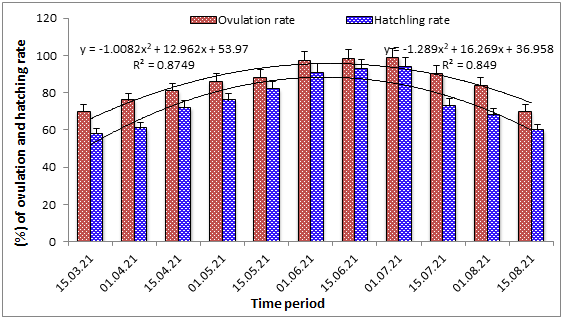
This study was conducted on the fish hatcheries of the 8 division of Bangladesh to identify about induced breeding practices of different hatcheries. About 6 native species viz. Rui (Labeo rohita), Catla (Catla catla), Mrigel (Cirrhinus mrigala), Calibaush (Labeo calbasu), Bata (Labeo bata) and Gonia (Labeo gonius), 7 exotic species viz. Silver carp (Hypopthalmicthys molitrix), Bighead carp (Hypopthalmicthys molitrix), Grass carp (Ctenopharyngodon idella), Common carp (Cyprinus carpio), Black carp (Mylopharyngodon piceum), Thai pangus (Pangasius sutchi), Thai puti or raj puti (Barbonymus gonionotus) and 06 Indigenous species pubda (Ompok pabda), Gulsa (Mystus cavasius), Tengra (Mystus tengra), Koi (Anabas testudineus), Shing (Heteronopneustes fossilis) and Magur (Clarius batrachus) were recorded for the induced breeding practice of fresh water of Bangladesh. Three types of inducing agents viz. PG (Pituitary Gland), HCG (Human Chorionic Gonadotropin) and GnRHa (Gonadotropin Releasing Hormone analogues) were used for induced breeding. Ovulation rate of Indian major carps and other exotic fish species were 65, 70, 74, 80, 84, 88, 92, 96, 98, 90 and 88%, respectively. The regression type is Polynomial and the equation is y = -0.751x2 + 11.36x +49.705 (R2 = 0.8449). The hatching rate were recorded at the rate of 52, 55, 62, 71, 77, 80, 86, 90, 94, 80 and 62%, respectively in different hatcheries and the regression type is Polynomial and the equation is y = -1.1254x2 + 15.96x +29.182 (R2 = 0.8328). The ovulation rate of 06 Indigenous fish species were 70, 76, 81, 84, 86, 88, 97, 98, 99, 90, 84 and 70%, respectively. The regression type is Polynomial and the equation is y = -1.0082x2 + 12.96x + 53.97 (R2 = 0.8749). The hatching rate were recorded at the rate of 58, 61, 72, 76, 82, 91, 93, 94, 73, 68 and 6%%, respectively. The regression type is Polynomial and the equation is y = -1.289x2 + 16.269x +36.958 (R2 = 0.849).
Introduction
The fish and fisheries play an important role in the national economy of Bangladesh, providing employment, animal protein, earing foreign currency and reducing poverty [1]. Bangladesh is one of the world’s leading fish producing country with a total production of 4.621 million mt in 2020- 2021 [2]. Fisheries sector alone contributes 1.35 % of the total export earnings and this sector also contributes 3.52% to the Gross Domestic Product (GDP) and 26.37 % to the agricultural GDP in 2020-21 [2]. Fish culture is increasing very quickly with the increase in demand. As the people have started aquaculture business in Bangladesh, the demand of fish seed is increasing gradually. Nowadays, fish hatchery is one of the main sources of fry production and about 98% fry of the country is produced by the hatcheries. Hatcheries are playing an active role in the fish production of Bangladesh [3]. There are around 1056 (including 103 government hatcheries) fish hatcheries in Bangladesh. In the year 2020- 2021, the total fry production in Bangladesh was 668801 kg [2].
Bangladesh is blessed and enriched with vast water resources, which show a wide range of variation in nature. As a consequence, natural fisheries resources are scattered all over the country. According to DoF, 2020-21, the contribution of fisheries sector to the national GDP (gross domestic product) is 4.37% and 2.01% to the export earning of Bangladesh. Bangladesh presently stands fourth in fresh water aquaculture according to this year’s (2014) report of UN’s Food and Agricultural Organization FAO [1]. Nowadays, due to the degradation of the ecological balance, changing catchments, construction of drainage structures and flood control, siltation, soil erosion, washing of industrial pollutants and agrochemicals, the capture fisheries in open waters of Bangladesh is under great danger. In 2012- 13 inland capture fisheries contributed only to 28.2% of the total fish production. For that reason, aquaculture has been developed in this country, which mainly depends on fish hatcheries, a place for artificial breading, hatching and rearing through the early life stages of fish [2].
The artificial breeding permits intensive production of a given species in controlled conditions. Induced breeding, also called hypophysation or artificial propagation, has now overcome the problems of fish seeds production for the particular fish which do not breed in captivity. This allows continue production of juveniles for restocking natural or control water bodies Montchowui E, et al. [4]. According to Bhuiyan et al. [5], induced breeding is a process where the fish, which do not breed in stagnant water bodies, will do so under the influence of some stimulants or hormones injected in their bodies. When some stimulants, hormones or pituitary extracts are injected in the brood fishes causing fish to spawn in the controlled condition out of natural environment is called induced breeding or artificial reproduction [6] which is a common practice in our country since 1967. Only a reliable induced breeding and fry rearing technique can ensure a steady supply of quality fish seeds [6, 7]. All government and non-government organizations should have more effective, ethical and planned activities to make artificial and induced spawning of fishes at grass-root levels [8]. The present work was done with a view to know about the induced breeding techniques and practices in the hatcheries in Bangladesh.
In aquaculture sector of Bangladesh, induced breeding was started for artificial propagation of fish and it established as a dependable source of fish seeds since the mid-1960s in fish hatcheries for production of fry or fingerlings [3]. Due to decrease of significant reduction of stocks of natural fisheries in the river, it is necessary to increase for developing artificial breeding technology for freshwater fish species in order to improve their reproductive potential for the production of fry and fingerlings for fish culture. Artificial propagation in freshwater fish species is usually performed using the hypophysation method [9].
Materials and Methods
Study Area and Duration
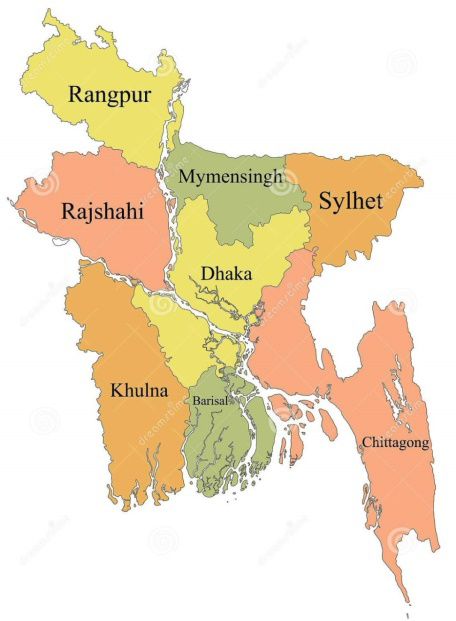
The study was conducted with fish hatcheries of northern region of Bangladesh (Figure 1). The Bangladesh consists of 08 divisions. Padma, Meghna, Jamuna, Brahmaputra and Karnafuly rivers are the rivers of the eight divisions. The study areas (eight divisions) are shown in the location map.
Data Collection
For data collection, the selection of sample size was one of the critical aspects for the study. Therefore, a reasonable sample size and a schedule for survey were considered for data collection on induced breeding of fish hatcheries in the 08 division of Bangladesh. The primary data were collected by interaction with hatchery owners in the hatchery side whereas; secondary data were collected from the Department of Fisheries (DoF) and the internet.
Sampling of Fish
The investigation was conducted from 2019-20 and was sampled simultaneously for breeding season of Indian major carps, exotic species and indigenous species from January to September to get a true picture of breeding season, breeding period, ovulation and hatching status of ovulated fishes.
Analysis of Experimental Data
The collected data were cheeked and cross-checked for reliability and accuracy. The data were analyzed through one way ANOVA using MSTAT followed by Duncan’s Multiple Range Test to find out whether any significant difference existed among the different means [10].
Results and Discussions
Brood Fishes Selection for Induced Breeding
Indian major carps (Labeo rohita, Catla catla and Cirrhinus cirrhosus), three exotic carps (Hypopthalmicthys molitrix, Ctenopharyngodon idella and Cyprinus carpio) and Thai Pangus (Pangasius sutchi) were the dominant fish species used as brood fish in most hatcheries of Bangladesh [11]. Genetically improved and healthy brood fish selection is important for induced spawning of Indian major carps [5].
Inducing Agents and Hormonal Dose Selection
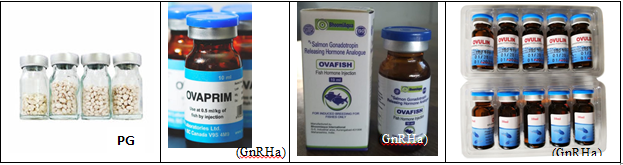
In the studied area, Hatchery owners used three types of inducing agents such as pituitary gland (PG), human chorionic Gonadotropin (HCG) and Gonadotropin Releasing Hormone analogues (GnRHa) under the trade name Ovupin, ovafish, ovaprim, ovacline, ovamach, pragnil, ovatid (100 mg Domperidone + 0.2 mg S-GnRHa), etc. for induced breeding purposes. Pituitary gland (PG) extract and Human Chorionic Gonadotropic (HCG) hormone were commonly used inducing agents for induced breeding though some other agents like Ovaprim, Profasi, Pregnyl, Luteinizing hormone releasing hormone (LH-RH) etc. were also used for both indigenous and exotic fish species (Figure 2). Though PG extract/ HCG injection of female fish is always given with one or two doses; in case of two doses six hours interval was maintained between two injections but the males were injected with a single dose of PG or HCG at the time of the first injection of the females with a continuous flow of fresh water. The dosage varies with the species, temperature, potency of the pituitary gland, gonadal maturity of the recipient and the prevailing climatic conditions [12].
Incubation and Hatching
The present practices of using dose of Human Chorionic
Gonadotropin (HCG) and Gonadotropin Releasing Hormone Analogues (GnRHa) mentioned below (Table 1).
| Species | Sex | 1st doses | Ovulation period | |||
|---|---|---|---|---|---|---|
| Species | (M=Male F=Female) | Ovulation period | HCG and GnRHa (ml/kg) | |||
| Species | Mini | Ovulation period | Maxi | |||
| Native Indian major carp | Catla (Catla catla) | M | 0.1 | 0.2 | 10-Jun | |
| Native Indian major carp | Catla (Catla catla) | F | 0.4 | 0.6 | 10-Jun | |
| Native Indian major carp | Rui (Labeo rohita) | M | 0.1 | 0.2 | 10-Jun | |
| Native Indian major carp | Rui (Labeo rohita) | F | 0.3 | 0.4 | 10-Jun | |
| Native Indian major carp | Mrigal (Cirrhina mrigala) | M | 0.1 | 0.2 | 10-Jun | |
| Native Indian major carp | Mrigal (Cirrhina mrigala) | F | 0.2 | 0.3 | 10-Jun | |
| Native Indian major carp | Calbaus (Labeo calbasu) | M | 0.1 | 0.2 | 10-Jun | |
| Native Indian major carp | Calbaus (Labeo calbasu) | F | 0.3 | 0.4 | 10-Jun | |
| Native Indian major carp | Bata (Labeo bata) | M | 0.1 | 0.15 | 10-Jun | |
| Native Indian major carp | Bata (Labeo bata) | F | 0.3 | 0.4 | 10-Jun | |
| Native Indian major carp | Gonia (Labeo gonius) | M | 0.1 | 0.2 | 10-Jun | |
| Native Indian major carp | Gonia (Labeo gonius) | F | 0.3 | 0.4 | 10-Jun | |
| Native Indian major carp | Indigenous species | Pabda | M | 1 | 1.5 | 10-Jun |
| (Ompok pabda) | Indigenous species | F | 1 | 2 | 10-Jun | |
| Gulsa | Indigenous species | M | 0.5 | 1 | 10-Jun | |
| (Mystus cavasius) | Indigenous species | F | 1 | 2 | 10-Jun | |
| Tengra | Indigenous species | M | 0.5 | 1 | 10-Jun | |
| (Mystus tengra) | Indigenous species | F | 1 | 2 | 10-Jun | |
| Heteropneustes fosslis | Indigenous species | M | 1 | 1.5 | 10-Jun | |
| Heteropneustes fosslis | Indigenous species | F | 1.5 | 2 | 10-Jun | |
| Clarias batrachus | Indigenous species | M | 1 | 1.5 | 10-Jun | |
| Clarias batrachus | Indigenous species | F | 1.5 | 2 | 10-Jun | |
| Koi (Anabas testudineus) | Indigenous species | M | 0.5 | 1 | 10-Jun | |
| Koi (Anabas testudineus) | Indigenous species | F | 1 | 1.5 | 10-Jun | |
| Exotic Species | Silver Carp (Hypopthalmicthys molitrix) | M | 0.1 | 0.2 | 10-Jun | |
| Exotic Species | Silver Carp (Hypopthalmicthys molitrix) | F | 0.4 | 0.7 | 10-Jun | |
| Exotic Species | Silver Carp (Hypopthalmicthys molitrix) | M | 0.1 | 0.2 | 10-Jun | |
| Exotic Species | Silver Carp (Hypopthalmicthys molitrix) | F | 0.4 | 0.7 | 10-Jun | |
| Exotic Species | Grass Carp | M | 0.1 | 0.2 | 10-Jun | |
| Exotic Species | Ctenopharyngodon idella | F | 0.4 | 0.8 | 10-Jun | |
| Exotic Species | Grass Carp | M | 0.1 | 0.2 | 10-Jun | |
| Exotic Species | Ctenopharyngodon idella | F | 0.3 | 0.4 | 10-Jun | |
| Exotic Species | Black Carp (Mylopharyngodon piceum) | M | 0.1 | 0.2 | 10-Jun | |
| Exotic Species | Black Carp (Mylopharyngodon piceum) | F | 0.4 | 0.8 | 10-Jun | |
| Exotic Species | Thai Pangus | M | 0.1 | 0.2 | 10-Jun | |
| Exotic Species | (Pangasius sutchi) | F | 0.4 | 0.8 | 10-Jun | |
| Exotic Species | Thai Puti or Raj Puti (Barbonymus gonionotus) | M | 0.1 | 0.2 | 10-Jun | |
| Exotic Species | Thai Puti or Raj Puti (Barbonymus gonionotus) | F | 0.2 | 0.3 | 10-Jun |
Table 1: Doses of HCG and GnRHa for the induced breeding of the fish.
The present practices of using dose of Pituitary gland (PG) (mg/kg) mentioned below (Tables 2 & 3).
| SL. No. | Species | Sex (M=Male F=Female) | 1st doses PG (mg/kg) and HCG* (IU/kg) | Interval (hr.) | 2nd doses PG (mg/kg) and HCG* (IU/ kg) | Ovulation period | ||
|---|---|---|---|---|---|---|---|---|
| Mini | Maxi | Mini | Max | |||||
| Native Indian major carp | Catla (Catla catla) | M | 0 | 0 | 1 | 2 | 8-Jun | |
| F | 1 | 2 | 6 | 4 | 8 | 8-Jun | ||
| Rui (Labeo rohita) | M | 0 | 0 | 1 | 2 | 8-Jun | ||
| F | 1 | 2 | 6 | 4 | 6 | 8-Jun | ||
| Mrigal (Cirrhina mrigala) | M | 0 | 0 | 1 | 2 | 8-Jun | ||
| F | 1 | 2 | 6 | 4 | 6 | 8-Jun | ||
| Calbaus (Labeo calbasu) | M | 0 | 0 | 1 | 2 | 8-Jun | ||
| F | 1 | 2 | 6 | 4 | 6 | 8-Jun | ||
| Bata (Labeo bata) | M | 0 | 0 | 1 | 2 | 8-Jun | ||
| F | 1 | 2 | 6 | 4 | 6 | 8-Jun | ||
| Gonia (Labeo gonius) | M | 0 | 0 | 1 | 2 | 8-Jun | ||
| F | 1 | 2 | 6 | 4 | 6 | 8-Jun | ||
| Indigenous species | Pabda | M | 3 | 4 | 6 | 7 | 8 | 8-Jun |
| (Ompok pabda) | F | 4 | 6 | 6 | 7 | 8 | 8-Jun | |
| Gulsa | M | 3 | 6 | 6 | 7 | 8 | 8-Jun | |
| (Mystus cavasius) | F | 3 | 7 | 6 | 12 | 16 | 8-Jun | |
| Tengra | M | 50* | 100* | 6 | 0 | 0 | 8-Jun | |
| (Mystus tengra) | F | 0 | 0 | 150* | 200* | 8-Jun | ||
| Heteropneustes fosslis | M | 0 | 0 | 1 | 2 | 8-Jun | ||
| F | 1 | 1.5 | 6 | 6 | 8 | 8-Jun | ||
| Clarias batrachus | M | 0 | 0 | 2 | 4 | 8-Jun | ||
| F | 1 | 1.5 | 6 | 6 | 8 | 8-Jun | ||
| Koi (Anabas testudineus) | M | 1 | 4 | 6 | 0 | 0 | 8-Jun | |
| F | 6 | 8 | 6 | 0 | 0 | 8-Jun | ||
| Exotic Species | Silver Carp (Hypopthalmicthys molitrix) | M | 0 | 0 | 150* | 200* | 8-Jun | |
| F | 100* | 150* | 6 | 4 | 7 | 8-Jun | ||
| Silver Carp (Hypopthalmicthys molitrix) | M | 0 | 0 | 150* | 200* | 8-Jun | ||
| F | 100* | 150* | 6 | 4 | 6 | 8-Jun | ||
| Grass Carp | M | 0 | 0 | 1 | 2 | 8-Jun | ||
| Ctenopharyngodon idella) | F | 1 | 2 | 6 | 4 | 6 | 8-Jun | |
| Grass Carp | M | 0 | 0 | 1.5 | 2 | 8-Jun | ||
| Ctenopharyngodon idella) | F | 1 | 2 | 6 | 4 | 6 | 8-Jun | |
| Black Carp (Mylopharyngodon piceum) | M | 0 | 0 | 1 | 3 | 8-Jun | ||
| F | 1 | 2 | 6 | 4 | 8 | 8-Jun | ||
| Thai Pangus | M | 0 | 0 | 1 | 2 | 8-Jun | ||
| (Pangasius sutchi) | F | 1 | 2 | 6 | 8 | 10 | 8-Jun | |
| Thai Puti or Raj Puti (Barbonymus gonionotus) | M | 1 | 2 | 1 | 2 | 8-Jun | ||
| F | 1 | 1.5 | 6 | 4 | 6 | 8-Jun |
Table 2: Doses of PG (mg/kg) and HCG for the induced breeding of the fish.
| Name of the Species | Weight (kg) Mean ±SD | Mature age (Yr.) | Percentage of Stocking density (%) | Total (kg/ha) | ||||
|---|---|---|---|---|---|---|---|---|
| Native Species | Rui (Labeo rohita) | 5.00±4.24 | 2+ | 30 | 1400-1500 | |||
| Native Species | Rui (Labeo rohita) | (2.0-7.0) | 2+ | 30 | 1400-1500 | |||
| Native Species | Catla (Catla catla) | 8.00±6.49 | 3+ | 10 | 1400-1500 | |||
| Native Species | Catla (Catla catla) | (3.0-12.0) | 3+ | 10 | 1400-1500 | |||
| Native Species | Mrigel | 4.50±4.24 | 2+ | 20 | 1400-1500 | |||
| Native Species | (Cirrhinus cirrhosus) | (2.0-7.0) | 2+ | 20 | 1400-1500 | |||
| Native Species | Calibaush (Labeo calbasu) | 3.50±2.12 | 2+ | 2 | 1400-1500 | |||
| Native Species | Calibaush (Labeo calbasu) | (2.0-5.0) | 2+ | 2 | 1400-1500 | |||
| Native Species | Bata (Labeo bata) | 0.70±0.42 | 1+ | 2 | 1400-1500 | |||
| Native Species | Bata (Labeo bata) | (0.4-0.80) | 1+ | 2 | 1400-1500 | |||
| Native Species | Gonia (Labeo gonius) | 3.05±6.01 | 2+ | 2 | 1400-1500 | |||
| Native Species | Gonia (Labeo gonius) | (1.0-4.50) | 2+ | 2 | 1400-1500 | |||
| Native Species | Exotic Species | Silver Carp (Hypopthalmicthys molitrix) | 3.00±3.23 | 2+ | 1400-1500 | 10 | ||
| (2.0-4.40) | Exotic Species | Silver Carp (Hypopthalmicthys molitrix) | ||||||
| Bighead Carp | Exotic Species | 3.50±1.44 | 2+ | 2+ | 1400-1500 | 10 | 5 | |
| (Hypopthalmicthys molitrix) | Exotic Species | (2.0-5.0) | 2+ | |||||
| Grass Carp | Exotic Species | 4.00±0.71 | 2+ | 5 | 1400-1500 | |||
| (Ctenopharyngodon idella) | Exotic Species | (3.50-6.00) | 2+ | 5 | 1400-1500 | |||
| Common Carp | Exotic Species | 2.50±1.01 | 1.5+ | 5 | ||||
| (Cyprinus carpio) | Exotic Species | (1.40-4.50) | 1.5+ | 5 | ||||
| Black Carp (Mylopharyngodon piceum) | Exotic Species | 5.00±2.06 | 5+ | 3 | ||||
| Black Carp (Mylopharyngodon piceum) | Exotic Species | 3.00-6.00) | 5+ | 3 | ||||
| Thai Puti or Raj Puti (Barbonymus gonionotus) | Exotic Species | 0.40±0.71 | 1+g | 3 | ||||
| Thai Puti or Raj Puti (Barbonymus gonionotus) | (0.30-5.00) | |||||||
| Exotic cat Species | Thai Pangus | 4.00±1.42 | 1+g | 3 | 2+ | 100 | 5 | 1500-1600 |
| Exotic cat Species | (Pangasius sutchi) | (3.00-5.50) | ||||||
| Indigenous species | Pabda (Ompok pabda) | 0.5±0.04 | 1+ | 30 | 2+ | 100 | 1500-1600 | 1500-1600 |
| Indigenous species | Pabda (Ompok pabda) | (0.30-0.60) | 1+ | 30 | ||||
| Indigenous species | Gulsa (Mystus cavasius) | 0.30±0.03 | 1+ | 30 | ||||
| Indigenous species | Gulsa (Mystus cavasius) | (0.20-0.35) | 1+ | 30 | ||||
| Indigenous species | Tengra (Mystus tengra) | 0.07±0.02 | 1+ | 20 | ||||
| Indigenous species | Tengra (Mystus tengra) | (0.05-0.08) | 1+ | 20 | ||||
| Koi (Anabas testudineus) | 0.50±0.05 | 1+ | 20 | 1500-1700 | ||||
| Koi (Anabas testudineus) | (0.30-0.60) | 1+ | 20 | 1500-1700 | ||||
| Cat Fish | Shing (Heteronopneustes fossilis) | 0.18±0.04 | 1+ | 50 | 1500-1700 | |||
| Cat Fish | Shing (Heteronopneustes fossilis) | (0.10-0.25) | 1+ | 50 | 1500-1700 | |||
| Cat Fish | Magur (Clarius batrachus) | 0.30±0.04 | 1+ | 50 | 1500-1700 | |||
| (0.20-0.40) | 1+ | 50 | ||||||
Table 3: Species wise, weight, age and percentage of stocking density of the brood fish which used in the hatcheries.
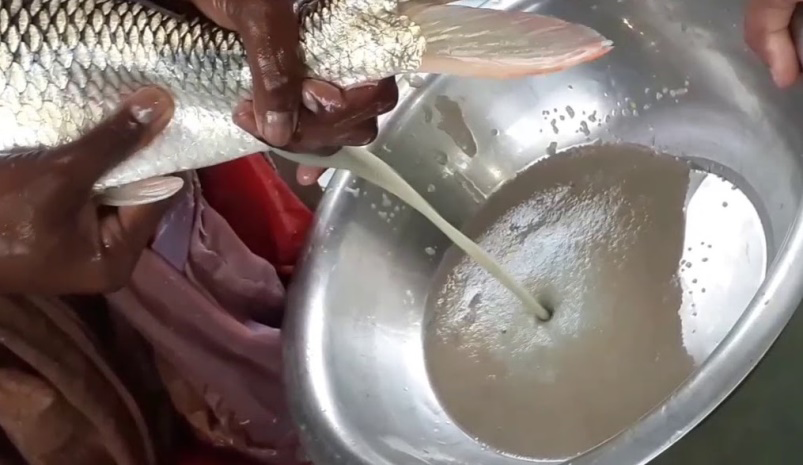
Ahmed [13] stated that PG influenced the spawning of Labeo rohita. Atz and Pickford [14] and Chaudhuri [15] mentioned various aspects of the fish pituitary gland and its role in modern aquaculture (Figure 3). From the investigational period, it was observed that the fish ovulated
98% when the appropriate doses of hormonal injections were applied and maintained temperature range (22-28)0C Alikunhi, et al. [16], Alam and Bhuiyan [17], Bhuiyan and Aktar [6], Haque [18] and Mahanta et al. [19]).
Incubation and Hatching
During the survey, it was found that the ovulation rate of Rui (Labeo rohita), Catla (Catla catla), Mrigel (Cirrhinus cirrhosus), Calibaush (Labeo calbasu), Bata (Labeo bata), Gonia (Labeo gonius), Silver Carp (Hypopthalmicthys molitrix), Bighead Carp (Hypopthalmicthys molitrix), Grass Carp (Ctenopharyngodon idella), Common Carp (Cyprinus carpio), Black Carp (Mylopharyngodon piceum), Thai Puti or Raj Puti (Barbonymus gonionotus) and Thai Pangus (Pangasius sutchi) fish species were 65, 70, 74, 80, 84, 88, 92, 96, 98, 90 and 88%, respectively (Figure 4). The regression type is Polynomial and the equation is y = -0.751x2 + 11.36x +49.705 (R2 = 0.8449).
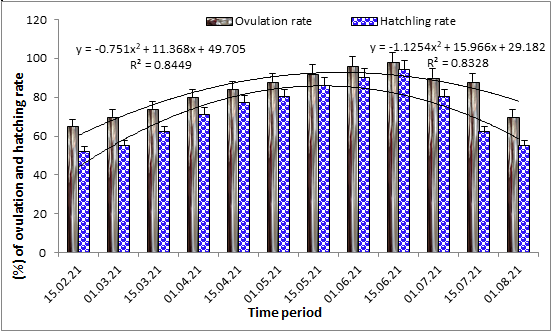
The fish hatching rate were recorded at the rate of 52, 55, 62, 71, 77, 80, 86, 90, 94, 80 and 62%, respectively in different hatcheries (Figure 4). The regression type is Polynomial and the equation is y = -1.1254x2 + 15.96x +29.182 (R2 = 0.8328). Highest ovulation and hatching was recorded at 99% and 94% in the month of June Singh BN, et al. [20] in the different hatcheries. The ovulation rate of Pabda (Ompok pabda), Gulsa (Mystus cavasius), Mrigel (Cirrhinus cirrhosus), Calibaush (Labeo calbasu), Bata (Labeo bata), Gonia (Labeo gonius), Tengra (Mystus tengra), Koi (Anabas testudineus), Shing (Heteronopneustes fossilis) and Magur (Clarius batrachus) fish species were 70, 76, 81,
84, 86, 88, 97, 98, 99, 90, 84 and 70%, respectively (Figure 5). The regression type is Polynomial and the equation is y = -1.0082x2 + 12.96x + 53.97 (R2 = 0.8749). The fish hatching rate were recorded at the rate of 58, 61, 72, 76, 82, 91, 93, 94, 73, 68 and 6%%, respectively in different hatcheries (Figure
5). The regression type is Polynomial and the equation is y = -1.289x2 + 16.269x +36.958 (R2 = 0.849). Highest ovulation and hatching was recorded at 99% and 94% in the month of July (Singh BN, et al. [20] in the different hatcheries.
From this study on the survey of the fish hatcheries of Bangladesh, it was found that fish hatcheries contributed to a remarkable production of inland fish species as well as to the aquaculture development of Bangladesh. In the fisheries sector, induced breeding has opened the door of a new horizon throughout the country. Quality and quantity seed of fish production is important for aquaculture sector to give logistic support of farmer. It is also necessary to develop hatchery facilities which include induced breeding techniques for the development of aquaculture in Bangladesh.
References
-
FAO (2014) The state of world fisheries and aquaculture. Food and Agriculture Organization, Rome, Italy, pp: 1-243.
-
FRSS (2021) Year book of Fisheries Statistics of Bangladesh (2020-21), pp: 1-74.
-
Rahman SMB, Mahmud Z, Ahmed F, Ghosh AK, Sabbir AW (2011) Induced breeding, embryonic and larval development of comet gold fish (Carassius auratus). Electronic Journal of Biology 7(2): 32-39.
-
Montchowui E, Bonou CA, Laleye P, Philippart JC, Poncin P (2011) Successful artificial reproduction of the African
-
Bhuiyan AS, Islam MK, Tanjeena Z (2007) Induced spawning of Puntius gonionotus (Bleeker). Bangladesh J Zool 14: 121-125.
-
Bhuiyan AS, Aktar N (2011) Observation on the induced spawning practices in the Hatcheries of Rajshahi district of Bangladesh. J Life Earth Sci 6: 65-68.
-
Mollah MFA, Amin MR, Sarowar MN, Muhammadullah (2008) Induced breeding of the riverine catfish Rita rita. J Bangladesh Agril Univ 6(2): 361-366.
-
Hossain DG, Siddiqui AB (2009) Present status of hatcheries and fish production of Rajshahi. BSS, ,Rajshahi, Bangladesh, pp: 2.
-
Chaudhuri H (1976) Uses of hormones in induced spawning of carps. J Fish Res Board Can 33(4): 940-947
-
Zar JH (1984) Biostatistics. Prentice-Hall, Inc. Englewood Cliffs, New Jersey, USA, pp: 718.
-
Hasan MR, Ahmed GU (2002) Issues in carp hatcheries and nurseries in Bangladesh, with special reference to health management. In: Arthur JR, et al. (Eds.), Primary Aquatic Animal Health Care in Rural Small-scale Aquaculture Development. FAO Fish. Bangladesh, pp. 147-164.
-
Sarder R (2007) Freshwater fish seed resources in Bangladesh. Pp. 105-128. In: Bondad-Reantaso MG, et al. (Eds.), Assessment of freshwater fish seed resources for sustainable aquaculture. FAO Fish, pp: 105-128.
-
Ahmed N (1945) Factors influencing the spawning of Indian carps. Symposium of the Factors influencing the spawning of Indian carps. Proc Nat Inst Sci India 11(3): 329.
-
AtzJ WJ, Pickford GE (1959) The use of pituitary hormones in fish culture. Endeavour 18(71): 125-129.
-
Chaudhuri H (1976) Uses of hormones in induced spawning of carps. Journal of the Fisheries Research Board of Canada 33(4): 940-947.
-
Alikunhi KH, Sukumaran KK, Parameswaran S, Banerjee SC (1964) Preliminary observations on commercial breeding of Indian carps under controlled temperature in the laboratory. Bull Cent Inland Fish Res Inst Barack pore 3: 1-20.
-
Alam MM, Bhuiyan AS (1999) Determination of optimum PG dose for induced spawning of Labeorohita (Hamilton 1822) Unvi J Zool Rajshahi Univ 18: 103-108.
-
Haque KA (1975) Some observations on the induced spawning of major carps by pituitary hormone injection. Freshwater fisheries Research Station Chandpur Bulletin 1: 19-33.
-
Mahanta PC, Rao KG, Pandev AK (1998) Induced spawning of an Indian major carp, Labeorohitain the breeding season under the agro climatic conditions of Assam. J Advanced Zoology. National Bureau of Fish frenetic resources India 19(2): 99-101.
-
Singh BN, Das RC, SahuAK, Pandey AK, Sahoo GC (2000) Balanced diet for the brood stock of Catlacatla and Labeorohita and induced breeding performance using Ovaprim. Journal of Advanced Zoology 21(2): 92-97.
- Genetic Improvement of Nile Tilapia (Oreochromis niloticus): Advances in Selective Breeding and Genomic Approaches for Sustainable Aquaculture
- Microplastics, Contaminants, and Waste Hotspots: Divergences and Faults in Prioritizing Control Efforts
- Creating a Healthier, More Vibrant Open and Closed Aquatic Environment. A Submersible, Centrifugal Magnetically Affixed Current Changing Aquarium Pump
- An Attempt to Assess Alpha Diversity and Sample Size: Using the Ostracod Assemblages off Kumamoto Port, Japan
- Assessment of the Efficiency of Common Fishing Gears and Crafts Used at Mohananda River of Chapai Nawabganj, Bangladesh
- Fish Productivity and Biodiversity Status of Sundarban Mangrove in Bangladesh