
Live Feeding Strategy for Striped Snakehead Fish (Channa striata) Larvae
Snakehead fish is an important freshwater fish in several developing countries, such as Vietnam, Malaysia, Bangladesh, and Indonesia. This fish has the potential to be cultivated. This study aimed to determine the feeding live feed strategy on snakehead fish, specifically from endogenous to exogenous live feed. This natural feeding transition is crucial for snakehead fish culture. The brood stock fish spawned naturally, and then the eggs were incubated and hatched in an aquarium. The newly hatched larvae were kept in an aquarium for two days before subjected to experiments. A total of 200 larvae were put into the aquarium and maintained without feeding. The mortality rate of larvae was calculated every hour until all larvae die. The second experiment was to calculate the amount of live feed Artemia salina consumed by larvae every day and identify the stage of the larva, where the consumption of live feed could be reduced and replaced with artificial food. All the experiment units were carried out with 3 replications. The results showed that the newly hatched larvae without being fed could survive up to 3 days, but after 10 days, the mortality reached 50%, and after 18 days, the mortality reached 100%. Consumption of live feed could be started on larvae aged 3 to 11 days after hatching, at age 12 to 17 days, larvae must be fed with a combination of live feed and artificial food with more amounts of live feed than artificial food, and at the age of 18 to 22 days after hatching the amount of live feed can be reduced, and the amount of artificial feed is increased. Therefore, the accuracy of feeding is a very important stage in aquaculture, especially in fish hatcheries.
Introduction
The striped snakehead Channa striata is a popular carnivorous freshwater fish with high value in Asian countries. The fish has a firm, white and boneless tasty flesh and flavor Sinh LX, et al. [1]; Rahman M, et al. [2]; Raizada S, et al. [3] and the fish flesh has beneficial for healing after surgery [4]. In an animal study, C. striata flesh extract has been shown to increase the tensile strength of the surgically stitched wound. It also has been formulated into aerosol/spray for a drug delivery system to wound and burn treatment [5, 6]. Evaluation of the film properties from the concentrate of aerosol had been done in other studies [7]. The cultured snakehead has become an economically important freshwater fish in developing countries as Thailand, Malaysia, Indonesia, Bangladesh, India, and Vietnam. In 2016, the total global capture and aquaculture production of the striped snakehead reached 92,523 tones [8]. In Vietnam, snakehead has been cultured for 60 years and becomes an important species in Mekong Delta. The production of snakeheads in the Vietnamese Mekong Delta increased from 5300 to 40,000 tones (2002-2009) [8].
The striped snakehead fish has the potential to be cultured. The fish can be survived even under high environmental stress [9]. Striped snakehead is an air-breathing fish, inhabiting swamps, which are dry in the dry season Djumanto, et al. The fish can survive in harsh environments with low dissolved oxygen and high ammonia [10]. Therefore, the fish can be cultured even in ponds with poor environmental conditions. Besides, the fish can be successfully induced to spawn using a synthetic gonadotropin-releasing hormone with a dopamine antagonist [11]. In Indonesia, the culture of snakeheads is still not commonly practiced due to the lack of larvae supply and knowledge of their feeding and breeding techniques. Therefore, it is necessary to do a detailed study of fish farming to develop snakehead fish cultivation. This study aimed to evaluate feeding the live feed on newly hatched larval snakehead fish to increase the larval survival rate. The commencement of the exogenous feeding stage of larvae is a critical point for larval fish as a whole. Therefore, a strategy for feeding live feed in newly hatched larvae of the striped snakehead fish plays an important role in increasing survival rate of the larval fish in breeding.
Materials and Methods
Study Area
The experiment was conducted at the Breeding and Genetics Laboratory of the Department of Aquaculture at the Pangkep State Polytechnic of Agriculture in July 2020. The snakehead fish broodstocks were originally from Mandalle, South Sulawesi, Indonesia (-4.568256, 119.598802).
Artemia culture
Artemia culture was conducted as reported by Mehrajuddin WAR, et al. [12] with modification. In brief, Artemia cysts (Mackay brine shrimp, South Ogden, USA) were hatched under the high light intensity in 5L conical flasks. Before hatching, the cysts were hydrated for three hours in 500mL of freshwater, and 20mL of bleach was added to disinfect and decapsulate the cysts. The temperature was maintained at 26°C with vigorous aeration for 24 hours.
Hatched Artemia nauplii were then cleaned with running fresh water for few minutes, and they were fed yeast until use. After cleaning, the required numbers of animals were fed to the larvae.
Larviculture
A pair of brood stock (male: 239g and female: 299g) was naturally nurtured in a 2000-L volume fibre tank. The tanks were filled with fresh water, which has been treated with chlorine (20ppm). Fertilized eggs that float were collected and incubated by put them in the aquarium until they hatch. Larvae were kept in a hatching aquarium until they are 2 days old. The larvae were then transferred to a 20-L volume aquarium for later use in experiments.
The first experiment was to determine how long the larvae could live without obtaining food from the outside (exogenous feeding) after the food reserves in the form of egg yolk run out. A total of 200 2-day-old larvae were put into a 20-L aquarium and maintained without being fed. The experiment was conducted in 3 replications. The number of larvae that died was observed every hour to determine the mortality rate of larvae. The observations were carried out until all larvae in the aquarium died.
The second experiment aimed to determine the amount of live feed from outside needed by the larvae every day until they become seeds. A total of 500 200 2-day-old larvae were put into a 20-L aquarium and fed with live feed Artemia salina (10 individuals/mL volume of water). The live feed was given twice a day at 8:00am and 4:00pm. Before feeding in the morning, cleaning the dirt and addition of freshwater were conducted every day. In another experiment, 200 2-day-old larvae were put into a 20-L aquarium and were given live feeds in the same density and given 100mg of flour pellets of artificial feed (MS Prima Feed, Surabaya, Indonesia) that contains protein (39%), Lipid (5%), Crude (6%), and ash (12%). The mixed feed was given twice a day at 8:00 am and 4:00 pm. All the experiment units were carried out with 3 replications. The growth (weight and length) and survival rates of larvae were sampled weekly. Measurement of weight and length was conducted using a digital scale and vernier calipers. The survival rate (S) was calculated using the following formulae:
S = Number of Fish at sampling Number of Fish at the beginning of experiment x 100% The amount of live feed, Artemia consumed by the larvae, was observed by random sampling of 5 larvae. One hour after feeding, larvae are taken and dissected into the stomach to count the amount of Artemia consumed. The calculated amount was expressed as the live feed amount needed by the larvae on that day or at that age. The experiments were carried out for 4 weeks or until the larvae became seeds. Changing larvae into seeds was done by observing the morphological growth of the fins. If the five fins, including the radius of the fins, have fully grown, the larva was declared to be a seed.
Data Analysis
The evaluation of feeding live feed strategies was conducted by calculating the mortality rate in the first experiment and the survival rate of the larvae in the second experiment. The evaluation of the second experiment was carried out by calculating the survival rate, length and weight gain of larvae, and the number of Artemia found in the larvae stomach. The data obtained were analysed with ANOVA with a confidence level of 95% and 99%.
Results and Discussion
In this work, the feeding strategy of live feed Artemia on snakehead fish was carried out during larval rearing. This is intended to determine when and how many live feed is given to produce high survival and growth rates.
Larval Mortality Rate without Feeding
In Figure 1 below, it appears that newly hatched larvae have a mortality rate of 0% up to day 3, which means that endogenous food reserves carried by larvae
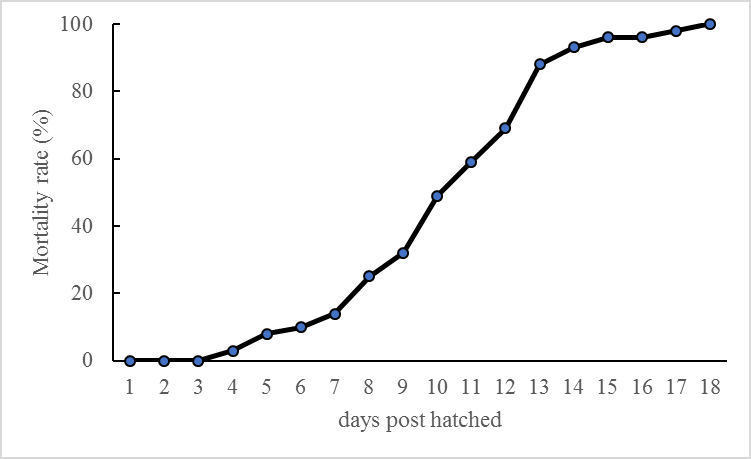
Since they are still eggs are still sufficient to support the development needs of larvae. Without feeding, the larvae slowly died every day as larvae age. Larval mortality reached 50% on the 10th day without obtaining food. Mortality increased dramatically on day 13, and on day 18, 100% of the larvae died.
In the newly hatched larval phase, fish cannot yet find food, but the larva has a yolk sac that provides nutrients for the larval development needs. Before the yolk sac is gone and the yolk is absorbed, the fish larvae must find their food. In silver perch (Bidyanus bidyanus), first feeding occurs slower than snakehead fish. Larvae begin to show signs of starvation at day 5 after hatching, and at 7 day-post-hatched (DPH), all yolk sacs are fully absorbed, and larval mortality reaches 50% [13]. This shows that the mortality rate of silver perch fish larvae without feeding is faster than snakehead fish larvae. Research on silver perch shows that exogenous feeds must be available at 4 DPH before the yolk sac is fully absorbed. Initial feeding at 5 and 6 DPH showed better larval growth rates than initial feeding at 7 and 8 DPH [14].
Live Feed Requirement of Larvae
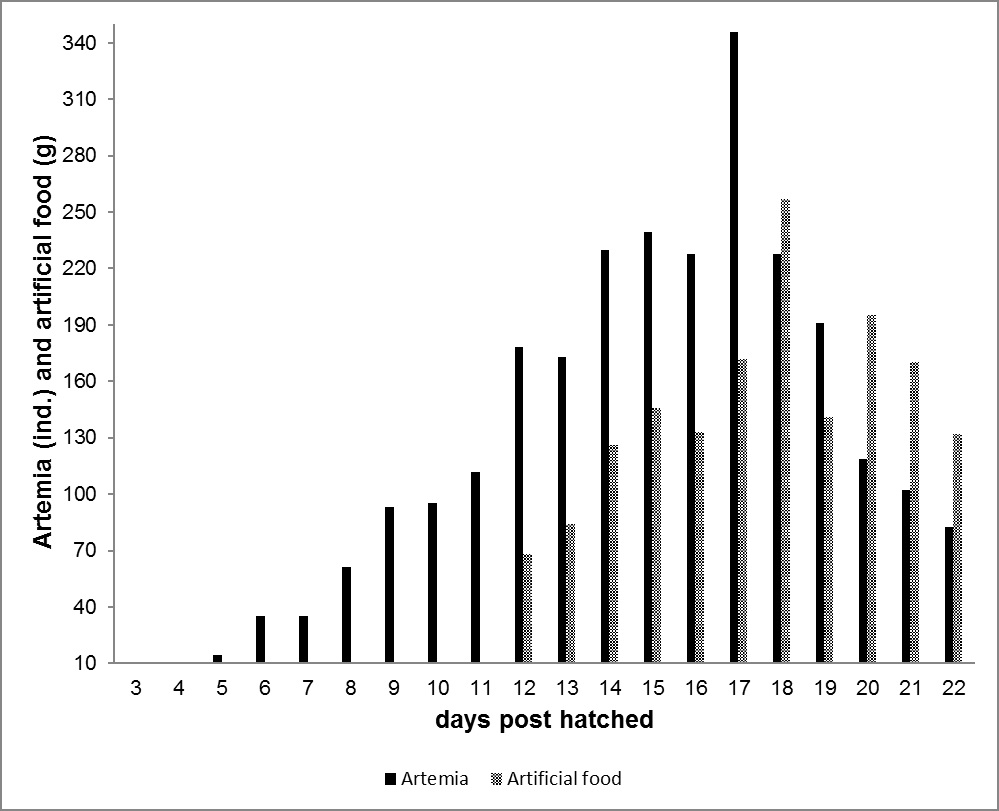
Figure 2 shows the amount of Artemia consumed by the larvae from day 3 to day 22 (the last stage of post larvae). It is clear that the number of Artemia consumed by snakehead fish larvae increases every day until the 17th or 18th day and gradually decreases the number of Artemia until the final post-larval stage on the 22nd day (starting from the juvenile stage). The results showed that the consumption of live feed could be started in larvae aged 3 days to 11 days after hatching, at 12 days to 17 days after hatching, the larvae must be fed with a combination of live feed and artificial feed with more live feed than artificial feed, and at the age of 18 days to 22 days after hatching the amount of live feed could be reduced, and the amount of artificial feed was increased.
Survival and Growth Rates
The survival rate of larvae fed with Artemia at 3 to 11 DPH shows a better trend than larvae fed with Artemia mixed with artificial feed (Figure 3). The larval survival rate decreases dramatically after the 2nd week and towards the 3rd week of cultivation. Similar results have been reported in studies of snakehead fish larvae feed with Artemia nauplii and Ceratophrys cornuta, where after 2 weeks of cultivation, the mortality rate of larvae increased significantly [12].
This phenomenon shows that live feed contains nutritional composition suitable for larval survival and can meet the dietary needs of larvae to support the ongoing process of developing the larvae’s organs to be perfect [15]. In the larval phase, artificial feed is still difficult to digest by larvae whose digestive organs and digestive enzymes are not yet perfect, so that artificial feed nutrients cannot be optimally absorbed so that it is not sufficient for developmental needs and successful living larvae. Artemia nauplii mixed cladoceran showed better survival (88±1.73%) for snakehead fish [12].
![Figure 3: The survival rate of larvae consumed live feed Artemia salina only and a combination between Artemia and artificial food Growth parameters, namely body length and weight gain are presented in Figures 4 & 5. The ANOVA results showed that there was a significant difference in the percentage of body length gain (P<0.01) and the percentage of weight gain (P<0.05) between treatments. The larvae treated with Artemia showed better results for the higher percentage of weight gain and length than those fed Artemia combined with artificial feed. These results indicate that fish need live feed in the early stages of life to support their development and growth. In addition, the live feed also contains the required nutritional composition with high protein content (46%) by the larvae and the enzyme composition that is suitable for the digestive system of the larvae. As it is known that at the larval stage, the digestive enzymes of larvae have not been produced completely, so that the digestive enzymes of larvae need the help of enzymes from outside to encourage the digestive process, these enzymes can be obtained from live feed consumed by fish larvae [16,17]. Whereas artificial food does not contain digestive enzymes, the larvae have to digest the food by relying on the body’s digestive enzymes. Because the digestive enzymes are not yet perfect, the digestion process of artificial feed is not perfect, so the feed’s nutrients cannot be utilized optimally to support larval growth. To support growth, larvae must consume nutrients. Food intake depends on the density, size, and type of prey (food). The size of prey that larvae can consume depends on the size of the mouth of the larva. As the larva’s body size increases, the chosen prey is also larger in size. This study showed that live feed could significantly influence snakehead fish larvae’s growth performance since this live feed can affect the feed ingestion and assimilation of larvae [18].](/fulltextimages/9498/fig_3.png)
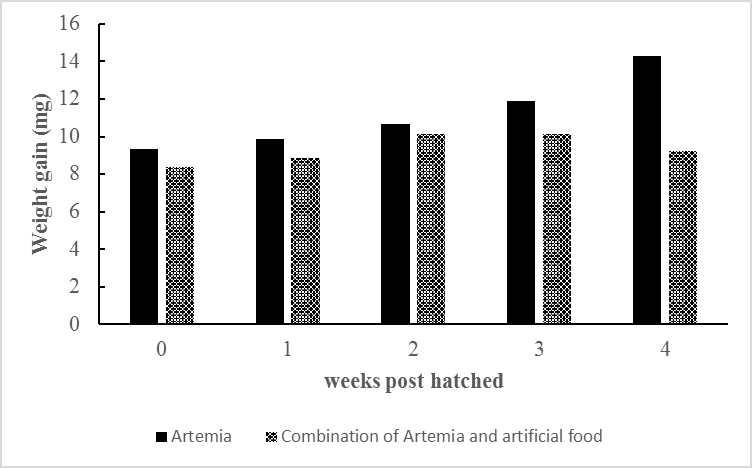
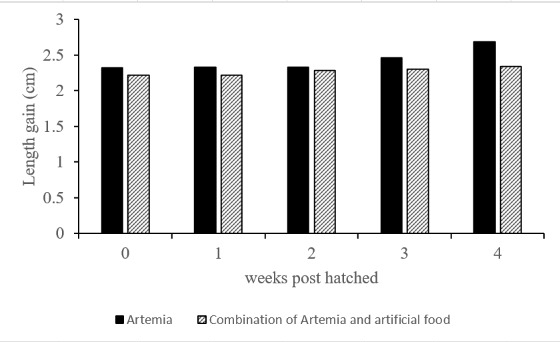
Figure 3: The survival rate of larvae consumed live feed Artemia salina only and a combination between Artemia and artificial food Growth parameters, namely body length and weight gain are presented in Figures 4 & 5. The ANOVA results showed that there was a significant difference in the percentage of body length gain (P<0.01) and the percentage of weight gain (P<0.05) between treatments. The larvae treated with Artemia showed better results for the higher percentage of weight gain and length than those fed Artemia combined with artificial feed. These results indicate that fish need live feed in the early stages of life to support their development and growth. In addition, the live feed also contains the required nutritional composition with high protein content (46%) by the larvae and the enzyme composition that is suitable for the digestive system of the larvae. As it is known that at the larval stage, the digestive enzymes of larvae have not been produced completely, so that the digestive enzymes of larvae need the help of enzymes from outside to encourage the digestive process, these enzymes can be obtained from live feed consumed by fish larvae [16, 17]. Whereas artificial food does not contain digestive enzymes, the larvae have to digest the food by relying on the body’s digestive enzymes. Because the digestive enzymes are not yet perfect, the digestion process of artificial feed is not perfect, so the feed’s nutrients cannot be utilized optimally to support larval growth. To support growth, larvae must consume nutrients. Food intake depends on the density, size, and type of prey (food). The size of prey that larvae can consume depends on the size of the mouth of the larva. As the larva’s body size increases, the chosen prey is also larger in size. This study showed that live feed could significantly influence snakehead fish larvae’s growth performance since this live feed can affect the feed ingestion and assimilation of larvae [18].
Cultivation of snakehead fish needs a live feed to support their growth rates. Several good live feeds for snakehead fish that have been reported are blood worms, trash fish, and acetes shrimp [19, 20]. Live feed that gives the best total length gain is trash fish followed by bloodworm and acetes shrimp, so trash fish is recommended as the best live feed to support growth, body weight gain, and Food Conversion Ratio (FCR) in snakehead fish cultivation [21].
Conclusions
This study has evaluated the feeding of live feed on newly hatched snakehead fish larvae to increase larval survival rate with the results showed that during larval rearing a combination of Artemia feed and artificial feed is needed. The larvae should be fed with live feed Artemia, from the age of 3 days to the age of 11 days, and after the age of 12, the larvae should be fed with a combination of Artemia and artificial food. At the age of 12 to 17 days, the larvae should be fed a combination of live feed and artificial feed with a higher amount of live feed than artificial feed, and at 18 to 22 days after hatching the amount of live feed can be reduced, and the amount of artificial feed increased. A combination feeding strategy between Artemia and artificial feed is needed to increase the survival rate in larval rearing of snakehead fish. The fulfillment of nutritional needs, especially the need for fatty acids during the larval rearing of snakehead fish, needs to be investigated due to fatty acids play a very important role as an energy source for the development and growth of all fish in the larval stage. This can be conducted by enrichment of Artemia with polyunsaturated fatty acids, such as eicosapentaenoic acid (EPA), docosahexaenoic acid (DHA), and arachidonic acid (ARA).
Acknowledgment
The first author thanks the Ministry of Research, Technology and Higher Education of Indonesia to award the research grant (Excellent Applied Research of University schemne with contract number 10/PL22.7.1/SP.PG/2009
References
-
Sinh LX, Navy H, Pomeroy RS (2014) Value chain of snakehead fish in the Lower Mekong Basin of Cambodia and Vietnam. Aquaculture Economics & Management 18(1): 76-96.
-
Rahman M, Aminur, Awal S (2016) Development of captive breeding, seed production and culture techniques of snakehead fish for species conservation and sustainable aquaculture. Int j Adv Agric Environ Eng 3(1): 117-120.
-
Raizada S, Rawat A, Srivastava PP, Lal KK (2021) Cannibalism mitigation in striped murrel, Channa striata, with hatchery seed weaned on pellet diet: A review. Reviews in Aquaculture 14(3): 1213-1233.
-
Sahid NA, Hayati F, Rao CV, Ramely R, Sani I, et al. (2018) Snakehead consumption enhances wound healing? From tradition to modern clinical practice: a prospective randomized controlled trial. Evidence- Based Complementary and Alternative Medicine 2018.
-
Febriyenti F, Noor AM, Baie SBB (2011) Physical evaluations of Haruan spray for wound dressing and wound healing. International Journal of Drug Delivery 3(1).
-
Laila L, Febriyenti F, Salhimi SM, Baie S (2011) Wound healing effect of Haruan (Channa striatus) spray. International Wound Journal 8(5): 484-491.
-
Febriyenti F, Noor AM, Bai SB (2010) Mechanical properties and water vapour permeability of film from Haruan (Channa striatus) and Fusidic acid spray for wound dressing and wound healing. Pak J Pharm Sci 23(2): 155-159.
-
Bich TTN, Tri DQ, Yi Ching C, Khoa HD (2020) Productivity and economic viability of snakehead Channa striata culture using an aquaponics approach. Aquacultural Engineering 89: 102057.
-
Arma NR, Illijas MA, Irmawati MA (2014) Morphometric and meristic characteristics of snakehead fish for hatchery production. Proceeding of the 3rd International and National Seminar on Fisheries and Marine Science: Strengthening Science and Technology towards the Development of Blue Economy, Faculty of Fisheries and Marine Science University of Riau, Riau, pp: 198-201.
-
Qin J, Fast AW, Kai AT (1997) Tolerance of snakehead Channa striatus to ammonia at different pH. Journal of the World Aquaculture Society 28(1): 87-90.
-
Marimuthu K, Kumar D, Haniffa MA (2007) Induced spawning of striped snakehead, Channa striatus, using Ovatide. Journal of Applied Aquaculture 19(4): 95-103.
-
Mehrajuddin WAR, Altaff K, Haniffa MA (2011) Growth and survival of larval snakehead Channa striatus (Bloch, 1793) fed different live feed organisms. Turkish Journal of Fisheries and Aquatic Sciences 11(4): 523-528.
-
Sulaeman, Fotedar R (2017) Yolk utilization and growth during the early larval life of the Silver Perch, Bidyanus bidyanus (Mitchell, 1838). International Aquatic Research 9(2): 107-116.
-
Sulaeman, Fotedar R (2018) The effects of delayed initial feeding on the growth and survival of silver perch, Bidyanus bidyanus (Mitchell, 1838). Aquaculture, Aquarium, Conservation & Legislation 11(4): 1025- 1037.
-
Amornsakun T, Sriwatana W, Promkaew P (2011) Some aspects in early life stage of snake head fish, Channa striatus larvae. Songklanakarin Journal of Science & Technology 33(6): 671-677.
-
Hien TTT, Tam BM, Tu TLC, Bengtson DA (2017) Weaning methods using formulated feeds for snakehead (Channa striata and Channa micropeltes) larvae. Aquaculture Research 48(9): 4774-4782.
-
Paray BA, Haniffa MA, Innocent X, Rather IA (2016) Effect of feed quality on growth and survival of striped snakehead, channa striatus (bloch, 1793) hatchlings. Indian Journal of Geo-Marine Sciences 45(1): 105-110.
-
Conceicao LEC (1997) Growth in early life stages of fishes: an explanatory model. Bibliotheek Landbouwuniversiteit, pp: 1-198.
-
Abol Munafi AB, Tarn BM, Ambak MA, Ismail P (2004) Effect of different diets on growth and survival rates of snakehead (Channa striata Bloch, 1797) larvae. Korean Journal of Biological Sciences 8(4): 313-317.
-
Rahman MA, Arshad A, Nurul Amin NSM (2012) Growth and production performance of threatened snakehead fish, Channa striatus (Bloch), at different stocking densities in earthen ponds. Aquaculture Research 43(2): 297-302.
-
Muntaziana MPA, Amin SMN, Kamarudin MS, Rahim AA (2013) Effect of selected diets on the growth and survival of snakehead fish (Channa striatus) fry. Journal of Fisheries and Aquatic Science 8(2): 405-411.
- Genetic Improvement of Nile Tilapia (Oreochromis niloticus): Advances in Selective Breeding and Genomic Approaches for Sustainable Aquaculture
- Microplastics, Contaminants, and Waste Hotspots: Divergences and Faults in Prioritizing Control Efforts
- Creating a Healthier, More Vibrant Open and Closed Aquatic Environment. A Submersible, Centrifugal Magnetically Affixed Current Changing Aquarium Pump
- An Attempt to Assess Alpha Diversity and Sample Size: Using the Ostracod Assemblages off Kumamoto Port, Japan
- Assessment of the Efficiency of Common Fishing Gears and Crafts Used at Mohananda River of Chapai Nawabganj, Bangladesh
- Fish Productivity and Biodiversity Status of Sundarban Mangrove in Bangladesh