
A Review on Reverse Osmosis Membrane Fouling Diagnosis
During long-term operation, reverse osmosis (RO) membrane fouling is an inevitable occurrence that leads to a decline in membrane performance. When the water quality fails to meet specific application requirements, it becomes necessary to replace the deteriorated membranes. Membrane autopsy is widely recognized as the most direct and effective method for studying and identifying membrane fouling. By analyzing the results of membrane autopsy and membrane fouling diagnosis, valuable insights can be gained to optimize the operation of the membrane system, maintain the membrane elements through regular routines, and restore membrane performance. However, the current practice of membrane autopsy and the study of membrane fouling diagnosis lack a systematic and comprehensive approach. This paper aims to address these gaps by introducing various analytical methods for membrane fouling, discussing the existing challenges in practical applications, and reviewing the diagnosis of fouling composition. These findings are expected to shed light on understanding the mechanisms and control methods of membrane fouling, and ultimately enhance the operation of membrane systems.
Introduction
Reverse osmosis (RO) membrane technology, as a commonly used technology in water treatment processes, has been increasingly applied in fields such as desalination of brackish water, seawater desalination, industrial wastewater treatment, and municipal wastewater treatment. However, during the long-term operation of the membrane, the surface will inevitably be contaminated by substances such as colloids, microorganisms, impurity particles, and insoluble salts [1, 2, 3]. Membrane fouling is the main influencing factor for the decline of membrane performance, therefore, the prediction and diagnosis of membrane fouling is the key to understanding the degree of membrane fouling, studying the mechanism of membrane fouling formation, and preventing membrane fouling.
Membrane dissection is an effective method for understanding the degree of membrane fouling and analyzing the causes of membrane fouling. Although this method requires destructive disassembly of membrane components, it can provide a more accurate and comprehensive analysis of membrane fouling. Membrane dissection analysis is currently the most intuitive and effective method for studying and determining membrane fouling [4, 5]. After offline detection, membrane dissection, and other characterization tests of membrane components, the membrane fouling diagnosis conclusions obtained from the dissection results can be used to evaluate the membrane fouling status and the degree of membrane performance loss, thereby providing effective basis for daily maintenance of membrane components, optimization of membrane system operation, and membrane performance repair [5, 6]. Therefore, this review first classifies and summarizes the commonly used membrane pollution diagnosis and analysis methods and their functions. And it also summarizes the diagnosis of membrane pollution components, in order to provide reference for the research of membrane pollution mechanism, membrane pollution prevention and control, and the improvement of membrane system operation.
Diagnostic and Analytical Methods for Membrane Fouling
The process of diagnosing membrane components mainly includes the selection, detection, and analysis, specifically referring to five steps: selection of dissecting objects, physical appearance inspection, pre-dissecting testing, membrane dissection and internal detection, membrane fouling characterization and diagnostic analysis.
Figure 1 is the flow chart of membrane dissection analysis.
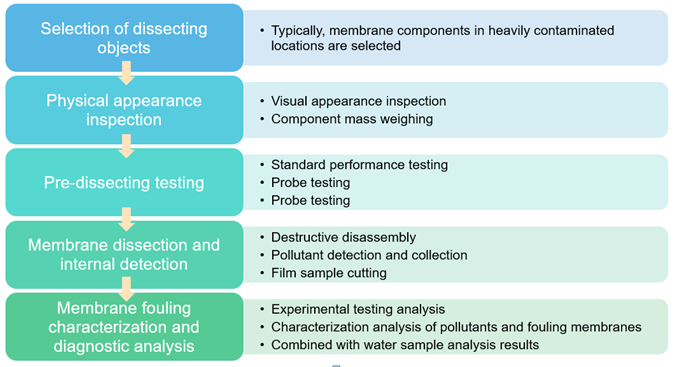
To determine the type of fouling of membrane components, it is necessary to conduct experimental testing and structural characterization analysis on the contaminated membranes and pollutants collected after dissection, and it usually need to combine the results of influent water quality testing [7, 8, 9, 10]. According to the characteristics of different membrane fouling diagnosis and analysis methods, Table 1 categorizes and summarizes the different methods and their effects by experimental testing, structural characterization, and water sample analysis.
| Method Name | Function | |
|---|---|---|
| experimental testing | loss on ignition (LOI) | Determine the proportion of organic and inorganic pollution based on the weight changes before and after burning |
| acid/alkali test | Qualitative analysis of carbonate inorganic or organic pollution | |
| Fujiwara test | Determine whether the surface of the contaminated film has been oxidized by chlorine or other halogens | |
| structural characterization | scanning electron microscope (SEM) | Observing the surface morphology and structure of pollutants and contaminated membranes |
| energy dispersive spectroscopy (EDS) | Analyze the composition and distribution of pollutants and elements on the surface of polluted membranes, and determine the inorganic pollution elements | |
| atomic force microscopy (AFM) | Observing the surface morphology of the contaminated membrane, determining the roughness of the membrane surface and one of the factors affecting the membrane’s anti fouling performance | |
| Fourier transform infrared spectroscopy (FTIR) | Determine the chemical structure and composition of pollutants, and determine the composition of organic pollutants | |
| attenuated total reflection- fourier transform infrared spectroscopy (ATR-FTIR) | Determine the surface functional groups and chemical structure composition of the contaminated film | |
| X-ray photoelectron spectroscopy (XPS) | Analyze the elemental ratio and chemical functional group composition structure of pollutants and polluted membrane surfaces | |
| nuclear magnetic resonance (NMR) | Characterization of pollutants and surface chemical structure composition of contaminated membranes | |
| contact angle (CA) | Determining the hydrophilicity and hydrophobicity of contaminated membranes, one of the factors affecting the membrane’s anti fouling performance | |
| zeta potential | Measure the surface charge characteristics of the contaminated film, one of the factors affecting the anti-fouling performance of membranes | |
| Rutherford backscattering spectrometry (RBS) | Analyzing pollutants and the elements and chemical structures on the surface of contaminated membranes | |
| gas chromatography-mass spectrometry (GC-MS) | Analyzing the organic pollution components of pollutants | |
| confocal laser scanning microscope (CLSM) | Analysis of organic pollution and its distribution on the surface of contaminated membranes | |
| pyro sequencing | Characterization of microbial pollutant components | |
| 16S rDNA sequencing | Characterization of microbial community structure | |
| water sample analysis | inductively coupled plasma-optical emission spectrometry/mass spectrometry (ICP-OES/MS) | Analyzing the cationic components of inorganic pollutants in water samples |
| ion chromatography (IC) | Analyzing the anionic components of inorganic pollutants in water samples | |
| three-dimensional excitation emission matrix fluorescence spectroscopy (3D-EEM) | Analysis of organic and biological pollutant components in water samples | |
| liquid chromatography- organic carbon detection (LC-OCD) | Analyze the composition of organic pollutants in water samples and detect the presence of inorganic colloids | |
| dissolved organic carbon (DOC) | Analyze the total amount of organic matter in the water sample |
Table 1: Common diagnostic and analytical methods for membrane fouling.
LOI, SEM, EDS, ATR-FTIR, ICP-MS/OES, IC and so on, are the most common diagnostic analysis methods for membrane fouling [11, 12, 13, 14]. The corresponding types of membrane fouling can be determined based on different experimental phenomena and characterization results. AFM, XPS, NMR, contact angle, zeta potential, and so on, are used as auxiliary analysis methods to further understand the structure and characteristics of pollutants and polluted film surface [15, 16, 17]. RBS, CLSM, 3DEEM and LC-OCD are methods used for membrane pollution diagnosis [18, 19, 20, 21], and their test results can more accurately determine the type of membrane pollution.
A RO membrane fouling diagnosis process is designed based on the dissection analysis process and contamination diagnosis method. Select the membrane components at the inlet and concentrates ends of the first and third sections for dissection and analysis. The diagnosis process of membrane fouling is as follows Table 2.
| Step | Analytical Methods | Results |
|---|---|---|
| 1 | Visual appearance inspection | |
| 2 | Standard performance testing | Detect the desalination rate and production water flow rate of membrane components. The water production and desalination rate of a membrane element are normal. However, the water production of the three stage membrane element has severely decreased (-54%), and the desalination rate is normal. |
| 3 | Destructive disassembly; Pollutant detection and collection | |
| 4 | Pollutant detection (SEM; FTIR) |
Table 2: The diagnosis process of membrane fouling.
Diagnosis of Membrane Fouling Components
Membrane pollution mainly includes four types, namely inorganic pollution, organic pollution, biological pollution, and colloidal particle pollution [22, 23, 24, 25]. Water sample detection analysis can determine the pollution components and their concentrations in water, and can also predict the risk of membrane fouling based on test results. However, the water sample detection results cannot truly reflect the pollution situation on the membrane surface. Membrane dissection analysis can provide effective basis for the diagnosis of membrane pollution components and degree. Therefore, researchers often use membrane dissection analysis to conduct different characterization tests on pollutants and contaminated membranes. And then determine the specific types and components of membrane fouling combined with water sample detection results.
Inorganic Pollution
Inorganic pollution is mainly caused by the gradual accumulation of inorganic salts present in water on the membrane surface, resulting in the formation of inorganic scale. The scaling process of inorganic salts is complex, and there are often coprecipitation and interaction of various inorganic salts [26, 27]. SEM, EDS, XRD and other structural characterization methods, as well as acid drop testing on the membrane surface, are commonly used for inorganic pollution diagnosis. Ruiz-García, et al. [28] conducted a dissection analysis of RO membrane components used for desalination of brackish water for 11 years. The dissection objects were selected from four different positions of membrane components, including the first and second stages of the reverse osmosis system’s first and last branches. Brown sediment can be seen intuitively on the first membrane of the first section. Coarse yellow scale can be seen on the last membrane of the second section. After SEM-EDS characterization and acid dripping analysis on the membrane surface, it is concluded that the membrane pollutants are mainly inorganic pollution containing calcium carbonate and aluminate.
XPS is a commonly used analytical method to characterize the elemental composition and chemical structure of membrane surfaces, but it can only detect the top of the membrane cortex, with a detection depth generally only of 7nm. RBS can also be used to analyze the composition and structure of membrane surface elements, and the detection depth of RBS is about 2 µm, which is deeper than the depth that XPS can detect. Therefore, RBS can also be used to detect the thickness of contaminated layers. Gorzalski, et al. [29] used RBS to study the surface pollutants of membranes and conducted a dissection analysis of nanofiltration membrane components used for 2.5 years of operation in silicon- containing groundwater treatment. The dissection objects were selected as the first and last membrane components of the first and second stage nanofiltration systems. Through characterization analysis such as SEM, XPS, RBS, and so on, it was found that the membrane pollutants were mainly inorganic pollutants containing Fe, Ca, Si, Al, and S elements. The Si and Al contents of the first stage membrane element were higher, while the Ca pollution of the second stage membrane element was heavier.
Organic Pollution
Organic pollution is mainly caused by humus, protein, polysaccharide and other organic substances in water. The elemental detection results of EDS can determine whether the pollutant is organic pollution. Farhat, et al. [30] conducted dissection analysis on membrane components for brackish water treatment. It found that there were a large number of brown pollutants on the surface of the membrane components. EDS characterization was performed on the contaminated membrane and the pollutants deposited on the membrane surface, respectively. The results showed that the main elemental composition of the pollutants were C, O, and N, indicating that the membrane pollution was mainly organic pollution. Although EDS results can be determined as organic pollution, they cannot diagnose the type of organic pollution.
IR and ATR-FTIR are important characterization methods for diagnosing organic pollution types. Researchers can judge the corresponding organic compounds based on the peak positions of different substances. Zheng, et al. [31] carried out an autopsy analysis on the RO membrane used for wastewater reuse in fossil-fuel power station. The object of the autopsy was the first membrane element of a section of RO system used in June, which was heavily polluted. It was observed that the collected pollutants were light brown loose structure with fishy smell.
In addition to the characterization of pollutants and fouling membranes, the results of water sample analysis can also diagnose the types of organic pollution. Jeong, et al. [32] conducted a dissection analysis of RO membrane components used for seawater desalination for 8 years. Three different positions of membrane components were selected for dissection, located in the front, middle, and rear of the primary RO system. A uniform layer of brown sediment can be seen on the surface of the contaminated film, with heavy pollution on the concentrated water side and inlet side, and the least pollution near the production side. According to the analysis of water sample test results characterized by LC- OCD and 3D-EEM, the organic pollutants of the membrane are mainly humus substances and small molecule neutral substances. Tang, et al. [33] carried out an autopsy analysis on the RO membrane element used for urban sewage reuse treatment for two months. The element is located in the first section of the RO system. Through LOI, FTIR, DOC, EEM, resin separation and other analysis, it was found that most of the membrane pollutants were microbial and humus organic pollutants containing unsaturated carbon or aromatic rings.
Biological Pollution
Biological pollution mainly refers to membrane fouling caused by the adhesion of microorganisms and their metabolites on the membrane surface. Although pre- treatment can effectively remove microorganisms, residual microorganisms reproduce rapidly. Biological pollution is the most difficult to control membrane fouling in RO systems. Moreover, high environmental temperatures can also lead to rapid microbial growth, resulting in more significant biological pollution of the membrane system in summer compared to other seasons.
Xu, et al. [34] conducted a dissection analysis of nanofiltration membrane components used for municipal wastewater treatment for 3 months, and selected membrane components from the first and second stage systems for dissection. The microbial community structure on the membrane surface was analyzed by 16SrDNA high-throughput sequencing. The results showed that the dominant bacteria on the membrane surface were Proteobacteria and Bacteroides. The microbial community diversity of the primary membrane element was higher than that of the secondary membrane element, indicating that the biological pollution of the primary system was serious.
Colloidal Particle Pollution
Colloidal particle pollution is mainly caused by colloidal substances generated in water and particles such as deposited clay and sludge, which can easily cause membrane, pore blockage and form a filter cake layer. The pollution density index (SDI) is commonly used in RO systems to determine the degree of colloidal particle pollution in the influent of the system, and ultrafiltration is used to pre-treat the RO system influent. However, smaller colloidal particles cannot be intercepted by ultrafiltration, and these pollutants are often adsorbed by the first membrane after entering the RO membrane system. Therefore, colloidal particle pollution in the membrane system often occurs at the inlet of the first membrane element.
Ho, et al. [35] carried out an autopsy analysis on the RO membrane of Singapore New Water Plant which has been operating for 8 months. It was observed by SEM that there was a thick polluted filter cake layer on the surface of the polluted membrane. Combined with the characterization results of EDS and LC-OCD, it was further proved that the membrane pollutant was mainly calcium phosphate colloidal particles.
Collaborative Pollution
The formation of membrane fouling is closely related to the water quality conditions of the influent. Therefore, for wastewater treatment membranes with complex water quality components, membrane fouling usually manifests as the synergistic effect of multiple pollutants. Li, et al. [36] conducted an autopsy analysis of the first and second stage RO membrane components of the brackish water RO device in the coal chemical wastewater treatment system. For each membrane component sample, randomly select a membrane bag and distribute it according to the “nine grid” pattern. Membrane samples were cut into 10 cm×10 cm and for further analysis. The characterization results of SEM- EDS, XPS, ATR-FTIR, and 3D-EEM indicated that from the first section to the second section along the inflow direction, organic pollution was severe throughout the entire process, inorganic pollution gradually intensifies, and microbial pollution showed a continuous decreasing trend. The organic pollutants were mainly proteins, while the inorganic pollutants were precipitates formed by Ca, Fe, and Si.
Chon, et al. [37] conducted an autopsy analysis of nan filtration membrane elements used for surface water treatment as drinking water. The first membrane element of the two-stage nan filtration system was selected as the dissection object. Combined with IC, ICP, 3D-EEM, SEM- EDS, ATR-FTIR, zeta potential, contact angle and other characterization analysis, the membrane pollutants are mainly inorganic pollutants containing Al, Ca, Cu, Fe, Mn, Mg, Zn, B, Si elements and organic pollutants containing hydrophilic polysaccharides, proteins and hydrophobic humus. Sharma, et al. [38] conducted membrane fouling analysis on a disc tube RO membrane used for distillery lees water treatment for 6 months. From the surface of the membrane, it can be seen that the membrane has undergone severe fading and has a layer of light red pollutants. Through SEM-EDS and AFM analysis of the contaminated membrane, combined with FTIR and XRD analysis of pollutants on the membrane, it was found that membrane fouling is mainly caused by colloidal particles, organic compounds containing polysaccharides and amines, and multivalent ions containing Ca2+, Mg2+, Fe2+, and SO42-.
Conclusion
LOI, SEM, EDS, ATR-FTIR, ICP, and IC are the most common diagnostic analysis methods for organic and inorganic pollution. CLSM, Pyrosequencing analysis, 16SrDNA high- throughput sequencing analysis are common diagnostic analysis methods for biological pollution. Combined with AFM, XPS, NMR, contact angle, zeta potential and other auxiliary characterization, the surface structural composition and performance changes of pollutants and contaminated films can be further analyzed. RBS, 3D-EEM, LC-OCD and other characterization methods have been commonly used in the diagnosis and analysis of membrane fouling in recent years, and their test results can more accurately determine the type of membrane fouling. However, the current practical application of membrane dissection analysis will omit most of the steps, making the research process not systematic and comprehensive. Further improvement is needed to maximize the significance and value of membrane dissection analysis.
References
-
Shu W, Xia H, Menachem E (2020) Complexation between dissolved silica and alginate molecules: implications for reverse osmosis membrane fouling. Journal of Membrane Science 605: 118109.
-
Zhonglong Y, Tiancheng W, Yan L (2020) Pre-ozonation for the mitigation of reverse osmosis (RO) membrane fouling by biopolymer: the roles of Ca2+ and Mg2+. Water Research 171: 115437.
-
Tang CY, Chong TH, Fane AG (2011) Colloidal interactions and fouling of NF and RO membranes: a review. Advances in Colloid and Interface Science 164(1/2): 126-143.
-
Darton T, Annunziata U, Fernando DV (2004) Membrane autopsy helps to provide solutions to operational problems. Desalination 167: 239-245.
-
Liu G, Pattanayak S, Navaneethakrishnan P (2018) Role of membrane autopsy in enhancing reverse osmosis plant operation. Water Practice and Technology 13 (1): 106-114.
-
Ibrahim D, Ismail K, Serkan G (2015) An autopsy of nanofiltration membrane used for landfill leachate treatment. The Scientific World Journal 2015: 850530.
-
Maxime P, Sophie R, Anju T (2055) Tools for membrane autopsies and antifouling strategies in seawater feeds: a review. Desalination 181(1/2/3): 75-90.
-
Amos A, Richard M, Patricia P (2020) Predicting the fouling tendency of thin film composite membranes using fractal analysis and membrane autopsy. Alexandria Engineering Journal 59(6): 4397-4407.
-
Ilham K, Said MM, Mohamed E (2020) Structural and morphological characterization of scale deposits on the reverse osmosis membranes: case of brackish water demineralization station in Morocco. Groundwater for Sustainable Development 11: 100483.
-
Pontié M, Thekkedath A, Kecili K (2007) Membrane autopsy as a sustainable management of fouling phenomena occurring in MF, UF and NF processes. Desalination 204(1/2/3): 155-169.
-
Thuy T, Brian B, Stephen G (2007) An autopsy study of a fouled reverse osmosis membrane element used in a brackish water treatment plant. Water Research 41(17): 3915-3923.
-
Dongsheng Z, Chang S, Guicai L (2019) Performance and autopsy of nanofiltration membranes at an oil-field wastewater desalination plant. Environmental Science and Pollution Research 26(3): 2681-2690.
-
Muhammad Kashif S, Young Gyun C (2018) The comparative study for scale inhibition on surface of RO membranes in wastewater reclamation: CO2 purging versus three different antiscalants. Journal of Membrane Science 546: 61-69.
-
Bhuvneshwar A, Aditya S, Akhilendra B (2020) Characterization and analysis of inorganic foulants in RO membranes for groundwater treatment. Desalination 491: 114567.
-
Shon HK, Vigneswaran S, Zareie MH (2009) Physicochemical pretreatment to seawater reverse osmosis (SWRO): organic characterization and membrane autopsy. Desalination 236(1/ 2/3): 282-290.
-
Mahdi M, Junyong Z, Bruggen Bart V (2020) Preparation, characterization and scaling propensity study of a dopamine incorporated RO/FO TFC membrane for pesticide removal. Journal of Membrane Science 612: 118458.
-
Douglas DM, Ritt Cody L, Rhea V (2020) Thin film composite membrane compaction in high-pressure reverse osmosis. Journal of Membrane Science 610: 118268.
-
Sheng L, Youngjin K, Laura C (2017) Impact of reverse nutrient diffusion on membrane biofouling in fertilizer- drawn forward osmosis. Journal of Membrane Science 539: 108-115.
-
Sanghun P, Taewoo N, Jongkwan P (2017) Investigating the influence of organic matter composition on biofilm volumes in reverse osmosis using optical coherence tomography. Desalination 419: 125-132.
-
Weilong S, Yoke LL, Enyu L (2020) Spatial variation of fouling behavior in high recovery nanofiltration for industrial reverse osmosis brine treatment towards zero liquid discharge. Journal of Membrane Science 609: 118185.
-
Shu W, Kang X, Xia H (2019) Characterizing the roles of organic and inorganic foulants in RO membrane fouling development: the case of coal chemical wastewater treatment. Separation and Purification Technology 210: 1008-1016.
-
Luca F, Abdullah HA, Andreia SFF, Zakzouk I, Sanghyun J, et al. (2020) Fouling investigation of a full-scale seawater reverse osmosis desalination (SWRO) plant on the Red Sea: membrane autopsy and pretreatment efficiency. Desalination 496: 114536.
-
Shanxue J, Yuening L, Bradley PL (2017) A review of reverse osmosis membrane fouling and control strategies. Science of the Total Environment 595: 567- 583.
-
Youngjin K, Sheng L, Noreddine G (2020) Evaluation of different cleaning strategies for different types of forward osmosis membrane fouling and scaling. Journal of Membrane Science 596: 117731.
-
Asif M, Tahar L, Wail F, Farooque M (2021) Fouling control in reverse osmosis for water desalination & reuse: current practices & emerging environment- friendly technologies. Science of the Total Environment 765: 142721.
-
Wen DL, Xu S, Alan P, Ahmed S, Thomas E (2017) Reverse osmosis membrane, seawater desalination with vibration assisted reduced inorganic fouling. Desalination 417: 102-114.
-
Saqib S, Che Jen L, Dong C (2010) Inorganic fouling of pressure-driven membrane processes-A critical review. Desalination 250(1): 236-248.
-
Ruiz García A, Melián Martel N, Mena V (2018) Fouling characterization of RO membranes after 11 years of operation in a brackish water desalination plant. Desalination 430: 180-185.
-
Alexander SG, Orlando C (2014) Fouling of nanofiltration membranes in full- and bench-scale systems treating groundwater containing silica. Journal of Membrane Science 468: 349-359.
-
Soumaya F, Mahmoud B, Fethi K (2018) Membrane autopsy to provide solutions to operational problems of Jerba brackish water desalination plant. Desalination 445: 225-235.
-
Libing Z, Dawei Y, Gang W, Yue Z, Zhang C, et al. (2018) Characteristics and formation mechanism of membrane fouling in a full-scale RO wastewater reclamation process: membrane autopsy and fouling characterization. Journal of Membrane Science 563: 843-856.
-
Sanghyun J, Gayathri N, Robert V, Leiknes T, Vigneswaran S (2016) Indepth analyses of organic matters in a full- scale seawater desalination plant and an autopsy of reverse osmosis membrane. Separation and Purification Technology 162: 171-179.
-
Fang T, Hongying H, Lijuan S, Wu QY, Jiang YM, et al. (2014) Fouling of reverse osmosis membrane for municipal wastewater reclamation: autopsy results from a full-scale plant. Desalination 349: 73-79.
-
Rui X, Wei Q, Bing Z, Wang X, Li T, et al. (2020) Nanofiltration in pilot scale for wastewater reclamation: long-term performance and membrane biofouling characteristics. Chemical Engineering Journal 395: 125087.
-
Shin HJ, Nuang SL, Richard DW, Viswanath B, Coster HGL, et al. (2017) Monitoring fouling behavior of reverse osmosis membranes using electrical impedance spectroscopy: a field trial study. Desalination 407: 75-84.
-
Yufang L, Mengchen L, Kang X, Huang X (2020) Reverse osmosis membrane autopsy in coal chemical wastewater treatment: evidences of spatially heterogeneous fouling and organic-inorganic synergistic effect. Journal of Cleaner Production 246: 118964.
-
Kangmin C, Jaeweon C (2016) Fouling behavior of dissolved organic matter in nanofiltration membranes from a pilot-scale drinking water treatment plant: an autopsy study. Chemical Engineering Journal 295: 268- 277.
-
Pinki S, Himanshu J (2014) Membrane autopsy based biofouling investigation of distillery spent wash RO treatment plant. Environmental Technology 35(21-24): 3047-3051.
- Genetic Improvement of Nile Tilapia (Oreochromis niloticus): Advances in Selective Breeding and Genomic Approaches for Sustainable Aquaculture
- Microplastics, Contaminants, and Waste Hotspots: Divergences and Faults in Prioritizing Control Efforts
- Creating a Healthier, More Vibrant Open and Closed Aquatic Environment. A Submersible, Centrifugal Magnetically Affixed Current Changing Aquarium Pump
- An Attempt to Assess Alpha Diversity and Sample Size: Using the Ostracod Assemblages off Kumamoto Port, Japan
- Assessment of the Efficiency of Common Fishing Gears and Crafts Used at Mohananda River of Chapai Nawabganj, Bangladesh
- Fish Productivity and Biodiversity Status of Sundarban Mangrove in Bangladesh