
Comparison of Coral Propagation Growth by Using Coconut Shell Media and Paralon Concrete Media on Wangi-Wangi Island, Wakatobi Regency, Indonesia
Coral reef ecosystems are coastal ecosystems that are rich in biodiversity. At this time many coral reefs are in a damaged condition which results in reduced coral reef ecosystems. Therefore, it is necessary to anticipate that coral reefs are not lost or reduced. Saving coral reefs can be done by propagation of coral with artificial reef. This study aims to carry out coral reef propagation techniques by using Coconut Shell Media and Paralon Concrete Media and see comparisons of coral reef growth. The research was conducted from March to June 2021 in Wangi-Wangi Island, Wakatobi, and Province Southeast Sulawesi. From the results of observations and measurements for 11 weeks, the absolute average growth of coral reefs on coconut shell media is 1.05 mm while on concrete media is 0.54 mm. Coral growth rate on coconut shell media is 0.10 mm/week and on concrete media is 0.05 mm/week. The survival rate of coral reefs on coconut shell media is 94.4% while on concrete media is 88.8%.
Introduction
Coral reef ecosystems are very important ecosystems in marine waters, because they have a role for the life of marine biota, such as fish and other biota. In addition, a good coral reef ecosystem can be used as a location for marine tourism, such as snorkelling and diving, because the coral reef ecosystem has a high aesthetic value [1]. Coral reef ecosystem itself is an ecosystem that is vulnerable to damage. Various human activities that are not environmentally friendly and global climate change have damaged the condition of coral reef ecosystems, so that the condition of good live coral cover is decreasing, while those experiencing damage are increasing [2].
The world’s coral reefs are under threat from human activities through pollution and habitat change. Threats to coral reefs in Indonesia are caused, among others, by fishing that is not environmentally friendly, pollution and damage from the sea, coastal development and pollution from watersheds [3]. Many efforts have been made by humans to overcome or repair damaged coral reef ecosystems. In general, the efforts made are the establishment of marine conservation areas or with rehabilitation technologies such as artificial reefs and coral propagation.
Artificial coral reefs are usually made of various constructions and materials. Artificial coral reefs are artificial habitats built in the sea and placed on the bottom of unproductive waters. Various kinds of constructions and materials commonly used in the manufacture of artificial reefs are usually carried out by imitating several forms and characteristics of natural coral reefs so that they can attract types of marine organisms to live and settle [4]. The high damage experienced by coral reef ecosystems needs to be minimized by various methods. One of the efforts that can be done is using the artificial reef method in collaboration with coral propagation. Coral propagation is a method of planting and growing a coral colony using the fragmentation method. The colony is taken from a certain parent colony. Coral propagation aims to accelerate the regeneration of damaged coral reefs or as a way to repair coral reef areas [5].
Coral propagation technology is one of the alternative efforts to restore coral reefs through cutting live corals to be propagationed elsewhere or in places where corals have been damaged, with the aim of restoring coral reefs [6]. Coral propagation plays a role in accelerating regeneration of damaged coral reefs and can also be used to build new coral reef areas that previously did not exist [7]. The use of coconut shells and coconut leaf midrib for coral reef propagations has never been done before. In this study, innovation was carried out by changing the habits of other people using paralon pipes containing plastic materials with coconut leaf midribs which are commonly found in the Wakatobi community that have not been widely used.
Wakatobi Regency is one of the areas that have the highest diversity of coral reef ecosystems in the world where there are 750 species out of a total of 850 species in the world or reaching 88%. Coral reefs in the study area are important because they have ecological and economic functions. Ecological functions include serving as a nutrient for marine biota, protection from waves, spawning grounds and a playground for marine biota. While the economic function is as a habitat for reef fish, as a tourist attraction and as a producer of building construction materials [8].
This study aimed to propagation coral reefs with 2 different media, namely coconut shell media with coconut leaf midrib binding poles and concrete media with paralon pipe binding poles, then see the comparison of coral reef growth. In addition, observations of the survival of coral reef seedlings were also carried out. The research was carried out in the waters of Wangi-Wangi Island, Wakatobi Regency, Southeast Sulawesi Province from March to June 2019. Propagation activities were carried out in this location because many coral reefs were damaged due to tourism activities in the waters of Wangi-Wangi Island.
Materials and Methods
Study Site
The research was carried out from March to June 2021 with locations in the waters of Wangi-Wangi Island, Waha II Village, Wangi-Wangi District, Wakatobi Regency, Southeast Sulawesi Province. The image of the research location shown in Figure 1.
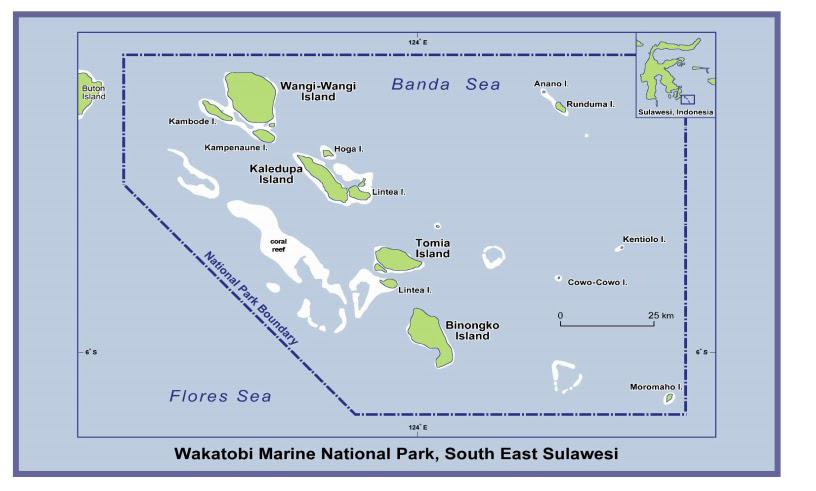
The Wakatobi Islands are one of the new districts in Southeast Sulawesi Province. Geographically, the island of Wakatobi is located south of the equator, stretching ± 160 km from north to south between 5º12’ – 6º25’ latitude and along ± 120 km from east to west between 123º20’– 124º39’ east longitude. As one of the new tourist destinations in Indonesia, Wakatobi has its own charm. Maritime tourism which is supported by the existence of Wakatobi Marine National Park is the main activity of Wakatobi Regency. The main attraction of Wakatobi Regency is coral reefs and various diverse marine biota with high aesthetic and conservation values [9].
Material
The coral propagation process requires supporting equipment and tools as shown in Table 1.
| No | Name of device | Utility |
|---|---|---|
| 1 | Scuba equipment | For diver breathing apparatus |
| 2 | Underwater Camera | Underwater photo/videography (documentation) |
| 3 | Refractometer | To measure the level of salinity in the waters of the location |
| 4 | Thermometer | To measure sea water temperature |
| 5 | Litmus paper | For measure pH / acidity in a water |
| 6 | Concrete molds | To form concrete that will be used as a medium |
| 7 | Paralon pipes | For poles for tying coral seedlings |
| 8 | Coconut shell | For substrate media |
| 9 | Coconut sheaths | For the poles for tying coral seedlings |
Table 1: Tools and materials used.
Methods of Observation and Data Collection
The observation method used is the experimental method on two (2) propagation techniques. There are two ways of propagationing coral reefs carried out in this study, namely:
- Propagation by using coconut shell media
- Propagation by using paralon concrete media Observations were made to see the comparison of growth between propagationed seedlings using coconut midrib shell media and using paralon pipe concrete media, where the data collected was growth. The absolute growth of coral length is the difference between the final length and the initial length [10]. Besides observing growth, the survival rate was also observed which is the value of the proportion (%) of the number of corals that live at a certain time and the number of coral fragments at the beginning of the study. The survival rate of corals is a determining factor for the success of coral reef propagations [11]. Water quality measurements are also carried out to determine environmental factors and water conditions [12].
Coconut Shell Media
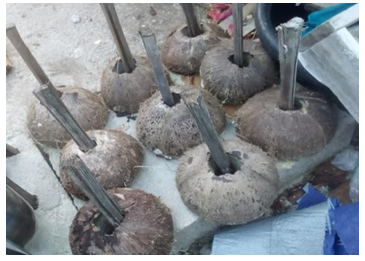
The built process of shell media with coconut fronds is the manufacture of concrete cement which is combined with coconut shell substrate and coconut frond binding poles. Making this media is almost the same as Bioreeftek, namely a coral reef propagation method that uses coconut shells as a medium to help coral growth. The choice of coconut shell material is because this material is environmentally friendly and cheap, namely by utilizing coconut shells and fronds that are not used by the local community, namely the remaining coconut processing into coconut oil. Making concrete molds as propagation media in the form of a rectangle with a length of 30 cm and a width of 30 cm. Making concrete requires sand, water, gravel and cement. Coconut fronds are obtained from coconut trees that are old and cut into pieces with a size of 25 cm. This coconut frond is used as a binding pole for coral reef seedlings. Propagation media with coconut shell is shown in Figure 2.
Paralon Concrete Media
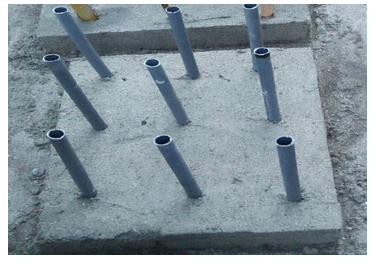
The built process of paralon pipe concrete media as a propagation substrate is not much different from the coconut shell media method, because this media also uses rectangular concrete which has a length of 30 cm and a width of 30 cm. The manufacture of this media is also almost the same as the production of Bioreeftek by Koroy [13]. The coconut frond was replaced with a paralon pipe with a length of 25 cm. Paralon pipe is used as a pole to bind coral seedlings. The choice of paralon material is because this material is environmentally friendly and cheap, namely by obtaining it from leftover materials for the construction of facilities and infrastructure in the local area which are no longer used. Propagation media with paralon concrete is shown in Figure 3.
Coral Reef Propagation Method
Coral reef propagation activities are carried out simultaneously with the collection of seeds in the sea. Planting activities take a long time so that scuba equipment is needed so that there is enough time in sea water. The stages of planting coral reefs are lowering the planting medium to the seabed and taking seeds. Coral reefs that will be used as seedlings should not be taken from coral reef brooders in order to maintain their sustainability. Saplings for coral propagation can be obtained directly from nurseries or from natural reefs. Natural reefs come from two sources: fragments that are broken/broken from the colony by natural processes (e.g., storms/waves) or human activities that can be found lying on the seabed [14].
Each stage in the coral propagation activity is the key to its success. Starting from site selection, seed selection, media making, coral planting, to the monitoring stage. Easy and practical methods are more widely used, but not all practical and simple methods can produce optimal results [15].
Coral Growth
Absolute height growth is the difference in length change at the end of the study with the beginning of the study. The following equation was used to determine the coral length growth:
L Lt Lo β = −
Where βL is the absolute growth (cm), Lt is the average branch length after the t-th observation; Lo is the average branch length at the beginning of the study [4].
Coral growth rate is the increase in height/length with various lengths of observation. The following equation was used to determine the coral growth rate:
( ) P Lt o t L = −
Where P is the coral growth rate (cm/s), Lt is the average height after the t-th month (cm), Lo is the average height at the time of initial measurement (cm), t is the observation time [4].
The survival rate of coral reefs determines the success of coral reef propagation. According to Nugraha (Nugraha, 2019) to determine the level of success in life, the formula is used:
100 Nt No SR = ×
Where SR is the survival rate (%), Nt is the number of living coral fragments/seedlings at the end of the study, No is teh number of coral fragments/seedlings at the beginning of the study.
To carry out data analysis carried out by statistical methods by describing and presenting the data that has been collected. There are basically two forms of presentation of statistical data, namely the form of presentation with tables and graphic forms. The data presented are parameters, namely coral reef growth, coral reef growth rate and coral reef survival rate. By presenting the data in tables and graphs, it can be seen that the minimum, maximum and average values of the coral reef parameter values above.
Water Quality Parameters
Water quality is an important factor for the growth of marine biota which require a certain level of water quality in order to grow healthily [16]. In general, water quality is determined by several physical parameters in the waters. Several parameters are very influential on the growth of coral reefs, namely temperature, salinity and acidity of sea water, these three parameters are very important for coral reefs so measurements must be made. Based on the literature, the results of research conducted previously known that the temperature required for optimal coral reef formation is in the range of 25ºC - 30ºC while the salinity required for coral growth is around 27‰ - 40‰ while the degree of acidity (pH) required for coral reefs to thrive is in the range of 7.5 - 8.4 [17].
Results and Discussion
Water Quality at Location
Measurement of sea water quality is carried out to see the condition and quality of water at the research location where data collection of water quality parameters is carried out twice a week. The results of measurements carried out at the study site obtained temperature in the range of 29.3°C
- 29.5°C. The average salinity value is, 33.8 - 34.3. The value of the acidity level (pH) of sea water around the waters is 7.7 - 7.8. With the value of the water quality parameter, it is already a necessary parameter for the growth of coral reef seedlings propagation [17].
Propagation Activities
The selection of propagation sites must be considered carefully and pay attention to supporting the success of coral reef propagations. Site selection is carried out before carrying out propagation activities so that it can be known whether it is feasible to carry out activities or not. The things that need to be considered for coral reef propagation locations are the location is not in a place free of community activities, there are not many coral reefs at the location, the location has the lowest low tide at 3 meters [18]. In this study, the selected location is a tourist area that is carrying out conservation activities so that it is safe from interference from the community, which could damage the media or uproot the planted seeds. Propagation was carried out using the same seed for both propagation media at a depth of 5-10 meters.
Decreasing coral reef planting media is not done in random places because there are many coral reef habitats that must be maintained. Decreasing the media must pay attention to the condition or ecosystem at the coral reef propagation site. The media preparation method is carried out carefully so that accidents do not occur in the media preparation process on the substrate location. In the process of preparing the media, it is necessary to pay attention to the preparation of snorkelling equipment, see around the substrate for interference and place the media not tilted. In propagation activities, it is not only the process of planting seedlings on substrate media, but also regarding monitoring and maintenance [14].
Propagation with Coconut Shell
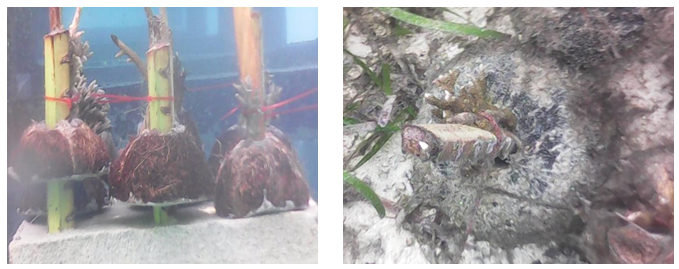
Shell media with coconut leaf midrib binding poles was the first medium used for propagationing coral reefs. This media is used because it has the advantage of using environmentally friendly materials and is easy to obtain. So far, coconut shells have been used for the manufacture of artificial coral reefs known as Bioreeftek, as a medium for attachment for coral larvae [19]. The results of observations made for 11 weeks showed a change in the media, where the coconut shell and midrib were overgrown with moss. With the abundance of moss and fine sand attached to the midrib and coconut shells, it is very influential in accelerating the growth of coral reefs because coral reefs are easier to get food and other substances. Figure 4 shows the propagation process on coconut shell media before and after changes.
Propagation with Paralon Concrete
Concrete media with paralon pipes has not been widely used in coral reef propagation experiments. Concrete media is usually used to make artificial coral reefs to attract planula (coral seedlings) and seeding mature coral reefs (propagation). The application of artificial reefs from concrete requires large costs, many divers and relatively complete supporting equipment [20]. In this study, propagation with paralon pipe concrete was used to compare the propagation process with coconut shell media.
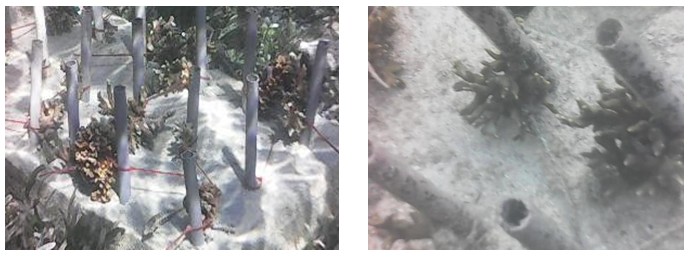
Changes in the concrete media with paralon pipe poles during the propagation process are not as fast as in coconut leaf midrib shell media where moss does not grow much on the concrete substrate media and this paralon pipe pole. This is probably because the paralon pipes contain chemicals (plastics) which can be a factor in the lack of moss growing on the paralon pipes. There are only slight changes in the paralon pipe media, namely a change in the color of the pipe to white and a little moss growing. Figure 5 shows the propagation process on the paralon pipe concrete media before and after any changes.
Coral Reef Growth
Growth is the difference in length change at the end of the study with the beginning of the study [4]. Observation of the growth of coral reef propagations in both media was carried out for 11 weeks, from April to June 2019. Measurement of changes in the growth of mangrove seedlings was measured using a ruler. There were 72 coral reef seedlings propagationed, consisting of 36 seedlings propagationed using coconut shells and 36 seedlings using paralon pipe concrete.
Data from observations of propagation growth using coconut shell media on 36 mangrove seedlings for 11 weeks showed growth in height/length of coral reefs from week to week, where some grew fast and slow. The growth data of propagationed coral reefs using coconut shell media is graphed, which is shown in Figure 6.
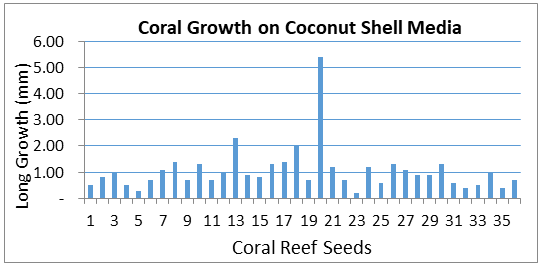
Figure 6: Graph of seedling growth on Coconut Shell Media. In Figure 6, it can be seen that the absolute height growth of coral reef seedlings with coconut shell media for all seedlings is 36 seedlings. From the graph, it can be seen that during the 11-week observation there was a different length growth for each seedling. By using the absolute height growth formula, which is the difference between the changes in the average height at the end and the average height at the beginning of the observation, the absolute length growth can be calculated. Based on this formula, absolute growth can be calculated, namely:
L Lt Lo β = − =1.09–0.04 = 1.05 mm Based on the results of the above calculations, it can be said that for 11 weeks, the absolute growth of mangrove seedlings propagationed with coconut shell media was 1.05 mm.
Data from observations of propagation growth using concrete pipe paralon media on 36 mangrove seedlings for 11 weeks showed growth in height/length of coral reefs from week to week, where some grew fast and slow. The growth data for propagation from coral reefs with piped concrete is graphed, which is shown in Figure 7.
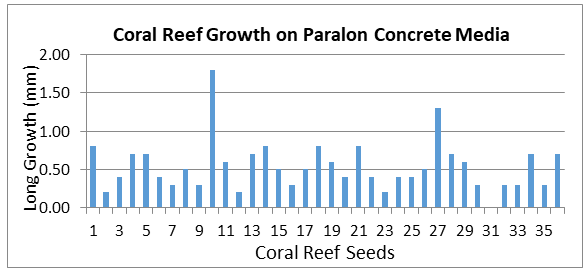
In Figure 7, it can be seen that the absolute growth of coral reef seedlings height with paralon pipe concrete media for all seedlings is 36 seedlings. From the graph, it can be seen that during the 11-week observation there was a different length growth for each seedling. By using the absolute height growth formula, namely the difference between the changes in the average height at the end (Lt) and the average height at the beginning of the observation (Lo), the absolute length growth can be calculated. Based on this formula, absolute growth can be calculated, namely:
L Lt Lo β = −
= 0.56–0.02 = 0.54 mm Based on the results of the above calculations, it can be said that for 11 weeks, the absolute growth of coral reef seedlings propagationed with concrete pipe paralon media is 0.54 mm.
When compared to the growth of coral propagations with the two media, it is seen that there is a difference in growth, where the growth with coconut shell media is greater than that using paralon pipe concrete media. This happens because the two media have different substrate content. According to Tumion and Sasongko [21], coral reef growth depends on environmental factors such as up welling, sunlight, clarity, depth, water temperature, salinity, deposition, currents and substrate. Besides that, tides and currents play a very important role in carrying nutrients as food ingredients and supplying food for microorganisms and oxygen as well as avoiding corals from accumulation of sediment [22].
Coral Reef Growth Rate
The growth rate is the absolute growth length divided by the time of observation [4], using the absolute growth data of coral reef seed propagations on both types of media, the growth rate of coral reef propagations can be calculated.
The growth rate of coral propagation on coconut shell media is:
( ) P Lt o L = −
t = 1.05/11 = 0.10 mm/week The growth rate of coral propagation in paralon concrete media is:
( ) P Lt o L = −
t = 0.54/11 = 0.05 mm/week
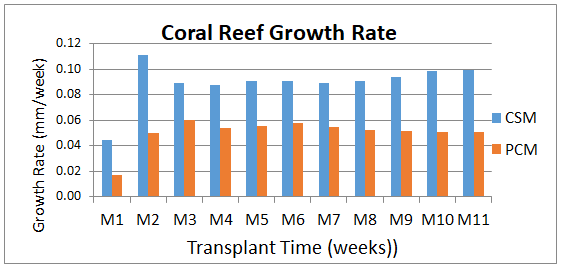
Based on the above calculation, it can be seen that the average growth rate of propagation of coral reefs with coconut shell media is 0.10 mm/week, which is greater than the average growth rate of propagation with paralon pipe concrete with a value of 0.05 mm/week. If a graph is made of the growth rate of coral reefs per week for coconut shell media (CSM) and paralon pipe concrete media (PCM) media, it can be seen that the difference in growth rates is as shown in Figure 8.
Based on Figure 8, a graph of the comparison of the average growth rate of coral reef seedling propagation per week (M1-M11) can be seen using coconut shell media (CSM) and paralon pipe concrete media (PCM). The average growth rate with coconut shell media is greater than the average growth rate with paralon pipe concrete. The highest growth rate was seen in the second week (M2) for coconut shell media while for paralon concrete media in the third week (M3).
Coral Reef Survival Rate
The success of coral reef propagation can be determined by the survival rate of the propagationed coral reefs. The survival rate depends on coral biology factors on environmental conditions and the size of the propagationed coral fragments. According to Nugraha, the ability to adapt to the environment greatly affects the survival rate of coral reefs. In this study, in addition to observing the growth of propagations, it also observed the survival of coral reef seedlings, whether there were seedlings that did not grow or died. To determine the survival rate of propagationed coral reefs, the following formula is used:
100 Nt No SR = ×
Where Nt is the number of live coral seedlings at the end of the study and No is the number of coral seedlings at the beginning of the study. In the 11-week observation carried out on 36 coral seedlings on coconut shell media and 36 seedlings on paralon pipe concrete, there were corals that did not grow, as many as 2 corals on coconut shell media and 4 corals on paralon pipe concrete media. Thus, the success rate of coral reef propagation with coconut shell media can be calculated:
100% Nt No SR = ×
34 100% 36 × =94.4% While for concrete pipe paralon media, the survival rate of coral reef propagation is: 100% Nt No SR = ×
32 100% 36 × =88.8% The survival rate of coral reefs from the propagation process with these two media can be seen in Table 2.
| Coral Reef Survival Rate | |||
|---|---|---|---|
| Media Type | Initial Amount | Final Amount | Percentage (%) |
| Coconut Shell | 36 | 34 | 94,4 |
| Concrete Paralon | 36 | 32 | 88,8 |
Table 2: The Survival of Coral Propagations.
Based on table 2 above, it can be seen that the survival of corals from propagation with coconut shell media was 94.4% higher than the survival of corals with paralon pipe concrete media which was 88.8%. Some of the reasons for the failure of this coral propagation, among others, due to corals that do not grow or are damaged due to environmental factors [23]. Besides that, there are natural factors at the research location such as the east monsoon which causes coral fracture and changes in the position of the propagationed coral.
The survival rate of coral reefs determines the success of coral reef propagation. Survival rates depend on coral biology, environmental conditions, and the size of the coral fragments transplanted. According to Nugraha DR, et al. [24]
the ability to adapt to the environment greatly affects the survival rate of corals. Based on Table 2 it can be seen that the survival of corals with coconut shell is higher than that of corals with concrete paralon. The difference in survival rate is usually due to failed propagation. Some of the causes include corals that do not grow or are damaged due to environmental factors [4]. In addition, there are natural factors at the study site such as the east monsoon which causes coral fractures and changes in the position of the propagated corals.
Conclusion
Based on the results of coral reef propagation research with 2 different media, which was carried out on Wangi-
Wangi Island-Wakatobi Regency for 11 weeks, it was found that the absolute growth of length and growth rate of coral reefs on coconut shell media was greater than the absolute growth of length and growth rate with medium paralon concrete. Likewise, the success rate of coral reef life, in coconut shell media is greater than using paralon concrete media. From the results of observations and measurements, the average absolute growth of coral reef length on coconut shell media is 1.05 mm while on concrete media is 0.54 mm. The average rate of coral growth on coconut shell media was 0.10 mm/week and on concrete media was 0.05 mm/week. The survival rate of coral reefs on coconut shell media is 94.4% while on concrete media is 88.8%.
Acknowledgment
We would like to thank the head of the Department of Marine Affairs and Fisheries of Wakatobi Regency for granting permission to carry out research on Wangi-Wangi Island. Biggest appreciation to the head of Wakatobi conservation, also to the director of Waha Tourism Community (WTC), village heads and communities in Wangi-Wangi sub-district who have provided support and assistance in survey and data collection activities in this research.
References
-
Kurniawan D, Putra RD, Susiana S, Jumsurizal J, Febrianto T, et al. (2021) Coral Transplantation as a Coral Reef Conservation Effort in Kampung Baru, Lagoi, Bintan. Journal of Maritime Empowerment 3(2): 26-32.
-
Sadili D, Sarmintohadi Ramli I, Rasdiana H, Sari RP, Miasto Y, et al. (2015) Coral Reef Rehabilitation Guidelines.
-
Subhan B, Madduppa H, Arafat D, Soedharma D (2014) Can Coral Transplants Improve Coral Reef Ecosystems?. Agricultural and Environment Policy Minutes: Formulation of Strategic Studies in Agriculture and the Environment 1(3): 159-164.
-
Prayoga B, Munasik, Irwani (2019) Differences in Transplantation Methods for Acropora aspera Coral Growth Rates on Artificial Patch Reefs in Panjang Island, Jepara. Journal of Marine Research 8(1): 1-10.
-
Taufina T, Faisal F, Lova SM (2018) Coral Reef Rehabilitation through Artificial Reef Collaboration and Coral Transplantation in Bungus Teluk Kabung District, Padang City. Journal of Community Service 24(2): 730.
-
Yunus BH, Diah PW, Agus S (2013)
-
Rahmania NA (2016) Transplanting coral reefs using the con-block method in the waters of Pramuka Island, the Thousand Islands National Park, and DKI Jakarta.
-
Ramadhan A, Lindawati, Nendah K (2016) Coral reef ecosystem economic value in wakatobi district 021.
-
Haryono E, Zulisthi G, Malawani MN (2014) Geodiversity of Wangi-Wangi Island, Wakatobi Regency and Its Potential for Ecotourism Development. Proceedings of the 2014 Indonesian Geographical Association Annual Scientific Meeting (PIT), pp: 937-951.
-
Sinipirang FA, Ngangi ELA, Mudeng JD (2017) Growth of different sized seedling fragments in the cultivation of ornamental coral Acropora formosa. Aquatic Cultivation E-Journal 4(3): 31-36.
-
Hermanto B (2015) Growth of acropora formosa fragments at different sizes with transplant methods in the lembeh strait waters. Scientific Journal Platax 3(2): 90-100.
-
Utami RT, Anggoro A (2021) Status of the Condition of Coral Reefs in the Waters of Bengkulu and the Thousand Islands of Jakarta. Enggano Journal 6(1): 188-200.
-
Koroy K, Wahab I, Popa S (2021) Design of Coral Growth Media Using the Bioreeftek Method. Journal of Indopacific Aquatic Resources 5(2): 137-144.
-
Harahap SA, Syamsuddin ML, Purba NP (2017) Planting of coral reefs in an effort to increasing environmental added value using the dome frame transplant method in pangandaran. Community Service 1(2): 68-71.
-
Saputra D (2020) Hexadome Coral: Efforts to Preserve Coral Reefs Using the Transplantation Method. Proceedings of The 1st UMYGrace 1(1): 181-187.
-
Pasaribu RP, Djari AA, Rahman A, Kabul A, Sagala HA (2023) Analysis of transplanted coral growth using the rock pile method in Karimunjawa National Park , Central Java , Indonesia. AACL Bioflux 16(1): 546-554.
-
Mansur W, Kamal MM, Krisanti M (2013) Management of coral reefs in Semak Daun Island waters Estimation of organic waste and waters carrying capacity in relation to coral reefs management on Semak Daun Island Thousand Islands. 2(3): 141-153.
-
Yahya MR, Andriyono S (2016) Coral Reefs Transplantation By Cv . Putra Pelangi Samudra, Denpasar, Bali. ResearchGate, pp: 1-6.
-
Elvan A, Tito CK, Triyulianty I, Widagti Nuryani, Mangku MP (2021) Coral recruitment spot on bioreeftek artificial reefs in the coastal waters of kerobokan village, buleleng, bali. Jfmr-Journal of Fisheries and Marine Research 5(2).
-
Arisandi A, Tamam B, Badami K (2017) Restoring damaged coral reef ecosystems in the Kangean Islands. Proceedings of the National Seminar on Maritime Affairs and Fisheries III 2017, pp: 222-229.
-
Tumion FF, Sasongko LW (2017) Bioreeftek for Coral Reef Conservation in Sungai Raya Kepulauan District, Bengkayang Regency. Journal of Agromix 8(1): 18-24.
-
Souhoka J (2013) Condition and Diversity of Coral Rocks in the Waters of Gangga Island, North Sulawesi. Marine Science UNDIP 18(4): 213-224.
-
Munasik M, Wijayanti DP, Hartati R, Pribadi R, Nozawa Y (2016) Composition of juvenile corals in different morphotypes of substrate at Karimunjawa Archipelago, Indonesia. Indonesian Journal of Marine Science 21(4): 185-190.
-
Nugraha DR (2019) The influence of hydro- oceanographic factors on growth and survival rates of coral reef transplants of Acropora sp. in Paiton Waters, Probolinggo, pp: 1-73.
- Genetic Improvement of Nile Tilapia (Oreochromis niloticus): Advances in Selective Breeding and Genomic Approaches for Sustainable Aquaculture
- Microplastics, Contaminants, and Waste Hotspots: Divergences and Faults in Prioritizing Control Efforts
- Creating a Healthier, More Vibrant Open and Closed Aquatic Environment. A Submersible, Centrifugal Magnetically Affixed Current Changing Aquarium Pump
- An Attempt to Assess Alpha Diversity and Sample Size: Using the Ostracod Assemblages off Kumamoto Port, Japan
- Assessment of the Efficiency of Common Fishing Gears and Crafts Used at Mohananda River of Chapai Nawabganj, Bangladesh
- Fish Productivity and Biodiversity Status of Sundarban Mangrove in Bangladesh