
Digestibility, Growth and Hepatosomatic Index of Oreochromis Niloticus (Linnaeus, 1758) Fed Diets Containing Blanched Lemna paucicostata (Hegelm)
This study evaluated digestibility, growth and hepatosomatic index of Oreochromis niloticus fed diets containing blanched Lemna paucicostata as a replacement for toasted soybean meal. Five iso-proteinous diets were formulated using feed solution software, blanched Lemna paucicostata was used to replace toasted soybean meal progressively at 0%, 25%, 50%, 75% and 100% respectively. Fifteen Hapa nets of 1m2 each were used. Ten Oreochromis niloticus juveniles were introduced into each of the nets. The fish were fed at 5% body weight three times daily for a period of six months. There was significant difference (P≤0.05) in the apparent protein digestibility coefficient among the treatments and the control. Highest apparent protein digestibility coefficient of 92.94% was recorded in the diet containing 75% blanched L. paucicostata meal while the least value of 86.86% was obtained in the diet with 100% L. paucicostata meal. The fish fed diet containing 75% blanched L. paucicostata meal recorded significantly highest (P≤0.05) mean final weight of 468.01g followed by the fish fed with 50% blanched L. paucicostata meal with 453.68g, the fish fed 100% blanched L. paucicostata meal recorded significantly lowest (P≤0.05) value of 401.54g. The fish fed diet containing 75% inclusion level of blanched L. paucicostata meal gave the best protein, lipid, ash and carbohydrate digestibility of 92.94%, 90.62%, 52.29% and 80.56%, respectively and also gave the best growth performance and hepatosomatic index.
Introduction
Nile tilapia (Oreochromis niloticus) is one of the most common cultured fish species in the world, after carp (Cyprinus carpio) [1]. It inhabits both freshwater and brackish water and can be easily identified by dark bands or stripes found on the body. In particular, the Oreochromis niloticus species has impacted aquaculture development since the 1970s and has become the preferred tilapia species for aquaculture, especially in developing countries [2]. The popularity of Nile tilapia is due to its market acceptability, fast growth rate, resistance to disease and ability to grow on a wide range of diets. It is also very tolerant to a wide range of environmental conditions, can reproduce readily in captivity and has a high prolific rate and good carcass taste [3]. The optimal growth of Oreochromis niloticus requires different diet formulations that include proteins, lipids, energy sources and vitamins. To achieve growth in fish, the requirement for the deposition of new body components has to be satisfied, which consists mainly of protein and lipids [4].
The most reliable and consistent estimates of nutrient digestibility were obtained using chromic oxide and crude fibre as dietary markers, while the performance of acid- washed sand and polyethylene as dietary markers was disappointing. The values of digestibility were significantly lower when using titanium dioxide instead of chromic oxide. On the other hand, Acid-insoluble ash (AIA) has also been reported as an internal marker and the marker yielded consistent and realistic apparent digestibility coefficients [5].
Duckweed is a monocotyledon, belonging to the Lemnaceae family, which consists of five genera (Spirodela, Landoltia, Lemna, Wolffia, and Wolffiella) and 37 species [6]. Duckweed (Lemna paucicostata, Hegelm) is a small, fragile, free-floating aquatic plant that grows well in static and nutrient-rich freshwater or a brackish aquatic environment [7]. Duckweed usually reproduces asexually with an extremely short cycle. The daughter plants of the duckweed are produced from the budding pouch of the mother plant. The exponential reproduction of duckweed results in a high biomass growth rate. The biomass of duckweed also doubles in 2 to 3 days under ideal conditions of nutrient availability, sunlight, pH (6.5-7.5), and temperature (20°C to 30°C) [8]. Generally, duckweed contains 6.8 to 45% crude protein (CP), 1.8 to 9.2% crude lipid (CL), 5.7 to 16.2% crude fibre, 12 to 27.6% ash, and the carbohydrate content is in the range of 14.1-43.6% on a dry matter basis [8]. The nutrient composition in each duckweed species varies depending on the condition of the water environment. Lemna paucicostata leaves contain a very low amount of fibre, therefore even monogastric animals can digest it and many fishes, especially herbivorous consume it readily because its cell wall of has low lignin. Thus, duckweed shows enhanced digestibility and is considered an ideal protein source of fish feed [9]. Therefore, this study aimed to evaluate the effect of dietary replacement of soybean with blanched Lemna paucicostata meal on digestibility, growth and hepatosomatic index of O. niloticus.
Materials and Methods
Experimental Site
The experiment was conducted in concrete pond of the Department of Fisheries and Aquaculture, Faculty of Agriculture, Ahmadu Bello University, Zaria which falls within latitude 11° 17’North and longitude 7° 63’East in the northern guinea savannah zone of Nigeria.
Procurement of Experimental Fish
Three hundred fingerlings of Oreochromis niloticus with an initial mean weight of 7.46g were procured from Kuka Farm, Gabasawa, Kano State and transported in an oxygenated polythene bag placed in 50 litres “Jerry-can”.
Collection and Culture Lemna paucicostata
Fresh L. paucicostata was collected during raining season from a burrow pit at Hanwa Low-cost, Kwangila, Zaria, Kaduna State, with a hand net and transported in nylon bags. The fresh L. paucicostata was cultured for two months in concrete ponds at the Department of Fisheries and Aquaculture, Ahmadu Bello University, Zaria.
Processing of Lemna paucicostata and Soybean Meals
Blanching and sun-drying methods were employed to process the cultured samples while toasting was used to process the soybean meal. Blanching was done by boiling duckweed in water for 5 minutes at 100°C as described by Abdullahi AI, et al. [10]. The blanched L. paucicostata was milled into a fine powder and sieved through a 0.5 mm. The second treatment involved sun drying L. paucicostata for three (3) days as described by Mmanda FP.
Formulation of Experimental Diets
Five iso-protenious diets were formulated using Feed Solution Software version 2022 which took into consideration the cost and the nutritive value of the ingredients. The soybean meal which serves as the control in the diets was replaced by blanched L. paucicostata meal at 25%, 50%, 75% and 100%, respectively. All the feed ingredients were integrated into computing, at the required quantities to make up a 100-unit quantity of the feed. Inclusion levels of each ingredient and proximate composition the experimental diets are resented in Tables 1 and 2, respectively.
| Ingredients | BLP0% | BLP25% | BLP50% | BLP75% | BLP100% |
|---|---|---|---|---|---|
| Soybean meal | 23.74 | 17.81 | 11.87 | 5.93 | 0 |
| BLP | 0 | 5.93 | 11.87 | 17.81 | 23.74 |
| Fish meal | 11.87 | 11.87 | 11.87 | 11.87 | 11.87 |
| Groundnut cake | 35.61 | 35.61 | 35.61 | 35.61 | 35.61 |
| Maize | 9.39 | 9.39 | 9.39 | 9.39 | 9.39 |
| Wheat bran | 9.39 | 9.39 | 9.39 | 9.39 | 9.39 |
| Palm oil | 2.5 | 2.5 | 2.5 | 2.5 | 2.5 |
| Salt | 0.5 | 0.5 | 0.5 | 0.5 | 0.5 |
| Pre-mix | 2.5 | 2.5 | 2.5 | 2.5 | 2.5 |
| DL-Methionine | 1.5 | 1.5 | 1.5 | 1.5 | 1.5 |
| L-Lysine | 2 | 2 | 2 | 2 | 2 |
| Klinofeed | 1 | 1 | 1 | 1 | 1 |
| Chromic oxide (Cr O ) 2 3 | 0.5 | 0.5 | 0.5 | 0.5 | 0.5 |
Table 1: Composition of the Experimental diets.
| Parameters | BLP0% | BLP25% | BLP50% | BLP75% | BLP100% |
|---|---|---|---|---|---|
| Moisture | 11.45 | 10.12 | 10.5 | 10.46 | 11.52 |
| Crude protein | 38.02 | 35.54 | 35.49 | 36.33 | 37.98 |
| Ether extract | 12.59 | 10.06 | 11.54 | 10.83 | 10.49 |
| Ash | 14.95 | 15.81 | 16.32 | 15.92 | 16.81 |
| Crude fibre | 6.98 | 7.01 | 7.04 | 6.96 | 6.85 |
| NFE | 16.01 | 21.46 | 19.11 | 19.5 | 16.35 |
| Gross energy (Kcal) | 2996 | 2861.34 | 2925.95 | 2912.61 | 2835.6 |
Table 2: Proximate composition of the experimental diets (%DM basis).
Experimental Design
A completely Randomized Design (CRD) was employed in this research. The experiment consisted of four treatments (BLP25%, BLP50%, BLP75%, BLP 100%) and one control (BLP0%) with three replications each. 150 Oreochromis niloticus was acclimatized for two weeks. After the period of acclimatization, 10 fish were randomly assigned to a 1m2 Hapa net. A total of 15 Hapa nets were used in outdoor concrete pond of 5m × 3.5m (l × b) and depth of 1.5m, and the five formulated diets were fed to the experimental fish and the pond water was daily monitored.
Digestibility Determination
Indirect method using Chromic oxide (Cr2O3) an indigestible marker was used for the experiment. Diets were formulated to accommodate 0.5kg/100kg chromic oxide and were fed to the experimental fish. Faeces were collected by dissecting the intestine as described by Belal EH, et al. [11].
The faeces from each treatment were pooled together to have enough faeces for analysis.
Apparent digestibility coefficient of crude protein, lipid, carbohydrate and dry matter was determined according to standard formula [12].
− = × ×
% % 100 % % Faecal nutrient Dietary chromic oxide ADC Dietary nutrient Faecal chromic oxide
Determination of Growth Performance and Nutrient Utilization Parameters
The data obtained on the growth performance and nutrient utilization of O. niloticus fed on the formulated diets were determined as follows:
• Mean Weight Gain (MWG) (g) Mean Weight Gain (MWG) = 2 1 W W −
Where W1 = Initial mean weight (g) W2 = Final mean weight (g)
- Daily Weight Gain (g/day) ( ) – FMW IMW Daily Weight Gain DWG T = Where FMW = Final mean weight (g) IMW = Initial mean weight (g) T=Feeding trial period in days
- Percentage Weight Gain (%) ( ) – % 100 FMW IMW Percentage weight gain PWG FW = × Where FMW = Final mean weight (g) IMW = Initial mean weight (g)
- Specific Growth Rate (SGR %/day)
2 1 % 100 2 – 1 log of W log of W SGR T T − = ×
Where W1 = Initial mean weight (g) W2 = Final mean weight (g) T1 = Initial time (g) T2 = Final time (g)
• Condition Factor (CF) ( )( ) ( ) ( )
100 3 Weight gain g CF Final Length cm =
• Survival Rate (%)
100 Number of fish that remain at the end of the experiment SR The initial number of fish stocked = × Daily Feed Intake (g) ( ) ( ) Quantity of feed fed g Daily Feed intake DFI Number of days =
- Protein Efficiency Ratio (PER) ( ) ( ) Total weight gain g Crude prot PE ein fed g R =
- Feed Conversion Ratio (FCR) ( ) ( ) Total weight of diet fed g Total weight of fish g FCR =
- Apparent Net Protein Utilization (ANPU) ( ) ( ) – 00 ( ) 1 Final carcass protein g Initial carcass protein g ANPU Protein fed g = ×
- Net Nitrogen Retention (NNR) ( ) ( )
100 Initial body protein g NNR Final body protein g = ×
• Mortality
100 Number of fish dead at the end of experiment M The initial number of fish stocked = ×
Somatic Indices
Somatic indices were used to know the condition of the experimental fish by determining the Viscerosomatic index (VSI) and Hepatosomatic index (HSI) according to Kubiriza GK, et al. [13] as follows:
( ) 100 FVM Viscerosomatic Index VSI FBM = ×
Where FVM = Fish visceral mass (g) FBM = fish body mass (g) ( ) 100 LM Hepatosomatic Index HSI BM = × Where LM = liver mass (g) BM = body mass (g)
Data Analysis
All data collected from the experiment were subjected to one-way analysis of variance to test for significant differences among treatment means using XLSTAT version 2022, followed by Duncan pairwise comparisons which was used to separate significantly different means at a confidence interval of 95%. The level of significance set for treatments was P≤ 0.05. Principal component analysis (PCA) was carried out to establish the relationship between the digestibility and growth performance.
Results
Apparent Digestibility Coefficients of Blanched Lemna paucicostata Meal in the Diet of Oreochromis Niloticus
The apparent digestibility coefficients of blanched L. paucicostata meal as a replacement for soybean meal in the diets of O. niloticus are presented in Table 3. There was significant difference (P≤0.05) in the apparent protein digestibility coefficient among the treatments and the control. Highest apparent protein digestibility coefficient of 92.94% was recorded in the diet containing 75% blanched L. paucicostata meal while the least value of 86.86% was obtained in the diet with 100% L. paucicostata meal.
| Treatments | |||||
|---|---|---|---|---|---|
| Parameters | BLP0% | BLP25% | BLP50% | BLP75% | BLP100% |
| AAD | 34.56±3.05c | 43.24±3.03b | 50.32±3.03a | 52.29±3.03a | 34.48±3.03c |
| APD | 88.38±2.97c | 88.22±2.97c | 91.73±2.97b | 92.94±2.97a | 86.86±2.97d |
| ALD | 83.06±3.53b | 80.20±3.53b | 88.37±3.53b | 90.62±3.53a | 78.16±3.53b |
| ACD | 63.11±4.17e | 66.36±4.17d | 78.48±4.17b | 80.56±4.17a | 60.57±4.17d |
Table 3: Apparent digestibility coefficients of the experimental diets for Oreochromis niloticus.
Growth Performance of Oreochromis Niloticus Fed Experimental Diets
The growth performance parameters of O. niloticus fed experimental diets are presented in Table 4. There was no significant difference (P>0.05) in the initial weight and initial length among all the treatments and the control. The fish fed diet containing 75% blanched L. paucicostata meal recorded significantly highest (P≤0.05) mean final weight of 468.01g followed by the fish fed with 50% blanched L. paucicostata meal with 453.68g, the fish fed 100% blanched L. paucicostata meal recorded significantly lowest (P≤0.05) value of 401.54g. There was significant difference in the mean final weight among all the treatments and the control (P≤0.05) diet.
| Treatments | |||||
|---|---|---|---|---|---|
| Parameters | BLP0% | BLP25% | BLP50% | BLP75% | BLP100% |
| IW (g) | 7.48±0.06a | 7.43±0.06a | 7.50±0.06a | 7.42±0.06a | 7.51±0.06a |
| IL (cm) | 7.79±0.07a | 7.75±0.07a | 7.87±0.07a | 7.78±0.07a | 7.86±0.07a |
| FW (g) | 416.88±56.90c | 425.57±56.90b | 453.68±56.90ab | 468.01±56.90a | 401.54±56.90d |
| FL (cm) | 27.07±0.43a | 27.19±0.43a | 27.68±0.43a | 27.72±0.43a | 26.72±0.43b |
| MWG (g) | 409.40±56.92c | 418.14±56.92b | 446.18±56.92ab | 460.59±56.92a | 394.03±56.92d |
| DWG (g) | 2.27±0.31c | 2.32±0.31b | 2.48±0.31ab | 2.55±0.31a | 2.19±0.31d |
| PWG (%) | 98.17±0.27b | 98.25±0.27ab | 98.31±0.27a | 98.33±0.27a | 98.12±0.27b |
| SGR (%) | 0.97±0.03ab | 0.97±0.03ab | 0.98±0.03a | 0.99±0.03a | 0.96±0.03b |
| CF | 2.10±0.24a | 2.12±0.24a | 2.13±0.24a | 2.18±0.24a | 2.10±0.24a |
| SR | 96.66±2.48b | 96.66±0.24b | 100.00±0.24a | 96.66±0.24b | 96.66±0.24b |
Table 4: Growth performance and survival of Oreochromis niloticus fed experimental diets.
Hepatosomatic Index and Feed Conversation Ratio of the Experimental Fish
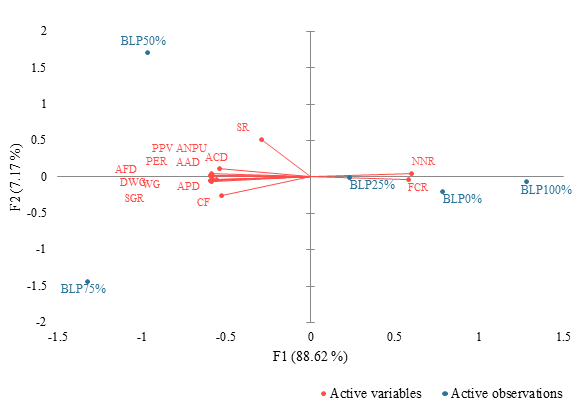
The results of hepatosomatic index and feed conversation ratio of O. niloticus fed experimental diets are presented in Table 5. There was significant difference (P≤0.05) in the hepatosomatic index, feed conversion ratio, feed intake, protein efficiency ratio, protein productive value and viscerosomatic index among all the treatments and the control. The principal component analysis of the digestibility and growth performance of the experimental fish is presented in Figure 1.
| Treatments | |||||
|---|---|---|---|---|---|
| Parameters | BLP0% | BLP25% | BLP50% | BLP75% | BLP100% |
| DFI (g) | 42.11±4.12ab | 42.61±4.12ab | 44.17±4.12a | 44.44±4.12a | 41.67±4.12b |
| PER | 10.77±1.55b | 11.76±1.55b | 12.57±1.55a | 12.67±1.55a | 10.37±1.55b |
| HIS | 0.65±0.11b | 0.68±0.11b | 0.88±0.11a | 0.95±0.11a | 0.63±0.11b |
| VSI | 7.21±1.12b | 7.48±1.12b | 9.77±1.12a | 9.90±1.12a | 6.99±1.12b |
| FCR | 1.99±0.19a | 1.91±0.19ab | 1.82±0.19b | 1.82±0.19b | 2.10±0.19a |
| ANPU | 34.96±1.27c | 39.08±1.27b | 43.14±1.27a | 44.23±1.27a | 33.65±1.27c |
| NNR | 77.09±1.10b | 76.31±1.10b | 74.50±1.10bc | 73.57±1.10c | 77.78±1.10ab |
| PPV | 1.53±0.43c | 1.65±0.43b | 1.69±0.43b | 1.66±0.43b | 1.51±0.43c |
Table 5: Hepatosomatic index and feed conversation ratio of the experimental fish.
Discussion
In all the experimental diets good values were obtained for the apparent digestibility coefficients. Differences in the quantity and quality of dietary nutrients influence the apparent digestibility in fish [14]. However, the apparent digestibility of nutrients varies from one fish species to another and even within an individual fish depending on sex, age, species, diet composition and water temperature [15]. Apparent Protein Digestibility (APD) is a key factor in the determination of the quality of a diet for fish and the potential of the diet to synthesize new tissues. All the experimental diets revealed a high APD (>86.86%). A high apparent protein digestibility in O. nilotucus fed feed ingredients of different origin has also been reported by Maina JG, et al. [16]; Köprücü K, et al. [17]. The range of the APD (86.86%~92.94%) obtained in this research is higher than the range of APD (75.90%~79.00%) and (46.30%~92.40%) in O. niloticus reported by El-shafai SA, et al. [18] and Mmanda FP, et al. [19], respectively. The blanched L. paucicostata meal used in this study had a higher protein content and a lower fibre content than previously reported by El-shafai SA, et al. [18] and Mmanda FP, et al. [19], which might explain the higher apparent protein digestibility obtained in this study. The protein content of L. paucicostata meal could vary widely depending on plant age, nutrient content of the aquatic environment and water temperature. In all the experimental diets, apparent ash digestibility (AAD) was in the range of 34.48-52.29%, which is lower than the range of 38.00%-62.90% reported for O. niloticus fishmeal-based diets, which included 20% and 40% of dry duckweed [18]. The lower values in this study could be attributed to the higher percentages of plant ingredients in the treatments. The apparent lipid digestibility (ALD) showed a large variation among the experimental diets and it was below the range of values reported for apparent lipid digestibility coefficients of the treatment diets for O. niloticus by El-shafai SA, et al. [18]. The variation could be explained by different lipid contents in the experimental diets used in this study and that of the previous authors. The highest apparent carbohydrate digestibility (ACD) value of 80.56% obtained in the treatment 75% blanched L. paucicostata meal among all the treatments and the control diet could be attributed to the high amylase activity observed in the treatment.
The growth performance of O. niloticus fed varying inclusion levels of blanched L. paucicostata meal as a replacement for soybean revealed that the initial mean weight (7.41g – 7.51g) and initial mean length (7.75cm – 7.87cm) were not significantly different (P>0.05) among the experimental treatments and the control showing uniformity in their sizes at onset of the experiment which indicated the accuracy of randomization process employed.
The high mean weight gain observed in the 75% blanched L. paucicostata meal and 50% blanched L. paucicostata meal was an indication that the fish were able to assimilate the diet more efficiently than the other treatments and the control diet. While the least mean weight gain obtained in 100% blanched L. paucicostata meal could be due to low feed consumption as a result of less palatability of the diet. Since it was observed that the fish were not actively responding to the diet during feeding when compared to the response in the other treatments and the control. The decrease in mean weight gain as a result of less palatability of the diet had been reported by Welker AM, et al. [20]. Daily weight gain, percentage weight gain and specific growth rate also revealed a similar trend with the mean weight gain. The best growth performance was observed in the fish fed diet containing 75% blanched L. paucicostata meal contradicts the findings of Effiong BN, et al. [21] who reported that the inclusion of duckweed at 10% in the diet of Heterobranchus longifilis fingerlings gives better results as compared to diets containing duckweed at 20% and 30%. Olaniyi CO, et al. [22] reported that the substitution of duckweed meal for 25% fish meal promotes higher growth performance than feeding only fish meal as the main source of protein in the Nile tilapia fish. These authors added that the growth performance of the fish that were fed the control diet was higher than those that received 50%, 75% and 100% duckweed meal. However, Oyas AA, et al. [23] replaced duckweed with fish meal in the diet of Cyprinus carpio fingerling at 0%, 15%, 30% and 45% inclusion levels and concluded that duckweed inclusion level at a lower level (15%) gives better results compared with higher inclusion levels (30% and 45%). The discrepancy observed between the results of this study and those of the mentioned authors could be due to the differences in experimental fish in relation to species, type of duckweed used, processing methods employed in treating antinutrients in the duckweed, the ingredient that was replaced in the diet, culture system (indoor or outdoor) used for the experiment, age and stage of the fish development and water quality management. The condition factors (2.06-2.18) which are the useful index for monitoring feeding intensity, age and growth rates in fish observed in this study were not significantly different among the treatments and the control indicating that all the experimental fish were in good condition. The survival rate of O. niloticus fed the experimental diets showed similar values (96.66% - 100.00%) among the experimental treatments and the control as no significant difference was observed.
The hepatosomatic index, feed conversion ratio and protein productive value of O. niloticus fed diets containing different dietary levels of blanched L. paucicostata meal showed significant differences (P≤0.05) among the experimental fish and the control. The lowest feed conversion ratio (1.82) observed in the fish fed 50% blanched L. paucicostata meal and 75% blanched L. paucicostata meal could be a result of the activation of digestive enzymes by the high mineral concentrations present in the blanched L. paucicostata meal. The best feed conversion ratio obtained in this research is in line with the findings of Sogbesan OA, et al. [24] and Ibrahim WM, et al. [25] who reported best feed conversion ratios of 1.85 and 1.95, respectively. Apparent net protein utilization differed significantly (P<0.05) among the experimental fish and the control. The highest ANPU (44.23) was recorded in the fish fed 75% blanched L. paucicostata meal while the least ANPU of 33.65 was obtained in the fish fed 100% blanched L. paucicostata meal, this could be due high weight gain (460.59g) obtained in the fish fed 75% blanched L. paucicostata meal and least weight gain (394.03g) obtained in the fish fed 100% blanched L. paucicostata meal, this observation revealed that high ANPU value will be obtained if the weight gain is high.
The assessment of nutrient utilization can be carried out using the morphometric characterization of the fish as described by Vatandoust S, et al. [26] using organ and tissue indices of a particular fish. The organ indices commonly used are the Viscerosomatic Index (VSI), Hepatosomatic Index (HSI), Gonadosomatic Index (GSI) and Spleenosomatic Index (SSI) as cited by Sudaporn T, et al. [27] and Babalola OA, et al. [28] described viscerosomatic and hepatosomatic indices as the ratio of organs to body weight measured in relation to body mass which can be used as indices of changes in nutritional and energy status. According to Gumus E, et al. [29], the assessment of viscerosomatic and hepatosomatic (organosomatic indices) plays a significant role in the secretion of digestive enzymes, digestion and absorption of food items as well as metabolism in fishes. The mean viscerosomatic index (6.99g - 9.90g) and hepatosomatic index (0.63g-0.95g) of O. niloticus fed with the experimental diets observed in this study, increase with the increase in mean weight gain, feed intake, protein efficiency ratio and protein productive value among the treatments and the control, this indicated that the fish were able to utilize the blanched L. paucicostata meal in the diet by converting it into muscle tissues.
The principal component analysis of the digestibility coefficient and growth performance as shown in Figure 1 revealed that a strong correlation exists among apparent ash digestibility, apparent protein digestibility, apparent lipid digestibility, apparent carbohydrate digestibility, mean weight gain, daily weight gain, percentage weight gain, specific growth rate, condition factor and survival rate, while net nitrogen retention and feed conversion ratio are strongly correlated. Component Analysis (PCA) F1 (88.63%) and F2 (7.17%) combined to give the biplot axes of 95.78%.
Conclusion
The digestibility, growth performance and hepatosomatic index of the experimental fish increased with the increase in the inclusion levels of blanched L. paucicostata meal up to 75% inclusion. The fish fed diet containing 75% inclusion level of blanched L. paucicostata meal gave the best protein, lipid, ash and carbohydrate digestibility of 92.94%, 90.62%, 52.29% and 80.56%, respectively and also gave the best growth performance and hepatosomatic index.
References
-
Francis PM (2020) Nutritive value and use of locally available low-cost feed ingredients for tilapia farming in Tanzania. Doctoral Thesis, Swedish University of Agricultural Sciences 2020: 36.
-
Ayuub AA (2010) Replacement of fishmeal with an alternative protein source in aquaculture diets. Thesis.
-
Francis PM, Jan EL, Anna NH, Matern SPM, Mtolera RK, et al. (2020) Digestibility of local feed ingredients in tilapia Oreochromis niloticus Juveniles, determined on faeces collected by siphoning or stripping. Fishes 5(4): 32.
-
Abushweka AAM (2018) Alternative protein sources as a replacement for fish meal in tilapia (Oreochromis niloticus) feed. International Journal of Research in Applied, Natural and Social Sciences 6(5): 77-90.
-
Yorcelis C, Claudia K, Walter V, Carsten S (2014) Digestibility coefficients of sun-dried and fermented aquatic macrophytes for Cachama blanca, Piaractus brachypomus (Cuvier, 1818). Orinoquia 18(1).
-
Gui Li Y, Dan F, Yu Ting L, Shi Ming L, Meng Meng Z, et al. (2021) Research progress of a potential bioreactor: Duckweed. Biomolecules 11(1): 93.
-
Abdullahi AI, Auta J, Abdullahi SA, Bolorunduro PIO, Onimisi HU (2023) Blood Chemistry and Enzyme Activity of _Oreochromis niloticus_ (Linnaeus, 1758) Fed Dietary Processed _Lemna paucicostata_ (Hegelm) as a Replacement for Soybean Meal. Aquaculture Studies 23(4).
-
Christine A, Annita SKY, Ching FF (2018) Supplementation of duckweed diet and citric acid on growth performance, feed utilization, digestibility and phosphorus utilization of TGGG hybrid grouper (_Epinephelus fuscoguttatus x_ _Epinephelus lanceolatus_) juvenile. Journal of Science and Technology 40(5): 1009-1016.
-
Tao X, Yang F, Yao X, Yan ling J, Xin Rong M, et al. (2013) Comparative transcriptome analysis to investigate the high starch accumulation of duckweed (_Landoltia_ _punctata_) under nutrient starvation. Biotechnol Biofuels 6(1): 72.
-
Abdullahi AI, Auta J, Abdullahi SA, Bolorunduro P, Onimisi HU (2022) Effect of different processing methods on nutritional composition of _Lemna paucicostata_ as inclusion in fish feed. Scholarly Journal of Food Nutrition 4(3): 1-5.
-
Belal EH (2005) A review of some fish nutrition methodologies. Bioresource Technology 96(4): 395-402.
-
Abdullahi AI, Isiyaku MS, Tukur M, Hassan MZ, Usman U, et al. (2023) Digestibility, blood profile and enzyme activity of Clarias gariepinus (Burchell, 1822) fed diets containing sweet potato peel. Arid Zone Journal of Basic and Applied Research 2(1): 156-166.
-
Kubiriza GK, Akol AM, Arnason J, Sigurgeirsson SS, Tómasson T, et al. (2017) Practical feeds for juvenile Nile tilapia are prepared by replacing _Rastrineobola argentea_ fishmeal with freshwater shrimp (_Caridina nilotica_) and mung bean (_Vigna radiata_) meals. Aquaculture Nutrition 24(1): 94-101.
-
Montoya Mejía M, García Ulloa M, Hernández Llamas A, Nolasco Soria H, Rodríguez González H (2017) Digestibility, growth, blood chemistry, and enzyme activity of juvenile _Oreochromis niloticus_ fed isocaloric diets containing animal and plant byproducts. Revista Brasileira de Zootecnia 46(12): 873-882.
-
NRC (National Research Council) (2011) Nutrient requirement of fish and shrimp, 500th (Edn.), The National Academies Press.
-
Maina JG, Beames RM, Higgs D, Mbugua PN, Iwama G, et al. (2002) Digestibility and feeding value of some feed ingredients fed to tilapia _Oreochromis niloticus_ (L.). Aquaculture Resources 33(11): 853-862.
-
Köprücü K, Özdemir Y (2005) Apparent digestibility of selected feed ingredients for Nile tilapia (_Oreochromis_ _niloticus_). Aquaculture 250(1-2): 308 -316.
-
El Shafai SA, El Gohary FA, Nasr FA, ven der Steen NP, Gijzen HJ (2004) Chronic ammonia toxicity to duckweed- fed tilapia (_Oreochromis niloticus_). Aquaculture 232(1- 4): 117 - 127.
-
Mmanda FP, Lindberg JE, Norman Haldén A, Mtolera MS, Kitula R, et al. (2020) Digestibility of local feed ingredients in tilapia _Oreochromis niloticus_ Juveniles, determined on faeces collected by siphoning or stripping. Fishes 5(4): 32.
-
Welker AM, Jaros BD, Puduvalli, VK, Imitola J, Kaur B, et al. (2016) Standardized orthotropic xenografts in zebrafish reveal glioma cell-line-specific characteristics and tumor cell heterogeneity. Disease Models and Mechanisms 9(2): 199-210.
-
Effiong BN, Sanni A, Fakunle JO (2009) Effect of partial replacement of fishmeal with duckweed (_Lemna_ _paucicostata_) meal on the growth performance of _Heterobranchus longifils_ fingerlings. Report and Opinion 1(3): 1-6.
-
Olaniyi CO, Oladunjoye IO (2012) Replacement value of duckweed (Lemna minor) in Nile tilapia (_Oreochromis_ _niloticus_) diet. Transnational Journal of Science and Technology 2(9): 1-9.
-
Oyas AA, Irfan AK, Tariq AB, Nasir H (2018) Duckweed (Lemna minor) is a plant protein source in the diet of common carp (_Cyprinus carpio_) fingerlings. Journal of Pharmacognosy and Phytochemistry 7(3): 42-45.
-
Sogbesan OA, Onoja CF, Adedeji HA, Idowu TA (2015) Utilization of treated duckweed meal (_Lemna_ _paucicostata_) as a plant protein supplement in African mud catfish (_Clarias gariepinus_) Juvenile Diets. Fish and Aquaculture Journal 6(4): 141.
-
Ibrahim WM, Eid AE, Mohamed K, Abd elfattah B (2017) Effect of replacement of soybean meal with duckweed (Lemna minor) meal on the growth performance and feed utilization in Nile tilapia fingerlings. Journal of Animal Poultry and Fish Production 6(1): 7-12.
-
Vatandoust S, Anvarifar H, Mousavi Sabet H (2014) Morphometric and meristic characteristics and morphological differentiation of Brown Trout Salmo trutta fario (Pisces: Salmonidae) along the Southern Caspian Sea Basin. European Journal of Zoological Research 3(2): 56-65.
-
Sudaporn T, Kringsak M, Yuwadee P (2010) Effect of replacing fish meal with Spirulina on growth, carcass composition, and pigments of Mekong Giant catfish. Journal of Agricultural Science 2(3): 106-110.
-
Babalola OA, Sunnuvu TF, Fakunmoju FA (2022) Viscerosomatic and hepatosomatic indices of African catfish (_Clarias gariepinus_) juvenile fed with Lemna minor leaf meal. International Journal of Science Environment and Technology 11(2): 94-104.
-
Gumus E, Ikiz, R (2009) Effect of dietary levels of lipid and carbohydrate on growth performance, chemical contents, and digestibility in rainbow trout, _Oncorhynchus mykiss_. Pakistan Veterinary Journal 29(2): 59-63.
- Genetic Improvement of Nile Tilapia (Oreochromis niloticus): Advances in Selective Breeding and Genomic Approaches for Sustainable Aquaculture
- Microplastics, Contaminants, and Waste Hotspots: Divergences and Faults in Prioritizing Control Efforts
- Creating a Healthier, More Vibrant Open and Closed Aquatic Environment. A Submersible, Centrifugal Magnetically Affixed Current Changing Aquarium Pump
- An Attempt to Assess Alpha Diversity and Sample Size: Using the Ostracod Assemblages off Kumamoto Port, Japan
- Assessment of the Efficiency of Common Fishing Gears and Crafts Used at Mohananda River of Chapai Nawabganj, Bangladesh
- Fish Productivity and Biodiversity Status of Sundarban Mangrove in Bangladesh