
The Microorganism Concern in the Aquaponics System
Aquaponics system (AP) is a promising form for mass-produced food in the future. The system reduces the mass water demand for food production. It solves the problem of nitrogenous waste removal from the recirculating aquaculture systems (RAS) by connecting with the hydroponic system (HP) in series. Microorganisms are essential in biochemical activities in an aquaculture system, such as nitrogen cycling, waste decomposition, and detoxification. However, excessive microorganisms in the system will increase the disease risk for aquatic organisms and plants. In the RAS system, high-density breeding enriches nutrients. That microbial management is even more critical. Through the design of zone isolation, the system confines different biochemical reactions to specific intervals, enhances its performance by shaping the dominant bacterial phase with environmental advantages, and simultaneously reduces the disturbance of microorganisms to the cultured organisms. Aquaponics farming, which emphasizes the symbiotic relationship between plants, aquatic organisms, and microorganisms, would create a more diverse and complex microbiota than the RAS system. Relevant studies have shown that the uncoupled aquaponics system using microbial zone management may be the right way to reduce management risks and increase production capacity. Research on the microbial phase of aquaponic systems is still minimal; limited research shows that the microbiota in the aquaponics system may vary considerably with the seasons and the geographical location of the farm. More active bacterial research and the establishment of effective management measures are the core technologies of future aquaculture management.
Introduction
The continuous growth of the global population has led to an escalating demand for food. However, our current environment is confronted with challenges such as global climate change, diminishing arable and grazing land, water resource shortage, and issues related to diseases and pests.
These challenges have become bottlenecks for developing agriculture, aquaculture, and pasturage. Innovative development and implementation of new agricultural methods have become urgent.
The recirculating Aquaculture Systems (RAS) and the hydroponic systems (HP) primarily focus on utilizing enclosed environments and limited water resources to cultivate aquatic organisms and vegetables, offering advantages such as versatile land utilization, water conservation, and ease of pest control. Integrating these two systems in the aquaponic system (AP) further achieves a synergistic approach. The production of nitrates from the RAS water was provided as nutrition for the plants in the hydroponic system, thus engendering a closed ecological cycle. In contrast to alternative aquaculture systems, drastically minimizes nutrient inputs and resultant waste (5). Furthermore, the coexistence of multiple crops and vegetables alongside fish cultivation renders this methodology notably advantageous. Simultaneously, this agricultural approach aligns with several key objectives of the United Nations’ Sustainable Development Goals (SDGs). These include zero hunger (SDG 2), clean water and sanitation (SDG 6), decent work and economic growth (SDG 8), responsible consumption and production (SDG 12), climate action (SDG 13), etc. While this enclosed aquaponic system may seem flawless, the key to its successful operation, much like other ecosystems on the Earth lies in the intricate collaboration among numerous microorganisms within the systems.
The Role of the Microorganism Plays In the RAS
The RAS encompasses a sophisticated approach to aquaculture wherein microorganisms act upon the ammonia nitrogen waste produced by fish metabolism within a biofilter or bioreactor. This process is the conversion of said waste into benign nitrates. The objectives of the RAS are mitigating toxicity to fish through specialized pieces of equipment for
- Solid waste removal
- Optimizing water quality parameters such as pH and temperature adjustment
- Increasing dissolved oxygen levels
- Reducing microbial populations Such enhancements ameliorate the aquaculture environment by amplifying water recycling while diminishing dependence on water exchange methodologies to sustain aquatic life [1, 2, 3]. Notably, though the system continues to evolve, its earliest theoretical underpinnings date back six decades [4].
The core of the RAS was a biofilter replete with diverse microorganisms that engage in reduction-oxidation reactions involving ammonia nitrogen, nitrates, and sulfates. Predominantly, the oxidation of ammonia nitrogen is catalyzed through nitrification, cooperated by autonomous ammonia-oxidizing bacteria (AOB). Notable constituents of AOB include Nitrosomonas sp., Nitrosococcus sp., and Nitrosospira genus bacteria. Some archaea microbes are also effectuated by ammonia nitrogen oxidation and are also referred to as ammonium-oxidizing Archaea (AOA). The nitrite-oxidizing bacteria (NOB) composed of Nitrospira sp., and Nitrobacter sp., further oxidation nitrite into innocuous nitrates. These nitrates can accumulate within the RAS aquaculture system or serve as nutrient sources in the aquaponics systems [5, 6, 7]. The prolific proliferation of these bacteria imbues the biofilter with a copious bacterial populace relative to other aquaculture systems. In a study about the RAS goldfish (Carassius auratus) cultivation, microbial concentrations were notably concentrated within the biofilter, with bacterial numbers potentially exceeding 109-1010 cells per gram [8]. Nonetheless, compared to other microorganisms, these autotrophic bacteria (AOB, NOB, etc.) evince sluggish growth rates, susceptible to influences stemming from environmental factors such as dissolved oxygen level, pH, and overall microbial flora dynamics. Therefore, during the RAS start-up stage, approximately four weeks are requisite for these nitrifying bacteria to attain adequate biomass for processing ammonia nitrogen discharge from cultivation, thereby endowing the entirety of the RAS system with operational stability.
Within the biofilter, other autotrophic species, including Thiomicrospira sp., Thiothrix sp., Rhodobacter sp., and Hydrogenophaga sp., can execute denitrification reactions. Denitrification culminates in the liberation of N2 into the air through a series of nitrite reduction reactions, resulting in nitrite removal from the aquaculture system. Except for autotrophic bacteria, some heterotrophic bacteria, such as Pseudomonas sp., Paracoccus sp., and Comamonas sp., were also involved in the denitrification reaction. However, in the ammonia nitrogen cycle of the RAS system, these reactions play a minor role compared to nitrification.
The interplay between heterotrophic and autotrophic bacteria manifests in a delicate interdependence marked by competition and cooperation. Heterotrophic bacteria exhibit a markedly abbreviated doubling time of roughly 2.7 hours, in stark contrast to the 16 to 189 hours for AOB bacteria and 18 to 69 hours for NOB bacteria [9] of autotrophic bacteria. Consequently, heterotrophic bacteria predominantly inhabit the outer biofiltration membrane layer, while autotrophic bacteria are primarily located in the inner biofilm stratum. Inadequate nutrient and oxygen accessibility adversely affects bacterial proliferation, consequently influencing nitrification efficiency. Conversely, the presence of heterotrophic bacteria helps the attachment of autotrophic bacteria to the biofilm surface, thereby modulating heterotrophic bacterial growth, thereby optimizing bioreactor performance [9].
However, residual feed within the culture system, cellular tissue, secretions, and diverse nutrients serves as abundant sustenance sources for heterotrophic bacteria. Ergo, the presence of these elements is prone to augmenting heterotrophic bacterial growth. A higher carbon-to- nitrogen (C/N) ratio similarly tends to diminish autotrophs and foster heterotrophic expansion [10, 11], including potentially pathogenic bacteria such as Flavobacterium and Pseudomonas. Elevated total ammonia nitrogen (TAN) levels not only exacerbate stress on the culture system but may also correlate with the proliferation of pathogenic heterotrophs such as Flavobacterium [12]. Due to the RAS’s low dilution rate and heightened organic loading, pathogenic bacteria accumulation may surpass that observed in the other conventional aquaculture system. Increased infection risk is especially plausible when biofilms rich in pathogens slough off and contact cultured organisms [13]. Biosecurity and daily management methodologies and appropriate water disinfection will help to maintain normal flora in the RAS, thwarting the growth of opportunistic bacteria [14].
Despite an ongoing absence of definitive conclusions regarding the dynamic flux of bacterial flora within the RAS and their regulation, however, daily management can effectively sustain and optimize water quality. Measures such as the introduction of probiotics into the water, known for secreting antibacterial substances while competing with pathogenic bacteria [15], intermittent cleansing of the biological filter bed to invigorate the balance between heterotrophic and autotrophic bacteria, and the application of disinfectants to curtail microbial proliferation, and keep water quality in good condition, all contribute to preserving the thriving development of microorganisms within the RAS system, thereby harnessing optimal nitrification performance.
The Role of the Microorganism Plays In the Hydroponics System
Unlike conventional plant cultivation methods, the hydroponic systems growing plants in nutrient-rich water instead of a soil-based environment. The system facilitates the recycling of water resources, allows for precise control of indoor growing environments, and effectively minimizes the incidence of soil-borne diseases and insect pests [16, 17]. Hence, hydroponics is widely regarded as an eco-conscious approach to cultivation.
Several factors influence the growth of hydroponic plants, including selecting a suitable growth medium, nutrient supplementation in the aqueous solution, and microbial communities. Microbial growth requires a suitable growth medium that provides an environment for attachment and proliferation. In conventional soil cultivation, these substrates create a conductive space for microbial growth. Microorganisms play a role in mineralizing organic nitrogen through ammonification and nitrification within the soil. However, the hydroponic systems lack the substrates like soil. Plants in hydroponic systems cannot use organic fertilizer because few microorganisms are present to mineralize the organic compounds into inorganic nutrients [18].
Certain microorganisms, known as the rhizosphere microbiome, surround plant roots and impact plant growth and health [19]. Most of them belong to beneficial microorganisms, such as Aeromonas, Bacillus, Corynebacterium, Mycobacterium, Pediococcus, Pseudomonas, and Serratia [20], which are called growth-promoting bacteria (PGPB). PGPB utilizes various mechanisms to enhance plant growth, encompassing stress reduction, increases in nutrient uptake (e.g. phosphorus, potassium, iron, or fixed nitrogen), plant hormone modulation (e.g. 1-aminocyclopropane-1-carboxylate (ACC) deaminase, and indole-3-acetic acid (IAA)), and biocontrol. As the presence of these microorganisms can beneficial for plants growth in the hydroponic systems, they can also be introduced to promote plant growth. For example, Pseudomonas fluorescens introduction increased tomato crop yields by up to 18% in the hydroponic system [21]. Moreover, the utilization of a mixture of Bacillus spp. within the hydroponic systems has been shown to enhance phosphorus solubilization for lettuce and subsequently increase yields [22]. In contrast, several studies have demonstrated that plants can grow under sterile conditions for over 30 days, even crop plants like wheat and barley [23, 24]. These findings indicate that the presence of microorganisms may not be essential for plant growth in hydroponic systems; however, some beneficial bacteria can still contribute to the growth of plants.
While most of these bacteria are non-pathogenic and beneficial for plant growth, it is important to note that some plant pathogens, such as phytopathogens, are still present [25]. Fusarium, Phytophthora, and Pythium were identified as phytopathogens in the hydroponic systems [26, 27]. Fusarium sp. is distributed and responsible for causing wilt and root diseases in various plant species [28]. Specifically, Fusarium oxysporum is known to induce root rot in crops such as basil, lettuce, and tomatoes [29, 30]. Phytophthora sp., another significant phytopathogen, leads to root rot and thrives in oxygen-deprived, moist environments [31]. Pythium sp., also causing root rot, affects hydroponically cultivated cucumber, pepper, and lettuce [32, 33, 34, 35]. Therefore, effective management techniques that prevent phytopathogen proliferation and enhance beneficial microorganism prevalence are essential for successful hydroponic systems [29]. Physical and chemical methods can prevent phytopathogen contamination [36, 37, 38]. Physical treatments encompass various disinfection techniques, such as water changes and ultraviolet (UV). Water changes play a crucial role in eliminating excessive microorganisms from the system. In this context, UV irradiation has effectively reduced microorganism levels [39]. Noteworthy research has explored the application of different UV doses (19, 38, 59, 88 mJ cm−2) in tomato cultivation. High doses of ultraviolet irradiation at 59 and 88 mJ cm−2 during a two-month treatment period have demonstrated significant suppression of microorganism populations and a resulting increase in tomato yield [36]. Carbendazim, hexanol, imidazole, and prochloraz triazole are chemical treatments utilized in hydroponic systems. Both physical and chemical methods can reduce the populations of beneficial microorganisms or phytopathogens.
The Role of the Microorganism Plays In the Aquaponics System
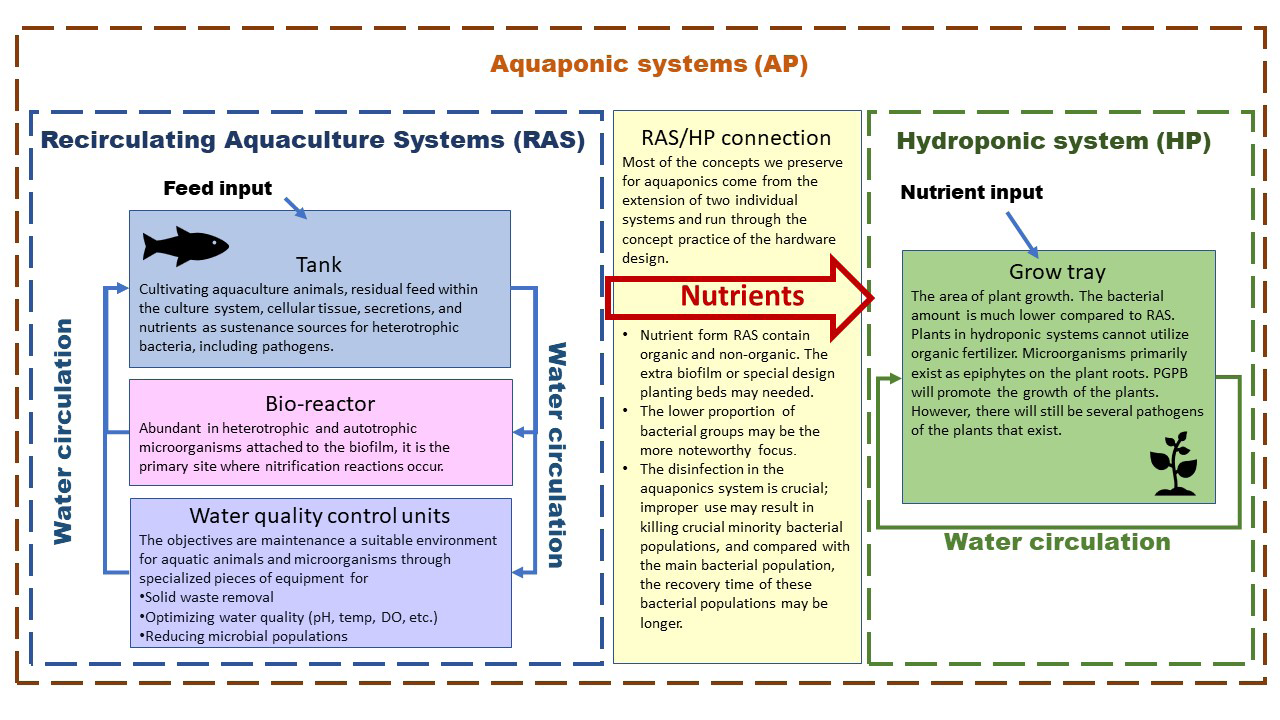
The aquaponics system results from the series connection of the RAS and the hydroponic system, and stability is an essential basis for the excellent operation of the system ecology [40]. Most of the concepts we preserve for aquaponics come from the extension of two individual systems and run through the concept practice of the hardware design; for example, the setting of biofilter in the aquaponics system also to reduce the toxicity risk of cultivation system by oxidation of ammonia, and further use these oxidation products as the basis for the large amounts of nitrogen fertilizers required for plant growth. We have reported this in the previous section. Nevertheless, there are more special parts in the enhanced aquaponics system, which we will discuss in the following.
A few systematic studies have revealed preliminary impressions of bacterial phases in the aquaponics systems. According to the studies, the bacteria of the members of phyla Proteobacteria and Bacteroidetes were dominant in the aquaponics system, accounting for about 34.6% and 25.5% [41, 42]. Proteobacteria and Bacteroidases are significant phyla of bacteria encompassing a diverse group of organisms with various ecological and physiological characteristics. Those studies might not be surprising. The lower proportion of bacterial groups may be the more noteworthy focus. For example, Nitrospira, a species of bacteria specifically ack a role in nitrification, is only a miner population group that accounts for 3.9% of the biofilter of the aquaponics system of study [42].
Various planting beds can be applied to the sales of aquaponics systems, including deep water culture (DWC), nutrient film technology (NFT) systems, and media-based cultures. Differences in the supply of various physicochemical factors result in differences in microbiota, although academic discussions on this aspect are still limited. Root health is critical to plant health and survival, and the composition of microbial populations near the root surface. Results reported in conventional soil agriculture studies indicate that plant roots produce, accumulate, and release a range of compounds, including organic acids, phenolic, vitamins, carbohydrates, putrescine, sterols, and vitamins [43]. Secreted compounds can act as chemical attractants or repellents [44]. Those provide the plant with beneficial symbiotic microbes and prevent the actions of potentially pathogenic bacteria. The method of soilless cultivation enables aquaponics to get rid of many traditional soil farming plant diseases. Root rot, which often occurs in the hydroponic systems, is a significant plant disease problem in farm management. It has been reported from the aquaponics system that microorganisms can be found against Pythium Aphanidermatum to inhibit the occurrence of lettuce Root rot disease, implying that the good operation of the microbial ecology in the aquaponics system can help suppress diseases and increase plant output [45].
Conclusion
Aquaponics, a promising food production method, has garnered attention. Kazozi et al.’s work in Annals of Microbiology [40] analyzes aquaponic microorganisms. Based on recent microbiota management research, this article focuses on practical techniques for current farms.
Fish farming’s organic emissions significantly affect aquaponic bacterial ecology, shaping the system’s microbiota. Priority lies in supporting critical microbes’ survival. Fish feeding strategies should consider microbiota, including frequency and feed [14]. Efficient filtration reduces solid residues, curbing heterotrophic bacteria growth. Total bacterial counts assess RAS nutrient status despite biases in methods like plate counting [46].
In RAS systems, farmers often use physical or chemical methods to control bacterial counts for disease management. Such approaches’ applicability in aquaponics is debatable; overuse can harm minority bacterial populations, impacting recovery and system stability. Proper dissolved oxygen supply and pH stability are vital for microorganism health (Figure 1).
References
-
Timmons M, Ebeling J (2013) Recirculating aquaculture, 3rd (Edn.), Ithaca Publishing Company. LLC.
-
Jenner A (2010) Recirculating aquaculture systems: The future of fish farming. The Christian Science Monitor.
-
Lawson TB (1994) Fundamentals of aquacultural engineering. Springer Science & Business Media.
-
Saeki A (1958) Studies on fish culture in aquarium of closed-circulating system. Its fundamental theory and standard plan. Nippon Suisan Gakkaishi 23(11): 684- 695.
-
Ackefors H, Huner J, Konikoff M (2017) Introduction to the general principles of aquaculture. 2017: CRC Press.
-
Schreier HJ, Mirzoyan N, Saito K (2010) Microbial diversity of biological filters in recirculating aquaculture systems. Current opinion in biotechnology 21(3): 318- 325.
-
Brown MN, Briones A, Diana J, Raskin L (2013) Ammonia- oxidizing archaea and nitrite-oxidizing nitrospiras in the biofilter of a shrimp recirculating aquaculture system. FEMS microbiology ecology 83(1): 17-25.
-
Sugita H, Nakamura H, Shimada T (2005) Microbial communities associated with filter materials in recirculating aquaculture systems of freshwater fish. Aquaculture 243(1-4): 403-409.
-
Leonard N, Guiraud JP, Gasset E, Cailleres JP, Blancheton JP (2002) Bacteria and nutrients—nitrogen and carbon— in a recirculating system for sea bass production. Aquacultural Engineering 26(2): 111-127.
-
Ling J, Chen S (2005) Impact of organic carbon on nitrification performance of different biofilters. Aquacultural engineering 33(2): 150-162.
-
Michaud L, Blancheton JP, Bruni V, Piedrahita R (2006) Effect of particulate organic carbon on heterotrophic bacterial populations and nitrification efficiency in biological filters. Aquacultural engineering 34(3): 224- 233.
-
Sharrer MJ, Summerfelt ST, Bullock GL, Gleason LE, Taeuber J (2005) Inactivation of bacteria using ultraviolet irradiation in a recirculating salmonid culture system. Aquacultural Engineering 33(2): 135-149.
-
Michaud L, Lo Giudice A, Troussellier M, Smedile F, Bruni V, et al. (2009) Phylogenetic characterization of the heterotrophic bacterial communities inhabiting a marine recirculating aquaculture system. Journal of applied microbiology 107(6): 1935-1946.
-
Rurangwa E, Verdegem MC (2015) Microorganisms in recirculating aquaculture systems and their management. Reviews in aquaculture 7(2): 117-130.
-
Verschuere L, Rombaut G, Sorgeloos P, Verstraete W (2000) Probiotic bacteria as biological control agents in aquaculture. Microbiology and molecular biology reviews 64(4): 655-671.
-
Molitor H (1989) The European perspective with emphasis on subirrigation and recirculation of water and nutrients in Symposium on Bedding and Pot Plant Culture.
-
Struik P (2007) The canon of potato science: 25. Minitubers. Potato research 50(3-4): 305-308.
-
Shinohara M, Aoyama C, Fujiwara K, Watanabe A, Ohmori H (2011) Microbial mineralization of organic nitrogen into nitrate to allow the use of organic fertilizer in hydroponics. Soil science and plant nutrition 57(2): 190-203.
-
Lobanov V, Keesman KJ, Joyce A (2022) Plants dictate root microbial composition in hydroponics and aquaponics. Frontiers in Microbiology 13: 848057.
-
Stegelmeier AA, Rose DM, Joris BR, Glick BR (2022) The use of PGPB to promote plant hydroponic growth. Plants 11(20): 2783.
-
Gagné S, Dehbi L, Quere DL, Cayer F, Morin JL, et al. (1993) Increase of greenhouse tomato fruit yields by plant growth-promoting rhizobacteria (PGPR) inoculated into the peat-based growing media. Soil Biology and Biochemistry 25(2): 269-272.
-
da Silva Cerozi B, Fitzsimmons K (2016) Use of Bacillus spp. to enhance phosphorus availability and serve as a plant growth promoter in aquaponics systems. Scientia Horticulturae 211: 277-282.
-
Alatorre-Cobos F, Calderón-Vázquez C, Ibarra-Laclette E, Yong-Villalobos L, Pérez-Torres CA, et al. (2014) An improved, low-cost, hydroponic system for growing Arabidopsis and other plant species under aseptic conditions. BMC Plant Biology 14(1): 1-13.
-
Kawasaki A (2018) A sterile hydroponic system for characterising root exudates from specific root types and whole-root systems of large crop plants. Plant Methods 14(1): 1-13.
-
Khalil S, Alsanius BW (2001) Dynamics of the indigenous microflora inhabiting the root zone and the nutrient solution of tomato in a commercial closed greenhouse system. Gartenbauwissenschaft 66(4): 188-198.
-
Li M, Ishiguro Y, Otsubo K, Suzuki H, Tsuji T, et al. (2014) Monitoring by real-time PCR of three water- borne zoosporic Pythium species in potted flower and tomato greenhouses under hydroponic culture systems. European journal of plant pathology 140: 229-242.
-
O Neill T, (2014) Monitoring tomato root microorganisms in VIII International Symposium on Chemical and Non- Chemical Soil and Substrate Disinfestation.
-
Fravel D, Larkin R (2002) Reduction of fusarium wilt of hydroponically grown basil by Fusarium oxysporum strain CS-20. Crop Protection 21(7): 539-543.
-
Lee S, Lee J (2015) Beneficial bacteria and fungi in hydroponic systems: Types and characteristics of hydroponic food production methods. Scientia Horticulturae 195: 206-215.
-
Nahalkova J, Fatehi J, Olivain C, Alabouvette C (2008) Tomato root colonization by fluorescent-tagged pathogenic and protective strains of Fusarium oxysporum in hydroponic culture differs from root colonization in soil. FEMS microbiology letters 286(2): 152-157.
-
Hutton D, Forsberg L (1991) Phytophthora root rot in hydroponically grown lettuce. Australasian Plant Pathology 20: 76-79.
-
Khan A, Sutton J, Grodzinski B (2003) Effects of Pseudomonas chlororaphis on Pythium aphanidermatum and root rot in peppers grown in small-scale hydroponic troughs. Biocontrol Science and Technology 13(6): 615- 630.
-
Rankin L, Paulitz T (1994) Evaluation of rhizosphere bacteria for biological control of Pythium root rot of greenhouse cucumbers in hydroponic culture. Plant Disease 78(5): 447-451.
-
Stanghellini M (1996) Efficacy of nonionic surfactants in the control of zoospore spread of Pythium aphanidermatum in a recirculating hydroponic system. Plant disease 80(4): 422-428.
-
Utkhede R, Lévesque C, Dinh D (2000) Pythium aphanidermatum root rot in hydroponically grown lettuce and the effect of chemical and biological agents on its control. Canadian Journal of Plant Pathology 22(2): 138-144.
-
Zhang W, Tu J (2000) Effect of ultraviolet disinfection of hydroponic solutions on Pythium root rot and non- target bacteria. European journal of plant pathology 106: 415-421.
-
Igura N, Fujii M, Shimoda M, Hayakawa I (2004) Research note: Inactivation efficiency of ozonated water for Fusarium oxysporum conidia under hydroponic greenhouse conditions. Ozone: Science and Engineering 26(5): 517-521.
-
Song W, Zhou L, Yang C, Cao X, Zhang L, et al. (2004) Tomato Fusarium wilt and its chemical control strategies in a hydroponic system. Crop protection 23(3): 243-247.
-
Buyanovsky G, Gale J, Degani N (1981) Ultra-violet radiation for the inactivation of microorganisms in hydroponics. Plant and soil 60: 131-136.
-
Kasozi N, Abraham B, Kaiser H, Wilhelmi B (2021) The complex microbiome in aquaponics: significance of the bacterial ecosystem. Annals of Microbiology 71(1): 1-13.
-
Eck M, Körner O, Jijakli MH (2019) Nutrient cycling in aquaponics systems. Aquaponics food production systems: Combined aquaculture and hydroponic production Technologies for the Future 2019: 231-246.
-
Schmautz Z, Graber A, Jaenicke S, Goesmann A, Junge R, et al. (2017) Microbial diversity in different compartments of an aquaponics system. Archives of microbiology 199(4): 613-620.
-
Michalet S, Rohr J, Warshan D, Bardon C, Roggy JC, et al. (2013) Phytochemical analysis of mature tree root exudates in situ and their role in shaping soil microbial communities in relation to tree N-acquisition strategy. Plant physiology and biochemistry 72: 169-177.
-
Kawasaki A, Donn S, Ryan PR, Mathesius U, Devilla R, et al. (2016) Microbiome and exudates of the root and rhizosphere of Brachypodium distachyon, a model for wheat. PloS one 11(10): e0164533.
-
Stouvenakers G, Massart S, Jijakli M (2023) First Study Case of Microbial Biocontrol Agents Isolated from Aquaponics Through the Mining of High-Throughput Sequencing Data to Control Pythium aphanidermatum on Lettuce. Microbial Ecology 86(2): 1107-1119.
-
Biswas R, Sarkar A, (2018) Omics tools in soil microbiology: the state of the art. Advances in Soil Microbiology: Recent Trends and Future Prospects 1: 35-64.
- Genetic Improvement of Nile Tilapia (Oreochromis niloticus): Advances in Selective Breeding and Genomic Approaches for Sustainable Aquaculture
- Microplastics, Contaminants, and Waste Hotspots: Divergences and Faults in Prioritizing Control Efforts
- Creating a Healthier, More Vibrant Open and Closed Aquatic Environment. A Submersible, Centrifugal Magnetically Affixed Current Changing Aquarium Pump
- An Attempt to Assess Alpha Diversity and Sample Size: Using the Ostracod Assemblages off Kumamoto Port, Japan
- Assessment of the Efficiency of Common Fishing Gears and Crafts Used at Mohananda River of Chapai Nawabganj, Bangladesh
- Fish Productivity and Biodiversity Status of Sundarban Mangrove in Bangladesh