
Ground Water Quality Assessment for Sustainable Drinking Purpose
Ground water is the purest form of water that can be in used agriculture and consumption purposes. Several factors have an impact on the quality of groundwater, including seasonal changes, the composition of dissolved salts, the water table’s elevation, and the geology of a particular location. The dumping of unexpurgated factory waste directly through watercourses, which results in substantial pollutants level in underground water as well as the surface, is the primary cause of groundwater contamination. As the human population increases, the groundwater becomes even more important for economic and social activity. The study conducted in the Bhubaneswar region of Orissa, India focused on assessing the water quality suitability of groundwater for drinking purposes. The research found that microorganisms had contaminated the groundwater. The study collected 40 water samples from four selected localities, and various analysis methods were conducted to assess the physicochemical and microbiological parameters of the collected samples. The physico-chemical parameters studied included total dissolved solids (TDS), pH, turbidity, total hardness, and chloride. The microbiological parameters studied were F. coliform and E. coli. The research found that some regions had TDS and total hardness levels below acceptable limits, according to IS 10500:2012. The chloride concentration was below the desired limit. However, the pH in some locations was much lower than acceptable. Overall, this study highlights the importance of regularly monitoring and assessing the quality of groundwater in different regions to ensure that it is safe for human use. The findings of this study can help policymakers and local authorities to develop effective strategies to protect groundwater resources and ensure that they remain safe for future generations.
Introduction
Water is a crucial natural resource and is essential for sustaining life on earth. Groundwater is considered the purest form of water that can be utilized in various industrial, agricultural, and domestic applications. However, groundwater contamination is a major environmental concern and can be caused by various anthropogenic activities such as agricultural practices, industrial activities, and urbanization [1].
Agriculture is indeed a major consumer of water worldwide, utilizing approximately 70% of the global water supply [2]. The demand for freshwater has significantly increased due to various factors such as population growth, urbanization, industrialization, and agricultural activities.
As a result, surface water, which includes rivers, lakes, and reservoirs, plays a crucial role in fulfilling the water requirements for irrigation, drinking, and fisheries [3].
Overutilization, pollution, and other factors have posed significant challenges to maintaining the quality of water resources [4]. Water, being a universal solvent, is susceptible to pollution from various sources, including industrial discharges, domestic waste, and agricultural runoff. These pollutants can include chemicals, pathogens, and other contaminants that pose health hazards when consumed or used for various purposes [5, 6].
Waterborne diseases are a common consequence of polluted water sources. Contaminated water can lead to illnesses such as typhoid, diarrhea, cholera, skin diseases, vomiting, kidney disorders, and gastrointestinal disorders [5, 6]. Therefore, monitoring and assessing water quality on a regular basis are essential due to the spatial and temporal variations in water quality [7]. Organizations like the World Health Organization (WHO) have established permissible values and guidelines for potable water safety to ensure the well-being and safety of human health [8].
The FAO statistics indicate that 20 percent of the irrigated land is responsible for producing 40 percent of the crops. However, irrigation practices come with certain risks that can affect water quality, such as water stagnation and increased salinity caused by irrigation return flows [9, 10]. The suitability and quantity of water required for irrigation depend on factors such as soil type and cultivated crops [11].
Given the importance of water quality in determining its suitability for various purposes, continuous monitoring of physical, chemical, and biological parameters is necessary. This monitoring generates a large amount of data, and to make sense of it, the water quality index (WQI) is used. The WQI provides a single numerical expression that summarizes the data, enabling a better understanding of water quality for different purposes [12]. The concept of using WQI for water quality assessment, considering multiple variables and deriving a single value, was initially described by Horton in 1965 [13]. The resulting value helps determine the overall quality and suitability of water, making the WQI a valuable tool for assessing water quality [14].
In the case of assessing irrigation water quality in India, several criteria provided by the Central Pollution Control Board (CPCB) and the Central Ground Water Board (CGWB) are generally followed [15]. These criteria serve as guidelines for evaluating the quality of water intended for irrigation purposes. By adhering to these criteria, it becomes possible to assess the suitability of water for irrigation in India.
Groundwater contamination has become a significant environmental problem globally, with a substantial impact on human health and the environment [16]. In many regions, water scarcity is a severe challenge, and the groundwater is the primary source of drinking water. In India, nearly 50% of urban residents and 80% of rural residents rely on contaminated groundwater, particularly in the state of Orissa, where the scarcity of pure drinking water is particularly acute [17]. Therefore, it is imperative to evaluate the quality of groundwater to determine its suitability for domestic use.
The research study conducted in Bhubaneswar, India focuses on evaluating the extent of groundwater pollution and determining its suitability for domestic use, specifically for drinking purposes. Bhubaneswar, being the capital of Odisha with a rapidly growing population, faces the challenge of meeting the water demands of its residents, and a significant portion of the population relies on groundwater as a source of drinking water. The study’s objectives are:
- Assess groundwater quality by analyzing variations in physicochemical parameters to identify contamination levels, including pH, electrical conductivity, heavy metals, and nitrates.
- Identify factors influencing water quality using geochemical plots and statistical analysis, examining industrial, agricultural, sewage, and natural impacts.
- Determine the suitability of Bhubaneswar’s groundwater for drinking purposes by comparing measured values with Bureau of Indian Standards (BIS) benchmarks, aiming to provide insights into water quality, influencing factors, and drinking water safety measures.
Materials and Methods
Bhubaneswar, the capital of Orissa, lies at 20°12’N to 20°25’N and 85° ‘E to 85°55’E, on the western edge of the coastal plain opposite the main axis of the Eastern Ghats in Kurda district (Figure 1). The Bhubaneswar region is a part of the ancient and most sustainable mainland in the world, Gondwana, according to geological data. The rocks range from Archean to recent. Most of the area is covered by quarterly alluvial and lateritic soils. Groundwater depth varies from 5 to 12 m in laterite and weathered sandstone. 0–50 m crushed brittle sandstone forming deeper aquifers in semi-restrictive to limited conditions. Rock formations in and around the western part of the city store water replenished by rainfall. The maximum depth is 6 m bgl in December and decreases to 8 m bgl in May.
Study Area
Assurance of groundwater quality for domestic and drinking water supply has become necessary in the National Capital Region (NCR) of New Delhi, India, due to diverse geological and topographical settings, growing population, and anthropogenic factors [1]. Anim Gyampo M, et al. [18] conducted research to assess the suitability of groundwater for irrigation and drinking, as well as the potential health risks to the population in Ghana’s Atankwidi basin. The city is on the northern bank of the River Daya and to the west of the River Kuakhai. The Kuakhai and Daya rivers can be found to the east and south, respectively, on the sloping land surrounding the city. Bhubaneswar city gets most of its water from the River Kuakhai, the River Daya, and the Spring Tanks, as well as from groundwater sources. The primary sources of surface water are the Rivers Daya and Kuakhai. Both domestic and industrial discharges reach the rivers.
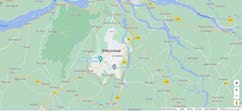
The topology of the city is one of undulating ridges and valleys, and it is drained by numerous natural drainage channels. The Kuakhai and Daya rivers, which encircle the city on its north and south sides, respectively, control the drainage. Aside from that, the city is crisscrossed by a number of open drains that run west to east, some of which eventually join to form Gangua Nallah. The distributaries of the River Kuakhai, the Gangua Nallah, meet the River Daya.
Methodology
There are total 40 samples of ground water were collected from four different locations of Bhubaneswar in 2019 and segmented as per postal pin codes (Table 1). The sampling methods were maintained as per Indian Standard IS: 3025 & IS: 1622 – 1981 (Techniques for Sampling and Testing Physical and Chemical Parameters for Water and Wastewater). All the samples were collected in a clean 250 ml sterilized bottles and the bottles were rinsed thoroughly prior to sampling and sealed tightly post samples collection. Further the analysis of water samples are being done by the testing method as per BIS: 10500:2012 (2nd Revision). Analytical methods for 7 investigated water quality indicators has been summarized in Table 2. All the samples are analysed at Department of Biotechnology Labs of Ravenshaw University.
| S. No | Sampling Sites | Name of Locality | Postal Pin Code |
|---|---|---|---|
| 1 | L-01 | Old Town | 751002 |
| 2 | L-02 | Laxmi Sagar | 751006 |
| 3 | L-03 | Aiginia | 751019 |
| 4 | L-04 | Chandrasekharpur | 751024 |
Table 1: Locations of the four sampling sites.
| Abbreviation | Adopted analytical method | Analytical instruments/techniques | |
|---|---|---|---|
| pH | - | IS 3025 (Part 11):1983, Reaffirmed, 2017 | Electrometric method (Eutech pH 700) |
| Total Dissolved Solid | TDS | IS 3025 (Part 16):1984, Reaffirmed:2017 | Gravimetric method |
| Turbidity | Turb. | IS 3025 (Part 10):1984, Reaffirmed, 2017 | Nephelometric method (Lovibond TB 300 IR) |
| Total Hardness | TH | IS 3025 (Part 21):1983 | EDTA Titrimetric Method |
| Total Hardness | TH | Reaffirmed, 2014 | EDTA Titrimetric Method |
| Chloride | Cl- | IS 3025 (Part 32):1988 | Argentometric method |
| Chloride | Cl- | RA: 2014 | Argentometric method |
| Faecal Coliform | FC | IS 1622:1981 | MPN |
| Faecal Coliform | FC | Reaffirmed:1993 | MPN |
| Faecal Coliform | FC | Reprint (2003) | MPN |
| E. coli | - | IS 1622:1981 | MPN |
| E. coli | - | Reaffirmed:1993 | MPN |
| E. coli | - | Reprint (2003) | MPN |
Table 2: Physico-chemical and microbiological water parameters and methods for analysis.
In factor analysis, the first step is to measure the relationship and strength between different chemical parameters. This is done using a “Pearson correlation matrix” Table 3 in an Excel sheet. The data used for the analysis comes from 40 sources and includes physio-chemical parameters for major elements and trace elements.
The correlation index is then classified into three categories based on their values:
- 95 to 99.9%: This indicates a very strong correlation between the parameters.
- 85 to 94.9%: This shows a strong correlation between the parameters.
- 70 to 84.9%: This indicates a moderate correlation between the parameters.
- Less than 70%: This suggests a weak or negative correlation between the parameters.
| TDS in PPM | pH | Turbidity (NTU) | Total Hardness (mg/l) | Chloride (mg/l) | Iron (mg/l) | Fluoride (mg/l) | Total Coliform (MPN/100ml) | |
|---|---|---|---|---|---|---|---|---|
| TDS in PPM | 1.00 | |||||||
| pH | -0.15 | 1.00 | ||||||
| Turbidity (NTU) | 0.08 | -0.18 | 1.00 | |||||
| Total Hardness (mg/l) | 0.98 | -0.19 | 0.08 | 1.00 | ||||
| Chloride (mg/l) | 0.85 | -0.05 | 0.21 | 0.86 | 1.00 | |||
| Iron (mg/l) | 0.02 | -0.19 | -0.07 | 0.05 | -0.13 | 1.00 | ||
| Fluoride (mg/l) | 0.23 | -0.15 | 0.11 | 0.32 | 0.27 | 0.06 | 1.00 | |
| Total Coliform (MPN/100ml) | 0.15 | -0.45 | 0.18 | 0.2 | 0.17 | 0 | 0.08 | 1.00 |
Table 3: Groundwater quality parameters correlation matrix (Pearson).
Result and Discussion
pH
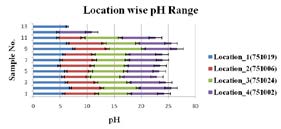
Bhat et al. proposed in 2022 that modifications to living thing and other bioactive compounds can cause pH readings to change. The pH level for drinking water should be between 6.5 and 8.5, according to IS: 10500. In this study pH varies between 4.6 to 7.5 during study period. It is further noted that the main source is acidic in character. Here in Figure 2 it shows the location wise pH range. According to the reference to Mandal SK, et al. [19], hydrolysis processes typically raise the pH level above 7, indicating alkaline conditions. Water with a pH above 7 is considered alkaline.
Turbidity
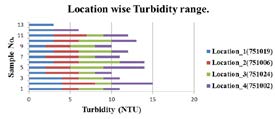
The range of turbidity was 2 to 5 NTU. There was no seasonal fluctuation in the samples. However, contaminated ground water may have a significant amount of high turbidity as a result of the action of subterranean soil and rock. The Figure 3 shows the turbidity range location wise.
Total Hardness
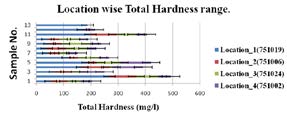
Total Hardness (TH) in water is primarily attributed to divalent cations, particularly calcium and magnesium. TH is a measure of the concentration of these cations in water and is used to assess water hardness. Based on the TH value, water can be classified into moderately hard to hard categories, as stated in Sarath Prasanth SV, et al. [20]. The hardness of the water causes the boiling point of the liquid to rise and prevents soap from lathering [21]. Total Hardness is permitted up to a maximum of 600 mg/l. Total hardness as CaCO3 ranged between 34 to 268 mg/l in water samples. High concentrations were found in the samples from the Aiginia and old town areas. The range location-wise is shown in Figure 4, and all samples fall below the permitted limits.
Chloride
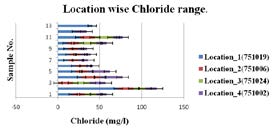
concentrations are below the desired levels. Water samples range in chloride level from 09 to 72 mg/l. Higher concentrations were observed in the Samantarapur area, but the remaining samples were determined to be beneath the BIS-acceptable level of 250 mg/l.
Chloride is naturally present in all types of water. Its concentration remains relatively low in naturally occurring fresh waters [21]. Here in Figure 5, show that the Chloride
Total Dissolved Solid
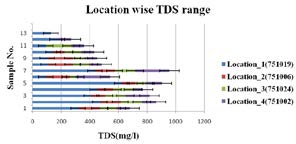
Acharya S, et al. [22] analyzed various parameter of water and among them TDS value is major indicator for ground water quality of Delhi. TDS (Total Dissolved Solids) refers to the collective concentration of dissolved ions, including cations, anions, trace metals, organic matter, and dissolved gases in water [23]. TDS is often used as an indicator of water quality. TDS of sample varied from 71 to 622mg/l. Sample drawn from Aiginia & Old town area record high value of TDS as compared to the desirable limit of BIS. Here in Figure 6 represents TDS range location wise. 96 % of TDS values were well within the permissible limit of 500 mg l−1 WHO [24] and can be classified as desirable for drinking type water [20].
TC & FC
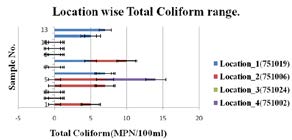
The research area’s ground water proved safe as none of the locations were above desirable limit of BIS for TC & FC. Here the Figure 7 shows the location wise Total coliform range. The research conducted by Atta SA, et al. [25] indicates that the higher levels of Fe, Mn, and Zn in the groundwater are natural and attributed to geogenic factors, not pollution sources. In line with this, the studies conducted by Khalil JB, et al. [26] and Awad SR, et al. [27] also highlight that the groundwater in the area is significantly impacted by freshwater seepage from canals and excessive irrigation.
In our study, we found that the contamination level of the groundwater is remarkably low, which indicates that it is safe for use, especially when compared to the standards set by the Bureau of Indian Standards (BIS). This finding suggests that the groundwater in the area is suitable for various purposes without posing any health risks to users.
Ground water is becoming more and more contaminated every day, according to the physico-chemical and microbiological parameters. Humans must raise public knowledge of the importance of maintaining the maximum level of water purity for a healthy lifestyle. Here in Table 4 shows the average range of all the parameters with respect to locations.
| Source | Average of TDS in mg/l | Average of Input-pH | Average of Turbidity (NTU) | Average of Total Hardness (mg/l) | Average of Chloride (mg/l) | Average of Total Coliform (MPN/100ml) | Average of Fecal Coliform (MPN/100ml) | Count of E Colli (MPN/100ml) | |
|---|---|---|---|---|---|---|---|---|---|
| L-01 | Bore Well | 123.67 | 6.35 | 2.92 | 57 | 14.75 | 0.58 | 0 | 0 |
| L-02 | Bore Well | 130 | 5.62 | 3.18 | 62.18 | 15.27 | 2.18 | 0 | 0 |
| L-03 | Well Water | 92 | 7.5 | 2 | 48 | 12 | 0 | 0 | 0 |
| L-03 | Bore Well | 287.33 | 5.64 | 3 | 128.33 | 25.33 | 2 | 0 | 0 |
| L-04 | Well Water | 120 | 6.1 | 3 | 48 | 14 | 0 | 0 | 0 |
| L-04 | Bore Well | 147 | 6.55 | 3 | 71.5 | 21.5 | 0 | 0 | 0 |
Table 4: Physico–Chemical and microbiological Characteristics of ground water.
Conclusion and Suggestions
The study found that groundwater in the Bhubaneswar region, the main source of irrigation and drinking water, has very low pH levels, indicating acidity. It needs pH correction to be safe for drinking. Human activities may harm groundwater quality, emphasizing the need for monitoring and environmental assessments in future projects to ensure safe and sustainable groundwater use.
In summary, the study highlights the need to rectify the extremely low pH levels in the groundwater of the Bhubaneswar region before it can be used for drinking purposes. It suggests that human intervention may be contributing to the degradation of groundwater quality, emphasizing the importance of continuous groundwater monitoring. However, further research is necessary to draw specific conclusions and evaluate potential clinical implications. My recommendation is that for all future development projects in the area of Bhubaneswar, it is essential to conduct a full environmental impact assessment. This assessment will help us understand the potential effects of the projects on groundwater resources. By doing so, we can take necessary measures to ensure the sustainable and responsible use of groundwater as a valuable resource in the region. This will help protect our environment and guarantee a reliable source of water for both present and future generations.
Ethical Responsibilities of Authors All authors have read, understood, and have complied as applicable with the statement on “Ethical responsibilities of Authors” as found in the Instructions for Authors.
Declaration of Competing Interest The authors whose names are recorded certify that they have no affiliation with or connection to any organization or substance with financial interests (e.g. fascinated (such as individual or professional connections, affiliations, information or beliefs) relating to the Topics or materials discussed in this original copy.
Data availability statement All the facts generated throughout and/or analyzed throughout the modern examination are to be had from the corresponding writer on affordable request.
Funding This research received no external funding.
References
-
Singh CK, Anand Kumar, Shashtri S, Kumar A, Kumar P, et al. (2017) Multivariate statistical analysis and geochemical modeling for geochemical assessment of groundwater of Delhi, India. Journal of Geochemical Exploration 175: 59-71.
-
Mohanty RK, Ambast SK, Panigrahi P, Mandal KG (2018) Water quality suitability and water use indices: Useful management tools in coastal aquaculture of Litopenaeusvannamei. Aquaculture 485: 210-219.
-
Saha P, Paul B (2018) Suitability assessment of surface water quality with reference to drinking, irrigation and fish culture: a human health risk perspective. Bull Environ Contam Toxicol 101(2): 262-271.
-
Mukate S, Wagh V, Panaskar D, Jacobs JA, Sawant A (2019) Development of new integrated water quality index (IWQI) model to evaluate the drinking suitability of water. Ecological Indicators 101: 348-354
-
Solangi GS, Siyal AA, Siyal P (2019) Analysis of Indus Delta groundwater and surface water suitability for domestic and irrigation purposes. Civil Engineering Journal 5(7): 1599-1608.
-
Singh V, Nagpoore NK, Jaichand, Lehri A (2020b) Monitoring and assessment of pollution load in surface water of river Ganga around Kanpur, India: A study for suitability of this water for different uses. Environmental Technology & Innovation 18: 100676.
-
Sakram G, Adimalla N (2018) Hydrogeochemical characterization and assessment of water suitability for drinking and irrigation in crystalline rocks of Mothkur region, Telangana State, South India. Applied Water Science 8(5): 1-21.
-
Aminiyan MM, Aitkenhead-Peterson J, Aminiyan FM (2018) Evaluation of multiple water quality indices for drinking and irrigation purposes for the Karoon river, Iran. Environmental Geochemistry and Health 40(6): 2707-2728.
-
Zhang W, Ma L, Abuduwaili J, Ge Y, Issanova G, et al. (2019) Hydrochemical, Hydrochemical characteristics and irrigation suitability of surface water in the Syr Darya River, Kazakhstan. Environ Monit Assess 191: 572.
-
Tiri A, Belkhiri L, Asma M, Mouni L (2020) Suitability and Assessment of Surface Water for Irrigation Purpose. In: Eyvaz M, Yüksel E, et al. (Eds.), Water Chemistry, Intech Open, pp: 250.
-
Mahtab MH, Zahid A (2018) Coastal surface water suitability analysis for irrigation in Bangladesh. Appl Water Sci 8: 28.
-
Jahin HS, Abuzaid AS, Abdellatif AD (2020) Using multivariate analysis to develop irrigation water quality index for surface water in Kafr El-Sheikh Governorate, Egypt. Environmental Technology & Innovation 17: 100532.
-
Kükrer S, Mutlu E (2019) Assessment of surface water quality using water quality index and multivariate statistical analyses in Saraydüzü Dam Lake, Turkey. Environ Monit Assess 191: 71.
-
De La Mora-Orozco C, Flores-Lopez H, Rubio-Arias H, Chavez-Duran A, Ochoa-Rivero J (2017) Developing a water quality index (WQI) for an irrigation dam. International Journal of Environmental Research and Public Health 14(5): 439.
-
Singh S, Ghosh NC, Gurjar S, Kumar S, Berwal P (2018) Index-based assessment of suitability of water quality for irrigation purpose under Indian conditions. Environ Monit Assess 190: 29.
-
Qiying Z, Hui Q, Panpan X, Kai H, Faxuan Y (2021) Groundwater quality assessment using a new integrated- weight water quality index (IWQI) and driver analysis in the Jiaokou Irrigation District, China. Ecotoxicology and Environmental Safety 212: 111992.
-
Mushtaq M, Gul A, Shaista, Sharma B, Singh H, et al. (2015) Ground water analysis of Kapurthala district (Punjab) in respect of some Physico-chemical parameters. Ecol Environ Conserv 21(1): 277-280.
-
Anim-Gyampo M, Anornu GK, Agodzo SK, Appiah-Adjei E (2019) Groundwater Risk Assessment for Shallow Aquifers within the Atankwidi Basin of (Ghana). Advances in Science Technology & Innovation.
-
Mandal SK, Dutta SK, Pramanik S, Kole RK (2019) Assessment of river water quality for agricultural irrigation. Int J Environ Sci Technol.16: 451-462.
-
Prasanth Sarath SV, Magesh NS, Jitheshlal KV, Chandrasekar N, Gangadhar K (2012) Evaluation of groundwater quality and its suitability for drinking and agricultural use in the coastal stretch of Alappuzha District, Kerala, India. Appl Water Sci 2: 165-175.
-
Bhat UH, Kapoor K, Sharma L (2022) Groundwater quality assessment for sustainable drinking purpose in some blocks of district Ludhiana. Materials today: Proceedings 68(4): 1135-1142.
-
Acharya S, Sharma SK, Khandegar V (2018) Assessment of groundwater quality by Water Quality Indices for Irrigation and drinking in South West Delhi, India. Data in Brief 18: 2019-2028.
-
Bikundia DS, Mohan D (2014) Major Ion Chemistry of the Ground Water at the Khoda Village, Ghaziabad, India. Sustainability of Water Quality and Ecology 3-4: 133- 150.
-
WHO (2021) Guidelines for drinking-water quality. 4th (Edn.), incorporating the 1st addendum. World Health Organization, pp: 631.
-
Atta SA, Afaf AO, Zamzam AH (2003) Hydrogeology and hydrochemistry of the groundwater at Khanka region, Egypt. International Symposium on Future Food Security for Africa, pp: 136-155.
-
Khalil JB, Atta SA (1986) Hydrogeochemistry of groundwater in South of Ismailia canal, Egypt. Egypt J Geol 30(1-2): 109-119.
-
Awad SR, El Fakharany ZM (2020) Mitigation of waterlogging problem in El-Salhiya area, Egypt. Water Sci J 34(1): 1-2.
- Genetic Improvement of Nile Tilapia (Oreochromis niloticus): Advances in Selective Breeding and Genomic Approaches for Sustainable Aquaculture
- Microplastics, Contaminants, and Waste Hotspots: Divergences and Faults in Prioritizing Control Efforts
- Creating a Healthier, More Vibrant Open and Closed Aquatic Environment. A Submersible, Centrifugal Magnetically Affixed Current Changing Aquarium Pump
- An Attempt to Assess Alpha Diversity and Sample Size: Using the Ostracod Assemblages off Kumamoto Port, Japan
- Assessment of the Efficiency of Common Fishing Gears and Crafts Used at Mohananda River of Chapai Nawabganj, Bangladesh
- Fish Productivity and Biodiversity Status of Sundarban Mangrove in Bangladesh