
Preliminary Determination of Organic Carbon Content in Seagrass Bed at Ao Pae, Rayong Province, Thailand
Seagrass meadows play crucial roles in delivering ecosystem services to various organisms and environmental systems, particularly in efficiently capturing and storing carbon. Thus, seagrasses are included in plans to address climate change challenges. However, there is limited data on carbon sequestration by seagrass in Thailand, especially in localized areas. Therefore, this study aimed to assess the carbon storage in both sediments and seagrass at Ao Pae, Rayong Province. The analysis focused on sediment depth and the impact of moisture content. Sediment and seagrass samples were collected during the low tide season during May 2022. The sampling area was divided into two zones: one with seagrass presence (9 stations) and another where seagrass was absent (4 stations). Sediment was collected from a depth of 60 cm, divided into six layers of 10 cm each. Results indicated that the highest organic carbon content was observed in sediment at depths of 0-10 cm (22.82±2.08%). Additionally, the organic carbon content showed a significant correlation with sediment moisture content in the area with seagrass presence (p<0.05). Furthermore, the mean belowground organic carbon (1.93±0.29%) exceeded the aboveground carbon (1.66±0.28%), and sediments from stations with seagrass had higher organic carbon content compared to those without seagrass. These findings underscore the potential role of seagrass as a significant carbon sequester in Ao Pae, Rayong Province.
Introduction
The quantity of carbon dioxide in the atmosphere has continuously increased from the past to the present. Primary contributors include diverse industries and the combustion of fossil fuels or petroleum products, leading to the accumulation of greenhouse gases that contribute to the rise in Earth’s temperature. The greenhouse gas emission situation in Thailand accounts for 0.88% of the global total and is considered one of the top 10 countries with the highest climate vulnerability index (https://www.bangkokbiznews.
com/environment/1060534). This information acts as a catalyst for Thailand to become more aware of environmental management. There is a drive towards the concept of a sustainable economy that integrates the development of the marine and coastal economy with the sustainable care of marine ecosystems [1].
The marine and oceanic ecosystems have a capacity to serve as effective carbon sinks by absorbing carbon dioxide from the atmosphere and storing it [2]. This process contributes to the reduction of greenhouse gases in the air. Given the extensive coverage of the sea and oceans, which spans approximately 2 out of 3 parts of the Earth, they can sequester carbon at a rate of up to 22 million metric tons per day, contributing to around 55% of global sequestration [3].
Reports indicate that seagrasses are particularly efficient in absorbing or sequestering carbon in the forms of both CO2 and HCO3 [4]. The economic value of this sequestration is estimated to range from about 1.9 to 13.7 trillion US dollars annually [5].
Seagrass ecosystems, characterized by their rich biodiversity, possess the capacity to sequester carbon, making them a notable player in carbon storage [6]. Despite global seagrass coverage ranging from only 0.1-5 percent, these ecosystems can sequester over 15 percent of oceanic carbon [7]. This capability is linked to the distinctive structure of seagrasses, featuring elongated stems and rhizomes that spread horizontally along the soil surface [8]. Seagrasses can accumulate organic carbon in aboveground tissues and leaves, as well as store it in belowground root systems [8, 9]. However, most of the carbon in seagrass ecosystems is retained in the sediment beneath the seagrass rather than in the aboveground biomass [10]. The carbon stored in the sediment can persist for extended periods under oxygen- deprived conditions (anoxia) after being decomposed by bacteria [8]. Once decomposed, the carbon becomes available for use by various types of living organisms [11]. Therefore, Thailand has directed its focus towards seagrass ecosystems, integrating seagrass conservation measures into its plans to tackle the challenges posed by climate change.
The seagrass habitat in the Ao Pae area of Rayong Province is an area with overall healthy seagrass conditions, with a coverage rate of 75 percent. Encompassing an area of about 738.02 rai (1,180,832 square meter or 291.71 acre), it comprises three seagrass species: Halodule pinifolia, Halodule uninervis, and Halophila ovalis [12]. These seagrasses flourish and propagate on sandy bottoms in shallow waters, an area with limited human utilization, making it a fertile seagrass source. However, despite the richness of this area, comprehensive data on seagrass carbon sequestration in Thailand, especially in specific regions, remains limited. This gap hinders effective management strategies for the area. Therefore, this study aims to evaluate the carbon sequestration in seagrass ecosystems in the Ao Pae area of Rayong Province. In particular, the focus is on the integration of sediment depth and soil moisture factors which are presumed to be linked to carbon quantity. This approach provides a comprehensive understanding of the carbon sequestration dynamics in the Ao Pae area by quantifying the amount of carbon stored in both seagrass biomass and sediment and examine the statistical significance of these findings. It will provide fundamental data regarding the carbon sequestration capabilities, serving as a basis for planning conservation strategies for seagrass resources in the future and show the role of seagrass habitats as carbon sinks.
Methodology
Determining Locations for the Collection of Sediment and Seagrass Samples
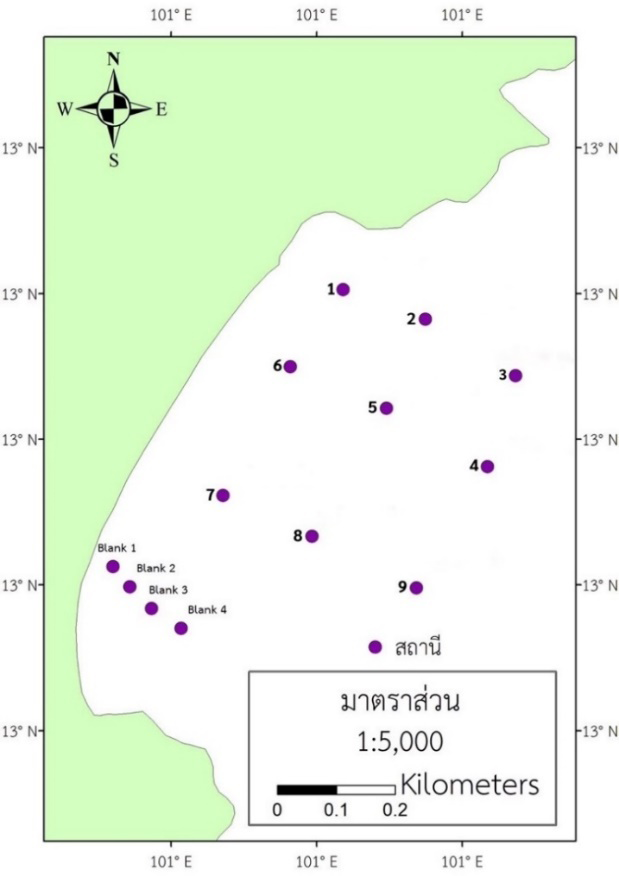
Collecting seagrass and sediment samples in the Ao Pae area, Rayong Province, during the low tide period in May 2022, which corresponds to the rainy season. The study area was divided to cover seagrass beds, with 9 stations where seagrasses were present (Station 1-9) and 4 stations where seagrasses were absent (Blank 1-4). The sampling stations were designated to use tools to pinpoint locations on the Earth’s surface or the Global Positioning System (GPS). The seagrass coverage percentage was assessed using aerial imagery from small unmanned aerial vehicles combined with field survey data (Table 1 and Figure 1).
| Latitude | Longitude | The percentage of seagrass coverage | |
|---|---|---|---|
| Blank 1 | 12.61361 | 101.42356 | 0 |
| Blank 2 | 12.61331 | 101.42382 | 0 |
| Blank 3 | 12.61298 | 101.42415 | 0 |
| Blank 4 | 12.61267 | 101.4246 | 0 |
| 1 | 12.61784 | 101.42707 | 1-25 |
| 2 | 12.61739 | 101.42833 | 51-75 |
| 3 | 12.61653 | 101.42971 | 26-50 |
| 4 | 12.61514 | 101.42928 | 26-50 |
| 5 | 12.61603 | 101.42773 | 51-75 |
| 6 | 12.61666 | 101.42627 | 51-75 |
| 7 | 12.6147 | 101.42524 | 1-25 |
| 8 | 12.61408 | 101.4266 | 1-25 |
| 9 | 12.61329 | 101.42819 | 76-100 |
Table 1: The coordinates of the sampling stations and the percentage of seagrass coverage.
Sediment Samples Collection
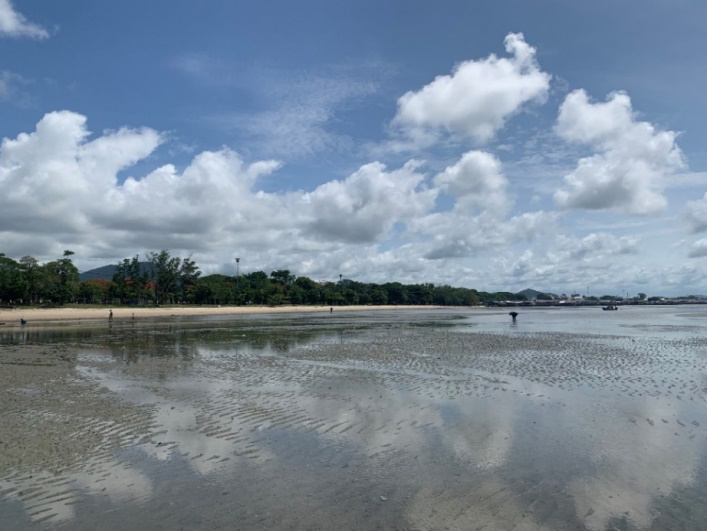
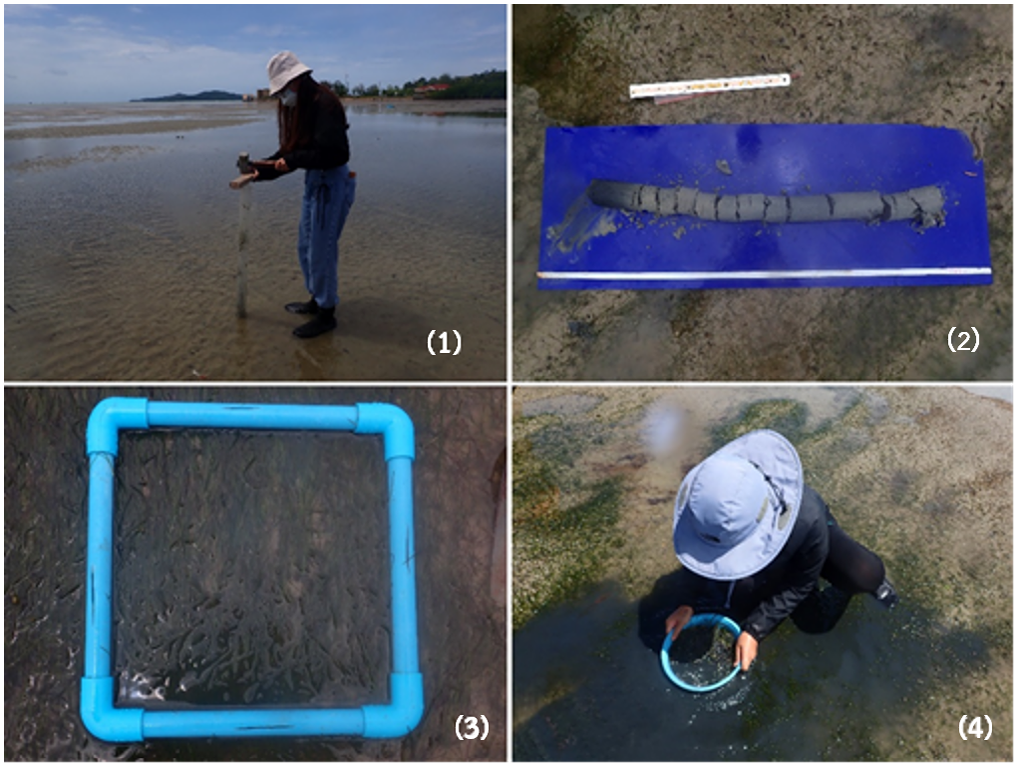
The sampling was done during the lowest tide period in the Ao Pae area, Rayong Province (Figure 2). The sediment samples were collected using a 2-inch diameter soil core at a depth of 60 cm from the soil surface. The soil was sectioned at 10 cm depth intervals, dividing it into six layers: Layer 1 (0-10 cm), Layer 2 (10-20 cm), Layer 3 (20-30 cm), Layer
4 (30-40 cm), Layer 5 (40-50 cm), and Layer 6 (50-60 cm). When collecting the seagrass samples, a 25x25 cm quadrat was utilized to delineate the sampling area (Figure 3). Then, the seagrass samples were collected using a hand trowel. The samples were subsequently placed in a basket to wash away soil debris. The seagrass samples were transferred into a plastic bag. After removing the excess air, the samples were stored at -20 degrees Celsius until used.
Analysis of the Seagrass Samples
Quantifying organic carbon content was carried out using the Loss on Ignition (LOI) method [10]. Initially, the seagrass samples underwent a cleaning process to separate epiphytes. Subsequently, the samples were divided into two parts: aboveground and belowground. Both portions were dried, and 2 grams of the samples were placed in a crucible and ignited at a temperature of 600 degrees Celsius for 3 hours. After cooling, the crucible was weighed to determine the weight loss due to moisture. The data obtained from these measurements were employed to calculate the quantity of organic matter using Equation (1).
% 100
Weight beforeignition Weight after ignition
$$ \% L O I = \frac {W e i g h t b e f o r e i g n i t i o n - W e i g h t a f t e r i g n i t i o n}{W e i g h t b e f o r e i g n i t i o n} \times 1 0 0 \tag {1} $$ The quantity of organic carbon (%OC) was calculated according to Equations (2) and (3).
$$ \% c _ {o r g} = 0. 4 0 * \% L O I - 0. 2 1 (\% L O I < 0. 2) \tag {2} $$
$$ \% c _ {o r g} = 0. 4 3 * \% L O I - 0. 3 3 (\% L O I > 0. 2) \tag {3} $$
Sediment moisture content was determined following AOAC, et al. [13]. The soil samples were ground and weighed and subsequently dried in an oven at a temperature of 105 degrees Celsius for 5-6 hours. The samples were placed in a desiccator for 24 hours. The weight was re-measured to determine the amount of water lost in the soil samples. The obtained data were used to calculate the soil moisture content using Equation (4).
− = × % 100 Weight of thesedement beforeheating Weight of thesedement after heating moisture Weight of thesedement beforeheating (4) Determination of organic carbon content was carried out by the Loss on Ignition (LOI) method [10, 13]. Two grams of the soil samples were placed in a crucible and ignited at 600 degrees Celsius for 3 hours. After cooling in a desiccator, the weight of the dried sediment was measured. The sediment weight obtained was used to calculate LOI as well as the quantity of organic carbon according to Equation (1), (2) and Equation (3), respectively.
Statistical Analysis
The statistical analysis in this study covers important points including calculation of average organic carbon content, determining statistical significance using appropriate tests (ANOVA) and exploring relationships between sediment layers and carbon sequestration. Analysis of variance to compare the amount of organic carbon in sediment samples from areas with and without seagrass was performed. At a confidence level of 95% (p<0.05), this analysis allowed to identify statistically significant differences in organic carbon content between the two site types throughout the sediment depth.
Results
The Amount of Organic Carbon in the Soil Sediment Samples
As stated earlier, seagrasses can capture and retain carbon. Therefore, the analysis of organic carbon content was conducted on soil samples collected from areas with and without seagrasses. The average organic carbon content in the sandy soil where seagrass was present was 10.31±0.86, 9.09±0.99, 8.99±0.41, 8.75±0.77, 8.50±1.43, and 8.41±0.84 percent at soil depths of 1 (0-10 cm), 2 (10-20 cm), 3 (20- 30 cm), 4 (30-40 cm), 5 (40-50 cm), and 6 (50-60 cm), respectively. In contrast, the organic carbon content in the sandy soil where seagrass was absent averaged 8.30±0.42, 8.44±0.52, 8.54±1.41, 8.61±0.95, and 8.69±1.11 percent at soil depths of 1, 2, 3, 4, and 5, respectively (Table 2). Notably, the organic carbon content in sandy soil with seagrass exhibited significant differences (p<0.05) compared to the area without seagrass at the 0-10 cm soil depth.
| Level and Depth (cm) | %OC (X±SD) | % moisture content (X±SD) | ||
|---|---|---|---|---|
| Seagrass-present area | Seagrass-absent area | Seagrass-present area | Seagrass-absent area | |
| 1 (0-10) | 10.31±0.86* | 8.30±0.42 | 22.82±2.08 | 18.52±1.52 |
| 2 (10-20) | 9.09±0.99 | 8.44±0.52 | 21.02±1.96 | 18.23±0.54 |
| 3 (20-30) | 8.99±0.41 | 8.54±1.41 | 19.79±2.37 | 18.49±2.23 |
| 4 (30-40) | 8.75±0.77 | 8.61±0.95 | 19.87±1.40 | 30.26±5.27 |
| 5 (40-50) | 8.50±1.43 | 8.69±1.11 | 20.18±2.43 | 40.16±12.89 |
| 6 (50-60) | 8.41±0.84 | n.d. | 21.11±0.97 | n.d. |
Table 2: ** Quantity of organic carbon and moisture content in sediment at the station where seagrass was present and absent.
Remark: 1. “ * ” indicates a significant difference (p<0.05) among stations where seagrass was present and stations where sea grass was absent at each level. 2. “ n.d.” means no data. There were a lot of shells at a depth of 50-60 cm and the sediment could not be analyzed. Table 2: Quantity of organic carbon and moisture content in sediment at the station where seagrass was present and absent.
When analyzing the relationship between depth levels and the amount of organic carbon in seagrass-present areas, it was found that there is a significant negative correlation between depth levels and soil organic carbon content at stations 3 (R2 = -0.846), 5 (R2 = -0.832), 6 (R2 = -0.873), 7 (R2 = -0.912), 8 (R2 = -0.889), and 9 (R2= -0.894) (p < 0.05). Conversely, in the analysis of the relationship between depth levels and soil organic carbon content in seagrass-absent areas, no statistically significant differences were observed (p > 0.05) at all four points (Blank 1-Blank 4).
Moisture Content in the Soil Sediment Samples
The existence of seagrass on sandy soil likely played a role in the sediment moisture levels. Consequently, an examination was conducted to assess the soil’s moisture content. The soil samples obtained from areas with seagrass exhibited average moisture content values of 22.82±2.08, 21.02±1.96, 19.79±2.37, 19.87±1.40, 20.18±2.43, and 21.11±0.97 percent at depths of 1 (0-10 cm), 2 (10-20 cm), 3 (20-30 cm), 4 (30-40 cm), 5 (40-50 cm), and 6 (50-60 cm), respectively. In contrast, the average soil moisture content in areas without seagrass 18.52±1.52, 18.23±0.54, 18.49±2.23, 30.26±5.27, and 40.16±12.89 percent at soil depths of 1, 2, 3, 4, and 5, respectively (Table 2).
When analyzing the relationship between moisture levels and the quantity of organic carbon in seagrass- present areas at different sediment depth, it was found to exhibit a statistically significant correlation (p < 0.05). This correlation was consistent across different depth levels, with values of 0.846 at depth level 1, 0.707 at depth level 2, 0.704 at depth level 3, 0.683 at depth level 4, and 0.782 at depth level 5 (Table 3). As for the variations in moisture content at stations without seagrass at various depth levels, it was observed that there was a significant difference in moisture levels between depth level 5 and depth levels 1 to 3 (p < 0.05).
| Soil depth (cm) | N | Correlation | p-value |
|---|---|---|---|
| 1 (0-10) | 9 | 0.846 | 0.004 |
| 2 (10-20) | 9 | 0.707 | 0.033 |
| 3 (20-30) | 9 | 0.704 | 0.034 |
| 4 (30-40) | 9 | 0.683 | 0.043 |
| 5 (40-50) | 9 | 0.782 | 0.013 |
| 6 (50-60) | 8 | 0.486 | 0.222 |
Table 3: The correlation between moisture levels and the quantity of organic carbon in seagrass-present areas at different sedime
When comparing the moisture content of soil samples with seagrass to those without seagrass, a statistically significant difference (p < 0.05) was observed at the depth levels of 1 (0-10 cm), 2 (10-20 cm), and 4 (30-40 cm).
Organic Carbon Quantity in the Seagrass
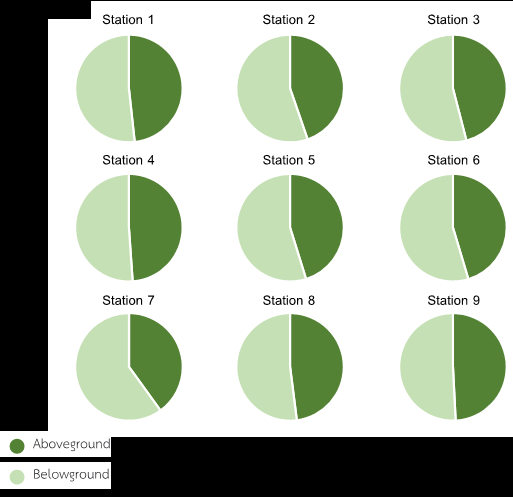
Within the studied area, H. pinifolia is predominant species of seagrass. After collecting samples to study the amount of organic carbon, it was found that the organic carbon content in the aboveground parts of the soil was 1.53, 1.95, 1.33, 1.34, 1.57, 1.62, 1.51, 1.90, and 2.15 percent, while the organic carbon content in the belowground parts of the soil was 1.89, 2.08, 1.57, 1.40, 1.90, 1.95, 2.26, 2.06, and 2.22 percent, respectively, at sampling stations 1 to 9, as shown in Figure 4. On average, the proportion of organic carbon content in the belowground parts was found to be higher than in the aboveground parts. The difference between the organic carbon content in the aboveground and belowground parts was statistically significant (p < 0.05).
Considering the seagrass coverage at each station, it was found that station 1, 7, and 8 have coverage proportions of 1-25%. Stations 3 and 4 have coverage proportions of 26- 50%, Stations 2, 5, and 6 have coverage proportions of 51- 75%, and Station 9 has the highest coverage proportion of approximately 76-100%. Combined with the data, it is evident that areas with seagrass coverage have a higher percentage of organic carbon (%OC) compared to areas without seagrass coverage, especially at the depth level of 1 (0-10 cm). It can be inferred that stations with a high proportion of seagrass coverage will have a higher %OC. Therefore, Station 9 has the highest %OC, followed by Stations 2, 5, 6, 3, 4, and Stations 1, 7, and 8 have the lowest %OC.
Discussion
Sediments form through the erosion of rocks and minerals, coupled with the presence of organic material resulting from the decay of plant and animal remnants. This process takes a considerable amount of time for accumulation. As a result, sediments become a crucial carbon storage source. The carbon content in soils is approximately three times higher than that found in plants and roughly twice higher that present in the atmosphere. Consequently, appropriate soil management and utilization significantly influences both carbon sequestration and the release of carbon dioxide from the soil surface. Several reports indicate that oceans can store up to 55 percent of global carbon storage, surpassing carbon storage in forests [14]. To sequester carbon effectively, vegetation plays a crucial role in facilitating its incorporation into the soil. Therefore, seagrasses can play a significant role in this process.
The organic carbon content in the sediment in areas where seagrass is present was higher than in areas without seagrass, indicating the potential of seagrass in the Ao Pae area, Rayong Province, as a carbon sink. In addition, the organic carbon content in the sediment in areas with seagrass is inversely correlated to depth levels (p<0.05). The highest organic carbon content in the sediment was found at depth level 1 (0-10 cm), with a percentage of 10.31±0.86, while the lowest is observed at depth level 6 (50-60 cm) with 8.41±0.84 percent. These results are consistent with the findings of Pendleton L, et al. [5].
In general, seagrasses store organic carbon in their roots. Consequently, with the dense concentration of seagrass rhizomes in the initial sediment layer, it becomes apparent that the organic carbon content in the belowground part of seagrass surpasses that of the aboveground part. In smaller- sized seagrass species, roots often extend to a depth of around 5-7 cm in the upper sediment layer [15].
The soil moisture content in seagrass-present areas shows a statistically significant correlation with the quantity of organic carbon in the sediment at a confidence level of 95% (p<0.05). Higher soil moisture content is associated with higher amounts of organic carbon. This is because soil moisture reflects the water-holding capacity of the sediment, and smaller-sized sediments, including seagrass-present ones, demonstrate better water retention capabilities, resulting in enhanced organic carbon storage compared to larger-sized sediments [16]. Additionally, it is observed that the soil moisture content in areas without seagrass increases with the depth level. This is attributed to the fact that seagrass-present areas tend to form water pockets, maintaining some seawater even during low tide. In contrast, areas without seagrass experience complete drying during low tide, causing the upper layer of the soil to be significantly impacted by these pronounced changes.
When surveying the area across all 9 sample collection stations in Ao Pae, Rayong Province, it was found that the seagrass species Halodule pinifolia is a prominent type. This finding aligns with Sirimungkara A, et al. [17] who reported on the environmental status of the coastal seagrass system in Rayong Province along the seagrass line at Ban Pae Beach, Rock Garden Village, and Hua Hin, from October 2013 to May 2014. The study identified three seagrass species: Halodule pinifolia, Halodule uninervis, and Halophila ovalis. Notably, Halodule pinifolia was predominant in all three areas, with coverage percentages ranging from 33.6-48.3% at Rock Garden Village, 10.4-14.8% at Ban Pae, and 2.0-7.3% at Hua Hin Pang Rat area, respectively.
From previous study, it was found that the seagrass species H. pinifolia could sequester carbon, primarily by storing it in the belowground parts such as rhizomes and roots. This tendency is attributed to the characteristics of H. pinifolia, a seagrass species belonging to the genus Halodule, which, like H. uninervis, exhibits a greater belowground biomass than aboveground biomass. Consequently, there is a trend of carbon accumulation in the same direction as the biomass of seagrass, indicating that the amount of organic carbon serves as an indicator of the seagrass ecosystem’s direct carbon sequestration capability. The study’s findings align with Jansingkon K, et al. [18] who discovered that the quantity of organic carbon in the belowground biomass of seagrass (H. uninervis) is higher than in the aboveground biomass. Furthermore, the organic carbon content in the sediment in the seagrass-present areas is greater than in areas without seagrass.
Genetic variations among different seagrass species result in differences in the accumulation of organic carbon. Cymodocea serrulata, found in the Koh Kradad region, has the highest quantity of organic carbon, comparable to the seagrass species Enhalus acoroides. Conversely, Halophila minor, another type of seagrass, exhibits the lowest overall organic carbon content, with the roots having the highest concentration [14]. Among these species, Enhalus acoroides, or tape seagrass, demonstrates the highest carbon sequestration capability, ranging from 3,795.67 to 4,100.12 gcm2. Following by H. uninervis, which can sequester carbon up to 2,883.10 gcm2, while Halophila minor has the least carbon sequestration capability compared to the other species.
The results clearly indicate the efficiency of seagrass that plays an important role in carbon fixation and helps reduce the greenhouse effect from carbon dioxide. The organic carbon in areas where seagrass appears tends to be related to the amount of underground biomass. It shows that the underground stem part plays a role in the accumulation of organic carbon in the sediment which will be recycled back to plants and the food chain that occurs in the sediment for further use. Statistical analysis along with the study methods in this research offers new insights about the carbon storage potential of seagrass ecosystems by quantifying the contribution of sediment depth and soil moisture to carbon sequestration. It also improves our understanding of the mechanisms about driving carbon sequestration in coastal areas. These approaches pave the way for future research efforts which aimed at increasing carbon sequestration in seagrass habitats and the resilience of coastal ecosystems to climate change.
Conclusion
The species of seagrass, H. pinifolia, is particularly notable in the Ao Pae region of Rayong Province. This seagrass type has a significant ability to sequester carbon, particularly in the belowground parts. The highest quantity of organic carbon in the sediment was observed at depth level 1 (0-10 cm), while the lowest was found at depth level 6 (50- 60 cm). Additionally, the soil moisture content in seagrass- present areas is correlated with the organic carbon quantity. The organic carbon content in the sediment in the seagrass- present areas exceeds that in areas without seagrass. This suggests that the seagrass ecosystem in Ao Pae, Rayong Province, has the potential to be a crucial carbon storage site. Therefore, promoting the conservation and restoration of seagrass planting in this area is a promising strategy to strengthen the environmental resilience and contribute to sustainable reduction of atmospheric carbon levels.
Acknowledgement
The Marine and Coastal Resources Research Center (Eastern Gulf of Thailand) is thankful for their support in sample collection for research purposes.
References
-
Supasa T, Hsiau SS, Lin SM, Wongsapai W, Chang KF, et al. (2017) Sustainable energy and CO2 reduction policy in Thailand: An input-output approach from production- and consumption-based perspectives. Energy for Sustainable Development 41: 36-48.
-
Heinze C, Meyer S, Goris N, Anderson L, Steinfeldt R, et al. (2015) The ocean carbon sink - impacts, vulnerabilities and challenges. Earth System Dynamics 6(1): 327-358.
-
Richard AF, Sabine CL, Fabry VJ (2006) Carbon dioxide and our ocean legacy.
-
Edward BB, Hacker SD, Kennedy C, Koch EW, Stier AC, et al. (2011) The value of estuarine and coastal ecosystem services. Ecological Monographs 81(2): 169-193.
-
Pendleton L, Donato DC, Murray BC, Crooks S, Jenkins WA, et al. (2012) Estimating global ‘‘blue carbon’’ emissions from conversion and degradation of vegetated coastal ecosystems. PLos One 7(9): e43542.
-
Mcleod E, Chmura GL, Bouillon S, Salm R, Björk M, et al. (2011) A blueprint for blue carbon: toward an improved understanding of the role of vegetated coastal habitats in sequestering CO2. Frontiers in Ecology and the Environment 9(10): 552-560.
-
Zhu ZB, Aller RC, Mak J (2002) Stable carbon isotope cycling in mobile coastal muds of Amapa, Brazil. Continental Shelf Research 22(15): 2065-2079.
-
Röhr ME, Holmer M, Baum JK, Björk M, Boyer K, et al. (2018) Blue Carbon Storage Capacity of Temperate Eelgrass (Zostera marina) Meadows. Global Biogeochemical Cycles 32(10): 1457-1475.
-
Trevathan-Tackett SM, Kelleway J, Macreadie PI, Beardall J, Ralph P, et al. (2015) Comparison of marine macrophytes for their contributions to blue carbon sequestration. Ecology 96(11): 3043-3057.
-
Fourqurean JW, Duarte CM, Kennedy H, Marbà N, Holmer M, et al. (2012) Seagrass ecosystems as a globally significant carbon stock. Nature Geoscience 5: 505-509.
-
Stankovic M, Panyawai J, Jansanit K, Upanoi T, Prathep A (2017) Carbon Content in Different Seagrass Species in Andaman Coast of Thailand. Sains Malaysiana 46 (9): 1441-1447.
-
Department of Marine and Coastal Resources (2022) DMCR ONEPAGE. Marine and Coastal Resources Research Center (Eastern Gulf of Thailand), Ministry of Natural Resources and Environment.
-
AOAC, Helrich H (1990) Official methods of analysis of the Association of Official Analytical Chemists. In: 15th (Edn.), The Association, Arlington, VA.
-
Srinamngoen P (2018) The role of blue carbon in seagrass at the east coast of Thailand. Final research report, Burapha University, Thailand, pp: 78.
-
Marba N, Duarte CM (2010) Mediterranean warming triggers seagrass (Posidonia oceanica) shoot mortality. Global Change Biology 16(8): 2366-2375.
-
Sukudom C, Kaewnern M, Wudtisin I, Yoshikawa T, Okamoto Y, et al. (2015) Organic contents and pH profiles of sediments in cockle farm at Bandon Bay, Surat Thani Province. Khon Kaen Agr J 43(2): 265-276.
-
Sirimungkara A, Laongmanee W, Paibulkichakul B, Yuvanatemiya V, Leadprathom (2016) Seasonal effect on distribution of seagrass in coastal of Rayong Province. Khon Kaen Agr J 44(S1): 745-751.
-
Jansingkon K, Muangham S, Suriyaphan J (2020) Organic carbon content in seagrass and sediments in seagrass beds, Sattahip Bay, Sattahip District, Chon Buri Province. Khon Kaen Agr J 48(1): 893-898.
- Genetic Improvement of Nile Tilapia (Oreochromis niloticus): Advances in Selective Breeding and Genomic Approaches for Sustainable Aquaculture
- Microplastics, Contaminants, and Waste Hotspots: Divergences and Faults in Prioritizing Control Efforts
- Creating a Healthier, More Vibrant Open and Closed Aquatic Environment. A Submersible, Centrifugal Magnetically Affixed Current Changing Aquarium Pump
- An Attempt to Assess Alpha Diversity and Sample Size: Using the Ostracod Assemblages off Kumamoto Port, Japan
- Assessment of the Efficiency of Common Fishing Gears and Crafts Used at Mohananda River of Chapai Nawabganj, Bangladesh
- Fish Productivity and Biodiversity Status of Sundarban Mangrove in Bangladesh