
Surgico-Therapeutic Management of Wounds and Fractures in Birds Affected Due to Kite Flying
This paper discussed the management of bird’s body injuries, wounds, and different type of bone fracture occurred during kite festival. Every year sacrifices the health of thousands of birds to the thrill of kite-flying festival. In present study, the highest incidences of kite string injuries were observed in Blue-rock Pigeons (64, 71.11%) followed by Blackeared Kite (9, 10%), Parrot (7, 7.77%), Ring necked dove (4, 4.44%), Crow (4, 4.44%) and Barn owls (2, 2.22%).
Shantanu Kumar Kuldeep1*, Sandhya Morwal2 and Jayesh Vyas3
Veterinary and Animal Science, Navania, Udaipur, India
and Animal Science, Navania, Udaipur, India
drshantanukuldeep@gmail.com Keywords: Fly Kite; Birds, Festival; Injury; Wound
Introduction
The festival of Makar Sankranti is celebrated all over India during the third week of January with great gaiety. Traditionally, the flying of kites has been an integral part of the festive celebrations [1, 2, 3].
Kite flying is practiced mainly three days 13 January to 15 January. During Sankranti, whole sky is filled with kites a million or more kites are known to dot the sky at the same time each trying to joust with neighbouring kites. This goes on all day, from before sunrise to after sunset.
Once the string of a rival kite is severed (the length of the string could vary from a couple of centimetres to several meters), it gets wind-blown and drifts along with the kite and settles or gets caught on tall trees.
As a result of the breeze, the kite strings too get twisted firmly on to the branches in the canopy and on other structures, wherever the kite settles. Being practically invisible, these suspended strings prove quite harmful to birds that get entangled in them while in flight [4, 5, 6, 7]. When these birds try to wriggle free of them, struggling in shock, they get further entrapped. Such trapped birds remain dangling from trees and other substrates for various periods of time until spotted by people. They undergo enormous stress and strain, may get maimed, or even die, if not rescued.
Every year, thousands of birds like Pigeons, Kites, Vultures, Owls and other species of birds get injured by sharp, glass-coated manja. They somehow get entangled with the manja, struggle in panic and then fall to the ground. The manja cuts their wings, feet, neck region and other body surface that it results in profuse bleeding and often gruesome death, if beheaded.
Different types of the injuries are found in birds due to the kite flying. The most common injuries include wing injuries (laceration and abrasions, broken feathers), Injury to the propatagium, injuries to the neck, eyes, beak and fracture of the different bones of body are very common.
Methodology
When owner’s and volunteers came the birds firstly complete examined the birds for any type of wound (fresh and infected), injuries and fracture on his body.
The feathers present on the edges of the wound were only removed by gentle plucking to allow more thorough cleansing and to prevent feather matting during the healing phases. The wound lavage was done using warm sterile normal saline with 5% povidone-iodine solution to remove foreign material, reduce bacterial numbers and rehydrate soft tissues.
In case of the minor bruises and abrasions, anti-septic dressing was done using 5% povidone-iodine solution and cetrimide spray. In case of major contaminated wound, debridement was done using Bard Parker blade No. 11 to remove as much of the devitalized tissue as possible until viable, vascularized tissue was recognized.
The wound involving propatagium was closed from both the sides by simple continuous suture pattern using vicryl 3-0 absorbable suture material.
The fresh wound was closed by simple interrupted sutures using vicryl 3-0 absorbable suture material. The older, infected and more complicated wounds (irreparable injuries, necrosis, severe infection, tissue loss and old fracture) were managed as open wounds and allowed to heal by second intention. Amputation of the wing also done as a last resort to save the life of the bird. The owners and volunteers was advised to regular cleaning and anti-septic dressing of wound and infected body parts. Meloxicam drug was used as an anti- inflammatory and analgesic administered @ 0.1 mg/kg IO for three days. To reduce the stress, multivitamin drops were given orally. The birds which were unable to take the feed by their own, hand feeding was given.
Results and Discussion
A detailed study was undertaken in ninety injured birds due to the kite string or other injuries presented. Based on species predisposition, the highest incidences of kite string injuries were observed in Blue-rock Pigeons (64, 71.11%) followed by Black-eared Kite (9, 10%), Parrot (7, 7.77%), Ring necked dove (4, 4.44%), Crow (4, 4.44%) and Barn owls (2, 2.22%).
Similar findings were observed by Tiwari, et al. [8] in a study of 3826 injured birds during kite flying festival, the incidence was more in Blue-rock Pigeons (68%) followed by Common Pariah Kites (19%).
Out of 90 birds , 30 birds (33.33%) had left wing injuries, 20 birds (22.22%) right wing injuries, 3 bird (2.98%) left limb injuries, 1 bird (1.11%) right limb injuries, 8 bird (9.00%) head region injury, 11 (12.22%) birds various body injuries, 11 (12.22%) birds wing fracture and 5 (5.55%) limb fracture (Table 1).
| S.no | Species | Wing injury | Limbs injury | Other injuries | Fracture | Total | ||||
| Species | Left | Right | Left | Right | Total | Head region | body | Wing | Limb | |
| 1 | Blue-rock Pigeon | 19 | 13 | 3 | 1 | 5 | 8 | 10 | 5 | 64 |
| 2 | Black-eared Kite | 5 | 4 | 0 | 0 | 0 | 0 | 0 | 0 | 9 |
| 3 | Parrot | 3 | 1 | 0 | 0 | 2 | 1 | 0 | 0 | 7 |
| 4 | Ring necked dove | 1 | 0 | 0 | 0 | 1 | 2 | 0 | 0 | 4 |
| 5 | Crow | 1 | 2 | 0 | 0 | 0 | 0 | 1 | 0 | 4 |
| 6 | Barn Owls | 1 | 0 | 0 | 0 | 1 | 0 | 0 | 0 | 2 |
| Total | 30 | 20 | 3 | 1 | 9 | 11 | 11 | 5 | 90 |
Table 1: Occurrence of different bird injuries during kite flying festival Table 1: Occurrence of different bird injuries during
in present study 50 cases were found affected with wing injury out of these 30 case were found affected with left wing injury and remaining 20 cases were affected with right wing injury. The involvement of left wing is more, probably due to reflex deviation to the right in the event of threat, hence predisposing left wing to thread injury.
Injuries to birds are mainly caused by chinese manja, glass coated threads that cut though flesh and bones. With more kites competing for space with birds, the number of hits has risen over the years. Not all birds entangled in manja are lucky enough to be rescued. Many birds have been seriously injured by manja.
The initial protocol for injured birds includes control of haemorrhage, heat support, analgesics and parenteral antibiotics. External haemorrhage should be stopped immediately [10]. The goal of treatment is patient survival first and then assessing traumatized tissue. A bird that has been struggling for hours with a trapped
wing may have a fractured bone, but is in more danger of dying from stress related to prolong struggling than complications from the fracture itself. Temporary stabilization of the traumatized tissue is enough until the bird is stable [11].
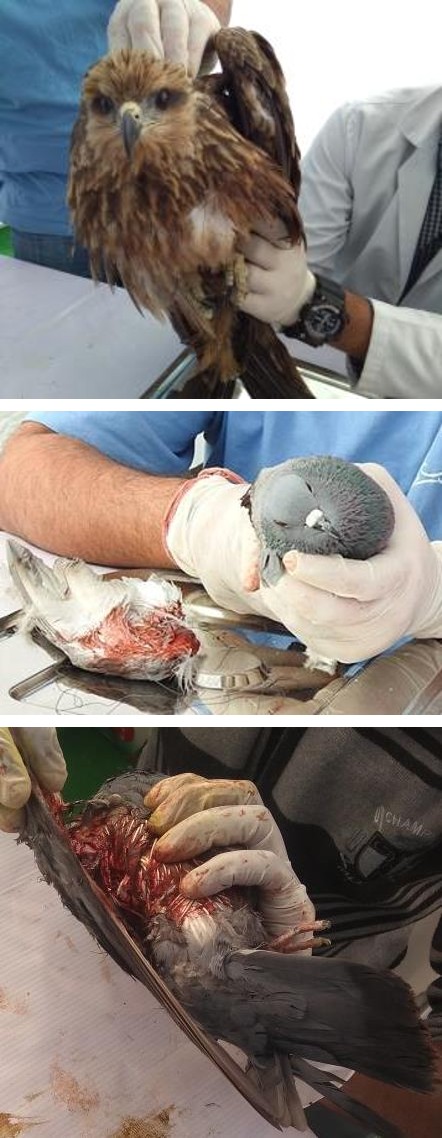
Administration of the dexamethasone in cases of the severe trauma and shock helped in recovery. Beneficial effects of corticosteroid administration are improved capillary membrane integrity, stabilization of lysosomal membranes, improved tissue perfusion and microcirculation, and gluconeogenesis. For optimum effect, water soluble drugs, such as dexamethasone (2 mg/kg) and prednisolone sodium succinate (2-4 mg/kg) should be given for the first 24-48 hours [12] Figure 1.
- Bird Treatment
- Rescued Kite
- Wing Wound in Kite
4. Cleaning of Wound 5. Wing Wound in Pigeon 6. Injured Pigeon with Amputated Wing
7. Extensive Wound at Propagation in Pigeon 8. Eye Injury during Struggle
Conclusion
Kite flying using Chinese manja is harmful to birds it may cause serious injury to the birds. In present study we found that 49 birds out of 90 affected with wing injury, among all some birds lost their capacity to flying permanently. Need to educate people for not to flying kites both, in the mornings, and evenings, when birds are most active. The compassionate solution is not to fly kites at all or shift to the simple thread without any glass and iron coatings. Always dispose the left over pieces of manja in a more careful manner so that the birds are not entangled in the manja.
References
-
Bareth N (2003) India celebrates kite flying. BBC News World Edition.
-
Prakash A (2003) Kites in India. Normad Heritage Trust, Mumbai.
-
Soumya E (2013) Kites that won’t let birds fly. Post Noon.
-
Chetan R (2011) Delhi lady calls city activists to save Lalbagh kite. Bangalore Mirror, pp: 8.
-
Chetan R (2012) It took 32 men to rescue a kite. Bangalore Mirror, pp: 8.
-
Chetan R (2013) Firemen didn’t know how to operate rescue ladder. Bangalore Mirror, pp: 5.
-
Vattam SS (2011) Chinese thread cutting birds’ lives short. Indian Express, pp: 12.
-
Tiwari DK, Dar MU, Parikh D, Patil PV, Jhala DB, et al. (2011) Incidence and management of birds injured during uttarayan festival: Report of two years. XXXVth Annual Congress of Indian Society for Veterinary Surgery. Kolkata, WB. India.
-
Kavechiya VP, Patel PB, Shashtri KB, Chaudhary DA, Barvalia DR, et al. (2012) Incidences of emergencies and their management in white-rumped vulture (Gyps bvengalensis) study on 107 cases. XXXVIth Annual Congress of Indian Society for Veterinary Surgery, Anand, Gujarat, India.
-
Bowles H, Lichtenberger M, Lennox A (2007) Emergency and critical care, of pet birds. Veterinary Clinics of North America Exotic Animal Practice 10(2): 275-712.
-
Lightfoot TL (2008) Avian emergency presentations I and II. Proceedings of the Western Veterinary Conference. Las Vegas, NV: VIN.
-
Ford SL, Jones M, Chitty J (2008) Stabilization and Supportive Care of Raptors. Raptor Medicine Master Class. Proceedings of the Association of Avian Veterinarians. Savannah, pp: 173-192.
- California Red-Legged Frog and Non-Listed Amphibians Response to Non-Native Fish Removal
- Industrial Standardization of the Bio-OS: Algorithmic Codification of Resilience Engineering Guidelines and Version V8 Architecture
- Climate Variability and the Sustainability of Snail Farming in Nigeria: Past Trends, Present Challenges and Potential Outlook
- The Evaluation of the Surveillance System of Anthrax in Gilgit-Baltistan, Pakistan, 2018
- Natural Decline to Extinction of A New Zealand Rabbit Population
- Mitochondrial Bio-Logistics: Steering Co-Enzyme Q10 and Lycopene Synergies within the Science 4.0 Bio-OS Framework