
Intestinal Bacterial Composition and Characteristics of Wintering Mandarin Duck (Aix Galericulata) in Shiqian Mandarin Duck Lake National Wetland Park, Guizhou Province
Intestinal bacteria are closely related to host's nutrition, metabolism and immunity. Therefore, understanding its composition is the basis for understanding health status of the host. In this study, using high-throughput sequencing of V3-V4 variable region of 16S rRNA, 14 fresh feces of Mandarin Ducks form Shiqian Mandarin Duck Lake National Wetland Park, Guizhou Province were examined to analyze composition and characteristics of intestinal bacteria. Results are as follows: 1107760 valid sequences and 74837 OTU are obtained by sequencing. 244 genera, 130 families, 65 orders, 40 classes and 22 phyla of bacteria are detected, among which 166 genera, 107 families, 60 orders, 40 classes and 22 phyla are identified. Firmicutes (45.72%), Proteobacteria (23.71%), Fusobacteria (14.05%) and Bacteroidetes (10.21%) are dominant phyla (93.69%). Fusobacterium (13.95%), Lactobacillus (6.74%), Pseudomonas (4.72%), Akkermansia (4.23%) and Bacteroides (3.98%) are dominant genera. Fusobacterium and Lactobacillus are common in all samples. Alpha diversity indices are significant differences in bacterial groups of samples, which might be related to daily food intake of Mandarin Ducks. However, the specific differences or influencing mechanism needed to be studied on the relationship between host's diet and intestinal bacteria. This study enriches micro ecology contents of Mandarin Duck, and has certain reference value for evaluating the survival and health conditions of Mandarin Ducks.
Introduction
Currently, a large number of studies have been conducted on the relationship between intestinal microorganisms and the host. In the early, studies focused on the composition, diversity, ecological and physiological characteristics of intestinal microorganisms for humans and mammals [1]. However, studies on intestinal microorganisms of birds are only found in economic species of artificial cultivation [2, 3]. With the wide application of high-throughput sequencing technology and the rapid development of bioinformatics analysis technology, the grand plan of intestinal micro biome research has been launched in many countries [4, 5] so that people are no longer limited to research poultry intestinal microorganisms [6], but gradually turn to wild birds intestinal microorganisms [7, 8]. Previous studies have shown that the number and abundance of intestinal microorganisms have been gradually increased from carnivores and omnivores to herbivores [9]. Therefore, mastering composition of intestinal microorganisms is the basis for studying the relationship between their functions and hosts.
Shiqian Mandarin Duck Lake National Wetland Park, Guizhou Province is located in 27 ° 24 '37 "- 27 ° 28' 35 'N, 108 ° 12' 08" 18 '- 108 ° 38' E, elevation of 468m-754m. At 8:00-9:00, 13:00-14:00 and 18:00-19:00 every day of January 31 and February 1, 2018, non-invasive sampling technology was used to collect 14 fresh feces form the wetland park. In order to ensure that all samples came from different individuals, the collection points of two adjacent samples were more than 2m apart. After observing Mandarin Duck feeding or resting on shore about 30minutes by 10x60 binoculars, we arrived at activity sites in time, using disposable sterile gloves and cotton swabs to quickly obtain about 3g fresh feces and putting them into 5ml sterile centrifuge tube containing anhydrous ethanol. At the same time, recording sample number and information (Table 1) and putting them into portable ice box in time. Then, back to the laboratory within 24h and save in ultra-low temperature freezer - 75℃.
Mandarin Duck (Aix galericulata) belongs to omnivorous birds, for our country Ⅱ class protected animals. At present, most studies on Mandarin Duck focus on macro aspects, such as reproduction and overwintering ecology [10, 11]. However, the study of intestinal microbial composition and characteristics is still blank. In addition, Mandarin Ducks are main protected objects of Shiqian Mandarin Duck Lake National Wetland Park. Therefore, the analysis of intestinal bacterial composition and characteristics of overwintering Mandarin Ducks not only has certain reference value for understanding their physiological function and health, but also has important significance for the protection of their population in Wetland Parks.
Based on this, high-throughput sequencing of bacterial 16S rRNA gene and modern molecular biological information analysis technology are used to study intestinal bacteria of wintering Mandarin Duck. The aim of the study are: (1): To understand their composition and dominant groups to enrich the content of its micro ecology research; (2): Characteristics of dominant bacteria are analyzed to provide basic data for the study of the relationship between intestinal bacteria diversity, host's dietary changes and physiological functions.
Methodology
Sampling and Sample Preservation
| Sampling time | Latitude and longitude | Foraging habitat | Sample size | Serial number | ||||||||||
|---|---|---|---|---|---|---|---|---|---|---|---|---|---|---|
| 2018.1.31 | 27°27'29.74"N,108°15'40.10"E | Artificial feeding (rice) | 2 | A1、A2 | ||||||||||
| 2018.1.31 | 27°27'45.31"N,108°15'53.39"E | Artificial feeding (rice) | 3 | B1、B2、B3 | ||||||||||
| 2018.2.01 | 27°27'05.06"N,108°16'08.03"E | Reservoir | 3 | C1、C2、C3 | ||||||||||
| 2018.2.01 | 27°25'56.53"N,108°16'11.22"E | A bank or shoal | 3 | D1、D2、D3 | ||||||||||
| 2018.2.01 | 27°24'56.49"N,108°16'14.61"E | Farmland | 3 | E1、E2、E3 |
Table 1: Collected information of 14 fresh fecal samples of overwinteringMandarin Ducks form Shiqian Mandarin Duck Table 1: Colle
Used Omega E.Z.N.A. ® Soil DNA Kit, Bacterial genome DNA were extracted, examined and quantified by 0.8% Fang ZY, et al. Intestinal Bacterial Composition and Characteristics of Wintering Mandarin Duck (Aix Galericulata) in Shiqian Mandarin Duck Lake National Wetland Park, Guizhou Province. Int J Zoo Animal Biol 2019, 2(3): 000158.
GGACTACHVGGGTWTCTAAT). Q5 high-fidelity DNA polymerase of NEB Company was used for PCR amplification of rRNA gene variable region or specific gene fragment. After 2% agarose gel electrophoresis and gelatinization of the target fragment, the products were recovered by Axygen DNA gel recovery kit [Axygen ap-gx- 50] and fluorescence quantification was performed. Fluorescence reagent is Quant-it PicoGreen dsDNA Assay Kit. a quantitative instrument is Microplate reader (BioTek, FLx800).
Illumina's TruSeq Nano DNA LT Library Prep Kit was used to prepare sequencing library. Illumina MiSeq platform was used for 2x300bp double-ended sequencing of DNA fragments. Average sequencing accuracy was more than 99%, and optimal sequencing length of target fragment was 200bp-450bp. Corresponding reagent was MiSeq Reagent Kit V3 (600 cycles).
Biological Information Processing and Analysis
QIIME (version 1.8.0) software was used to identify and eliminate the question sequence. Using FLASH (v1.2.7) software to connect and remove chimeras (overlapping base length≥10bp), no base mismatch was allowed). Using 97% similarity of non-repetitive sequences as threshold clustering OTU (Operational Taxonomic Unit), the OTUs whose abundance value was less than 0.001% of the total sample sequencing was removed. Finally, high-quality sequence and OTU are obtained.
(Release 11.1) Database and Silva (Release115) Database were selected as required, with a confidence threshold of 0.7 [13, 14, 15]. The OTU representative sequence, which couldn't be classified into a known classification unit, was clustered into "Unclassified". QIIME software was used to draw Rarefaction curve with random sampling sequence and OTUs, analyze the bacterial composition and abundance of each sample at each taxonomic level, and calculate Alpha diversity index of OTU groups (Chao1 and ACE reflect species richness in the community, while Shannon and Simpson tend to reflect species composition uniformity in the community). The similarity of bacterial community structure of different samples was analyzed by OTU clustering heat map. In this paper, according to the corresponding data, all graphs were displayed through R software to visually present results of study.
Results
Amount of Sequencing and Rarefaction Curve
The sequencing length of the target fragment was between 211bp-450bp, with an average of 380.70bp and a coverage rate of 98.87%. This indicated that the sequencing conforms to the V3-V4 region of 16S rRNA gene and the sequence length designed by primers, and the DNA quality of samples extracted in this experiment was good. Results of sequences and OTU reduction (Table 2) showed a total of 110,7760 valid sequences were obtained and exactly matched Index, and the number of valid sequences varies from 5,7899 to 10,5221. Sequence clustering obtained 7,6423 OTUs, and the OTUs of each sample varied from 2794 to 7180.
- OTU was classified and identified by Greengenes
- (Release 13.8) 16S rRNA gene [12]. Meanwhile, RDP
- Sample
- Amount of sequence
- OTUs chao1
- ACE
- Simpson
- Shannon
- A1
- 73796
- 6112
- 1456.04
- 1483.98
- 0.98
- 7.7
- A2
- 81065
- 6364
- 1402
- 1402
- 0.91
- 6.72
- B1
- 79682
- 6689
- 1710.52
- 1706.53
- 0.95
- 6.53
- B2
- 100385
- 6131
- 1451.24
- 1430.15
- 0.91
- 6.46
- B3
- 105221
- 7180
- 1735.14
- 1770.43
- 0.88
- 6.2
- C1
- 57899
- 4721
- 1118
- 1118
- 0.97
- 7.36
- C2
- 73565
- 5682
- 1390.41
- 1405.55
- 0.96
- 6.71
- C3
- 97293
- 4252
- 996.29
- 999.28
- 0.98
- 7.19
- D1
- 83487
- 4977
- 1260.53
- 1269.79
- 0.91
- 5.33
- D2
- 82868
- 2794
- 711.18
- 720.69
- 0.58
- 2.7
- D3
- 72958
- 6037
- 1321.21
- 1326.38
- 0.86
- 5.68
- E1
- 70254
- 5784
- 1383.33
- 1402.05
- 0.96
- 7.3
- E2
- 61142
- 4676
- 1121
- 1121
- 0.93
- 6.46
- E3
- 68145
- 5024
- 1207.02
- 1208.25
- 0.98
- 7.39
Table 2: Sequences, OTUs and bacteria diversity indices of 14 fresh fecal samples from overwintering Mandarin Ducks.
Fang ZY, et al. Intestinal Bacterial Composition and Characteristics of Wintering Mandarin Duck (Aix Galericulata) in Shiqian Mandarin Duck Lake National Wetland Park, Guizhou Province. Int J Zoo Animal Biol 2019, 2(3): 000158.
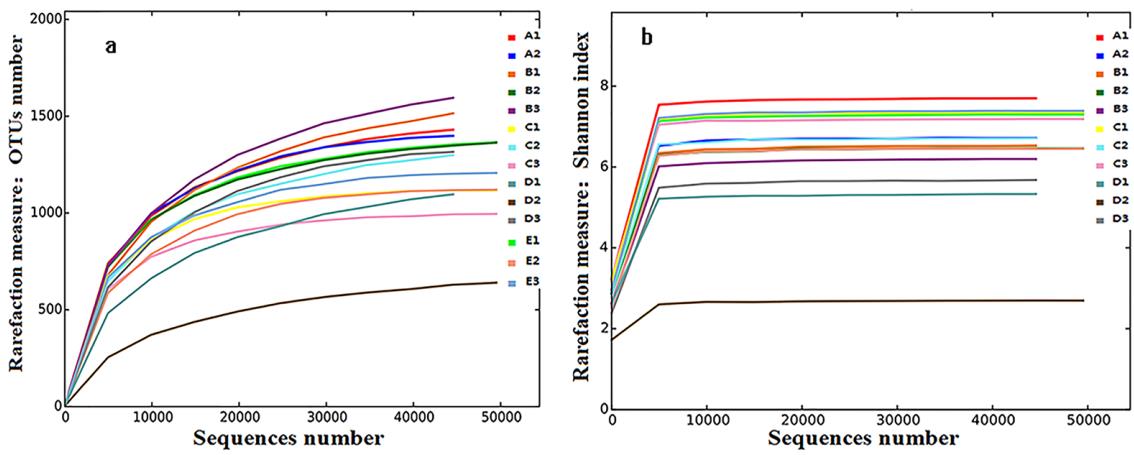
The Rarefaction Curves of sequences and OTUs (Figure 1a) showed that all curves began to flatten when sequences were about 10000, and the new OTUs generated by increasing the sequencing quantity were very few. This indicated that the sequence sufficiently reflected biodiversity of all samples. Meanwhile, by drawing OTUs' Shannon index sparsity curve (Figure 2), we also found that the sequencing quantity appeared inflection point around 5000, and Shannon indices covered 97.42% of all OTU diversities, and then the curves tended to be flat. This also showed that the number of sequencing strips has covered the vast majority of microorganisms in the sample, fully demonstrating their diversity and ensuring the reliability of subsequent analysis.
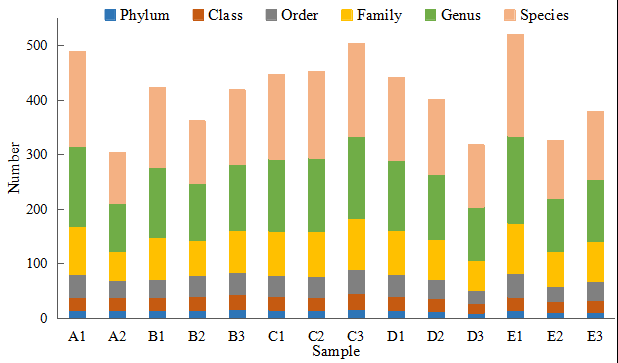
After the OTU abundance matrix of samples was uniformly resampled at the minimum sequencing depth of 90%, the bacterial diversity index of each sample was calculated (Table 2). We found that four Alpha diversity Indies of D2 sample were the lowest, chao1 and ACE of B3 sample were the highest, and the Simpson and Shannon of A1 sample were the highest. Such results indicated that D2 sample had the least diverse bacterial species and the largest number difference of each classification level, B3 sample had the most abundant bacterial species, A1 sample had the most abundant and the most uniform at each classification level. The OTU identification results of 14 samples (Figure 2) showed that 282 bacteria were detected, belonging to 22 phyla, 40 classes, 65 orders, 130 families and 244 genera. Among them, through the current database, 22 phyla, 40 classes, 60 orders, 107 families, 166 genera and 64 species can be identified. Therefore, bacteria below class classification level couldn't be completely identified, and their identification rates were 92.31%, 82.31%, 68.03% and 22.70% respectively.
Fang ZY, et al. Intestinal Bacterial Composition and Characteristics of Wintering Mandarin Duck (Aix Galericulata) in Shiqian Mandarin Duck Lake National Wetland Park, Guizhou Province. Int J Zoo Animal Biol 2019, 2(3): 000158.
The analysis of bacterial Phylum classification level.
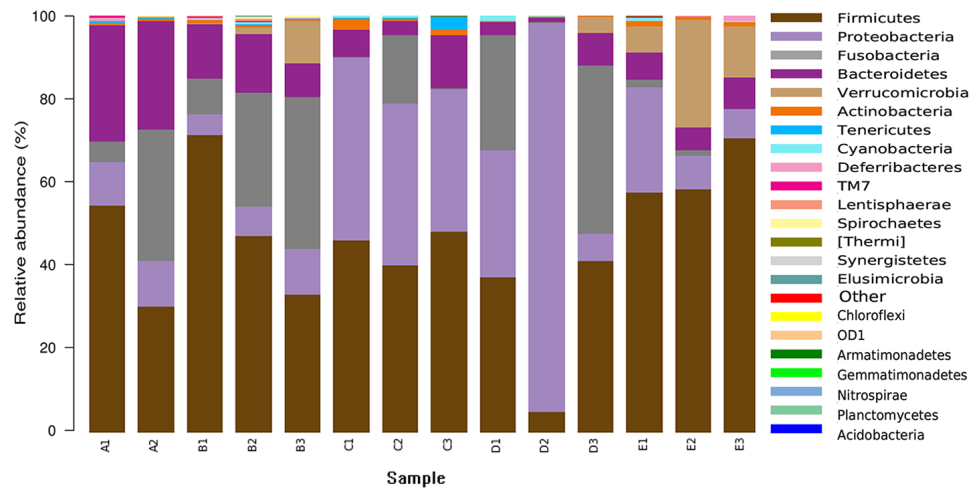
According to the figure of 22 phyla composition and abundance of bacteria (Figure 4), the average relative abundance of Firmicutes is the highest (45.72%), followed by Proteobacteria (23.71%), Fusobacteria (14.05%) and Bacteroidetes (10.21%). In addition, the average relative abundance of Verrucomicrobia (4.34%) is also high. The abundance of the remaining bacteria was only 1.97 percent.
According to the composition and abundance of 22 bacterial phyla (Figure 3), the average relative abundance of Firmicutes is the highest (45.72%), followed by Proteobacteria (23.71%), Fusobacteria (14.05%) and Bacteroidetes (10.21%). In addition, the average relative abundance of Verrucomicrobia (4.34%) is also high. However, the abundance value of other phyla only accounted for 1.97%. Seven common bacterial phyla are identified in 14 samples, including Firmicutes, Proteobacteria, Fusobacteria, Bacteroidetes, Actinobacteria, Tenericutes and Verrucomicrobia, accounting for 99.18% of the total sequences. Among them, Firmicutes and Proteobacteria are common dominant bacteria of all samples.
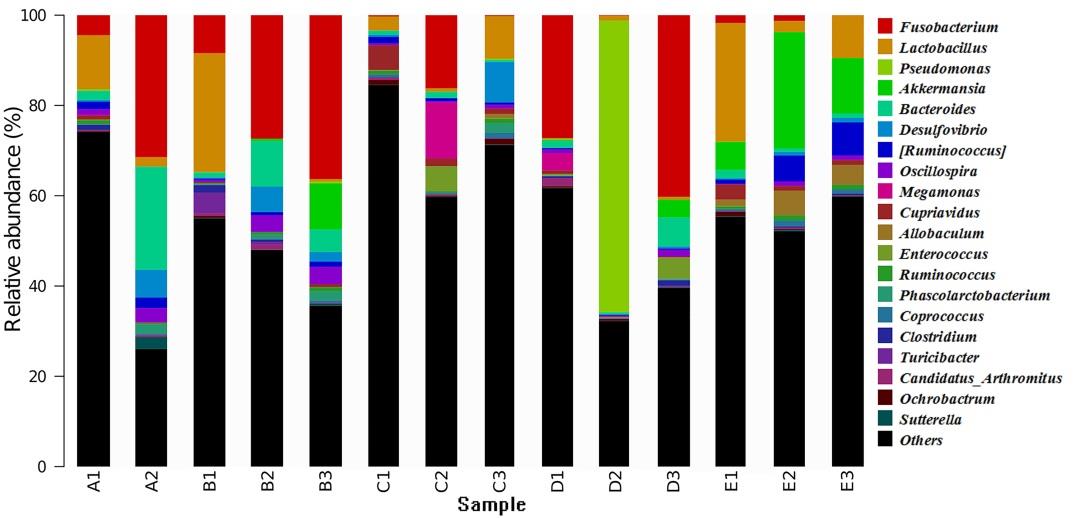
(Note: “other” means 146 known genera and 78 unclassified genera) Figure 4: Relative abundance of the first 20 bacterial genera and other bacterial genera of 14 fresh fecal samples from overwintering Mandarin Ducks.
Fang ZY, et al. Intestinal Bacterial Composition and Characteristics of Wintering Mandarin Duck (Aix Galericulata) in Shiqian Mandarin Duck Lake National Wetland Park, Guizhou Province. Int J Zoo Animal Biol 2019, 2(3): 000158.
The Analysis of Bacterial Genera Classification Level
According to OTUs clustering heat map of the top 50 bacterial genera (excluding unclassified genera) (Figure 5), we found B2, A2, and B3 are grouped into a group, among them, Sphaerochaeta, Barnesiella, Sutterella and Anearobiospirillum have higher absolute abundance. E2 and E3 were clustered together, and Mucispirillum and Akkermancia are dominant in the group. C2, D2, D1, and D3 have high similarity and were gathered, among them, Megamonas and Pseudomonas are dominant. A1 and B1 were together, among them, Bacillus and Turicibacter are the most main ones. C3, C1, and E1 are grouped, Streptococcus, Blautia, Paraprevotella, Aerococcus and Corynebacterium of which are dominant.
According to the relative abundance of the first 20 genera in 14 samples (Figure 5), we know that the average relative abundance of Fusobacterium (13.95%) is the highest, followed by Lactobacillus (_6.74%), _Pseudomonas (_4.72%), _Akkermansia (_4.23%) and _Bacteroides (3.98%). In all samples, 43 common genera of bacteria were detected, among which Fusobacterium and Lactobacillus of which were common dominant genera.
Cluster Analysis of Major Bacterial Genera
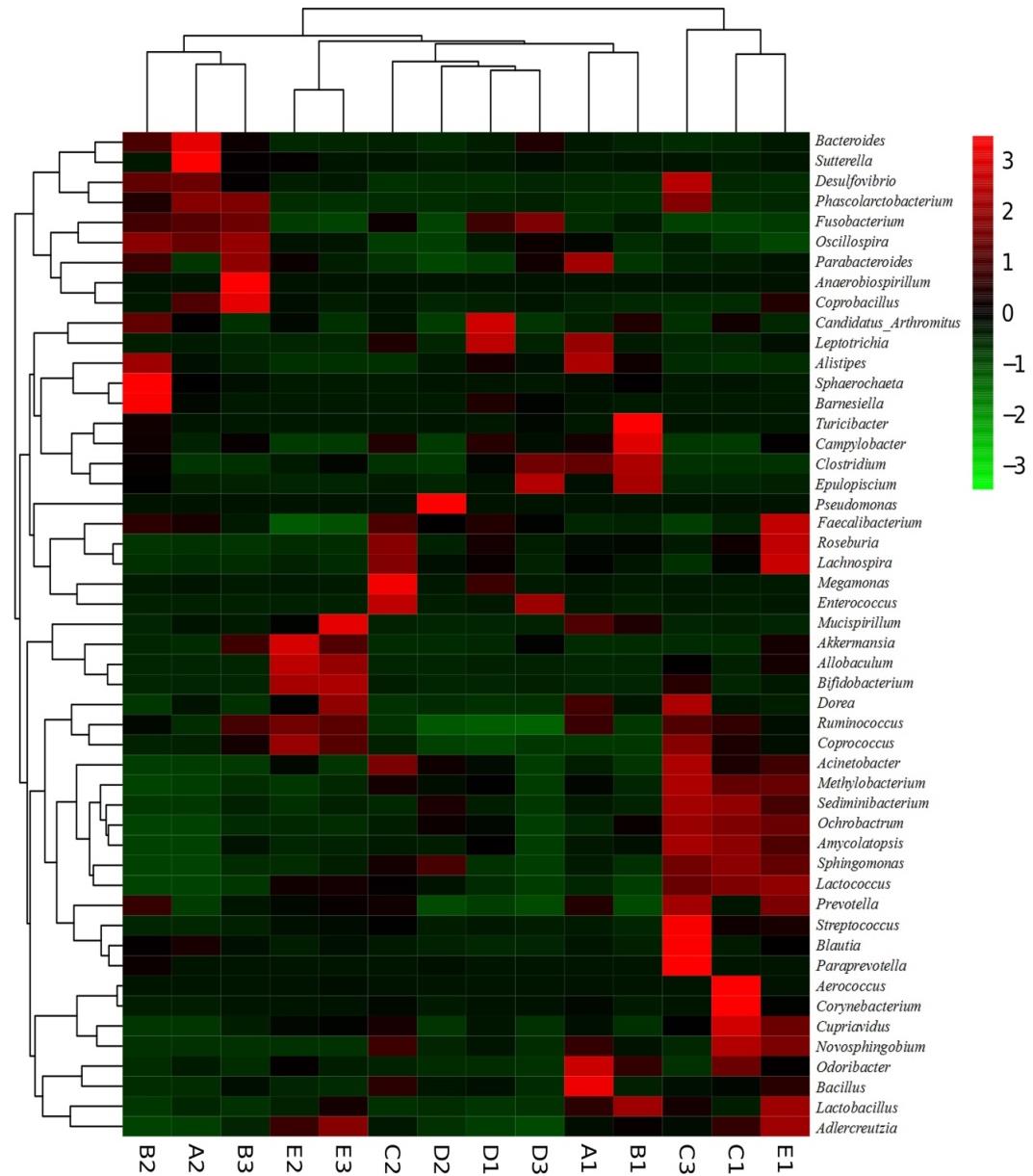
Fang ZY, et al. Intestinal Bacterial Composition and Characteristics of Wintering Mandarin Duck (Aix Galericulata) in Shiqian Mandarin Duck Lake National Wetland Park, Guizhou Province. Int J Zoo Animal Biol 2019, 2(3): 000158.
Discussion and Conclusions
Detected OTUs were not fully identified, and identification rate at Species level was only 22.34%. This was due to the limited selection of bacterial identification database, which limited the amount of biological information of sequences to some extent. It might also be that a few novel or unknown microorganisms that coexist with the gut of Mandarin Ducks. The V3-V4 variable region of 16S rRNA gene obtained sequence fragments within 500bp, which is far less than complete length of bacteria 16S rRNA gene. Moreover, most of sequences could only be identified at genus level (the identification rate of bacteria genus was 68.03%). Therefore, in future studies, sequencing depth of target fragment should be increased to obtain more biological information.
Firmicutes, Proteobacteria, Fusobacteria and Bacteroidetes are play leading roles (93.69%) in intestinal bacteria composition of Mandarin Ducks. This is consistent with the dominant bacteria of 75 intestinal bacterial phyla being identified by humans [16]. They are ubiquitous and predominant in intestinal tract of humans and animals, which is related to their metabolic function. Under the condition of long-term evolution and symbiosis with the host, a relatively stable symbiosis mechanism is formed, which then dominates composition and structure of the host intestinal bacteria.
Firmicutes is ubiquitous and species-rich in the intestinal tract of vertebrates, which could involve in carbohydrate metabolism and nutrient absorption widely ,has the most abundance in intestinal bacteria of Mandarin Ducks, among them, Lactobacillus is the most dominant. In Lactobacillus, many bacteria are probiotics that could coexist with their hosts. They have the function of enhancing the antibody-mediated immune response and inducing intestinal T cells to express cytokines [17, 18]. Therefore, Lactobacillus could decompose sugars in food timely to provide energy for wintering Mandarin Ducks to survive, and also play a important role in maintaining the stability of the intestinal environment.
As the second dominant bacteria phylum of Mandarin Ducks, Proteobacteria is also the most diverse type in all bacteria, which had a variety of physiological functions, among them a small part is probiotics, which could obtain a large amount of carbon sources in food [19]. Pseudomonas is the most dominant in Proteobacteria, probably to better adapt to or cope with the complex feeding characteristics of Mandarin Ducks. Because, Mandarin Ducks still eat very complex foods in overwintering, ranging from high-protein meat, a variety of insects, aquatic plants to terrestrial plants [20]. However, many bacteria groups of Proteobacteria could regulate metabolism flexibly and tolerate different nutritional levels of foods [21], and some also had the function of degrading plant cellulose [22]. Therefore, compared with other bacteria kinds, they are more competitive or have strong broad-spectrum properties and coexist with other bacteria, and enriched in the intestinal tract of Mandarin Ducks.
Fusobacteria is associated with host nutrient absorption and synthesis of short-chain fatty acids [23], but many of them are pathogenic bacteria [24]. Studies have shown that various bacteria of Fusobacterium had pathogenic to humans and animals [25]. In this study, only Fusobacterium is found in Mandarin Ducks intestinal Fusobacterium, and its abundance is the highest, accounting for 13.95% of the total bacterial genera. Although no obvious health problems were found in Mandarin Ducks during years of observation and sampling by the reserve administrators, some pathogenic bacteria of Fusobacterium also might be latent in the intestinal tract of Mandarin Ducks or inhibited or lost under coexistence with other bacteria.
Bacteroidetes is able to involve in metabolism of steroids and bile acids, degradation polysaccharides and fermentation carbohydrates, etc [26]. Among them, Bacteroides is the most dominant, which were able to participate in metabolism of plant fiber and polysaccharide [27], and help Mandarin Ducks obtain nutrients in food. However, when the normal micro- ecological balance was broken, they also caused endogenous infection [28]. Results of intestinal bacterial composition of Mandarin Duck verified the conclusion that dominant intestinal bacteria of Anseriformes birds were very similar to that of other birds in phylum level, and intestinal bacteria of most birds were mainly concentrated in Firmicutes, Proteobacteria, Fusobacteria, Bacteroidetes, Actinobacteria and Tenericutes, such as Anseriformes and Sphenisciformes, Galliformes, Gruiformes [7, 29, 30, 31].
Compared with Anser, Proteobacteria (23.71%) and Cyanobacteria (0.30%) in intestines of wintering Mandarin Ducks are much lower than that of Anser indicus (64.69% and 8.48%) [32], while Fusobacteria (14.05%) is much higher (that of Anser indicus 0.56%) [33]. This apparent abundance difference is largely due to different genetic factors (host itself) and host's diet [34]. Richness and evenness of intestinal bacteria of Mandarin Ducks is Fang ZY, et al. Intestinal Bacterial Composition and Characteristics of Wintering Mandarin Duck (Aix Galericulata) in Shiqian Mandarin Duck Lake National Wetland Park, Guizhou Province. Int J Zoo Animal Biol 2019, 2(3): 000158.
significant differences form different samples, which is probably influenced by changes in food resources.
The relative abundance of Proteobacteria (9.18%) in artificial feeding sites is much lower than that in other foraging habitats (including reservoirs, shoals and farmland) (average 31.96%). Moreover, the bacterial groups of the feeding point samples were clustered into a separate group, while the bacteria of the non-feeding point samples were clustered into three groups. Such results were likely to be caused by food resources changes in different foraging habitats, because, intestinal microorganisms were highly sensitive to food changes or feeding types of the host [35]. However, specific differences or effects need to be further studied on the relationship between diet and intestinal bacteria of Mandarin Ducks. Foundation project: Natural Science Foundation Project of Guizhou province (Guizhou Forestry Science and Technology Cooperation No. 11 [2017] ); National Natural Science Foundation of China (No. 31801990); Guizhou Science and Technology Cooperation Platform Talent Project (No. 5781 [2018]); School-county Cooperative Project.
References
-
Smriga S, Sandin SA, Azam F (2010) Abundance,diversity,and activityof microbial assemblages associated with coral reefish guts and feces. FEMS Microbiol Ecol 73(1): 31-42.
-
Kohl KD (2012) Diversity and function of the avian gut microbiota. J Comp Physiol B 182(5): 591-602.
-
Pan D, Yu Z (2014) Intestinal microbiome of poultry and its interaction with host and diet. Gut Microbes 5(1):108-119.
-
Pylro VS, Mui TS, Rodrigues JL, Andreote FD, Roesch LFW, et al. (2016) A step forward to empower global microbiome research through local leadership. Trends in Microbiology 24(10): 767-771.
-
Stulberg E, Fravel D, Proctor LM, Murray DM, LoTempio J, et al. (2016) An assessment of US microbiome research. Nature Microbiology 1: 15015.
-
Ding JM, Zhao LL, Wang LF, Zhao W, Zhai Z, et al. (2016) Divergent selection-induced obesity alters the composition and functional pathways of chicken gut microbiota. Genetics Selection Evolution Gse 48(1): 93.
-
Zhao GH, Zhou LZ, Dong YQ, Cheng Y, Song Y (2017) The gut microbiome of hooded cranes (Grus monacha) wintering at Shengjin Lake,China. Microbiologyopen 6(3): 447.
-
Zhou LZ (2018) Avian gut microecology and its research hot spot. Journal of Anhui University (Natural Science Edition) 42: 14-21.
-
Ley RE, Hamady M, Lozupone C, Turnbaugh PJ, Ramey RR, et al. (2008) Evolution of mammals and their gut microbes. Science 320(5883): 1647-1651.
-
Gong Z (2016) Reproductive tactics of conspecifc brood parasitism in Mandarin Duck Aix galericulata. Changchun: Northeast normal university.
-
You YY, Lu YP, Cao YN (2017) Mandarin Ducks nest site selection and influence on the reproductive parameter in the city park. Journal of Northeast Normal Univcrsity (Natural Scicnce Edition) 49: 109- 113.
-
DeSantis TZ, Hugenholtz P, Larsen N, Rojas M, Brodie EL, et al. (2006) Greengenes,a chimera-checked 16S rRNA gene database and workbench compatible with ARB. Appl Environ Microbiol 72: 5069-5072.
-
Cole JR, Wang Q, Cardenas E (2009) The Ribosomal Database Project:improved alignments and new tools for rRNA analysis. Nucleic Acids Res 37: 141-145.
-
Quast C, Pruesse E, Yilmaz P, Gerken J, Schweer T, et al. (2013) The SILVA ribosomal RNA gene database project:improved data processing and web-based tools. Nucleic Acids Res 41: 590-596.
-
Wand Q, Garrity GM, Tiedje JM, Cole JR (2007) Naive Bayessian classifier for rapid assignment of rRNA sequences into the new bacterial taxonomy. Appl Environ Microb 73(16): 5261-5267.
-
Kevin KD (2012) Diversity and function of the avian gut microbiota. Journal of Comparative Physiology B 182: 591-602.
-
Haghighi HR, Gong J, Gyles CL, Hayes MA, Sanei B, et al. (2005) Modulation of antibody-mediated immune response by probiotics in chickens. Clinical & Fang ZY, et al. Intestinal Bacterial Composition and Characteristics of Wintering Mandarin Duck (Aix Galericulata) in Shiqian Mandarin Duck Lake National Wetland Park, Guizhou Province. Int J Zoo Animal Biol 2019, 2(3): 000158. Diagnostic Laboratory Immunology 12(12): 1387- 1392.
-
Brisbin JT, Gong J, Orouji S, Esufali J, Mallick AI, et al. (2011) Oral Treatment of Chickens with Lactobacilli Influences Elicitation of Immune Responses. Clinical and Vaccine Immunology 18(9): 1447-1455.
-
Samanta AK, Torok VA, Percy NJ (2012) Microbial fingerprinting detects unique bacterial communities in the feacal microbiota of rats with experimentally- induced colitis. Journal of Microbiology 50(2): 218- 225.
-
Zhong FS, Chen DP (1992) Ecological observation of Mandarin Ducks in winter. Chinese Journal of Zoology 27:27-28
-
Berg M, Stenuit B, Ho J, Wang A, Parke C, et al. (2016) Assembly of the Caenor-habditis elegans gut microbiota from diverse soil microbial environments. The ISME Journal 10: 1998-2009.
-
Reid NM, Addison SL, Macdonald LJ, Lloyd-Jones G (2011). Biodiversity of Active and Inactive Bacteria in the Gut Flora of Wood-Feeding Huhu Beetle Larvae (_Prionoplus reticularis_). Applied and Environmental Microbiology 77: 7000-7006.
-
Pryde SE, Duncan SH, Hold GL, Stewart CS, Flint HJ, et al. (2002) The microbiology of butyrate formation in the human colon. FEMS Microbiology Letters 217(2): 133-139.
-
Zhang PW, Yang CW, Ji SN (2016) Gut microbiota and related diseases. World Chinese Journal of Digestology 24: 2355-2360.
-
Hsieh FC, Lee CL, Chai CY, Chen WT, Lu YC, et al. (2013) Oral administration of Lactobacillus, reuteri GMNL-263 improves insulin resistance and ameliorates hepatic steatosis in high fructose-fed rats. Nutrition & Metabolism 10(1): 35-49.
-
Dumas ME, Barton RH, Toye A, Cloarec O, Blancher C, et al. (2006) Metabolic profiling reveals a contribution of gut microbiota to fatty liver phenotype in insulin-resistant mice. Proc Natl Acad Sci USA 103(33): 12511-12516.
-
Turnbaugh PJ, Ridaura VK, Faith JJ, Rey FE, Knight R , et al. (2009) The Effect of Diet on the Human Gut Microbiome:A Metagenomic Analysis in Humanized Gnotobiotic Mice. Science Translational Medicine 1(6): 6-14.
-
Filippo DC, Cavalieri D, Di Paola M, Ramazzotti M, Poullet JB, et al. (2010) Impact of diet in shaping gut microbiota revealed by a comparative study in children from Europe and rural Africa. Proceedings of the National Academy of Sciences of the United States of America 107(33): 14691-14696.
-
Wang W, Cao J, Yang F, Wang X, Zheng S, et al. (2016) High-throughput sequencing reveals the core gut microbiome of Bar-headed goose (Anser indicus) in different wintering areas in Tibet. MicrobiologyOpen 5(2): 287-295.
-
Banks JC, Cary SC, Hogg ID (2010) The phylogeography of Adelie penguin faecal flora. Environmental Microbiology 11(3): 577-588.
-
Shen JB, Zhang XJ, Wu W (2016) The Gut Microbes’ Diversity and Function of Phasianidae Provide Insights on the Adaptation to Their Diet. Journal of NanJing Normal University (Natural Science Edition) 39: 90-95.
-
Yang Y, Deng Y, CAO L (2016) Characterising the interspecific variations and convergence of gut microbiota in Anscriformes herbivores at wintering areas. Scientific Reports 6: 32655.
-
Zheng SS, Wang W, Wang AZ (2018) Comparative Analysis of the Cloacal Microbiome of both Adult and Chick Bar-Headed Geese (Anser indicus). Chinese Journal of Zoology 53: 641-651.
-
Mikaelyan A, Dietrich C, Köhler T, Poulsen M, Sillam- Dussès D, et al. (2015) Diet is the primary determinant of bacterial community structure in the guts of higher termites. Molecular Ecology 24(20): 5284-5295.
-
David LA, Maurice CF, Carmody RN, Gootenberg DB2, Button JE, et al. (2014) Diet rapidly and reproducibly alters the human gut microbiome. Nature 505(7484): 559-563. Fang ZY, et al. Intestinal Bacterial Composition and Characteristics of Wintering Mandarin Duck (Aix Galericulata) in Shiqian Mandarin Duck Lake National Wetland Park, Guizhou Province. Int J Zoo Animal Biol 2019, 2(3): 000158.
- California Red-Legged Frog and Non-Listed Amphibians Response to Non-Native Fish Removal
- Industrial Standardization of the Bio-OS: Algorithmic Codification of Resilience Engineering Guidelines and Version V8 Architecture
- Climate Variability and the Sustainability of Snail Farming in Nigeria: Past Trends, Present Challenges and Potential Outlook
- The Evaluation of the Surveillance System of Anthrax in Gilgit-Baltistan, Pakistan, 2018
- Natural Decline to Extinction of A New Zealand Rabbit Population
- Mitochondrial Bio-Logistics: Steering Co-Enzyme Q10 and Lycopene Synergies within the Science 4.0 Bio-OS Framework