
New Data on the Distribution and Conservation Status of the Two Endemic Scrapers in the Turkish Mediterranean Sea Drainages (Teleostei: Cyprinidae)
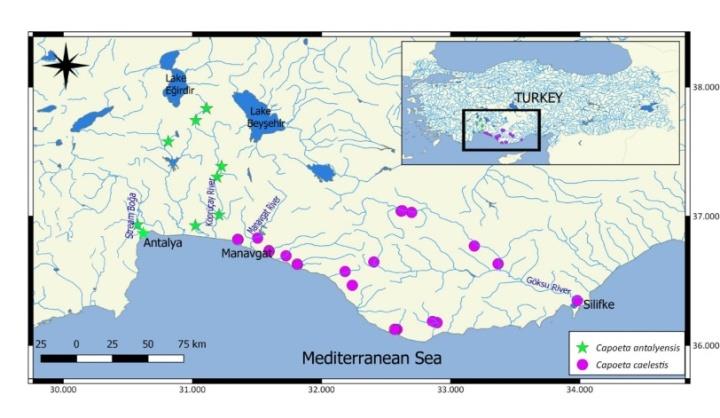
In the scope of this study, exact distribution of the two endemic Capoeta species in the Turkish Mediterranean Sea drainages was presented. Fishes were caught with pulsed DC electro-fishing equipment from 28 sampling sites throughout Turkish Mediterranean Sea drainages between Göksu River and stream Boğa. The findings of the study demonstrate that Capoeta antalyensis inhabits in Köprüçay and Aksu rivers, and streams Boğa and Gündoğdu, all around Antalya. Capoeta caelestis widely distributed in coastal stream and rivers between Stream Dim (Alanya) in the west and Göksu River (Silifke) in the east. Metric and meristic characters were collected from the fish samples which obtained in the field for Capoeta caelestis and Capoeta antalyensis, and museum material for Capoeta damascina. In this way, morphologic features of the species revealed and Capoeta caelestis compared with Capoeta damascina to remove the hesitations about the validity of the species. The conservation status of Capoeta antalyensis was recommended to uplist from Vulnerable to Endangered.
Introduction
Capoeta is one of the most widespread genus in Anatolia. The diversity in the genus in Turkey has been studied intensively in the last 15 years by the both molecular and taxonomic studies [1, 2, 3, 4, 5, 6, 7, 8, 9, 10, 11, 12, 13, 14, 15]. Among these studies, Turan [5] examined mitochondrial 16S rDNA New Data on the Distribution and Conservation Status of the Two Endemic Scrapers in the Turkish Mediterranean Sea Drainages (Teleostei: Cyprinidae) gene sequences in order to reassess the taxonomic status of Capoeta species in Anatolia. According to his findings; C. antalyensis, C. barroisi, C. damascina, C. pestai, C. tinca and C. trutta are valid species, as well as there are four subspecies of C. capoeta (C. c. angorae, C. c. bergamae, C. c. capoeta and C. c. sieboldii). Turan [5] also suggested that Göksu River and Dalaman Stream populations are belong Int J Zoo Animal Biol
to two new species that have not yet been named. Subsequently, Schöter, et al. [7] identified Göksu River populations as C. caelestis. Recently, Dalaman River populations have been identified as C. aydinensis with populations inhabit in Tersakan, Namnam and Büyük Menderes River [4]. Alwan [15] and Alwan, et al. [16] conclusively demonstrated that C. angorae from the Seyhan and Ceyhan is a synonym of C. damascina, this view also supported by following molecular and taxonomic studies [4, 9, 11, 12, 13, 17].
Küçük & Güçlü [18] reported C. antalyensis between Peri Village (near Gündoğdu-Manavgat, Antalya) and stream Boğa (almost the westernmost side of the Antalya city).
According to the studies mentioned above, Capoeta antalyensis is known from stream and rivers around Antalya, and C. caelestis is known from Göksu River (near Silifke, Mersin) where it was described first and some coastal streams between Antalya and Göksu River. Here, we checked streams and rivers draining to Turkish Mediterranean Sea to determine the exact distribution range of the both species.
On the other hand, Özdemir [10] reported that Capoeta caelestis is taxonomically close to C. damascina and there is confusion in the taxonomic situation of this species. Her claim triggered us to evaluate the taxonomic validity of C. caelestis and compare it with C. damascina.
Catalog number Sampling sites Coordinates N Sampling date Capoeta caelestis
03-0018 Göksu River at Yelmez 37.039444, 32.616111 4 10.10.2004 03-0084 Göksu River at Hamamköy- 36.631389, 33.367778 12 26.06.2012 03-0020 Göksu River at near Dülgerler 37.029167, 32.697778 57 10.10.2004 03-0046 Steam Gevne at Çayarası 36.645833, 32.405000 5 18.10.2009 03-0003 Manavgat River at 7 km northeast Manavgat 36.830556, 31.504167 N 14.10.1995 03-0006 Stream Karpuz at Hacıobası 36.728889, 31.593333 9 25.05.1995 03-0028 Stream Alara at Çakallar 36.693611, 31.724444 4 13.10.1995 03-0047 Stream Ilıca -at Ilıca 36.818611, 31.353056 2 02.05.2009 03-0044 Stream Dragon (Anamur)-at Alaköprü 36.175833, 32.895000 13 17.06.2008 03-0045 Stream Karpuz at Hacıobası 36.728889, 31.593333 2 18.10.2009 03-0048 Stream Kaledran at Anıtlı 36.123333, 32.584444 4 17.06.2008 03-0114 Stream Kargı at northern Türkler 36.624940, 31.813196 5 18.06.2008 03-0120 Stream Kargı at northern Türkler 36.624940, 31.813196 4 15.10.1995 IFC-ESUF
1962 Stream Güneybahşiş at Güneybahşiş 36.185000, 32.859000 27 24.03.2019 1964 Stream Sapadere at north of Beyreli 36.465007, 32.237990 7 25.03.2019 1965 Kaledran Çayı western Anıtlı 36.122000, 32.570000 6 26.03.2019 1966 Göksu River at 5 km southeast Silifke 36.346611, 33.980613 10 24.03.2019 FFR
Material and Methods
Fishes were caught with pulsed DC electro-fishing equipment from 28 sampling sites throughout Turkish Mediterranean Sea drainages between Göksu River and stream Boğa (Figure 1 & Table 1). After anastesia, fish samples were fixed in 4% formalin and transferred to the laboratory for classify at species level. Measurements were made using a dial calliper (0.1 mm). All measurements were made point-to point, never by projections. Meristic counts and measurements follow Kottelat & Freyhof [19] and Kaya [14]. The map (Figure 1) was created using the Qgis v. 2.6.1-Brighton software available at http://divagis.org.
| 1967 | Stream Dim at west of Üzümlü | 36.572002, 32.182004 | 8 | 25.03.2019 | |
|---|---|---|---|---|---|
| 1922 | Göksu River at Yağcı | 37.042117, 32.625608 | 8 | 10.10.2004 | |
| 1943 | Göksu River at Göksu | 36.769517, 33.183086 | 14 | 10.11.2016 | |
| Capoeta antalyensis | |||||
| IFC-ESUF | 03-0007 | Köprüçay River | 37.741944, 31.025556 | 13 | 15.10.2003 |
| IFC-ESUF | 03-0008 | Köprüçay at west of Sağırin | 37.010278, 31.205556 | 6 | 18.05.1996 |
| IFC-ESUF | 03-0009 | Köprüçay, at Başpınar | 37.833056, 31.108889 | 6 | 15.05.1996 |
| IFC-ESUF | 03-0010 | Kayaburnu bridge at Kayaburnu | 36.926881, 31.022211 | 2 | 31.05.1998 |
| IFC-ESUF | 03-0011 | Köprüçay River at Çaltepe, | 37.302222, 31.190833 | 4 | 15.09.1996 |
| IFC-ESUF | 03-0029 | Köprüçay River at Başpınar | 37.833056, 31.108889 | 9 | 15.10.2003 |
| IFC-ESUF | 03-0030 | Stream Boğa at Antalya | 36.865556, 30.618611 | 1 | 09.05.2004 |
| IFC-ESUF | 03-0031 | Stream Kovada (Aksu) at southwest of Aşağıgökdere | 37.576785, 30.812212 | 23 | 20.08.2014 |
| IFC-ESUF | 03-0040 | Köprüçay River at Değirmenözü | 37.385556, 31.225278 | 1 | 19.06.2008 |
| IFC-ESUF | 03-0113 | Stream Karaman at northwest of Antalya | 36.933889, 30.574167 | 4 | 22.05.2010 |
Table 1: Sampling sites in the studied area.
Comparative Material
Capoeta damascina: FFR 01887, 15, 102-230 mm SL; Gaziantep, Islahiye; Orontes River, stream Karasu, 07.06.2014, 36.853, 36.687. FFR 01881, 25, 74-187 mm SL; Hatay, Serinyol; Orontes River, stream Serinyol,
07.06.2014, 36.365, 36.214.
Results
Metric and meristic characters of Capoeta antalyensis, C. caelestis and C. damascina were given in Tables 2&3.
| C. antalyensis, n=18 | C. caelestis, n=20 | C. damascina, n=10 | |||||||
|---|---|---|---|---|---|---|---|---|---|
| range | mean | SD | range | mean | SD | range | mean | SD | |
| Standard length (mm) | 115-199 | 146.1 | 28.8 | 113-177 | 130.7 | 15.4 | 148-208 | 171.8 | 22 |
| %Standard length | |||||||||
| Head length | 23.5-24.8 | 24.1 | 0.5 | 23.5-26.2 | 24.9 | 0.7 | 21.8-24.0 | 23.1 | 0.7 |
| Body depth at dorsal-fin origin | 23.0-25.4 | 24.1 | 0.6 | 23.3-27.1 | 24.9 | 1 | 23.8-26.7 | 25.2 | 0.9 |
| Body depth at anal-fin origin | 17.0-18.7 | 17.7 | 0.6 | 16.8-18.2 | 17.5 | 0.4 | 16.1-17.3 | 16.6 | 0.4 |
| Depth of caudal peduncle | 11.1-12.2 | 11.5 | 0.3 | 10.4-12.2 | 11.2 | 0.5 | 10.7-11.7 | 11.2 | 0.4 |
| Length of caudal peduncle | 17.0-19.0 | 18 | 0.6 | 16.0-19.2 | 17.9 | 0.9 | 17.5-19.1 | 18.5 | 0.6 |
| Head width at interorbital region | 11.9-13.1 | 12.6 | 0.4 | 11.8-13.8 | 13.2 | 0.5 | 11.3-13.3 | 12.5 | 0.7 |
| Head width at nape | 14.7-16.1 | 15.3 | 0.5 | 13.7-17.0 | 15.9 | 0.7 | 13.9-16. | 15.3 | 0.7 |
| Head depth at interorbital region | 12.4-13.7 | 13.1 | 0.4 | 12.6-14.0 | 13.2 | 0.4 | 10.9-13.0 | 12.3 | 0.7 |
| Head depth at nape | 16.3-17.8 | 17.1 | 0.4 | 16.7-18.6 | 17.5 | 0.5 | 15.1-17.0 | 16.5 | 0.6 |
| Snout width | 9.4-10.6 | 10 | 0.4 | 9.7-11.2 | 10.5 | 0.4 | 8.3-10.2 | 9.7 | 0.7 |
| Snout depth | 8.4-9.7 | 9.2 | 0.4 | 8.9-10.2 | 9.5 | 0.4 | 8.1-9.5 | 9 | 0.5 |
| Eye diameter | 3.7-5.2 | 4.5 | 0.4 | 3.7-5.6 | 5 | 0.5 | 3.4-4.4 | 4 | 0.4 |
| Snout length | 9.0-9.8 | 9.4 | 0.3 | 9.4-10.2 | 9.8 | 0.2 | 8.6-9.5 | 9 | 0.3 |
| Postorbital distance | 10.8-12.1 | 11.3 | 0.4 | 10.4-12.4 | 11.2 | 0.5 | 10.5-11.7 | 11.1 | 0.5 |
| Interorbital width | 8.6-9.9 | 9.2 | 0.4 | 8.8-10.1 | 9.5 | 0.4 | 9.1-10.5 | 9.8 | 0.5 |
| Width of mouth gape | 6.7-9.0 | 7.9 | 0.7 | 7.3-9.7 | 8.6 | 0.7 | 5.5-8.1 | 7 | 1 |
| Length of maxillary barbel | 2.4-4.4 | 3.6 | 0.5 | 4.0-5.7 | 4.9 | 0.5 | 2.9-3.7 | 3.3 | 0.3 |
| Predorsal length | 49.7-52.4 | 51.4 | 0.9 | 51.4-54.8 | 53 | 1 | 48.9-51. | 50.2 | 0.8 |
| Prepelvic length | 54.0-57.0 | 55.2 | 0.8 | 52.2-56.3 | 54.4 | 1.2 | 51.0-54.1 | 52.7 | 0.9 |
| Postdorsal length | 35.4-39.8 | 37.5 | 1.3 | 34.0-40.2 | 37 | 1.9 | 37.8-41.5 | 39.7 | 1.3 |
| Preanal length | 75.7-80.1 | 77.7 | 1.4 | 74.4-78.4 | 76.5 | 1.2 | 74.7-76. | 75.8 | 0.7 |
| Distance between pectoral and anal fins | 54.4-59.2 | 56.8 | 1.6 | 51.8-58.0 | 54.5 | 1.4 | 52.2-57.8 | 55.5 | 1.9 |
| Distance between pectoral and pelvic fins | 32.3-36.4 | 33.7 | 1.2 | 30.3-34.9 | 32 | 1.2 | 29.8-34.4 | 31.8 | 1.7 |
| Distance between pelvic and anal fins | 21.9-26.8 | 23.9 | 1.4 | 21.4-24.5 | 23 | 0.7 | 23.0-26.0 | 24.9 | 1.1 |
| Height of dorsal-fin | 17.4-20.3 | 18.7 | 0.8 | 17.9-22.9 | 20.3 | 1.2 | 19.1-23.4 | 20.9 | 1.4 |
| Length of dorsal-fin base | 12.4-13.5 | 13 | 0.4 | 12.5-14.4 | 13.6 | 0.6 | 13.4-15.6 | 14.6 | 0.8 |
| Length of pectoral-fin | 17.6-19.6 | 18.6 | 0.7 | 19.0-22.8 | 21.3 | 1.1 | 18.6-20.9 | 19.5 | 0.7 |
| Length of pelvic-fin | 15.3-17.3 | 16.3 | 0.6 | 15.3-20.1 | 17.8 | 1.1 | 15.9-18.6 | 17.1 | 0.9 |
| Height of anal-fin | 15.1-19.8 | 17.7 | 1.3 | 15.5-21.7 | 19 | 1.7 | 17.5-19.8 | 18.6 | 0.8 |
| Length of anal-fin base | 6.6-8.7 | 7.5 | 0.6 | 6.7-8.9 | 7.8 | 0.5 | 6.4-8.2 | 7.3 | 0.5 |
| Length of upper caudal-fin lobe | 23.3-28.4 | 26.1 | 1.5 | 26.2-32.6 | 29.1 | 1.3 | 24.6-28.7 | 26.4 | 1.2 |
| Length of median caudal-fin rays | 11.4-14.3 | 13.1 | 0.5 | 11.2-12.9 | 12.1 | 0.4 | 12.1-13.8 | 12.8 | 0.6 |
Table 2: Morphometry of Capoeta antalyensis, C. caelestis and C. damascina. Capoeta antalyensis (Battalgil, 1944) - Pamphylian sc
Table 2: Morphometry of Capoeta antalyensis, C. caelestis and C. damascina. Capoeta antalyensis (Battalgil, 1944) - Pamphylian scraper The species characterized by having two pairs barbel, comparatively large scales (51-57 lateral line scales), less gill rakers on the first gill arch (14-17), a very weak last unbranched dorsal-fin ray (ossified 8-18%) and the absence of serrae along the posterior margin of the last unbranched dorsal-fin ray (Figure 2).
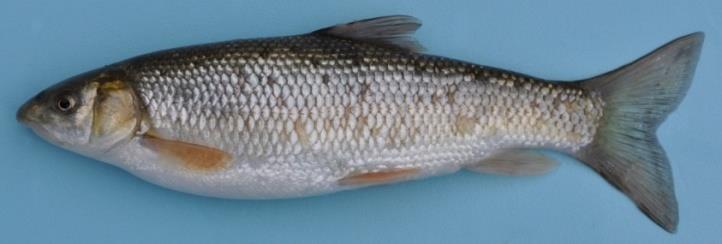
The species found from Köprüçay and Aksu rivers and streams Boğa and Gündoğdu, all around Antalya (Table 1 & Figure 1). • Habitat The species prefer fast flowing rivers and larger streams with gravel or rocky substrates. However, it is also known in dam lakes on Aksu River.
Discussion and Suggestion
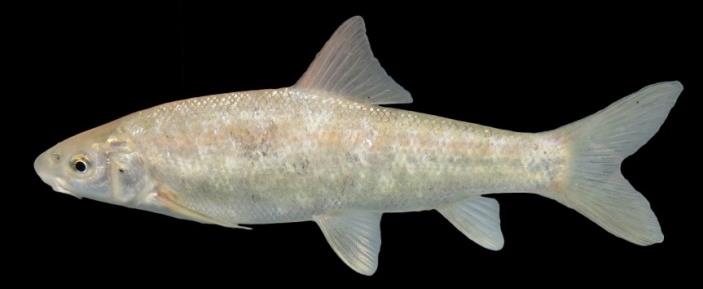
The findings of this study demonstrate that Capoeta antalyensis and Capoeta caelestis inhabits very close geographically. Capoeta caelestis is distinguished from Capoeta antalyensis by having one pair barbels (vs. two pairs), more lateral line scales (57-67, vs. 51-57) and more gill rakers on the first gill arch (17-21, vs. 14-17) (Table 3). Additionally, it was reported that there are 4.14%
differences in cyt b gene sequences between C. caelestis and C. antalyensis [11].
| Lateral-line scales | |||||||||||||||||||||||||||||||||||||||||
|---|---|---|---|---|---|---|---|---|---|---|---|---|---|---|---|---|---|---|---|---|---|---|---|---|---|---|---|---|---|---|---|---|---|---|---|---|---|---|---|---|---|
| n | 51 | 52 | 53 | 54 | 55 | 56 | 57 | 58 | 59 | 60 | 61 | 62 | 63 | 64 | 65 | 66 | 67 | 68 | 69 | 70 | 71 | 72 | 73 | 74 | 75 | 76 | mean | ||||||||||||||
| C. antalyensis | 20 | 1 | 3 | 6 | 2 | 5 | 2 | 1 | 53.9 | ||||||||||||||||||||||||||||||||
| C. caelestis | 20 | 1 | 1 | 1 | 4 | 2 | 4 | 3 | 3 | 1 | 61.5 | ||||||||||||||||||||||||||||||
| C. damascina | 16 | 1 | 1 | 1 | 2 | 2 | 3 | 1 | 1 | 3 | 1 | 71.8 | |||||||||||||||||||||||||||||
| Transversal scales | |||||||||||||||||||||||||||||||||||||||||
| Between dorsal-fin and lateral line | Between anal-fin and lateral line | Number of gill rakers | |||||||||||||||||||||||||||||||||||||||
| n | 10 | 11 | 12 | 13 | 14 | 15 | mean | 7 | 8 | 9 | 10 | mean | 14 | 15 | 16 | 17 | 18 | 19 | 20 | 21 | 22 | 23 | 24 | 25 | mean | ||||||||||||||||
| C. antalyensis | 20 | 2 | 13 | 5 | 11.2 | 20 | 7 | 2 | 6 | 10 | 2 | 15.6 | |||||||||||||||||||||||||||||
| C. caelestis | 20 | 10 | 7 | 3 | 11.7 | 13 | 7 | 7.4 | 2 | 6 | 5 | 4 | 3 | 19 | |||||||||||||||||||||||||||
| C. damascina | 16 | 2 | 9 | 4 | 1 | 13.3 | 2 | 13 | 1 | 8.9 | 1 | 4 | 5 | 3 | 1 | 2 | 22.3 |
Table 3: Frequency distribution of meristic features of the species of Capoeta antalyensis, C. caelestis and C. damascina.
The second river is Köprüçay which is faced with environmental pollution in upper part. However, the situation seems to be slightly better than Aksu River. In recent years, because of the activities of marble and quarry cement-derived substances are mixed with the river. These activities have led to mass fish deaths in the river several times. The habitat between the Köprülü canyon and the DSİ Aspendos regulator remains a suitable habitat for Capoeta antalyensis.
Freyhof [23] emphasized the situation of the both Aksu and Köprüçay. Accordingly, he assessed the conservation status of the species as Vulnerable. However, our recent observation in the field shows that the situation is worse and -at least for now- there is not any solution to protect the species. Therefore, we are Freyhof [23] mentioned that several populations of C. antalyensis seem to be impacted by (natural) hybridization with Capoeta caelestis. Geiger, et al. [17] supported this opinion with molecular data. This opinion triggered us to compare the specimens accordingly. Our comparisons show that all of populations located west of stream Gündoğdu (36.850182, 31.290019) belong to Capoeta antalyensis. It has been observed that there are some variations in terms of meristic features (such as lateral line scales and number of barbels which are diagnostically important for the both species in the region) among the specimens which are distributed in the region between Ilıca and Kargı streams. In order to solve this problem exactly, detailed morphological and molecular studies are needed.
Freyhof [24] emphasized that Capoeta caelestis is relatively resistant against most threats despite it has a relatively small distribution range. Besides, he remarked that the species has more than 10 independent populations and it is not believed to has declined fast enough to qualify for a threat category or "Near Threatened". Therefore, he assessed the conservation status of the species as "Least Concern". In this study, we found the species from 18 different locations and at least 12 independent water sources. Our findings very similar to the result of Freyhof [24]. Therefore, we agree about the conservation status of the species as "Least Concern" by following Freyhof [24].
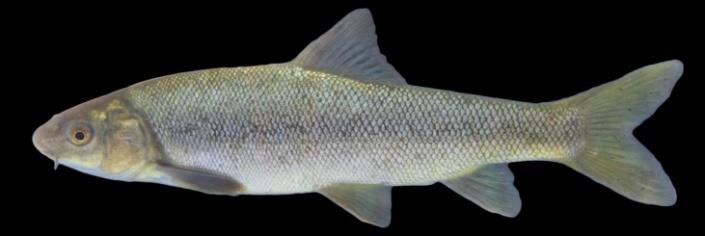
Özdemir [10] claimed that Capoeta caelestis is taxonomically close to C. damascina (Figure 4) and there is confusion in the taxonomic situation of this species. According to our comparison, Capoeta caelestis is distinguished from C. damascina by having weaker last unbranched dorsal-fin ray (ossified 32-50%, vs. 50-75%) and the absence of serrae along the posterior margin of it (vs. presence). Besides, C. caelestis has less lateral line scales than C. damascina (57-67, vs. 66-76), less scale rows between lateral line and anal fin origin (7-8, vs. 8-12) and fewer gill rakers on the first gill arch (17-21, vs. 20-25) (Table 3). Additionally, it was reported that there are 2% differences in cyt b gene sequences between C. caelestis and C. damascina [11].
These results show that the both species are well separated from each other by both molecular and morphological data. Therefore, there is not any confusion about the validity of C. caelestis as Özdemir [10] mentioned.
Acknowledgment
We thank to Salim Serkan Güçlü (Isparta) and Züleyha Akpınar (Rize) for their help during the fieldworks, Esra Bayçelebi (Rize) for producing the distribution map for us. This work was supported by the Recep Tayyip Erdoğan University Scientific Research Projects Coordination Unit (Project No: 2015.53002.103.01.06).
References
-
Turan D, Kottelat M, Ekmekci FG, Imamoglu HO (2006) A review of Capoeta tinca, with descriptions of two new species from Turkey (Teleostei: Cyprinidae). Rev Suisse Zool 113: 421-436.
-
Turan D, Kottelat M, Kırankaya SG, Engin S (2006) Capoeta ekmekciae, a new species of cyprinid fish from northeastern Anatolia (Teleostei: Cyprinidae). Ichthyol Explor Fres 17(2): 147-156.
-
Turan D, Kottelat M, Ekmekci FG (2008) Capoeta erhani, a new species of cyprinid fish from Ceyhan River, Turkey (Teleostei: Cyprinidae). Ichthyol Explor Fres 19(3): 263-270.
-
Turan D, Kucuk F, Kaya C, Guclu SS, Bektas Y (2017) Capoeta aydinensis, a new species of scraper from southwestern Anatolia, Turkey (Teleostei: Cyprinidae). Turk J Zool 41: 436-442.
-
Turan C (2008) Molecular systematics of Capoeta (Cyprinidae) species complex inferred from mitochondrial 16S rDNA sequence data. Acta Zool Crac 51(1-2): 1-14.
-
Ozuluğ M, Freyhof J (2008) Capoeta turani, a new species of barbel from River Seyhan, Turkey (Teleostei: Cyprinidae). Ichthyol Explor Fres 19: 289- 296.
-
Schöter C, Özuluğ M, Freyhof J (2009) Capoeta caelestis, a new species from Göksu River, Turkey (Teleostei: Cyprinidae). Ichthyol Explor Fres 20(3): 229-236.
-
Kucuk F, Turan D, Sahin C, Gulle I (2009) Capoeta mauricii n. sp., a new species of cyprinid fish from Lake Beysehir, Turkey (Osteichthyes: Cyprinidae). Zool Middle East 47: 71-82.
-
Levin BA, Freyhof J, Lajbner Z, Perea S, Abdoli A, et al. (2012) Phylogenetic relationships of the algae scraping cyprinid genus Capoeta (Teleostei. Cyprinidae). Mol Phylogenet Evol 62(1): 542-549.
-
Ozdemir F (2013) Capoeta in Turkey (Teleostei: Cyprinidae) Classical and Molecular Systematics Methods of Using Revision of the genus species and subspecies. PhD Thesis. Hacettepe University, Institute of Science and Technology, Ankara. Türkiye pp: 157.
-
Bektas Y, Turan D, Aksu I, Ciftci Y, Eroglu O, et al. (2017) Molecular phylogeny of the genus Capoeta (Teleostei. Cyprinidae) in Anatolia, Turkey. Biochem Syst Ecol 70: 80-94.
-
Bektas Y, Aksu I, Kaya C, Turan D (2019) DNA barcoding of the Genus Capoeta (Actinopterygii: Cyprinidae) from Anatolia. Turk J Fish Aquat Sc 19(9): 739-752.
-
Elp M, Osmanoglu MI, Kadak AE, Turan D (2018) Characteristics of Capoeta oguzelii, a new species of cyprinid fish from the Ezine Stream, Black Sea basin, Turkey (Teleostei: Cyprinidae). Zool Middle East 64: 102-111.
-
Kaya C (2019) Taxonomic Revision of the Genus Species Belong to Genus Capoeta Distributed in Turkey. PhD Thesis. Recep Tayyip Erdogan University, Institute of Science and Technology, Rize, Turkey pp: 126.
-
Alwan N (2010) Systematics, taxonomy, phylogeny and zoogeography of the Capoeta damascina species complex (Pisces: Teleostei: Cyprinidae) inferred from comparative morphology and molecular markers. Unpublished PhD Thesis Dissertation. Johann Wolfgang Goethe-Universita¨t, Frankfurt am Main pp; 264.
-
Alwan N, Esmaeili HR, Krupp F (2016) Molecular phylogeny and zoogeography of the Capoeta damascina species complex (Pisces: Teleostei: Cyprinidae). Plos One 11(6): 1-25.
-
Geiger MF, Herder F, Monaghan MT, Almada V, Barbieri R, et al. (2014) Spatial heterogeneity in the Mediterranean Biodiversity Hotspot affects barcoding accuracy of its freshwater fishes. Mol Ecol Resour 14(6): 1210-1221.
-
Kucuk F, Guclu SS (2006) Capoeta antalyensis (Battalgil, 1944) (Pisces: Cyprinidae)’in yayılış alanı ve taksonomik özelliklerinin karşılaştırılması. J Fish Aqua Sc 23(3-4): 251-256.
-
Kottelat M, Freyhof J (2007) Handbook of European freshwater fishes. In: Kottelat, Cornol, Freyhof, Berlin, et al. pp: 646.
-
Battalgil F (1944) New Fish Species from Inlandwaters. Istanbul University, Basımevi, Turkey pp: 126-133.
-
Karaman MS (1971) Freshwaters of Turkey, 8. Parts: Revision of Barbus Genus from North Africa, Middle East and Europa. Mit Hamburg Zoo Mus İnst Band 67: 175-254.
-
Erk'akan F, Kuru M (1983) Re-discussion of Systematical Status of Varicorhinus antalyensis Battalgil, 1944. Hacettepe Bull Nat Sci Eng 12: 49-65.
-
Freyhof J (2014) Capoeta antalyensis. The IUCN Red List of Threatened Species 2014.
-
Freyhof J (2014) Capoeta caelestis. The IUCN Red List of Threatened Species 2014.
- Mitochondrial Bio-Logistics: Steering Co-Enzyme Q10 and Lycopene Synergies within the Science 4.0 Bio-OS Framework
- Hymenoptera Specimens from the Caño Negro Wetland, of the National Museum Collection, Costa Rica
- Science 4.0: Comprehensive Architecture of the Biological Operating System (Bio-OS) A Framework for Systemic Resilience and Industrialized Bio-Governance
- Rabbit on, or Hare Back? Understanding Climate Change
- Clinical Validation of Science 4.0: Flow Steering and Epigenetic Drift Inversion on a 76-Year-Old Hybrid System
- Seeds Planted by another Mind