
First Record of Polymelia in the Paradox Frog Pseudis Paradoxa (Linnaeus, 1758) from Northern Brazil
During herpetofaunal monitoring studies on ESEC Maraca-Jipioca we found an individual Pseudis paradoxa exhibiting morphological abnormality. We diagnose abnormality following current etiology in herpetological literature and tested movement of member affected by touching. The anuran presented polymely in the right hand with duplicated radio-ulna linked to a pair of fully formed fingers. Since ESEC Maracá-Jipioca is a coastal island with very low anthropogenic impact, we think abnormality observed is more linked to endogenous factors or parasite infection, which is a common cause for polymely.
Introduction
Morphological abnormalities affecting bone structure are often related to individuals with extra, missing, or short limbs [1, 2]. A rate of 5% in prevalence of these abnormalities can occur naturally in anuran populations, but when this number exceeds, it may be considered of high concern [3]. Pseudis paradoxa (Amphibia: Hylidae) is a large-moderate sized species (SVL: 45-75 mm), with yellow dorsolateral which a brown band crosses the eyes parallel and extends to its nostrils [4]. This species occurs geographically in Colombia, Guiana, from northeastern Venezuela to Guyana, Surinam, and French Guiana to eastern Amazon and from northern Bolivia to southeastern Peru [5]. The aim of this paper is report two morphological abnormalities in Pseudis paradoxa for the first time in this species from eastern Amazon, northern Brazil.
Materials and Methods
The Ecological Station (ESEC) of Maracá-Jipioca is a island located in the coastal zone of Amapá state, Brazil (2.0047ºN, 50.4367º W, Datum: WGS 84). It comprehends an area of 58.756,95 h of floodplains, mangroves, bamboo forest and small areas of terra firme forest. During herpetofaunal monitoring studies on 11 October 2018, we found an adult P. paradoxa (SVL: 62 mm; 27 g) in a flooded ground.
By analyzing physical integrity of the individual, we noted a discrepancy in the morphology of its right forelimb. We analyzed and diagnose the anomaly and classified following the terminology of Lannoo MJ and Henle k, et al. [6, 7]. Abnormal structures were also mechanically stimulated by touching, to verify the functionality of the member. We found this only individual of species exhibiting physical abnormality and we fixed the specimen in 10% formalin and later transferred to 70% ethanol [8], and housed in the Herpetological Collection of the Universidade Federal do Amapá (CECCAMPOS 2725, collection permits from ICMBio-48102).
Results and Discussion
Right forelimb of specimen shows more fingers than usual, which seems to be a six fingered hand. A protrusion in the forearm exhibits a duplication of the radio-ulna bones linked to the two additional fingers fully formed above the complete hand (Figure 1). In herpetological literature, cases of duplication of a complete limb or parts thereof, in which more the digits are duplicated, is termed as polymely.
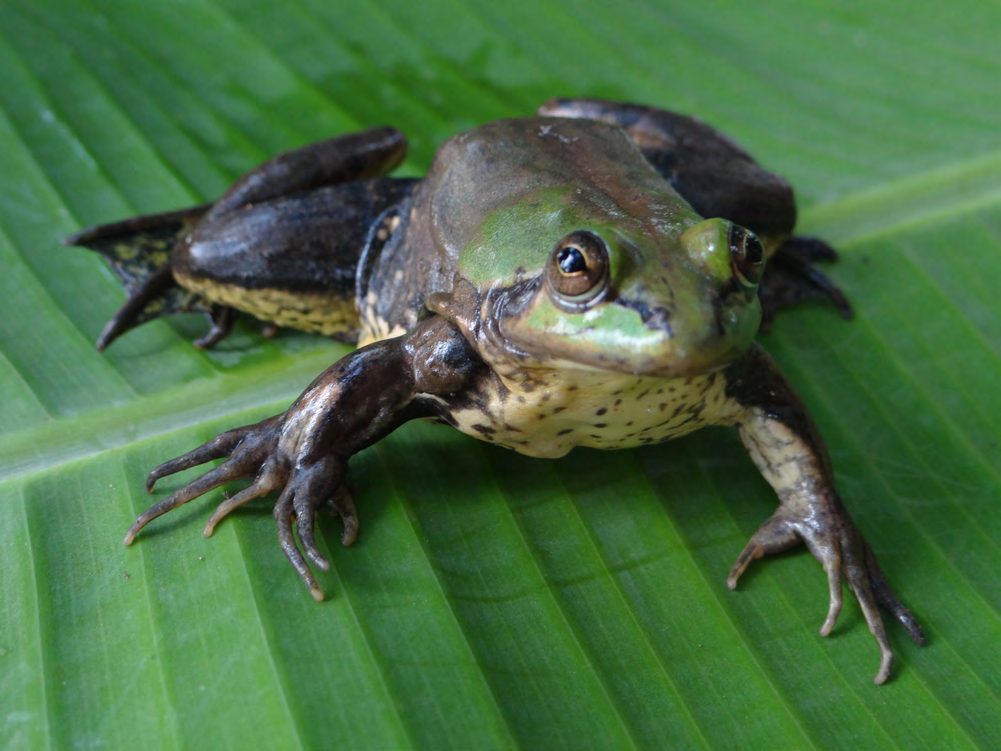
All the segments of the duplicated hand showed no range of locomotion compared to the healthy limbs, nor the hand or fingers answered when stimulated by touching. As argued by Zamora-Camacho FJ, et al. [9] the abnormal forelimbs may compromise the anuran locomotion, which reduces the salutatory movement and may increase susceptibility to predators. In the case of P. paradoxa, it’s possible to affect its fitness in aquatic environment in which this species inhabit.
Physical developmental abnormalities can be induced by several factors and can be multifactorial, main causes include climate change, UV radiation, genetic mutations, environmental pollutants, and parasites [10, 11, 12, 13]. Some cases of syndactyly, polydactyly and polymely in anurans have been associated to parasite infection, such as the presence of trematodes of the genus Ribeiroia [14, 15], which have to be yet investigated in this species.
Maracá-Jipioca islands are established as a protected area with low demography and little anthropogenic influence of mining, agriculture and industry. To our knowledge, this is the first record of polymely in the paradox frog Pseudis paradoxa in Eastern Amazon and only the second case of anomalies found in this ecological station [16, 17]. The accumulation of such anecdotic information about the occurrence of anomalies in natural amphibian populations may inspire hypotheses and is essential as stimulus for future studies on environmental status and possible impact of causal agents.
References
-
Reaser JK, Johnson PTJ (1997) Amphibians abnormalities: a review. Froglog 24: 2-3.
-
Johnson PTJ, Lunde KB, Ritchie EG, Reaser JK, Launer AE (2001) Morphological abnormality patterns in a California amphibian community. Herpetologica 57(3): 336-352.
-
Johnson PTJ, Reeves MK, Krest SK, Pinkney AE (2010) A decade of deformities: advances in our understanding of amphibian malformations and their implications. In: Sparling DW, Linder G, Bishop CA, Krest SK, et al. (Eds.), Ecotoxicology of Amphibians and Reptiles. 2nd (Edn.), Boca Raton (CRC Press), pp: 511-536.
-
De Sa ROD, Grant T, Camargo A, Heyer WR, Ponssa ML, et al. (2014) Systematics of the neotropical genus Leptodactylus Fitzinger, 1826 (Anura: Leptodactylidae): phylogeny, the relevance of non-molecular evidence, and species accounts. South American Journal of Herpetology 9(S1): 1-100.
-
Frost DR (2018) Amphibian Species of the World: an Online Reference. Version 6.0. Electronic Database accessible at. American Museum of Natural History, New York, USA.
-
Lannoo MJ (2009) Malformed frogs: the collapse of aquatic ecosystems. Berkeley and Los Angeles, University of California Press, USA, pp: 288.
-
Henle K, Dubois A, Vershinin V (2017) Commented glossary, terminology and synonymies of anomalies in natural populations of amphibians. Mertensiella 25: 9-48.
-
Heyer WR, Donnelly MA, Mcdiarmid RW, Hayek LAC, Foster MS (1994) Measuring and Monitoring Biological Diversity: Standard Methods for Amphibians. Biological Diversity Handbook Series. Washington: Stmithsonian Institution Press.
-
Zamora-Camacho FJ, Aragón P (2019) Hindlimb abnormality reduces locomotor performance in Pelobates cultripes metamorphs but is not predicted by larval morphometrics. Herpetozoa 32: 125.
-
Cohen MM (2001) Frog Decline, Frog Malformations, and a Comparison of Frog and Human Health. American Journal of Medical Genetics 104(2): 101-109.
-
Ankley GT, Tietge JE, Holcombe GW, DeFoe DL, Diamond SA, et al. (2000) Effects of laboratory ultraviolet radiation and natural sunlight on survival and development of Rana pipiens. Can J Zool 78(6): 1092-1100.
-
Ankley GT, Diamond SA, Tietge JE, Holcombe GW, Jensen KM, et al. (2002) Assessment of the risk of ultraviolet radiation to amphibians. I. Dose-dependent induction of hind limb malformations in the Northern Leopard frog (Rana pipiens). Environ Sci Technol 36(13): 2853- 2858.
-
Johnson PTJ, Lunde KB, Thurman EM, Ritchie EG, Wray SN, et al. (2002) Parasite (Ribeiroia ondatrae) infection linked to amphibian malformations in the western United States. Ecol Monogr 72(2): 151-168.
-
Johnson PTJ, Preu ER, Sutherland DR, Romansic J, Han B, et al. (2006) Adding infection to injury: synergistic effects of predation and parasitism on salamander limb malformations. Ecology 87(9): 2227-2235.
-
Stopper GF, Hecker L, Franssen RA, Sessions SK (2002) How trematodes cause limb deformities in amphibians. Journal of Experimental Zoology 294(3): 252-263.
-
Schotthoefer AM, Koehler AV, Meteyer CU, Cole RA (2003) Influence of Ribeiroia ondatrae (Trematoda: Digenea) infection on limb development and survival of Northern Leopard Frogs (Rana pipiens): effects of host stage and parasite-exposure level. Canadian Journal of Zoology 81(7): 1144-1153.
-
Sousa JC, Costa Campos CE (2017) Records of ocular anomaly in two species of anurans in Eastern Amazon. Herpetology Notes 10: 413-415.
- California Red-Legged Frog and Non-Listed Amphibians Response to Non-Native Fish Removal
- Industrial Standardization of the Bio-OS: Algorithmic Codification of Resilience Engineering Guidelines and Version V8 Architecture
- Climate Variability and the Sustainability of Snail Farming in Nigeria: Past Trends, Present Challenges and Potential Outlook
- The Evaluation of the Surveillance System of Anthrax in Gilgit-Baltistan, Pakistan, 2018
- Natural Decline to Extinction of A New Zealand Rabbit Population
- Mitochondrial Bio-Logistics: Steering Co-Enzyme Q10 and Lycopene Synergies within the Science 4.0 Bio-OS Framework