
Snow is not an Enemy, but a Building Material for the Roadway
Snowfalls and blizzards block roads and create massive congestion on city streets and long-distance routes. Considering the processes of road surface formation during snowfall, it can be noted that snow during the fall is light fluffs, which, at an indefinite time, with different intensities, at different temperatures, stacked in layers, gradually by the wheels of cars, are compacted into a slippery tuberous canvas. The rubber tread, rolling through the freshly deposited layers, compresses the snow, forming a rut. The resulting trail adheres firmly to the asphalt. Almost all cars go on the trail, therefore the wheels of the following cars condense mainly the same track. On inactive roads, leaving the track during overtaking or detour leads to smoothing and compaction of the freezing walls of the track (Figures 1-4).
Opinion
Snowfalls and blizzards block roads and create massive congestion on city streets and long-distance routes.
Considering the processes of road surface formation during snowfall, it can be noted that snow during the fall is light fluffs, which, at an indefinite time, with different intensities, at different temperatures, stacked in layers, gradually by the wheels of cars, are compacted into a slippery tuberous canvas. The rubber tread, rolling through the freshly deposited layers, compresses the snow, forming a rut. The resulting trail adheres firmly to the asphalt. Almost all cars go on the trail, therefore the wheels of the following cars condense mainly the same track. On inactive roads, leaving the track during overtaking or detour leads to smoothing and compaction of the freezing walls of the track (Figures 1-4).
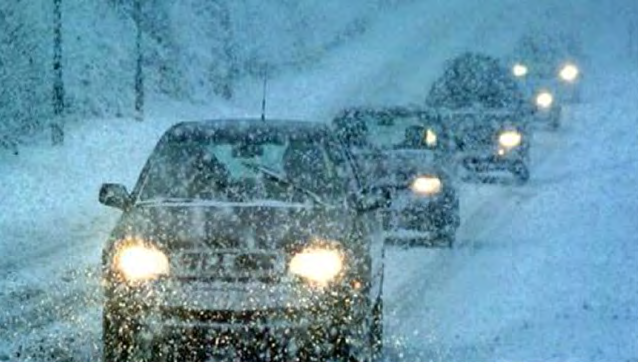
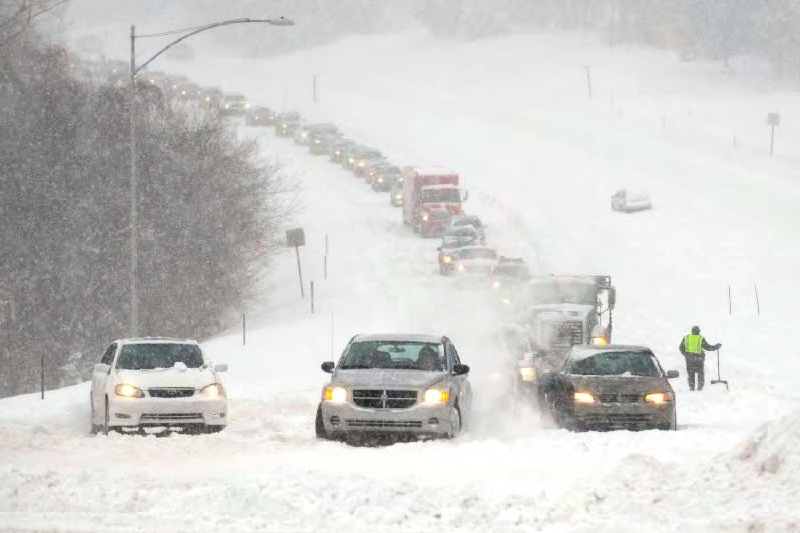
With heavy snowfall and rarely moving vehicles, the layers of snow increase, the ruts become deeper, and the cars begin to row the snow with their pallets, suspension. A little more snow and ... congestion. With intensively moving vehicles, entrances and exits to and from paved tracks become more frequent. Traces of Opinion various thicknesses and widths randomly superimposed upon each other as snowfall, with different volumes and temperatures, humidity, wind, and traffic intensity, gradually freeze and harden. A hard, icy surface of a slippery, bumpy, indefinite shape is formed.
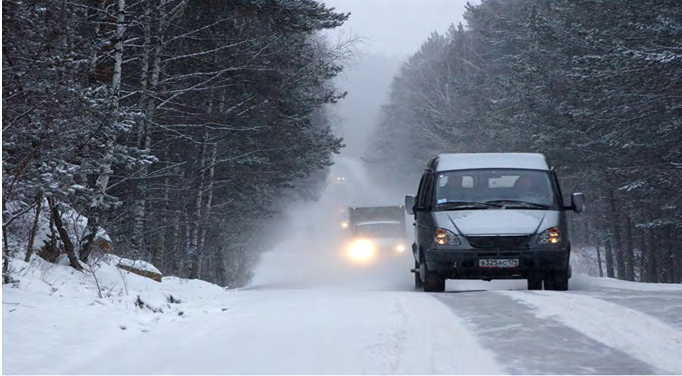
To combat this, snow removal equipment is used. Raking snow from the curb, and then removing it from there, loading, transporting, storing snow at special landfills is a ruinous activity. On city roads, throughput is reduced. But no matter how hard the army of specialists with snow removal equipment tries, often the roads are completely covered with layers of snow and ice, covering all asphalt.
Snow layers of 1 cm and, for example, 20 cm are the same in sliding and this technique will not remove this ice cover. Of course, where there are many snowplows, snow can be cleaned in time to the asphalt. But this is not everywhere. On the outskirts of cities and on intercity routes, snow still compacts and covers the hard surface.
But what if you do not remove snow from the roads at all, but level the road with snow itself. In fact, cars go on such roads. Can it just give the compacted snow the given parameters? To avoid ruts, there were no slippage. Maybe this should be done not by special equipment, but by moving vehicles themselves? To everyone. Or its majority, for example, by scheduled passenger cars and electric vehicles within the city. And on intercity routes - by large trucks. Snow, in a still loose state, when pushed by a wheel, can be shifted with small scrapers or brushes a little, to the width of the wheel, to the right. The design and size of the scrapers or brushes may be different. It is assumed that palm size is sufficient.
Brushes or scrapers are fixed in the most convenient place for fastening the vehicle in close proximity to the roadway, at an angle to the direction of movement, with the possibility of displacement of a small strip of fresh snow, loose snow mass in front of the wheel and/or behind the wheel. To shift the formed ridge of extruded snow to the right and into its own rut after the passage of the wheel. For right-hand traffic: right. Ideal-clearing the snow in front of the wheel and completely falling asleep own track behind the wheel.
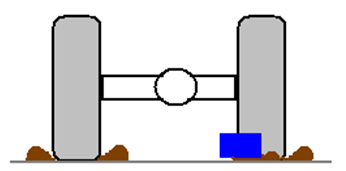
Shown here is the rear axle of the car a rear view and a scraper behind the right wheel. One scraper on the right wheel is enough. The scraper shifts only one snow roller into its own track. Of course, it is better on both wheels, but this is enough to prevent ruts in deep snow.
The track of the wheels is lost among the tracks of the wheels of the previous machines, the factor of movement of the track into the track and tamping of the single track disappears.
Many cars in a given zone move randomly, from the leftmost row to the right side of the road, along a multi-row track, evenly rolling along the entire surface of the road. If each of the wheels will shift its snow roller to the right, then the snow will gradually go to the side of the road and beyond. At subzero temperatures, the snow flakes freeze and form a grooved surface in the longitudinal direction, but even along the width of the road. And at the curb an ice curb is formed, which protects the cars from slipping off the road.
Moving snow into the ruts with all or most of the moving equipment can create shallow furrows and low curbs in the longitudinal direction. It turns corrugation in the longitudinal direction. Different profiles of scrapers of different machines at different times during freezing will leave a different mark. Longitudinal compacted and frozen ridges of these tracks can prevent wheels from slipping laterally. This is no longer smooth and indefinitely lumpy slippery pov surface. Multiple snowfalls will cover the road in ever greater layers. A continuous displacement, smoothing and compaction of moving vehicles, still light snow mass, creates a smooth canvas with a comb profile. This is not a smooth, shapeless road surface with polished tires with tubercles, but a uniformly compacted corrugated road without tubercles. Snow does not become a burden, a load or an enemy of roads, but an ally, the building material of new roads. The need for its collection, transportation and storage disappears.
The snow mass during thawing in the spring again becomes mobile and able to slowly approach the curb. In this case, the snow structure becomes loose, and the entire snow mass gradually goes to the side of the road and to the side of the road.
Each type of vehicle has its own design, dimensions, wheel arrangement. Each of them needs an individual approach and its own design. There are many options, for example, you can rotate all existing mudguards 15-45 degrees around the vertical axis. Snow is displaced in the state of its friability. Before setting it in the cold. Designs of scrapers, brushes, reflectors, aprons, mudguards can be a great many. From specially designed elements mounted on an axle with a spring-loaded wheel. To the simplest piece of rubber or board suspended on chains.
Of course, immediately installing such devices on all machines is impossible.
An experimental test of the principle itself is necessary. To do this, you can conduct an experiment on a specific section of the road with not very heavy traffic.
Willful efforts and organizational abilities of one of the local leaders, any district, city or region of any country are needed. Choose just one bus or trolley bus route that goes to any outskirts of the city. Make such a scraper on all buses of this route alone and see the result. You can rotate the mud flaps around the vertical axis of degrees 30-45 to the right side. The road along this route, unlike all others, will be flat without ruts, in severe frosts. At positive temperatures, snow and dirt will gradually go to the side of the road and behind it. There will be no dust in spring and summer. The positive visible result of the chain reaction instantly spreads along all roads. The first experiment is needed.
On long-distance routes, a small workshop at the exit from the city will be able to quickly and expertly hang up ready-made devices, pre-designed structures for various types of long-distance vehicles, characteristic of this road. Before and during snowfall, this can be done in minutes, at the wheels of cars leaving the city. In the suburbs, a cooperative solution and installation of such scrapers on private cars of this particular region is possible. It is more rational to use trucks, regularly delivering products and materials, buses and trolleybuses of city and suburban routes.
Upon the manifestation of the effect, the method instantly spreads to other roads. It will grow to a large scale. And this is a new quality that will simply oblige car mills to begin to supplement new cars with devices more efficient, more economical.
Economic efficiency appears in reducing the accident rate on the roads, the possibility of eliminating congestion and emergency situations. The need to sprinkle roads with salt and other chemical reagents disappears, which will preserve the environment. During prolonged and heavy snowfalls, a layer of compacted snow will save the road from damage during temperature changes.
The need for snow removal equipment and the entire industry with warehouses, factories, designers, ministries disappears. This is not just a tangible saving of fuel, money and labor resources, it is a revolution in the road sector.
This will not happen: http://www.inform.kz/ru/zakryty-avtotrassy-v-akmolinskoy- oblasti_a2978704
- California Red-Legged Frog and Non-Listed Amphibians Response to Non-Native Fish Removal
- Industrial Standardization of the Bio-OS: Algorithmic Codification of Resilience Engineering Guidelines and Version V8 Architecture
- Climate Variability and the Sustainability of Snail Farming in Nigeria: Past Trends, Present Challenges and Potential Outlook
- The Evaluation of the Surveillance System of Anthrax in Gilgit-Baltistan, Pakistan, 2018
- Natural Decline to Extinction of A New Zealand Rabbit Population
- Mitochondrial Bio-Logistics: Steering Co-Enzyme Q10 and Lycopene Synergies within the Science 4.0 Bio-OS Framework