
The Methodology of Regressive Objective Regression According to the New SARSCoV-2 COVID-19 Pandemic in the Municipality of Santa Clara and Cuba
Since the beginning of civilization, infectious diseases have affected humans. The early history of these diseases was characterized by sudden and unpredictable outbreaks, often of epidemic proportions, so that the current situation that the planet is experiencing because of the new coronavirus is a trigger more product of multiple factors, with a high share derived from anthropogenic activity. Two major epidemics have been described, the severe acute coronavirus respiratory syndrome (SARS-CoV) in 2002 and the Middle East Respiratory Syndrome (MERSCoV) in 2012, until the appearance in China of SARS-CoV-2 or COVID-19 (Coronavirus Infection Disease) in December 2019, which will be referred to as the coronavirus.
Opinion
Since the beginning of civilization, infectious diseases have affected humans. The early history of these diseases was characterized by sudden and unpredictable outbreaks, often of epidemic proportions, so that the current situation that the planet is experiencing because of the new coronavirus is a trigger more product of multiple factors, with a high share derived from anthropogenic activity. Two major epidemics have been described, the severe acute coronavirus respiratory syndrome (SARS-CoV) in 2002 and the Middle East Respiratory Syndrome (MERSCoV) in 2012, until the appearance in China of SARS-CoV-2 or COVID-19 (Coronavirus Infection Disease) in December 2019, which will be referred to as the coronavirus.
Coronaviruses belong to the family Coronaviridae. Genome size ranges from 26 to 32 kilonucleotides, with one of the largest RNA-positive viruses. They have a nucleocapsid of helical symmetry with an envelope that has glycoprotein structures that look like a crown of spikes (this is why they have been called coronaviruses). Coronaviruses can cause respiratory and digestive diseases, both in birds and mammals, including man, in whom they can produce diseases ranging from a common cold to more severe conditions such as bronchitis, bronchiolitis and pneumonia. Monitoring and communication with the medical team is essential to detect respiratory distress early.
The new coronavirus (2019-nCoV) identified on December 31, 2019 in Wuhan, China, now officialzed d as SARS-CoV2, produces COVID-19. In addition, this virus is Opinion the first in its family to be declared a pandemic by the World Health Organization (WHO), on March 11, 2020. Global epidemiological studies of coronavirus (CoV) over 15 years have shown that bats in Asia, Europe, Africa, the Americas and Australia are home to a wide variety of viruses, which harbor and spread these infectious agents quite easily, increasing their ability to transmit. According to the Research Group Mathematical Models in Science and Technology: Development, Analysis, Numerical Simulation and Control (MOMAT) of the Institute of Interdisciplinary Mathematics of the Complutense University of Madrid, Spain, the application of the Be-CoDiS (Between-Countries Disease Spread) model in the analysis of the COVID-19 pandemic numerically projects that this viral phenomenon will be present until July 2020 in the world. Therefore, it is important to estimate the trend in the behavior of the epidemiological curve of the COVID-19 pandemic.
The objective of the study carried out in our country was to mathematically model a set of parameters of the pandemic/COVID-19 (deaths, critical, severe, confirmed and new cases) in the municipality of Santa Clara and Cuba using the methodology of Regressive Objective Regression (ROR). The work used data from the pandemic of deaths, serious and critical cases for Cuba and confirmed cases for the municipality of Santa Clara, Villa Clara province. The prognosis was made using Regressive Objective Regression (ROR) methodology, which has been implemented in different variables such as viruses and bacteria circulating in Villa Clara province. Regressive Objective Modelling (ROR), is based on a combination of Dummy variables with ARIMA modelling, where only two Dummy variables are created and the trend of the series is obtained. It requires few cases to be used and also allows the use of exogenous variables that make it possible to model and forecast in the long term, depending on the exogenous variable.
In ROR methodology, dichotomous variables DS, DI and NoC are created in a first step, where: NoC: Number of cases from the base, DS = 1, if NoC is odd; DI = 0, if NoC is even, when DI=1, DS=0 and vice versa. Then, the module corresponding to the SPSS version 19.0 statistical package Regression Analysis (IBM Company, 2010) is executed, specifically the ENTER method where the predicted variable and the ERROR are obtained. Then the autocorrelations of the variable ERROR will be obtained, with attention to the maximums of the significant partial autocorrelations PACF. The new variables are then calculated taking into account the significant lag of the PACF. Finally, these variables are included in the new regression in a process of successive approximations until obtaining a white noise in the errors of the regression. The data runs in this study are made until April 23, 2020, according to data taken from the work published in the local newspaper of Villa Clara, which in turn used the source of the Ministry of Health of Cuba (MINSAP). As of the date of the study, there were 3,393 people admitted to hospitals for clinical-epidemiological surveillance of COVID-19; 6,727 people were being monitored at home from primary health care, with 1,283 confirmed cases of the virus, 69 per cent of which were active cases and 36 per cent of which were closed. The entire analysis was carried out with the help of the IBM company’s SPSS statistical package, Version 19.
The results of the deaths in Cuba according to the ROR methodology explain 88.9 % of the deaths with an error of 1,143 cases. The model obtained according to ROR, the trend is significant positive, at 99%, the other parameters contribute explained variance to the model, although they are not significant. This model depends on the deceased 14 days ago, and the value has a negative value, which indicates that, from 14 days up to now, the trend of deceased is negative or decreasing, so the procedures in the care rooms of these patients are highly valued. The model and its parameters depend on the cases 15 days ago (Lag15 New) and on the stage variable, which represents the two stages in which the pandemic has manifested itself in Cuba. Before 16 April, the stage takes the value of zero and after 16 April it takes the value of 1, so that its inclusion brings an increase of 30 cases, as can be seen the trend is downwards, although it is not significant yet. The trend in new cases is also downward by -0.195 cases, although statistically not significant.
The long-term prognosis for new cases of COVID-19 in Cuba showed a decline in the number of new cases, indicating that the maximum number of cases in the series could have been reached by April 17, if the measures of physical and social isolation continued. As well as the hygienic and personal protection measures taken by the government, this mortality could continue to decrease until it disappears in the last days of June. This is why precautions must be taken so that new cases continue to decline and disappearances are more clearly shown (Figure 1).
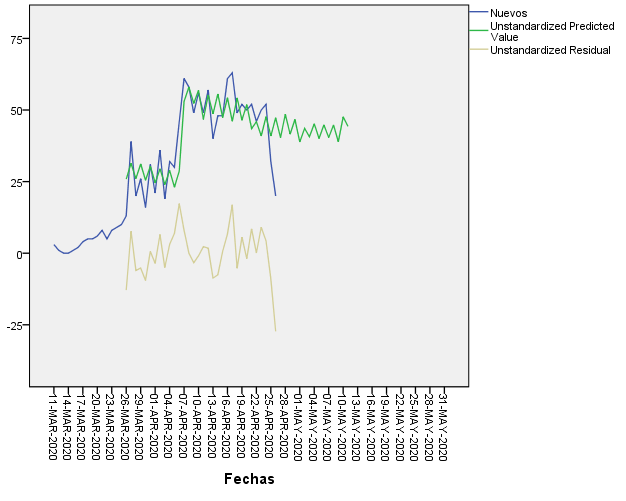
The long-term model for the municipality of Santa Clara explains 96.8% with an error of 1.76 cases, the Durbin Watson statistic is close to 2, so we are dealing with a model where the errors are white noise and can be considered a good model. It is necessary to wait until 6 May to see if another maximum is obtained; that is to say, the maximum number of cases and, therefore, those confirmed disappear, but even so, the measures of physical and social isolation must be maintained until the cases are reduced to zero for two consecutive periods of 10 days; otherwise, the maximum number of confirmed cases will have been reached on
16 April. We must wait until 6 May to see if this has been achieved. The model depends on the cases confirmed 10 days ago (Lag10Confirmed) and presents a slightly increasing trend, the Step variables correspond to the numbers of cases that have been significant throughout the process of the series.
It is concluded that the COVID-19 despite being a new disease in the world can be followed by ROR modeling; this allows reducing the number of deaths, severe and critical, for better management of the pandemic.
- California Red-Legged Frog and Non-Listed Amphibians Response to Non-Native Fish Removal
- Industrial Standardization of the Bio-OS: Algorithmic Codification of Resilience Engineering Guidelines and Version V8 Architecture
- Climate Variability and the Sustainability of Snail Farming in Nigeria: Past Trends, Present Challenges and Potential Outlook
- The Evaluation of the Surveillance System of Anthrax in Gilgit-Baltistan, Pakistan, 2018
- Natural Decline to Extinction of A New Zealand Rabbit Population
- Mitochondrial Bio-Logistics: Steering Co-Enzyme Q10 and Lycopene Synergies within the Science 4.0 Bio-OS Framework