
Influence of Geomagnetic M-Index on Light-Trap Catch of Macrolepidoptera Species Selected from Different Families and Subfamilies
The study deals with the number of Macrolepidoptera species caught by light-trap, in connection with the geomagnetic M-index. We found close correlation between the nightly sum values of geomagnetic M-index and relative catch of Macrolepidoptera species separated from different families and subfamilies caught by light-traps of the Hungarian Forestry Light-Trap Network. Three behaviours were identified, but these behaviours do not depend on the taxonomic location of the species. We suggest that the geomagnetic M-indices provide more trouble-free spatial orientation of moths.
Introduction
It is well known for a long time that the insects detect the geomagnetic field, and even can use it as a three-dimensional orientation. A number of laboratory experiments and comprehensive studies are devoted to the physiological bases of perception and the ways of orientation [1, 2, 3, 4, 5].
The magnetic field of the Earth is an omnipresent, reliable source of orientation information. A magnetic compass has been demonstrated in 18 species of migrating birds [6].
After investigation of different species of termites (Isoptera), beetles (Coleoptera), flies (Diptera), orthopteroids (Orthoptera), and hymenopterans (Hymenoptera), Becker [7] found that these species use the natural magnetic field in their orientation. According to the examinations the way of their mobility is North-South, rarely East-West. Their original way of movement could be modified by artificial magnetic field.
Mletzko, et al. [8] made the experiments with specimens of ground beetles (Broscus cephalotes L., Carabus nemoralis Mull. and Pterostichus vulgaris L.) on a 100 square meter asphalt coated area in the Moscow botanical garden.
Iso-Ivari, et al. [9] examined the influence of geomagnetism on light-trap catch of insects in the northernmost part of Finland. In their experiments they used the K index values measured in every three hours, as well as the ΣK and the δH values. A weak but significant correlation was found between the geomagnetic parameters and the number of specimens of the various orders of insects caught.
Examinations over the last decades Baker, et al. [10] have also showed that some Lepidoptera species, such as Large Yellow Underwing (Noctua pronuba L.) and Heart & Dart (Agrotis exclamationis L.) Baker, et al. [11] is helped by both the Moon and geomagnetism in their orientation, and they are even capable of integrating these two sources of information.
We used in the investigation the catch material of the Kecskemét fractionating light-trap, we have examined the light trapping of Turnip Moth (Agrotis segetum Den. et Schiff.), Heart & Dart (Agrotis exclamationis L.) and Fall Webworm Moth (Hyphantria cunea Drury) in connection with the horizontal component of the geomagnetic field strength [12]. The fractionating light-trap gave hourly data of insects.
According to the authors of recent publications [5, 13, 14] the orientation/navigation of moths at night may becomes not by the Moon or other celestial light sources, but many other phenomena such as geomagnetism.
Using hourly data from the material of the Kecskemét fractionating light-trap, we have examined the light trapping of Turnip Moth (Agrotis segetum Den. et Schiff.), Heart & Dart (Agrotis exclamationis L.) and Fall Webworm (Hyphantria cunea Drury) in relationship with the horizontal component (H-index) of the geomagnetic field strength [12].
We have already found that the H-index influence the efficiency of light trapping [15, 16, 17]. We found connection between Microlepidoptera spec. indet and C9 index [18]. We examined the effect of Kp and M-index of changes the number of Macrolepidoptera individuals and species [19]. Carlier, et al. [20] investigated the relationship between Kp- index and insects.
In a previous study we studied light-trapped of caddisfly (Trichoptera) species in connection with the geomagnetic H-index. Different results were obtained for different species. Growth and decrease results were both on the rising values of the H index [21]. The study of Puskás, et al. [22] deals with the light-trap catch of Microlepidoptera spec. indet. in connection with the geomagnetic M-index. They found the catch of Microlepidoptera species decreased at high M-index values.
Worthy to note our own studies other researchers did not make any researches dealing with the connection between light-trap catch of insects and the M-index.
Our aim was to determine relationship between geomagnetic M-index and light trapping of Macrolepidoptera species separated from other families and subfamilies.
Material
The geomagnetic data measured along the magnetic meridian (direction: North-West to South-East) in function of time. These measurements are made at Nagycenk, near Sopron in the Geodetical and Geophysical Research Institute of the Hungarian Academy of Sciences. The geographical coordinates of Observatory are 47° 38’ (N); 16° 43’ (E). Its distance from the Kámon Botanic Garden (Szombathely) is 43 km.
The observatory is situated about 10 km to E of the city Sopron and 60 km SE of Vienna, on the southern shore of lake Fertő. The observatory lies on thick conductive sediment and it is surrounded by the Fertő-Hanság National Park.
Values of local horizontal component, M-index for our research have been taken from a series of observations carried out at Nagycenk (Western Hungary) description of which can be found in: Observatoriums Berichte des Geophysikalischen Forschungslaboratoriums der UAdW in Sopron, 1962-1966 and Geophysical Observatory Reports of the Geodetical and Geophysical Research Institute of the Hungarian Academy of Sciences in Sopron, 1967-1976.
The geomagnetic M-index data measurements are made at Nagycenk, near Sopron in the Geodetical and Geophysical Research Institute of the Hungarian Academy of Sciences.
The M-index is similar to the C-index, but the C9 values have no dependence on the value of the index in local time, but globally are characterized by geomagnetic activity.
The three-hour magnetic M-index is local in nature. It has strong dependence on local time and its moderate widths include less magnetic disturbances typical of the polar zone and equation zones. In the case of a local phenomenon such as the flying night butterflies, the M-index is much more useful than any other global index, as it expresses local conditions (Verő, personal communication).
The Observatory determined and reports between 1962-1991 M-index and a range of up to 0-9 integer values contains. The M-index is a linear scale, 7 nT (nanoTesla) steps. The 9 degrees are > less than 63 nT (Judit Szendrői personal communication).
The Hungarian forestry light-trap network with the same Jermy-type light-traps [23] has been operating continuously to this day since 1962. Between 1962 and 1970, 20 light traps operated in all regions of the country (Table 1).
| Light-trap stations | Years | Geographical coordinates | Light-trap stations | Years | Geographical coordinates |
|---|---|---|---|---|---|
| Budakeszi | 1962-1970 | 47°30’N 18°56’E | Sopron | 1962-1970 | 47°41’N 16°34’E |
| Felsőtárkány | 1962-1970 | 47°58’N 20°25’E | Szakonyfalu | 1967-1970 | 46°51’N 16°13’E |
| Gerla | 1967-1970 | 46°40’N 21°05’E | Szentpéterfölde | 1968-1970 | 46°37’N 16°45’E |
| Gyulaj | 1969-1970 | 46°30’N 18°17’E | Szombathely | 1962-1970 | 47°14’N 16°37’E |
| Makkoshotyka | 1962-1970 | 48°21’N 21°31’E | Tolna | 1962-1970 | 46°25’N 18°46’E |
| Mátraháza | 1962-1970 | 47°46’N 19°55’E | Tompa | 1962-1970 | 46°12’N 19°32’E |
| Répáshuta | 1962-1970 | 48°02’N 20°31’E | Várgesztes | 1962-1970 | 47°28’N 18°23’E |
| Farkasgyepű | 1965-1970 | 47°12’N 17°38’E | Kunfehértó | 1962-1970 | 46°21’N 19°24’E |
| Erdősmecske | 169-1970 | 46°10’N 18°30’E | Kömörő | 1969-1970 | 48°01’N 22°35’E |
| Kőkút | 1969-1970 | 46°11’N 17°34’E | Zalaerdőd | 1970 | 47°03’N 17°08’E |
Table 1: The stations of Forestry light-traps, their catching years and geographical coordinates.
| Families, Species | Individuals | Data |
|---|---|---|
| Drepanidae, Thyatirinae | ||
| Poplar Lutestring (Tethea or Denis & Schiffermüller, 1775) | 3,503 | 620 |
| Geometridae, Sterrhinae | ||
| Maiden’s Blush (Cyclophora punctaria Linnaeus, 1758) | 110,543 | 1,393 |
| Geometridae, Ennominae | ||
| Sharp-angled Peacock (Macaria alternata Denis & Schiffermüller, 1775) | 26,473 | 1,176 |
| Notodontidae, Pygaerinae | ||
| Chocolate-tip Clostera curtula Linnaeus, 1758) | 620 | 375 |
| Erebidae, Rivulinae | ||
| Straw Dot Rivula sericealis Scopoli, 1763 | 7,747 | 797 |
| Erebidae, Herminiinaee | ||
| Jubilee Fan-foot Zanclognatha lunalis Scopoli, 1783 | 19,127 | 674 |
| Erebidae, Boletobinae | ||
| Lesses Belle Colobochyla salicis Denis & Schiffermüller, 1775 | 2,245 | 423 |
| Noctuidae, Eustrotiinae | ||
| Marbled White Spot Deltote pygarga Hufnagel, 1766 | 8,987 | 714 |
| Noctuidae, Pantheinae | ||
| Nut-tree Tussock Colocasia coryli Linnaeus, 1758 | 2,648 | 303 |
| Noctuidae, Hadeninae | ||
| Athetis furvula Hufnagel, 1808 | 52,404 | 501 |
| Noctuidae, Noctuinae | ||
| Setaceous Hebrew Character Xestia c-nigrum Linnaeus, 1758 | 3,950 | 867 |
Table 2: Catching data of caught moths.
They have provided invaluable data for scientific researches. The light source of this light-trap is a 100W normal electric bulb and the killing agent is chloroform [23]. Lepidoptera is the best-processed taxon. During these years, all caught moths were identified and the number of trapped individuals of all species recorded daily in the light-trap registers.
From this vast amount of collection data, we selected species to represent as many families and subfamilies as possible (Table 2). Our aim was to determine whether different species would react identically or differently to the effect of the M magnetic index.
Methods
Relative catch values were calculated from the number of caught moths for each species and sampling night until the trap of the year worked. The relative catch was defined as the quotient of the number of moth caught during a sampling time unit (1 night) per the average catch (number of moths) within the same catching period to the same time unit. For example, when the actual catch was equal to the average moth number caught in the same catching period, the relative catch was 1 [24].
The values of M-index were arranged into groups. The number of groups was determined according to Sturges’ methods [25]. Following we arranged the data of averaged M-index in classes. The averaged data of relative catch values were placed according to the features of the given night, and then were summed up and averaged. The data are plotted for each relative catch values in Figures.
Results and Discussion
Our results are shown in Figures 1-11.
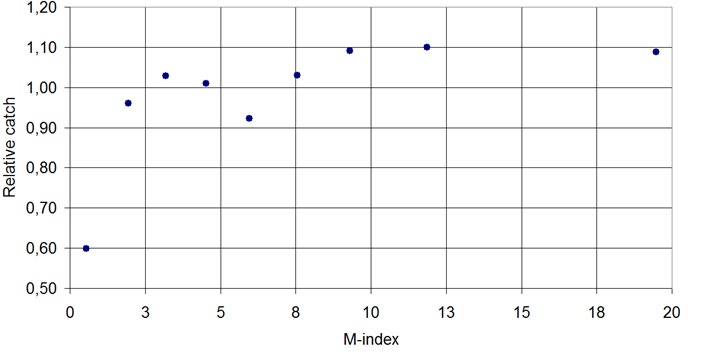
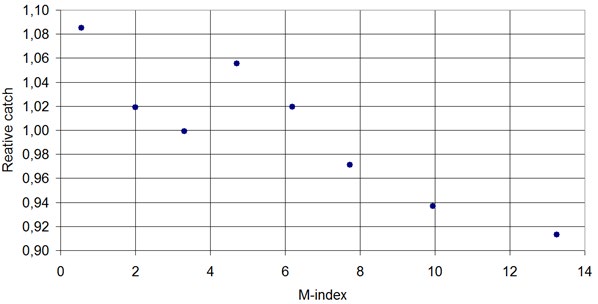
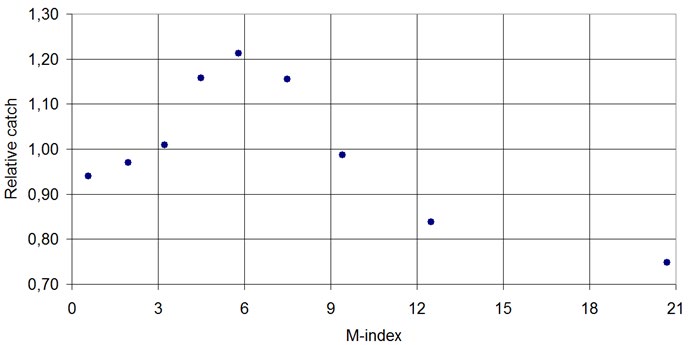
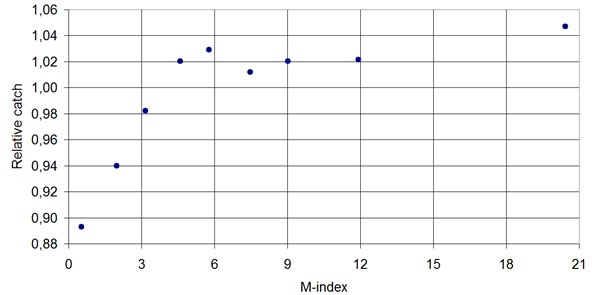
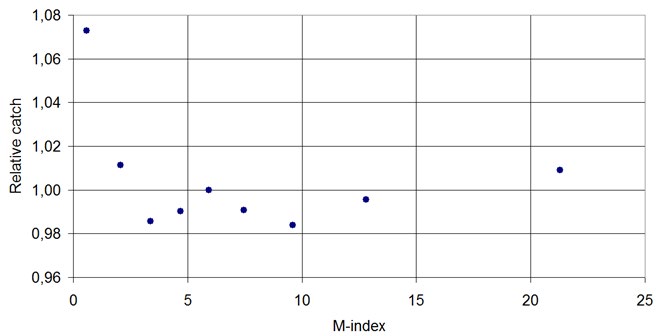
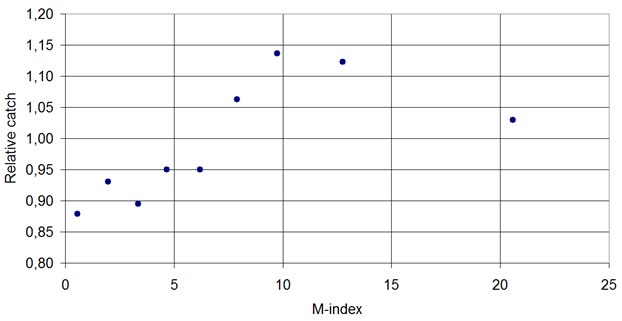
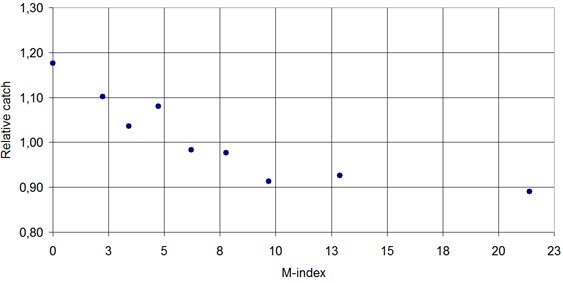
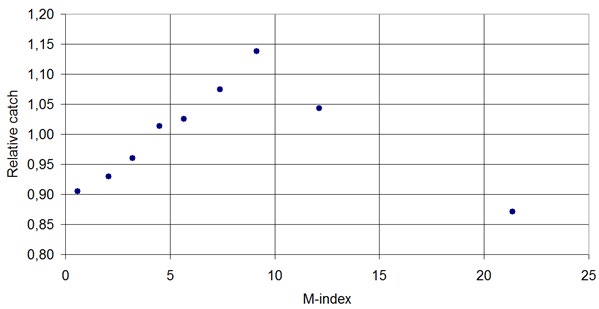
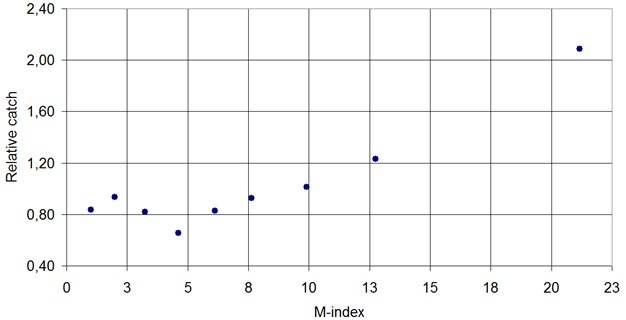
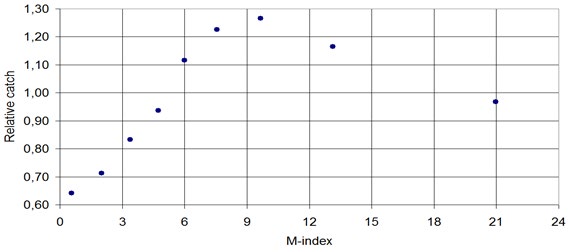
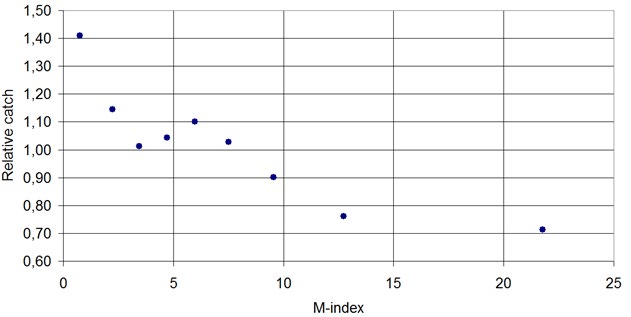
Growth of the geomagnetic field strength may generate an intensification of the flying activity of insects. Three behaviors were identified. As the geomagnetic M-index values increase, the light trapping catch of the given species increases with M-index values, otherwise the light trapping catch of the given species decreases. The third case is a combination of these two ones, initially increasing, but at high M-index values the catch is already decreasing. However, these behaviors do not depend on the taxonomic location of the species. We suggest that the geomagnetic M-indices provides more trouble-free spatial orientation and therefore increases.
Conclusion
The light-trap catches of Macrolepidoptera species depending on the geomagnetic M-index. On this basis, it can be stated that it is also suitable for insect ecological studies.
Acknowledgement
We thank Prof. József Verő for his useful advices and Judit Szendrői for the personal communication.
References
-
Wehner, Lobhart TH (1970) Perception of the geomagnetic field in the Drosophila melanogaster. Experientia 26: 967-968.
-
Kirschvink JL (1983) Biomagnetic geomagnetism. Rev Geophys 21(3): 672-675.
-
Wehner R (1984) Astronavigation in insects. Ann Rev Entomol 29: 277-298.
-
Wehner R (1992) Hunt for the magnetoreceptor. Nature 359: 105-106.
-
Jahn E (1986) Physikalische Felder und Insekten. Ein Übersichtsreferat. Anz Schädlingskde Pflanzenschutz Umweltschutz 59: 8-14.
-
Wiltschko W, Wiltschko R (1996) Magnetic Orientation in Birds. The Journal of Experimental Biology 199: 29- 38.
-
Becker G (1964) Reaktion von Insekten auf Magnetfelder, elektrische Felder und atmos- pherics. Zeitschtrift für angewandte Entomologie 54(1-4): 75-88.
-
Mletzko GG (1969) Orientation rhythm at Carabidae (in Russian). Zhurn Obshch Biol 30: 232-233.
-
Iso Ivari L, Koponen S (1976) Insect catches by light trap compared with geomagnetic and weather factors in subarctis Lapland. Rep Kevo Subarctic Res Stat 13: 33- 35.
-
Baker RR, Mather JG (1982) Magnetic compass sense in the large yellow underwing moth, Noctua pronuba L. Anim Behav 30(2): 543-548.
-
Baker RR (1987) Integrated use of moon and magnetic compasses by the heart and dart moth, Agrotis exclamationis. Anim Behav 35(1): 94-101.
-
Kiss M, Ekk I, Tóth Gy, Szabó S, Nowinszky L (1981) Common effect of geomagnetism and change of moon phases on light trap catches of fall webworm moth (Hyphantria cunea Drury). Z ang Ent 91(1-5): 403-411.
-
Srygley RB, Oliveira EG (2001) Sun compass and wind drift compensation in migrating butterflies. The Journal of Navigation 54(3): 405-417.
-
Gillet MPT, Gardner AS (2009) An unusual observation- attraction of caterpillars to mercury vapour light in the Abu Dhabi (Lepidoptera: Pyralidae). Tribulus 18: 56-59.
-
Saleh SMM, Al-Shareef LAH, Al-Zahrany RAA (2010) Effect of geomagnetic field on whitefly Bemisia tabaci (Gennadius) flight to the cardinal and halfway directions and their attraction to different colors in Jeddah of Saudi Arabia. Agric Biol J N Am 1(6): 1349-1356.
-
Nowinszky L, Puskás J (2015) Light-trap Catch of European Corn-borer (Ostrinia nubilalis Hübner) in Connection with the Polarized Moonlight and Geomagnetic H-Index. Annual of Natural Sciences 1(1): 3-8.
-
Nowinszky L, Puskás J (2016) Light-Trap Catch of Heart and Dart Moth (Agrotis exclamationis L.) in Connection with the Hourly Values of Geomagnetic H-index. Global Journal of Research and Review 3: 1-4.
-
Nowinszky L, Puskás J, Barczikay G (2016) Pheromone Trap Catch of the Harmful Microlepidoptera Species in Connection with the Geomagnetic C9 Index. In: Nowinszky L & Puskás J [Eds.], Pheromone Trap Catch of the Microlepidoptera Species in Connection with the Environmental Effects. e-Acta Naturalia Pannonica 9, Part II,The solar activity and its influence on Earth, Chapter 6, pp: 48-58.
-
Nowinszky L, Puskás J (2016) Changes in the Number of Macrolepidoptera Individuals and Species Caught by Light-Trap, in Connection with the Geomagnetic Kp and M-Index. Acta Entomologica Serbca 21(1):1-9.
-
Carlier N, Desloovere M (2018) Deployment of unmanned aircraft systems as part of precision agriculture in Finland. Tampere University of Applied Sciences pp: 58.
-
Nowinszky L, Puskás J, Kiss O (2015) Light-Trap Catch of the Fluvial Trichoptera Species in Connection with the Geomagnetic H-Index. Journal of Biology and Nature 4(4): 206-216.
-
Puskás J, Nowinszky L, Kiss M (2018) Light Trapping of Microlepidoptera Individuals in Connection with the Geomagnetic M-index and AP-index. Asian Journal of Agriculture & Life Sciences 3(4): 5-8.
-
Jermy T (1961) Investigation of the swarming of harmful insects using light-traps (in Hungarian). A Növényvédelem Időszerű Kérdései 2: 53-61.
-
Nowinszky L (2003) The Handbook of Light Trapping. Savaria University Press pp: 276.
-
Odor P, Iglói L (1987) An introduction to the sport’s biometry (in Hungarian). ÁISH Tudományos Tanácsának Kiadása. Budapest, pp: 267.
- California Red-Legged Frog and Non-Listed Amphibians Response to Non-Native Fish Removal
- Industrial Standardization of the Bio-OS: Algorithmic Codification of Resilience Engineering Guidelines and Version V8 Architecture
- Climate Variability and the Sustainability of Snail Farming in Nigeria: Past Trends, Present Challenges and Potential Outlook
- The Evaluation of the Surveillance System of Anthrax in Gilgit-Baltistan, Pakistan, 2018
- Natural Decline to Extinction of A New Zealand Rabbit Population
- Mitochondrial Bio-Logistics: Steering Co-Enzyme Q10 and Lycopene Synergies within the Science 4.0 Bio-OS Framework