
Effect of Cage Housing Environment and Sex on Welfare of New Zealand White Rabbits at Bunda College, Lilongwe, Malawi
A total number of 16 New Zealand White rabbits were used at Small Animal-unit Farm, Bunda College of the Lilongwe University of Agriculture and Natural Resources (Malawi) to assess effect of cage housing environment on their behavioural and physiological parameters (indoor versus outdoor cages) and how sex affects response. They were equally and randomly divided into two groups each of eight rabbits (4 males and 4 females). Same feed and water was given ad lib, and other management practices in their respective treatments without bias. Means± SE of vital signs differed non-significantly (P>0.05), outdoors had better values than in indoors in weight (1.49± 0.24 vs 1.38± 0.13) kg; respiratory rate (150± 11.0 vs 136± 5.47) breaths/min; and temperature (38.3± 0.0918 vs 38.0± 0.14)oC. Same trend with sex, female and male rabbits in outdoor had better values than indoors and both differed in their treatments. Outdoor rabbits had high prevalence of diarrhoea and mortality rate in health indicator while indoors had high prevalence of coughing or sneezing especially females. In tests of stress indicators, rabbits in outdoor had better scores than indoors in lower fear levels, pain levels, emotional reactivity and anxiety while indoors had only better scores in ease of handling. With sex, in outdoor; female rabbits scored better than males and indoor; male rabbits scored better than females. In conclusion, outdoor cage housing environment is good rearing system recommended for fattening, petting and breeding systems with better performance in welfare and productivity of rabbits especially females.
Introduction
The domestic rabbit (Oryctolagus cuniculus L.) is singly or group housed intensively in cages or hutches using two housing environments. The two housing environments are managed by placing cages and hutches in either indoor or outdoor especially in buildings, structures like barns and even on open environment. The cage housing environments are mainly practiced to achieve high levels of productivity by fattening, petting and breeding rabbits of different breeds. The types of housing are managed using two cage systems; enriched and barren cages. Enriched cages have large space with a platform with sections of plastic flooring and a gnawing block while barren cages have limited space which allows single or small group housing and it is common in meat rabbit production [1]. Raising rabbits in cages ease handling of rabbits and treatment in case of infections, thereby improving productivity. Large cage space makes rabbit meat breeds like New Zealand white rabbits to have wider, heavier bones and improves litter size at weaning due to low pre-weaning mortality rates [2]. Single housing may provide stimulation to the rabbit’s brain activities by their surroundings like lighting and ventilation which has great psychological benefits [3, 4]. Rabbits which access to an outdoor environment show less fear to humans than rabbits housed in indoor environment due to living in a more stimulating environment with natural light and good ventilation hence offers a higher welfare prospect. This effect allows them to express natural behaviours like foraging, exploration and appreciation to their environment which reduces abnormal behavior [5, 6, 7]. Rabbits need good ventilation for fresh air and direct sunlight which contain ultraviolet light that act as a disinfectant in disease control. Both ventilation and direct sunlight help to reduce ammonia, moisture and the number of disease-causing microorganisms in the building. It is almost possible to have too much ventilation as long as the rabbits are protected from the weather and from direct winds but it is essential in getting rid of ammonia gas which is produced from urea in urine reacting with water. Ammonia gas irritates the nose and eyes of rabbits hence reducing their productivity and health [8]. Lighting is one of aspects of environment, in which male rabbits require only eight hours out of 24 hours for high rate of spermatogenesis. Female rabbits require only 16 hours out of 24 hours for high rate of oogenesis, while both animals do better in reproduction rates when exposed to 12 hours out of 24 hours. Moreover, feed intake is affected in both animals leading to reduction in body weight, and energy and nutrients body reserves [9]. Rabbits need a dawn-dusk transition since rabbits are crepuscular, meaning they are most active at change from light to dark at dusk and from dark to light at dawn, which is effected by sunlight. Natural light has beneficial effects in reproduction activities, nursing behaviour in does and activities like eating, exercising and resting in fattening rabbits [6]. Natural light can be provided through windows or solar bulbs and can be supplemented with artificial lighting and furthermore, rabbits need enclosed spaces with lower light levels to hide and rest [7]. The main objective of this study was to assess the effect of cage housing environments on welfare of New Zealand White rabbits at Small animal unit farm. Specific objectives were to assess effect of cage housing environment and sex to welfare response of New Zealand White rabbits at Small animal unit. The null hypotheses are that Cage housing environment has no effect on welfare of New Zealand white rabbits and that sex has no effect on how rabbits respond to Cage housing environment.
Materials and Methods
Study Area
The experiment was carried out at the Small Animal- unit Farm, Bunda College of the Lilongwe University of Agriculture and Natural Resources (Malawi).
Experimental Animals
A total of 16 New Zealand White rabbits of both sexes and ages of 16-24 weeks (4-6 months) were used of which similar ages of each sex were replicated in each treatment with the same level of positioning. Male rabbits were of 4-5 months while female were of 5-6 months, which are ages at onset of their puberty stage [9]. The rabbits were inspected for diarrhoea, injuries and physical disabilities and were ear tagged, treated, dewormed and reared for 3 months in groups (5 rabbits in each pen) at Small Animal-unit (Deep-litter system) before placement into the treatments. They were given clean water and rabbit ration in bowls (Soyabean meal, fish meal, maize bran, maize meal, and vitamin-premix).
Experimental Design
The experiment was laid out in randomized complete block design, blocked by sex in two groups of columns representing levels of positioning. The experiment had two treatments, outdoor and indoor rearing cage housing environments.
Management of Rabbits
Well-cleaned barren wire cages (rectangular) of the same size measured approximately 75cm long x 54cm high x 44cm high x 51cm wide were used, with front doors and the top part covered with a small rectangular iron sheet. Allocation was achieved by; two groups of eight New Zealand white rabbits housed individually in 8 stacked cages inside the rabbit house (indoor cages) located far from the door and inside a barn cover (outdoor cages) beside the rabbit house for 21 days (3 weeks) excluding a week after placement (acclimatisation period). Two rabbits in stacked individual cages were placed at the front of the experimental cages in each treatment. No physical contact was allowed between rabbits but their normal behaviour like sniffing, nose-body contact and nose to nose contact was allowed. Clean water and feeds like rabbit ration and maize bran were provided separately ad libitum as free-choice.
The light illumination inside the barn cover was natural and artificial ventilation was allowed while light illumination inside the rabbit house was artificial and air ventilation was unorganized or natural.
Approval of Animal Ethics
In Lilongwe City, there are custodians for animal rights namely LSPCA (Lilongwe Society for the Protection and Care of Animals) and Department of Animal Health and Livestock Development which influence the University to carry out positive welfare aspects in experiments and practical’s. All
animal rights including freedom from hunger and thirst, from discomfort, pain/injury and disease, to express normal behaviour, and from fear and distress were ensured by good housing through shading and covering (translucent white paper on barn cover) with little difference between treatments in terms of lighting and air flow, good treatment, watering and feeding and others. The experiment respected the three Rs; replacement, reduction and refinement as discussed in this section. To avoid harm to the outdoor rabbits before experimental period, a black paper was used to cover the bottom and top side on the west to avoid attention from other animals to enter the barn and to avoid direct afternoon sunlight to the rabbits respectively (shown on figure 1 caption). In indoors, the door was being left open during carrying management practices like feeding, watering and cleaning inside which allowed fresh air to enter the building providing a certain relief. The sample size of 16 rabbits (8 females and 8 males) was justified with the assessment protocol which was done in two consecutive days (morning and afternoon respectively) and the experimental period of 3 weeks gave satisfied results and sample size. This allowed for rabbits to be fed and watered as their usual time stretched a little bit (even with initial vital signs data before placement) during the first day while on the second day, they were assessed after being fed and watered but the assessment was not allowed to reach at late evening to avoid ham. The sample size at the end of the experimental period of 13 rabbits were proven to be valid, such that sample variances (S²) of both analysed initial and final data of two treatments were falling in the same level in decimals and hundreds of their comparison while those of sexes were falling in different levels since males of both treatments were combined, same as for females in comparison between sexes.
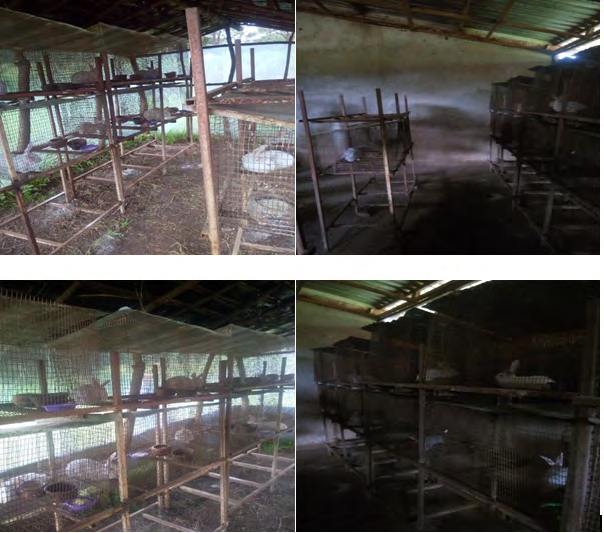
Outdoors at left side and indoors at right side (separate photos taken at a range of time in minutes). Figure 1: Cage housing environments of rabbits at SAU Farm (own photos).
Collected Data
Data were collected at 22nd and 23rd day of the experiment. Methods of welfare assessment were achieved as described by Roelofs S, et al. [10, 11, 12] and some methods were added.
Physiological Parameters
*Health indicators (Clinical signs): Coughing/sneezing: Auditory/ visual observation was done during carrying out management practices to check coughing and sneezing in rabbits. Auditory observation was done by hearing breathing sound many times noting those producing abnormal breathing sounds plus wet nostrils in times of no feeding or drinking hence counted for presence of coughing.
Diarrhoea: visual assessment was done to all rabbits by checking fur of rabbits in the caudal area of the body if soiled with faeces plus checking for pasty wire floors with faeces which meant for presence of diarrhoea conditions.
Mortality: number of dead rabbits in each cage housing environment was noted during the experimental period (3 weeks) while those in acclimatisation period and after collecting first results of final data (On 22nd day) were ignored to be included in analysis of data except for the data of the rabbit that died after 22nd day. The cause was also noted with much interest on clinical signs.
*Stress indicators (Vital signs) Change in body weight: The body weights of rabbits were measured three times (kilograms) before the start of the study and at the end of the study using a weighing scale balance. Measurement were taken when the readings were stable with the normal sitting of rabbits.
Change in body temperature: Rabbits in a calm condition were restrained on a weighing scale plate, temperature in oF was measured using a small rectal thermometer while lubricating and cleaning it with water before use and was done three times in hourly interval at the start and end of experiment. Thermometer was being cleaned with water using paper cuttings when soiled with faeces.
Change in respiratory rate: by setting a stop watch in one minute, breaths of each rabbit was counted by focusing a twitch on the rabbit’s nose as they breathe and it was measured three times in an hourly interval of a day at the start and end of experiment. When rabbits coughed, choke or sneezed, counting stopped while timing continued and counting resumed immediately when coughing, choking or sneezing stopped (these three disrupts breathing).
Behavioural Parameters
*Stress indicators (Stress tests) Human hand approach: Firstly, the door of each cage was opened, then slowly an arm was inserted inside the cage (advancing horizontally, not from above). Then the rabbit’s response whether it contacted the arm or ran away was observed during two minutes. Score description of fear for this test; 0, Fearful (did not contact arm and ran away): 1, Less friendly (contacted arm and ran away): 2, Very friendly (contacted arm but stayed for some time).
Handling test: Each rabbit behaviour was noted whether it was submissive or aggressive while picking them up from their cages after catching them first while also noting them whether they ran away or stay put in attempt to catching them (ease at catch which is a neutral one for both welfare aspects like good at treating while on the other part susceptible for predation hence its dependent on handling test). Score description of ease of handling test are; 0, Less (little aggressive/submissive and did not ran away):1, Moderate (submissive but ran away): 2, Very (submissive and did not ran away) and for ease at catching; 0, Less (aggressive/ submissive but ran away): 1, Moderate (little aggressive/ submissive and did not ran away): 2, Very (submissive and did not ran away).
Emergence test: Each rabbit was placed inside a closed carton box of normal size in relation to rabbit body sizes and then it was closed. Then after opening it, attempts to leave the box for two minutes was measured. Score description of general fear for this test; 0, High (zero/ no attempt): 1, Moderate (1 and 2 attempts): 2, Low (3 and 4 attempts).
Tonic immobility test: this was done inside the rabbit house, by placing each rabbit on its back on a V-shaped object i.e., wooden object for three attempts to induce tonic immobile state for two minutes. Score description of fear for this test; 0, High (1 attempt and it was induced): 1, Moderate (2 attempts and it was induced): 2, Lower (3 attempts and it was induced): 3, No/very low (3 attempts but it was not induced). Open field test: Each rabbit was introduced to an enclosure of rectangular shape of 1.5m by 1m of bricks with squares marked with left, right, back, center and front places with numbers providing no hiding places. Movement behavior that covered in these places was noted except at the front (point of insertion of rabbits) for two minutes. Score description of emotion and anxiety for this test; 0, High (little or no exploratory and remaining on one side or moving on the sides only): 1, Moderate (moderate exploratory with movement on 3 places): 2, Lower (more exploratory with movement on all 4 places): 3, No/least (very exploratory with fast movement on all 4 places).
*Pain indicator (Pain also cause stress) Facial expression: using the Rabbit Grimace scale, rabbits inside their cages were assessed by looking at tightening of eyelids, position of whiskers, flattening of cheeks, nose shape and ear position. Score description of pain of this test; 0, Normal (whisker curved downwards, puffy shape of cheeks, U shape of nares, wide eyelids tightening and alert ear shape): 1, Less (whisker curved downwards, cheeks contracted a little and alert ear shape or whisker partly curved downwards, puffy shape of cheeks and ears droopy in front but both with U shape of nares and wide eyelids tightening): 2, Moderate (whisker partly curved downwards, contracted cheeks and alert ear shape or whisker partly curved downwards, cheeks contracted a little and alert ear shape or cheeks flattened to the sides, puffy shape of cheeks and ears droopy in front but both with U shape of nares and wide eyelids tightening): 3, Severe (whisker partly curved downwards, cheeks contracted a little, less U shape of nares, wide eyelids tightening and ears droopy in front). The method used are in line with [13].
Since rabbits are crepuscular in nature, the order of assessment was done in this orderly manner to avoid disturbing them for the other test (following ones).
On 22nd day in the morning, these were done before feeding and watering; starting with outdoors first then indoors, pain assessment, human hand approach test and clinical signs were assessed at once in this orderly manner on each rabbit. Then, starting with outdoors again, handling test was assessed once at first round in both treatments then after that followed three rounds (same for initial data of vital signs) in sequence order (all three done on each rabbit before the next one) of weight measurement, respiratory rate and temperature measurement, in each round ending with indoors. On 23rd day in the afternoon, these were done after feeding and watering; starting with indoors, tonic immobility test, emergence test and open field test were assessed at once in this orderly manner on each rabbit.
Statistical Analysis
The following data; breaths per minute, temperature in oF converted first to oC and weight (kg) were analysed by t-test using MS Excel reported as Mean ± SE. This was done by first summing individual average data, total average data to come up with sample means, standard deviations and variances of each treatment (and between sexes but done separate) for testing hypothesis of the difference between two means (outdoor vs indoor and males vs females), both of their sample size were less than 30 while using a smaller degree of freedom from each (two-tailed test) and used them to find P-values {=TDIST (value of t, small degree of freedom; n-1, 2 for two tailed test)}. Data of clinical signs of infections, pain and fear levels were reported with scores and prevalence of both sexes of the treatments, which the latter was calculated as percentage of the total number of rabbits assessed in each cage housing environment. Scores were computed by noting all trends of the qualitative data together with their categories of ordinal scale (no, moderate and very). In some indicators where only one female rabbit in outdoor was present, the rabbit was compared against a female rabbit on the same level of positioning in indoor, then against all for an overall overview. Reports that rabbits of a certain treatment (with better scores) had no or low or moderate or high level of an indicator especially a certain sex, then it means that the other sex in the same treatment had low or moderate or high or moderate level (for worse scores) respectively but this works vice versa for those with worse scores. This was based on skew distribution of the scores of each sex in tables 3 and 5 (if more are on each extreme only; high and low scores then on average score they were on moderate level of response, and the same with more number on High and Moderate than on Low score except when no rabbit at Low score then that level with large number gets the level of response, and also more on Moderate and Low than on high score except when no rabbit at High score then that level with large number gets the level of response, works the same in four level of scores).
Results
Stress Indicators (Vital signs) Tables 1 and 2 shows Means ± SE of temperature, weight and respiratory rate of 13 NZW rabbits. Both mean temperature, weight and respiratory rate of NZW rabbits of final data were found out to differ non-significantly same as initial data (P>0.05) hence it shows that Cage housing environment has no effect on both variables of data (Tables 1 & 2).
| Variable | Overall Cage Housing Environment | P-value | |
|---|---|---|---|
| Outdoor | Indoor | ||
| Body weight | |||
| Initial (kg) | 1.15 ± 0.24 | 1.11 ± 0.11 | 0.87 |
| Final (kg) | 1.49 ± 0.24 | 1.38 ± 0.13 | 0.69 |
| Respiratory rate | |||
| Initial (breaths/ min) | 176 ± 5.13 | 155 ± 7.47 | 0.09 |
| Final (breaths/ min) | 150 ± 11.0 | 136 ± 5.47 | 0.12 |
| Temperature | |||
| Initial (oC) | 39.0 ± 0.12 | 38.9 ± 0.24 | 0.65 |
| Final (oC) | 38.3 ± 0.09 | 38.0 ± 0.14 | 0.15 |
Table 1: Overall Means ± SE of weight, respiratory rate and temperature of NZW rabbits as affected by cage housing environments a
Means ± SE differs non-significantly between treatments (P>0.05). SE= Standard error of means, NZW= New Zealand White rabbits. Table 1: Overall Means ± SE of weight, respiratory rate and temperature of NZW rabbits as affected by cage housing environments and their interaction.
| Variable | Overall Sex | P-value | |
|---|---|---|---|
| Male | Female | ||
| Body weight | |||
| Initial (kg) | 1.05 ± 0.24 | 1.21 ± 0.63 | 0.82 |
| Final (kg) | 1.33 ± 0.31 | 1.53 ± 0.70 | 0.95 |
| Respiratory rate | |||
| Initial (breaths/min) | 171 ± 29.9 | 154 ± 72.8 | 0.84 |
| Final (breaths/min) | 150 ± 30.1 | 132 ± 64.8 | 0.82 |
| Temperature | |||
| Initial (oC) | 39.2 ± 10.7 | 38.6 ± 21.9 | 0.98 |
| Final (oC) | 38.1 ± 9.76 | 38.1 ± 21.9 | 1 |
Table 2: Means ± SE of weight, respiratory rate and temperature of NZW rabbits as affected by sex response in both cage housing e
Means ± SE differs non-significantly between sex (P>0.05). SE= Standard error of means, NZW= New Zealand White rabbits. Stress Indicators (Stress tests) Table 2: Means ± SE of weight, respiratory rate and temperature of NZW rabbits as affected by sex response in both cage housing environments.
| Sex Score level | Cage Housing Environment | |||||
|---|---|---|---|---|---|---|
| Outdoor | Indoor | |||||
| 0 | 1 | 2 | 0 | 1 | 2 | |
| Scores for handling test | ||||||
| Female | 1 | 1 | 0 | 1 | 0 | 3 |
| Male | 0 | 1 | 2 | 0 | 1 | 3 |
| Level of handling | Less ease | Moderate ease | Very ease | Less ease | Moderate ease | Very ease |
| Scores for ease at catch | ||||||
| Female | 1 | 1 | 0 | 1 | 0 | 3 |
| Male | 1 | 0 | 2 | 0 | 1 | 3 |
| Level of ease at catch | Less ease | Moderate ease | Very ease | Less ease | Moderate ease | Very ease |
| Prevalence%(ease at catch) | 60% | 88% | ||||
| Scores for hand approach test | ||||||
| Female | 0 | 2 | 0 | 2 | 1 | 1 |
| Male | 1 | 2 | 0 | 2 | 0 | 2 |
| Level of fear | Fearful | Less friendly | Very friendly | Fearful | Less friendly | Very friendly |
| Prevalence% (friendliness) | 80% | 50% | ||||
| Scores for emergence test | ||||||
| Female | 0 | 0 | 1 | 1 | 2 | 1 |
| Male | 0 | 3 | 0 | 1 | 1 | 2 |
| Level of general fear | High | Moderate | Low | High | Moderate | Low |
Table 3: ** Scores of NZW Rabbits in handling, human-hand approach and emergence tests affected by cage housing environments.
NZW means New Zealand White rabbits, each number falling in each sex of each score means number of each sex in each treatment that scored in that level of a parameter. Prevalence (%) of ease at catch involves those at moderate and very ease at catch (scores 1&2) and of friendliness involves those at friendly (scores 1&2) both divided by total number×100. Prevalence (%) are for both sexes in that particular treatment. Health Indicators (Clinical signs) Table 3: Scores of NZW Rabbits in handling, human-hand approach and emergence tests affected by cage housing environments.
Table 3 shows level of scores of fear and handling of NZW rabbits with their associated prevalence. In handling test of 13 rabbits, male rabbits in outdoor were moderate at ease handling than females while male rabbits in indoor were very easy at handling than females. In human-hand approach test of 13 rabbits, rabbits in outdoor had moderate fear levels especially females while indoors had high fear levels especially females. In emergence test of 12 rabbits, rabbits in indoor showed moderate level of general fear especially males while outdoors showed lower level of general fear especially a female rabbit. Rabbits in indoor were easily caught during handling test especially males than outdoor rabbits especially females, while rabbits in outdoor especially females were more friendly in hand-approach than those in indoor especially females.
| Sex | Cage Housing Environment | |||
|---|---|---|---|---|
| Outdoor | Indoor | |||
| 0 | 1 | 0 | 1 | |
| Score level | present | absent | present | absent |
| Scores for diarrhoea | ||||
| Female | 1 | 3 | 0 | 4 |
| Male | 1 | 3 | 1 | 3 |
| Prevalence (%) | 25% | 13% | ||
| Scores for coughing/sneezing | ||||
| Female | 0 | 4 | 3 | 1 |
| Male | 0 | 4 | 1 | 3 |
| Prevalence (%) | 0% | 50% | ||
| Scores for Mortality rate | ||||
| Female | 1 | 3 | 0 | 4 |
| Male | 1 | 3 | 0 | 4 |
| Prevalence(%) | 25% | 0% |
Table 4: ** Scores of NZW Rabbits in Clinical signs affected by Cage Housing Environments.
NZW means New Zealand White rabbits, each number falling in each sex of each score means number of each sex in each treatment that scored in that level of a parameter. Prevalence (%) of diarrhoea, coughing/sneezing and mortality involves those at present (score 0) divided by total number×100. Prevalence (%) are for both sexes in that particular treatment. Stress Indicators (Stress tests) and Pain Indicator Table 4: Scores of NZW Rabbits in Clinical signs affected by Cage Housing Environments.
Table 4 shows level of scores of coughing/sneezing, diarrhea and mortality of NZW rabbits and their associated prevalence. In cases of diarrhea of 15 rabbits, rabbits in outdoor had high prevalence which led to the death of two rabbits in experimental period. Only one rabbit in indoor suffered diarrhoea while others were normal as before (Table 4). Mortality rate was counted for 14 rabbits with 2 rabbits only in outdoor while 2 rabbits died in acclimatization and after collecting data of clinical signs respectively, hence were not accounted for. In cases of coughing/sneezing of 15 rabbits, noted 3 female rabbits and a male rabbit in indoors only.
Table 5 shows level of scores of fear, pain experienced, and emotional reactivity and anxiety of NZW rabbits. In tonic immobility test of 12 rabbits, outdoors showed lower levels of fear especially a female rabbit while indoors showed moderate levels of fear especially males. In open field test of 12 rabbits, outdoors showed moderate levels of emotional reactivity and anxiety especially a female rabbit while indoors showed high levels of emotional reactivity and anxiety especially females. In grimace scale test of 13 rabbits, outdoors showed lower levels of pain experienced especially females while those in indoor showed moderate levels of pain experienced especially females but less difference between males of the two treatments (Table 6).
| Sex | Cage Housing Environment | |||||||
|---|---|---|---|---|---|---|---|---|
| Outdoor | Indoor | |||||||
| Score level | 0 | 1 | 2 | 3 | 0 | 1 | 2 | 3 |
| Immobility test | ||||||||
| Female | 0 | 0 | 0 | 1 | 2 | 1 | 1 | 0 |
| Male | 0 | 1 | 1 | 1 | 2 | 0 | 1 | 1 |
| Level of fear | High | Moderate | Lower | No/least | High | Moderate | Lower | No/least |
| Open field test | ||||||||
| Female | 0 | 0 | 1 | 0 | 2 | 2 | 0 | 0 |
| Male | 0 | 2 | 1 | 0 | 2 | 0 | 1 | 1 |
| Emotion& anxiety | High | Moderate | Lower | No/least | High | Moderate | Lower | No/least |
| Grimace scale test | ||||||||
| Female | 0 | 2 | 0 | 0 | 2 | 1 | 0 | 1 |
| Male | 0 | 2 | 1 | 0 | 1 | 0 | 3 | 0 |
| pain experi- enced | Normal/no | Less | Moderate | Severe | Normal/no | Less | Moderate | Severe |
Table 5: Scores of NZW Rabbits in tonic immobility, open field and grimace scale tests affected by cage housing environments.
NZW means New Zealand White rabbits, each number falling in each sex of each score means number of each sex in each treatment that scored in that level of a parameter. Table 5: Scores of NZW Rabbits in tonic immobility, open field and grimace scale tests affected by cage housing environments.
| Blocks(sex) of columns | Indoor Cages | Outdoor Cages | Totals | ||
|---|---|---|---|---|---|
| (Two Columns) | (Two Columns) | ||||
| Positioning of cages | Top | Bottom | Top | Bottom | |
| Male : 1 | 2 Rabbits | 2 Rabbits | 2 Rabbits | 2 Rabbits | 8 Rabbits |
| Female : 2 | 2 Rabbits | 2 Rabbits | 2 Rabbits | 2 Rabbits | 8 Rabbits |
Table 6: Experimental Layout.
Discussions
Effect of Cage Housing Environment on Temperature, Weight and Respiratory Rate
Both overall means of temperature, weight and respiratory rate of NZW rabbits of final data were found out to differ non-significantly as initial data and this is so because environmental factors affect animals at a slow rate than other factors [14]. Although data were found not to differ significantly but outdoor rabbits were better than indoors and in terms of sex, females in outdoor outclassed males only in change of mean weight and temperature while males in indoor outclassed females only in change in mean weight and respiratory rate. The present results of final data of temperature in female rabbits are not in agreement with [15]. And still on temperature, the present results of final data found a large overall mean value of temperature (rectal) in outdoor rabbits than indoors (Table 1). This is so because low temperatures of the surrounding in outdoors resulted in increase in metabolism for extra energy to keep warm while high or warm temperatures in indoors resulted in decrease in metabolic rate and muscle activity to decrease heat production (observed by differing trends of both initial and final data with their P-values).
The present results of final data of respiratory rate in female rabbits are not in agreement with Ashour G, et al. [15] and still on respiratory rate, present results of final data found a large mean value in outdoor rabbits than indoors (Table 1) . This could be so because of their physical make- up of their bodies to such breathing patterns (same trends of both initial and final data with their P-values) and that rabbits in indoor were subjected to strong smell of ammonia gas hence minimised their breathing rates to lessen its effect. The present results of both data of temperature in oC and respiratory rate in breaths per minute (Tables 1&2) are justified with the findings of Ashour G, et al. [15] who also reported that body temperature of NZW rabbits is 39.5oC and respiratory rate is 168 per minute hence fluctuations in the parameters is a result of stress and mechanism of adaptations.
Present results found a large change in overall mean body weight in outdoor rabbits than indoors but differed non-significantly (Table 1). Similar trend was found by De Knegt S, et al. [16] in rabbits reared in colony cages (group housing). The present results of body weight found a large change in weight in outdoor rabbits than indoors but females had gained more weight than males contrary to indoor ones (Table 1).
This is so because rabbits in outdoor are known to have increased in locomotion activities (exercising) than indoors, which helps in muscle growth hence large change in weight and also that animals with a lot of stress are known to have high cortisol hormone levels which is involved in carbohydrate and protein metabolism for energy to be used in survival or flight response hence small change in weight in indoors.
Effect of Cage Housing Environment on Fear and Handling
Rabbits in outdoor were better than indoors in human- hand approach and emergence test except handling test (Table 3). In terms of sex, male rabbits in indoors were better than those in outdoors at ease of handling, fear levels, general fear levels, friendliness and ease at catching while female rabbits in outdoors were better than those in indoors at fear levels, general fear levels, ease at catching and friendliness except at ease of handling. The present results on scores of human-hand approach are in agreement with Popescu S, et al. [11]. This could be because rabbits in outdoor were more stimulated by environmental enrichment like natural light and access to outdoor environment which allowed them to show their natural behaviors like exploring, foraging (sorting) and appreciating their surroundings.
Effect of Cage Housing Environment on Incidence of Coughing/Sneezing, Diarrhoea and Mortality
There was high prevalence of diarrhoea in outdoor rabbits than indoors and it was observed in both sexes of rabbits. Mortality rate was prevalent in outdoor rabbits only, whereby it was noted in both sexes. In terms of incidence of coughing or sneezing, rabbits in outdoor had no cases while those in indoor had high prevalence especially in females than males (Table 4). The present results on prevalence of coughing or sneezing are in agreement with Popescu S, et al. [11] while are not in agreement with the present results on prevalence of diarrhoea and mortality. Coughing or sneezing was only prevalent in indoor rabbits especially those on upper level because lack of rapid flow of fresh air at that position and allowed the build-up of ammonia gas in the rabbitry. The case of diarrhoea where most rabbits that suffered diarrhoea and died in outdoor were at lower level of positioning even one rabbit in indoor. This shows that they were not able to cope with stress than those at the upper level.
Effect of Cage Housing Environment on Levels of Fear, Pain Experienced, and Emotional Reactivity and Anxiety
Rabbits in outdoor were better than indoors in scores of tonic immobility, open-field and grimace scale test (Table 5). In terms of sex, rabbits in outdoors especially a female rabbit were better than those in indoors in fear levels, emotion and anxiety levels, and pain levels. Male rabbits in outdoors were better than those in indoors in fear levels and pain levels except emotion and anxiety levels. The current results in tonic immobility and open-field tests are in agreement with De Knegt S, et al. [16] who also found low levels of fear and emotion/anxiety in outdoor rabbits. This could be because outdoor rabbits were stimulated by a number of strange stimuli in their surrounding environment such as enrichment like natural light and fresh air flow than indoors hence more appreciation to express their natural behaviours in outdoor environment.
In grimace scale test, the current results found that all parameters to assess pain level were efficient which found that outdoor rabbits had low levels of pain experienced than indoors, but orbital tightening and nose shape were not easily distinctive between the outdoors and indoors. The method is effective in assessing pain levels in between one breed using the similar scores like of grimace figures of Hampshire V, et al. [13] but may vary or be the same between breeds and treatments hence good visual assessment is needed.
Conclusion
Positive welfare aspects were present in both cage housing environments, but better positive welfare aspect was in outdoor than indoor. Rabbits in outdoor cage housing environment were better in vital signs of stress indicators in physiological parameters and also in stress tests of behavioral parameters than indoors but were worse than indoors in clinical signs of health indicator of physiological parameters. Depending on the overall assessment in both cage housing environments, the results do not support both null hypotheses. It is well-known that outdoor rabbits were exposed to much lighting of not more than 12 hours out of 24 hours together with much flow of fresh air while indoor rabbits were exposed to less lighting of not more than 10
hours out of 24 hours together with less flow of fresh air. The mentioned above environmental situations played a big part in better welfare aspect in outdoor rabbits than indoors, in which females were better than males in outdoor and males were better than females in indoor. This is equivalent to their needed optimal lighting say 12 hours for females and 8 hours for males but both do better at around 12 hours lighting.
Acknowledgement
The authors gratefully acknowledge the Department of Animal Science of Bunda College of the Lilongwe University of Agriculture and Natural Resources in Malawi for material support for the completion of this study. Special thanks should go to the team of staff at the Small Animal Unit Farm for their support. Lastly, the special thanks should also go to Dr. G. Chingala, Mr. F. Chimwendo, Mr. W.M.D. Mvula, Mr. K. Liwinga for the support they rendered to the success of this study.
References
-
Hansen LT, Bethelsen H (2000) The effect of environment enrichment on the behaviour of caged rabbits (Oryctolagus Cuniculus). Journal of Applied Animal Behaviour Science 68(2): 163-178.
-
Serem JK (2014) Characterization of rabbit production systems in Central, Coastal, Eastern and Rift Valley Regions of Kenya. MS thesis. Nairobi, Kenya: University of Nairobi, Department of Animal Production.
-
Smith CP (2005) Animal welfare concerns for companion and Laboratory Rabbits. Information Resource on the Care and Welfare of Rabbits. Beltsville, Maryland: US. Department of Agriculture and Research Service Press.
-
Niles W (2009) Tropical Rabbit Production: keep 2 female rabbits: A guide to raising rabbits with few resources. North fortmyers, USA: ECHO technical note Press.
-
Agata DM, Preziuso G, Russo C, Dalle Zotte A, Mourvaki E, et al. (2009) Effect of an outdoor rearing system on the welfare, growth performance, Carcass and meat quality of a slow-growing rabbit population. Journal in Meat Science 83(4): 691-696.
-
Ribikauskas V, Ribikauskiene D, Skurdeniene I (2010) Effect of Housing system (wire cage versus group housing) and in-house air quality parameters on the behaviour of fattening rabbits. Journal in World Rabbit Science 18: 243-250.
-
Díez Valle C, Sánchez García Abad C, Pérez Garrido J, Bartolomé D, González Eguren V, et al. (2013) Behavioural activity of wild rabbits (Oryctolagus cuniculus) under semi-natural rearing systems: establishing a seasonal pattern. Journal in World Rabbit Science 21: 263-270.
-
Mc Nitt J (2009) Rabbit Housing: Hutches, Cages, Wires. Practical Rabbit Housing. Baton Rouge, LA 70813: Southern University Agricultural Research and Extension Center Press.
-
Lebas F, Coudert P, de Rochambeau H, Thebault RG (1997) The Rabbit: Husbandry, Health and Production (new revised version). FAO Animal Production and Health Series No.21. Rome, Italy: FAO of the United Nations Press.
-
Roelofs S (2016) Domestic Rabbit Welfare-Utrecht University Repository. Welfare issues surrounding a Multipurpose Animal. MS thesis. Budapestlaan, Utrecht: Utrecht University, Department of Animals in Science and Society.
-
Popescu S, Diugan EA, Borda C, El Mahdy C (2013) Welfare Assessment of Farmed Rabbits Housed in Indoor and Outdoor Cages. Journal in Animal Science and Biotechnologies 46(2): 200-205.
-
Trocino A, Filiou E, Tazzoli M, Bertotto D, Negrato E, et al. (2014) Behaviour and welfare of growing rabbits housed in cages and pens. Livestock Science Journal 167: 305-314.
-
Hampshire V, Robertson S (2015) Using the facial grimace scale to evaluate rabbit wellness in post-procedural monitoring. Journal Article in Lab Animal 44(7): 259.
-
Falconer DS, Mackay TF (1996) Introduction to Quantitative Genetics. 4th (Edn.), Essex, England: Longman Scientific and Technical Inc.
-
Ashour G, Sedki AA, Abdel Rahman SM, El-Kholy KH (2017) Physiological responses of rabbit does to Synertox supplementation under different housing condition during summer in Egypt. Egyptian Journal of Rabbit Science 27(2): 377-397.
-
De Knegt S (2012) Welfare assessment in young pet rabbits and guinea pigs in the Netherlands. Utrecht, the Netherlands: PPM Co. Inc.
- Natural Decline to Extinction of A New Zealand Rabbit Population
- Mitochondrial Bio-Logistics: Steering Co-Enzyme Q10 and Lycopene Synergies within the Science 4.0 Bio-OS Framework
- Hymenoptera Specimens from the Caño Negro Wetland, of the National Museum Collection, Costa Rica
- Science 4.0: Comprehensive Architecture of the Biological Operating System (Bio-OS) A Framework for Systemic Resilience and Industrialized Bio-Governance
- Rabbit on, or Hare Back? Understanding Climate Change
- Clinical Validation of Science 4.0: Flow Steering and Epigenetic Drift Inversion on a 76-Year-Old Hybrid System