
Ecological Study of Bird Assembles in Cubanacan Protected Area, Villa Clara, Cuba
This paper describes an ecological study of bird assembling carried out in Cubanacán Protected Area in Villa Clara province, Cuba, in the months of June and July. The ornithological work was carried out in an area with xeromorphic shrub plant formation on serpentine soil. For the data collection, the area was sampled by the linear transepts method, two in total, 250 m long and 15 m wide on both sides of the observer. A total of 4 counts were made in the months of June and July, which were executed by the visual and auditory method, supported by a binocular. The data obtained were quantified and the different ecological indexes were applied. In the study area, there are 22 bird species belonging to 12 families of 8 orders, Passeriformes being the best represented order with 5 families and 10 species. Of the total number of birds reported, 2 genera (25%), 5 species (53.8%) and 10 subspecies (14.0%) are endemic. In the plant formation, 7 trophic guilds are distinguished in the months of June and July. A density of 59.25 individuals / ha was found in June, while in July it was only 53.93. The similarity index between both months was 70%, very similar to that obtained in this plant formation for other months. The diversity was 2.22 and 2.52 for June and July, respectively, while the richness was 13.0 for both months. Equity varied very little 0.79 in June and 0. 88 in July, so the distribution of the number of individuals is fairly uniform.
Introduction
The ecological evaluation of the bird community or ornitocenosis is currently the focus of numerous research projects, which are very important to understand the role birds perform in different ecosystems, provided the great influence they exert on the ecological balance due to the great diversity of species [1, 2, 3].
The authors of this paper agree with Armiñana, et al. [4] in acknowledging the value of the results provided by other authors [5, 6, 7, 8, 9, 10, 11, 12, 13].
Birds (Gr. Ornis; Lat. Birds) are perhaps the most studied and best known group of vertebrate animals, men have given them their greatest attention, in addition, they are the easiest to recognize because of the feathers covering their body (feature not present in the rest of the vertebrates). This makes the members of this class more similar among each other than the members of any other animal group [14, 15].
According to Madrid, et al. [15] around 9,800 bird species have been registered in the world. In Cuba, 397 have been confirmed, included in 71 families and grouped into 26 orders, of which the most diverse are Paseriformes, Charadriiformes, and Anseriformes. Of the total number of species, 280 are considered common, some are exotic ones that have been naturalized, and the rest are very rare or occasional; 70% of the species are migratory [16, 17].
Around 50% of the species registered in the Antilles are present in the Cuban birdlife [4]. At present, different factors are affecting the Cuban fauna and, of course, birds are not exempt from them: the destruction of habitats (identified as the main factor considering that many species are restricted to certain areas of the archipelago), poaching, the introduction of invasive alien species, illegal trading, and environmental pollution [18, 19, 20, 21, 22]. Additionally, different researchers like agree that climate change has modified natural habitats [23, 24, 25, 26, 27]. 30 bird species (8% of the total) are threatened, including some migratory species that have seen their breeding areas reduced in North America [28, 29]. Out of the 9,917 bird species evaluated by the International Union for Conservation of Nature (IUCN), 12% have been categorized as threatened [30].
In the study of different bird communities in Cuba, conducted ornitocenosis research in a coastline mangrove of the eastern region of Cuba, obtaining a species richness of 16 [1, 6, 31]. When studying the structure of the bird community in a seasonal evergreen forest, in an area of the Sierra del Rosario in Pinar del Río, they obtained a density of 13.69 for April and of 15.14 for May, H ‘= 2.041, J’ = 0.869 and a dominance of 0.07.
Studying the fauna in two plant formations: coast line bushes and mangroves in Cayo Matías (Canarreos island group), in April and May, obtained that S = 21% and 17%; H ‘= 2, 09 and 2,038; and J ‘= 0.75 and 0.93, respectively in the coast line bushes, while in May for the mangrove, H = 1.47, S = 22% and J’ = 0.94 [8].
Taking into account all the above, the present paper aims to provide the main ecological characteristics of birdlife in an area with xeromorphic scrub plant formation on streamer soil, in Cubanacán protected area in Villa Clara, Cuba.
Materials and Methods
Study Area
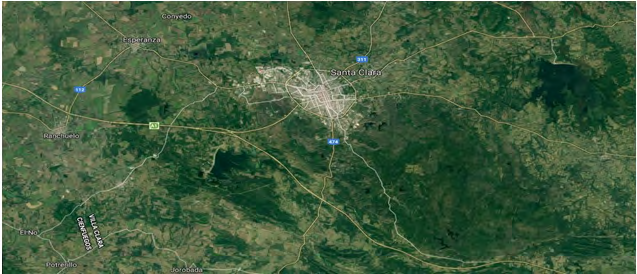
To carry out the research, an area with xeromorphic scrub plant formation on streamer soil was selected in Cubanacán Protected Area. This is framed within the Heights of Cubanacán in the province of Villa Clara, occupying areas of Santa Clara and Placetas municipalities. It is part of the serpentine axis that crosses the island from east to west. It has an extension of 7237 ha, which corresponds entirely to land area. The reserve extends in the form of a trapeze from the Central Road to the National Highway, being wider in its southern portion.
It limits on the North with the Central highway at kilometer 306, on the Northeast with areas belonging to the Forestry Company, on the Southeast with farms of an Agricultural Production Cooperative (APC), on the South with another APC, on the Southwest with Revacadero town, and with private lands that extend all the way to the north as part of an area known as Llanos de Agabama (Figure 1).
As natural values of the area, metamorphic rocks can be found as part of a tectonic matrix of serpentinites in which they form dense clusters that could be either blocks or small chains of heights. In Sierra Alta de Agabama mountain range, abundant large blocks of these rocks have been identified. Serpentinite rocks are differentiated by their structural peculiarities and mineral composition.
The geographic relief of the area is diverse, from slightly plain to undulating or with hills, pre-mountains, or low mountains ranging between 100 and 475 meters above the sea level. The highest elevations form a central core with steep slopes that have been strongly modified by erosional processes, surrounded by a ring of hills that becomes flatter towards the periphery. The plant formations present in the area (Capote and Berazaín 1984) [32] are:
Thorny Xeromorphic Scrub on Serpentinites (Cuabal)
It is characterized by presenting a dense shrub layer between 2 and 4 meters high and occasionally between 4 and 6meters, the herbaceous formations are dispersed and there is a large number of palm trees, epiphytes, and lianas. The flora at Cuabales area comprises 426 different species) with a high level of endemism, among which 14 are local [33].
Subthorny Scrub on Shales
It is developed on shales in more humid areas and on some slopes close to Palma Sola and Sierra Alta de Agabama hills. It is characterized by vegetation influenced by elements of the Cuabal, but with abundant species.
Gallery Forest
It develops on the banks of streams and rivers and it is characterized by the presence of abundance of palm trees. This formation is influenced by floristic elements present in the Cuabal.
Secondary Vegetation
It is present in areas altered by fire, forest planting or other anthropic actions. The entire area was either directly or indirectly linked to the historical events related to the settlement of the founders of Santa Clara migrating from San Juan de los Remedios village. The area was the basis for the economic and agricultural support of the city, it provided the resources to build it with the use of slave forces and, therefore, it was the scenario of their struggles, as well as of the activities related to the independence wars.
A total of 426 spermatophyta species belonging to 286 genera and 90 families (48.6% of the families represented in Cuba) are reported in the area. The genus-family ratio is 3.17 and the species-genus ratio is 1.48. The families represented by the largest number of genera are: Poaceae (26); Fabaceae and Rubiaceae (18), Asteraceae (14), Euforbiaceae (12) and Orquidaceae (10). The greatest diversity of species by genus occurs in Tillandsia (9), Eugenia and Croton (7), Erythroxilon and Zanthoxylum (6), Cassia, among others [33].
The serpentinite district of Santa Clara has a high level of endemism, out of the 739 endemic genera, 6 are represented. 30.17% are endemic; 14 are local, 17 are endemic to Central Cuba, 59 are national endemic, which corroborates what was stated about the endemism found on this substrate in Cuba. The area constitutes one of the main evolution centers of plant species in Central Cuba with 1 genus and 14 local endemic species.
To collect the data in the study area, it was sampled using the linear transects method, two in total, with a length of 250 m and a width of 15 m on both sides of the observer.
A total of four counts were made, which were made from 7:00 am until 10.30 am, and were performed by the visual and auditory method, supported by a TENTO ETPZ Soviet binocular 2, 7x50.
The data obtained were quantified and the ecological indexes listed below were applied:
Similarity: Index used to compare the degree of similarity between two samples and between two assembling.
$$ \mathrm {S} = \frac {2 \mathrm {C P q}}{\mathrm {C P} + \mathrm {C q}} \mathrm {X} 1 0 0 \mathrm {S} $$ Sorensen (1948) Dissimilarity: To compare the degree of difference between two samples and between communities.
S’ = 100 – S Sorensen (1948)
Diversity: It associates two concepts, the richness of species and the number of individuals by species, that is, richness based on the number of species in the ornitocenosis. Diversity includes both variables in the diversity index.
$$ \mathrm {H} ^ {\prime} = - \sum \mathrm {P i} \ln \mathrm {P i} \text {w h e r e} \mathrm {P i} = \frac {\mathrm {N i}}{\mathrm {N}} $$
Piln Pi wherePi= N
∑
Shannon – Weaver (1948) The richness of species or variety of species is contemplated in the index: s-1 d = 1 1nS Margalef (1958) Equity: It takes into account the distribution of the number of individuals by species, it is measured by the index:
' H 'J = Hmax
Pielou (1966)
Prevalence: Dominant effect exerted by a population in the community and it is measured by the index:
Ni e N = Simpson (1949)
In addition to the previous ecological indexes, the density or abundance estimator parameters were calculated, represented by a population size referred to the unit of species.
The birds reported for the study area were systematically located, which were organized in guilds or trophic groups [34, 35]. According to the criteria:
• Granivores: species that feed primarily on grains.
• Ground insectivores: species that feed on insects captured on the ground.
• Perch insectivores: species that feed on insects captured on the fly, starting from a resting position on a branch or perch.
• Foliage insectivores: species that capture their prey within the foliage.
• Trunk insectivores: species that feed on insects captured on or inside tree trunks.
• Fruit insectivores: species that feed on insects and fruit.
• Nectarivores: birds that feed on the nectar of flowers, completing their diet with some insects.
• Predators: Members of this group eat insects and vertebrates or only vertebrates.
The success in the use of guilds for the systematic sampling of the assembling is highly dependent on the criteria of aggregation chosen, on the need for a particular resource or habitat component for the target group of organisms, and on the relationship between the type and particular intensity of the disturbance and the afore mentioned resource [36]. Assures that, in general, the arrangement of species in guilds with an ecological value allows a more realistic characterization of the structure of the communities, as well as the inference of their intrinsic functioning models [37].
Results and Discussion
Systematic Composition
The avifauna present in the plant formation comprises a total of 8 orders (Table 1) out of the 26 present in the Cuban fauna (30.7%), 12 families out of the 71 reported (16.9%) (Table 2), and 22 species out of the 397 confirmed for the Cuban archipelago (5.5%) (Table 3).
The best represented order in families (5) and species (10) is Passeriformes. It is important to point out that the study was carried out during the summer, when winter migratory species are not found and that the Cuban birdlife is composed of approximately 70% of these migratory species.
Among the birds in this plant formation, there are species of great importance for their endemism, beauty, color, hunting value, and for the ecological function they perform in the ecosystem (Table 4).
Two genera: Glaucidium and Xiphidiopicus; five species: Glaucidium siju, Priotelus temnurus, Todus multicolor, Xiphidiopicus percussus, and Vireo gundlachii, and 10 subspecies, are endemic.
The species with significant hunting value are only three belonging to the Columbiformes order: Paloma Rabiche, Paloma Aliblanca, and Torcaza Cuellimorada; however, due to the characteristics of the plant formation and the population density, there are no possibilities to perform sport hunting in the area.
Among the birds that stand out for their ecological function are the two wood peckers (the Bobito and the Pitirre) that step in the balance of the ecosystem by consuming a large number of insects. In addition, they prepare places for the nesting of different species such as the Sijú Platanero, the Tocororo, among others. Several species with aesthetic value for their beautiful colors and for their melodious sounds are present in the study area, including the Humming Bird or Zunzún, the Cuban Trogon or Tocororo, the Cuban Tody or Cartacuba, the Yellow-faced Grassquit or Tomeguín de la Tierra and the Cuban Bulfinch or Negrito.
Of the species reported in the xeromorphic bush on serpentinites, one is part of the Red Book of Cuban Vertebrates, the Negrito or Melopyrrha nigra nigra (Figure 2), whose main threat factors are: illegal trade, fragmentation and habitat loss, tourism development, fires and hurricanes.
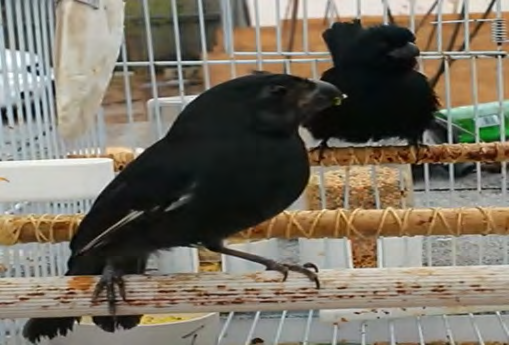
Melopyrrha nigra is the only living species of its kind, with a distribution restricted only to the Caribbean, specifically to Cuba (M. n. Nigra) and Grand Cayman (M. n. Taylori) [38].
The subspecies M. n. Nigra (Negrito) is widely distributed in Cuba, including Isla de la Juventud, different keys along the north coast and Cayo Cantiles on the south coast. It can be found from sea level to moderate altitudes in different types of forests, including evergreen forest, semi-deciduous forest, rainforest, pine forest and mangrove. In addition, it is common in shrubs and secondary vegetation [16].
However, the number of plant formations where the reproduction of the species has been verified is lower, as preliminary studies suggest [39, 40].
The reproductive season comprises the months from March to August. The nest, globular in shape and with a lateral entry, is built at a height that fluctuates between 1 and 5 m, usually on a substrate consisting of spiny plants.
It lays from 3 to 5 off-white eggs, with spots ranging from brown to lilac and concentrated towards one end. The incubation period is about 12 to 13 days and the nestlings leave the nest between 14 and 16 days [41, 42, 43].
| Orders | No. Of families | % |
|---|---|---|
| Columbidae | 1 | 100 |
| Cuculidae | 1 | 100 |
| Strigidae | 1 | 50 |
| Micropodidae | 1 | 50 |
| Trogonidae | 1 | 100 |
| Coraciidae | 1 | 50 |
| Picidae | 1 | 100 |
| Passeridae | 5 | 31 |
Table 1: Systematic composition of the diurnal terrestrial birdlife in the plant formation.
| Families | No. Of species | % |
|---|---|---|
| Columbidae | 4 | 36 |
| Cuculidae | 2 | 40 |
| Strigidae | 1 | 20 |
| Trochilidae | 1 | 33 |
| Trogonidae | 1 | 100 |
| Todidae | 1 | 100 |
| Picidae | 2 | 33 |
| Tyranidae | 2 | 13 |
| Turdidae | 1 | 10 |
| Vireonidae | 2 | 5 |
| Icteridae | 3 | 5 |
| Fringillidae | 2 | 10.5 |
| Families | Scientificname | Vulgar name |
| Columbidae | Patagioenas squamosa (Bonnaterre, 1792) | Torcaza Cuellimorada/ Scaly-naped Pigeon |
| Zenaida macroura (Linneo, 1758) | Paloma Rabiche / Mourning Dove | |
| Zenaida asiatica (Linneo, 1758) | Paloma Aliblanca / White-winged Dove | |
| Columbina passerina (Linneo, 1758) | Tojosa / Common Ground-Dove | |
| Cuculidae | Coccyzus merlini (d’Orbigny, 1839) | Arriero / Gread Lizard-Cuckoo *** |
| Crotophaga ani Linneo, 1758 | Judío / Smooth-billedAni | |
| Strigidae | Glaucidium siju (d’Orbigny, 1839) | Sijú Platanero / Cuban Pygmy-Owi * |
| Trochilidae | Chlorostilbon ricordii (Gervais, 1835) | Zunzún / Cuban Emerald *** |
| Trogonidae | Priotelus temnurus (Temminck, 1825) | Tocororo / CubanTrogon * |
| Todidae | Todu smulticolor Gould, 1837 | Cartacuba / Cuban Tody *** |
| Picidae | Melanerpes superciliaris (Temminck, 1827) | Carpintero Jabado /West Indian Woodpecker *** |
| Xiphidiopicus percussus (Temminck, 1826) | Carpintero Verde / Cuban Green Woodpecker * | |
| Tyrannidae | Tyrannus dominicensis (Gmelin, 1788) | Pitirre Abejero / Gray Kingbird |
| Contopus caribaeus (d’Orbigny, 1839) | Bobito Chico / Cuban Pewee *** | |
| Turdidae | Turdus plumbeusLinneo, 1758 | Zorzal Real / Red-legged Thrush *** |
| Vireonidae | Vireo altiloquus(Vieillot, 1807) | Bien TeVeo / Black-whiskered Vireo |
| Vireo gundlachii gundlachiiLembeye, 1850 | Juan Chiví / Cuban Vireo *** | |
| Icteridae | Quiscalus niger(Boddaert, 1783) | Chichinguaco / Greater Antillean Grackle *** |
| Agelaius humeralis(Vigors, 1827) | Mayito / Tawny-shouldered Blackbird | |
| Icterus melanopsis(Wagler, 1829) | Solibio / Cuban Oriole *** | |
| Thraupidae | Tiaris olivaceus(Linneo, 1766) | Tomeguín de la Tierra / Yellow-faced Grassquit |
| Melopyrrha nigra nigra(Linneo, 1758) | Negrito / Cuban Bulfinch *** |
Table 2: Systematic composition of the diurnal terrestrial birdlife in the plant formation.
Symbology: (*) Endemic genus () Endemic species (*) Species with endemic subspecies. Table 3: Systematic relationship of birds in plant formation.
| Taxon | Quantity | % |
|---|---|---|
| Genus | 2 | 25 |
| Species | 5 | 23 |
| Subspecies | 10 | 14 |
Table 3: Endemism of birdlife.
Trophic Groups or Guilds
All the bird species existing in the study area were separated by guilds, an aspect of utmost importance because between two trophic groups (even if they are related) there is no competition for food, allowing a high richness of species in the same habitat and, therefore, a good use of the food sources. This is very important to our bird fauna that receives many continental migratory species, especially during the winter, softening the competition effect.
As shown in Table 5, the birds were grouped into 8 guilds, each of them specifying the species. When analyzing the plant formation, it is observed that the guild of the granivores increases by one in July, although the Tojosa is not reported that month, the three species that influence the variations are the pigeons that nest and find food in the area. The perch insectivore guild undergoes variations from one month to another, three species in each month, although one of them, the Pitirre abejero, is not characteristic of that plant formation.
Frugivorous insectivores are not typical species of the plant formation in which the ornithological studies are carried out, however, they were located in the area mainly because it provides them with shelter and some food, especially some small fruits.
Only in July were carpenters reported species not representative of the place and members of the guild of trunk insectivorous. They were located occasionally, very likely in search of food.
Three predatory species were observed: the Arriero, the Judío and the Sijú Platanero, all find food in the area, especially insects, amphibians and reptiles. Only two species of foliage insectivorous birds are found in the area, one being a resident (Juan Chiví) and the other a summer migratory species (Bien TeVeo), not reported in July, probably due to not having the proper vegetation (Table 5).
| Trophic group | Species | June | July | ||
|---|---|---|---|---|---|
| No | % | No | % | ||
| Granivores | Paloma Rabiche | 4 | 18.8 | 5 | 22.7 |
| Paloma Aliblanca | |||||
| Tojosa | |||||
| Torcaza Cuellimorada | |||||
| Tomeguín de la Tierra | |||||
| Negrito | |||||
| Hanger insectivores | Cartacuba | 3 | 13.6 | 3 | 13.6 |
| Pitirre Abejero | |||||
| Bobito Chico | |||||
| Soil insectivores | Zorzal Real | 1 | 4.5 | 0 | 0 |
| Fruit Insectivorous | Tocororo | 3 | 13.6 | 3 | 13.6 |
| Mayito | |||||
| Chichinguaco | |||||
| Solibio | |||||
| Trunk insectivores | Carpintero Verde | 0 | 0 | 2 | 9.9 |
| Carpintero jabado | |||||
| Foliage insectivores | Juan Chiví | 2 | 9.9 | ||
| Bien Te Veo | |||||
| Nectarivores | Zunzún | 1 | 4.5 | 1 | 4.5 |
| Predators | Judío | 3 | 13.6 | 2 | 9.9 |
| Arriero | |||||
| Sijú Platanero |
Table 4: Distribution of birds by trophic groups.
Similarity and Dissimilarity
If the degree of similarity between both months in the plant formation is analyzed, the result is 70%, much higher than the 51%obtained by Artiles, et al. [44] in a Cuabal of the Cubanacán protected area during the months of April and May. Taking into account that the study was carried out during the summer months, June and July, where there are no reported entries or exits of migratory species, it can be stated that the factor determining the dissimilarity (30%) between both months is the presence of species that are not typical but occasional.
Density
As shown in Table 6, the density of the xeromorphic bush on serpentines oil in the study area was 59.26 individuals/ ha for the month of June and 53.93 for the month of July. Comparing one month to the other, the difference is of 5.23 individuals / ha. Out of the total number of species, five are not reported in each month (Table 6).
| Species | June | July |
|---|---|---|
| Torcaza Cuellimorada | 0 | 1.33 |
| Paloma Rabiche | 4 | 3.33 |
| Paloma Aliblanca | 0 | 1.33 |
| Tojosa | 1.33 | 0 |
| Arriero | 4 | 4.66 |
| Judío | 2.66 | 0 |
| Sijú Platanero | 4.66 | 4.66 |
| Zunzún | 3.33 | 3.33 |
| Tocororo | 0 | 1.33 |
| Cartacuba | 5.33 | 4.66 |
| Carpintero Jabado | 0 | 2 |
| Carpintero Verde | 0 | 2.66 |
| Pitirre Abejero | 2.66 | 3.33 |
| Bobito Chico | 3.33 | 3.33 |
| Zorzal Real | 2.66 | 0 |
| Bien Te Veo | 1.33 | 0 |
| Juan Chiví | 4 | 4.66 |
| Chichinguaco | 2.60 | 0 |
| Mayito | 3.33 | 2 |
| Solibio | 4.66 | 3.33 |
| Tomeguín de la Tierra | 6.66 | 5.33 |
| Negrito | 2.66 | 2.66 |
| 59.26 | 53.93 |
Table 5: Density (individuals / ha) of land birds in the spiny xeromorphic bush on serpentine soil.
Equity
Equity is an index that varies little in both months, 0.79 for June and 0.88 for the month of July, very similar a formation in the Cubanacán protected area in the months of April and May that were 0.80 and 0.69. In the study area, the distribution of the number of individuals is fairly uniform and stable in the two months and there is no marked dominance [44, 45]. The dominant species (Table 7) for the month of June were the Cartacuba (0.0064), Sijú Platanero (0.0049), while in the month of July they were the Cartacuba, the Arriero and the Sijú Platanero, all with 0.0064.
| Species | June | July |
|---|---|---|
| Torcaza Cuellimorada | 0 | 0.0004 |
| Paloma Rabiche | 0.0036 | 0.0036 |
| Paloma Aliblanca | 0 | 0.0004 |
| Tojosa | 0.0004 | 0 |
| Arriero | 0.0016 | 0.0064 |
| Judío | 0.0036 | 0 |
| Sijú Platanero | 0.0049 | 0.0064 |
| Zunzún | 0.005 | 0.0036 |
| Tocororo | 0 | 0.0004 |
| Cartacuba | 0.0064 | 0.0064 |
| Carpintero Jabado | 0.08 | 0.0009 |
| Carpintero Verde | 0 | 0.0004 |
| Pitirre Abejero | 0.0016 | 0.0036 |
| Bobito Chico | 0.005 | 0.0036 |
| Zorzal Real | 0.0016 | 0 |
| Bien Te Veo | 0.0004 | 0 |
| Juan Chiví | 0.0036 | 0.0048 |
| Chichinguaco | 0.0016 | 0 |
| Mayito | 0.005 | 0.0009 |
| Solibio | 0.0045 | 0.0036 |
| Tomeguín de la Tierra | 0.001 | 0.001 |
| Negrito | 0.0036 | 0.005 |
Table 6: Ecological predominance of bird species observed in the study area.
Taking into account the results obtained, it is concluded that in the study area there are 22 species of birds belonging to 12 families of 8 orders, the best represented order being the Passeriformes with 5 families and 10 species. Out of the total number of reported birds, 2 genera (25%), 5 species (53.8%), and 10 subspecies (14.0%) are endemic. In the plant formation, 7 trophic groups are distinguished in the months of June and July. A density of 59.25 individuals / ha was obtained in the month of June, and 53.93 in the month of July. The difference was caused by occasional species, since there were no migration effects when the study was conducted. The index of similarity obtained for both months (70%) is very similar to that obtained in this formation for other months of the year. The diversity for both months was 2.22 and 2.52, respectively and the wealth was the same for both 13.0. Equity varied very little in months, 0.79 and 0.88, so the distribution of the number of individuals is fairly uniform.
Conflict of Interest Statement
The authors declare that they have no conflict of interest.
Contribution
All the authors contributed substantially to the concrescence of the manuscript.
Financing
No funding was available.
References
-
Acosta M, Mugica L (1988) Structure of the bird communities that inhabit the Cuban forests. Biological Sciences 19: 9-19.
-
Aguilar S (2010) Áreas importantes para la conservación de las aves en Cuba. Editorial Academia, La Habana pp: 136.
-
Alonso T, Rodríguez M, Alonso JY (2010) Cambios climáticos y sus efectos en la conducta reproductiva de _Crocodylus acutus_. Cubazoo 19: 51-53.
-
Andraca L (2010) Reglas de ensamblaje y modelos de coexistencia de especies en las comunidades de aves cubanas. Tesis de Diploma, Facultad de Biología, Universidad de La Habana. La Habana, Cuba pp: 71.
-
Arminana GR, Fimia DR, Olivera BD, Ferrer ZY (2017) Las Especies Exóticas Invasoras en Cuba. Incidencia en la salud humana. Centro Nacional de Áreas Protegidas (CNAP), PNUD, SNAP, CITMA, (gef and gaia). La Habana. Cuba. ISBN: 978-959-287-078-9.
-
Armiñana, GR, Olivera BD, Fimia DR, Alarcón EPM, Aldaz CJW, et al. (2019) Ornitocenosis de Monte Ramonal en Santo Domingo, provincia Villa Clara, Cuba. Revista Biotempo 16(2): 11-24.
-
Arredondo AC, Armiñana GR, Chirino FN, Agüero CR (1996) Zoología de los Cordados (segunda parte). Editorial Pueblo y Educación. Ciudad de La Habana, Cuba, pp: 400.
-
Artiles RF, Pérez BJ (1989) Estudio ecológico de comunidades de aves en el área Protegida Cubanacán. Trabajo de Diploma, en opción al título de Licenciado en Educación Biología. Instituto Pedagógico “Félix Varela”. Villa Clara, Cuba, pp: 50.
-
Baillie JEM, Hilton Taylor C, Stuart SN (2004) IUCN Red List of Threatened Species. A Global Species Assessment. IUCN, Gland, Switzerland and Cambridge, UK, pp: 191.
-
Berovides AV, Acosta M (1982) Ornitocenosis de una manigua costera de la región oriental de Cuba. Revista Ciencias Biológicas No 8. La Habana, pp: 134-137.
-
Blanco R, Sanchez OPB (2008) Impacto del cambio climático sobre la avifauna cubana. En: efecto de los cambios globales sobre biodiversidad. In: Volpedoand AV, Reyes LF, et al. (Eds.), CYTED, pp: 139 -154.
-
Capote R, Berazaín R (1984) Clasificación de las formaciones vegetales en Cuba. Jardín Botánco Nacional 5(2): 27-75.
-
Chirino RL (2020) Las Especies Exóticas Invasoras presentes en el Área Protegida Cubanacán. Tesis presentada en opción al Título de Licenciado en Educación. Biología. Universidad Central “Marta Abreu” de Las Villas, Villa Clara. Cuba, pp: 46.
-
Cubillas S, Berovides AV (1987) Índices ecológicos de una comunidad de aves, en un área protegida de Cuba. II. Gremios y diversidad. Ciencias Biológicas 17: 85-90.
-
Díaz BLM, Cádiz A, Chong A, Silva A (2007) First report of chytridiomycosis in a dying toad (Anura: Bufonidae) form Cuba: a new conservation challenge for the island Eco. Health 4(2): 172-175.
-
Díaz BLM, Cádiz A (2008) Guía taxonómica de los anfibios de Cuba. Abc Taxa 4: 1-294.
-
Emlen JT (1971) Population densities of birds derived from transect counts. The Auk 88: 323-342.
-
García M (1986) Breve caracterización de la avifauna de una localidad de la Península de Zapata, Matanzas. Ciencias Biológicas 16: 117-120.
-
García N, Rojas M (1997) Notas acerca de la nidificación de las aves en la Reserva de la Biosfera Baconao de la provincia Santiago de Cuba, Cuba. El Pitirre 10(2): 53- 54.
-
Garrido OH, Kirkconnell A (2000) Field guide to the birds of Cuba. Cornell University press, Ithaca, New York, 253: 51.
-
González AH (1982) Estructura de una comunidad de aves de una zona de la Sierra del Rosario próxima a Pinar del Río, Cuba. Ciencias Biológicas 8: 105-107.
-
González AH (1996) Composición y abundancia de aves residentes y migratorias en Cuba occidental y central durante el período migratorio. Tesis Doctoral, Universidad de La Habana, pp: 93.
-
González AH, Godínez E, Blanco P, Pérez A (1997) Características ecológicas de las comunidades de aves en diferentes hábitats de la Reserva de la Biosfera. Península de Guanahacabibes, Pinar del Río, Cuba. Avicennia 6: 103-110.
-
González FS (2004) Corales pétreos: jardines sumergidos de Cuba. Editorial Academia, La Habana, pp: 318.
-
González AH, Rodríguez SL, Rodríguez A, Mancina CA, Ramos GI (2012) Libro rojo de los vertebrados de Cuba. Editorial Academia, La Habana, pp: 304.
-
González AH, Pérez HA, Estrada PF, López AM (2017) Aves terrestres [412-447] In: Diversidad biológica de Cuba: métodos de inventario, monitoreo y colecciones biológicas. In: Mancina CA, Cruz DD, et al. (Eds.), Editorial AMA. La Habana, pp: 502.
-
Herrera OP (2007) Flora y Vegetación. En: Biodiversidad de Cuba. Ediciones polímitas S.A. Ciudad de Guatemala, Guatemala 330: 142-177.
-
Kirkconnell A, Garrido O, Posada RM, Cubillas SO (1992) Los grupos tróficos en la avifauna cubana. Poeyana 415: 17-21.
-
Madrid I, Cruzado EFC (2017) Avistamiento de aves en el Campus de la Universidad Ricardo Palma, Lima, Perú. Biotempo 14 (2): 167-177.
-
Más L, Romero M, Faife M, Ruiz E, Rodríguez P, et al. (2007) Flora y vegetación donde anida el Negrito (_Melopyrrha nigra_) en Cayo Las Brujas, Villa Clara. Centro Agrícola 34(1): 75-79.
-
Milesi FA, Marone L, López de Casenave J, Cueto VR, Mezquida ET (2002) Gremios de manejo como indicadores de las condiciones del ambiente: un estudio de caso con aves y perturbaciones del hábitat en el Monte central, Argentina. Ecología Austral 12: 149-161.
-
Pérez E, Osa E, Matamoros Y, Seal US (1996) Report of conservation assessment and Management Plan Workshop for Selected Cuban Species II. IUCN/SSC Conservation Breeding Specialist Group, Apple Valley, Minnesota, pp: 174: 73.
-
Pérez E, Osa E, Matamoros Y, Seal US (1998a) Report of conservation assessment and Management Plan Workshop for Selected Cuban Species II. IUCN/SSC Conservation Breeding Specialist Group, Apple Valley, Minnesota.
-
Pérez E, Osa E, Matamoros Y, Shillcox J, Seal US (1998b) Report of conservation assessment and Management Plan Workshop for Selected Cuban Species II. IUCN/SSC Conservation Breeding Specialist Group, Apple Valley, Minnesota, pp: 275.
-
Pérez E, Osa E, Matamoros Y, Ellis S (2001) Report of conservation assessment and Management Plan Workshop for Selected Cuban Species. IUCN/SSC Conservation Breeding Specialist Group, Apple Valley, Minnesota, USA.
-
Posada RM, Kirkconnell A, de Arazoza F, Llanes A (1989) Ornitocenosis de los cayos Campos, Avalos y Cantiles, Archipiélago de los Canarreos, Cuba, Poeyana 365: 1-9.
-
Raffaelle H, Wiley J, Garrido OH, Keith A, Raffaelle J (1998) A guide to the birds of the West Indies. Princeton University press. Princeton 424-425.
-
Rodríguez D, García ME (1987) Ornitocenosis de una vegetación litoral al norte de la Habana. Poeyana 347: 1-7.
-
Rodríguez D (2000) Composición y estructura de las comunidades de aves en tres formaciones de Cayo Coco Archipiélago de Sabana – Camagüey. Cuba. Tesis en opción al grado de Doctor en Ciencias. pp: 86
-
Ruiz E, Arias A, Más L, Romero CN, Vergara C (2006) Resultados del monitoreo poblacional del Negrito (_Melopyrrha nigra nigra_) en el cayo Las Brujas, Villa Clara. Informe anual, proyecto Sabana-Camagüey CUB/98/G32.
-
Sánchez B, Oviedo, Navarro N, Hernández A, Peña C, et al. (1998) Composición y abundancia de la avifauna en tres formaciones vegetales en la meseta de Nipe, Holguín, Cuba. El Pitirre 3: 102-107.
-
Segovia Y (2007) Ecología reproductiva de la comunidad de aves de la Reserva Ecológica Siboney-Juticí. Tesis de Diploma, Universidad de Oriente, Facultad de Ciencias Naturales. 76 pp.
-
Terborgh JW (1992) Perspectives on the conservation of Neotropical migrant land birds. In: Ecology and Conservation of Neotropical Migrant Land birds. Hagan JM, Johnston DW, (Eds.), Smithsonian Institution Press.
-
Valdés V (1984) Datos de nidificación sobre las avesque crían en Cuba. Poeyana 282: 1-27.
-
Vales GMA, Álvarez A, Montes L, Ávila A (1998) Estudio nacional sobre diversidad biológica en la República de Cuba. Editorial CESYTA, Madrid, pp: 480.
- Natural Decline to Extinction of A New Zealand Rabbit Population
- Mitochondrial Bio-Logistics: Steering Co-Enzyme Q10 and Lycopene Synergies within the Science 4.0 Bio-OS Framework
- Hymenoptera Specimens from the Caño Negro Wetland, of the National Museum Collection, Costa Rica
- Science 4.0: Comprehensive Architecture of the Biological Operating System (Bio-OS) A Framework for Systemic Resilience and Industrialized Bio-Governance
- Rabbit on, or Hare Back? Understanding Climate Change
- Clinical Validation of Science 4.0: Flow Steering and Epigenetic Drift Inversion on a 76-Year-Old Hybrid System